instrument panel CHEVROLET TRAIL BLAZER 2007 1.G Service Manual
[x] Cancel search | Manufacturer: CHEVROLET, Model Year: 2007, Model line: TRAIL BLAZER, Model: CHEVROLET TRAIL BLAZER 2007 1.GPages: 574, PDF Size: 2.94 MB
Page 378 of 574
Making Turns
Notice:Making very sharp turns while
trailering could cause the trailer to come in
contact with the vehicle. Your vehicle could be
damaged. Avoid making very sharp turns
while trailering.
When you’re turning with a trailer, make wider
turns than normal. Do this so your trailer
won’t strike soft shoulders, curbs, road signs,
trees or other objects. Avoid jerky or sudden
maneuvers. Signal well in advance.
Turn Signals When Towing a Trailer
The arrows on your instrument panel will
ash whenever you signal a turn or lane change.
Properly hooked up, the trailer lamps will also
ash, telling other drivers you’re about to
turn, change lanes or stop.
When towing a trailer, the arrows on your
instrument panel will ash for turns even if the bulbs
on the trailer are burned out. Thus, you may think
drivers behind you are seeing your signal when
they are not. It’s important to check occasionally to
be sure the trailer bulbs are still working.
Driving On Grades
Reduce speed and shift to a lower gearbefore
you start down a long or steep downgrade. If you
don’t shift down, you might have to use your
brakes so much that they would get hot and no
longer work well.
You can tow in DRIVE (D). You may want to shift
the transmission to THIRD (3) or a lower gear,
under heavy loads or hilly conditions.
When towing at high altitude on steep uphill
grades, consider the following: Engine coolant will
boil at a lower temperature than at normal
altitudes. If you turn your engine off immediately
after towing at high altitude on steep uphill grades,
your vehicle may show signs similar to engine
overheating. To avoid this, let the engine run while
parked (preferably on level ground) with the
automatic transmission in PARK (P) for a few
minutes before turning the engine off. If you do get
the overheat warning, seeEngine Overheating
on page 418.
378
Page 382 of 574
Your vehicle is also equipped with wiring for an
electric trailer brake controller. These wires
are located inside the vehicle on the driver’s side
under the instrument panel. These wires should
be connected to an electric trailer brake controller
by your dealer or a qualied service center.
Your vehicle may be equipped with a four-pin
trailer towing harness. This harness has a four-pin
trailer connector that contains the following
trailer circuits:
Yellow: Left Stop/Turn Signal
Dark Green: Right Stop/Turn Signal
Brown: Running Lamps
White: GroundThis harness also contains the following trailer
circuits that are not connected to the four-pin trailer
connector:
Light Green: Back-Up Lamps
Dark Blue: Electric Brakes
Red: Battery Feed
If your vehicle is a TrailBlazer SS, you were
provided with a trailer wiring harness extension,
and instructions for installing this extension, when
your vehicle was delivered. This extension will
allow your vehicle’s trailer wiring harness to
be more easily accessible. There is a four-way
connector on the harness. A seven-way adapter
plug is also included in case your trailer requires it.
382
Page 384 of 574
Windshield Wiper Blade Replacement....... 444
Tires............................................................ 448
Winter Tires.............................................. 449
Tire Sidewall Labeling............................... 450
Tire Terminology and Denitions............... 454
Ination - Tire Pressure............................. 457
High-Speed Operation............................... 458
Tire Pressure Monitor System................... 459
Tire Inspection and Rotation...................... 464
When It Is Time for New Tires.................. 466
Buying New Tires...................................... 466
Different Size Tires and Wheels................ 468
Uniform Tire Quality Grading..................... 469
Wheel Alignment and Tire Balance............ 470
Wheel Replacement.................................. 470
Tire Chains............................................... 472
Accessory Inator...................................... 472
If a Tire Goes Flat.................................... 474
Changing a Flat Tire................................. 474
Removing the Spare Tire and Tools.......... 476
Removing the Flat Tire and Installing
the Spare Tire....................................... 479Secondary Latch System........................... 484
Storing a Flat or Spare Tire and Tools...... 488
Spare Tire................................................. 491
Appearance Care........................................ 491
Cleaning the Inside of Your Vehicle.......... 491
Fabric/Carpet............................................. 493
Leather...................................................... 494
Instrument Panel, Vinyl, and Other
Plastic Surfaces..................................... 494
Care of Safety Belts.................................. 495
Weatherstrips............................................ 495
Washing Your Vehicle............................... 495
Cleaning Exterior Lamps/Lenses................ 496
Finish Care............................................... 496
Windshield, Backglass, and
Wiper Blades......................................... 497
Aluminum Wheels...................................... 498
Tires......................................................... 498
Sheet Metal Damage................................. 498
Finish Damage.......................................... 499
Underbody Maintenance............................ 499
Chemical Paint Spotting............................ 499
Vehicle Care/Appearance Materials............ 500
Section 5 Service and Appearance Care
384
Page 388 of 574
Fuel
Use of the recommended fuel is an important part
of the proper maintenance of your vehicle.
To help keep the engine clean and maintain
optimum vehicle performance, GM recommends
the use of gasoline advertised as TOP TIER
Detergent Gasoline.
The 8th digit of the Vehicle Identication Number
(VIN) shows the code letter or number that
identies your vehicle’s engine. The VIN is at the
top left of the instrument panel. SeeVehicle
Identication Number (VIN) on page 501.
Gasoline Octane
If your vehicle has the 4.2L L6 engine (VIN Code S)
or the 5.3L V8 engine (VIN Code M), use regular
unleaded gasoline with a posted octane rating
of 87 or higher. If the octane rating is less than 87,
you might notice an audible knocking noise when
you drive, commonly referred to as spark knock.If this occurs, use a gasoline rated at 87 octane or
higher as soon as possible. If you are using
gasoline rated at 87 octane or higher and you hear
heavy knocking, the engine needs service.
If your vehicle has the 6.0L V8 engine
(VIN Code H), use premium unleaded gasoline
with a posted octane rating of 91 or higher.
You can also use regular unleaded gasoline rated
at 87 octane or higher, but your vehicle’s
acceleration could be slightly reduced, and you
might notice a slight audible knocking noise,
commonly referred to as spark knock. If the
octane is less than 87, you might notice a heavy
knocking noise when you drive. If this occurs,
use a gasoline rated at 87 octane or higher
as soon as possible. Otherwise, you could damage
the engine. If you are using gasoline rated at
87 octane or higher and you hear heavy knocking,
the engine needs service.
388
Page 392 of 574
{CAUTION:
Fuel can spray out on you if you open the
fuel cap too quickly. If you spill fuel and
then something ignites it, you could be
badly burned. This spray can happen if
your tank is nearly full, and is more likely
in hot weather. Open the fuel cap slowly
and wait for any hiss noise to stop. Then
unscrew the cap all the way.
Be careful not to spill fuel. Do not top off or overll
the tank and wait a few seconds after you have
nished pumping before removing the nozzle.
Clean fuel from painted surfaces as soon as
possible. SeeWashing Your Vehicle on page 495.
When replacing the fuel cap, turn it clockwise until
it clicks. Make sure the cap is fully installed.
The diagnostic system can determine if the fuel
cap has been left off or improperly installed.
This would allow fuel to evaporate into the
atmosphere. SeeMalfunction Indicator Lamp
on page 212.There may also be a light that comes on in the
instrument panel to let you know if your gas cap
is not properly installed. SeeCheck Gas Cap Light
on page 219for more information.
{CAUTION:
If a re starts while you are refueling, do
not remove the nozzle. Shut off the ow
of fuel by shutting off the pump or by
notifying the station attendant. Leave the
area immediately.
Notice:If you need a new fuel cap, be sure to
get the right type. Your dealer/retailer can
get one for you. If you get the wrong type,
it may not t properly. This may cause
your malfunction indicator lamp to light and
may damage your fuel tank and emissions
system. SeeMalfunction Indicator Lamp
on page 212.
392
Page 394 of 574
Checking Things Under
the Hood
{CAUTION:
Things that burn can get on hot engine
parts and start a re. These include
liquids like fuel, oil, coolant, brake uid,
windshield washer and other uids, and
plastic or rubber. You or others could be
burned. Be careful not to drop or spill
things that will burn onto a hot engine.
Hood Release
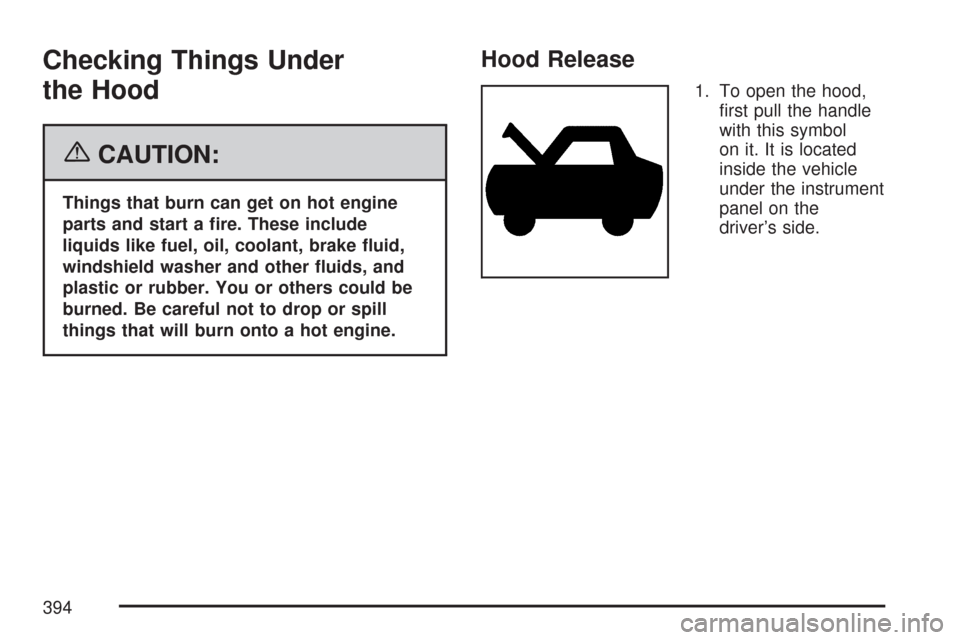
1. To open the hood,
rst pull the handle
with this symbol
on it. It is located
inside the vehicle
under the instrument
panel on the
driver’s side.
394
Page 418 of 574
Radiator Pressure Cap
Notice:If the pressure cap is not tightly
installed, coolant loss and possible engine
damage may occur. Be sure the cap is properly
and tightly secured.
SeeEngine Compartment Overview on page 396
for information on location.
Engine Overheating
You will nd a coolant temperature gage on your
vehicle’s instrument panel. SeeEngine Coolant
Temperature Gage on page 211for more
information.
If your vehicle has a Driver Information Center
(DIC), the display will show an Engine Coolant
Hot/Engine Overheated message. SeeDIC
Warnings and Messages on page 224for more
information.
If Steam Is Coming From Your Engine
{CAUTION:
Steam from an overheated engine can
burn you badly, even if you just open the
hood. Stay away from the engine if you
see or hear steam coming from it. Just
turn it off and get everyone away from the
vehicle until it cools down. Wait until
there is no sign of steam or coolant
before you open the hood.
If you keep driving when your engine is
overheated, the liquids in it can catch re.
You or others could be badly burned.
Stop your engine if it overheats, and get
out of the vehicle until the engine is cool.
Notice:If your engine catches re because
you keep driving with no coolant, your vehicle
can be badly damaged. The costly repairs
would not be covered by your warranty.
418
Page 460 of 574
When a low tire pressure condition is detected,
the TPMS will illuminate the low tire pressure
warning symbol located on the instrument panel
cluster, and at the same time a message will also
appear on the DIC display. The low tire pressure
warning symbol on the instrument panel cluster
and the CHECK TIRE PRESSURE warning
message on the DIC will appear at each ignition
cycle until the tires are inated to the correct
ination pressure. For additional information and
details about the DIC operation and displays
seeDIC Operation and Displays on page 221and
DIC Warnings and Messages on page 224.
You may notice, during cooler weather conditions,
that the tire pressure monitor light, located on
the instrument panel cluster, and the CHECK TIRE
PRESSURE message will appear when the
vehicle is rst started, and then turn off as you
start to drive the vehicle. This could be an
early indicator that the tire pressures are getting
low and need to be inated to the proper pressure.
Each tire, including the spare (if provided),
should be checked monthly when cold and
inated to the ination pressure recommended
by the vehicle manufacturer on the vehicle
placard or tire ination pressure label.(If your vehicle has tires of a different size than
the size indicated on the vehicle placard or tire
ination pressure label, you should determine the
proper tire ination pressure for those tires.)
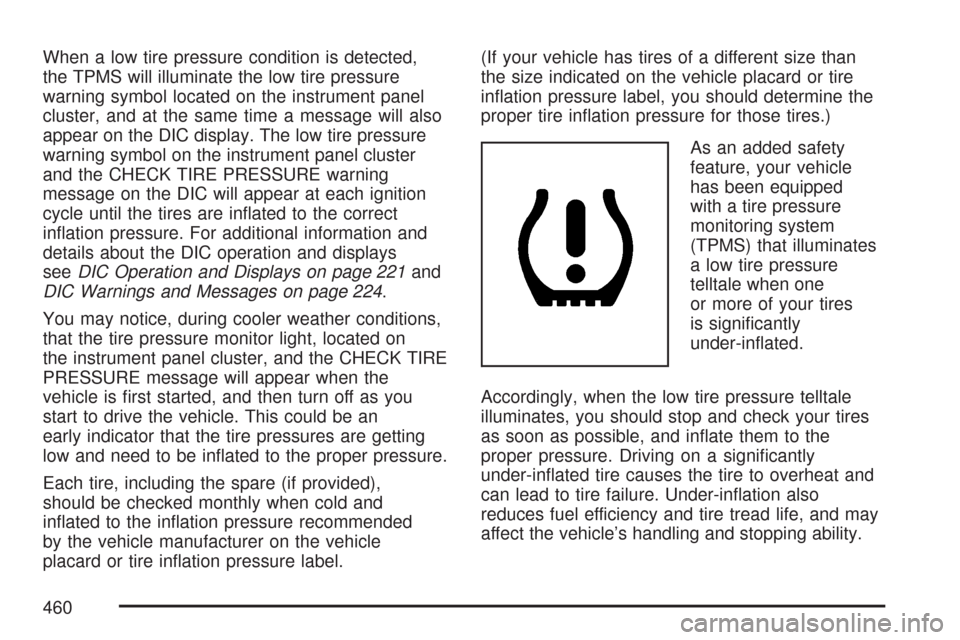
As an added safety
feature, your vehicle
has been equipped
with a tire pressure
monitoring system
(TPMS) that illuminates
a low tire pressure
telltale when one
or more of your tires
is signicantly
under-inated.
Accordingly, when the low tire pressure telltale
illuminates, you should stop and check your tires
as soon as possible, and inate them to the
proper pressure. Driving on a signicantly
under-inated tire causes the tire to overheat and
can lead to tire failure. Under-ination also
reduces fuel efficiency and tire tread life, and may
affect the vehicle’s handling and stopping ability.
460
Page 494 of 574
Leather
A soft cloth dampened with water may be used to
remove dust. If a more thorough cleaning is
necessary, a soft cloth dampened with a mild soap
solution can be used. Allow the leather to dry
naturally. Do not use heat to dry. Never use steam
to clean leather. Never use spot lifters or spot
removers on leather. Many commercial leather
cleaners and coatings that are sold to preserve
and protect leather may permanently change
the appearance and feel of your leather and are
not recommended. Do not use silicone or
wax-based products, or those containing organic
solvents to clean your vehicle’s interior because
they can alter the appearance by increasing
the gloss in a non-uniform manner. Never use
shoe polish on your leather.
Instrument Panel, Vinyl, and Other
Plastic Surfaces
A soft cloth dampened with water may be used to
remove dust. If a more thorough cleaning is
necessary, a clean soft cloth dampened with a
mild soap solution can be used to gently remove
dust and dirt. Never use spot lifters or removers
on plastic surfaces. Many commercial cleaners and
coatings that are sold to preserve and protect
soft plastic surfaces may permanently change the
appearance and feel of your interior and are
not recommended. Do not use silicone or
wax-based products, or those containing organic
solvents to clean your vehicle’s interior because
they can alter the appearance by increasing
the gloss in a non-uniform manner.
Some commercial products may increase gloss on
your instrument panel. The increase in gloss
may cause annoying reections in the windshield
and even make it difficult to see through the
windshield under certain conditions.
494
Page 501 of 574
Vehicle Identication
Vehicle Identication Number (VIN)
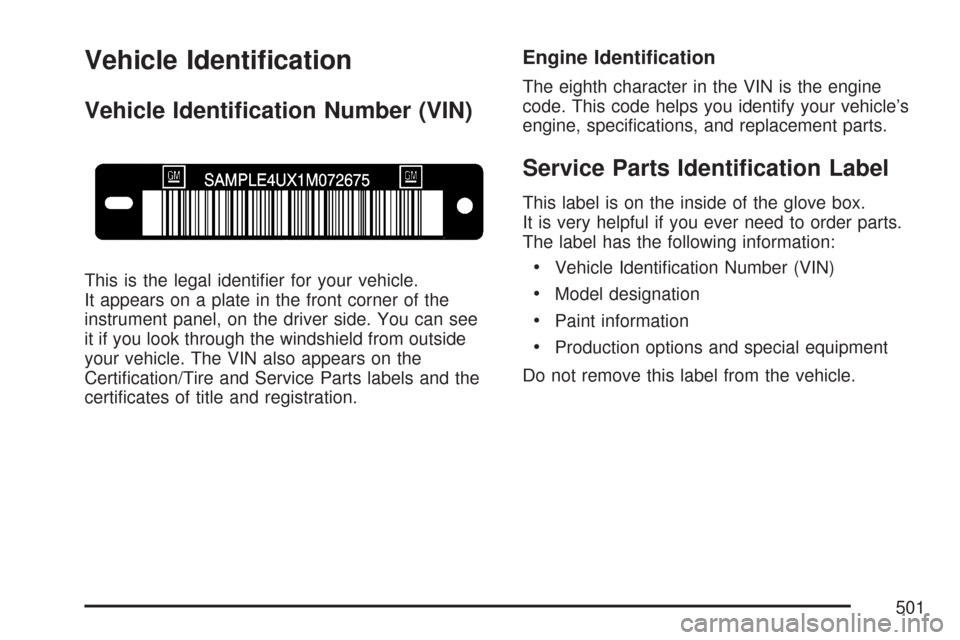
This is the legal identier for your vehicle.
It appears on a plate in the front corner of the
instrument panel, on the driver side. You can see
it if you look through the windshield from outside
your vehicle. The VIN also appears on the
Certication/Tire and Service Parts labels and the
certicates of title and registration.
Engine Identication
The eighth character in the VIN is the engine
code. This code helps you identify your vehicle’s
engine, specications, and replacement parts.
Service Parts Identication Label
This label is on the inside of the glove box.
It is very helpful if you ever need to order parts.
The label has the following information:
Vehicle Identication Number (VIN)
Model designation
Paint information
Production options and special equipment
Do not remove this label from the vehicle.
501