display CHEVROLET TRAVERSE 2009 1.G Owners Manual
[x] Cancel search | Manufacturer: CHEVROLET, Model Year: 2009, Model line: TRAVERSE, Model: CHEVROLET TRAVERSE 2009 1.GPages: 422, PDF Size: 2.06 MB
Page 243 of 422
Rear Seat Audio (RSA)
For vehicles with Rear Seat
Audio (RSA), rear seat passengers
can listen to and control any of the
music sources: radio, CDs, DVDs,
or other auxiliary sources. The rear
seat passengers can only control
the music sources the front seat
passengers are not listening to
(except on some radios where dual
control is allowed). For example,
rear seat passengers can control
a CD and listen to it through the
headphones, while the driver listens
to the radio through the front
speakers. The rear seat passengers
have control of the volume for each
set of headphones.The RSA functions operate even
when the main radio is off. The front
audio system displaysXwhen the
RSA is on, and disappears from the
display when it is off.
Audio can be heard through wired
headphones (not included) plugged
into the jacks on the RSA. If the
vehicle has this feature, audio can
also be heard on Channel 2 of
the wireless headphones.The audio system mutes the rear
speakers when the RSA audio
is active through the headphones.
To listen to an iPod or portable
audio device through the RSA,
attach the iPod or portable audio
device to the front auxiliary input
(if available), located on the
front audio system. Turn the iPod
on, then choose the front auxiliary
input with the RSA SRCE button.
Instrument Panel 3-123
Page 244 of 422
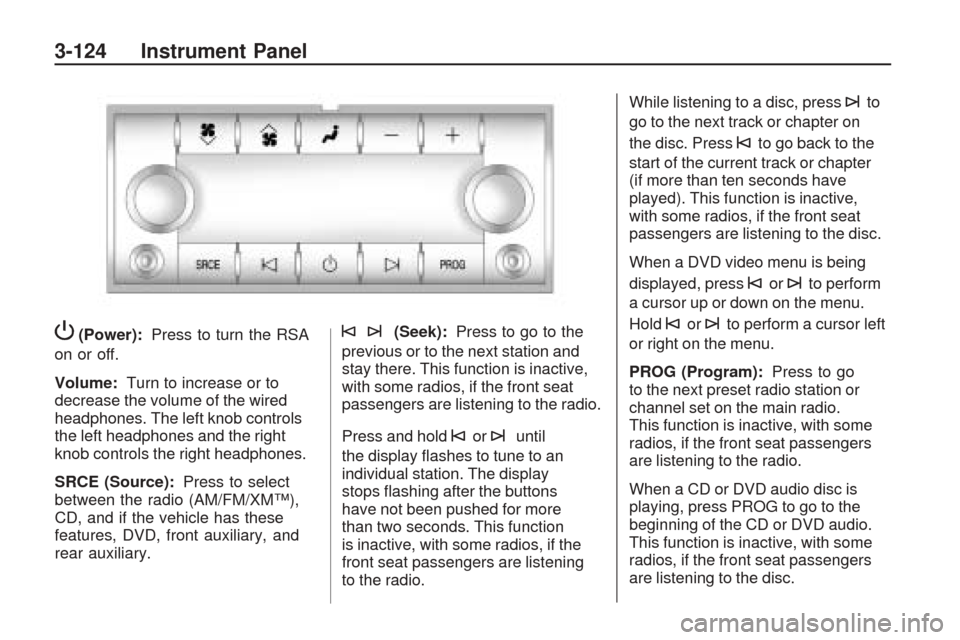
P(Power):Press to turn the RSA
on or off.
Volume: Turn to increase or to
decrease the volume of the wired
headphones. The left knob controls
the left headphones and the right
knob controls the right headphones.
SRCE (Source): Press to select
between the radio (AM/FM/XM™),
CD, and if the vehicle has these
features, DVD, front auxiliary, and
rear auxiliary.©¨(Seek): Press to go to the
previous or to the next station and
stay there. This function is inactive,
with some radios, if the front seat
passengers are listening to the radio.
Press and hold
©or¨until
the display ashes to tune to an
individual station. The display
stops ashing after the buttons
have not been pushed for more
than two seconds. This function
is inactive, with some radios, if the
front seat passengers are listening
to the radio. While listening to a disc, press
¨to
go to the next track or chapter on
the disc. Press
©to go back to the
start of the current track or chapter
(if more than ten seconds have
played). This function is inactive,
with some radios, if the front seat
passengers are listening to the disc.
When a DVD video menu is being
displayed, press
©or¨to perform
a cursor up or down on the menu.
Hold
©or¨to perform a cursor left
or right on the menu.
PROG (Program): Press to go
to the next preset radio station or
channel set on the main radio.
This function is inactive, with some
radios, if the front seat passengers
are listening to the radio.
When a CD or DVD audio disc is
playing, press PROG to go to the
beginning of the CD or DVD audio.
This function is inactive, with some
radios, if the front seat passengers
are listening to the disc.
3-124 Instrument Panel
Page 245 of 422
When a disc is playing in the CD or
DVD changer, press PROG to select
the next disc, if multiple discs are
loaded. This function is inactive,
with some radios, if the front seat
passengers are listening to the disc.
When a DVD video menu is being
displayed, press PROG to perform
the ENTER menu function.
Theft-Deterrent Feature
THEFTLOCK®is designed to
discourage theft of the vehicle’s
radio by learning a portion of
the Vehicle Identication Number
(VIN). The radio does not operate
if it is stolen or moved to a different
vehicle.
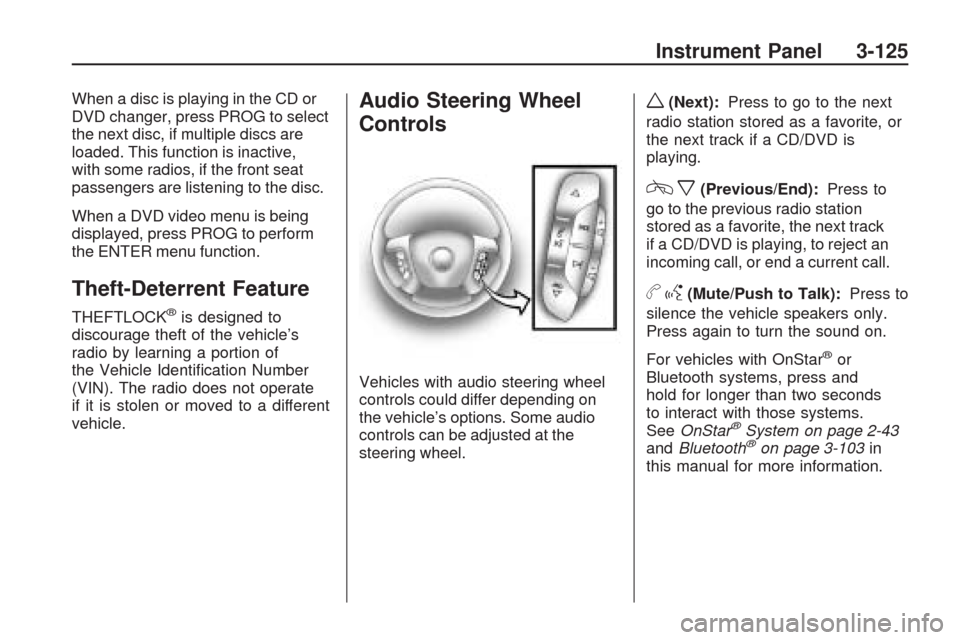
Audio Steering Wheel
Controls
Vehicles with audio steering wheel
controls could differ depending on
the vehicle’s options. Some audio
controls can be adjusted at the
steering wheel.
w(Next):Press to go to the next
radio station stored as a favorite, or
the next track if a CD/DVD is
playing.
cx(Previous/End):Press to
go to the previous radio station
stored as a favorite, the next track
if a CD/DVD is playing, to reject an
incoming call, or end a current call.
bg(Mute/Push to Talk):Press to
silence the vehicle speakers only.
Press again to turn the sound on.
For vehicles with OnStar
®or
Bluetooth systems, press and
hold for longer than two seconds
to interact with those systems.
SeeOnStar
®System on page 2-43
andBluetooth®on page 3-103in
this manual for more information.
Instrument Panel 3-125
Page 254 of 422
The system may be heard or felt
while it is working. This is normal and
does not mean there is a problem
with the vehicle. The system should
initialize before the vehicle reaches
20 mph (32 km/h). In some cases, it
may take approximately two miles
(3.2 km) of driving before the system
initializes.
If the system fails to turn on or
activate, the StabiliTrak light along
with one of the following messages
will be displayed on the Driver
Information Center (DIC):
TRACTION CONTROL OFF,
SERVICE TRACTION CONTROL,
SERVICE STABILITRAK. If these
conditions are observed, turn the
vehicle off, wait 15 seconds, and
then turn it back on again to reset the
system. If any of these messages still
appear on the Driver Information
Center (DIC), the vehicle should
be taken in for service. For more
information on the DIC messages,
seeDriver Information Center (DIC)
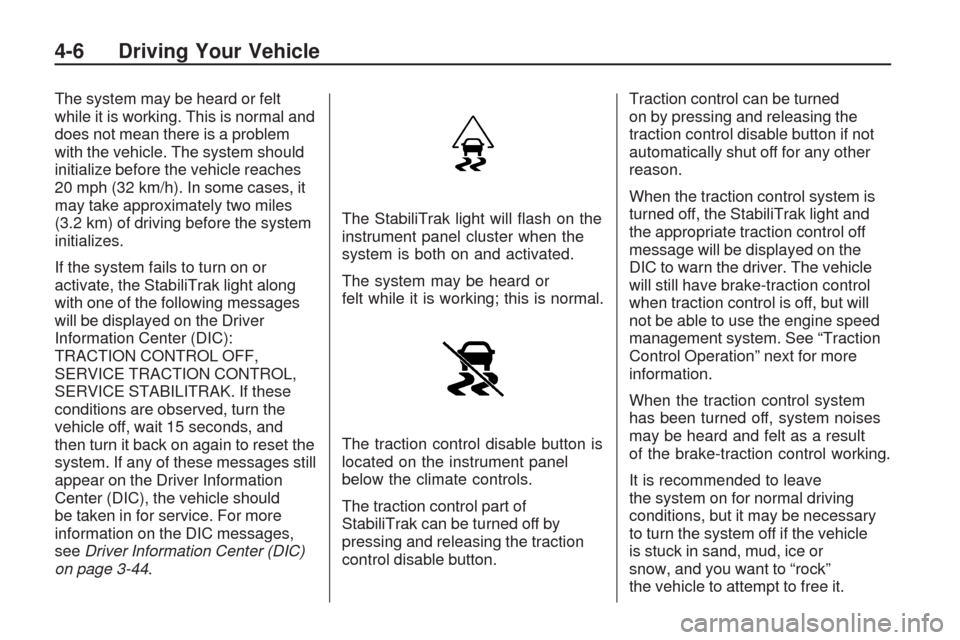
on page 3-44.The StabiliTrak light will ash on the
instrument panel cluster when the
system is both on and activated.
The system may be heard or
felt while it is working; this is normal.
The traction control disable button is
located on the instrument panel
below the climate controls.
The traction control part of
StabiliTrak can be turned off by
pressing and releasing the traction
control disable button.Traction control can be turned
on by pressing and releasing the
traction control disable button if not
automatically shut off for any other
reason.
When the traction control system is
turned off, the StabiliTrak light and
the appropriate traction control off
message will be displayed on the
DIC to warn the driver. The vehicle
will still have brake-traction control
when traction control is off, but will
not be able to use the engine speed
management system. See “Traction
Control Operation” next for more
information.
When the traction control system
has been turned off, system noises
may be heard and felt as a result
of the brake-traction control working.
It is recommended to leave
the system on for normal driving
conditions, but it may be necessary
to turn the system off if the vehicle
is stuck in sand, mud, ice or
snow, and you want to “rock”
the vehicle to attempt to free it.
4-6 Driving Your Vehicle
Page 255 of 422
It may also be necessary to turn off
the system when driving in extreme
off-road conditions where high wheel
spin is required. SeeIf Your Vehicle
is Stuck in Sand, Mud, Ice, or Snow
on page 4-16.
Traction Control Operation
The traction control system is part
of the StabiliTrak system. Traction
control limits wheel spin by reducing
engine power to the wheels (engine
speed management) and by applying
brakes to each individual wheel
(brake-traction control) as necessary.
The traction control system is
enabled automatically when the
vehicle is started. It will activate
and the StabiliTrak light will ash
if it senses that any of the wheels
are spinning or beginning to lose
traction while driving. If traction
control is turned off, only the
brake-traction control portion of
traction control will work. The engine
speed management will be disabled.In this mode, engine power is not
reduced automatically and the driven
wheels can spin more freely. This
can cause the brake-traction control
to activate constantly.
Notice:If the wheel(s) of one axle
is allowed to spin excessively
while the StabiliTrak, ABS and
brake warning lights and any
relevant DIC messages are
displayed, the transfer case could
be damaged. The repairs would
not be covered by the vehicle
warranty. Reduce engine power
and do not spin the wheel(s)
excessively while these lights and
messages are displayed.
The traction control system may
activate on dry or rough roads or
under conditions such as heavy
acceleration while turning or
abrupt upshifts/downshifts of the
transmission. When this happens, a
reduction in acceleration may be
noticed, or a noise or vibration may
be heard. This is normal.If cruise control is being used when
the system activates, the StabiliTrak
light will ash and cruise control will
automatically disengage. Cruise
control may be reengaged when
road conditions allow. SeeCruise
Control on page 3-9.
StabiliTrak may also turn off
automatically if it determines that a
problem exists with the system.
If the problem does not clear itself
after restarting the vehicle, see your
dealer/retailer for service.
All-Wheel Drive (AWD)
System
If the vehicle has this feature, engine
power is sent to all four wheels when
extra traction is needed. This is like
four-wheel drive, but there is no
separate lever or switch to engage
or disengage the axle. It is fully
automatic, and adjusts itself as
needed for road conditions.
Driving Your Vehicle 4-7
Page 290 of 422
The diagnostic system can
determine if the fuel cap has been
left off or improperly installed. This
would allow fuel to evaporate into the
atmosphere. SeeMalfunction
Indicator Lamp on page 3-39.
If the vehicle has a Driver Information
Center (DIC), the TIGHTEN GAS
CAP message displays if the fuel cap
is not properly installed.
{CAUTION
If a re starts while you are
refueling, do not remove the
nozzle. Shut off the ow of fuel by
shutting off the pump or by
notifying the station attendant.
Leave the area immediately.Notice:If you need a new fuel
cap, be sure to get the right type.
Your dealer/retailer can get one for
you. If you get the wrong type, it
might not t properly. This can
cause the malfunction indicator
lamp to light and can damage the
fuel tank and emissions system.
SeeMalfunction Indicator Lamp
on page 3-39.
Filling a Portable Fuel
Container
{CAUTION
Never ll a portable fuel container
while it is in the vehicle. Static
electricity discharge from the
container can ignite the fuel vapor.
(Continued)
CAUTION (Continued)
You can be badly burned and the
vehicle damaged if this occurs. To
help avoid injury to you and others:
Dispense fuel only into
approved containers.
Do not ll a container while it
is inside a vehicle, in a
vehicle’s trunk, pickup bed, or
on any surface other than the
ground.
Bring the ll nozzle in contact
with the inside of the ll
opening before operating the
nozzle. Contact should be
maintained until the lling is
complete.
Do not smoke while
pumping fuel.
Do not use a cellular phone
while pumping fuel.
5-8 Service and Appearance Care
Page 296 of 422
When the system has calculated
that oil life has been diminished,
it indicates that an oil change is
necessary. A CHANGE ENGINE OIL
SOON message comes on. Change
the oil as soon as possible within
the next 600 miles (1 000 km). It is
possible that, if driving under the best
conditions, the oil life system might
not indicate that an oil change is
necessary for over a year. However,
the engine oil and lter must be
changed at least once a year and at
this time the system must be reset.
Your dealer/retailer has trained
service people who will perform this
work using genuine parts and reset
the system. It is also important to
check the oil regularly and keep it at
the proper level.If the system is ever reset
accidentally, the oil must be
changed at 3,000 miles (5 000 km)
since the last oil change. Remember
to reset the oil life system whenever
the oil is changed.
How to Reset the Engine Oil
Life System
The Engine Oil Life System
calculates when to change the
engine oil and lter based on vehicle
use. Whenever the oil is changed,
reset the system so it can calculate
when the next oil change is required.
If a situation occurs where the oil
is changed prior to a CHANGE
ENGINE OIL SOON message being
turned on, reset the system.If the vehicle does not have Driver
Information Center (DIC) buttons:
1. Turn the ignition to ON/RUN, with
the engine off. The vehicle must
be in P (Park) to access this
display. Press the trip odometer
reset stem until OIL LIFE
REMAINING displays.
2. Press and hold the trip
odometer reset stem until OIL
LIFE REMAINING shows 100%.
Three chimes sound and the
CHANGE ENGINE OIL SOON
message goes off.
3. Turn the key to LOCK/OFF.
If the CHANGE ENGINE OIL
SOON message comes back on
when the vehicle is started, the
engine oil life system has not
reset. Repeat the procedure.
5-14 Service and Appearance Care
Page 297 of 422
If the vehicle has Driver Information
Center (DIC) buttons:
1. Turn the ignition to ON/RUN,
with the engine off.
2. Press the vehicle information
button until OIL LIFE
REMAINING displays.
3. Press and hold the set/reset
button until 100% is displayed.
Three chimes sound and
the CHANGE ENGINE OIL
SOON message goes off.
4. Turn the key to LOCK/OFF.
If the CHANGE ENGINE OIL SOON
message comes back on when the
vehicle is started, the engine oil life
system has not reset. Repeat the
procedure.What to Do with Used Oil
Used engine oil contains certain
elements that can be unhealthy for
your skin and could even cause
cancer. Do not let used oil stay on
your skin for very long. Clean your
skin and nails with soap and water,
or a good hand cleaner. Wash or
properly dispose of clothing or rags
containing used engine oil. See the
manufacturer’s warnings about the
use and disposal of oil products.
Used oil can be a threat to the
environment. If you change your own
oil, be sure to drain all the oil from the
lter before disposal. Never dispose
of oil by putting it in the trash, pouring
it on the ground, into sewers, or into
streams or bodies of water. Recycle
it by taking it to a place that collects
used oil.
Engine Air Cleaner/Filter
When to Inspect the Engine
Air Cleaner/Filter
Inspect the air cleaner/lter at the
MaintenanceIIintervals and replace
it at the rst oil change after each
50,000 mile (80 000 km) interval.
SeeScheduled Maintenance on
page 6-3for more information. If you
are driving in dusty/dirty conditions,
inspect the lter at each engine oil
change.
SeeEngine Compartment Overview
on page 5-10for the location of
the engine air cleaner/lter.
How to Inspect the Engine Air
Cleaner/Filter
To inspect the air cleaner/lter,
remove the lter from the vehicle and
lightly shake the lter (away from
vehicle) to release loose dust and
dirt. If the lter remains caked with
dirt, a new lter is required.
Service and Appearance Care 5-15
Page 304 of 422
Engine Overheating
The vehicle has several indicators
to warn of engine overheating.
There is an engine coolant
temperature gage on the instrument
panel cluster. SeeEngine Coolant
Temperature Gage on page 3-38.
The vehicle may also display
an ENGINE OVERHEATED
IDLE ENGINE and ENGINE
OVERHEATED STOP ENGINE
message in the Driver Information
Center (DIC). SeeDIC Warnings and
Messages on page 3-56.
You may decide not to lift the hood
when this warning appears, but
instead get service help right away.
SeeRoadside Assistance Program
on page 7-6.
If you do decide to lift the hood,
make sure the vehicle is parked
on a level surface.Then check to see if the engine
cooling fans are running. If the
engine is overheating, both fans
should be running. If they are
not, do not continue to run the
engine and have the vehicle
serviced.
Notice:Engine damage from
running the engine without
coolant is not covered by the
warranty.
Notice:If the engine catches re
while driving with no coolant,
the vehicle can be badly
damaged. The costly repairs
would not be covered by
the vehicle warranty. See
Overheated Engine Protection
Operating Mode on page 5-23for
information on driving to a
safe place in an emergency.
If Steam Is Coming From The
Engine Compartment
{CAUTION
Steam from an overheated engine
can burn you badly, even if you
just open the hood. Stay away
from the engine if you see or hear
steam coming from it. Turn it off
and get everyone away from the
vehicle until it cools down. Wait
until there is no sign of steam or
coolant before you open the hood.
If you keep driving when the
vehicles engine is overheated, the
liquids in it can catch re. You or
others could be badly burned.
Stop the engine if it overheats,
and get out of the vehicle until the
engine is cool.
SeeOverheated Engine Protection
Operating Mode on page 5-23for
information on driving to a safe
place in an emergency.
5-22 Service and Appearance Care
Page 305 of 422
If No Steam Is Coming From
The Engine Compartment
If an engine overheat warning is
displayed but no steam can be seen
or heard, the problem may not be
too serious. Sometimes the
engine can get a little too hot when
the vehicle:
Climbs a long hill on a hot day.
Stops after high-speed driving.
Idles for long periods in traffic.
Tows a trailer.
If the overheat warning is displayed
with no sign of steam:
1. Turn the air conditioning off.
2. Turn the heater on to the highest
temperature and to the highest
fan speed. Open the windows as
necessary.3. If in a traffic jam, shift to
N (Neutral), otherwise, shift
to the highest gear while
driving —D (Drive) or L (Low).
If the temperature overheat gage is
no longer in the overheat zone or an
overheat warning no longer displays,
the vehicle can be driven. Continue
to drive the vehicle slow for about
10 minutes. Keep a safe vehicle
distance from the car in front of you.
If the warning does not come back
on, continue to drive normally.
If the warning continues, pull over,
stop, and park the vehicle right away.
If there is no sign of steam, idle
the engine for three minutes while
parked. If the warning is still
displayed, turn off the engine until it
cools down. Also, see “Overheated
Engine Protection Operating Mode”
next in this section.
Overheated
Engine Protection
Operating Mode
This emergency operating mode lets
the vehicle be driven to a safe place
in an emergency situation. If an
overheated engine condition exists,
an overheat protection mode which
alternates ring groups of cylinders
helps prevent engine damage. In this
mode, there is a signicant loss in
power and engine performance.
The temperature gage indicates an
overheat condition exists. Driving
extended distances and/or towing a
trailer in the overheat protection
mode should be avoided.
Notice:After driving in the
overheated engine protection
operating mode, to avoid engine
damage, allow the engine to cool
before attempting any repair.
The engine oil will be severely
degraded. Repair the cause of
coolant loss, change the oil and
reset the oil life system. See
Engine Oil on page 5-11.
Service and Appearance Care 5-23