maintenance schedule CHEVROLET TRAVERSE 2009 1.G User Guide
[x] Cancel search | Manufacturer: CHEVROLET, Model Year: 2009, Model line: TRAVERSE, Model: CHEVROLET TRAVERSE 2009 1.GPages: 422, PDF Size: 2.06 MB
Page 330 of 422
The TPMS sensor matching process
is outlined below:
1. Set the parking brake.
2. Turn the ignition switch to
ON/RUN with the engine off.
3. Press the Remote Keyless
Entry (RKE) transmitter’s LOCK
and UNLOCK buttons at the
same time for approximately
ve seconds. The horn sounds
twice to signal the receiver
is in relearn mode and TIRE
LEARNING ACTIVE message
displays on the DIC screen.
4. Start with the driver side front tire.
5. Remove the valve cap from the
valve cap stem. Activate the
TPMS sensor by increasing or
decreasing the tire’s air pressure
for ve seconds, or until a horn
chirp sounds. The horn chirp,
which may take up to 30 seconds
to sound, conrms that the sensor
identication code has been
matched to this tire and wheel
position.6. Proceed to the passenger side
front tire, and repeat the
procedure in Step 5.
7. Proceed to the passenger side
rear tire, and repeat the
procedure in Step 5.
8. Proceed to the driver side rear
tire, and repeat the procedure
in Step 5. The horn sounds
two times to indicate the sensor
identication code has been
matched to the driver side rear
tire, and the TPMS sensor
matching process is no longer
active. The TIRE LEARNING
ACTIVE message on the
DIC display screen goes off.
9. Turn the ignition switch to
LOCK/OFF.
10. Set all four tires to the
recommended air pressure level
as indicated on the Tire and
Loading Information label.
11. Put the valve caps back on the
valve stems.Tire Inspection and
Rotation
We recommend that you
regularly inspect the vehicle’s
tires, including the spare tire, if
the vehicle has one, for signs of
wear or damage. SeeWhen It Is
Time for New Tires on page 5-50
for more information.
Tires should be rotated
every 5,000 to 8,000 miles
(8 000 to 13 000 km). See
Scheduled Maintenance on
page 6-3.
The purpose of a regular tire
rotation is to achieve a uniform
wear for all tires on the vehicle.
This will ensure that the vehicle
continues to perform most like it
did when the tires were new.
5-48 Service and Appearance Care
Page 375 of 422
Maintenance
Schedule
Maintenance ScheduleIntroduction..........................6-1
Maintenance Requirements.....6-1
Your Vehicle and the
Environment........................6-1
Using the Maintenance
Schedule............................6-2
Scheduled Maintenance.........6-3
Additional Required Services. . .6-6
Maintenance Footnotes..........6-7
Owner Checks and Services. . .6-9
At Each Fuel Fill...................6-9
At Least Once a Month..........6-9
At Least Once a Year..........6-10
Recommended Fluids and
Lubricants.........................6-12
Maintenance Replacement
Parts................................6-14
Engine Drive Belt Routing.....6-15
Maintenance Record............6-16
Maintenance
Schedule
Introduction
Important: Keep engine oil at the
proper level and change as
recommended.
Have you purchased the GM
Protection Plan? The Plan
supplements the vehicle warranties.
See the Warranty and Owner
Assistance booklet or your
dealer/retailer for details.
Maintenance
Requirements
Notice:Maintenance intervals,
checks, inspections, replacement
parts, and recommended uids
and lubricants as prescribed
in this manual are necessary to
keep this vehicle in good working
condition. Any damage caused
by failure to follow scheduled
maintenance might not be
covered by the vehicle warranty.
Your Vehicle and the
Environment
Proper vehicle maintenance not only
helps to keep the vehicle in good
working condition, but also helps the
environment. All recommended
maintenance is important. Improper
vehicle maintenance can even affect
the quality of the air we breathe.
Maintenance Schedule 6-1
Page 376 of 422
Improper uid levels or the wrong tire
ination can increase the level of
emissions from the vehicle. To help
protect the environment, and to keep
the vehicle in good condition, be sure
to maintain the vehicle properly.
Using the Maintenance
Schedule
We want to help keep this vehicle in
good working condition. But we do
not know exactly how you will drive it.
You might drive very short distances
only a few times a week. Or you
might drive long distances all the
time in very hot, dusty weather.
You might use the vehicle in making
deliveries. Or you might drive it to
work, to do errands, or in many
other ways.
Because of all the different
ways people use their vehicles,
maintenance needs vary. You might
need more frequent checks and
replacements. So please read the
following and note how you drive.If you have any questions on how to
keep the vehicle in good condition,
see your dealer/retailer.
This schedule is for vehicles that:
carry passengers and cargo
within recommended limits on the
Tire and Loading Information
label. SeeLoading the Vehicle on
page 4-16.
are driven on reasonable road
surfaces within legal driving
limits.
use the recommended fuel. See
Gasoline Octane on page 5-5.
The services inScheduled
Maintenance on page 6-3should
be performed when indicated.
SeeAdditional Required Services
on page 6-6andMaintenance
Footnotes on page 6-7for further
information.
{CAUTION
Performing maintenance work on
a vehicle can be dangerous. In
trying to do some jobs, you can
be seriously injured. Do your own
maintenance work only if you
have the required know-how and
the proper tools and equipment
for the job. If you have any doubt,
see your dealer/retailer to have a
qualied technician do the work.
SeeDoing Your Own Service
Work on page 5-4.
Some maintenance services can
be complex. So, unless you are
technically qualied and have the
necessary equipment, have your
dealer/retailer do these jobs.
When you go to your dealer/retailer
for service, trained and supported
service technicians will perform
the work using genuine parts.
6-2 Maintenance Schedule
Page 377 of 422
To purchase service information,
seeService Publications Ordering
Information on page 7-15.
Owner Checks and Services on
page 6-9tells what should be
checked, when to check it, and what
can easily be done to help keep
the vehicle in good condition.
The proper replacement parts,
uids, and lubricants to use are
listed inRecommended Fluids and
Lubricants on page 6-12and
Maintenance Replacement Parts
on page 6-14. When the vehicle is
serviced, make sure these are used.
All parts should be replaced and all
necessary repairs done before you
or anyone else drives the vehicle.
We recommend the use of genuine
parts from your dealer/retailer.Scheduled Maintenance
When the CHANGE ENGINE OIL
SOON message displays, service is
required for the vehicle. Have the
vehicle serviced as soon as possible
within the next 600 miles (1 000 km).
It is possible that, if driving under the
best conditions, the engine oil life
system might not indicate that
vehicle service is necessary for over
a year. However, the engine oil and
lter must be changed at least once
a year and at this time the system
must be reset. Your dealer/retailer
has trained service technicians who
will perform this work using genuine
parts and reset the system.If the engine oil life system is ever
reset accidentally, service the vehicle
within 3,000 miles (5 000 km) since
the last service. Remember to reset
the oil life system whenever the oil
is changed. SeeEngine Oil Life
System on page 5-13for information
on the Engine Oil Life System and
resetting the system.
When the CHANGE ENGINE
OIL SOON message appears,
certain services, checks, and
inspections are required. Required
services are described in the
following for “MaintenanceI” and
“MaintenanceII.” Generally, it is
recommended that the rst service
be MaintenanceI, the second
service be MaintenanceII, and then
alternate MaintenanceIand
MaintenanceIIthereafter. However,
in some cases, MaintenanceIImay
be required more often.
Maintenance Schedule 6-3
Page 378 of 422
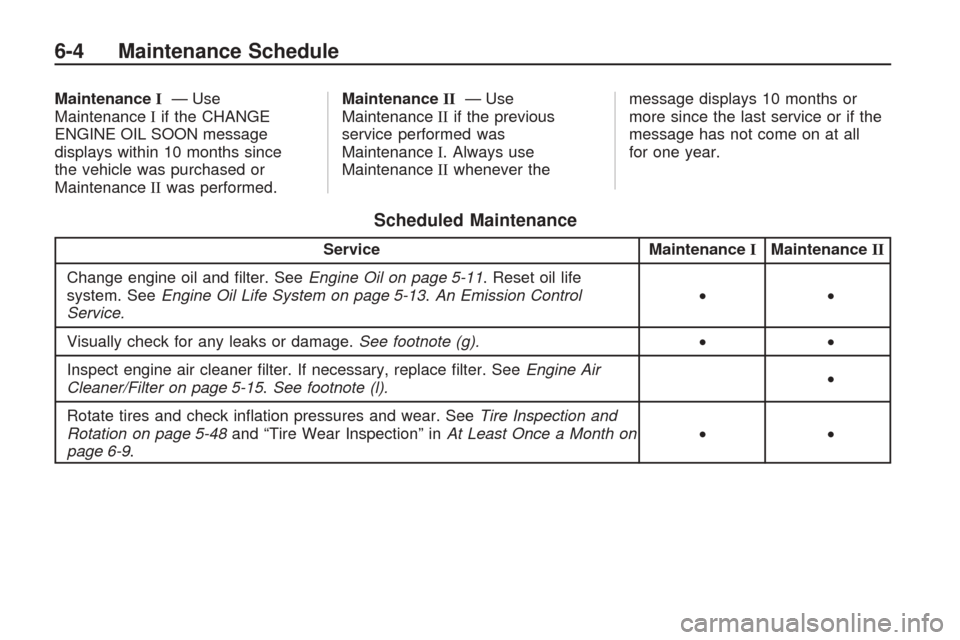
MaintenanceI—Use
Maintenance Iif the CHANGE
ENGINE OIL SOON message
displays within 10 months since
the vehicle was purchased or
Maintenance IIwas performed. Maintenance
II—Use
Maintenance IIif the previous
service performed was
Maintenance I. Always use
Maintenance IIwhenever the message displays 10 months or
more since the last service or if the
message has not come on at all
for one year.
Scheduled Maintenance
Service
MaintenanceIMaintenance II
Change engine oil and lter. See Engine Oil on page 5-11. Reset oil life
system. See Engine Oil Life System on page 5-13 .An Emission Control
Service. ••
Visually check for any leaks or damage. See footnote (g). ••
Inspect engine air cleaner lter. If necessary, replace lter. See Engine Air
Cleaner/Filter on page 5-15 .See footnote (l). •
Rotate tires and check ination pressures and wear. See Tire Inspection and
Rotation on page 5-48 and “Tire Wear Inspection” in At Least Once a Month on
page 6-9. ••
6-4 Maintenance Schedule
Page 379 of 422
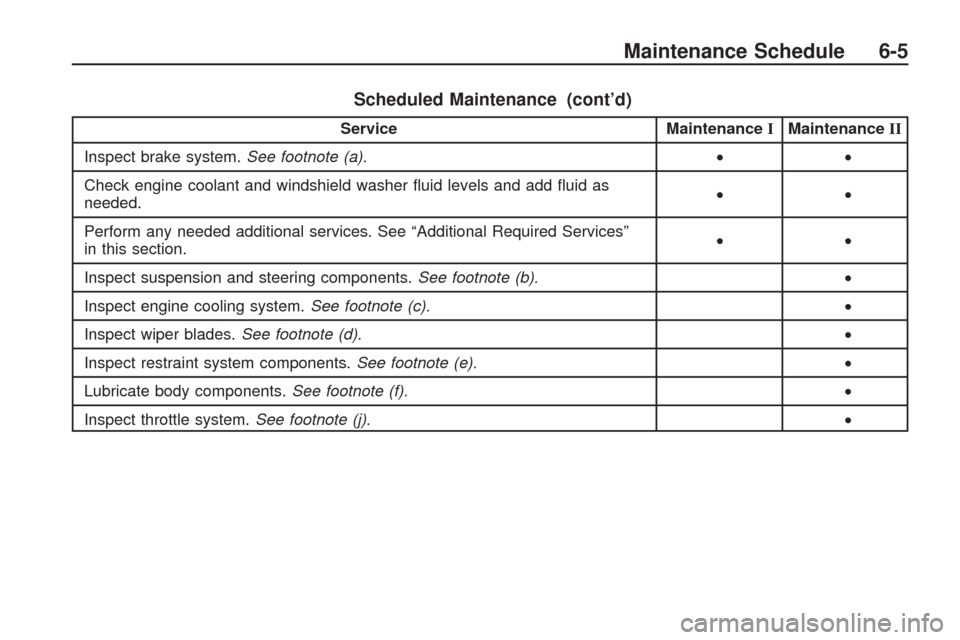
Scheduled Maintenance (cont’d)
ServiceMaintenanceIMaintenance II
Inspect brake system. See footnote (a). ••
Check engine coolant and windshield washer uid levels and add uid as
needed. ••
Perform any needed additional services. See “Additional Required Services”
in this section. ••
Inspect suspension and steering components. See footnote (b). •
Inspect engine cooling system. See footnote (c). •
Inspect wiper blades. See footnote (d). •
Inspect restraint system components. See footnote (e). •
Lubricate body components. See footnote (f). •
Inspect throttle system. See footnote (j). •
Maintenance Schedule 6-5
Page 380 of 422
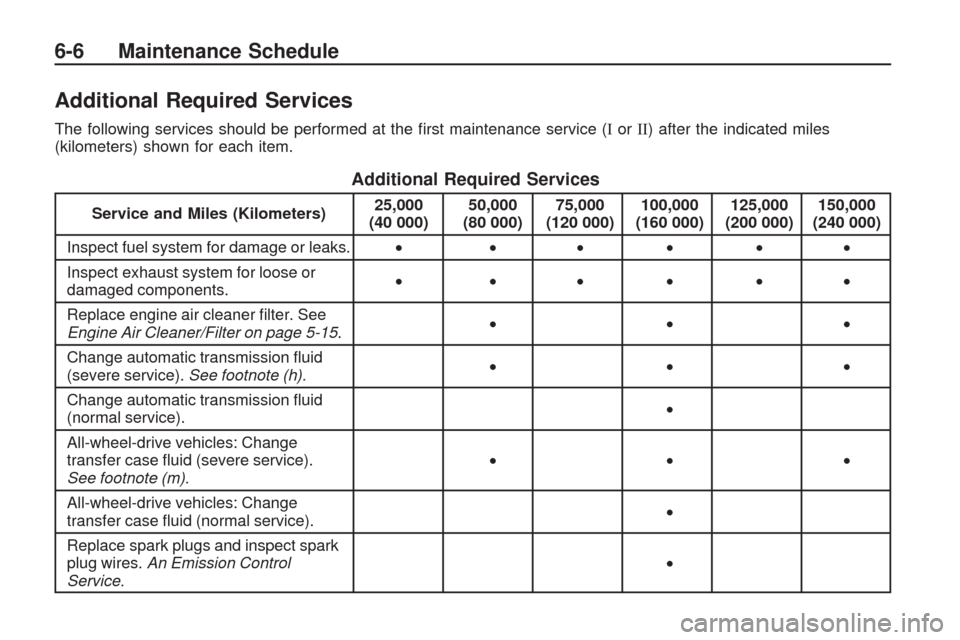
Additional Required Services
The following services should be performed at the rst maintenance service (Ior II) after the indicated miles
(kilometers) shown for each item.
Additional Required Services
Service and Miles (Kilometers) 25,000
(40 000) 50,000
(80 000) 75,000
(120 000) 100,000
(160 000) 125,000
(200 000) 150,000
(240 000)
Inspect fuel system for damage or leaks. • •••••
Inspect exhaust system for loose or
damaged components. • •••••
Replace engine air cleaner lter. See
Engine Air Cleaner/Filter on page 5-15 .•••
Change automatic transmission uid
(severe service). See footnote (h). •••
Change automatic transmission uid
(normal service). •
All-wheel-drive vehicles: Change
transfer case uid (severe service).
See footnote (m). •••
All-wheel-drive vehicles: Change
transfer case uid (normal service). •
Replace spark plugs and inspect spark
plug wires. An Emission Control
Service. •
6-6 Maintenance Schedule
Page 381 of 422
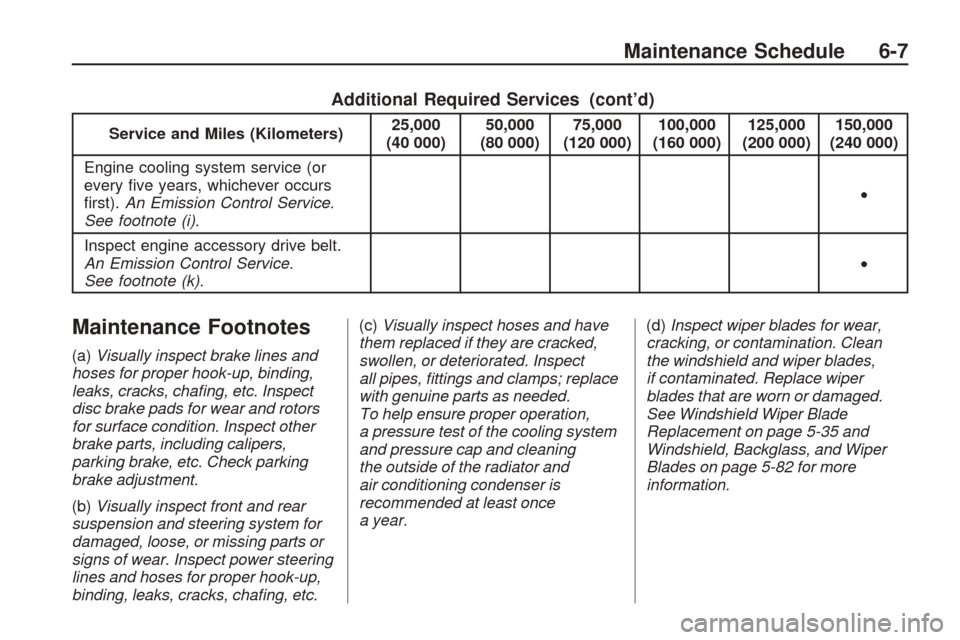
Additional Required Services (cont’d)
Service and Miles (Kilometers)25,000
(40 000) 50,000
(80 000) 75,000
(120 000) 100,000
(160 000) 125,000
(200 000) 150,000
(240 000)
Engine cooling system service (or
every ve years, whichever occurs
rst). An Emission Control Service.
See footnote (i). •
Inspect engine accessory drive belt.
An Emission Control Service.
See footnote (k). •
Maintenance Footnotes
(a)
Visually inspect brake lines and
hoses for proper hook-up, binding,
leaks, cracks, chafing, etc. Inspect
disc brake pads for wear and rotors
for surface condition. Inspect other
brake parts, including calipers,
parking brake, etc. Check parking
brake adjustment.
(b) Visually inspect front and rear
suspension and steering system for
damaged, loose, or missing parts or
signs of wear. Inspect power steering
lines and hoses for proper hook-up,
binding, leaks, cracks, chafing, etc. (c)
Visually inspect hoses and have
them replaced if they are cracked,
swollen, or deteriorated. Inspect
all pipes, fittings and clamps; replace
with genuine parts as needed.
To help ensure proper operation,
a pressure test of the cooling system
and pressure cap and cleaning
the outside of the radiator and
air conditioning condenser is
recommended at least once
a year. (d)
Inspect wiper blades for wear,
cracking, or contamination. Clean
the windshield and wiper blades,
if contaminated. Replace wiper
blades that are worn or damaged.
See Windshield Wiper Blade
Replacement on page 5-35 and
Windshield, Backglass, and Wiper
Blades on page 5-82 for more
information.
Maintenance Schedule 6-7
Page 382 of 422
(e)Make sure the safety belt
reminder light and safety belt
assemblies are working properly.
Look for any other loose or damaged
safety belt system parts. If you see
anything that might keep a safety
belt system from doing its job, have
it repaired. Have any torn or frayed
safety belts replaced. Also see
Checking the Restraint Systems
on page 1-59.
(f)Lubricate all key lock cylinders,
hood latch assemblies, secondary
latches, pivots, spring anchor and
release pawl, hood and door hinges,
rear folding seats, and liftgate
hinges. More frequent lubrication
may be required when exposed to
a corrosive environment. Applying
silicone grease on weatherstrips with
a clean cloth will make them last
longer, seal better, and not stick
or squeak.
(g)A fluid loss in any vehicle system
could indicate a problem. Have the
system inspected and repaired and
the fluid level checked. Add fluid if
needed.(h)Change automatic transmission
fluid if the vehicle is mainly driven
under one or more of these
conditions:
In heavy city traffic where the
outside temperature regularly
reaches 90°F (32°C) or higher.
In hilly or mountainous terrain.
When doing frequent trailer
towing.
Uses such as found in taxi, police,
or delivery service.
(i)Drain, flush, and refill cooling
system. This service can be
complex; you should have your
dealer/retailer perform this service.
See Engine Coolant on page 5-17 for
what to use. Inspect hoses. Clean
radiator, condenser, pressure cap,
and filler neck. Pressure test the
cooling system and pressure cap.(j)Check system for interference or
binding and for damaged or missing
parts. Replace parts as needed.
Replace any components that have
high effort or excessive wear. Do not
lubricate accelerator or cruise control
cables.
(k)Visually inspect belt for fraying,
excessive cracks, or obvious
damage. Replace belt if necessary.
(l)If driving regularly under dusty
conditions, inspect the filter at each
engine oil change.
(m)Change transfer case fluid if the
vehicle is mainly driven under one
or more of these conditions:
In heavy city traffic where the
outside temperature regularly
reaches 90°F (32°C) or higher.
In hilly or mountainous terrain.
When doing frequent trailer
towing.
Uses such as found in taxi, police,
or delivery service.
6-8 Maintenance Schedule
Page 383 of 422
Owner Checks and
Services
These owner checks and services
should be performed at the intervals
specied to help ensure vehicle
safety, dependability, and emission
control performance. Your dealer/
retailer can assist with these checks
and services.
Be sure any necessary repairs are
completed at once. Whenever any
uids or lubricants are added to the
vehicle, make sure they are the
proper ones, as shown in
Recommended Fluids and
Lubricants on page 6-12.
At Each Fuel Fill
It is important to perform these
underhood checks at each
fuel fill.
Engine Oil Level Check
Notice:It is important to check
the engine oil regularly and
keep it at the proper level. Failure
to keep the engine oil at the
proper level can cause damage to
the engine not covered by the
vehicle warranty.
Check the engine oil level and add
the proper oil if necessary. See
Engine Oil on page 5-11.
Engine Coolant Level Check
Check the engine coolant level
and add DEX-COOL®coolant
mixture if necessary. SeeEngine
Coolant on page 5-17.
Windshield Washer Fluid
Level Check
Check the windshield washer uid
level in the windshield washer
uid reservoir and add the proper
uid if necessary.
At Least Once a Month
Tire Ination Check
Inspect the vehicle’s tires and make
sure they are inated to the correct
pressures. Do not forget to check
the spare tire, if the vehicle has one.
SeeInflation - Tire Pressure on
page 5-42. If the vehicle has a spare
tire, check to make sure it is stored
securely. SeeChanging a Flat Tire
on page 5-65.
Tire Wear Inspection
Tire rotation may be required for
high mileage highway drivers prior to
the Engine Oil Life System service
notication. Check the tires for
wear and, if necessary, rotate the
tires. SeeTire Inspection and
Rotation on page 5-48.
Maintenance Schedule 6-9