oil pressure CHEVROLET TRAVERSE 2009 1.G User Guide
[x] Cancel search | Manufacturer: CHEVROLET, Model Year: 2009, Model line: TRAVERSE, Model: CHEVROLET TRAVERSE 2009 1.GPages: 422, PDF Size: 2.06 MB
Page 293 of 422
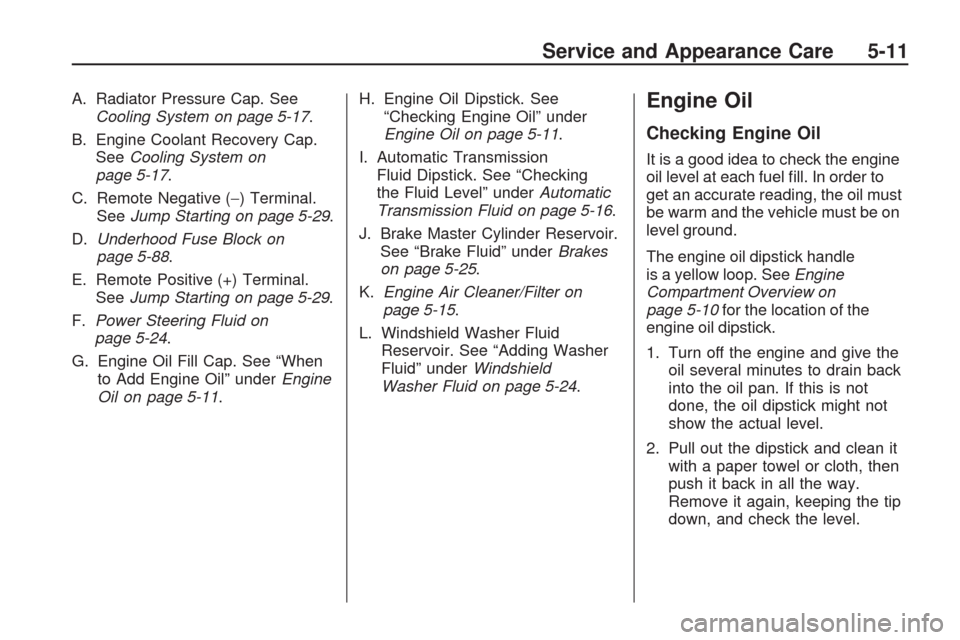
A. Radiator Pressure Cap. See
Cooling System on page 5-17.
B. Engine Coolant Recovery Cap.
SeeCooling System on
page 5-17.
C. Remote Negative (−) Terminal.
SeeJump Starting on page 5-29.
D.Underhood Fuse Block on
page 5-88.
E. Remote Positive (+) Terminal.
SeeJump Starting on page 5-29.
F.Power Steering Fluid on
page 5-24.
G. Engine Oil Fill Cap. See “When
to Add Engine Oil” underEngine
Oil on page 5-11.H. Engine Oil Dipstick. See
“Checking Engine Oil” under
Engine Oil on page 5-11.
I. Automatic Transmission
Fluid Dipstick. See “Checking
the Fluid Level” underAutomatic
Transmission Fluid on page 5-16.
J. Brake Master Cylinder Reservoir.
See “Brake Fluid” underBrakes
on page 5-25.
K.Engine Air Cleaner/Filter on
page 5-15.
L. Windshield Washer Fluid
Reservoir. See “Adding Washer
Fluid” underWindshield
Washer Fluid on page 5-24.Engine Oil
Checking Engine Oil
It is a good idea to check the engine
oil level at each fuel ll. In order to
get an accurate reading, the oil must
be warm and the vehicle must be on
level ground.
The engine oil dipstick handle
is a yellow loop. SeeEngine
Compartment Overview on
page 5-10for the location of the
engine oil dipstick.
1. Turn off the engine and give the
oil several minutes to drain back
into the oil pan. If this is not
done, the oil dipstick might not
show the actual level.
2. Pull out the dipstick and clean it
with a paper towel or cloth, then
push it back in all the way.
Remove it again, keeping the tip
down, and check the level.
Service and Appearance Care 5-11
Page 322 of 422
Bead:The tire bead contains
steel wires wrapped by steel
cords that hold the tire onto
the rim.
Bias Ply Tire
:A pneumatic
tire in which the plies are laid
at alternate angles less than
90 degrees to the centerline of
the tread.
Cold Tire Pressure
:The
amount of air pressure in a tire,
measured in pounds per square
inch (psi) or kilopascals (kPa)
before a tire has built up heat
from driving. SeeInflation - Tire
Pressure on page 5-42.
Curb Weight
:The weight of a
motor vehicle with standard
and optional equipment including
the maximum capacity of fuel,
oil, and coolant, but without
passengers and cargo.DOT Markings
:A code
molded into the sidewall of a
tire signifying that the tire is in
compliance with the U.S.
Department of Transportation
(DOT) motor vehicle safety
standards. The DOT code
includes the Tire Identication
Number (TIN), an alphanumeric
designator which can also
identify the tire manufacturer,
production plant, brand, and date
of production.
GVWR
:Gross Vehicle Weight
Rating. SeeLoading the Vehicle
on page 4-16.
GAWR FRT
:Gross Axle Weight
Rating for the front axle. See
Loading the Vehicle on
page 4-16.
GAWR RR
:Gross Axle Weight
Rating for the rear axle. See
Loading the Vehicle on
page 4-16.Intended Outboard Sidewall
:The side of an asymmetrical tire,
that must always face outward
when mounted on a vehicle.
Kilopascal (kPa)
:The metric
unit for air pressure.
Light Truck (LT-Metric) Tire
:A tire used on light duty trucks
and some multipurpose
passenger vehicles.
Load Index
:An assigned
number ranging from 1 to 279
that corresponds to the load
carrying capacity of a tire.
Maximum Ination Pressure
:The maximum air pressure to
which a cold tire can be inated.
The maximum air pressure is
molded onto the sidewall.
Maximum Load Rating
:The load rating for a tire at the
maximum permissible ination
pressure for that tire.
5-40 Service and Appearance Care
Page 361 of 422
Do not clean the vehicle using:
A knife or any other sharp object
to remove a soil from any interior
surface.
A stiff brush. It can cause damage
to the vehicle’s interior surfaces.
Heavy pressure or aggressive
rubbing with a cleaning cloth. Use
of heavy pressure can damage
the interior and does not improve
the effectiveness of soil removal.
Laundry detergents or
dishwashing soaps with
degreasers can leave residue
that streaks and attracts dirt. For
liquid cleaners, about 20 drops
per gallon (3.78 L) of water is a
good guide. Use only mild,
neutral-pH soaps.
Too much cleaner that saturates
the upholstery.
Organic solvents such as naptha,
alcohol, etc. that can damage the
vehicle’s interior.
Fabric/Carpet
Use a vacuum cleaner with a
soft brush attachment frequently
to remove dust and loose dirt.
A canister vacuum with a beater bar
in the nozzle may only be used on
oor carpet and carpeted oor mats.
For any soil, always try to remove it
rst with plain water or club soda.
Before cleaning, gently remove as
much of the soil as possible using
one of the following techniques:
For liquids: gently blot the
remaining soil with a paper towel.
Allow the soil to absorb into the
paper towel until no more can be
removed.
For solid dry soils: remove as
much as possible and then
vacuum.
To clean:
1. Saturate a lint-free, clean white
cloth with water or club soda.
2. Wring the cloth to remove excess
moisture.3. Start on the outside edge of the
soil and gently rub toward the
center. Continue cleaning, using
a clean area of the cloth each
time it becomes soiled.
4. Continue to gently rub the soiled
area until the cleaning cloth
remains clean.
5. If the soil is not completely
removed, use a mild soap
solution and repeat the cleaning
process that was used with
plain water.
If any of the soil remains, a
commercial fabric cleaner or spot
lifter may be necessary. When a
commercial upholstery cleaner or
spot lifter is to be used, test a small
hidden area for colorfastness rst.
If the locally cleaned area gives any
impression that a ring formation may
result, clean the entire surface.
After the cleaning process has been
completed, a paper towel can be
used to blot excess moisture from
the fabric or carpet.
Service and Appearance Care 5-79
Page 378 of 422
MaintenanceI—Use
Maintenance Iif the CHANGE
ENGINE OIL SOON message
displays within 10 months since
the vehicle was purchased or
Maintenance IIwas performed. Maintenance
II—Use
Maintenance IIif the previous
service performed was
Maintenance I. Always use
Maintenance IIwhenever the message displays 10 months or
more since the last service or if the
message has not come on at all
for one year.
Scheduled Maintenance
Service
MaintenanceIMaintenance II
Change engine oil and lter. See Engine Oil on page 5-11. Reset oil life
system. See Engine Oil Life System on page 5-13 .An Emission Control
Service. ••
Visually check for any leaks or damage. See footnote (g). ••
Inspect engine air cleaner lter. If necessary, replace lter. See Engine Air
Cleaner/Filter on page 5-15 .See footnote (l). •
Rotate tires and check ination pressures and wear. See Tire Inspection and
Rotation on page 5-48 and “Tire Wear Inspection” in At Least Once a Month on
page 6-9. ••
6-4 Maintenance Schedule
Page 382 of 422
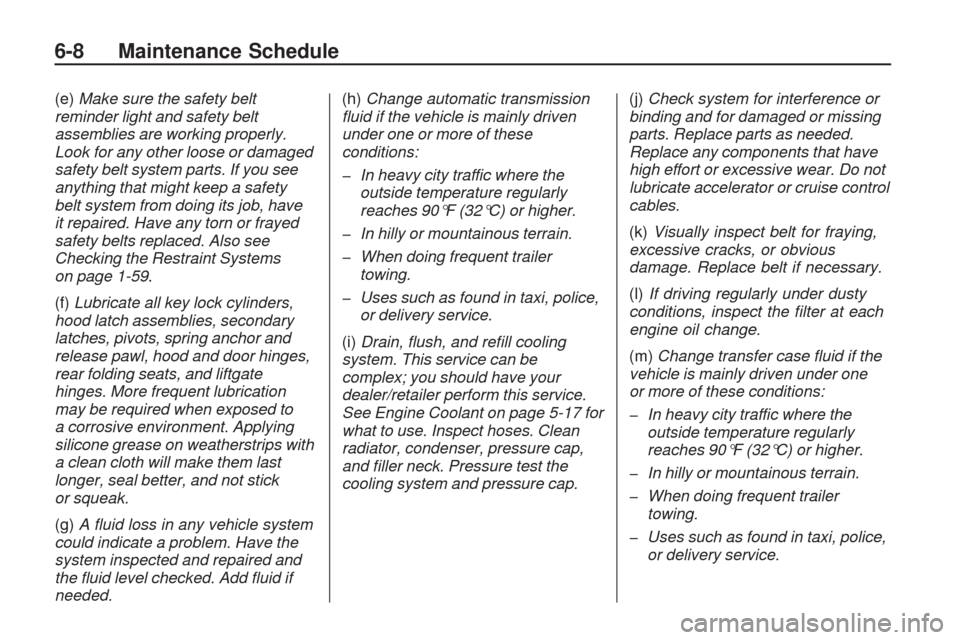
(e)Make sure the safety belt
reminder light and safety belt
assemblies are working properly.
Look for any other loose or damaged
safety belt system parts. If you see
anything that might keep a safety
belt system from doing its job, have
it repaired. Have any torn or frayed
safety belts replaced. Also see
Checking the Restraint Systems
on page 1-59.
(f)Lubricate all key lock cylinders,
hood latch assemblies, secondary
latches, pivots, spring anchor and
release pawl, hood and door hinges,
rear folding seats, and liftgate
hinges. More frequent lubrication
may be required when exposed to
a corrosive environment. Applying
silicone grease on weatherstrips with
a clean cloth will make them last
longer, seal better, and not stick
or squeak.
(g)A fluid loss in any vehicle system
could indicate a problem. Have the
system inspected and repaired and
the fluid level checked. Add fluid if
needed.(h)Change automatic transmission
fluid if the vehicle is mainly driven
under one or more of these
conditions:
In heavy city traffic where the
outside temperature regularly
reaches 90°F (32°C) or higher.
In hilly or mountainous terrain.
When doing frequent trailer
towing.
Uses such as found in taxi, police,
or delivery service.
(i)Drain, flush, and refill cooling
system. This service can be
complex; you should have your
dealer/retailer perform this service.
See Engine Coolant on page 5-17 for
what to use. Inspect hoses. Clean
radiator, condenser, pressure cap,
and filler neck. Pressure test the
cooling system and pressure cap.(j)Check system for interference or
binding and for damaged or missing
parts. Replace parts as needed.
Replace any components that have
high effort or excessive wear. Do not
lubricate accelerator or cruise control
cables.
(k)Visually inspect belt for fraying,
excessive cracks, or obvious
damage. Replace belt if necessary.
(l)If driving regularly under dusty
conditions, inspect the filter at each
engine oil change.
(m)Change transfer case fluid if the
vehicle is mainly driven under one
or more of these conditions:
In heavy city traffic where the
outside temperature regularly
reaches 90°F (32°C) or higher.
In hilly or mountainous terrain.
When doing frequent trailer
towing.
Uses such as found in taxi, police,
or delivery service.
6-8 Maintenance Schedule
Page 383 of 422
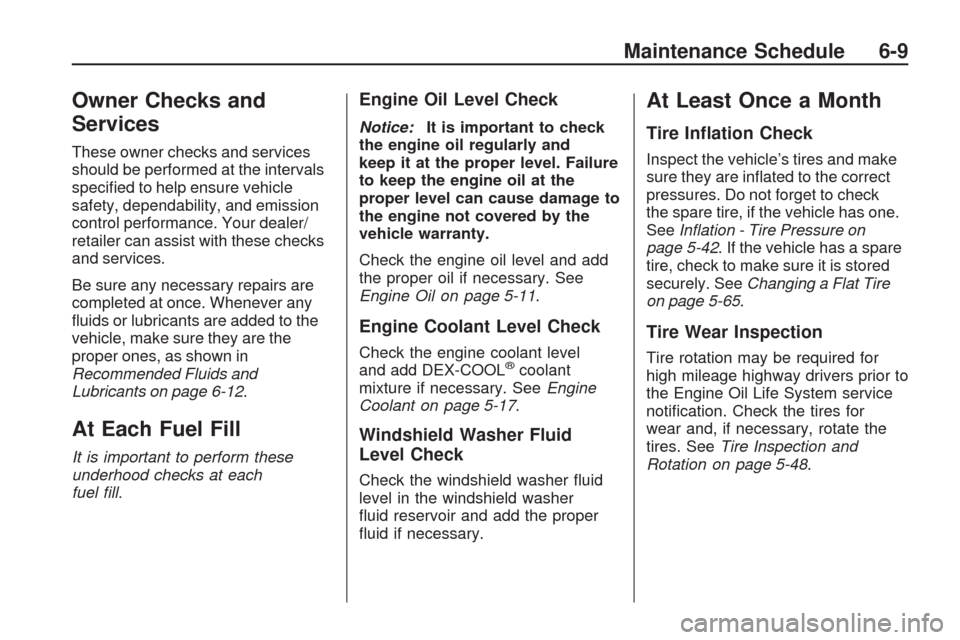
Owner Checks and
Services
These owner checks and services
should be performed at the intervals
specied to help ensure vehicle
safety, dependability, and emission
control performance. Your dealer/
retailer can assist with these checks
and services.
Be sure any necessary repairs are
completed at once. Whenever any
uids or lubricants are added to the
vehicle, make sure they are the
proper ones, as shown in
Recommended Fluids and
Lubricants on page 6-12.
At Each Fuel Fill
It is important to perform these
underhood checks at each
fuel fill.
Engine Oil Level Check
Notice:It is important to check
the engine oil regularly and
keep it at the proper level. Failure
to keep the engine oil at the
proper level can cause damage to
the engine not covered by the
vehicle warranty.
Check the engine oil level and add
the proper oil if necessary. See
Engine Oil on page 5-11.
Engine Coolant Level Check
Check the engine coolant level
and add DEX-COOL®coolant
mixture if necessary. SeeEngine
Coolant on page 5-17.
Windshield Washer Fluid
Level Check
Check the windshield washer uid
level in the windshield washer
uid reservoir and add the proper
uid if necessary.
At Least Once a Month
Tire Ination Check
Inspect the vehicle’s tires and make
sure they are inated to the correct
pressures. Do not forget to check
the spare tire, if the vehicle has one.
SeeInflation - Tire Pressure on
page 5-42. If the vehicle has a spare
tire, check to make sure it is stored
securely. SeeChanging a Flat Tire
on page 5-65.
Tire Wear Inspection
Tire rotation may be required for
high mileage highway drivers prior to
the Engine Oil Life System service
notication. Check the tires for
wear and, if necessary, rotate the
tires. SeeTire Inspection and
Rotation on page 5-48.
Maintenance Schedule 6-9
Page 416 of 422
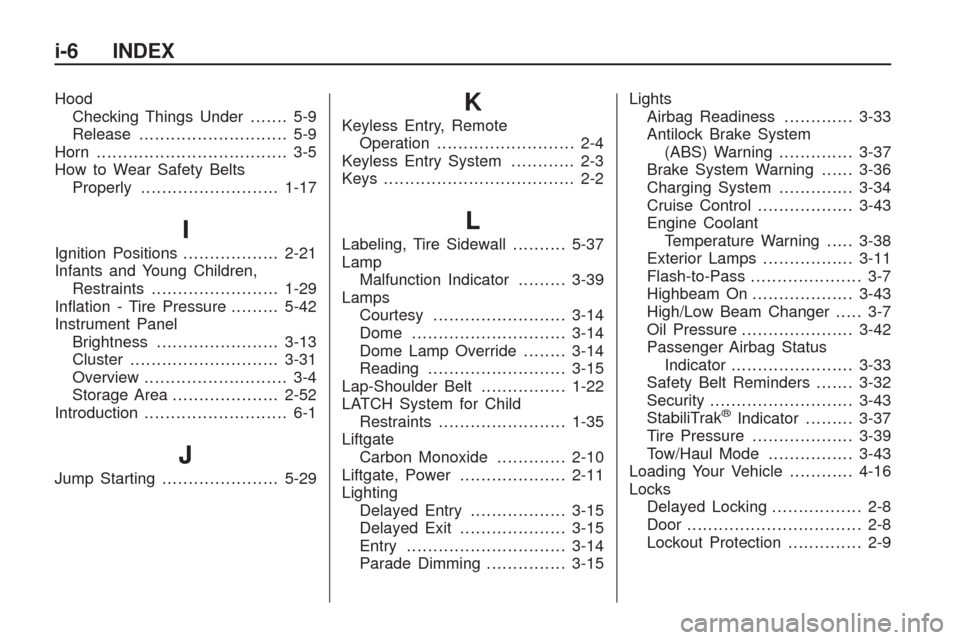
Hood
Checking Things Under....... 5-9
Release............................ 5-9
Horn .................................... 3-5
How to Wear Safety Belts
Properly..........................1-17
I
Ignition Positions..................2-21
Infants and Young Children,
Restraints........................1-29
Ination - Tire Pressure.........5-42
Instrument Panel
Brightness.......................3-13
Cluster............................3-31
Overview........................... 3-4
Storage Area....................2-52
Introduction........................... 6-1
J
Jump Starting......................5-29
K
Keyless Entry, Remote
Operation.......................... 2-4
Keyless Entry System............ 2-3
Keys.................................... 2-2
L
Labeling, Tire Sidewall..........5-37
Lamp
Malfunction Indicator.........3-39
Lamps
Courtesy.........................3-14
Dome .............................3-14
Dome Lamp Override........3-14
Reading..........................3-15
Lap-Shoulder Belt................1-22
LATCH System for Child
Restraints........................1-35
Liftgate
Carbon Monoxide.............2-10
Liftgate, Power....................2-11
Lighting
Delayed Entry..................3-15
Delayed Exit....................3-15
Entry..............................3-14
Parade Dimming...............3-15Lights
Airbag Readiness.............3-33
Antilock Brake System
(ABS) Warning..............3-37
Brake System Warning......3-36
Charging System..............3-34
Cruise Control..................3-43
Engine Coolant
Temperature Warning.....3-38
Exterior Lamps.................3-11
Flash-to-Pass..................... 3-7
Highbeam On...................3-43
High/Low Beam Changer..... 3-7
Oil Pressure.....................3-42
Passenger Airbag Status
Indicator.......................3-33
Safety Belt Reminders.......3-32
Security...........................3-43
StabiliTrak
®Indicator.........3-37
Tire Pressure...................3-39
Tow/Haul Mode................3-43
Loading Your Vehicle............4-16
Locks
Delayed Locking................. 2-8
Door ................................. 2-8
Lockout Protection.............. 2-9
i-6 INDEX
Page 417 of 422
Locks (cont.)
Power Door ....................... 2-8
Programmable Automatic
Door Locks.................... 2-9
Rear Door Security Locks.... 2-9
Loss of Control....................4-10
Lower Anchors and Tethers
for Children......................1-35
Luggage Carrier...................2-54
Lumbar
Manual Controls................. 1-4
Power Controls.................. 1-5
M
Maintenance
Footnotes.......................... 6-7
Maintenance Schedule
Additional Required
Services........................ 6-6
At Each Fuel Fill................ 6-9
At Least Once a Month....... 6-9
At Least Once a Year.......6-10
Maintenance Record.........6-16
Maintenance Replacement
Parts...........................6-14
Maintenance Requirements . . . 6-1Maintenance Schedule (cont.)
Owner Checks and
Services........................ 6-9
Recommended Fluids and
Lubricants....................6-12
Scheduled Maintenance....... 6-3
Using............................... 6-2
Your Vehicle and the
Environment................... 6-1
Malfunction Indicator Lamp....3-39
Manual Lumbar Controls......... 1-4
Manual Seats........................ 1-3
Memory Seat and Mirrors....... 1-6
Message
DIC Warnings and
Messages....................3-56
Mirrors
Automatic Dimming
Rearview......................2-31
Blind Spot.......................2-34
Manual Rearview Mirror.....2-31
Outside Convex Mirror.......2-35
Outside Heated Mirrors......2-35
Outside Power Foldaway
Mirrors.........................2-33
Outside Power Mirrors.......2-32
Park Tilt..........................2-35
MP3 ...........................3-92, 3-96
N
Navigation System, Privacy....7-17
Navigation/Radio System,
see Navigation Manual....3-103
Net
Convenience....................2-55
New Vehicle Break-In...........2-20
O
Odometer...........................3-32
Off-Road
Recovery.......................... 4-9
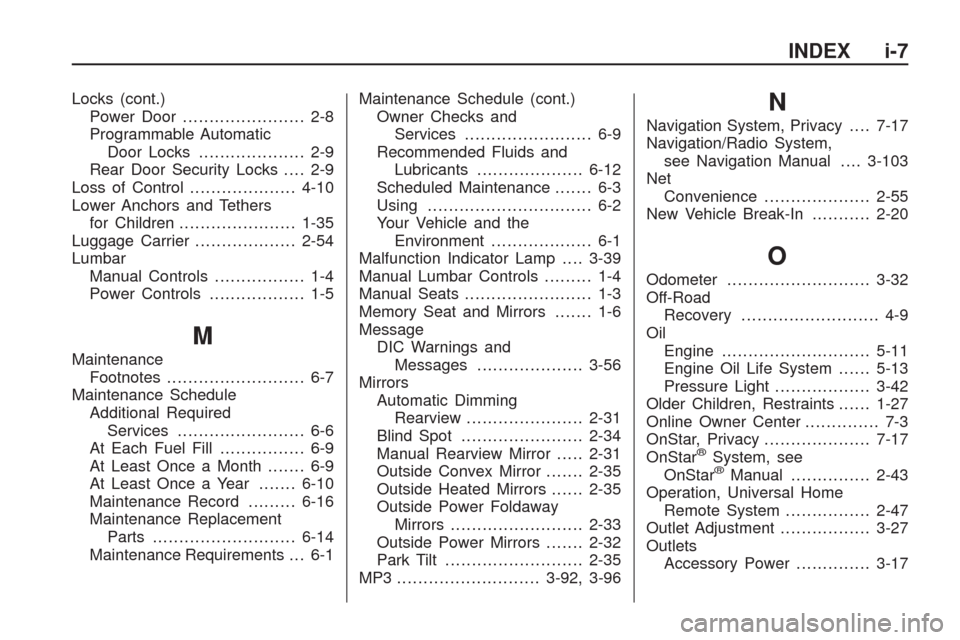
Oil
Engine............................5-11
Engine Oil Life System......5-13
Pressure Light..................3-42
Older Children, Restraints......1-27
Online Owner Center.............. 7-3
OnStar, Privacy....................7-17
OnStar
®System, see
OnStar®Manual...............2-43
Operation, Universal Home
Remote System................2-47
Outlet Adjustment.................3-27
Outlets
Accessory Power..............3-17
INDEX i-7