service reset CHEVROLET TRAVERSE 2009 1.G User Guide
[x] Cancel search | Manufacturer: CHEVROLET, Model Year: 2009, Model line: TRAVERSE, Model: CHEVROLET TRAVERSE 2009 1.GPages: 422, PDF Size: 2.06 MB
Page 297 of 422
If the vehicle has Driver Information
Center (DIC) buttons:
1. Turn the ignition to ON/RUN,
with the engine off.
2. Press the vehicle information
button until OIL LIFE
REMAINING displays.
3. Press and hold the set/reset
button until 100% is displayed.
Three chimes sound and
the CHANGE ENGINE OIL
SOON message goes off.
4. Turn the key to LOCK/OFF.
If the CHANGE ENGINE OIL SOON
message comes back on when the
vehicle is started, the engine oil life
system has not reset. Repeat the
procedure.What to Do with Used Oil
Used engine oil contains certain
elements that can be unhealthy for
your skin and could even cause
cancer. Do not let used oil stay on
your skin for very long. Clean your
skin and nails with soap and water,
or a good hand cleaner. Wash or
properly dispose of clothing or rags
containing used engine oil. See the
manufacturer’s warnings about the
use and disposal of oil products.
Used oil can be a threat to the
environment. If you change your own
oil, be sure to drain all the oil from the
lter before disposal. Never dispose
of oil by putting it in the trash, pouring
it on the ground, into sewers, or into
streams or bodies of water. Recycle
it by taking it to a place that collects
used oil.
Engine Air Cleaner/Filter
When to Inspect the Engine
Air Cleaner/Filter
Inspect the air cleaner/lter at the
MaintenanceIIintervals and replace
it at the rst oil change after each
50,000 mile (80 000 km) interval.
SeeScheduled Maintenance on
page 6-3for more information. If you
are driving in dusty/dirty conditions,
inspect the lter at each engine oil
change.
SeeEngine Compartment Overview
on page 5-10for the location of
the engine air cleaner/lter.
How to Inspect the Engine Air
Cleaner/Filter
To inspect the air cleaner/lter,
remove the lter from the vehicle and
lightly shake the lter (away from
vehicle) to release loose dust and
dirt. If the lter remains caked with
dirt, a new lter is required.
Service and Appearance Care 5-15
Page 305 of 422
If No Steam Is Coming From
The Engine Compartment
If an engine overheat warning is
displayed but no steam can be seen
or heard, the problem may not be
too serious. Sometimes the
engine can get a little too hot when
the vehicle:
Climbs a long hill on a hot day.
Stops after high-speed driving.
Idles for long periods in traffic.
Tows a trailer.
If the overheat warning is displayed
with no sign of steam:
1. Turn the air conditioning off.
2. Turn the heater on to the highest
temperature and to the highest
fan speed. Open the windows as
necessary.3. If in a traffic jam, shift to
N (Neutral), otherwise, shift
to the highest gear while
driving —D (Drive) or L (Low).
If the temperature overheat gage is
no longer in the overheat zone or an
overheat warning no longer displays,
the vehicle can be driven. Continue
to drive the vehicle slow for about
10 minutes. Keep a safe vehicle
distance from the car in front of you.
If the warning does not come back
on, continue to drive normally.
If the warning continues, pull over,
stop, and park the vehicle right away.
If there is no sign of steam, idle
the engine for three minutes while
parked. If the warning is still
displayed, turn off the engine until it
cools down. Also, see “Overheated
Engine Protection Operating Mode”
next in this section.
Overheated
Engine Protection
Operating Mode
This emergency operating mode lets
the vehicle be driven to a safe place
in an emergency situation. If an
overheated engine condition exists,
an overheat protection mode which
alternates ring groups of cylinders
helps prevent engine damage. In this
mode, there is a signicant loss in
power and engine performance.
The temperature gage indicates an
overheat condition exists. Driving
extended distances and/or towing a
trailer in the overheat protection
mode should be avoided.
Notice:After driving in the
overheated engine protection
operating mode, to avoid engine
damage, allow the engine to cool
before attempting any repair.
The engine oil will be severely
degraded. Repair the cause of
coolant loss, change the oil and
reset the oil life system. See
Engine Oil on page 5-11.
Service and Appearance Care 5-23
Page 315 of 422
Headlamp Aiming
Headlamp aim has been preset at
the factory and should need no
further adjustment.
However, if your vehicle is damaged
in a crash, the headlamp aim may
be affected. Aim adjustment to
the low-beam headlamps may be
necessary if oncoming drivers ash
their high-beam headlamps at
you (for vertical aim).
If the headlamps need to be
re-aimed, it is recommended that
you take the vehicle to your
dealer/retailer for service.
Bulb Replacement
For the proper type of replacement
bulbs, seeReplacement Bulbs
on page 5-34.
For any bulb changing procedure
not listed in this section, contact
your dealer/retailer.
Halogen Bulbs
{CAUTION
Halogen bulbs have pressurized
gas inside and can burst if you
drop or scratch the bulb. You or
others could be injured. Be sure
to read and follow the instructions
on the bulb package.
Taillamps, Turn Signal,
Stoplamps and
Sidemarker Lamps
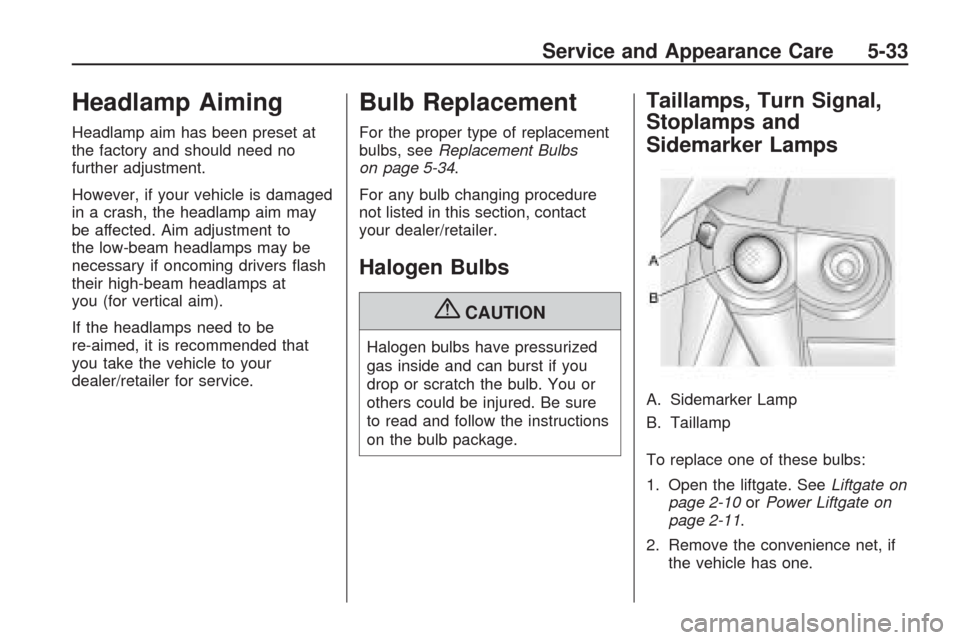
A. Sidemarker Lamp
B. Taillamp
To replace one of these bulbs:
1. Open the liftgate. SeeLiftgate on
page 2-10orPower Liftgate on
page 2-11.
2. Remove the convenience net, if
the vehicle has one.
Service and Appearance Care 5-33
Page 331 of 422
Any time you notice unusual
wear, rotate the tires as soon
as possible and check wheel
alignment. Also check for
damaged tires or wheels.
SeeWhen It Is Time for New
Tires on page 5-50andWheel
Replacement on page 5-54.
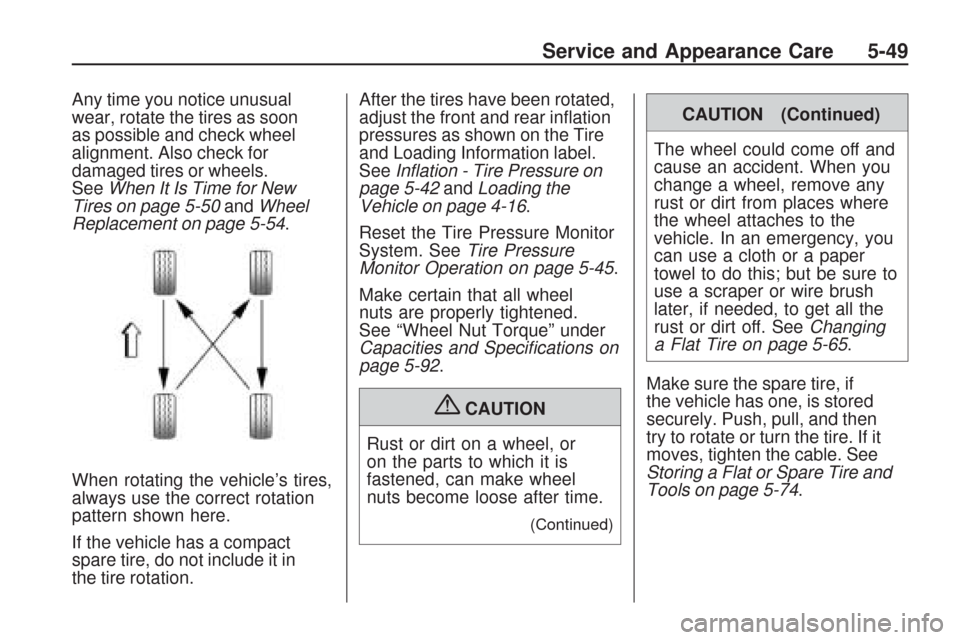
When rotating the vehicle’s tires,
always use the correct rotation
pattern shown here.
If the vehicle has a compact
spare tire, do not include it in
the tire rotation.After the tires have been rotated,
adjust the front and rear ination
pressures as shown on the Tire
and Loading Information label.
SeeInflation - Tire Pressure on
page 5-42andLoading the
Vehicle on page 4-16.
Reset the Tire Pressure Monitor
System. SeeTire Pressure
Monitor Operation on page 5-45.
Make certain that all wheel
nuts are properly tightened.
See “Wheel Nut Torque” under
Capacities and Specifications on
page 5-92.
{CAUTION
Rust or dirt on a wheel, or
on the parts to which it is
fastened, can make wheel
nuts become loose after time.
(Continued)
CAUTION (Continued)
The wheel could come off and
cause an accident. When you
change a wheel, remove any
rust or dirt from places where
the wheel attaches to the
vehicle. In an emergency, you
can use a cloth or a paper
towel to do this; but be sure to
use a scraper or wire brush
later, if needed, to get all the
rust or dirt off. SeeChanging
a Flat Tire on page 5-65.
Make sure the spare tire, if
the vehicle has one, is stored
securely. Push, pull, and then
try to rotate or turn the tire. If it
moves, tighten the cable. See
Storing a Flat or Spare Tire and
Tools on page 5-74.
Service and Appearance Care 5-49
Page 377 of 422
To purchase service information,
seeService Publications Ordering
Information on page 7-15.
Owner Checks and Services on
page 6-9tells what should be
checked, when to check it, and what
can easily be done to help keep
the vehicle in good condition.
The proper replacement parts,
uids, and lubricants to use are
listed inRecommended Fluids and
Lubricants on page 6-12and
Maintenance Replacement Parts
on page 6-14. When the vehicle is
serviced, make sure these are used.
All parts should be replaced and all
necessary repairs done before you
or anyone else drives the vehicle.
We recommend the use of genuine
parts from your dealer/retailer.Scheduled Maintenance
When the CHANGE ENGINE OIL
SOON message displays, service is
required for the vehicle. Have the
vehicle serviced as soon as possible
within the next 600 miles (1 000 km).
It is possible that, if driving under the
best conditions, the engine oil life
system might not indicate that
vehicle service is necessary for over
a year. However, the engine oil and
lter must be changed at least once
a year and at this time the system
must be reset. Your dealer/retailer
has trained service technicians who
will perform this work using genuine
parts and reset the system.If the engine oil life system is ever
reset accidentally, service the vehicle
within 3,000 miles (5 000 km) since
the last service. Remember to reset
the oil life system whenever the oil
is changed. SeeEngine Oil Life
System on page 5-13for information
on the Engine Oil Life System and
resetting the system.
When the CHANGE ENGINE
OIL SOON message appears,
certain services, checks, and
inspections are required. Required
services are described in the
following for “MaintenanceI” and
“MaintenanceII.” Generally, it is
recommended that the rst service
be MaintenanceI, the second
service be MaintenanceII, and then
alternate MaintenanceIand
MaintenanceIIthereafter. However,
in some cases, MaintenanceIImay
be required more often.
Maintenance Schedule 6-3
Page 378 of 422
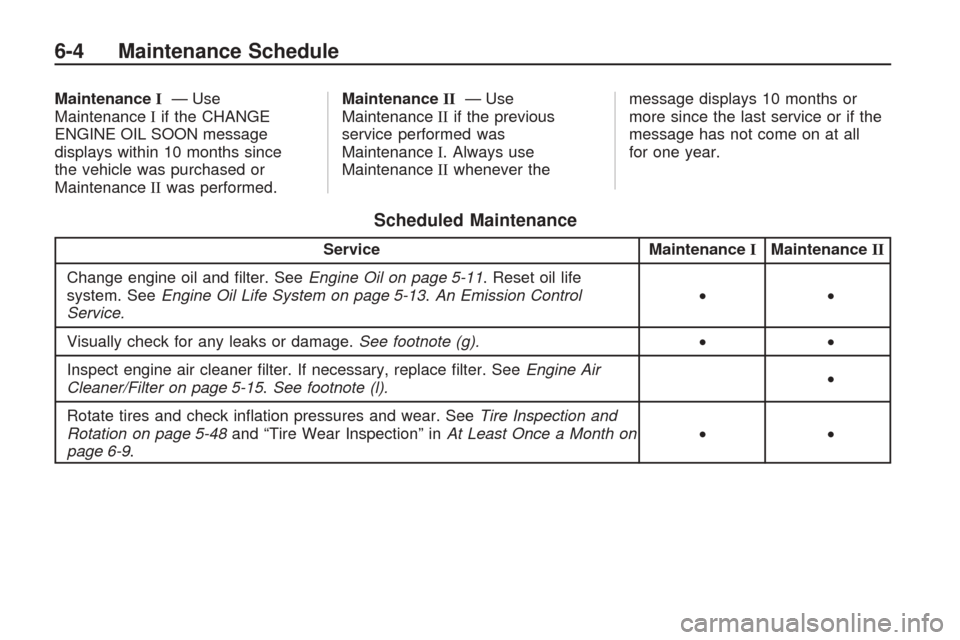
MaintenanceI—Use
Maintenance Iif the CHANGE
ENGINE OIL SOON message
displays within 10 months since
the vehicle was purchased or
Maintenance IIwas performed. Maintenance
II—Use
Maintenance IIif the previous
service performed was
Maintenance I. Always use
Maintenance IIwhenever the message displays 10 months or
more since the last service or if the
message has not come on at all
for one year.
Scheduled Maintenance
Service
MaintenanceIMaintenance II
Change engine oil and lter. See Engine Oil on page 5-11. Reset oil life
system. See Engine Oil Life System on page 5-13 .An Emission Control
Service. ••
Visually check for any leaks or damage. See footnote (g). ••
Inspect engine air cleaner lter. If necessary, replace lter. See Engine Air
Cleaner/Filter on page 5-15 .See footnote (l). •
Rotate tires and check ination pressures and wear. See Tire Inspection and
Rotation on page 5-48 and “Tire Wear Inspection” in At Least Once a Month on
page 6-9. ••
6-4 Maintenance Schedule