transmission CHEVROLET TRAVERSE 2009 1.G User Guide
[x] Cancel search | Manufacturer: CHEVROLET, Model Year: 2009, Model line: TRAVERSE, Model: CHEVROLET TRAVERSE 2009 1.GPages: 422, PDF Size: 2.06 MB
Page 112 of 422
Do not use the Universal Home
Remote with any garage door
opener that does not have the stop
and reverse feature. This includes
any garage door opener model
manufactured before April 1, 1982.
Read the instructions completely
before attempting to program
the Universal Home Remote.
Because of the steps involved, it
may be helpful to have another
person available to assist you in the
programming the Universal Home
Remote.
Keep the original hand-held
transmitter for use in other vehicles
as well as for future Universal
Home Remote programming. It is
also recommended that upon
the sale of the vehicle, the
programmed Universal Home
Remote buttons should be erased
for security purposes. See “Erasing
Universal Home Remote Buttons”
later in this section.When programming a garage door,
park outside of the garage. Park
directly in line with and facing
the garage door opener motor-head
or gate motor-head. Be sure that
people and objects are clear of the
garage door or gate that is being
programmed.
It is recommended that a new
battery be installed in your
hand-held transmitter for quicker
and more accurate transmission of
the radio-frequency signal.
Programming the Universal
Home Remote System
For questions or help programming
the Universal Home Remote
System, call 1-800-355-3515 or
go to www.homelink.com.
Programming a garage door opener
involves time-sensitive actions,
so read the entire procedure before
starting. Otherwise, the device
will time out and the procedure will
have to be repeated.To program up to three devices:
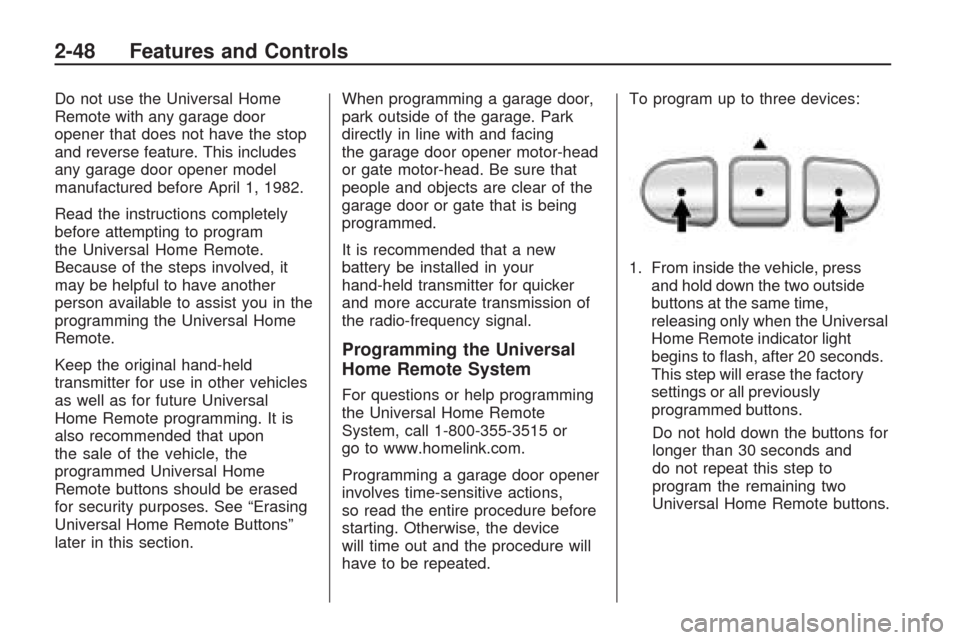
1. From inside the vehicle, press
and hold down the two outside
buttons at the same time,
releasing only when the Universal
Home Remote indicator light
begins to ash, after 20 seconds.
This step will erase the factory
settings or all previously
programmed buttons.
Do not hold down the buttons for
longer than 30 seconds and
do not repeat this step to
program the remaining two
Universal Home Remote buttons.
2-48 Features and Controls
Page 114 of 422
7. Firmly press and release the
“Learn” or “Smart” button.
After you press this button,
you will have 30 seconds to
complete Step 8.
8. Immediately return to the vehicle.
Firmly press and hold the
Universal Home Remote button,
chosen in Step 3 to control
the garage door, for two seconds,
and then release it. If the
garage door does not move,
press and hold the same button
a second time for two seconds,
and then release it. Again, if
the door does not move, press
and hold the same button a
third time for two seconds, and
then release.
The Universal Home Remote
should now activate the
garage door.To program the remaining two
Universal Home Remote buttons,
begin with Step 2 of “Programming
the Universal Home Remote
System.” Do not repeat Step 1,
as this will erase all previous
programming from the Universal
Home Remote buttons.
Gate Operator and Canadian
Programming
If you have questions or need help
programming the Universal
Home Remote System, call
1-800-355-3515 or go to
www.homelink.com.
Canadian radio-frequency laws
require transmitter signals to time
out or quit after several seconds of
transmission. This may not be
long enough for Universal HomeRemote to pick up the signal during
programming. Similarly, some
U.S. gate operators are
manufactured to time out in the
same manner.
If you live in Canada, or you are
having difficulty programming a gate
operator or garage door opener
by using the “Programming
Universal Home Remote”
procedures, regardless of where
you live, replace Step 3 under
“Programming Universal Home
Remote” with the following:
Continue to press and hold the
Universal Home Remote button
while you press and release every
two seconds (cycle) the hand-held
transmitter button until the frequency
signal has been successfully
2-50 Features and Controls
Page 160 of 422
If the check engine light comes on
and stays on, while the engine
is running, this indicates that there
is an OBD II problem and service
is required.
Malfunctions often are indicated by
the system before any problem is
apparent. Being aware of the light
can prevent more serious damage
to the vehicle. This system assists
the service technician in correctly
diagnosing any malfunction.
Notice:If the vehicle is
continually driven with this
light on, after a while, the
emission controls might not
work as well, the vehicle’s fuel
economy might not be as good,
and the engine might not run as
smoothly. This could lead to
costly repairs that might not be
covered by the vehicle warranty.Notice:Modications made to
the engine, transmission, exhaust,
intake, or fuel system of the
vehicle or the replacement of the
original tires with other than those
of the same Tire Performance
Criteria (TPC) can affect the
vehicle’s emission controls and
can cause this light to come on.
Modications to these systems
could lead to costly repairs not
covered by the vehicle warranty.
This could also result in a failure
to pass a required Emission
Inspection/Maintenance test.
SeeAccessories and
Modifications on page 5-3.This light comes on during a
malfunction in one of two ways:
Light Flashing:A misre condition
has been detected. A misre
increases vehicle emissions and
could damage the emission control
system on the vehicle. Diagnosis
and service might be required.
The following can prevent more
serious damage to the vehicle:
Reduce vehicle speed.
Avoid hard accelerations.
Avoid steep uphill grades.
If towing a trailer, reduce the
amount of cargo being hauled
as soon as it is possible.
If the light continues to ash, when
it is safe to do so, stop the vehicle.
Find a safe place to park the vehicle.
Turn the key off, wait at least
10 seconds, and restart the engine.
If the light is still ashing, follow the
previous steps and see your dealer/
retailer for service as soon as
possible.
3-40 Instrument Panel
Page 164 of 422
An arrow on the fuel gage indicates
the side of the vehicle the fuel
door is on.
Here are four things that some
owners ask about. None of these
show a problem with the fuel gage:
At the gas station, the gas
pump shuts off before the gage
reads full.
It takes a little more or less fuel
to ll up than the gage indicated.
For example, the gage might have
indicated the tank was half full,
but it actually took a little more or
less than half the tank’s capacity
to ll the tank.
The gage moves a little while
turning a corner or speeding up.
The gage does not go back to
empty when the ignition is
turned off.
Driver Information
Center (DIC)
Your vehicle has a Driver
Information Center (DIC).
The DIC displays information about
your vehicle. It also displays warning
messages if a system problem is
detected.
All messages will appear in the DIC
display located at the top of the
instrument panel cluster.
The DIC comes on when the
ignition is on. After a short delay,
the DIC will display the information
that was last displayed before
the engine was turned off.
The DIC also displays a shift lever
position indicator on the bottom
line of the display. SeeAutomatic
Transmission Operation on
page 2-24for more information.
The outside air temperature
and compass, if equipped, also
displays on the DIC when viewing
the trip and fuel information.The outside air temperature
automatically appears in the top
right corner of the DIC display.
If there is a problem with the system
that controls the temperature display,
the numbers will be replaced with
dashes. If this occurs, have the
vehicle serviced. The compass
will be shown in the bottom right
corner of the DIC display. SeeDIC
Compass on page 3-54for more
information.
If your vehicle has DIC buttons,
see “DIC Operation and Displays
(With DIC Buttons)” later in
this section andDIC Vehicle
Customization (With DIC Buttons) on
page 3-65for the displays available.
If your vehicle does not have
DIC buttons, see “DIC Operation
and Displays (Without DIC Buttons)”
later in this section for the displays
available.
3-44 Instrument Panel
Page 183 of 422
SERVICE TIRE MONITOR
SYSTEM
On vehicles with the Tire Pressure
Monitor System (TPMS), this
message displays if a part on the
TPMS is not working properly.
The tire pressure light also ashes
and then remains on during the
same ignition cycle. SeeTire
Pressure Light on page 3-39.
Several conditions may cause this
message to appear. SeeTire
Pressure Monitor Operation on
page 5-45for more information.
If the warning comes on and stays
on, there may be a problem with
the TPMS. See your dealer/retailer.
SERVICE TRACTION
CONTROL
This message displays when there
is a problem with the Traction Control
System (TCS). When this message
is displayed, the system will not
limit wheel spin. Adjust your driving
accordingly. See your dealer/retailer
for service. SeeStabiliTrak
®System
on page 4-5for more information.
SERVICE TRANSMISSION
This message displays when there
is a problem with the transmission.
See your dealer/retailer for service.
SERVICE VEHICLE SOON
This message displays when
a non-emissions related malfunction
occurs. Have the vehicle serviced
by your dealer/retailer as soon
as possible.
SPEED LIMITED TO
XXX MPH (KM/H)
This message displays when your
vehicle speed is limited to 80 mph
(128 km/h) because the vehicle
detects a problem in the speed
variable assist steering system.
Have your vehicle serviced by
your dealer/retailer.
STARTING DISABLED
SERVICE THROTTLE
This message displays when your
vehicle’s throttle system is not
functioning properly. Have your
vehicle serviced by your dealer/
retailer.
THEFT ATTEMPTED
This message displays if the content
theft-deterrent system has detected
a break-in attempt while you were
away from your vehicle. SeeContent
Theft-Deterrent on page 2-16for
more information.
Instrument Panel 3-63
Page 184 of 422
TIGHTEN GAS CAP
This message may display along
with the check engine light on the
instrument panel cluster if the
vehicle’s fuel cap is not tightened
properly. SeeMalfunction Indicator
Lamp on page 3-39. Reinstall the
fuel cap fully. SeeFilling the Tank
on page 5-7. The diagnostic system
can determine if the fuel cap has
been left off or improperly installed.
A loose or missing fuel cap
allows fuel to evaporate into the
atmosphere. A few driving trips
with the cap properly installed
should turn this light and
message off.
TIRE LEARNING ACTIVE
On vehicles with the Tire Pressure
Monitor System (TPMS), this
message displays when the TPMS
is re-learning the tire positions on
your vehicle. The tire positions must
be re-learned after rotating the tires
or after replacing a tire or sensor.
SeeTire Inspection and Rotation
on page 5-48,Tire Pressure
Monitor System on page 5-43,
andInflation - Tire Pressure on
page 5-42for more information.
TRACTION CONTROL OFF
This message displays when
the Traction Control System (TCS)
is turned off. Adjust your driving
accordingly. SeeStabiliTrak
®
System on page 4-5for more
information. This message
clears itself after 10 seconds.
TRANSMISSION HOT IDLE
ENGINE
Notice:If you drive your vehicle
while the transmission uid is
overheating and the transmission
temperature warning is displayed
on the instrument panel cluster
and/or DIC, you can damage the
transmission. This could lead to
costly repairs that would not be
covered by your warranty. Do not
drive your vehicle with overheated
transmission uid or while the
transmission temperature warning
is displayed.
This message displays and a chime
sounds if the transmission uid in the
vehicle gets hot. Driving with the
transmission uid temperature high
can cause damage to the vehicle.
Stop the vehicle and let it idle to
allow the transmission to cool.
This message clears when the uid
temperature reaches a safe level.
3-64 Instrument Panel
Page 255 of 422
It may also be necessary to turn off
the system when driving in extreme
off-road conditions where high wheel
spin is required. SeeIf Your Vehicle
is Stuck in Sand, Mud, Ice, or Snow
on page 4-16.
Traction Control Operation
The traction control system is part
of the StabiliTrak system. Traction
control limits wheel spin by reducing
engine power to the wheels (engine
speed management) and by applying
brakes to each individual wheel
(brake-traction control) as necessary.
The traction control system is
enabled automatically when the
vehicle is started. It will activate
and the StabiliTrak light will ash
if it senses that any of the wheels
are spinning or beginning to lose
traction while driving. If traction
control is turned off, only the
brake-traction control portion of
traction control will work. The engine
speed management will be disabled.In this mode, engine power is not
reduced automatically and the driven
wheels can spin more freely. This
can cause the brake-traction control
to activate constantly.
Notice:If the wheel(s) of one axle
is allowed to spin excessively
while the StabiliTrak, ABS and
brake warning lights and any
relevant DIC messages are
displayed, the transfer case could
be damaged. The repairs would
not be covered by the vehicle
warranty. Reduce engine power
and do not spin the wheel(s)
excessively while these lights and
messages are displayed.
The traction control system may
activate on dry or rough roads or
under conditions such as heavy
acceleration while turning or
abrupt upshifts/downshifts of the
transmission. When this happens, a
reduction in acceleration may be
noticed, or a noise or vibration may
be heard. This is normal.If cruise control is being used when
the system activates, the StabiliTrak
light will ash and cruise control will
automatically disengage. Cruise
control may be reengaged when
road conditions allow. SeeCruise
Control on page 3-9.
StabiliTrak may also turn off
automatically if it determines that a
problem exists with the system.
If the problem does not clear itself
after restarting the vehicle, see your
dealer/retailer for service.
All-Wheel Drive (AWD)
System
If the vehicle has this feature, engine
power is sent to all four wheels when
extra traction is needed. This is like
four-wheel drive, but there is no
separate lever or switch to engage
or disengage the axle. It is fully
automatic, and adjusts itself as
needed for road conditions.
Driving Your Vehicle 4-7
Page 261 of 422
Highway Hypnosis
Always be alert and pay attention
to your surroundings while driving.
If you become tired or sleepy, nd
a safe place to park your vehicle
and rest.
Other driving tips include:
Keep the vehicle well ventilated.
Keep interior temperature cool.
Keep your eyes moving — scan
the road ahead and to the sides.
Check the rearview mirror and
vehicle instruments often.
Hill and Mountain Roads
Driving on steep hills or through
mountains is different than driving
on at or rolling terrain. Tips for
driving in these conditions include:
Keep the vehicle serviced
and in good shape.
Check all uid levels and brakes,
tires, cooling system, and
transmission.
Going down steep or long hills,
shift to a lower gear.
{CAUTION
If you do not shift down, the
brakes could get so hot that they
would not work well. You would
then have poor braking or even
none going down a hill. You could
crash. Shift down to let the engine
assist the brakes on a steep
downhill slope.
{CAUTION
Coasting downhill in N (Neutral) or
with the ignition off is dangerous.
The brakes will have to do all the
work of slowing down and they
could get so hot that they would
not work well. You would then
have poor braking or even none
going down a hill. You could crash.
Always have the engine running
and the vehicle in gear when going
downhill.
Stay in your own lane. Do not
swing wide or cut across the
center of the road. Drive at
speeds that let you stay in your
own lane.
Top of hills: Be alert — something
could be in your lane (stalled car,
accident).
Pay attention to special road
signs (falling rocks area, winding
roads, long grades, passing or
no-passing zones) and take
appropriate action.
Driving Your Vehicle 4-13
Page 264 of 422
If Your Vehicle is Stuck in
Sand, Mud, Ice, or Snow
Slowly and cautiously spin the
wheels to free the vehicle when
stuck in sand, mud, ice, or snow.
SeeRocking Your Vehicle to Get It
Out on page 4-16.
If the vehicle has a traction system, it
can often help to free a stuck vehicle.
Refer to the vehicle’s traction system
in the Index. If stuck too severely for
the traction system to free the
vehicle, turn the traction system off
and use the rocking method.
{CAUTION
If you let your vehicle’s tires spin at
high speed, they can explode, and
you or others could be injured. The
vehicle can overheat, causing an
engine compartment re or other
damage. Spin the wheels as little
as possible and avoid going above
35 mph (55 km/h) as shown on the
speedometer.For information about using tire
chains on the vehicle, seeTire
Chains on page 5-55.
Rocking Your Vehicle to
Get It Out
Turn the steering wheel left and right
to clear the area around the front
wheels. Turn off any traction or
stability system. Shift back and forth
between R (Reverse) and a forward
gear, spinning the wheels as little as
possible. To prevent transmission
wear, wait until the wheels stop
spinning before shifting gears.
Release the accelerator pedal while
shifting, and press lightly on the
accelerator pedal when the
transmission is in gear. Slowly
spinning the wheels in the forward
and reverse directions causes a
rocking motion that could free the
vehicle. If that does not get the
vehicle out after a few tries, it might
need to be towed out. If the vehicle
does need to be towed out, see
Towing Your Vehicle on page 4-21.
Loading the Vehicle
It is very important to know how
much weight your vehicle can
carry. This weight is called the
vehicle capacity weight and
includes the weight of all
occupants, cargo, and all
nonfactory-installed options.
Two labels on your vehicle show
how much weight it may properly
carry, the Tire and Loading
Information label and the
Certication/Tire label.
4-16 Driving Your Vehicle
Page 270 of 422
Dinghy Towing
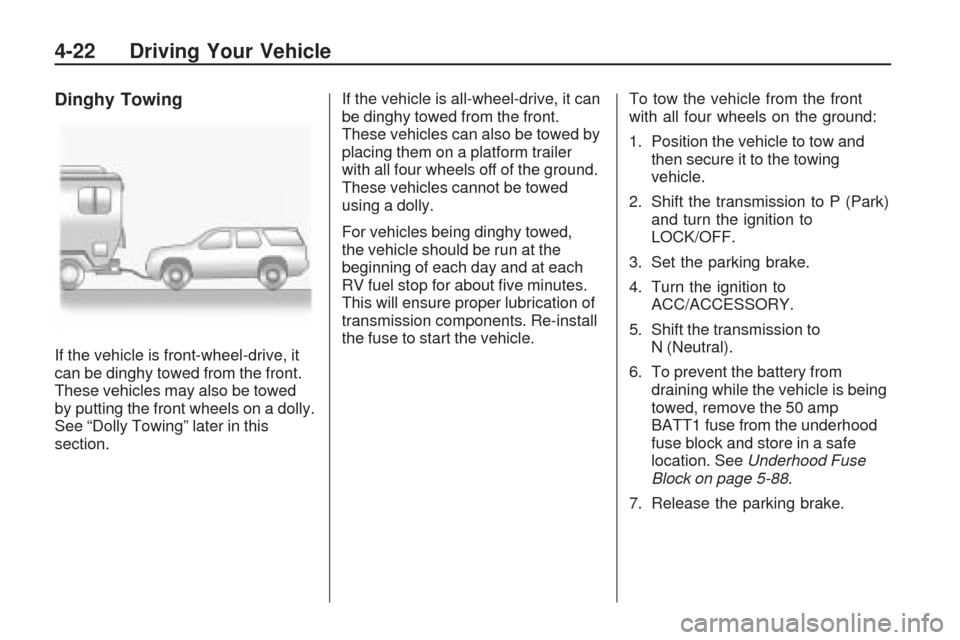
If the vehicle is front-wheel-drive, it
can be dinghy towed from the front.
These vehicles may also be towed
by putting the front wheels on a dolly.
See “Dolly Towing” later in this
section.If the vehicle is all-wheel-drive, it can
be dinghy towed from the front.
These vehicles can also be towed by
placing them on a platform trailer
with all four wheels off of the ground.
These vehicles cannot be towed
using a dolly.
For vehicles being dinghy towed,
the vehicle should be run at the
beginning of each day and at each
RV fuel stop for about ve minutes.
This will ensure proper lubrication of
transmission components. Re-install
the fuse to start the vehicle.To tow the vehicle from the front
with all four wheels on the ground:
1. Position the vehicle to tow and
then secure it to the towing
vehicle.
2. Shift the transmission to P (Park)
and turn the ignition to
LOCK/OFF.
3. Set the parking brake.
4. Turn the ignition to
ACC/ACCESSORY.
5. Shift the transmission to
N (Neutral).
6. To prevent the battery from
draining while the vehicle is being
towed, remove the 50 amp
BATT1 fuse from the underhood
fuse block and store in a safe
location. SeeUnderhood Fuse
Block on page 5-88.
7. Release the parking brake.
4-22 Driving Your Vehicle