maintenance CHEVROLET TRAVERSE 2011 1.G Owner's Manual
[x] Cancel search | Manufacturer: CHEVROLET, Model Year: 2011, Model line: TRAVERSE, Model: CHEVROLET TRAVERSE 2011 1.GPages: 454, PDF Size: 6.56 MB
Page 358 of 454
Black plate (48,1)Chevrolet Traverse Owner Manual - 2011
10-48 Vehicle Care
Your vehicle's TPMS can warn you
about a low tire pressure condition
but it does not replace normal tire
maintenance. SeeTire Inspection
on page 10‑50,Tire Rotationon
page 10‑50and Tires on
page 10‑38.
Notice: Tire sealant materials are
not all the same. A non-approved
tire sealant could damage the Tire
Pressure Monitor System (TPMS)
sensors. TPMS sensor damage
caused by using an incorrect tire
sealant is not covered by the
vehicle warranty. Always use only
the GM approved tire sealant
available through your dealer or
included in the vehicle.
Factory-installed Tire Inflator Kits
use a GM approved liquid tire
sealant. Using non-approved tire
sealants could damage the TPMS
sensors. See Tire Sealant and
Compressor Kit
on page 10‑61for
information regarding the inflator kit
materials and instructions.
TPMS Malfunction Light and
Message
The TPMS will not function properly
if one or more of the TPMS sensors
are missing or inoperable. When the
system detects a malfunction, the
low tire warning light flashes for
about one minute and then stays on
for the remainder of the ignition
cycle. A DIC warning message is
also displayed. The low tire warning
light and DIC warning message
come on at each ignition cycle until
the problem is corrected. Some of
the conditions that can cause the
malfunction light and DIC message
to come on are:
.One of the road tires has been
replaced with the spare tire,
if your vehicle has one. The
spare tire does not have a
TPMS sensor. The TPMS
malfunction light and DIC
message should go off once
you re‐install the road tire
containing the TPMS sensor.
.The TPMS sensor matching
process was started but not
completed or not completed
successfully after rotating the
vehicle's tires. The DIC message
and TPMS malfunction light
should go off once the TPMS
sensor matching process is
performed successfully. See
“TPMS Sensor Matching
Process” later in this section.
.One or more TPMS sensors
are missing or damaged. The
DIC message and the TPMS
malfunction light should go off
when the TPMS sensors are
installed and the sensor
matching process is performed
successfully. See your dealer for
service.
.Replacement tires or wheels do
not match your vehicle's original
equipment tires or wheels. Tires
and wheels other than those
recommended for your vehicle
could prevent the TPMS from
functioning properly. See Buying
New Tires on page 10‑52.
Page 360 of 454
Black plate (50,1)Chevrolet Traverse Owner Manual - 2011
10-50 Vehicle Care
7. Proceed to the passenger siderear tire, and repeat the
procedure in Step 5.
8. Proceed to the driver side rear tire, and repeat the procedure
in Step 5. The horn sounds
two times to indicate the sensor
identification code has been
matched to the driver side rear
tire, and the TPMS sensor
matching process is no longer
active. The TIRE LEARNING
ACTIVE message on the
DIC display screen goes off.
9. Turn the ignition switch to LOCK/OFF.
10. Set all four tires to the recommended air pressure
level as indicated on the Tire
and Loading Information label.
11. Put the valve caps back on the valve stems.Tire Inspection
We recommend that you
regularly inspect your vehicle's
tires, including the spare tire,
if the vehicle has one, for signs
of wear or damage at least
once a month.
Always remove the tires if any of
the following statements
are true:
.You can see the indicators at
three or more places around
the tire.
.You can see cord or fabric
showing through the tire's
rubber.
.The tread or sidewall is
cracked, cut, or snagged
deep enough to show cord or
fabric.
.The tire has a bump, bulge,
or split.
.The tire has a puncture, cut,
or other damage that cannot
be repaired well because of
the size or location of the
damage.
Tire Rotation
Tires should be rotated every
12 000 km (7,500 miles). See
Scheduled Maintenance
on
page 11‑2
.
The purpose of a regular tire
rotation is to achieve a uniform
wear for all tires on the vehicle.
This will ensure that the vehicle
continues to perform most like it
did when the tires were new.
The first rotation is the most
important. See Scheduled
Maintenance
on page 11‑2.
Any time you notice unusual
wear, rotate the tires as soon as
possible and check wheel
alignment. Also check for
damaged tires or wheels.
Page 362 of 454
Black plate (52,1)Chevrolet Traverse Owner Manual - 2011
10-52 Vehicle Care
When It Is Time for New
Tires
Various factors, such as
maintenance, temperatures, driving
speeds, vehicle loading, and road
conditions influence when you need
new tires.
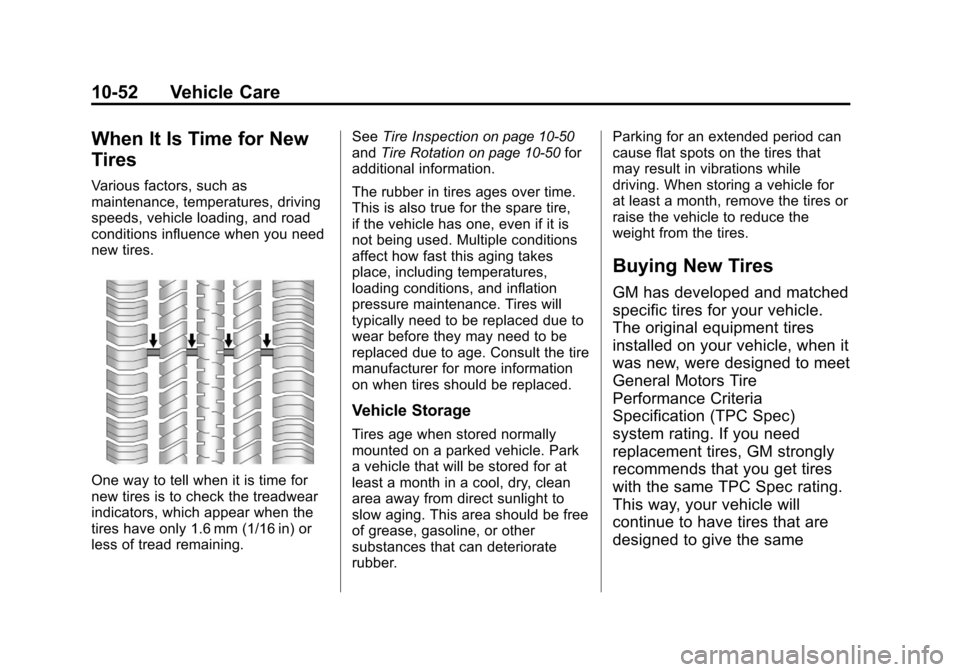
One way to tell when it is time for
new tires is to check the treadwear
indicators, which appear when the
tires have only 1.6 mm (1/16 in) or
less of tread remaining.See
Tire Inspection
on page 10‑50andTire Rotationon page 10‑50for
additional information.
The rubber in tires ages over time.
This is also true for the spare tire,
if the vehicle has one, even if it is
not being used. Multiple conditions
affect how fast this aging takes
place, including temperatures,
loading conditions, and inflation
pressure maintenance. Tires will
typically need to be replaced due to
wear before they may need to be
replaced due to age. Consult the tire
manufacturer for more information
on when tires should be replaced.
Vehicle Storage
Tires age when stored normally
mounted on a parked vehicle. Park
a vehicle that will be stored for at
least a month in a cool, dry, clean
area away from direct sunlight to
slow aging. This area should be free
of grease, gasoline, or other
substances that can deteriorate
rubber. Parking for an extended period can
cause flat spots on the tires that
may result in vibrations while
driving. When storing a vehicle for
at least a month, remove the tires or
raise the vehicle to reduce the
weight from the tires.
Buying New Tires
GM has developed and matched
specific tires for your vehicle.
The original equipment tires
installed on your vehicle, when it
was new, were designed to meet
General Motors Tire
Performance Criteria
Specification (TPC Spec)
system rating. If you need
replacement tires, GM strongly
recommends that you get tires
with the same TPC Spec rating.
This way, your vehicle will
continue to have tires that are
designed to give the same
Page 369 of 454
Black plate (59,1)Chevrolet Traverse Owner Manual - 2011
Vehicle Care 10-59
It may be very bumpy and noisy, but
you can still steer. Gently brake to a
stop, well off the road, if possible.
{WARNING
Driving on a flat tire will cause
permanent damage to the tire.
Re-inflating a tire after it has been
driven on while severely
under-inflated or flat may cause a
blowout and a serious crash.
Never attempt to re-inflate a tire
that has been driven on while
severely under-inflated or flat.
Have your dealer or an authorized
tire service center repair or
replace the flat tire as soon
as possible.
{WARNING
Lifting a vehicle and getting
under it to do maintenance or
repairs is dangerous without the
appropriate safety equipment and
training. If a jack is provided with
the vehicle, it is designed only for
changing a flat tire. If it is used for
anything else, you or others could
be badly injured or killed if the
vehicle slips off the jack. If a jack
is provided with the vehicle, only
use it for changing a flat tire.If a tire goes flat, avoid further tire
and wheel damage by driving slowly
to a level place, well off the road,
if possible. Turn on the hazard
warning flashers. See
Hazard
Warning Flashers on page 6‑3.
Page 402 of 454
Black plate (92,1)Chevrolet Traverse Owner Manual - 2011
10-92 Vehicle Care
Sheet Metal Damage
If the vehicle is damaged and
requires sheet metal repair or
replacement, make sure the body
repair shop applies anti-corrosion
material to parts repaired or
replaced to restore corrosion
protection.
Original manufacturer replacement
parts will provide the corrosion
protection while maintaining the
vehicle warranty.
Finish Damage
Any stone chips, fractures, or deep
scratches in the finish should be
repaired right away. Bare metal will
corrode quickly and may develop
into major repair expense.
Minor chips and scratches can be
repaired with touch-up materials
available from your dealer. Larger
areas of finish damage can be
corrected in your dealer's body and
paint shop.
Underbody Maintenance
Chemicals used for ice and snow
removal and dust control can collect
on the underbody. If these are not
removed, corrosion and rust can
develop on the underbody parts
such as fuel lines, frame, floor pan,
and exhaust system even though
they have corrosion protection.
At least every spring, flush these
materials from the underbody with
plain water. Clean any areas where
mud and debris can collect. Dirt
packed in close areas of the frame
should be loosened before being
flushed. Your dealer or an
underbody car washing system can
do this.
Chemical Paint Spotting
Some weather and atmospheric
conditions can create a chemical
fallout. Airborne pollutants can fall
upon and attack painted surfaces on
the vehicle. This damage can take
two forms: blotchy, ring-shapeddiscolorations, and small, irregular
dark spots etched into the paint
surface.
Interior Care
The vehicle's interior will continue to
look its best if it is cleaned often.
Dust and dirt can accumulate on the
upholstery and cause damage to
the carpet, fabric, leather, and
plastic surfaces. Stains should be
removed quickly as extreme heat
could cause them to set rapidly.
Lighter colored interiors may require
more frequent cleaning.
Newspapers and garments that can
transfer color to home furnishings
can also transfer color to the
vehicle's interior.
Remove dust from small buttons
and knobs with a small brush with
soft bristles.
Your dealer has products for
cleaning the vehicle's interior. When
cleaning the vehicle's interior, only
use cleaners specifically designed
for the surfaces that are being
Page 407 of 454
Black plate (1,1)Chevrolet Traverse Owner Manual - 2011
Service and Maintenance 11-1
Service and
Maintenance
General Information
General Information . . . . . . . . . . 11-1
Scheduled Maintenance
Scheduled Maintenance . . . . . 11-2
Recommended Fluids,
Lubricants, and Parts
Recommended Fluids andLubricants . . . . . . . . . . . . . . . . . . 11-6
Maintenance Replacement Parts . . . . . . . . . . . . . . . . . . . . . . . 11-8
Maintenance Records
Maintenance Records . . . . . . . . 11-9
General Information
Notice: Maintenance intervals,
checks, inspections,
recommended fluids, and
lubricants are necessary to keep
this vehicle in good working
condition. Damage caused by
failure to follow scheduled
maintenance might not be
covered by the vehicle warranty.
As the vehicle owner, you are
responsible for the scheduled
maintenance in this section.
We recommend having your
dealer perform these services. Proper vehicle maintenance helps
to keep the vehicle in good working
condition, improves fuel economy,
and reduces vehicle emissions for
better air quality.
Because of all the different ways
people use vehicles, maintenance
needs vary. The vehicle might need
more frequent checks and services.
Please read the information under
Scheduled Maintenance. To keep
the vehicle in good condition, see
your dealer.
Page 408 of 454
Black plate (2,1)Chevrolet Traverse Owner Manual - 2011
11-2 Service and Maintenance
The maintenance schedule is for
vehicles that:
.Carry passengers and cargo
within recommended limits on
the Tire and Loading Information
label. SeeVehicle Load Limits
on page 9‑12.
.Are driven on reasonable road
surfaces within legal driving
limits.
.Use the recommended fuel.
SeeRecommended Fuelon
page 9‑41.
{WARNING
Performing maintenance work can
be dangerous. Some jobs can
cause serious injury. Perform
maintenance work only if you
have the required know-how and
the proper tools and equipment.
If in doubt, see your dealer to
have a qualified technician do
the work. See Doing Your Own
Service Work on page 10‑4. At your dealer, you can be certain
that you will receive the highest
level of service available. Your
dealer has specially trained
service technicians, uses genuine
replacement parts, as well as,
up‐to‐date tools and equipment to
ensure fast and accurate
diagnostics.
The proper replacement parts,
fluids, and lubricants to use are
listed in
Recommended Fluids and
Lubricants
on page 11‑6and
Maintenance Replacement Partson
page 11‑8. We recommend the use
of genuine parts from your dealer.
Rotation of New Tires
To maintain ride, handling, and
performance of the vehicle, it is
important that the first rotation
service for new tires be performed.
Tires should be rotated every
12 000 km/7,500 miles. See Tire
Rotation on page 10‑50.
Scheduled
Maintenance
When the Change Engine Oil
Soon Message Displays
Change engine oil and filter.
See Engine Oilon page 10‑8.
An Emission Control Service.
When the CHANGE ENGINE OIL
SOON message displays, service is
required for the vehicle as soon as
possible, within the next 1 000 km/
600 miles. If driving under the best
conditions, the engine oil life system
might not indicate the need for
vehicle service for more than a year.
The engine oil and filter must be
changed at least once a year and
the oil life system must be reset.
Your dealer has trained service
technicians who will perform this
work and reset the system. If the
engine oil life system is reset
accidentally, service the vehicle
within 5 000 km/3,000 miles since
the last service.
Page 409 of 454
Black plate (3,1)Chevrolet Traverse Owner Manual - 2011
Service and Maintenance 11-3
Reset the oil life system whenever
the oil is changed. SeeEngine Oil
Life System on page 10‑11.
Every Engine Oil Change
.Change engine oil and filter.
Reset oil life system. See
Engine Oil
on page 10‑8and
Engine Oil Life Systemon
page 10‑11. An Emission Control
Service.
.Engine coolant level check. See
Engine Coolant on page 10‑14.
.Engine cooling system
inspection. Visual inspection of
hoses, pipes, fittings, and
clamps and replacement,
if needed.
.Windshield washer fluid level
check. See Washer Fluidon
page 10‑22.
.Windshield wiper blade
inspection for wear, cracking,
or contamination and windshield
and wiper blade cleaning,
if contaminated. See Exterior
Care
on page 10‑89. Worn or damaged wiper blade
replacement. See
Wiper Blade
Replacement on page 10‑28.
.Tire inflation pressures check.
See Tire Pressure on
page 10‑44.
.Tire wear inspection. See Tire
Inspection on page 10‑50.
.Rotate tires if necessary. See
Tire Rotation on page 10‑50.
.Fluids visual leak check
(or every 12 months, whichever
occurs first). A leak in any
system must be repaired and
the fluid level checked.
.Engine air cleaner filter
inspection. See Engine Air
Cleaner/Filter on page 10‑12.
.Brake system inspection
(or every 12 months, whichever
occurs first).
.Steering and suspension
inspection. Visual inspection for
damaged, loose, or missing
parts or signs of wear.
.Body hinges and latches, key
lock cylinders, hood latch
assemblies, secondary latches,
pivots, spring anchor and
release pawl, hood and door
hinges, rear folding seats, and
liftgate hinges lubrication. See
Recommended Fluids and
Lubricants
on page 11‑6. More
frequent lubrication may be
required when the vehicle is
exposed to a corrosive
environment. Applying silicone
grease on weatherstrips with a
clean cloth makes them last
longer, seal better, and not stick
or squeak.
.Restraint system component
check. See Safety System
Check on page 3‑30.
.Fuel system inspection for
damage or leaks.
.Exhaust system and nearby heat
shields inspection for loose or
damaged components.
Page 410 of 454
Black plate (4,1)Chevrolet Traverse Owner Manual - 2011
11-4 Service and Maintenance
Additional Required Services
Every 12 000 km/7,500 Miles
.Rotate tires. Tires should be
rotated every 12 000 km/
7,500 miles. SeeTire Rotation
on page 10‑50.
At Each Fuel Stop
.Engine oil level check. See
Engine Oil on page 10‑8.
.Engine coolant level check. See
Engine Coolant on page 10‑14.
.Windshield washer fluid level
check. See Washer Fluidon
page 10‑22.
Once a Month
.Tire inflation check. See Tire
Pressure on page 10‑44.
.Tire wear inspection. See Tire
Inspection on page 10‑50.
.Sunroof track and seal
inspection, if equipped.
See Sunroof on page 2‑21. Once a Year
.See
Starter Switch Checkon
page 10‑26.
.See Automatic Transmission
Shift Lock Control Function
Check on page 10‑27.
.See Ignition Transmission Lock
Check on page 10‑27.
.See Park Brake and P (Park)
Mechanism Checkon
page 10‑28.
.Accelerator pedal check for
damage, high effort, or binding.
Replace if needed.
.If the vehicle has a Tire Sealant
and Compressor Kit, check the
sealant expiration date printed
on the instruction label of
the kit. See Tire Sealant and
Compressor Kit on page 10‑61.
.Underbody flushing service. First Engine Oil Change After
Every 80 000 km/50,000 Miles
.Engine air cleaner filter
replacement. See
Engine Air
Cleaner/Filter on page 10‑12.
.Automatic transmission fluid
change (severe service) for
vehicles mainly driven in heavy
city traffic in hot weather, in hilly
or mountainous terrain, when
frequently towing a trailer,
or used for taxi, police,
or delivery service.
See Automatic Transmission
Fluid on page 10‑12.
.All‐wheel drive only: Transfer
case fluid change (severe
service) for vehicles mainly
driven when frequently towing a
trailer, or used for taxi, police,
or delivery service. During any
maintenance, if a power washer
is used to clean mud and dirt
from the underbody, care
should be taken to not directly
spray the transfer case
output seals.
Page 411 of 454
Black plate (5,1)Chevrolet Traverse Owner Manual - 2011
Service and Maintenance 11-5
High pressure water can
overcome the seals and
contaminate the transfer case
fluid. Contaminated fluid will
decrease the life of the transfer
case and should be replaced.
.Evaporative control system
inspection. Check all fuel and
vapor lines and hoses for proper
hook‐up, routing, and condition.
Check that the purge valve,
if the vehicle has one, works
properly. Replace as needed.
An Emission Control Service.
The U.S. Environmental
Protection Agency or the
California Air Resources Board
has determined that the failure
to perform this maintenance item
will not nullify the emission
warranty or limit recall liability
prior to the completion of the
vehicle's useful life. We,
however, urge that all
recommended maintenance
services be performed at the
indicated intervals and the
maintenance be recorded.First Engine Oil Change After
Every 160 000 km/100,000 Miles
.Automatic transmission fluid
change (normal service).
See
Automatic Transmission
Fluid on page 10‑12.
.Spark plug replacement and
spark plug wires inspection.
An Emission Control Service.
.All‐wheel drive only: Transfer
case fluid change (normal
service). During any
maintenance, if a power washer
is used to clean mud and dirt
from the underbody, care should
be taken to not directly spray
the transfer case output seals.
High pressure water can
overcome the seals and
contaminate the transfer case
fluid. Contaminated fluid will
decrease the life of the transfer
case and should be replaced. First Engine Oil Change After
Every 240 000 km/150,000 Miles
.Engine cooling system drain,
flush, and refill (or every
five years, whichever occurs
first). See
Cooling System
on
page 10‑14. An Emission Control
Service.
.Engine drive belts inspection
for fraying, excessive cracks,
or obvious damage (or every
10 years, whichever occurs
first). Replace, if needed.