warning CHEVROLET TRAVERSE 2011 1.G Owner's Manual
[x] Cancel search | Manufacturer: CHEVROLET, Model Year: 2011, Model line: TRAVERSE, Model: CHEVROLET TRAVERSE 2011 1.GPages: 454, PDF Size: 6.56 MB
Page 63 of 454
Black plate (9,1)Chevrolet Traverse Owner Manual - 2011
Seats and Restraints 3-9
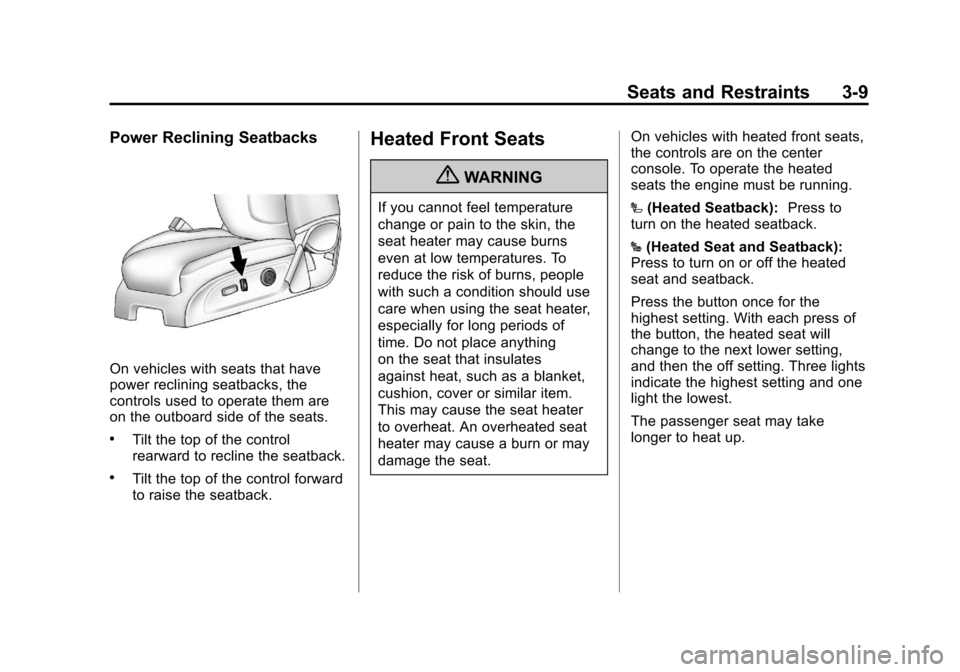
Power Reclining Seatbacks
On vehicles with seats that have
power reclining seatbacks, the
controls used to operate them are
on the outboard side of the seats.
.Tilt the top of the control
rearward to recline the seatback.
.Tilt the top of the control forward
to raise the seatback.
Heated Front Seats
{WARNING
If you cannot feel temperature
change or pain to the skin, the
seat heater may cause burns
even at low temperatures. To
reduce the risk of burns, people
with such a condition should use
care when using the seat heater,
especially for long periods of
time. Do not place anything
on the seat that insulates
against heat, such as a blanket,
cushion, cover or similar item.
This may cause the seat heater
to overheat. An overheated seat
heater may cause a burn or may
damage the seat.On vehicles with heated front seats,
the controls are on the center
console. To operate the heated
seats the engine must be running.
I
(Heated Seatback): Press to
turn on the heated seatback.
J (Heated Seat and Seatback):
Press to turn on or off the heated
seat and seatback.
Press the button once for the
highest setting. With each press of
the button, the heated seat will
change to the next lower setting,
and then the off setting. Three lights
indicate the highest setting and one
light the lowest.
The passenger seat may take
longer to heat up.
Page 64 of 454
Black plate (10,1)Chevrolet Traverse Owner Manual - 2011
3-10 Seats and Restraints
Remote Start Heated Seats
When it is cold outside, the heated
seats may turn on automatically
during a remote vehicle start. The
heated seats will be canceled when
the ignition is turned on. Press the
desired heated seat button to use
the heated seats after the vehicle
is started.
The heated seat button lights will
not turn on during a remote start.
The temperature of an unoccupied
seat may be reduced.
SeeRemote Vehicle Start
on
page 2‑5for more information.
Heated and Ventilated
Front Seats
{WARNING
If you cannot feel temperature
change or pain to the skin, the
seat heater may cause burns
even at low temperatures. See
the Warning under Heated Front
Seats on page 3‑9.
On vehicles with the heated and
ventilated seat feature, the controls
are on the center console. To
operate the heated seats the
engine must be running.
H(Ventilated Seat): Press to
ventilate the entire seat.
J(Heated Seat and Seatback):
Press to heat the entire seat.
Press the button once for the
highest setting. With each press of
the button, the seat will change to
the next lower setting, and then to the off setting. The lights indicate
three for the highest setting and one
for the lowest.
The passenger heated seat may
take longer to heat up.
The heated and ventilated seats are
canceled after the ignition is
turned off.
Remote Start Heated Seats
When it is cold outside, the heated
seats may turn on automatically
during a remote vehicle start. The
heated seats will be canceled when
the ignition is turned on. Press the
heated seat button to use the
heated seats after the vehicle is
started.
The heated seat button lights will
not turn on during a remote start.
The temperature of an unoccupied
seat may be reduced.
See
Remote Vehicle Start
on
page 2‑5for more information.
Page 65 of 454
Black plate (11,1)Chevrolet Traverse Owner Manual - 2011
Seats and Restraints 3-11
Rear Seats
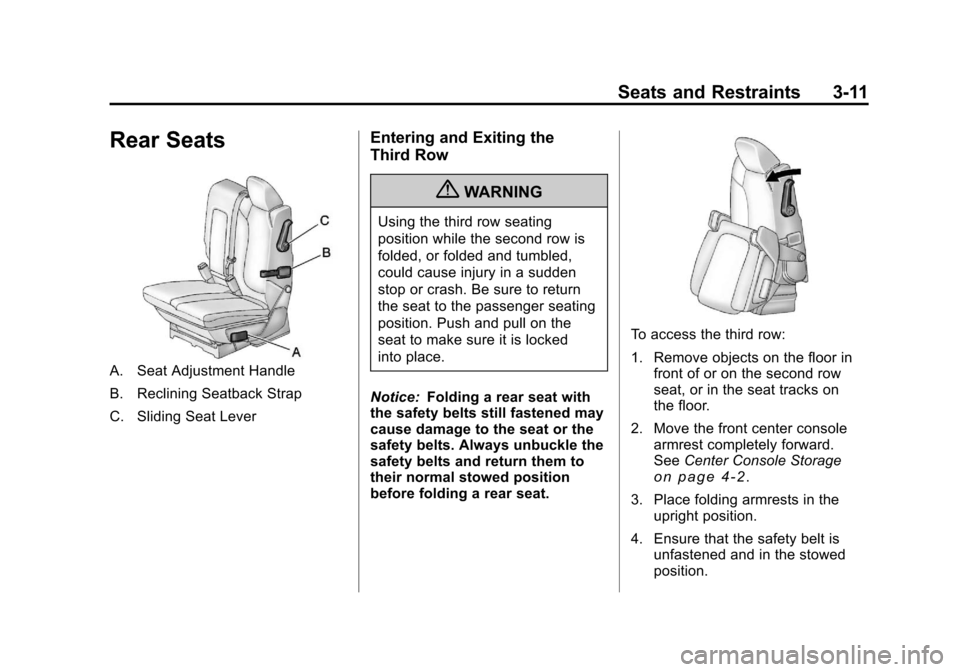
A. Seat Adjustment Handle
B. Reclining Seatback Strap
C. Sliding Seat Lever
Entering and Exiting the
Third Row
{WARNING
Using the third row seating
position while the second row is
folded, or folded and tumbled,
could cause injury in a sudden
stop or crash. Be sure to return
the seat to the passenger seating
position. Push and pull on the
seat to make sure it is locked
into place.
Notice: Folding a rear seat with
the safety belts still fastened may
cause damage to the seat or the
safety belts. Always unbuckle the
safety belts and return them to
their normal stowed position
before folding a rear seat.
To access the third row:
1. Remove objects on the floor in front of or on the second row
seat, or in the seat tracks on
the floor.
2. Move the front center console armrest completely forward.
See Center Console Storage
on page 4‑2.
3. Place folding armrests in the upright position.
4. Ensure that the safety belt is unfastened and in the stowed
position.
Page 67 of 454
Black plate (13,1)Chevrolet Traverse Owner Manual - 2011
Seats and Restraints 3-13
Adjusting the Seats
To adjust the second row seats, pull
outward on the seat adjustment
handle (A). Slide the seat forward or
rearward to the desired position.
Release the handle and push and
pull on the seat to make sure it
is locked.
Third Row Seats
{WARNING
Using the third row seating
position while the second row is
folded, or pushed forward in the
entry position, could cause injury
in a sudden stop or crash. Be
sure to return the seat to the
passenger seating position. Push
and pull on the seat to make sure
it is locked into place.
The third row seats can be folded
forward or removed.
Notice: Folding a rear seat with
the safety belts still fastened may
cause damage to the seat or the
safety belts. Always unbuckle the
safety belts and return them to
their normal stowed position
before folding a rear seat. To fold the seatback:
1. Remove anything on or under
the seat.
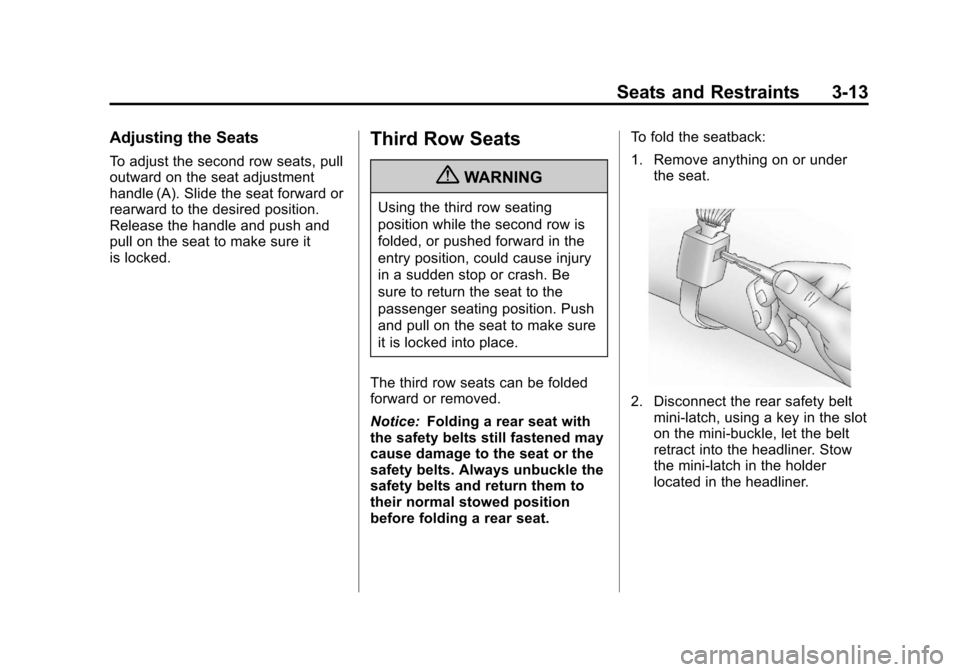
2. Disconnect the rear safety beltmini-latch, using a key in the slot
on the mini-buckle, let the belt
retract into the headliner. Stow
the mini-latch in the holder
located in the headliner.
Page 68 of 454
Black plate (14,1)Chevrolet Traverse Owner Manual - 2011
3-14 Seats and Restraints
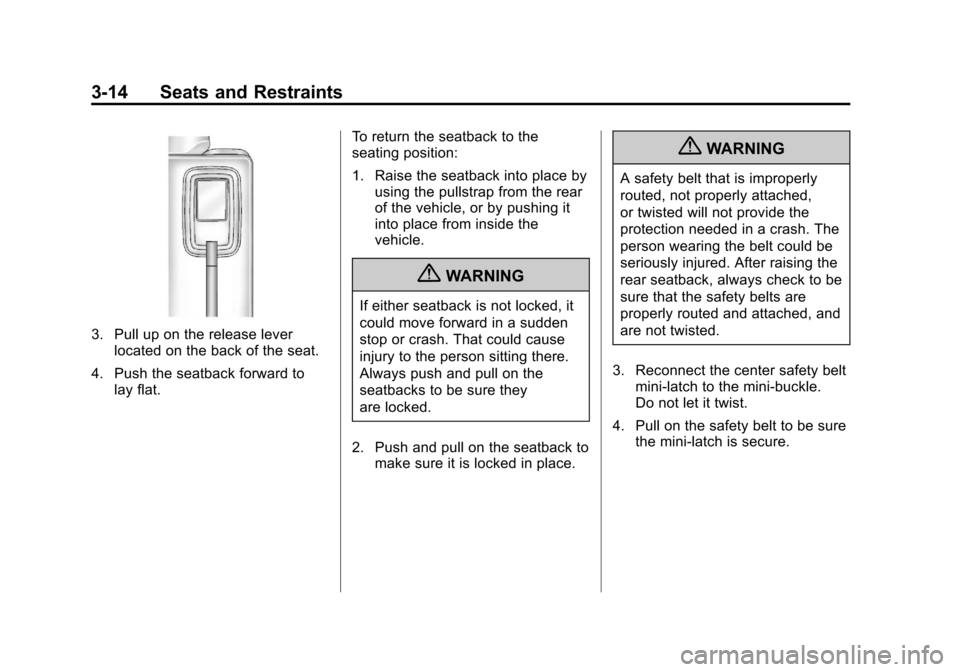
3. Pull up on the release leverlocated on the back of the seat.
4. Push the seatback forward to lay flat. To return the seatback to the
seating position:
1. Raise the seatback into place by
using the pullstrap from the rear
of the vehicle, or by pushing it
into place from inside the
vehicle.
{WARNING
If either seatback is not locked, it
could move forward in a sudden
stop or crash. That could cause
injury to the person sitting there.
Always push and pull on the
seatbacks to be sure they
are locked.
2. Push and pull on the seatback to make sure it is locked in place.
{WARNING
A safety belt that is improperly
routed, not properly attached,
or twisted will not provide the
protection needed in a crash. The
person wearing the belt could be
seriously injured. After raising the
rear seatback, always check to be
sure that the safety belts are
properly routed and attached, and
are not twisted.
3. Reconnect the center safety belt mini-latch to the mini-buckle.
Do not let it twist.
4. Pull on the safety belt to be sure the mini-latch is secure.
Page 70 of 454
Black plate (16,1)Chevrolet Traverse Owner Manual - 2011
3-16 Seats and Restraints
Safety Belts
This section of the manual
describes how to use safety belts
properly. It also describes some
things not to do with safety belts.
{WARNING
Do not let anyone ride where a
safety belt cannot be worn
properly. In a crash, if you or your
passenger(s) are not wearing
safety belts, the injuries can be
much worse. You can hit things
inside the vehicle harder or be
ejected from the vehicle. You and
your passenger(s) can be
seriously injured or killed. In the
same crash, you might not be,
if you are buckled up. Always
fasten your safety belt, and check
that your passenger(s) are
restrained properly too.
{WARNING
It is extremely dangerous to ride
in a cargo area, inside or outside
of a vehicle. In a collision, people
riding in these areas are more
likely to be seriously injured or
killed. Do not allow people to ride
in any area of your vehicle that is
not equipped with seats and
safety belts. Be sure everyone in
your vehicle is in a seat and using
a safety belt properly.
This vehicle has indicators as a
reminder to buckle the safety belts.
See Safety Belt Reminders
on
page 5‑14for additional
information. In most states and in all Canadian
provinces, the law requires wearing
safety belts. Here is why:
You never know if you will be in a
crash. If you do have a crash, you
do not know if it will be a
serious one.
A few crashes are mild, and some
crashes can be so serious that even
buckled up, a person would not
survive. But most crashes are in
between. In many of them, people
who buckle up can survive and
sometimes walk away. Without
safety belts they could have been
badly hurt or killed.
After more than 40 years of safety
belts in vehicles, the facts are clear.
In most crashes buckling up does
matter ... a lot!
Page 74 of 454
Black plate (20,1)Chevrolet Traverse Owner Manual - 2011
3-20 Seats and Restraints
The shoulder belt should go over
the shoulder and across the chest.
These parts of the body are best
able to take belt restraining forces.
The shoulder belt locks if there is a
sudden stop or crash.
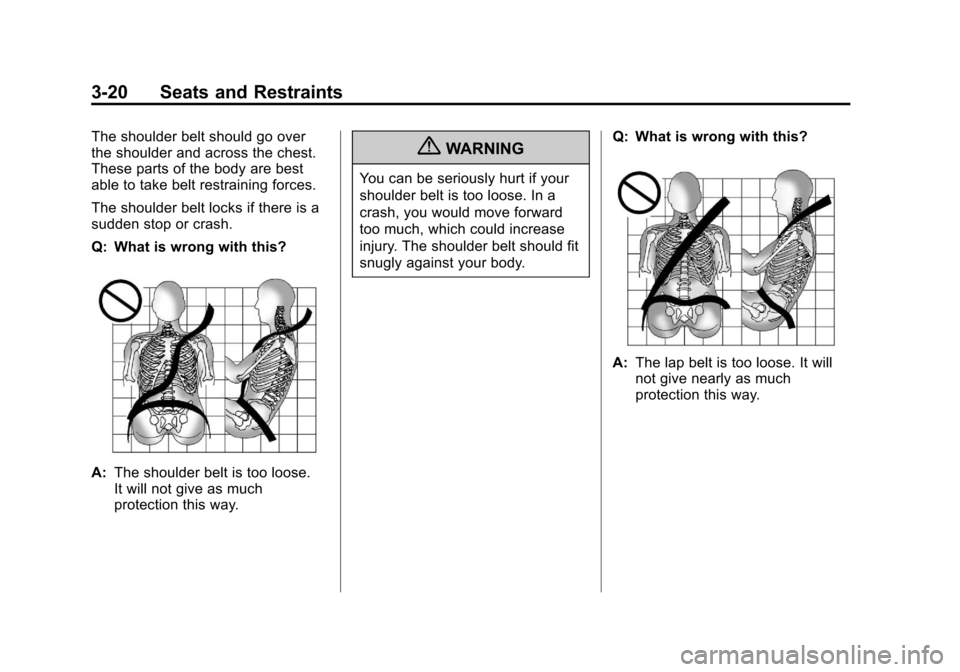
Q: What is wrong with this?
A:The shoulder belt is too loose.
It will not give as much
protection this way.
{WARNING
You can be seriously hurt if your
shoulder belt is too loose. In a
crash, you would move forward
too much, which could increase
injury. The shoulder belt should fit
snugly against your body. Q: What is wrong with this?
A:
The lap belt is too loose. It will
not give nearly as much
protection this way.
Page 75 of 454
Black plate (21,1)Chevrolet Traverse Owner Manual - 2011
Seats and Restraints 3-21
{WARNING
You can be seriously hurt if your
lap belt is too loose. In a crash,
you could slide under the lap belt
and apply force on your
abdomen. This could cause
serious or even fatal injuries.
The lap belt should be worn low
and snug on the hips, just
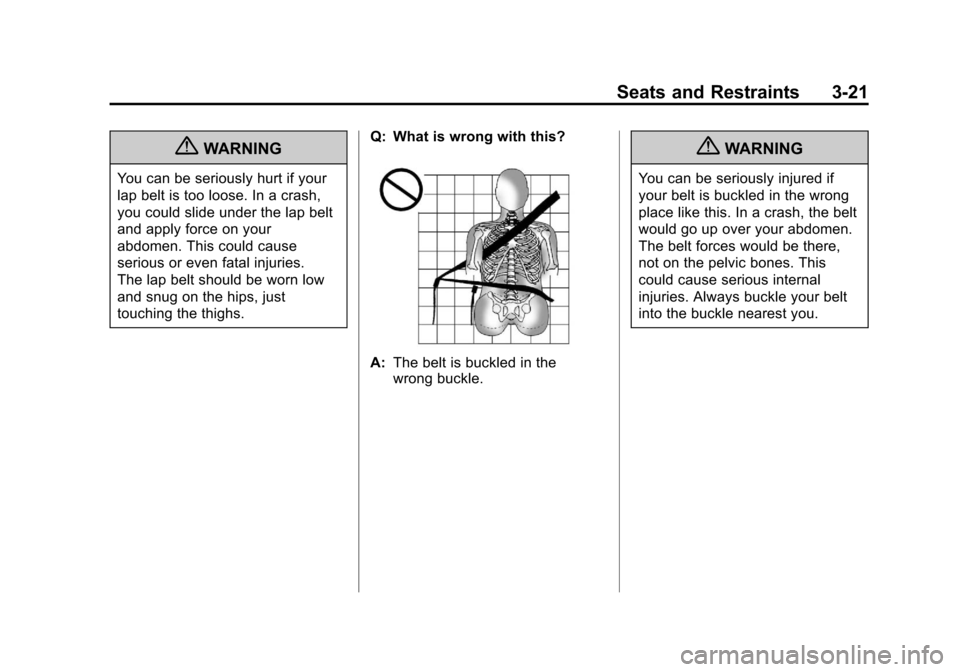
touching the thighs.Q: What is wrong with this?
A:
The belt is buckled in the
wrong buckle.
{WARNING
You can be seriously injured if
your belt is buckled in the wrong
place like this. In a crash, the belt
would go up over your abdomen.
The belt forces would be there,
not on the pelvic bones. This
could cause serious internal
injuries. Always buckle your belt
into the buckle nearest you.
Page 76 of 454
Black plate (22,1)Chevrolet Traverse Owner Manual - 2011
3-22 Seats and Restraints
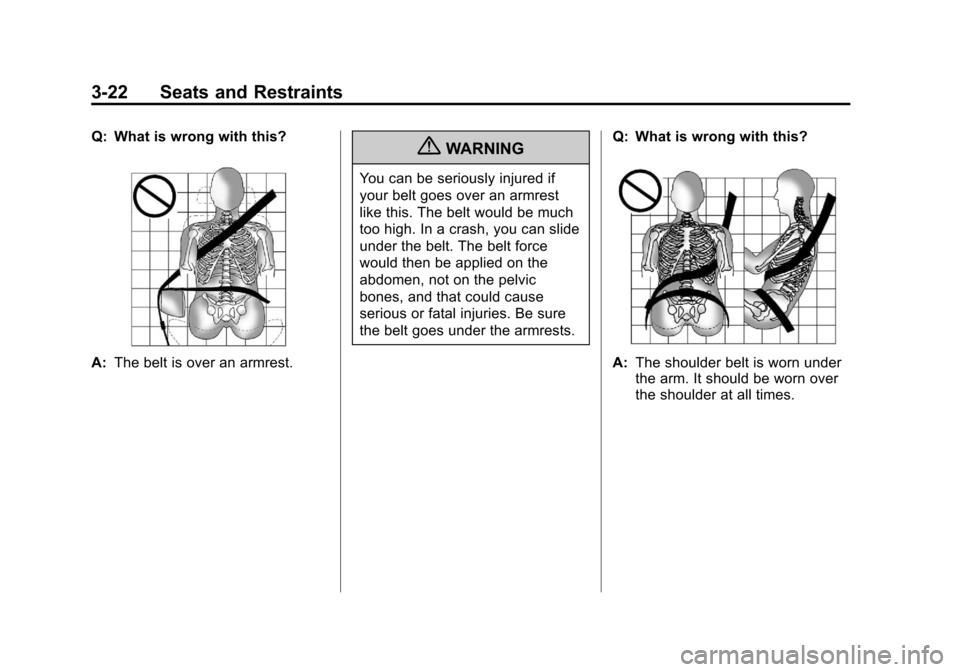
Q: What is wrong with this?
A:The belt is over an armrest.
{WARNING
You can be seriously injured if
your belt goes over an armrest
like this. The belt would be much
too high. In a crash, you can slide
under the belt. The belt force
would then be applied on the
abdomen, not on the pelvic
bones, and that could cause
serious or fatal injuries. Be sure
the belt goes under the armrests. Q: What is wrong with this?
A:
The shoulder belt is worn under
the arm. It should be worn over
the shoulder at all times.
Page 77 of 454
Black plate (23,1)Chevrolet Traverse Owner Manual - 2011
Seats and Restraints 3-23
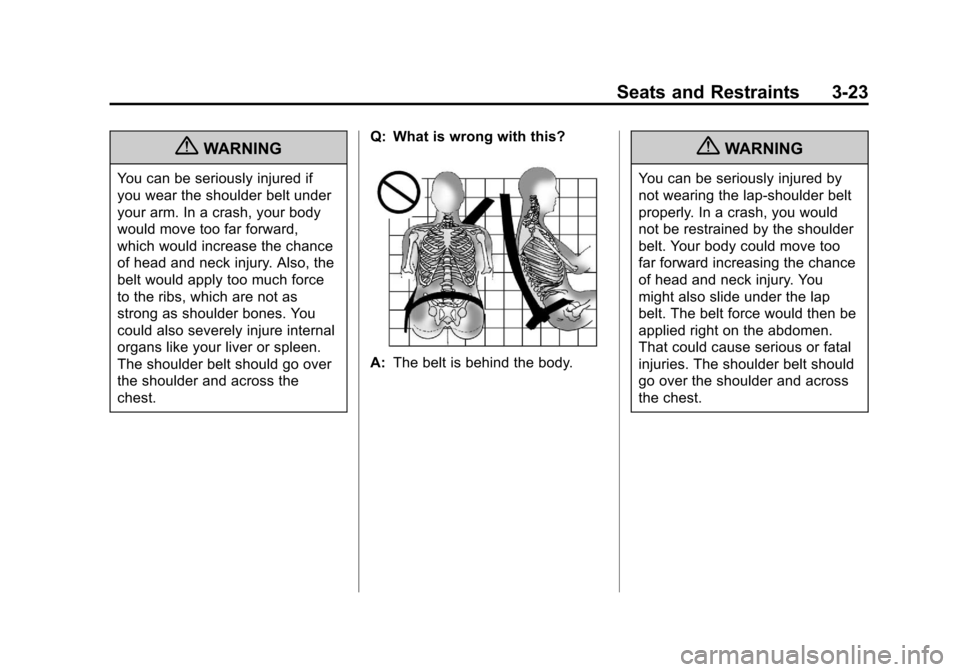
{WARNING
You can be seriously injured if
you wear the shoulder belt under
your arm. In a crash, your body
would move too far forward,
which would increase the chance
of head and neck injury. Also, the
belt would apply too much force
to the ribs, which are not as
strong as shoulder bones. You
could also severely injure internal
organs like your liver or spleen.
The shoulder belt should go over
the shoulder and across the
chest.Q: What is wrong with this?
A:
The belt is behind the body.
{WARNING
You can be seriously injured by
not wearing the lap-shoulder belt
properly. In a crash, you would
not be restrained by the shoulder
belt. Your body could move too
far forward increasing the chance
of head and neck injury. You
might also slide under the lap
belt. The belt force would then be
applied right on the abdomen.
That could cause serious or fatal
injuries. The shoulder belt should
go over the shoulder and across
the chest.