clock CHEVROLET TRAVERSE 2018 User Guide
[x] Cancel search | Manufacturer: CHEVROLET, Model Year: 2018, Model line: TRAVERSE, Model: CHEVROLET TRAVERSE 2018Pages: 419, PDF Size: 5.92 MB
Page 298 of 419
Chevrolet Traverse Owner Manual (GMNA-Localizing-U.S./Canada/Mexico-
10603118) - 2018 - CRC - 1/29/18
Vehicle Care 297
{Warning
Plain water, or other liquids such
as alcohol, can boil before the
proper coolant mixture will. With
plain water or the wrong mixture,
the engine could get too hot but
there would not be an overheat
warning. The engine could catch
fire and you or others could be
burned.
{Warning
Spilling coolant on hot engine
parts can burn you. Coolant
contains ethylene glycol and it will
burn if the engine parts are hot
enough.
Caution
Failure to follow the specific
coolant fill procedure could cause
the engine to overheat and could
cause system damage. If coolant
is not visible in the surge tank,
contact your dealer.
If no problem is found, check to see
if coolant is visible in the coolant
surge tank. If coolant is visible but
the coolant level is not at the
indicated level mark, add a
50/50 mixture of clean, drinkable
water and DEX-COOL coolant at the
coolant surge tank, but be sure the
cooling system, including the
coolant surge tank pressure cap, is
cool before you do it.
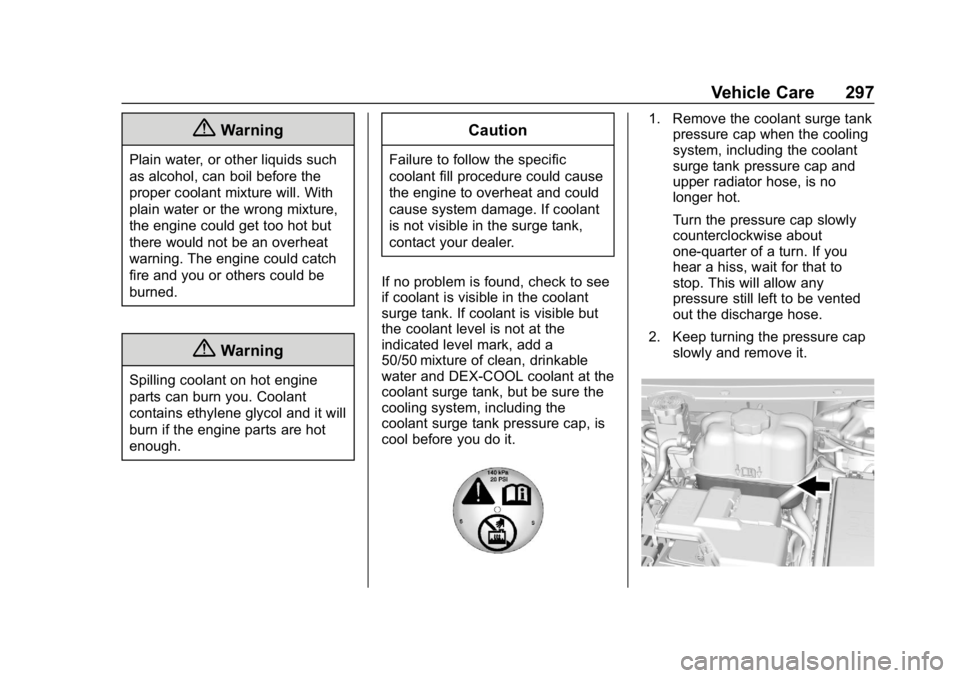
1. Remove the coolant surge tank pressure cap when the cooling
system, including the coolant
surge tank pressure cap and
upper radiator hose, is no
longer hot.
Turn the pressure cap slowly
counterclockwise about
one-quarter of a turn. If you
hear a hiss, wait for that to
stop. This will allow any
pressure still left to be vented
out the discharge hose.
2. Keep turning the pressure cap slowly and remove it.
Page 309 of 419
Chevrolet Traverse Owner Manual (GMNA-Localizing-U.S./Canada/Mexico-
10603118) - 2018 - CRC - 1/29/18
308 Vehicle Care
LED Lighting
This vehicle has several LED lamps.
For replacement of any LED lighting
assembly, contact your dealer.
Headlamps, Front Turn
Signal, and Sidemarker
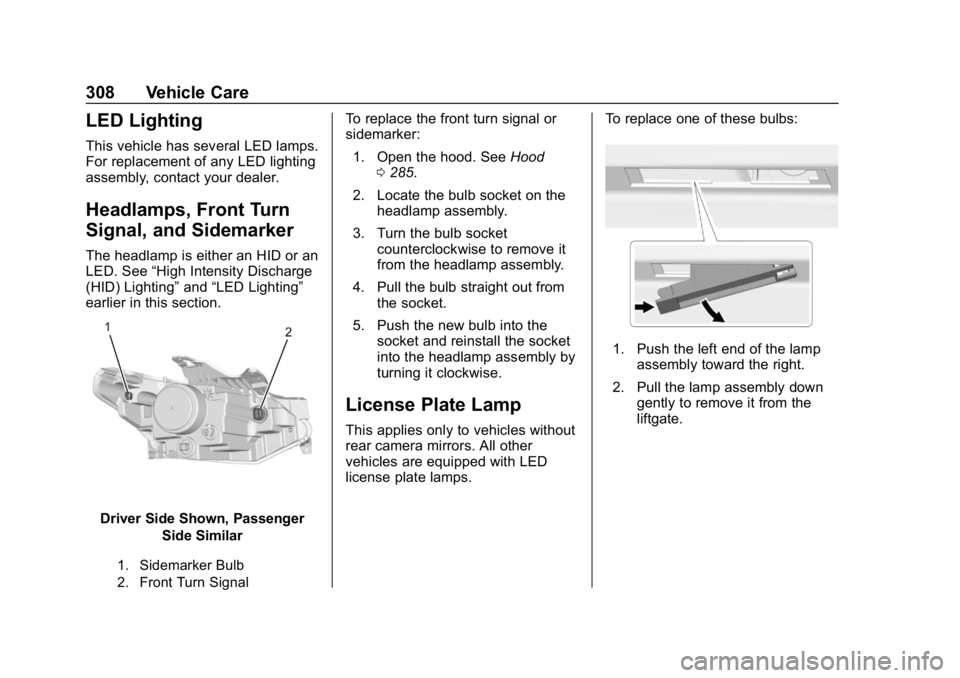
The headlamp is either an HID or an
LED. See“High Intensity Discharge
(HID) Lighting” and“LED Lighting”
earlier in this section.
Driver Side Shown, Passenger
Side Similar
1. Sidemarker Bulb
2. Front Turn Signal
To replace the front turn signal or
sidemarker:
1. Open the hood. See Hood
0 285.
2. Locate the bulb socket on the headlamp assembly.
3. Turn the bulb socket counterclockwise to remove it
from the headlamp assembly.
4. Pull the bulb straight out from the socket.
5. Push the new bulb into the socket and reinstall the socket
into the headlamp assembly by
turning it clockwise.
License Plate Lamp
This applies only to vehicles without
rear camera mirrors. All other
vehicles are equipped with LED
license plate lamps. To replace one of these bulbs:
1. Push the left end of the lamp
assembly toward the right.
2. Pull the lamp assembly down gently to remove it from the
liftgate.
Page 310 of 419
Chevrolet Traverse Owner Manual (GMNA-Localizing-U.S./Canada/Mexico-
10603118) - 2018 - CRC - 1/29/18
Vehicle Care 309
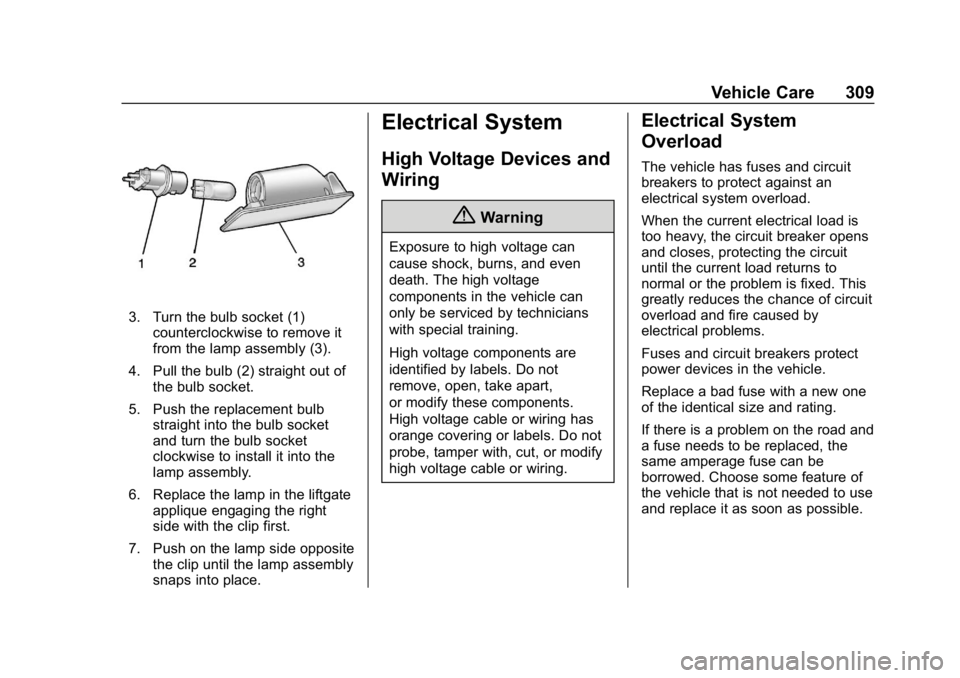
3. Turn the bulb socket (1)counterclockwise to remove it
from the lamp assembly (3).
4. Pull the bulb (2) straight out of the bulb socket.
5. Push the replacement bulb straight into the bulb socket
and turn the bulb socket
clockwise to install it into the
lamp assembly.
6. Replace the lamp in the liftgate applique engaging the right
side with the clip first.
7. Push on the lamp side opposite the clip until the lamp assembly
snaps into place.
Electrical System
High Voltage Devices and
Wiring
{Warning
Exposure to high voltage can
cause shock, burns, and even
death. The high voltage
components in the vehicle can
only be serviced by technicians
with special training.
High voltage components are
identified by labels. Do not
remove, open, take apart,
or modify these components.
High voltage cable or wiring has
orange covering or labels. Do not
probe, tamper with, cut, or modify
high voltage cable or wiring.
Electrical System
Overload
The vehicle has fuses and circuit
breakers to protect against an
electrical system overload.
When the current electrical load is
too heavy, the circuit breaker opens
and closes, protecting the circuit
until the current load returns to
normal or the problem is fixed. This
greatly reduces the chance of circuit
overload and fire caused by
electrical problems.
Fuses and circuit breakers protect
power devices in the vehicle.
Replace a bad fuse with a new one
of the identical size and rating.
If there is a problem on the road and
a fuse needs to be replaced, the
same amperage fuse can be
borrowed. Choose some feature of
the vehicle that is not needed to use
and replace it as soon as possible.
Page 342 of 419
Chevrolet Traverse Owner Manual (GMNA-Localizing-U.S./Canada/Mexico-
10603118) - 2018 - CRC - 1/29/18
Vehicle Care 341
Warning (Continued)
5. Place wheel blocks,if equipped, on both sides of
the tire at the opposite
corner of the tire being
changed.
When the vehicle has a flat tire (2),
use the following example as a
guide to assist in the placement of
the wheel blocks (1), if equipped.
1. Wheel Block (If Equipped)
2. Flat Tire
The following information explains
how to repair or change a tire.
Tire Changing
Removing the Spare Tire and
Tools
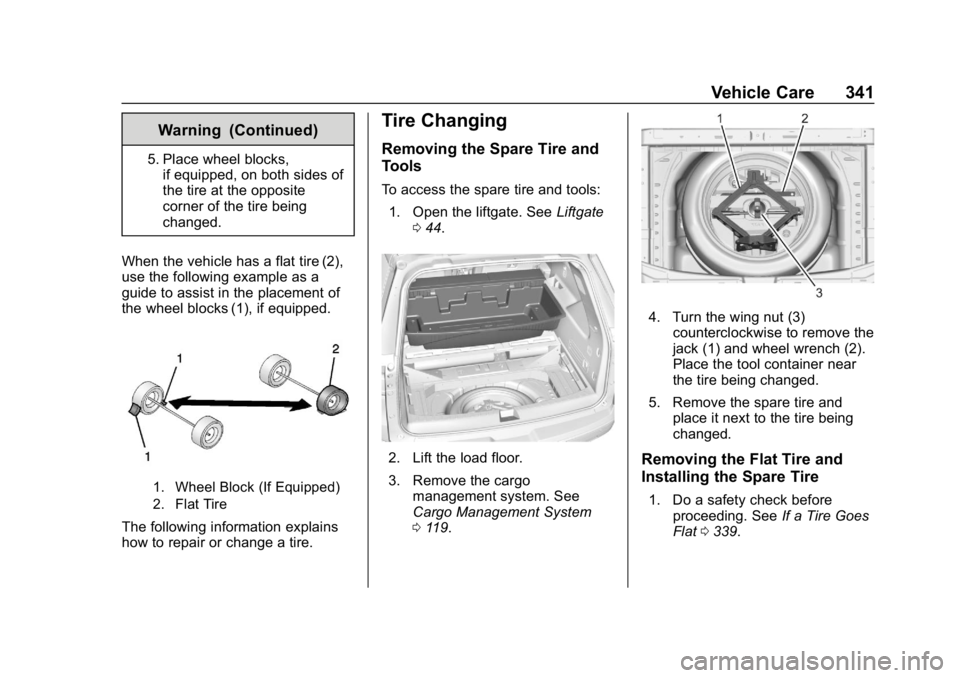
To access the spare tire and tools: 1. Open the liftgate. See Liftgate
0 44.
2. Lift the load floor.
3. Remove the cargo
management system. See
Cargo Management System
0119.
4. Turn the wing nut (3)
counterclockwise to remove the
jack (1) and wheel wrench (2).
Place the tool container near
the tire being changed.
5. Remove the spare tire and place it next to the tire being
changed.
Removing the Flat Tire and
Installing the Spare Tire
1. Do a safety check beforeproceeding. See If a Tire Goes
Flat 0339.
Page 343 of 419
Chevrolet Traverse Owner Manual (GMNA-Localizing-U.S./Canada/Mexico-
10603118) - 2018 - CRC - 1/29/18
342 Vehicle Care
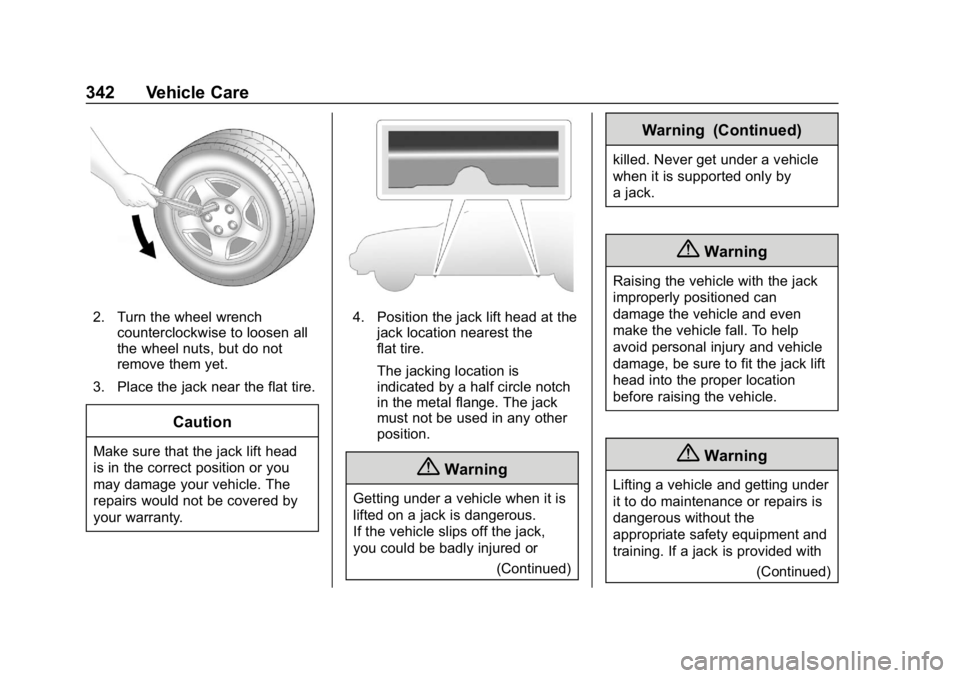
2. Turn the wheel wrenchcounterclockwise to loosen all
the wheel nuts, but do not
remove them yet.
3. Place the jack near the flat tire.
Caution
Make sure that the jack lift head
is in the correct position or you
may damage your vehicle. The
repairs would not be covered by
your warranty.
4. Position the jack lift head at the jack location nearest the
flat tire.
The jacking location is
indicated by a half circle notch
in the metal flange. The jack
must not be used in any other
position.
{Warning
Getting under a vehicle when it is
lifted on a jack is dangerous.
If the vehicle slips off the jack,
you could be badly injured or
(Continued)
Warning (Continued)
killed. Never get under a vehicle
when it is supported only by
a jack.
{Warning
Raising the vehicle with the jack
improperly positioned can
damage the vehicle and even
make the vehicle fall. To help
avoid personal injury and vehicle
damage, be sure to fit the jack lift
head into the proper location
before raising the vehicle.
{Warning
Lifting a vehicle and getting under
it to do maintenance or repairs is
dangerous without the
appropriate safety equipment and
training. If a jack is provided with(Continued)
Page 344 of 419
Chevrolet Traverse Owner Manual (GMNA-Localizing-U.S./Canada/Mexico-
10603118) - 2018 - CRC - 1/29/18
Vehicle Care 343
Warning (Continued)
the vehicle, it is designed only for
changing a flat tire. If it is used for
anything else, you or others could
be badly injured or killed if the
vehicle slips off the jack. If a jack
is provided with the vehicle, only
use it for changing a flat tire.
Caution
Using a jack to raise the vehicle
without positioning it correctly
could damage your vehicle. When
raising your vehicle on a jack, be
sure to position it correctly under
the frame and avoid contact with
the plastic molding.
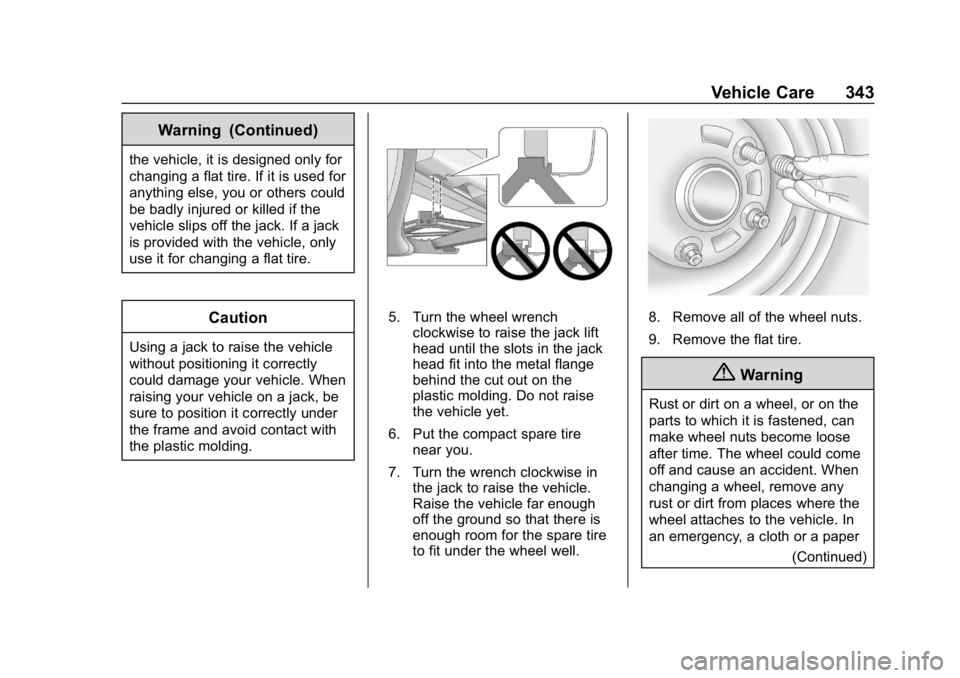
5. Turn the wheel wrenchclockwise to raise the jack lift
head until the slots in the jack
head fit into the metal flange
behind the cut out on the
plastic molding. Do not raise
the vehicle yet.
6. Put the compact spare tire near you.
7. Turn the wrench clockwise in the jack to raise the vehicle.
Raise the vehicle far enough
off the ground so that there is
enough room for the spare tire
to fit under the wheel well.8. Remove all of the wheel nuts.
9. Remove the flat tire.
{Warning
Rust or dirt on a wheel, or on the
parts to which it is fastened, can
make wheel nuts become loose
after time. The wheel could come
off and cause an accident. When
changing a wheel, remove any
rust or dirt from places where the
wheel attaches to the vehicle. In
an emergency, a cloth or a paper
(Continued)
Page 345 of 419
Chevrolet Traverse Owner Manual (GMNA-Localizing-U.S./Canada/Mexico-
10603118) - 2018 - CRC - 1/29/18
344 Vehicle Care
Warning (Continued)
towel can be used; however, use
a scraper or wire brush later to
remove all rust or dirt.
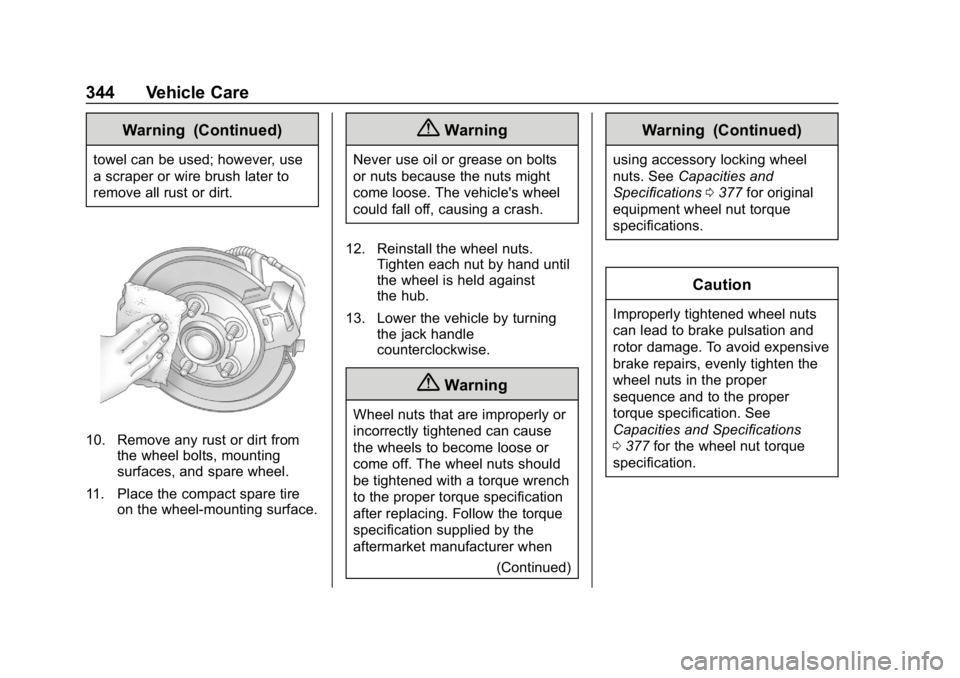
10. Remove any rust or dirt fromthe wheel bolts, mounting
surfaces, and spare wheel.
11. Place the compact spare tire on the wheel-mounting surface.
{Warning
Never use oil or grease on bolts
or nuts because the nuts might
come loose. The vehicle's wheel
could fall off, causing a crash.
12. Reinstall the wheel nuts. Tighten each nut by hand until
the wheel is held against
the hub.
13. Lower the vehicle by turning the jack handle
counterclockwise.
{Warning
Wheel nuts that are improperly or
incorrectly tightened can cause
the wheels to become loose or
come off. The wheel nuts should
be tightened with a torque wrench
to the proper torque specification
after replacing. Follow the torque
specification supplied by the
aftermarket manufacturer when
(Continued)
Warning (Continued)
using accessory locking wheel
nuts. SeeCapacities and
Specifications 0377 for original
equipment wheel nut torque
specifications.
Caution
Improperly tightened wheel nuts
can lead to brake pulsation and
rotor damage. To avoid expensive
brake repairs, evenly tighten the
wheel nuts in the proper
sequence and to the proper
torque specification. See
Capacities and Specifications
0 377 for the wheel nut torque
specification.
Page 409 of 419

Chevrolet Traverse Owner Manual (GMNA-Localizing-U.S./Canada/Mexico-
10603118) - 2018 - CRC - 1/29/18
408 Index
ChargingWireless . . . . . . . . . . . . . . . . . . . . . . 131
Charging System Light . . . . . . . . . 141
Check Engine Light (MalfunctionIndicator) . . . . . . . . . . . . . . . . . . . . 141
Child Restraints
Infants and Young Children . . . . . 99
Lower Anchors and Tethersfor Children . . . . . . . . . . . . . . . . . 104
Older Children . . . . . . . . . . . . . . . . . . 97
Securing . . . . . . . . . . . . . . . . . .112, 114
Systems . . . . . . . . . . . . . . . . . . . . . . 101
Circuit Breakers . . . . . . . . . . . . . . . . 310
Cleaning Exterior Care . . . . . . . . . . . . . . . . . 353
Interior Care . . . . . . . . . . . . . . . . . . 358
Climate Control Systems Dual Automatic . . . . . . . . . . . . . . . 200
Rear . . . . . . . . . . . . . . . . . . . . . . . . . . 203
Clock . . . . . . . . . . . . . . . . . . . . . . . . . . . 128
Cluster, Instrument . . . . . . . . . . . . . 134
Collision Damage Repair . . . . . . . 387
Compact Spare Tire . . . . . . . . . . . . 347
Compartments
Storage . . . . . . . . . . . . . . . . . . . . . . . .118
Compass . . . . . . . . . . . . . . . . . . . . . . . 127 Connections
OnStar . . . . . . . . . . . . . . . . . . . . . . . 397
Control Traction and ElectronicStability . . . . . . . . . . . . . . . . . . . . . 239
Control of a Vehicle . . . . . . . . . . . . . 209
Convex Mirrors . . . . . . . . . . . . . . . . . . 53
Coolant Engine Temperature Gauge . . 138
Cooling . . . . . . . . . . . . . . . . . . . . 200, 203
Cooling System . . . . . . . . . . . . . . . . . 294
Courtesy Lamps . . . . . . . . . . . . . . . . 171
Courtesy Transportation Program . . . . . . . . . . . . . . . . . . . . . . . 386
Cruise Control . . . . . . . . . . . . . . . . . . 244 Light . . . . . . . . . . . . . . . . . . . . . . . . . . 149
Cruise Control, Adaptive . . . . . . . . 246
Customer Assistance . . . . . . . . . . . 383 Offices . . . . . . . . . . . . . . . . . . . . . . . . 382
Text Telephone (TTY)Users . . . . . . . . . . . . . . . . . . . . . . . 383
Customer Information Service PublicationsOrdering Information . . . . . . . . 389
Customer Satisfaction
Procedure . . . . . . . . . . . . . . . . . . . . . 380D
Damage Repair, Collision . . . . . . . 387
Danger, Warning, and Caution . . . . 3
Data CollectionInfotainment System . . . . . . . . . . 393
OnStar . . . . . . . . . . . . . . . . . . . . . . . 393
Data Recorders, Event . . . . . . . . . 392
Daytime Running Lamps (DRL) . . . . . . . . . . . . . . . . . . 168
Defensive Driving . . . . . . . . . . . . . . . 209
Delayed Locking . . . . . . . . . . . . . . . . . 42
Devices
Auxiliary . . . . . . . . . . . . . . . . . . . . . . 190
Diagnostics
OnStar . . . . . . . . . . . . . . . . . . . . . . . 399
Distracted Driving . . . . . . . . . . . . . . . 208
Dome Lamps . . . . . . . . . . . . . . . . . . . 171
Door Ajar Light . . . . . . . . . . . . . . . . . . . . . 149
Delayed Locking . . . . . . . . . . . . . . . . 42
Locks . . . . . . . . . . . . . . . . . . . . . . . . . . . 40
Power Locks . . . . . . . . . . . . . . . . . . . . 42
Drive Belt Routing, Engine . . . . . . 379
Drive Systems All-Wheel Drive . . . . . . . . . . 235, 303
Driver Assistance Systems . . . . . 255
Driver Information Center (DIC) . . . . . . . . . . . . . . . . . . 150