heating CHEVROLET TRAVERSE 2020 User Guide
[x] Cancel search | Manufacturer: CHEVROLET, Model Year: 2020, Model line: TRAVERSE, Model: CHEVROLET TRAVERSE 2020Pages: 382, PDF Size: 5.87 MB
Page 260 of 382
Chevrolet Traverse Owner Manual (GMNA-Localizing-U.S./Canada/Mexico-
13527526) - 2020 - CRC - 9/5/19
Vehicle Care 259
2. Engine Coolant Surge Tankand Pressure Cap
{Warning
An underhood electric fan can
start up even when the engine is
not running and can cause injury.
Keep hands, clothing, and tools
away from any underhood
electric fan.
{Warning
Do not touch heater or radiator
hoses, or other engine parts.
They can be very hot and can
burn you. Do not run the engine if
there is a leak; all coolant could
leak out. That could cause an
engine fire and can burn you. Fix
any leak before driving the
vehicle.
Engine Coolant
The cooling system in the vehicle is
filled with DEX-COOL engine
coolant. This coolant needs to be
checked and replaced at
appropriate intervals. See
Maintenance Schedule 0329.
The following explains the cooling
system and how to check and add
coolant when it is low. If there is a
problem with engine overheating,
see Engine Overheating 0262.
What to Use
{Warning
Plain water, or other liquids such
as alcohol, can boil before the
proper coolant mixture will. With
plain water or the wrong mixture,
the engine could get too hot but
there would not be an overheat
warning. The engine could catch
fire and you or others could be
burned. Use a 50/50 mixture of clean,
drinkable water and DEX-COOL
coolant. This mixture:
.
Gives freezing protection down
to−37 °C (−34 °F), outside
temperature.
. Gives boiling protection up to
129 °C (265 °F), engine
temperature.
. Protects against rust and
corrosion.
. Will not damage aluminum parts.
. Helps keep the proper engine
temperature.Caution
Do not use anything other than a
mix of DEX-COOL coolant that
meets GM Standard
GMW3420 and clean, drinkable
water. Anything else can cause
damage to the engine cooling
system and the vehicle, which
would not be covered by the
vehicle warranty.
Page 261 of 382

Chevrolet Traverse Owner Manual (GMNA-Localizing-U.S./Canada/Mexico-
13527526) - 2020 - CRC - 9/5/19
260 Vehicle Care
Never dispose of engine coolant by
putting it in the trash, pouring it on
the ground, or into sewers, streams,
or bodies of water. Have the coolant
changed by an authorized service
center, familiar with legal
requirements regarding used
coolant disposal. This will help
protect the environment and your
health.
Checking Coolant
The vehicle must be on a level
surface when checking the coolant
level.
Check to see if coolant is visible in
the coolant surge tank. If the coolant
inside the coolant surge tank is
boiling, do not do anything else until
it cools down. If coolant is visible
but the coolant level mark is not
visible, add a 50/50 mixture of
clean, drinkable water and
DEX-COOL coolant at the coolant
surge tank to the top rib on the
middle of the tank, but be sure the
cooling system is cool before this is
done. SeeEngine Overheating
0 262.
The coolant surge tank is located in
the engine compartment on the
driver side of the vehicle. See
Engine Compartment Overview
0 252.
How to Add Coolant to the
Coolant Surge Tank
{Warning
Steam and scalding liquids from a
hot cooling system are under
pressure. Turning the pressure
(Continued)
Warning (Continued)
cap, even a little, can cause them
to come out at high speed and
you could be burned. Never turn
the cap when the cooling system,
including the pressure cap, is hot.
Wait for the cooling system and
pressure cap to cool.
{Warning
Plain water, or other liquids such
as alcohol, can boil before the
proper coolant mixture will. With
plain water or the wrong mixture,
the engine could get too hot but
there would not be an overheat
warning. The engine could catch
fire and you or others could be
burned.
Page 263 of 382
Chevrolet Traverse Owner Manual (GMNA-Localizing-U.S./Canada/Mexico-
13527526) - 2020 - CRC - 9/5/19
262 Vehicle Care
5. Replace the pressure captightly.
6. Verify coolant level after the engine is shut off and the
coolant is cold. If necessary,
repeat coolant fill procedure
Steps 1–6.
If the coolant still is not at the
proper level when the system
cools down again, see your
dealer.
Caution
If the pressure cap is not tightly
installed, coolant loss and engine
damage may occur. Be sure the
cap is properly and tightly
secured.
Engine Overheating
The vehicle has several indicators
to warn of the engine overheating.
There is an engine coolant
temperature gauge on the
instrument cluster. See Engine
Coolant Temperature Gauge 0122. The vehicle may also display a
message on the Driver Information
Center (DIC).
If the decision is made not to lift the
hood when this warning appears,
get service help right away. See
Roadside Assistance Program
0
349.
If the decision is made to lift the
hood, make sure the vehicle is
parked on a level surface. Then
check to see if the engine cooling
fan is running. If the engine is
overheating, the fan should be
running. If it is not, do not continue
to run the engine. Have the vehicle
serviced.
Caution
Do not run the engine if there is a
leak in the engine cooling system.
This can cause a loss of all
coolant and can damage the
system and vehicle. Have any
leaks fixed right away.
If Steam Is Coming from the
Engine Compartment
{Warning
Steam and scalding liquids from a
hot cooling system are under
pressure. Turning the pressure
cap, even a little, can cause them
to come out at high speed and
you could be burned. Never turn
the cap when the cooling system,
including the pressure cap, is hot.
Wait for the cooling system and
pressure cap to cool.
If No Steam Is Coming from
the Engine Compartment
If an engine overheat warning is
displayed but no steam can be seen
or heard, the problem may not be
too serious. Sometimes the engine
can get a little too hot when the
vehicle:
. Climbs a long hill on a hot day.
. Stops after high-speed driving.
. Idles for long periods in traffic.
Page 277 of 382
Chevrolet Traverse Owner Manual (GMNA-Localizing-U.S./Canada/Mexico-
13527526) - 2020 - CRC - 9/5/19
276 Vehicle Care
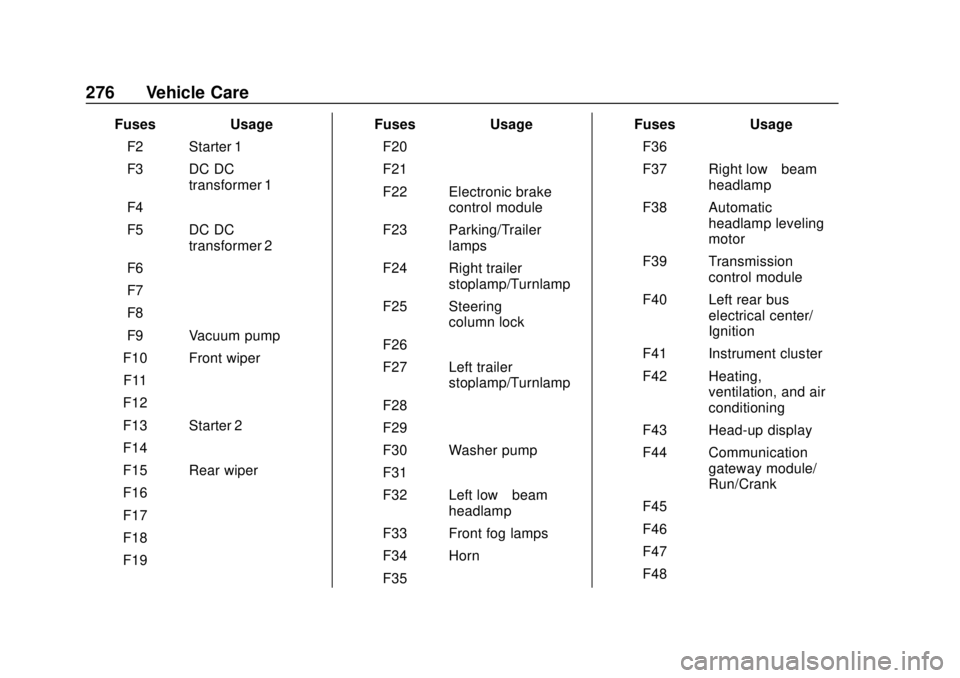
FusesUsage
F2 Starter 1
F3 DC DC transformer 1
F4 –
F5 DC DC transformer 2
F6 –
F7 –
F8 –
F9 Vacuum pump
F10 Front wiper F11 –
F12 –
F13 Starter 2
F14 –
F15 Rear wiper
F16 –
F17 –
F18 –
F19 – Fuses
Usage
F20 –
F21 –
F22 Electronic brake control module
F23 Parking/Trailer lamps
F24 Right trailer stoplamp/Turnlamp
F25 Steering column lock
F26 –
F27 Left trailer stoplamp/Turnlamp
F28 –
F29 –
F30 Washer pump
F31 –
F32 Left low –beam
headlamp
F33 Front fog lamps
F34 Horn
F35 – Fuses
Usage
F36 –
F37 Right low –beam
headlamp
F38 Automatic headlamp leveling
motor
F39 Transmission control module
F40 Left rear bus electrical center/
Ignition
F41 Instrument cluster
F42 Heating, ventilation, and air
conditioning
F43 Head-up display
F44 Communication gateway module/
Run/Crank
F45 –
F46 –
F47 –
F48 –
Page 279 of 382
Chevrolet Traverse Owner Manual (GMNA-Localizing-U.S./Canada/Mexico-
13527526) - 2020 - CRC - 9/5/19
278 Vehicle Care
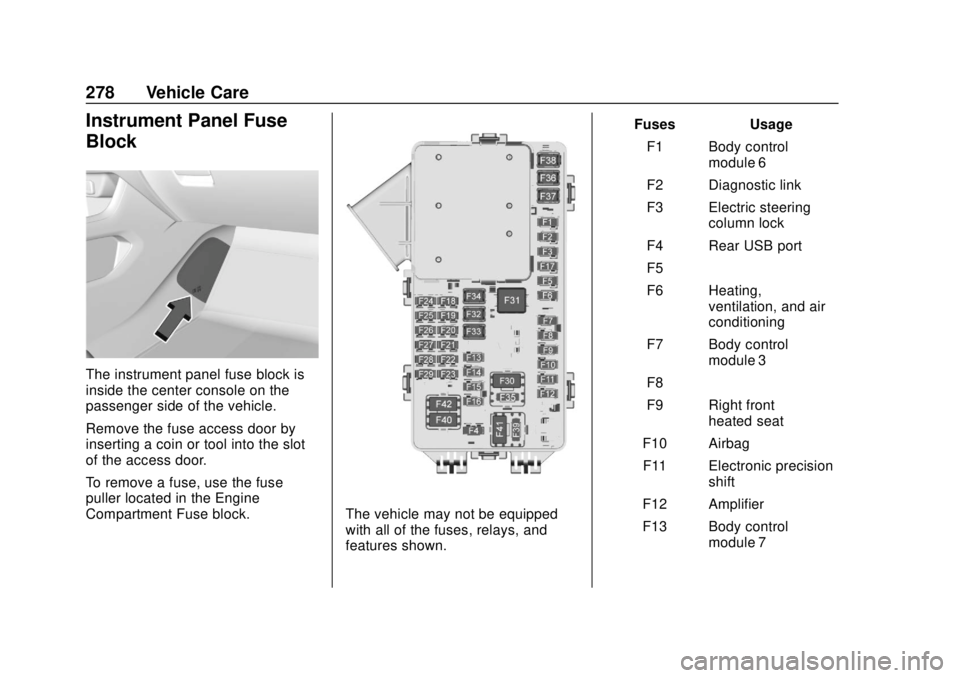
Instrument Panel Fuse
Block
The instrument panel fuse block is
inside the center console on the
passenger side of the vehicle.
Remove the fuse access door by
inserting a coin or tool into the slot
of the access door.
To remove a fuse, use the fuse
puller located in the Engine
Compartment Fuse block.
The vehicle may not be equipped
with all of the fuses, relays, and
features shown.Fuses Usage
F1 Body control module 6
F2 Diagnostic link
F3 Electric steering column lock
F4 Rear USB port
F5 –
F6 Heating, ventilation, and air
conditioning
F7 Body control module 3
F8 –
F9 Right front heated seat
F10 Airbag
F11 Electronic precision shift
F12 Amplifier
F13 Body control module 7
Page 280 of 382
Chevrolet Traverse Owner Manual (GMNA-Localizing-U.S./Canada/Mexico-
13527526) - 2020 - CRC - 9/5/19
Vehicle Care 279
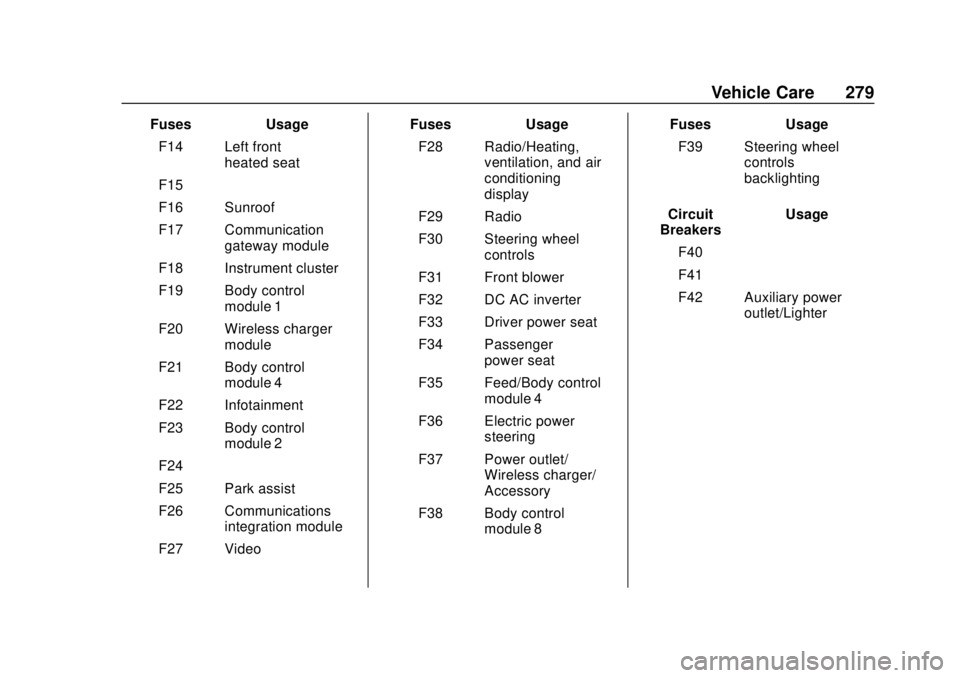
FusesUsage
F14 Left front heated seat
F15 –
F16 Sunroof
F17 Communication gateway module
F18 Instrument cluster
F19 Body control module 1
F20 Wireless charger module
F21 Body control module 4
F22 Infotainment
F23 Body control module 2
F24 –
F25 Park assist
F26 Communications integration module
F27 Video Fuses
Usage
F28 Radio/Heating, ventilation, and air
conditioning
display
F29 Radio
F30 Steering wheel controls
F31 Front blower
F32 DC AC inverter
F33 Driver power seat
F34 Passenger power seat
F35 Feed/Body control module 4
F36 Electric power steering
F37 Power outlet/ Wireless charger/
Accessory
F38 Body control module 8 Fuses
Usage
F39 Steering wheel controls
backlighting
Circuit
Breakers Usage
F40 –
F41 –
F42 Auxiliary power outlet/Lighter
Page 284 of 382
Chevrolet Traverse Owner Manual (GMNA-Localizing-U.S./Canada/Mexico-
13527526) - 2020 - CRC - 9/5/19
Vehicle Care 283
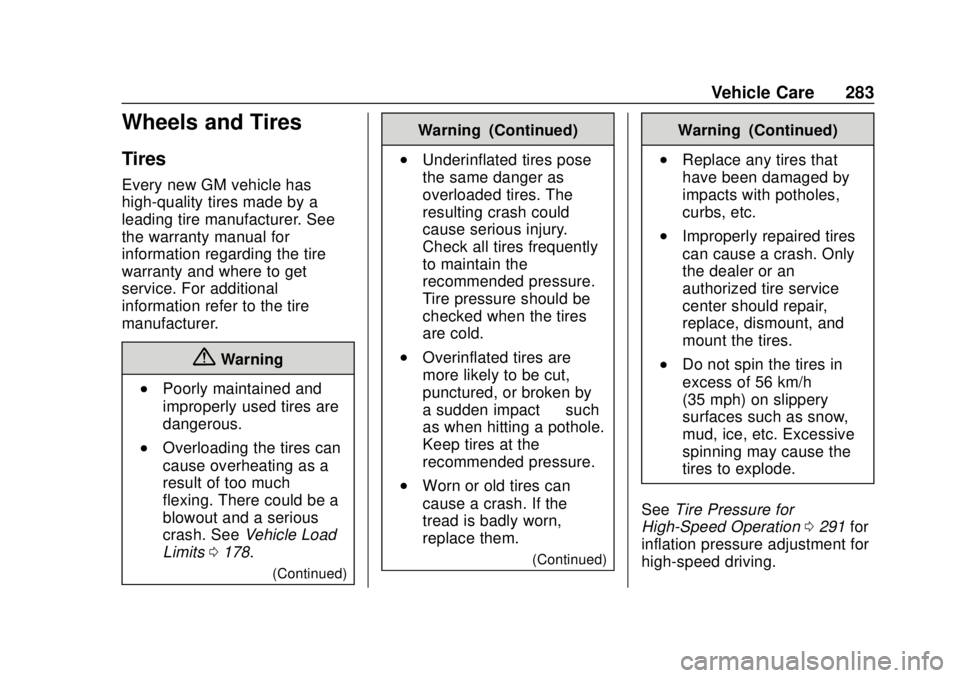
Wheels and Tires
Tires
Every new GM vehicle has
high-quality tires made by a
leading tire manufacturer. See
the warranty manual for
information regarding the tire
warranty and where to get
service. For additional
information refer to the tire
manufacturer.
{Warning
.Poorly maintained and
improperly used tires are
dangerous.
.Overloading the tires can
cause overheating as a
result of too much
flexing. There could be a
blowout and a serious
crash. SeeVehicle Load
Limits 0178.
(Continued)
Warning (Continued)
.Underinflated tires pose
the same danger as
overloaded tires. The
resulting crash could
cause serious injury.
Check all tires frequently
to maintain the
recommended pressure.
Tire pressure should be
checked when the tires
are cold.
.Overinflated tires are
more likely to be cut,
punctured, or broken by
a sudden impact —such
as when hitting a pothole.
Keep tires at the
recommended pressure.
.Worn or old tires can
cause a crash. If the
tread is badly worn,
replace them.
(Continued)
Warning (Continued)
.Replace any tires that
have been damaged by
impacts with potholes,
curbs, etc.
.Improperly repaired tires
can cause a crash. Only
the dealer or an
authorized tire service
center should repair,
replace, dismount, and
mount the tires.
.Do not spin the tires in
excess of 56 km/h
(35 mph) on slippery
surfaces such as snow,
mud, ice, etc. Excessive
spinning may cause the
tires to explode.
See Tire Pressure for
High-Speed Operation 0291 for
inflation pressure adjustment for
high-speed driving.
Page 291 of 382
Chevrolet Traverse Owner Manual (GMNA-Localizing-U.S./Canada/Mexico-
13527526) - 2020 - CRC - 9/5/19
290 Vehicle Care
capacity weight and the original
equipment tire size and
recommended inflation pressure.
See“Tire and Loading
Information Label” underVehicle
Load Limits 0178.
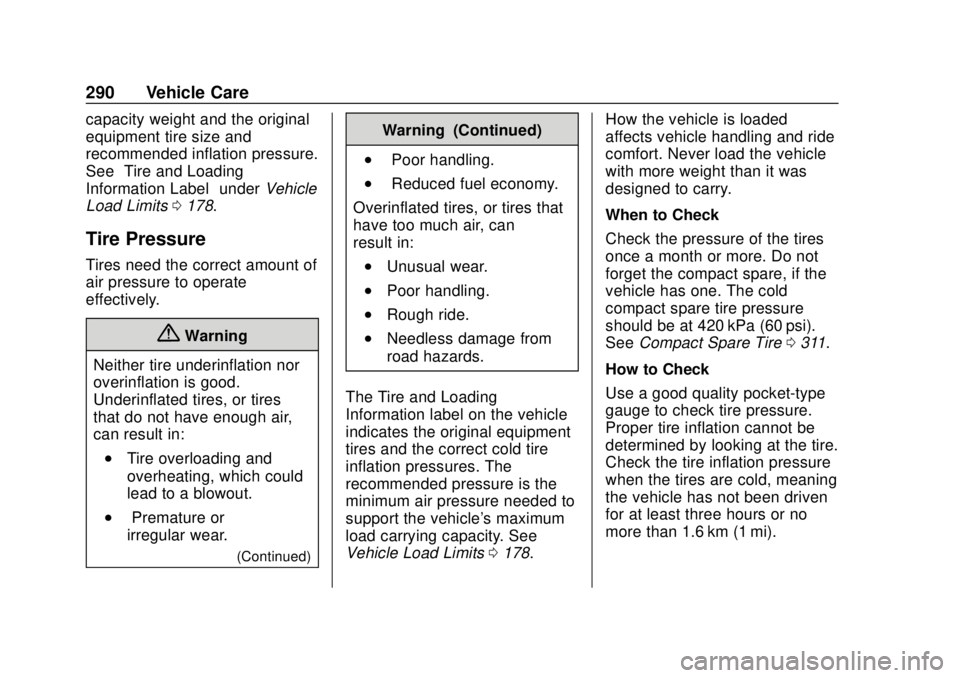
Tire Pressure
Tires need the correct amount of
air pressure to operate
effectively.
{Warning
Neither tire underinflation nor
overinflation is good.
Underinflated tires, or tires
that do not have enough air,
can result in:
.Tire overloading and
overheating, which could
lead to a blowout.
.Premature or
irregular wear.
(Continued)
Warning (Continued)
.Poor handling.
.Reduced fuel economy.
Overinflated tires, or tires that
have too much air, can
result in:
.Unusual wear.
.Poor handling.
.Rough ride.
.Needless damage from
road hazards.
The Tire and Loading
Information label on the vehicle
indicates the original equipment
tires and the correct cold tire
inflation pressures. The
recommended pressure is the
minimum air pressure needed to
support the vehicle's maximum
load carrying capacity. See
Vehicle Load Limits 0178. How the vehicle is loaded
affects vehicle handling and ride
comfort. Never load the vehicle
with more weight than it was
designed to carry.
When to Check
Check the pressure of the tires
once a month or more. Do not
forget the compact spare, if the
vehicle has one. The cold
compact spare tire pressure
should be at 420 kPa (60 psi).
See
Compact Spare Tire 0311.
How to Check
Use a good quality pocket-type
gauge to check tire pressure.
Proper tire inflation cannot be
determined by looking at the tire.
Check the tire inflation pressure
when the tires are cold, meaning
the vehicle has not been driven
for at least three hours or no
more than 1.6 km (1 mi).
Page 374 of 382

Chevrolet Traverse Owner Manual (GMNA-Localizing-U.S./Canada/Mexico-
13527526) - 2020 - CRC - 9/5/19
Index 373
DrivingAssistance Systems . . . . . . . . . . 219
Better Fuel Economy . . . . . . . . . 166
Characteristics and
Towing Tips . . . . . . . . . . . . . . . . . 233
Defensive . . . . . . . . . . . . . . . . . . . . . 167
Drunk . . . . . . . . . . . . . . . . . . . . . . . . . 167
Hill and Mountain Roads . . . . . . 175
If the Vehicle is Stuck . . . . . . . . . 177
Loss of Control . . . . . . . . . . . . . . . 169
Off-Road . . . . . . . . . . . . . . . . . . . . . 170
Off-Road Recovery . . . . . . . . . . . 169
Vehicle Load Limits . . . . . . . . . . . 178
Wet Roads . . . . . . . . . . . . . . . . . . . 174
Winter . . . . . . . . . . . . . . . . . . . . . . . . 176
Dual Automatic Climate
Control System . . . . . . . . . . . . . . . . 157
E
Electric Parking Brake . . . . . . . . . . 196
Electric Parking Brake Light . . . . 127
Electrical Equipment,Add-On . . . . . . . . . . . . . . . . . . . . . . . 246
Electrical System Engine Compartment FuseBlock . . . . . . . . . . . . . . . . . . . . . . . . 274
Fuses and Circuit Breakers . . . 274 Electrical System (cont'd)
Instrument Panel Fuse
Block . . . . . . . . . . . . . . . . . . . . . . . . 278
Overload . . . . . . . . . . . . . . . . . . . . . 273
Rear Compartment Fuse
Block . . . . . . . . . . . . . . . . . . . . . . . . 280
Emergency OnStar . . . . . . . . . . . . . . . . . . . . . . . 360
Engine
Air Cleaner/Filter . . . . . . . . . . . . . 257
Check Light (MalfunctionIndicator) . . . . . . . . . . . . . . . . . . . . 125
Compartment Overview . . . . . . . 252
Coolant Temperature Gauge . . . . . . . . . . . . . . . . . . . . . . 122
Cooling System . . . . . . . . . . . . . . . 258
Drive Belt Routing . . . . . . . . . . . . 344
Exhaust . . . . . . . . . . . . . . . . . . . . . . 190
Heater . . . . . . . . . . . . . . . . . . . . . . . . 186
Oil Life System . . . . . . . . . . . . . . . 255
Oil Pressure Light . . . . . . . . . . . . 131
Overheating . . . . . . . . . . . . . . . . . . 262
Power Messages . . . . . . . . . . . . . 137
Running While Parked . . . . . . . . 190
Starting . . . . . . . . . . . . . . . . . . . . . . . 184
Engine Air Filter Life System . . . . 257
Entry Lighting . . . . . . . . . . . . . . . . . . . 154
Equipment, Towing . . . . . . . . . . . . . 241 Event Data Recorders . . . . . . . . . . 357
Exit Lighting . . . . . . . . . . . . . . . . . . . . 154
Extended Parking . . . . . . . . . . . . . . . 189
Extender, Seat Belt . . . . . . . . . . . . . . 63
Exterior Lamp Controls . . . . . . . . . 147
Exterior Lighting Battery
Saver . . . . . . . . . . . . . . . . . . . . . . . . . 155
F
Filter,
Engine Air Cleaner . . . . . . . . . . . 257
Flash-to-Pass . . . . . . . . . . . . . . . . . . . 149
Flashers, Hazard Warning . . . . . . 151
Flat Tire . . . . . . . . . . . . . . . . . . . . . . . . 303
Changing . . . . . . . . . . . . . . . . . . . . . 305
Floor Mats . . . . . . . . . . . . . . . . . . . . . . 326
Fluid Automatic Transmission . . . . . . 256
Brakes . . . . . . . . . . . . . . . . . . . . . . . . 265
Washer . . . . . . . . . . . . . . . . . . . . . . . 263
Fog Lamps . . . . . . . . . . . . . . . . . . . . . 151
Folding Mirrors . . . . . . . . . . . . . . . . . . 31
Forward Collision Alert
(FCA) System . . . . . . . . . . . . . . . . . 219
Frequency Statement Radio . . . . . . . . . . . . . . . . . . . . . . . . . 355
Front Fog Lamp Light . . . . . . . . . . . . . . . . . . . . . . . . . . 132
Page 375 of 382

Chevrolet Traverse Owner Manual (GMNA-Localizing-U.S./Canada/Mexico-
13527526) - 2020 - CRC - 9/5/19
374 Index
Front Pedestrian Braking(FPB) System . . . . . . . . . . . . . . . . . 223
Front Seats Adjustment . . . . . . . . . . . . . . . . . . . . . 42
Heated and Ventilated . . . . . . . . . . 48
Fuel Additives . . . . . . . . . . . . . . . . . . . . . 230
Economy, Driving for Better . . . 166
Filling a Portable Fuel
Container . . . . . . . . . . . . . . . . . . . 232
Filling the Tank . . . . . . . . . . . . . . . 231
Foreign Countries . . . . . . . . . . . . 230
Gauge . . . . . . . . . . . . . . . . . . . . . . . . 121
Low Fuel Warning
Light . . . . . . . . . . . . . . . . . . . 131, 132
Prohibited Fuels . . . . . . . . . . . . . . 230
Recommended . . . . . . . . . . . . . . . 230
Top Tier . . . . . . . . . . . . . . . . . . . . . . 229
Fuses Engine Compartment FuseBlock . . . . . . . . . . . . . . . . . . . . . . . . 274
Fuses and Circuit Breakers . . . 274
Instrument Panel Fuse Block . . . . . . . . . . . . . . . . . . . . . . . . 278
Rear Compartment Fuse
Block . . . . . . . . . . . . . . . . . . . . . . . . 280G
Garage Door Opener . . . . . . . . . . . 143Programming . . . . . . . . . . . . . . . . . 143
Gas Strut(s) . . . . . . . . . . . . . . . . . . . . 269
Gauges Engine CoolantTemperature . . . . . . . . . . . . . . . . 122
Fuel . . . . . . . . . . . . . . . . . . . . . . . . . . 121
Odometer . . . . . . . . . . . . . . . . . . . . . 120
Speedometer . . . . . . . . . . . . . . . . . 120
Tachometer . . . . . . . . . . . . . . . . . . . 120
Trip Odometer . . . . . . . . . . . . . . . . 120
Warning Lights and Indicators . . . . . . . . . . . . . . . . . . . .114
General Information Service and Maintenance . . . . . 327
Towing . . . . . . . . . . . . . . . . . . . . . . . . 233
Vehicle Care . . . . . . . . . . . . . . . . . . 248
Glove Box . . . . . . . . . . . . . . . . . . . . . . 100
GM Mobility Reimbursement
Program . . . . . . . . . . . . . . . . . . . . . . . 349
H
Hazard Warning Flashers . . . . . . . 151
Head Restraints . . . . . . . . . . . . . . . . . 40
HeadlampsAiming . . . . . . . . . . . . . . . . . . . . . . . . 271
Automatic . . . . . . . . . . . . . . . . . . . . . 150 Headlamps (cont'd)
Bulb Replacement . . . . . . . . . . . . 271
Daytime Running
Lamps (DRL) . . . . . . . . . . . . . . . . 149
Flash-to-Pass . . . . . . . . . . . . . . . . . 149
High Intensity Discharge (HID) Lighting . . . . . . . . . . . . . . . 271
High-Beam On Light . . . . . . . . . . 132
High/Low Beam Changer . . . . . 149
Lamps On Reminder . . . . . . . . . 133
Heated Rear Seats . . . . . . . . . . . . . . . . . . . . . 52
Steering Wheel . . . . . . . . . . . . . . . 106
Heated and Ventilated Front
Seats . . . . . . . . . . . . . . . . . . . . . . . . . . 48
Heated Mirrors . . . . . . . . . . . . . . . . . . . 32
Heater Engine . . . . . . . . . . . . . . . . . . . . . . . . 186
Heating . . . . . . . . . . . . . . . . . . . . 157, 161
High Voltage Devices and Wiring . . . . . . . . . . . . . . . . . . . . . . . . . 273
High-Beam On Light . . . . . . . . . . . . 132
High-Speed Operation . . . . . . . . . . 291
Hill and Mountain Roads . . . . . . . . 175
Hill Start Assist (HSA) . . . . . . . . . . 197
Hood . . . . . . . . . . . . . . . . . . . . . . . . . . . 250
Horn . . . . . . . . . . . . . . . . . . . . . . . . . . . . 107