Cooling CHEVROLET TRAX 2013 1.G User Guide
[x] Cancel search | Manufacturer: CHEVROLET, Model Year: 2013, Model line: TRAX, Model: CHEVROLET TRAX 2013 1.GPages: 408, PDF Size: 6.59 MB
Page 282 of 408
Black plate (18,1)Chevrolet TRAX Owner Manual - 2013 - CRC - 3/6/13
10-18 Vehicle Care
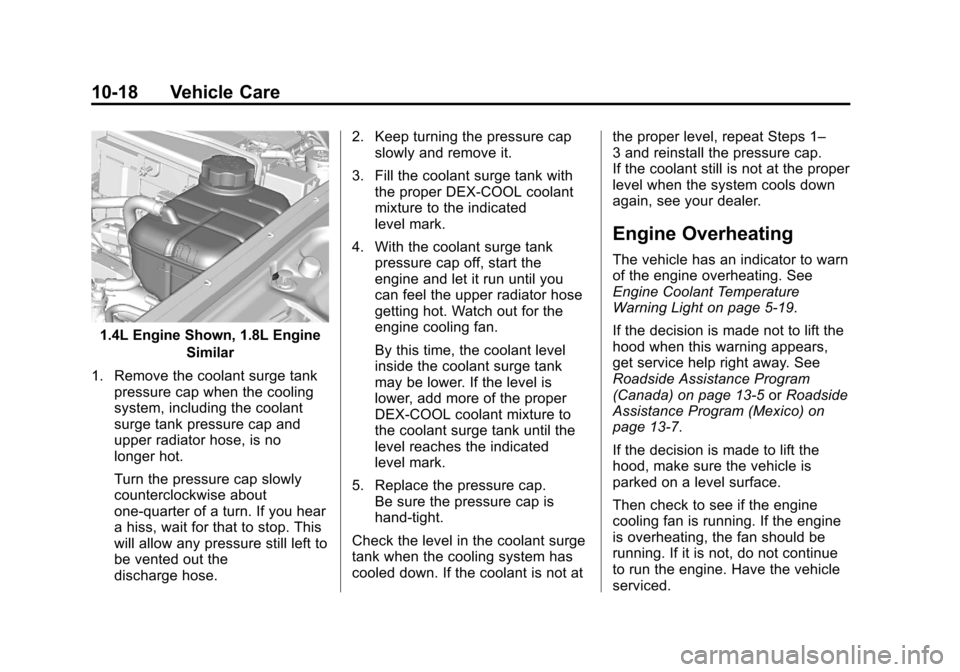
1.4L Engine Shown, 1.8L EngineSimilar
1. Remove the coolant surge tank pressure cap when the cooling
system, including the coolant
surge tank pressure cap and
upper radiator hose, is no
longer hot.
Turn the pressure cap slowly
counterclockwise about
one-quarter of a turn. If you hear
a hiss, wait for that to stop. This
will allow any pressure still left to
be vented out the
discharge hose. 2. Keep turning the pressure cap
slowly and remove it.
3. Fill the coolant surge tank with the proper DEX-COOL coolant
mixture to the indicated
level mark.
4. With the coolant surge tank pressure cap off, start the
engine and let it run until you
can feel the upper radiator hose
getting hot. Watch out for the
engine cooling fan.
By this time, the coolant level
inside the coolant surge tank
may be lower. If the level is
lower, add more of the proper
DEX-COOL coolant mixture to
the coolant surge tank until the
level reaches the indicated
level mark.
5. Replace the pressure cap. Be sure the pressure cap is
hand-tight.
Check the level in the coolant surge
tank when the cooling system has
cooled down. If the coolant is not at the proper level, repeat Steps 1–
3 and reinstall the pressure cap.
If the coolant still is not at the proper
level when the system cools down
again, see your dealer.
Engine Overheating
The vehicle has an indicator to warn
of the engine overheating. See
Engine Coolant Temperature
Warning Light on page 5‑19.
If the decision is made not to lift the
hood when this warning appears,
get service help right away. See
Roadside Assistance Program
(Canada) on page 13‑5
orRoadside
Assistance Program (Mexico) on
page 13‑7.
If the decision is made to lift the
hood, make sure the vehicle is
parked on a level surface.
Then check to see if the engine
cooling fan is running. If the engine
is overheating, the fan should be
running. If it is not, do not continue
to run the engine. Have the vehicle
serviced.
Page 299 of 408
Black plate (35,1)Chevrolet TRAX Owner Manual - 2013 - CRC - 3/6/13
Vehicle Care 10-35
Mini Fuses Usage32 Right High-Beam Headlamp
33 Engine Control Module Battery
34 Horn
35 Air Conditioning Compressor Clutch
36 Front Fog Lamps
J-Case Fuses Usage
1 Electronic Brake Control
Module Pump
2 Front Wiper
3 Blower Motor
4 IEC R/C
5 Not Used
6 Not Used J-Case
Fuses Usage
7 Not Used
8 Cooling Fan Low/ Mid (1.4L)/Cooling
Fan Low (1.8L)
9 Cooling Fan High
10 EVP 11 Starter Solenoid
U-Micro Relays Usage
2 Fuel Pump (1.8L Only)
4 Spare
HC-Micro Relays Usage
7 Starter Mini
Relays Usage
1 Run Crank
3 Cooling Fan Mid (1.4L Only)
5 Powertrain Relay
8 Cooling Fan Low
HC-Mini Relays Usage
6 Cooling Fan High
Page 300 of 408
Black plate (36,1)Chevrolet TRAX Owner Manual - 2013 - CRC - 3/6/13
10-36 Vehicle Care
Auxiliary Fuse Block
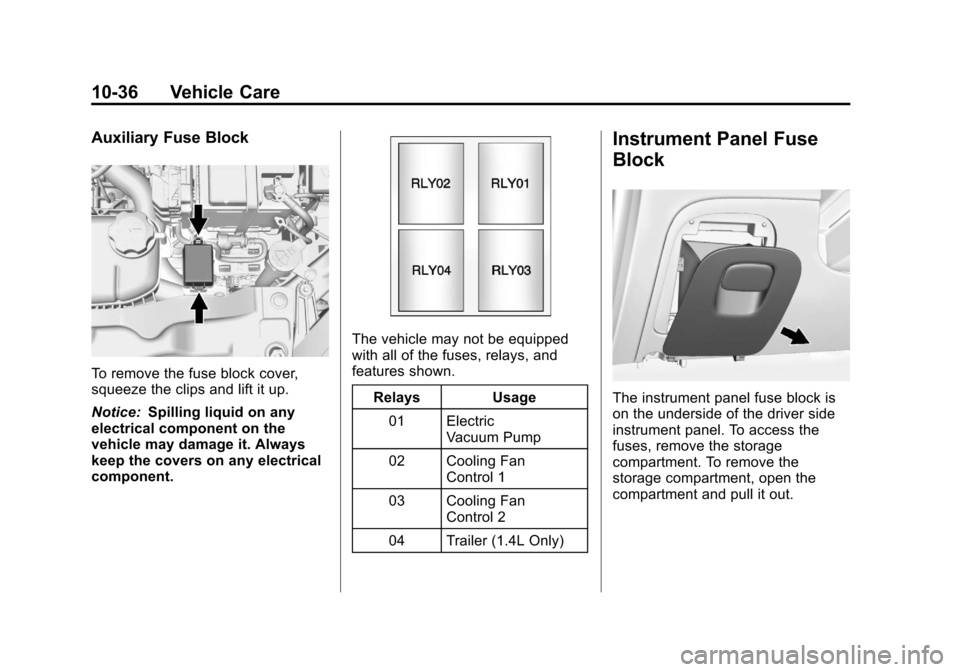
To remove the fuse block cover,
squeeze the clips and lift it up.
Notice:Spilling liquid on any
electrical component on the
vehicle may damage it. Always
keep the covers on any electrical
component.
The vehicle may not be equipped
with all of the fuses, relays, and
features shown.
Relays Usage01 Electric Vacuum Pump
02 Cooling Fan Control 1
03 Cooling Fan Control 2
04 Trailer (1.4L Only)
Instrument Panel Fuse
Block
The instrument panel fuse block is
on the underside of the driver side
instrument panel. To access the
fuses, remove the storage
compartment. To remove the
storage compartment, open the
compartment and pull it out.
Page 324 of 408
Black plate (60,1)Chevrolet TRAX Owner Manual - 2013 - CRC - 3/6/13
10-60 Vehicle Care
will not be necessary on a regular
basis. However, check the
alignment if there is unusual tire
wear or if the vehicle is pulling to
one side or the other. If the vehicle
vibrates when driving on a smooth
road, the tires and wheels might
need to be rebalanced. See your
dealer for proper diagnosis.
Wheel Replacement
Replace any wheel that is bent,
cracked, or badly rusted or
corroded. If wheel nuts keep coming
loose, the wheel, wheel bolts, and
wheel nuts should be replaced.
If the wheel leaks air, replace it.
Some aluminum wheels can be
repaired. See your dealer if any of
these conditions exist.
Your dealer will know the kind of
wheel that is needed.
Each new wheel should have the
same load-carrying capacity,
diameter, width, offset, and be
mounted the same way as the one it
replaces.Replace wheels, wheel bolts, wheel
nuts, or Tire Pressure Monitor
System (TPMS) sensors with new
GM original equipment parts.
{WARNING
Using the wrong replacement
wheels, wheel bolts, or wheel
nuts can be dangerous. It could
affect the braking and handling of
the vehicle. Tires can lose air,
and cause loss of control, causing
a crash. Always use the correct
wheel, wheel bolts, and wheel
nuts for replacement.
Notice: The wrong wheel can
also cause problems with bearing
life, brake cooling, speedometer
or odometer calibration,
headlamp aim, bumper height,
vehicle ground clearance, and tire
or tire chain clearance to the
body and chassis.
Used Replacement Wheels
{WARNING
Replacing a wheel with a used
one is dangerous. How it has
been used or how far it has been
driven may be unknown. It could
fail suddenly and cause a crash.
When replacing wheels, use a
new GM original equipment
wheel.
Tire Chains
{WARNING
Do not use tire chains. There is
not enough clearance. Tire chains
used on a vehicle without the
proper amount of clearance can
cause damage to the brakes,
suspension, or other vehicle
(Continued)
Page 350 of 408
Black plate (4,1)Chevrolet TRAX Owner Manual - 2013 - CRC - 3/6/13
11-4 Service and Maintenance
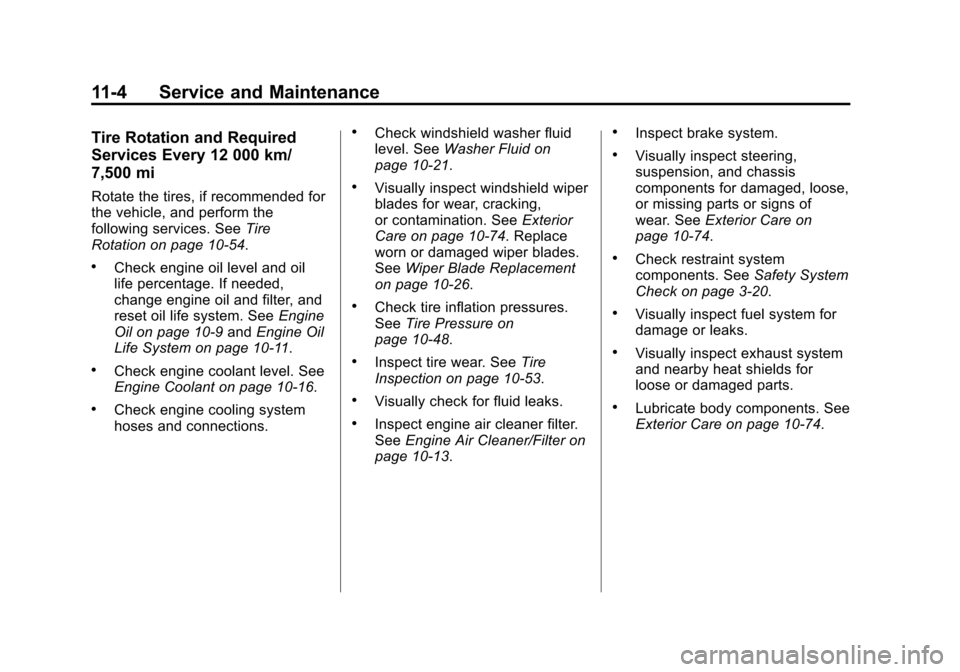
Tire Rotation and Required
Services Every 12 000 km/
7,500 mi
Rotate the tires, if recommended for
the vehicle, and perform the
following services. SeeTire
Rotation on page 10‑54.
.Check engine oil level and oil
life percentage. If needed,
change engine oil and filter, and
reset oil life system. See Engine
Oil on page 10‑9 andEngine Oil
Life System on page 10‑11.
.Check engine coolant level. See
Engine Coolant on page 10‑16.
.Check engine cooling system
hoses and connections.
.Check windshield washer fluid
level. See Washer Fluid on
page 10‑21.
.Visually inspect windshield wiper
blades for wear, cracking,
or contamination. See Exterior
Care on page 10‑74. Replace
worn or damaged wiper blades.
See Wiper Blade Replacement
on page 10‑26.
.Check tire inflation pressures.
See Tire Pressure on
page 10‑48.
.Inspect tire wear. See Tire
Inspection on page 10‑53.
.Visually check for fluid leaks.
.Inspect engine air cleaner filter.
See Engine Air Cleaner/Filter on
page 10‑13.
.Inspect brake system.
.Visually inspect steering,
suspension, and chassis
components for damaged, loose,
or missing parts or signs of
wear. See Exterior Care on
page 10‑74.
.Check restraint system
components. See Safety System
Check on page 3‑20.
.Visually inspect fuel system for
damage or leaks.
.Visually inspect exhaust system
and nearby heat shields for
loose or damaged parts.
.Lubricate body components. See
Exterior Care on page 10‑74.
Page 352 of 408
Black plate (6,1)Chevrolet TRAX Owner Manual - 2013 - CRC - 3/6/13
11-6 Service and Maintenance
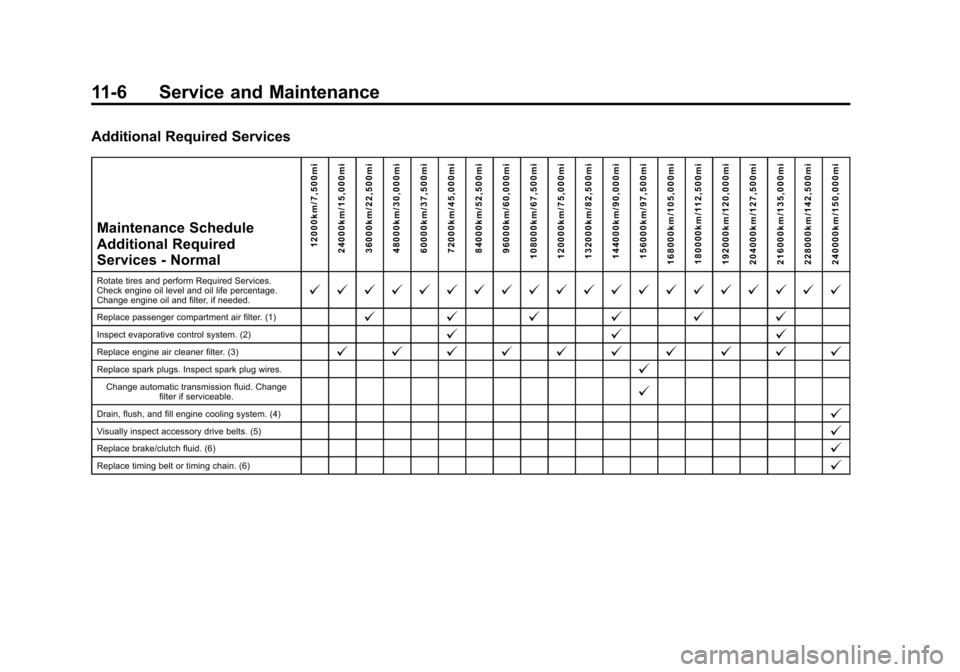
Additional Required ServicesMaintenance Schedule
Additional Required
Services - Normal
12000km/7,500mi
24000km/15,000mi
36000km/22,500mi
48000km/30,000mi
60000km/37,500mi
72000km/45,000mi
84000km/52,500mi
96000km/60,000mi
108000km/67,500mi
120000km/75,000mi
132000km/82,500mi
144000km/90,000mi
156000km/97,500mi
168000km/105,000mi 180000km/112,500mi
192000km/120,000mi
204000km/127,500mi
216000km/135,000mi
228000km/142,500mi
240000km/150,000mi
Rotate tires and perform Required Services.
Check engine oil level and oil life percentage.
Change engine oil and filter, if needed.@ @ @ @ @ @ @ @ @ @ @ @ @ @ @ @ @ @ @ @
Replace passenger compartment air filter. (1)@ @@@@@
Inspect evaporative control system. (2)@ @@
Replace engine air cleaner filter. (3)@ @ @ @ @ @ @ @ @ @
Replace spark plugs. Inspect spark plug wires.@
Change automatic transmission fluid. Change
filter if serviceable.@
Drain, flush, and fill engine cooling system. (4)@
Visually inspect accessory drive belts. (5)@
Replace brake/clutch fluid. (6)@
Replace timing belt or timing chain. (6)@
Page 353 of 408
Black plate (7,1)Chevrolet TRAX Owner Manual - 2013 - CRC - 3/6/13
Service and Maintenance 11-7
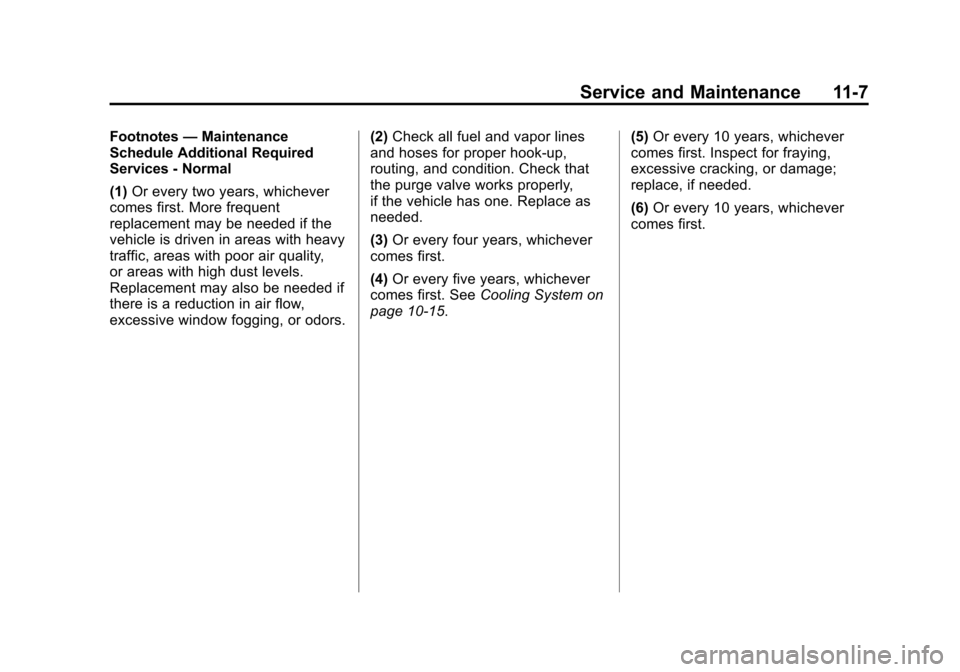
Footnotes—Maintenance
Schedule Additional Required
Services - Normal
(1) Or every two years, whichever
comes first. More frequent
replacement may be needed if the
vehicle is driven in areas with heavy
traffic, areas with poor air quality,
or areas with high dust levels.
Replacement may also be needed if
there is a reduction in air flow,
excessive window fogging, or odors. (2)
Check all fuel and vapor lines
and hoses for proper hook-up,
routing, and condition. Check that
the purge valve works properly,
if the vehicle has one. Replace as
needed.
(3) Or every four years, whichever
comes first.
(4) Or every five years, whichever
comes first. See Cooling System on
page 10‑15. (5)
Or every 10 years, whichever
comes first. Inspect for fraying,
excessive cracking, or damage;
replace, if needed.
(6) Or every 10 years, whichever
comes first.
Page 354 of 408
Black plate (8,1)Chevrolet TRAX Owner Manual - 2013 - CRC - 3/6/13
11-8 Service and Maintenance
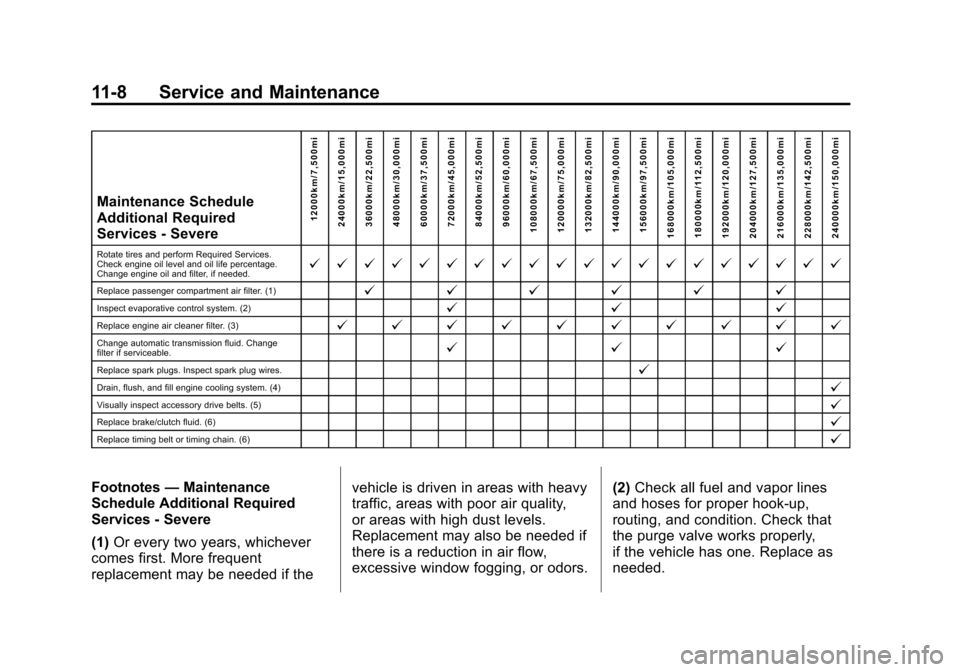
Maintenance Schedule
Additional Required
Services - Severe12000km/7,500mi
24000km/15,000mi
36000km/22,500mi
48000km/30,000mi
60000km/37,500mi
72000km/45,000mi
84000km/52,500mi
96000km/60,000mi
108000km/67,500mi
120000km/75,000mi
132000km/82,500mi
144000km/90,000mi
156000km/97,500mi
168000km/105,000mi 180000km/112,500mi
192000km/120,000mi
204000km/127,500mi
216000km/135,000mi
228000km/142,500mi
240000km/150,000mi
Rotate tires and perform Required Services.
Check engine oil level and oil life percentage.
Change engine oil and filter, if needed.@ @ @ @ @ @ @ @ @ @ @ @ @ @ @ @ @ @ @ @
Replace passenger compartment air filter. (1)@ @@@@@
Inspect evaporative control system. (2)@ @@
Replace engine air cleaner filter. (3)@ @ @ @ @ @ @ @ @ @
Change automatic transmission fluid. Change
filter if serviceable.@@@
Replace spark plugs. Inspect spark plug wires.@
Drain, flush, and fill engine cooling system. (4)@
Visually inspect accessory drive belts. (5)@
Replace brake/clutch fluid. (6)@
Replace timing belt or timing chain. (6)@
Footnotes—Maintenance
Schedule Additional Required
Services - Severe
(1) Or every two years, whichever
comes first. More frequent
replacement may be needed if the vehicle is driven in areas with heavy
traffic, areas with poor air quality,
or areas with high dust levels.
Replacement may also be needed if
there is a reduction in air flow,
excessive window fogging, or odors.
(2)
Check all fuel and vapor lines
and hoses for proper hook-up,
routing, and condition. Check that
the purge valve works properly,
if the vehicle has one. Replace as
needed.
Page 355 of 408
Black plate (9,1)Chevrolet TRAX Owner Manual - 2013 - CRC - 3/6/13
Service and Maintenance 11-9
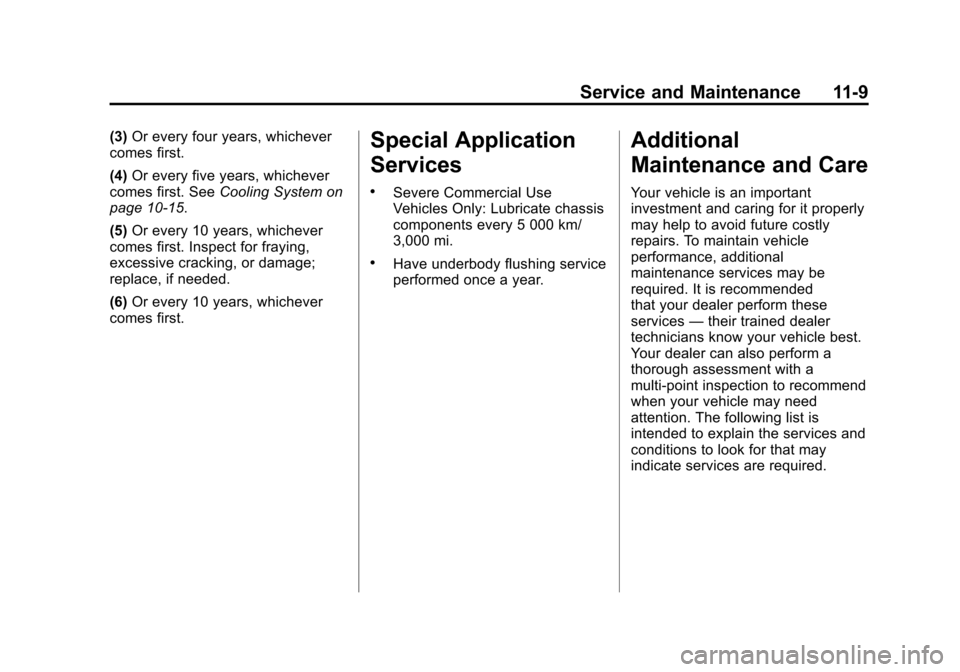
(3)Or every four years, whichever
comes first.
(4) Or every five years, whichever
comes first. See Cooling System on
page 10‑15.
(5) Or every 10 years, whichever
comes first. Inspect for fraying,
excessive cracking, or damage;
replace, if needed.
(6) Or every 10 years, whichever
comes first.Special Application
Services
.Severe Commercial Use
Vehicles Only: Lubricate chassis
components every 5 000 km/
3,000 mi.
.Have underbody flushing service
performed once a year.
Additional
Maintenance and Care
Your vehicle is an important
investment and caring for it properly
may help to avoid future costly
repairs. To maintain vehicle
performance, additional
maintenance services may be
required. It is recommended
that your dealer perform these
services —their trained dealer
technicians know your vehicle best.
Your dealer can also perform a
thorough assessment with a
multi‐point inspection to recommend
when your vehicle may need
attention. The following list is
intended to explain the services and
conditions to look for that may
indicate services are required.
Page 366 of 408
Black plate (2,1)Chevrolet TRAX Owner Manual - 2013 - CRC - 3/6/13
12-2 Technical Data
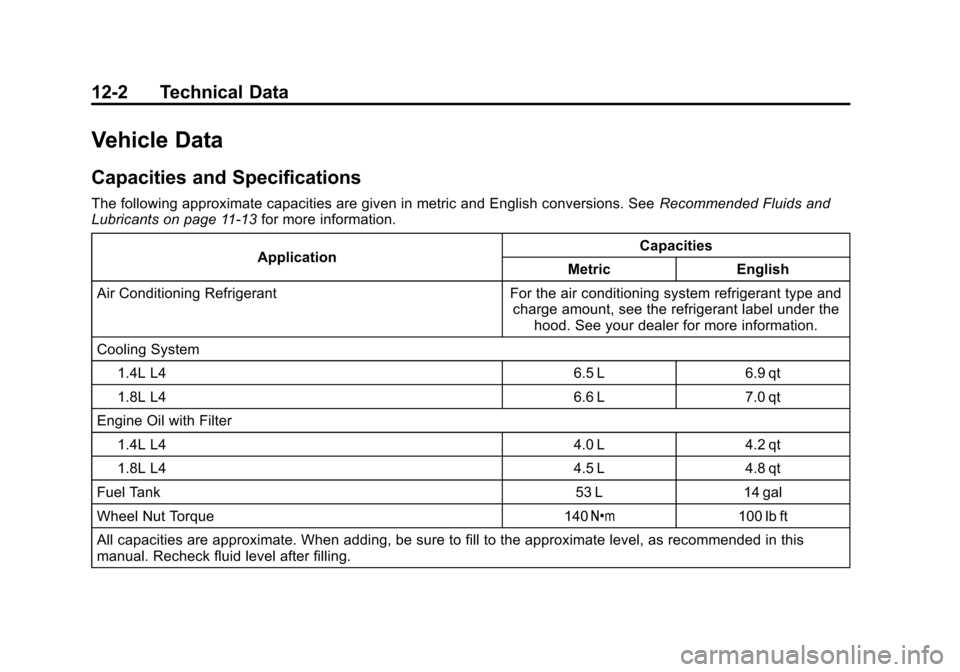
Vehicle Data
Capacities and Specifications
The following approximate capacities are given in metric and English conversions. SeeRecommended Fluids and
Lubricants on page 11‑13 for more information.
Application Capacities
Metric English
Air Conditioning Refrigerant For the air conditioning system refrigerant type and charge amount, see the refrigerant label under thehood. See your dealer for more information.
Cooling System 1.4L L4 6.5 L 6.9 qt
1.8L L4 6.6 L 7.0 qt
Engine Oil with Filter 1.4L L4 4.0 L4.2 qt
1.8L L4 4.5 L4.8 qt
Fuel Tank 53 L14 gal
Wheel Nut Torque 140Y 100 lb ft
All capacities are approximate. When adding, be sure to fill to the approximate level, as recommended in this
manual. Recheck fluid level after filling.