clock CHEVROLET TRAX 2016 1.G Owner's Manual
[x] Cancel search | Manufacturer: CHEVROLET, Model Year: 2016, Model line: TRAX, Model: CHEVROLET TRAX 2016 1.GPages: 358, PDF Size: 5.07 MB
Page 290 of 358
Chevrolet TRAX Owner Manual (GMNA-Localizing-U.S./Canada/Mexico-
9159371) - 2016 - crc - 5/21/15
Vehicle Care 289
Warning (Continued)
you could be badly injured or
killed. Never get under a vehicle
when it is supported only by
a jack.
{Warning
Raising the vehicle with the jack
improperly positioned can
damage the vehicle and even
make the vehicle fall. To help
avoid personal injury and vehicle
damage, be sure to fit the jack lift
head into the proper location
before raising the vehicle.
{Warning
Lifting a vehicle and getting under
it to do maintenance or repairs is
dangerous without the
appropriate safety equipment and(Continued)
Warning (Continued)
training. If a jack is provided with
the vehicle, it is designed only for
changing a flat tire. If it is used for
anything else, you or others could
be badly injured or killed if the
vehicle slips off the jack. If a jack
is provided with the vehicle, only
use it for changing a flat tire.
7. Turn the wheel wrench clockwise to raise the vehicle
far enough off the ground so
there is enough room for the
spare tire to fit underneath the
wheel well.
8. Turn the wheel nuts counterclockwise to
remove them.
9. Remove the flat tire.
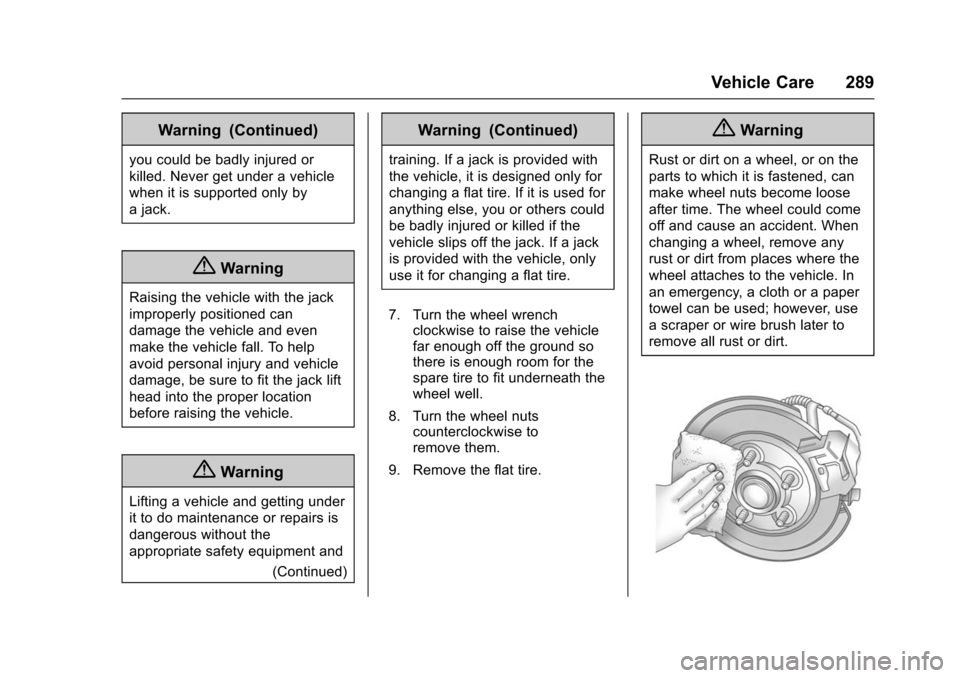
{Warning
Rust or dirt on a wheel, or on the
parts to which it is fastened, can
make wheel nuts become loose
after time. The wheel could come
off and cause an accident. When
changing a wheel, remove any
rust or dirt from places where the
wheel attaches to the vehicle. In
an emergency, a cloth or a paper
towel can be used; however, use
a scraper or wire brush later to
remove all rust or dirt.
Page 291 of 358
Chevrolet TRAX Owner Manual (GMNA-Localizing-U.S./Canada/Mexico-
9159371) - 2016 - crc - 5/21/15
290 Vehicle Care
10. Remove any rust or dirt fromthe wheel bolts, mounting
surfaces, and spare wheel.
11. Place the spare tire on the wheel-mounting surface.
{Warning
Never use oil or grease on bolts
or nuts because the nuts might
come loose. The vehicle's wheel
could fall off, causing a crash.
12. Reinstall the wheel nuts. Turn each nut clockwise, by hand,
until the wheel is held against
the hub.
13. Lower the vehicle by turning the wheel wrench
counterclockwise. Lower the
jack completely.
{Warning
Wheel nuts that are improperly or
incorrectly tightened can cause
the wheels to become loose or
(Continued)
Warning (Continued)
come off. The wheel nuts should
be tightened with a torque wrench
to the proper torque specification
after replacing. Follow the torque
specification supplied by the
aftermarket manufacturer when
using accessory locking wheel
nuts. SeeCapacities and
Specifications 0321 for original
equipment wheel nut torque
specifications.
Caution
Improperly tightened wheel nuts
can lead to brake pulsation and
rotor damage. To avoid expensive
brake repairs, evenly tighten the
wheel nuts in the proper
sequence and to the proper
torque specification. See
Capacities and Specifications
0 321 for the wheel nut torque
specification.
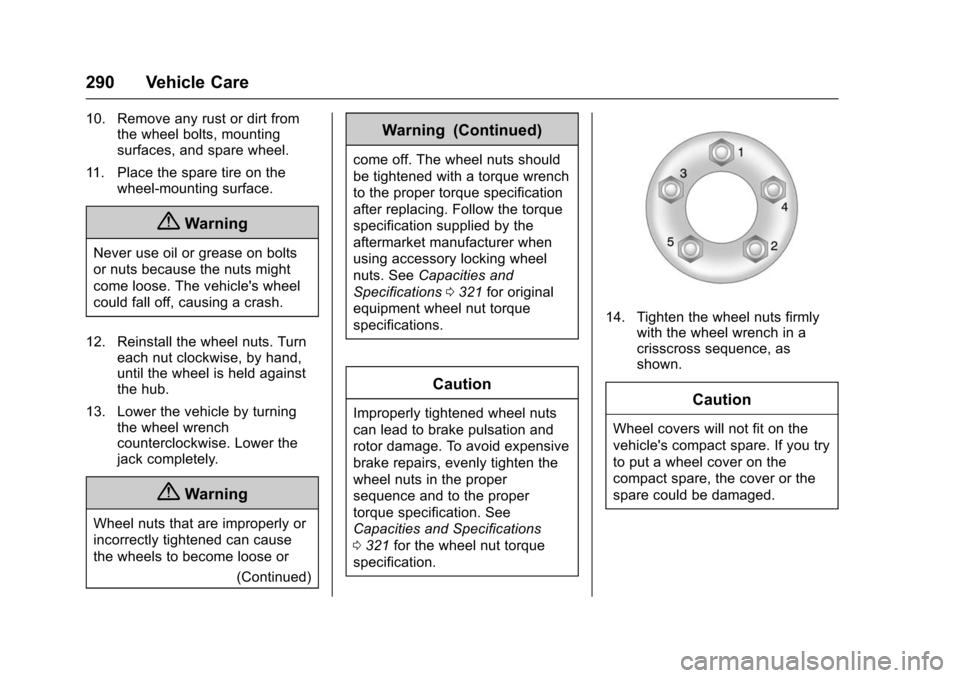
14. Tighten the wheel nuts firmly with the wheel wrench in a
crisscross sequence, as
shown.
Caution
Wheel covers will not fit on the
vehicle's compact spare. If you try
to put a wheel cover on the
compact spare, the cover or the
spare could be damaged.
Page 297 of 358
Chevrolet TRAX Owner Manual (GMNA-Localizing-U.S./Canada/Mexico-
9159371) - 2016 - crc - 5/21/15
296 Vehicle Care
Caution
Improper use of the tow eye can
cause vehicle damage. Use
caution and low speeds to
prevent damage to the vehicle.
If equipped, carefully open the cover
by using the small notch that
conceals the tow eye socket.
Install the tow eye into the socket by
turning it clockwise until it stops.
When the tow eye is removed,
reinstall the cover with the notch in
the original position.
Consult your dealer or a
professional towing service if the
disabled vehicle must be towed.
Recreational Vehicle
Towing
Recreational vehicle towing means
towing the vehicle behind another
vehicle, such as behind a motor
home. The two most common types
of recreational vehicle towing are
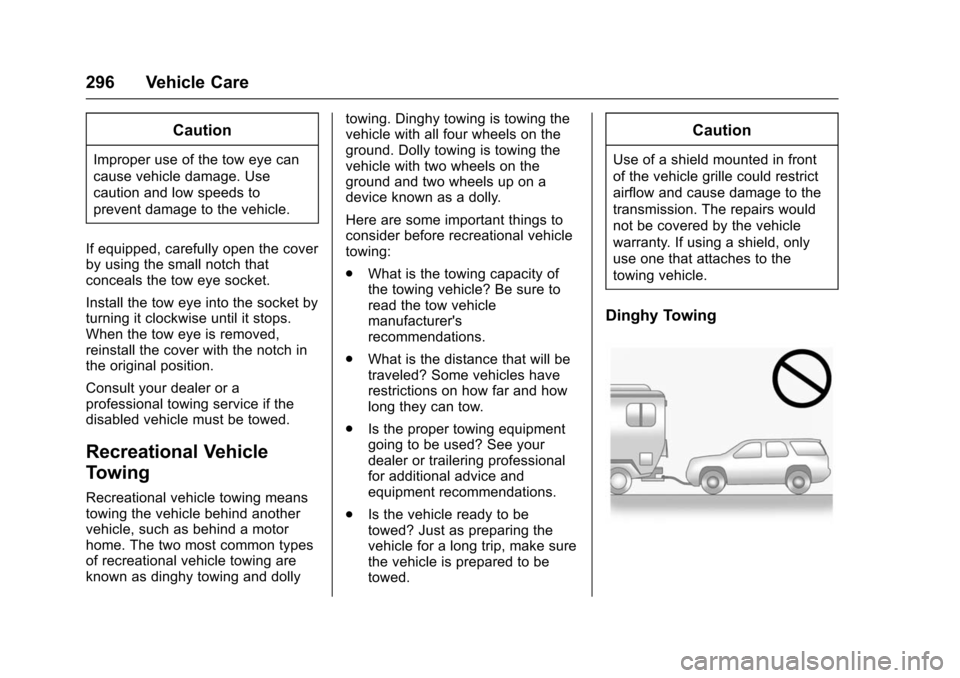
known as dinghy towing and dolly towing. Dinghy towing is towing the
vehicle with all four wheels on the
ground. Dolly towing is towing the
vehicle with two wheels on the
ground and two wheels up on a
device known as a dolly.
Here are some important things to
consider before recreational vehicle
towing:
.
What is the towing capacity of
the towing vehicle? Be sure to
read the tow vehicle
manufacturer's
recommendations.
. What is the distance that will be
traveled? Some vehicles have
restrictions on how far and how
long they can tow.
. Is the proper towing equipment
going to be used? See your
dealer or trailering professional
for additional advice and
equipment recommendations.
. Is the vehicle ready to be
towed? Just as preparing the
vehicle for a long trip, make sure
the vehicle is prepared to be
towed.
Caution
Use of a shield mounted in front
of the vehicle grille could restrict
airflow and cause damage to the
transmission. The repairs would
not be covered by the vehicle
warranty. If using a shield, only
use one that attaches to the
towing vehicle.
Dinghy Towing
Page 350 of 358

Chevrolet TRAX Owner Manual (GMNA-Localizing-U.S./Canada/Mexico-
9159371) - 2016 - crc - 5/21/15
Index 349
Cleaning (cont'd)Interior Care . . . . . . . . . . . . . . . . . . 303
Climate Control Systems . . . . . . . 186 Air Conditioning . . . . . . . . . . . . . . 186
Heating . . . . . . . . . . . . . . . . . . . . . . . 186
Clock . . . . . . . . . . . . . . . . . . . . . . . . . . . . 93
Cluster, Instrument . . . . . . . . . . . . . . 97
Clutch, Hydraulic . . . . . . . . . . . . . . . 242
Collision Damage Repair . . . . . . . 330
Compact Spare Tire . . . . . . . . . . . . 291
Compartments Storage . . . . . . . . . . . . . . . . . . . . . . . . . 86
Compass . . . . . . . . . . . . . . . . . . . . . . . . 93
Computer, Trip . . . . . . . . . . . . . . . . . . 112
Connections OnStar
®. . . . . . . . . . . . . . . . . . . . . . 339
Control Traction and Electronic
Stability . . . . . . . . . . . . . . . . . . . . . 218
Control of a Vehicle . . . . . . . . . . . . . 193
Convenience Net . . . . . . . . . . . . . . . . 88
Convex Mirrors . . . . . . . . . . . . . . . . . . 35
Coolant Engine . . . . . . . . . . . . . . . . . . . . . . . . 244
Engine TemperatureWarning Light . . . . . . . . . . . . . . . 106
Cooling System . . . . . . . . . . . . . . . . . 243
Courtesy Lamps . . . . . . . . . . . . . . . . 126 Courtesy Transportation
Program . . . . . . . . . . . . . . . . . . . . . . . 329
Cover Cargo . . . . . . . . . . . . . . . . . . . . . . . . . . . 87
Cruise Control . . . . . . . . . . . . . . . . . . 220 Light . . . . . . . . . . . . . . . . . . . . . . . . . . 109
Cupholders . . . . . . . . . . . . . . . . . . . . . . 87
Customer Assistance . . . . . . . . . . . 326
Offices . . . . . . . . . . . . . . . . . . . . . . . . 325
Text Telephone (TTY)Users . . . . . . . . . . . . . . . . . . . . . . . 326
Customer Information Service PublicationsOrdering Information . . . . . . . . 332
Customer Satisfaction Procedure . . . . . . . . . . . . . . . . . . . . . 323
D
Damage Repair, Collision . . . . . . . 330
Danger, Warning, and Caution . . . . 3
Data Recorders, Event . . . . . . . . . 335
Daytime Running
Lamps (DRL) . . . . . . . . . . . . . . . . . . 123
Indicator Light . . . . . . . . . . . . . . . . 108
Defensive Driving . . . . . . . . . . . . . . . 193
Delayed Locking . . . . . . . . . . . . . . . . . 30
Devices Auxiliary . . . . . . . . . . . . . . . . . . . . . . 151 Diagnostics
OnStar
®. . . . . . . . . . . . . . . . . . . . . . 341
Distracted Driving . . . . . . . . . . . . . . . 192
Dome Lamps . . . . . . . . . . . . . . . . . . . 126
Door Ajar Light . . . . . . . . . . . . . . . . . . . . . 109
Delayed Locking . . . . . . . . . . . . . . . . 30
Locks . . . . . . . . . . . . . . . . . . . . . . . . . . . 29
Power Locks . . . . . . . . . . . . . . . . . . . . 30
Drive Belt Routing, Engine . . . . . . 322
Drive Systems All-Wheel Drive . . . . . . . . . . 216, 253
Driver Behavior . . . . . . . . . . . . . . . . . 192
Driver Information Center (DIC) . . . . . . . . . . . . . . . . . . 109
Driving
Defensive . . . . . . . . . . . . . . . . . . . . . 193
Drunk . . . . . . . . . . . . . . . . . . . . . . . . . 193
Environment . . . . . . . . . . . . . . . . . . 192
For Better Fuel Economy . . . . . . . 23
Hill and Mountain Roads . . . . . . 197
If the Vehicle is Stuck . . . . . . . . . 198
Loss of Control . . . . . . . . . . . . . . . 195
Off-Road Recovery . . . . . . . . . . . 195
Vehicle Load Limits . . . . . . . . . . . 199
Wet Roads . . . . . . . . . . . . . . . . . . . 196
Winter . . . . . . . . . . . . . . . . . . . . . . . . 197
Driving the Vehicle . . . . . . . . . . . . . . . . 3