warning light CHEVROLET TRAX 2018 Workshop Manual
[x] Cancel search | Manufacturer: CHEVROLET, Model Year: 2018, Model line: TRAX, Model: CHEVROLET TRAX 2018Pages: 366, PDF Size: 5.44 MB
Page 249 of 366
Chevrolet TRAX Owner Manual (GMNA-Localizing-U.S./Canada/Mexico-
11354406) - 2018 - crc - 10/12/17
248 Vehicle Care
Checking Brake Fluid
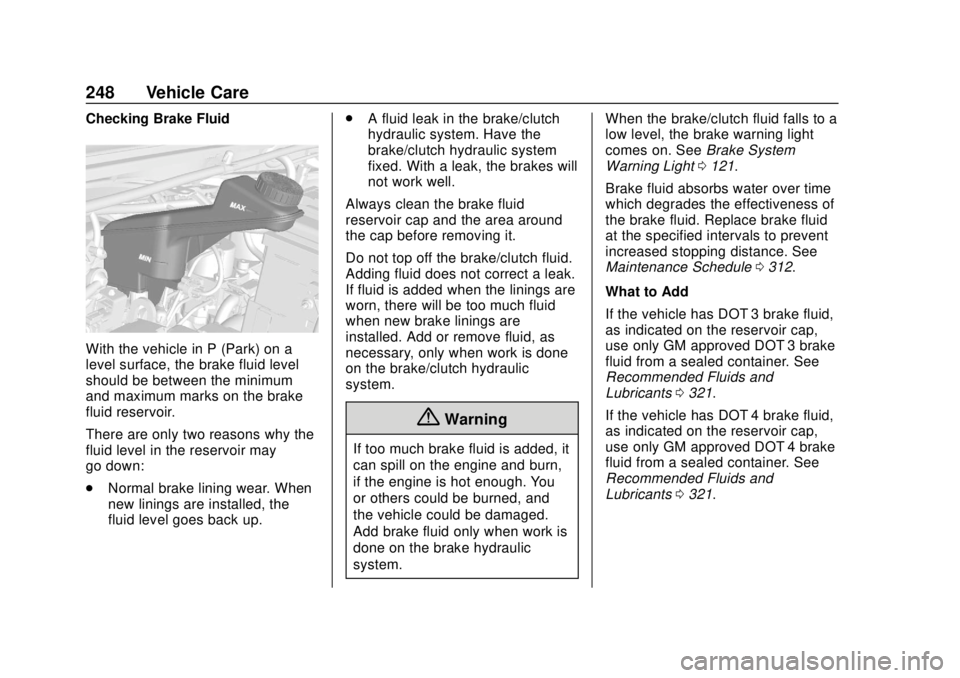
With the vehicle in P (Park) on a
level surface, the brake fluid level
should be between the minimum
and maximum marks on the brake
fluid reservoir.
There are only two reasons why the
fluid level in the reservoir may
go down:
.Normal brake lining wear. When
new linings are installed, the
fluid level goes back up. .
A fluid leak in the brake/clutch
hydraulic system. Have the
brake/clutch hydraulic system
fixed. With a leak, the brakes will
not work well.
Always clean the brake fluid
reservoir cap and the area around
the cap before removing it.
Do not top off the brake/clutch fluid.
Adding fluid does not correct a leak.
If fluid is added when the linings are
worn, there will be too much fluid
when new brake linings are
installed. Add or remove fluid, as
necessary, only when work is done
on the brake/clutch hydraulic
system.
{Warning
If too much brake fluid is added, it
can spill on the engine and burn,
if the engine is hot enough. You
or others could be burned, and
the vehicle could be damaged.
Add brake fluid only when work is
done on the brake hydraulic
system. When the brake/clutch fluid falls to a
low level, the brake warning light
comes on. See
Brake System
Warning Light 0121.
Brake fluid absorbs water over time
which degrades the effectiveness of
the brake fluid. Replace brake fluid
at the specified intervals to prevent
increased stopping distance. See
Maintenance Schedule 0312.
What to Add
If the vehicle has DOT 3 brake fluid,
as indicated on the reservoir cap,
use only GM approved DOT 3 brake
fluid from a sealed container. See
Recommended Fluids and
Lubricants 0321.
If the vehicle has DOT 4 brake fluid,
as indicated on the reservoir cap,
use only GM approved DOT 4 brake
fluid from a sealed container. See
Recommended Fluids and
Lubricants 0321.
Page 255 of 366
Chevrolet TRAX Owner Manual (GMNA-Localizing-U.S./Canada/Mexico-
11354406) - 2018 - crc - 10/12/17
254 Vehicle Care
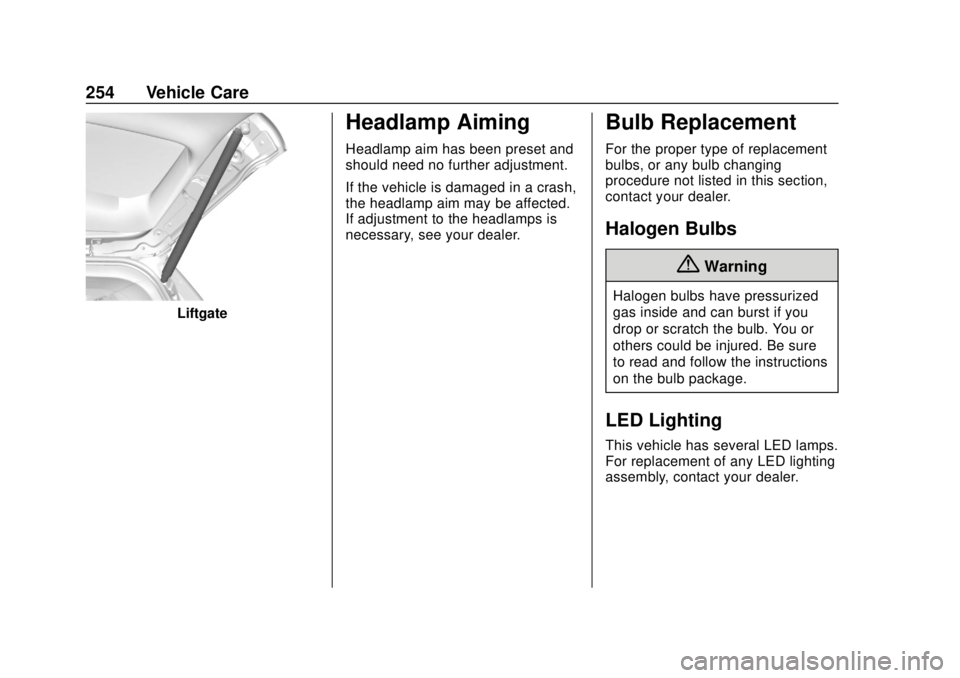
Liftgate
Headlamp Aiming
Headlamp aim has been preset and
should need no further adjustment.
If the vehicle is damaged in a crash,
the headlamp aim may be affected.
If adjustment to the headlamps is
necessary, see your dealer.
Bulb Replacement
For the proper type of replacement
bulbs, or any bulb changing
procedure not listed in this section,
contact your dealer.
Halogen Bulbs
{Warning
Halogen bulbs have pressurized
gas inside and can burst if you
drop or scratch the bulb. You or
others could be injured. Be sure
to read and follow the instructions
on the bulb package.
LED Lighting
This vehicle has several LED lamps.
For replacement of any LED lighting
assembly, contact your dealer.
Page 278 of 366
Chevrolet TRAX Owner Manual (GMNA-Localizing-U.S./Canada/Mexico-
11354406) - 2018 - crc - 10/12/17
Vehicle Care 277
lead to tire failure. Under-inflation
also reduces fuel efficiency and tire
tread life, and may affect the
vehicle's handling and stopping
ability.
Please note that the TPMS is not a
substitute for proper tire
maintenance, and it is the driver's
responsibility to maintain correct tire
pressure, even if under-inflation has
not reached the level to trigger
illumination of the TPMS low tire
pressure telltale.
Your vehicle has also been
equipped with a TPMS malfunction
indicator to indicate when the
system is not operating properly.
The TPMS malfunction indicator is
combined with the low tire pressure
telltale. When the system detects a
malfunction, the telltale will flash for
approximately one minute and then
remain continuously illuminated.
This sequence will continue upon
subsequent vehicle start-ups as
long as the malfunction exists.
When the malfunction indicator is
illuminated, the system may not be
able to detect or signal low tirepressure as intended. TPMS
malfunctions may occur for a variety
of reasons, including the installation
of replacement or alternate tires or
wheels on the vehicle that prevent
the TPMS from functioning properly.
Always check the TPMS malfunction
telltale after replacing one or more
tires or wheels on your vehicle to
ensure that the replacement or
alternate tires and wheels allow the
TPMS to continue to function
properly.
See
Tire Pressure Monitor
Operation 0277.
See Radio Frequency Statement
0 337.
Tire Pressure Monitor
Operation
This vehicle may have a Tire
Pressure Monitor System (TPMS).
The TPMS is designed to warn the
driver when a low tire pressure
condition exists. TPMS sensors are
mounted onto each tire and wheel
assembly, excluding the spare tire
and wheel assembly. The TPMS sensors monitor the air pressure in
the tires and transmit the tire
pressure readings to a receiver
located in the vehicle.
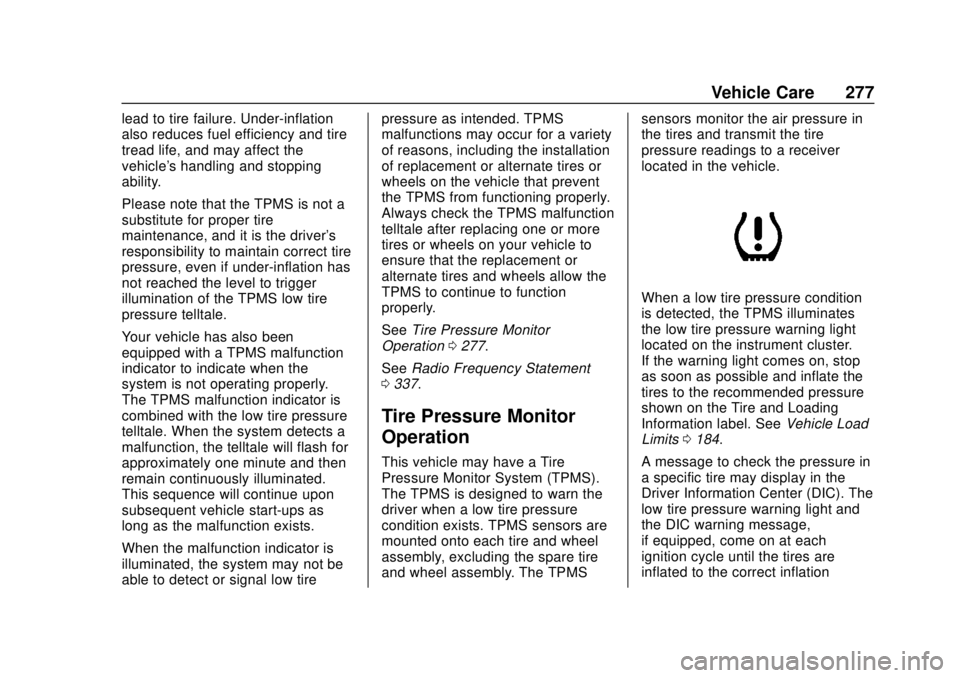
When a low tire pressure condition
is detected, the TPMS illuminates
the low tire pressure warning light
located on the instrument cluster.
If the warning light comes on, stop
as soon as possible and inflate the
tires to the recommended pressure
shown on the Tire and Loading
Information label. See
Vehicle Load
Limits 0184.
A message to check the pressure in
a specific tire may display in the
Driver Information Center (DIC). The
low tire pressure warning light and
the DIC warning message,
if equipped, come on at each
ignition cycle until the tires are
inflated to the correct inflation
Page 279 of 366
Chevrolet TRAX Owner Manual (GMNA-Localizing-U.S./Canada/Mexico-
11354406) - 2018 - crc - 10/12/17
278 Vehicle Care
pressure. Using the DIC, it may be
possible to view the tire pressure
levels. For additional information
and details about the DIC operation
and displays, seeDriver Information
Center (DIC) 0127.
The low tire pressure warning light
may come on in cool weather when
the vehicle is first started, and then
turn off as the vehicle is driven. This
could be an early indicator that the
air pressure is getting low and
needs to be inflated to the proper
pressure.
A Tire and Loading Information label
shows the size of the original
equipment tires and the correct
inflation pressure for the tires when
they are cold. See Vehicle Load
Limits 0184, for an example of the
Tire and Loading Information label
and its location. Also see Tire
Pressure 0275.
The TPMS can warn about a low
tire pressure condition, but it does
not replace normal tire
maintenance. See Tire Inspection
0 280, Tire Rotation 0281, and
Tires 0268.Caution
Tire sealant materials are not all
the same. A non-approved tire
sealant could damage the TPMS
sensors. TPMS sensor damage
caused by using an incorrect tire
sealant is not covered by the
vehicle warranty. Always use only
the GM approved tire sealant
available through your dealer or
included in the vehicle.
TPMS Malfunction Light and
Message
The TPMS will not function properly
if one or more of the TPMS sensors
are missing or inoperable. When the
system detects a malfunction, the
low tire pressure warning light,
defined above, flashes for about
one minute and then stays on for
the remainder of the ignition cycle.
A DIC warning message may also
display. The malfunction light and
DIC warning message, if equipped,
come on at each ignition cycle until the problem is corrected. Some of
the conditions that can cause these
to come on are:
.
One of the road tires has been
replaced with the spare tire. The
spare tire does not have a
TPMS sensor. The malfunction
light and the DIC message,
if equipped, should go off after
the road tire is replaced and the
sensor matching process is
performed successfully. See
"TPMS Sensor Matching
Process" later in this section.
. The TPMS sensor matching
process was not done or not
completed successfully after
rotating the tires. The
malfunction light and the DIC
message, if equipped, should go
off after successfully completing
the sensor matching process.
See "TPMS Sensor Matching
Process" later in this section.
. One or more TPMS sensors are
missing or damaged. The
malfunction light and the DIC
message, if equipped, should go
off when the TPMS sensors are
Page 282 of 366
Chevrolet TRAX Owner Manual (GMNA-Localizing-U.S./Canada/Mexico-
11354406) - 2018 - crc - 10/12/17
Vehicle Care 281
Tire Rotation
Tires should be rotated every
12 000 km (7,500 mi). See
Maintenance Schedule0312.
Tires are rotated to achieve a
more uniform wear for all tires.
The first rotation is the most
important.
Anytime unusual wear is
noticed, rotate the tires as soon
as possible, check for proper tire
inflation pressure, and check for
damaged tires or wheels. If the
unusual wear continues after the
rotation, check the wheel
alignment.
See When It Is Time for New
Tires 0282 andWheel
Replacement 0286.
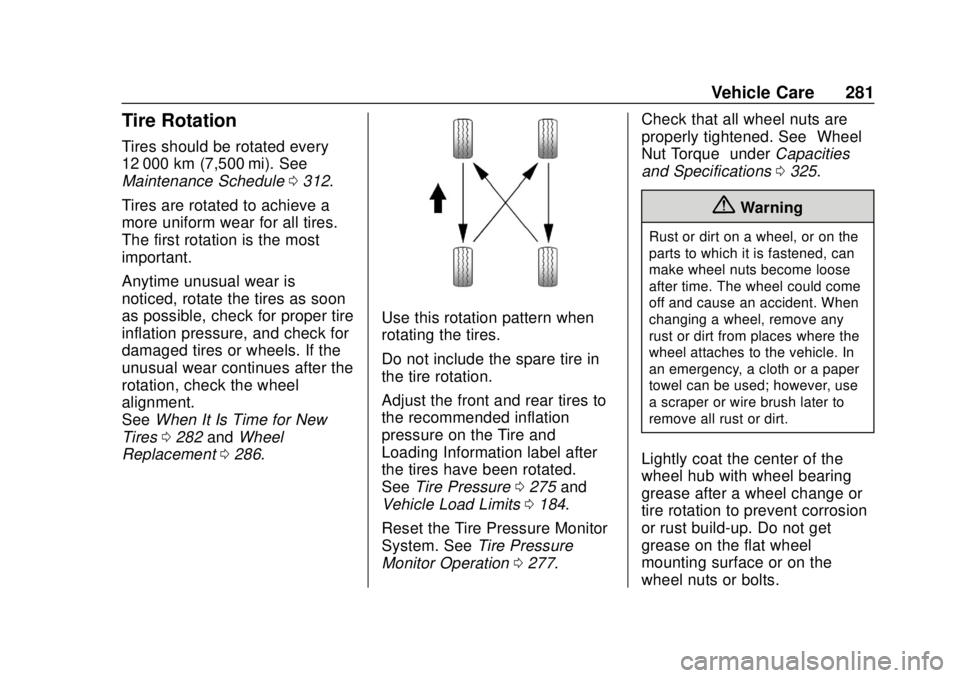
Use this rotation pattern when
rotating the tires.
Do not include the spare tire in
the tire rotation.
Adjust the front and rear tires to
the recommended inflation
pressure on the Tire and
Loading Information label after
the tires have been rotated.
See Tire Pressure 0275 and
Vehicle Load Limits 0184.
Reset the Tire Pressure Monitor
System. See Tire Pressure
Monitor Operation 0277. Check that all wheel nuts are
properly tightened. See
“Wheel
Nut Torque” underCapacities
and Specifications 0325.
{Warning
Rust or dirt on a wheel, or on the
parts to which it is fastened, can
make wheel nuts become loose
after time. The wheel could come
off and cause an accident. When
changing a wheel, remove any
rust or dirt from places where the
wheel attaches to the vehicle. In
an emergency, a cloth or a paper
towel can be used; however, use
a scraper or wire brush later to
remove all rust or dirt.
Lightly coat the center of the
wheel hub with wheel bearing
grease after a wheel change or
tire rotation to prevent corrosion
or rust build-up. Do not get
grease on the flat wheel
mounting surface or on the
wheel nuts or bolts.
Page 285 of 366
Chevrolet TRAX Owner Manual (GMNA-Localizing-U.S./Canada/Mexico-
11354406) - 2018 - crc - 10/12/17
284 Vehicle Care
load range, speed rating, and
construction (radial) as the
original tires.
Vehicles that have a tire
pressure monitoring system
could give an inaccurate
low-pressure warning if non-TPC
Spec rated tires are installed.
SeeTire Pressure Monitor
System 0276.
The Tire and Loading
Information label indicates the
original equipment tires on the
vehicle. See Vehicle Load Limits
0 184.
Different Size Tires and
Wheels
If wheels or tires are installed that
are a different size than the original
equipment wheels and tires, vehicle
performance, including its braking,
ride and handling characteristics,
stability, and resistance to rollover
may be affected. If the vehicle has
electronic systems such as antilock
brakes, rollover airbags, traction control, electronic stability control,
or All-Wheel Drive, the performance
of these systems can also be
affected.
{Warning
If different sized wheels are used,
there may not be an acceptable
level of performance and safety if
tires not recommended for those
wheels are selected. This
increases the chance of a crash
and serious injury. Only use GM
specific wheel and tire systems
developed for the vehicle, and
have them properly installed by a
GM certified technician.
See Buying New Tires 0282 and
Accessories and Modifications
0 228.
Uniform Tire Quality
Grading
The following information relates
to the system developed by the
United States National Highway Traffic Safety Administration
(NHTSA), which grades tires by
treadwear, traction, and
temperature performance. This
applies only to vehicles sold in
the United States. The grades
are molded on the sidewalls of
most passenger car tires. The
Uniform Tire Quality Grading
(UTQG) system does not apply
to deep tread, winter tires,
compact spare tires, tires with
nominal rim diameters of
10 to 12 inches (25 to 30 cm),
or to some limited-production
tires.
While the tires available on
General Motors passenger cars
and light trucks may vary with
respect to these grades, they
must also conform to federal
safety requirements and
additional General Motors Tire
Performance Criteria (TPC)
standards.
Page 287 of 366
Chevrolet TRAX Owner Manual (GMNA-Localizing-U.S./Canada/Mexico-
11354406) - 2018 - crc - 10/12/17
286 Vehicle Care
underinflation, or excessive
loading, either separately or in
combination, can cause heat
buildup and possible tire failure.
Wheel Alignment and Tire
Balance
The tires and wheels were aligned
and balanced at the factory to
provide the longest tire life and best
overall performance. Adjustments to
wheel alignment and tire balancing
are not necessary on a regular
basis. Consider an alignment check
if there is unusual tire wear or the
vehicle is significantly pulling to one
side or the other. Some slight pull to
the left or right, depending on the
crown of the road and/or other road
surface variations such as troughs
or ruts, is normal. If the vehicle is
vibrating when driving on a smooth
road, the tires and wheels may need
to be rebalanced. See your dealer
for proper diagnosis.
Wheel Replacement
Replace any wheel that is bent,
cracked, or badly rusted or
corroded. If wheel nuts keep coming
loose, the wheel, wheel bolts, and
wheel nuts should be replaced.
If the wheel leaks air, replace it.
Some aluminum wheels can be
repaired. See your dealer if any of
these conditions exist.
Your dealer will know the kind of
wheel that is needed.
Each new wheel should have the
same load-carrying capacity,
diameter, width, offset, and be
mounted the same way as the one it
replaces.
Replace wheels, wheel bolts, wheel
nuts, or Tire Pressure Monitor
System (TPMS) sensors with new
GM original equipment parts.{Warning
Using the wrong replacement
wheels, wheel bolts, or wheel
nuts can be dangerous. It could
affect the braking and handling of
the vehicle. Tires can lose air,
and cause loss of control, causing
a crash. Always use the correct
wheel, wheel bolts, and wheel
nuts for replacement.
Caution
The wrong wheel can also cause
problems with bearing life, brake
cooling, speedometer or
odometer calibration, headlamp
aim, bumper height, vehicle
ground clearance, and tire or tire
chain clearance to the body and
chassis.
Page 297 of 366
Chevrolet TRAX Owner Manual (GMNA-Localizing-U.S./Canada/Mexico-
11354406) - 2018 - crc - 10/12/17
296 Vehicle Care
Caution
If the other vehicle does not have
a 12-volt system with a negative
ground, both vehicles can be
damaged. Only use a vehicle that
has a 12-volt system with a
negative ground for jump starting.
2. Position the two vehicles so that they are not touching.
3. Set the parking brake firmly and put the shift lever in
P (Park) with an automatic
transmission, or Neutral with a
manual transmission. See
Shifting Into Park 0196 with an
automatic transmission,
or Parking 0198 with a manual
transmission.
Caution
If any accessories are left on or
plugged in during the jump
starting procedure, they could be
(Continued)
Caution (Continued)
damaged. The repairs would not
be covered by the vehicle
warranty. Whenever possible, turn
off or unplug all accessories on
either vehicle when jump starting.
4. Turn the ignition off. Turn off all lights and accessories in both
vehicles, except the hazard
warning flashers if needed.
{Warning
An electric fan can start up even
when the engine is not running
and can injure you. Keep hands,
clothing, and tools away from any
underhood electric fan.
{Warning
Using a match near a battery can
cause battery gas to explode.
People have been hurt doing this,
and some have been blinded.
Use a flashlight if you need more
light.
Battery fluid contains acid that
can burn you. Do not get it on
you. If you accidentally get it in
your eyes or on your skin, flush
the place with water and get
medical help immediately.
{Warning
Fans or other moving engine
parts can injure you badly. Keep
your hands away from moving
parts once the engine is running.
5. Connect one end of the red positive (+) cable to the
positive (+) terminal on the
discharged battery.
Page 354 of 366

Chevrolet TRAX Owner Manual (GMNA-Localizing-U.S./Canada/Mexico-
11354406) - 2018 - crc - 10/12/17
Index 353
IndexA
About Driving the Vehicle . . . . . . . . . 2
Accessories andModifications . . . . . . . . . . . . . . . . . . 228
Accessory Power . . . . . . . . . . . . . . . 195
Add-On Electrical Equipment . . . 224
Additional Information
OnStar . . . . . . . . . . . . . . . . . . . . . . . 347
Additional Maintenance and Care . . . . . . . . . . . . . . . . . . . . . . 318
Adjustments Lumbar, Front Seats . . . . . . . . . . . . 58
Agreements Trademarks and License . . . . . 169
Air Cleaner/Filter, Engine . . . . . . . 238
Air Conditioning . . . . . . . . . . . . . . . . 171
Air Filter, Passenger Compartment . . . . . . . . . . . . . . . . . 174
Air Intake . . . . . . . . . . . . . . . . . . . . . . . 174
Air Vents . . . . . . . . . . . . . . . . . . . . . . . 173
Airbag System
Check . . . . . . . . . . . . . . . . . . . . . . . . . . 83
How Does an AirbagRestrain? . . . . . . . . . . . . . . . . . . . . . 76
Passenger Sensing System . . . . 78
What Makes an Airbag Inflate? . . . . . . . . . . . . . . . . . . . . . . . . 76 Airbag System (cont'd)
What Will You See after an
Airbag Inflates? . . . . . . . . . . . . . . . 77
When Should an Airbag
Inflate? . . . . . . . . . . . . . . . . . . . . . . . . 75
Where Are the Airbags? . . . . . . . . 74
Airbags Adding Equipment to theVehicle . . . . . . . . . . . . . . . . . . . . . . . . 82
Passenger Status Indicator . . . .117
Readiness Light . . . . . . . . . . . . . . .117
Servicing Airbag-Equipped Vehicles . . . . . . . . . . . . . . . . . . . . . . . 82
System Check . . . . . . . . . . . . . . . . . . 72
Alarm Vehicle Security . . . . . . . . . . . . . . . . 46
Alert Side Blind Zone (SBZA) . . . . . . 217
All-Season Tires . . . . . . . . . . . . . . . . 269
All-Wheel Drive . . . . . . . . . . . . 205, 249
AM-FM Radio . . . . . . . . . . . . . . . . . . . 150
Antenna Backglass . . . . . . . . . . . . . . . . . . . . 152
Multi-band . . . . . . . . . . . . . . . . . . . . 153
Antilock Brake System (ABS) . . . 206 Warning Light . . . . . . . . . . . . . . . . . 121
Page 355 of 366

Chevrolet TRAX Owner Manual (GMNA-Localizing-U.S./Canada/Mexico-
11354406) - 2018 - crc - 10/12/17
354 Index
Appearance CareExterior . . . . . . . . . . . . . . . . . . . . . . . 301
Interior . . . . . . . . . . . . . . . . . . . . . . . . 305
Apple CarPlay and Android Auto . . . . . . . . . . . . . . . . . . 164
Armrest Front Seat . . . . . . . . . . . . . . . . . . . . . . 60
Rear Seat . . . . . . . . . . . . . . . . . . . . . . 65
Assistance Program, Roadside . . . . . . . . . . . . . . . . . . . . . . 331
Audio
Bluetooth . . . . . . . . . . . . . . . . . . . . . 157
Automatic Door Locks . . . . . . . . . . . . . . . . . . . . . 42
Headlamp System . . . . . . . . . . . . 140
Transmission . . . . . . . . . . . . . . . . . 200
Transmission Fluid . . . . . . . . . . . 238
Automatic Transmission Manual Mode . . . . . . . . . . . . . . . . . 201
Shift Lock Control FunctionCheck . . . . . . . . . . . . . . . . . . . . . . . 250
Auxiliary Jack . . . . . . . . . . . . . . . . . . . 156
Avoiding Untrusted Media Devices . . . . . . . . . . . . . . . . . . . . . . . 153B
Backglass Antenna . . . . . . . . . . . . . 152
BatteryExterior Lighting BatterySaver . . . . . . . . . . . . . . . . . . . . . . . 144
Load Management . . . . . . . . . . . . 143
Power Protection . . . . . . . . . . . . . 144
Battery - North America . . . . 249, 294
Blade Replacement, Wiper . . . . . 251
Bluetooth Overview . . . . . . . . . . . . . . . . 159, 160
Bluetooth Audio . . . . . . . . . . . . . . . . 157
Brake System Warning Light . . . . . . . . 121
Brakes . . . . . . . . . . . . . . . . . . . . . . . . . . 247 Antilock . . . . . . . . . . . . . . . . . . . . . . . 206
Assist . . . . . . . . . . . . . . . . . . . . . . . . . 207
Fluid . . . . . . . . . . . . . . . . . . . . . . . . . . 247
Parking . . . . . . . . . . . . . . . . . . . . . . . 206
Braking . . . . . . . . . . . . . . . . . . . . . . . . . 179
Break-In, New Vehicle . . . . . . . . . . 188
Bulb Replacement Halogen Bulbs . . . . . . . . . . . . . . . . 254
Headlamp Aiming . . . . . . . . . . . . . 254
Headlamps . . . . . . . . . . . . . . . . . . . 254 Bulb Replacement (cont'd)
Headlamps, Front Turn
Signal, and Parking
Lamps . . . . . . . . . . . . . . . . . . . . . . 255
License Plate Lamps . . . . . . . . . 260
Taillamps, Turn Signal, Sidemarker, Stoplamps,
and Backup Lamps . . . . . . . . . . 257
Buying New Tires . . . . . . . . . . . . . . . 282
C
Calibration . . . . . . . . . . . . . . . . . . . . . . 110
California Perchlorate Materials
Requirements . . . . . . . . . . . . . . . 228
California Proposition
65 Warning . . . . . . . . . .227, 249, 294, Back Cover
Camera Rear Vision (RVC) . . . . . . . . . . . . 212
Canadian Vehicle Owners . . . . . . . . 2
Capacities and Specifications . . . . . . . . . . . . . . . . . 325
Carbon Monoxide Engine Exhaust . . . . . . . . . . . . . . . 199
Liftgate . . . . . . . . . . . . . . . . . . . . . . . . . 44
Winter Driving . . . . . . . . . . . . . . . . 183