climate control CHEVROLET TRAX 2023 User Guide
[x] Cancel search | Manufacturer: CHEVROLET, Model Year: 2023, Model line: TRAX, Model: CHEVROLET TRAX 2023Pages: 280, PDF Size: 12.13 MB
Page 129 of 280
Chevrolet TRAX Owner Manual (GMNA-Localizing-U.S./Canada-15498927) -
2022 - CRC - 5/27/21
128 Climate Controls
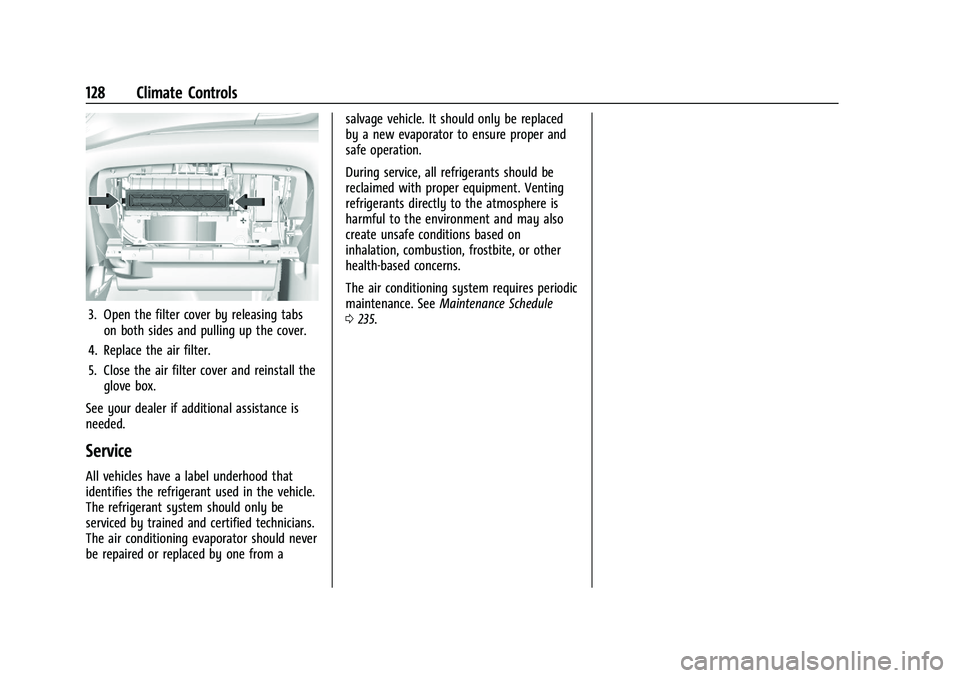
3. Open the filter cover by releasing tabson both sides and pulling up the cover.
4. Replace the air filter.
5. Close the air filter cover and reinstall the glove box.
See your dealer if additional assistance is
needed.
Service
All vehicles have a label underhood that
identifies the refrigerant used in the vehicle.
The refrigerant system should only be
serviced by trained and certified technicians.
The air conditioning evaporator should never
be repaired or replaced by one from a salvage vehicle. It should only be replaced
by a new evaporator to ensure proper and
safe operation.
During service, all refrigerants should be
reclaimed with proper equipment. Venting
refrigerants directly to the atmosphere is
harmful to the environment and may also
create unsafe conditions based on
inhalation, combustion, frostbite, or other
health-based concerns.
The air conditioning system requires periodic
maintenance. See
Maintenance Schedule
0 235.
Page 131 of 280
Chevrolet TRAX Owner Manual (GMNA-Localizing-U.S./Canada-15498927) -
2022 - CRC - 5/27/21
130 Driving and Operating
Driving Information
Driver Behavior
Driving is an important responsibility. Driver
behavior, the driving environment, and the
vehicle's design all affect how well a vehicle
performs.
Being aware of these factors can help in
understanding how the vehicle handles and
what can be done to avoid many types of
crashes, including a rollover crash.
Most serious injuries and fatalities to
unbelted occupants can be reduced or
prevented by the use of seat belts. In a
rollover crash, an unbelted person is
significantly more likely to die than a
person wearing a seat belt. In addition,
avoiding excessive speed, sudden or abrupt
turns, and drunken or aggressive driving can
help make trips safer and avoid the
possibility of a crash.
Driving Environment
Be prepared for driving in inclement
weather, at night, or during other times
where visibility or traction may be limited,such as on curves, slippery roads, or hilly
terrain. Unfamiliar surroundings can also
have hidden hazards.
Vehicle Design
Utility vehicles have a significantly higher
rollover rate than other types of vehicles.
This is because they have a higher ground
clearance and a narrower track or shorter
wheelbase than passenger cars, which makes
them more capable for off-road driving.
While these design characteristics provide
the driver with a better view of the road,
these vehicles do have a higher center of
gravity than other types of vehicles.
A utility vehicle does not handle the same
as a vehicle with a lower center of gravity,
like a car, in similar situations.
Safe driver behavior and understanding of
the environment can help avoid a rollover
crash in any type of vehicle, including utility
vehicles.
Driving for Better Fuel Economy
Driving habits can affect fuel mileage. Here
are some driving tips to get the best fuel
economy possible:
.Set the climate controls to the desired
temperature after the engine is started,
or turn them off when not required.
.Avoid fast starts and accelerate smoothly.
.Brake gradually and avoid abrupt stops.
.Avoid idling the engine for long periods
of time.
.When road and weather conditions are
appropriate, use cruise control.
.Always follow posted speed limits or
drive more slowly when conditions
require.
.Keep vehicle tires properly inflated.
.Combine several trips into a single trip.
.Replace the vehicle's tires with the same
TPC Spec number molded into the tire's
sidewall near the size.
.Follow recommended scheduled
maintenance.
Distracted Driving
Distraction comes in many forms and can
take your focus from the task of driving.
Exercise good judgment and do not let other
activities divert your attention away from
the road. Many local governments have
Page 132 of 280
Chevrolet TRAX Owner Manual (GMNA-Localizing-U.S./Canada-15498927) -
2022 - CRC - 5/27/21
Driving and Operating 131
enacted laws regarding driver distraction.
Become familiar with the local laws in
your area.
To avoid distracted driving, keep your eyes
on the road, keep your hands on the
steering wheel, and focus your attention on
driving.
.Do not use a phone in demanding driving
situations. Use a hands-free method to
place or receive necessary phone calls.
.Watch the road. Do not read, take notes,
or look up information on phones or
other electronic devices.
.Designate a front seat passenger to
handle potential distractions.
.Become familiar with vehicle features
before driving, such as programming
favorite radio stations and adjusting
climate control and seat settings. Program
all trip information into any navigation
device prior to driving.
.Wait until the vehicle is parked to
retrieve items that have fallen to the
floor.
.Stop or park the vehicle to tend to
children.
.Keep pets in an appropriate carrier or
restraint.
.Avoid stressful conversations while
driving, whether with a passenger or on a
cell phone.
{Warning
Taking your eyes off the road too long or
too often could cause a crash resulting in
injury or death. Focus your attention on
driving.
Refer to the infotainment section for more
information on using that system and the
navigation system, if equipped, including
pairing and using a cell phone.
Defensive Driving
Defensive driving means “always expect the
unexpected.” The first step in driving
defensively is to wear the seat belt. See
Seat Belts 037.
.Assume that other road users
(pedestrians, bicyclists, and other drivers)
are going to be careless and make
mistakes. Anticipate what they may do
and be ready.
.Allow enough following distance between
you and the driver in front of you.
.Focus on the task of driving.
Impaired Driving
Death and injury associated with impaired
driving is a global tragedy.
{Warning
Drinking alcohol or taking drugs and then
driving is very dangerous. Your reflexes,
perceptions, attentiveness, and judgment
can be affected by even a small amount
of alcohol or drugs. You can have a
serious —or even fatal —collision if you
drive after drinking or taking drugs.
Do not drive while under the influence of
alcohol or drugs, or ride with a driver
who has been drinking or is impaired by
drugs. Find alternate transportation
home; or if you are with a group,
designate a driver who will remain sober.
Control of a Vehicle
Braking, steering, and accelerating are
important factors in helping to control a
vehicle while driving.
Page 136 of 280
Chevrolet TRAX Owner Manual (GMNA-Localizing-U.S./Canada-15498927) -
2022 - CRC - 5/27/21
Driving and Operating 135
Winter Driving
Driving on Snow or IceCaution
To avoid damage to the wheels and
brake components, always clear snow and
ice from inside the wheels and
underneath the vehicle before driving.
Snow or ice between the tires and the road
creates less traction or grip, so drive
carefully. Wet ice can occur at about 0 °C
(32 °F) when freezing rain begins to fall.
Avoid driving on wet ice or in freezing rain
until roads can be treated.
For Slippery Road Driving:
.Accelerate gently. Accelerating too quickly
causes the wheels to spin and makes the
surface under the tires slick.
.Turn on Traction Control. See Traction
Control/Electronic Stability Control 0154.
.The Antilock Brake System (ABS) improves
vehicle stability during hard stops, but
the brakes should be applied sooner than
when on dry pavement. See Antilock
Brake System (ABS) 0153.
.Allow greater following distance and
watch for slippery spots. Icy patches can
occur on otherwise clear roads in shaded
areas. The surface of a curve or an
overpass can remain icy when the
surrounding roads are clear. Avoid sudden
steering maneuvers and braking while
on ice.
.Turn off cruise control.
Cold Weather Mode
In very low temperatures, a cold weather
message may display on the Driver
Information Center (DIC). The engine speed,
transmission shift patterns, and cabin fan
speed may operate differently to enable the
vehicle to warm up quicker. You can
manually override the cabin fan speed in
cold weather mode.
Blizzard Conditions
Stop the vehicle in a safe place and signal
for help. Stay with the vehicle unless there
is help nearby. If possible, use Roadside
Assistance. See Roadside Assistance Program
0 253. To get help and keep everyone in the
vehicle safe:
.Turn on the hazard warning flashers.
.Tie a red cloth to an outside mirror.
{Warning
Snow can trap engine exhaust under the
vehicle. This may cause exhaust gases to
get inside. Engine exhaust contains
carbon monoxide (CO), which cannot be
seen or smelled. It can cause
unconsciousness and even death.
If the vehicle is stuck in snow:
.Clear snow from the base of the
vehicle, especially any blocking the
exhaust pipe.
.Open a window about 5 cm (2 in) on
the vehicle side that is away from the
wind, to bring in fresh air.
.Fully open the air outlets on or under
the instrument panel.
.Adjust the climate control system to
circulate the air inside the vehicle and
set the fan speed to the highest
setting. See “Climate Control Systems.”
For more information about CO, see
Engine Exhaust 0149.
Page 146 of 280
Chevrolet TRAX Owner Manual (GMNA-Localizing-U.S./Canada-15498927) -
2022 - CRC - 5/27/21
Driving and Operating 145
Winter Cover
If equipped, the winter cover can be used to
enhance heater performance in extremely
cold conditions below−7 °C (20 °F). The
winter cover installs over the grille and
restricts airflow to the engine compartment.
For vehicles that did not come with a winter
cover, a winter cover can be purchased. See
your dealer for additional information.
When the winter cover is installed, the
climate controls AUTO mode may not
function properly. Use the manual settings
for comfort.
Usage Guidelines
The winter cover should only be used while
operating the vehicle in extremely cold
temperatures or in heavy snow for extended
periods. In these temperatures, the vehicle
does not need a large amount of air to
properly cool the engine. When more
airflow is required to cool the vehicle, the
winter cover should not be used. The
following usage guidelines will allow
adequate airflow for proper radiator and air
cooler performance:
.Do not use the winter cover if towing a
trailer. The vehicle may overheat if the
radiator is covered while towing.
.Do not modify the cover. The winter
cover does not cover some sections of the
front of the vehicle to provide enough
airflow.
.Keep the underside of the winter cover as
clean as possible. Remove monthly or as
necessary and clean away dust and
debris.
.Do not use the winter cover above −0 °C
(32 °F).
Use only a mild soap to clean. Do not use
harsh soap, strong detergents, or vinyl
protectant/sealant type products as they
may damage the special finish. Allow the
winter cover to dry completely before
reinstalling.
Installation Instructions
When first trying to fit the cover, it may
appear to be undersized but will stretch
during installation to ensure a tight fit. The
initial installation of the cover is best
performed when the winter cover is warm.
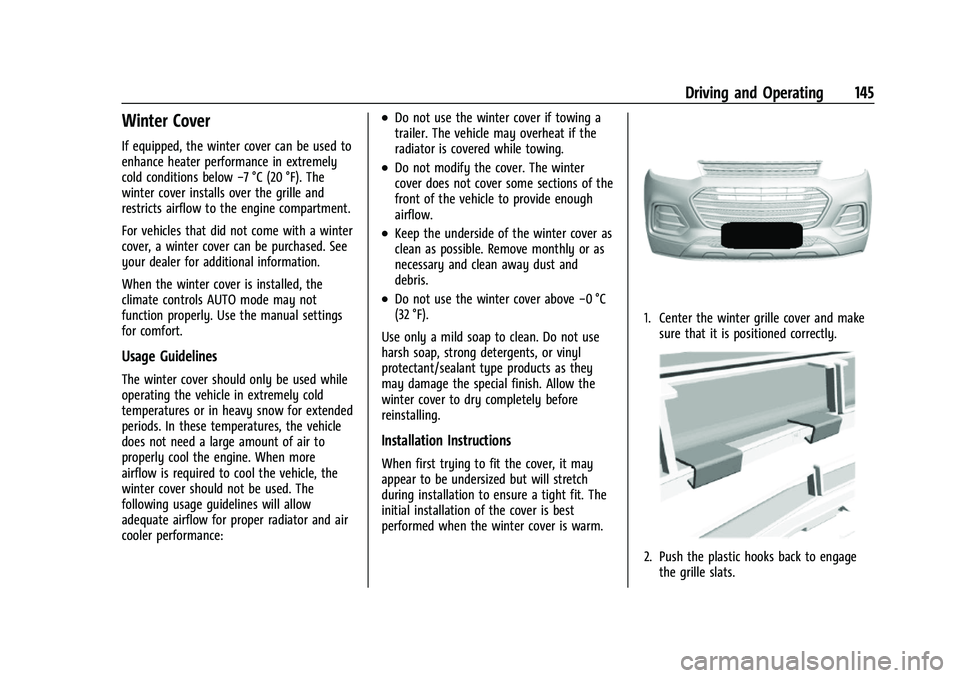
1. Center the winter grille cover and make sure that it is positioned correctly.
2. Push the plastic hooks back to engagethe grille slats.
Page 214 of 280
Chevrolet TRAX Owner Manual (GMNA-Localizing-U.S./Canada-15498927) -
2022 - CRC - 5/27/21
Vehicle Care 213
tires with nominal rim diameters of
10 to 12 inches (25 to 30 cm), or to some
limited-production tires.
While the tires available on General
Motors passenger cars and light trucks
may vary with respect to these grades,
they must also conform to federal
safety requirements and additional
General Motors Tire Performance
Criteria (TPC) standards.
Quality grades can be found where
applicable on the tire sidewall between
tread shoulder and maximum section
width. For example:
Treadwear 200 Traction AA Temperature A
All Passenger Car Tires Must Conform to
Federal Safety Requirements In Addition
To These Grades.
Treadwear
The treadwear grade is a comparative
rating based on the wear rate of the
tire when tested under controlled
conditions on a specified government
test course. For example, a tire graded
150 would wear one and one-half (1½)times as well on the government course
as a tire graded 100. The relative
performance of tires depends upon the
actual conditions of their use, however,
and may depart significantly from the
norm due to variations in driving habits,
service practices and differences in road
characteristics and climate.
Traction
The traction grades, from highest to
lowest, are AA, A, B, and C. Those
grades represent the tire's ability to
stop on wet pavement as measured
under controlled conditions on specified
government test surfaces of asphalt and
concrete. A tire marked C may have
poor traction performance. Warning:
The traction grade assigned to this tire
is based on straight-ahead braking
traction tests, and does not include
acceleration, cornering, hydroplaning,
or peak traction characteristics.
Temperature
The temperature grades are A (the
highest), B, and C, representing the
tire's resistance to the generation of
heat and its ability to dissipate heat
when tested under controlled conditions
on a specified indoor laboratory test
wheel. Sustained high temperature can
cause the material of the tire to
degenerate and reduce tire life, and
excessive temperature can lead to
sudden tire failure. The grade C
corresponds to a level of performance
which all passenger car tires must meet
under the Federal Motor Safety
Standard No. 109. Grades B and A
represent higher levels of performance
on the laboratory test wheel than the
minimum required by law. Warning:
The temperature grade for this tire is
established for a tire that is properly
inflated and not overloaded. Excessive
speed, underinflation, or excessive
loading, either separately or in
combination, can cause heat buildup
and possible tire failure.
Page 271 of 280
Chevrolet TRAX Owner Manual (GMNA-Localizing-U.S./Canada-15498927) -
2022 - CRC - 5/27/21
270 Index
AutomaticDoor Locks . . . . . . . . . . . . . . . . . . . . . . . . . . . . . . 20
Headlamp System . . . . . . . . . . . . . . . . . . . . . . 97
Transmission . . . . . . . . . . . . . . . . . . . . . . . . . . . 150
Transmission Fluid . . . . . . . . . . . . . . . . . . . . . 174
Automatic Transmission Manual Mode . . . . . . . . . . . . . . . . . . . . . . . . . 152
Shift Lock Control Function Check . . . . . . 183
Auxiliary Jack . . . . . . . . . . . . . . . . . . . . . . . . . . . . . 112
Avoiding Untrusted Media Devices . . . . . . . 109
B
Battery Exterior Lighting Battery Saver . . . . . . . . 101
Load Management . . . . . . . . . . . . . . . . . . . . . 100
Power Protection . . . . . . . . . . . . . . . . . . . . . . 101
Battery - North America . . . . . . . . . . . . .182, 220
Blade Replacement, Wiper . . . . . . . . . . . . . . . 184
Bluetooth
Overview . . . . . . . . . . . . . . . . . . . . . . . . . . . . . . . 113
Bluetooth Audio . . . . . . . . . . . . . . . . . . . . . . . . . . 112
Brake
System Warning Light . . . . . . . . . . . . . . . . . . 85
Brakes . . . . . . . . . . . . . . . . . . . . . . . . . . . . . . . . . . . 180 Antilock . . . . . . . . . . . . . . . . . . . . . . . . . . . . . . . . 153
Assist . . . . . . . . . . . . . . . . . . . . . . . . . . . . . . . . . . 154
Fluid . . . . . . . . . . . . . . . . . . . . . . . . . . . . . . . . . . . . 181
Parking . . . . . . . . . . . . . . . . . . . . . . . . . . . . . . . . 153 Braking . . . . . . . . . . . . . . . . . . . . . . . . . . . . . . . . . . . 132
Break-In, New Vehicle . . . . . . . . . . . . . . . . . . . . 139
Bulb Replacement
Halogen Bulbs . . . . . . . . . . . . . . . . . . . . . . . . . 186
Headlamp Aiming . . . . . . . . . . . . . . . . . . . . . . 186
Headlamps . . . . . . . . . . . . . . . . . . . . . . . . . . . . 186
Headlamps, Front Turn Signal, andParking Lamps . . . . . . . . . . . . . . . . . . . . . . . 186
License Plate Lamps . . . . . . . . . . . . . . . . . . . . 191
Taillamps, Turn Signal, Sidemarker, Stoplamps, and Backup Lamps . . . . . . . 189
Buying New Tires . . . . . . . . . . . . . . . . . . . . . . . . . 211
C
Calibration . . . . . . . . . . . . . . . . . . . . . . . . . . . . . . . . 78
California Perchlorate Materials Requirements . . . 168
California Proposition 65 Warning . . . . . . . . . . . . . . . . . . . . . . . .182, 220, Back Cover
Camera
Rear Vision (RVC) . . . . . . . . . . . . . . . . . . . . . . 159
Canadian Vehicle Owners . . . . . . . . . . . . . . . . . . . 1
Capacities and Specifications . . . . . . . . . . . . . 247
Carbon Monoxide Engine Exhaust . . . . . . . . . . . . . . . . . . . . . . . . 149
Liftgate . . . . . . . . . . . . . . . . . . . . . . . . . . . . . . . . . . 21
Winter Driving . . . . . . . . . . . . . . . . . . . . . . . . . 135 Cargo
Cover . . . . . . . . . . . . . . . . . . . . . . . . . . . . . . . . . . . 73
Management System . . . . . . . . . . . . . . . . . . . 73
Caution, Danger, and Warning . . . . . . . . . . . . . .2
Chains, Tire . . . . . . . . . . . . . . . . . . . . . . . . . . . . . . .214
Charging System Light . . . . . . . . . . . . . . . . . . . . 83
Check Engine Light (Malfunction Indicator) . . . . 83
Child Restraints Infants and Young Children . . . . . . . . . . . . . 55
Lower Anchors and Tethers forChildren . . . . . . . . . . . . . . . . . . . . . . . . . . . . . . . 60
Older Children . . . . . . . . . . . . . . . . . . . . . . . . . . 54
Securing . . . . . . . . . . . . . . . . . . . . . . . . . . . . 67, 69
Systems . . . . . . . . . . . . . . . . . . . . . . . . . . . . . . . . 57
Circuit Breakers . . . . . . . . . . . . . . . . . . . . . . . . . . 193
Cleaning
Exterior Care . . . . . . . . . . . . . . . . . . . . . . . . . . . 226
Interior Care . . . . . . . . . . . . . . . . . . . . . . . . . . . 230
Climate Control Systems . . . . . . . . . . . . . . . . . . 125 Air Conditioning . . . . . . . . . . . . . . . . . . . . . . . 125
Heating . . . . . . . . . . . . . . . . . . . . . . . . . . . . . . . . 125
Clock . . . . . . . . . . . . . . . . . . . . . . . . . . . . . . . . . . . . . 78
Cluster, Instrument . . . . . . . . . . . . . . . . . . . . . . . 80
Collision Damage Repair . . . . . . . . . . . . . . . . . 255
Compact Spare Tire . . . . . . . . . . . . . . . . . . . . . . 220
Compartments Storage . . . . . . . . . . . . . . . . . . . . . . . . . . . . . . . . . 72
Page 277 of 280
Chevrolet TRAX Owner Manual (GMNA-Localizing-U.S./Canada-15498927) -
2022 - CRC - 5/27/21
276 Index
Reduced Engine Power Light . . . . . . . . . . . . . . 89
Reimbursement Program, GMMobility . . . . . . . . . . . . . . . . . . . . . . . . . . . . . . . 252
Remote Keyless Entry (RKE) System . . . . 9, 12
Remote Vehicle Start . . . . . . . . . . . . . . . . . . . . . .18
Replacement Parts Airbags . . . . . . . . . . . . . . . . . . . . . . . . . . . . . . . . . 54
Maintenance . . . . . . . . . . . . . . . . . . . . . . . . . . . 244
Replacing Airbag System . . . . . . . . . . . . . . . . . . 54
Replacing LATCH System Parts after a Crash . . . . . . . . . . . . . . . . . . . . . . . . . . . . . . . . . . . 67
Replacing Seat Belt System Parts after a Crash . . . . . . . . . . . . . . . . . . . . . . . . . . . . . . . . . 44
Reporting Safety Defects Canadian Government . . . . . . . . . . . . . . . . . 258
General Motors . . . . . . . . . . . . . . . . . . . . . . . . 259
U.S. Government . . . . . . . . . . . . . . . . . . . . . . . 258
Restraints Where to Put . . . . . . . . . . . . . . . . . . . . . . . . . . . 59
Retained Accessory Power (RAP) . . . . . . . . . .147
Roads Driving, Wet . . . . . . . . . . . . . . . . . . . . . . . . . . . 133
Roadside Assistance Program . . . . . . . . . . . . 253
Roof Rack System . . . . . . . . . . . . . . . . . . . . . . . . . 74
Rotation, Tires . . . . . . . . . . . . . . . . . . . . . . . . . . . 209
Routing, Engine Drive Belt . . . . . . . . . . . . . . . 249
Running the Vehicle While Parked . . . . . . . 150S
Safety Defects Reporting Canadian Government . . . . . . . . . . . . . . . . . 258
General Motors . . . . . . . . . . . . . . . . . . . . . . . . 259
U.S. Government . . . . . . . . . . . . . . . . . . . . . . . 258
Safety Locks . . . . . . . . . . . . . . . . . . . . . . . . . . . . . . . 21
Safety System Check . . . . . . . . . . . . . . . . . . . . . 43
Satellite Radio . . . . . . . . . . . . . . . . . . . . . . . . . . . 108
Scheduling Appointments . . . . . . . . . . . . . . . . 254
Seat Belts . . . . . . . . . . . . . . . . . . . . . . . . . . . . . . . . . .37 Care . . . . . . . . . . . . . . . . . . . . . . . . . . . . . . . . . . . . 43
Extender . . . . . . . . . . . . . . . . . . . . . . . . . . . . . . . . 43
How to Wear Seat Belts Properly . . . . . . . 38
Lap-Shoulder Belt . . . . . . . . . . . . . . . . . . . . . . . 40
Reminders . . . . . . . . . . . . . . . . . . . . . . . . . . . . . . 81
Replacing after a Crash . . . . . . . . . . . . . . . . . 44
Use During Pregnancy . . . . . . . . . . . . . . . . . . 42
Seats Adjustment, Front . . . . . . . . . . . . . . . . . . . . . . 30
Head Restraints . . . . . . . . . . . . . . . . . . . . . . . . . 29
Heated Front . . . . . . . . . . . . . . . . . . . . . . . . . . . 33
Lumbar Adjustment, Front . . . . . . . . . . . . . . 33
Power Adjustment, Front . . . . . . . . . . . . . . . . 31
Rear . . . . . . . . . . . . . . . . . . . . . . . . . . . . . . . . . . . . 34
Reclining Seatbacks . . . . . . . . . . . . . . . . . . . . . 32
Underseat Storage . . . . . . . . . . . . . . . . . . . . . . 73
Securing Child Restraints . . . . . . . . . . . . . . 67, 69 Security
OnStar . . . . . . . . . . . . . . . . . . . . . . . . . . . . . . . . . 262
Vehicle . . . . . . . . . . . . . . . . . . . . . . . . . . . . . . . . . 22
Vehicle Alarm . . . . . . . . . . . . . . . . . . . . . . . . . . . 22
Service . . . . . . . . . . . . . . . . . . . . . . . . . . . . . . . . . . . .128 Accessories and Modifications . . . . . . . . . 168
Climate Control System . . . . . . . . . . . . . . . . 125
Doing Your Own Work . . . . . . . . . . . . . . . . . 168
Maintenance Records . . . . . . . . . . . . . . . . . . 245
Maintenance, General Information . . . . . 234
Parts Identification . . . . . . . . . . . . . . . . . . . . . 246
Scheduling Appointments . . . . . . . . . . . . . . 254
Vehicle Soon Light . . . . . . . . . . . . . . . . . . . . . . 85
Services Special Application . . . . . . . . . . . . . . . . . . . . . 240
Servicing the Airbag . . . . . . . . . . . . . . . . . . . . . . .52
Settings . . . . . . . . . . . . . . . . . . . . . . . . . . . . . . . . . . . 118
Shift Lock Control Function Check,
Automatic Transmission . . . . . . . . . . . . . . . . .183
Shifting Into Park . . . . . . . . . . . . . . . . . . . . . . . . . . . . . . 147
Out of Park . . . . . . . . . . . . . . . . . . . . . . . . . . . . 148
Side Blind Zone Alert (SBZA) . . . . . . . . . . . . . . 161
Sidemarker Bulb Replacement . . . . . . . . . . . . . . . . . . . . . . 189
Signals, Turn and Lane-Change . . . . . . . . . . . . 98
Spare Tire Compact . . . . . . . . . . . . . . . . . . . . . . . . . . . . . . . 220