child seat CHEVROLET UPLANDER 2006 Owner's Manual
[x] Cancel search | Manufacturer: CHEVROLET, Model Year: 2006, Model line: UPLANDER, Model: CHEVROLET UPLANDER 2006Pages: 458, PDF Size: 3.19 MB
Page 64 of 458
Securing a Child Restraint in a
Rear Seat Position
If your child restraint is equipped with the LATCH
system, seeLower Anchors and Tethers for Children
(LATCH) on page 1-52.
For vehicles with a third row, there are no top tether
anchors in the outboard seating positions. Do not secure
a child seat in these positions if a national or local law
requires that the top tether be anchored, or if the
instructions that come with the child restraint say that
the top strap must be anchored.
If your child restraint does not have the LATCH system,
you will be using the lap-shoulder belt to secure the
child restraint. Be sure to follow the instructions
that came with the child restraint. Secure the child in the
child restraint when and as the instructions say.
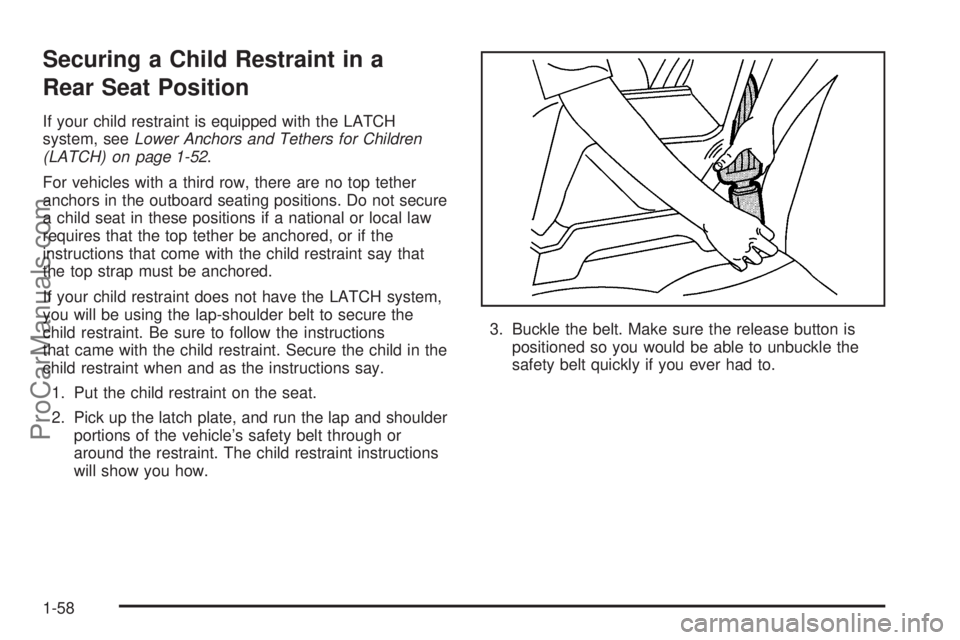
1. Put the child restraint on the seat.
2. Pick up the latch plate, and run the lap and shoulder
portions of the vehicle’s safety belt through or
around the restraint. The child restraint instructions
will show you how.3. Buckle the belt. Make sure the release button is
positioned so you would be able to unbuckle the
safety belt quickly if you ever had to.
1-58
ProCarManuals.com
Page 66 of 458
6. If your child restraint has a top tether, and the
position that you are using has a top tether
anchor, attach and tighten the top tether to the top
tether anchor. Refer to the instructions that
came with the child restraint and toLower Anchors
and Tethers for Children (LATCH) on page 1-52.
7. Push and pull the child restraint in different
directions to be sure it is secure.
To remove the child restraint, if the top tether is attached
to the top tether anchor, disconnect it. Unbuckle the
vehicle’s safety belt and let it go back all the way. The
safety belt will move freely again and be ready to
work for an adult or larger child passenger.
Securing a Child Restraint in the
Right Front Seat Position
Your vehicle has airbags. A rear seat is a safer place to
secure a forward-facing child restraint. SeeWhere to
Put the Restraint on page 1-50.
In addition, your vehicle has a passenger sensing
system. The passenger sensing system is designed to
turn off the right front passenger’s airbag or airbags
when an infant in a rear-facing infant seat or a small
child in a forward-facing child restraint or booster seat is
detected. SeePassenger Sensing System on page 1-82
andPassenger Airbag Status Indicator on page 3-35
for more information on this including important
safety information.If your vehicle has a rear seat, a label on your sun visor
says, “Never put a rear-facing child seat in the front.”
This is because the risk to the rear-facing child is
so great, if the airbag deploys.
{CAUTION:
A child in a rear-facing child restraint can be
seriously injured or killed if the right front
passenger’s airbag inates. This is because
the back of the rear-facing child restraint
would be very close to the inating airbag.
Even though the passenger sensing system is
designed to turn off the passenger’s frontal
airbag and seat-mounted side impact airbag (if
equipped) under certain conditions, no system
is fail-safe, and no one can guarantee that an
airbag will not deploy under some unusual
circumstance, even though it is turned off.
General Motors recommends that rear-facing
child restraints be secured in the rear seat,
even if the airbag is off.
If your vehicle does not have a rear seat that will
accommodate a rear-facing child restraint, never put a
child in a rear-facing child restraint in the right front
1-60
ProCarManuals.com
Page 67 of 458
passenger seat the unless passenger airbag status
indicator shows off. Never put a rear facing child
restraint in the right front passenger seat unless the
airbag is off. Here is why:
{CAUTION:
A child in a rear-facing child restraint can be
seriously injured or killed if the right front
passenger’s airbag inates. This is because
the back of the rear facing child restraint
would be very close to the inating airbag. Be
sure the airbag is off before using a rear-facing
child restraint in the right front seat position.
Even though the passenger sensing system is
designed to turn off the passenger’s frontal
airbag and side impact airbag (if equipped) if
the system detects a rear-facing child restraint,
no system is fail-safe, and no one can
guarantee that an airbag will not deploy under
some unusual circumstance, even though it is
turned off. We recommend that rear-facing
child restraints be transported in vehicles with
a rear seat that will accommodate a rear-facing
child restraint, whenever possible.If you need to secure a forward-facing child restraint in
the right front seat position, move the seat as far
back as it will go before securing the forward-facing
child restraint. SeeManual Seats on page 1-2or
Six-Way Power Seats on page 1-3.
If your child restraint is equipped with the LATCH
system, seeLower Anchors and Tethers for Children
(LATCH) on page 1-52.
There is no top tether anchor at the right front seating
position. Do not secure a child seat in this position
if a national or local law requires that the top tether be
anchored or if the instructions that come with the
child restraint say that the top tether must be anchored.
SeeLower Anchors and Tethers for Children (LATCH)
on page 1-52if your child restraint has a top tether.
1-61
ProCarManuals.com
Page 68 of 458
You will be using the lap-shoulder belt to secure the
child restraint in this position. Be sure to follow the
instructions that came with the child restraint. Secure
the child in the child restraint when and as the
instructions say.
1. Your vehicle has a right front passenger’s airbags.
SeePassenger Sensing System on page 1-82.
General Motors recommends that rear-facing child
restraints be secured in a rear seat, even if the airbag
or airbags are off. If your child restraint is
forward-facing, move the seat as far back as it will go
before securing the child restraint in this seat. See
Manual Seats on page 1-2orSix-Way Power Seats
on page 1-3.
When the passenger sensing system has turned off
the right front passenger’s airbag or airbags, the
off indicator in the passenger airbag status indicator
should light and stay lit when you turn the ignition
to RUN or START. SeePassenger Airbag
Status Indicator on page 3-35.
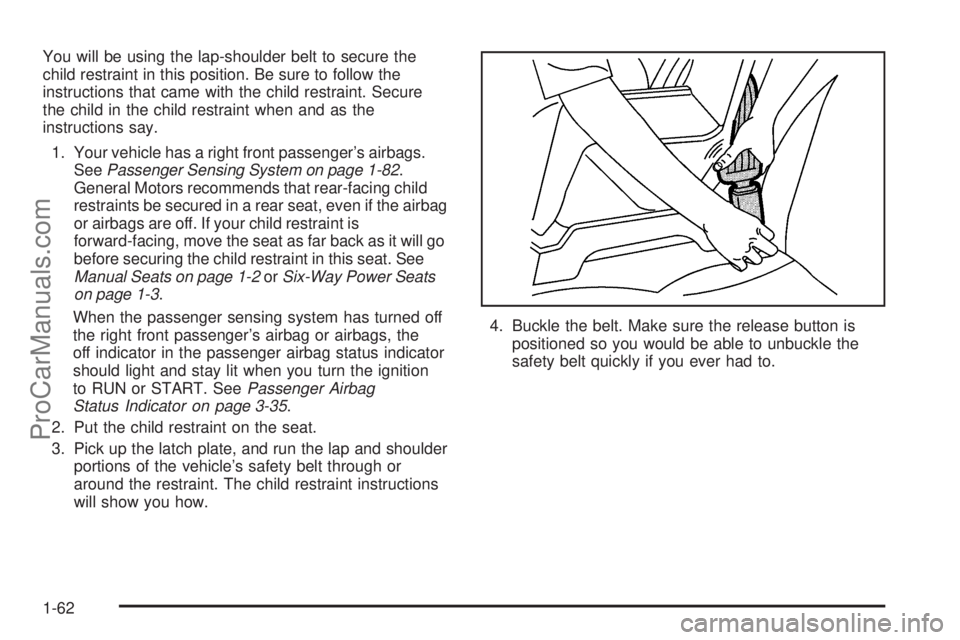
2. Put the child restraint on the seat.
3. Pick up the latch plate, and run the lap and shoulder
portions of the vehicle’s safety belt through or
around the restraint. The child restraint instructions
will show you how.4. Buckle the belt. Make sure the release button is
positioned so you would be able to unbuckle the
safety belt quickly if you ever had to.
1-62
ProCarManuals.com
Page 70 of 458
7. Push and pull the child restraint in different
directions to be sure it is secure.
8. If the airbag or airbags are off, the off indicator on
the instrument panel will be lit and stay lit when the
key is turned to RUN or START.
If a child restraint has been installed and the on
indicator is lit, turn the vehicle off. Remove the child
restraint from the vehicle and reinstall the child restraint.
If after reinstalling the child restraint and restarting
the vehicle, the on indicator is still lit, check to make
sure that the vehicle’s seatback is not pressing the child
restraint into the seat cushion. If this happens, slightly
recline the vehicle’s seatback and adjust the seat
cushion if possible. Also make sure the child restraint is
not trapped under the vehicle head restraint. If this
happens, adjust the head restraint.
If the on indicator is still lit, secure the child in the child
restraint in a rear seat position in the vehicle if one is
available and check with your dealer.
To remove the child restraint, if the top tether is attached
to the top tether anchor, disconnect it. Unbuckle the
vehicle’s safety belt and let it go back all the way. The
safety belt will move freely again and be ready to
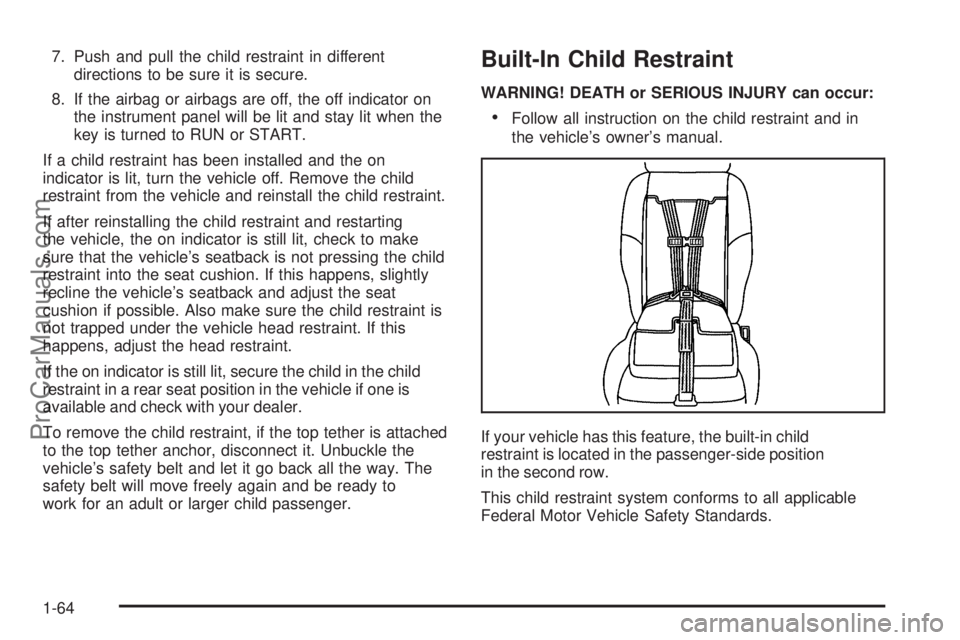
work for an adult or larger child passenger.Built-In Child Restraint
WARNING! DEATH or SERIOUS INJURY can occur:
Follow all instruction on the child restraint and in
the vehicle’s owner’s manual.
If your vehicle has this feature, the built-in child
restraint is located in the passenger-side position
in the second row.
This child restraint system conforms to all applicable
Federal Motor Vehicle Safety Standards.
1-64
ProCarManuals.com
Page 71 of 458
Use only with children who weigh between 22 and
40 pounds (10 and 18 kg) and whose height is between
33.5 and 40 inches (850 and 1 016 mm). Use only
with children whose shoulders are below the shoulder
belt slots for the harness system and who are capable of
sitting upright alone.
The child should also be at least one year old. It is
important to use a rear-facing infant restraint until the
child is at least one year old. A rear-facing restraint gives
the infant’s head, neck and body the support they
would need in a crash. SeeOlder Children on page 1-40
orInfants and Young Children on page 1-43.
A child whose weight is over 40 pounds, whose height
is over 40 inches or whose shoulders are above the
shoulder belt slots for the harness system, should
be restrained in an add-on booster seat appropriate for
the child’s size. SeeChild Restraint Systems on
page 1-46. Once the booster seat is outgrown, the child
should sit on the vehicle’s regular seat and use the
vehicle’s safety belts.
{CAUTION:
Using the vehicle’s built-in child restraint as a
booster seat for a larger child could cause
injury to the child in a sudden stop or crash. A
child whose weight is over 40 pounds, whose
height is over 40 inches or whose shoulders
are above the shoulder belt slots for the
harness system should use a restraint system
that is appropriate for their size, either an
add-on booster seat or the vehicle’s safety
belt. See “Child Restraints” or “Older
Children” in the Index.
1-65
ProCarManuals.com
Page 72 of 458
Securing a Child in the Built-In Child
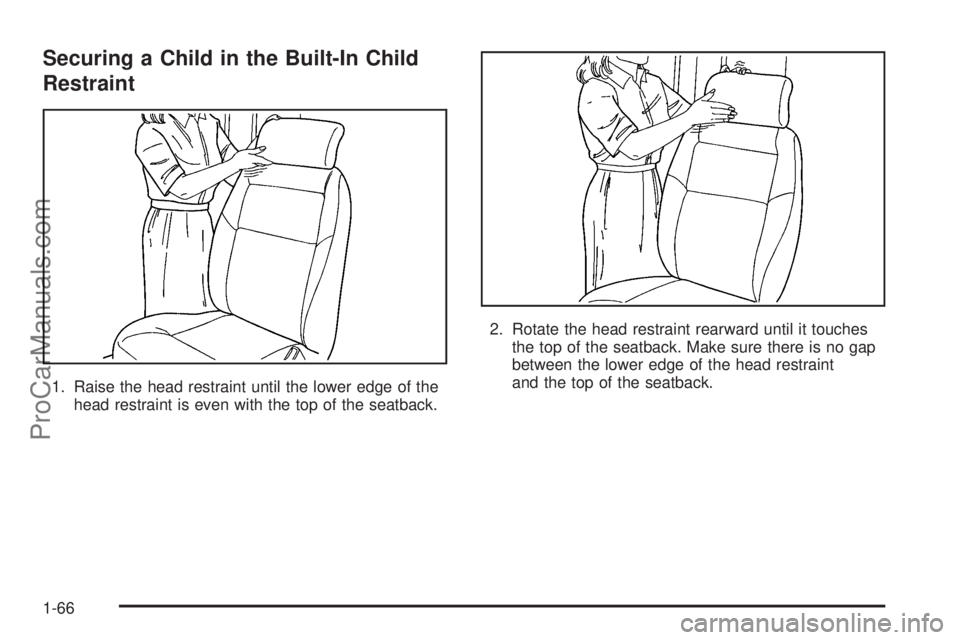
Restraint
1. Raise the head restraint until the lower edge of the
head restraint is even with the top of the seatback.2. Rotate the head restraint rearward until it touches
the top of the seatback. Make sure there is no gap
between the lower edge of the head restraint
and the top of the seatback.
1-66
ProCarManuals.com
Page 73 of 458
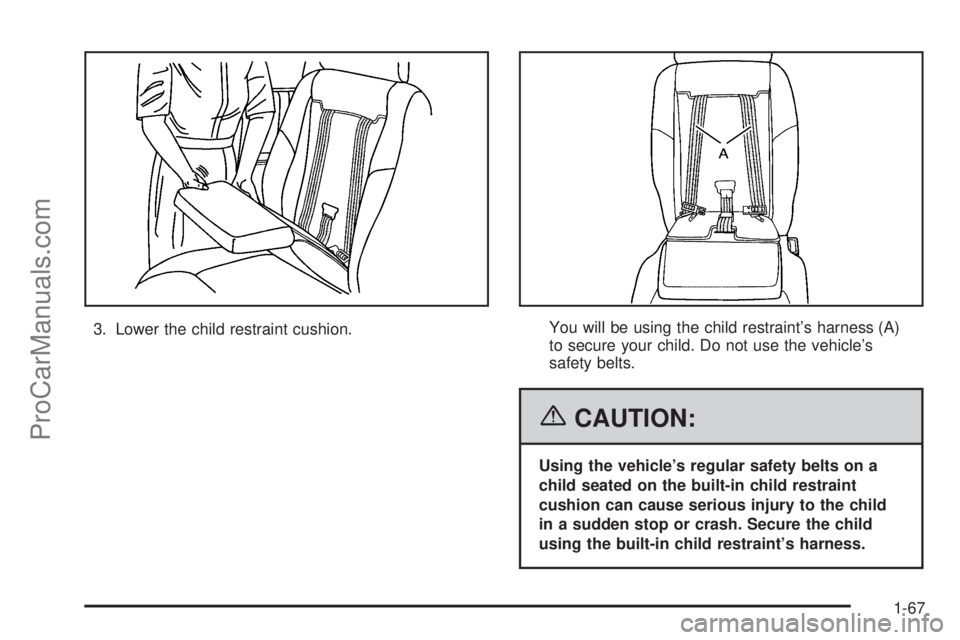
3. Lower the child restraint cushion.You will be using the child restraint’s harness (A)
to secure your child. Do not use the vehicle’s
safety belts.
{CAUTION:
Using the vehicle’s regular safety belts on a
child seated on the built-in child restraint
cushion can cause serious injury to the child
in a sudden stop or crash. Secure the child
using the built-in child restraint’s harness.
1-67
ProCarManuals.com
Page 74 of 458
WARNING:FAILURE TO FOLLOW THE
MANUFACTURER’S INSTRUCTIONS ON THE USE
OF THIS CHILD RESTRAINT SYSTEM CAN RESULT
IN YOUR CHILD STRIKING THE VEHICLE’S
INTERIOR DURING A SUDDEN STOP OR CRASH.
SNUGLY ADJUST THE BELTS PROVIDED WITH THIS
CHILD RESTRAINT AROUND YOUR CHILD.
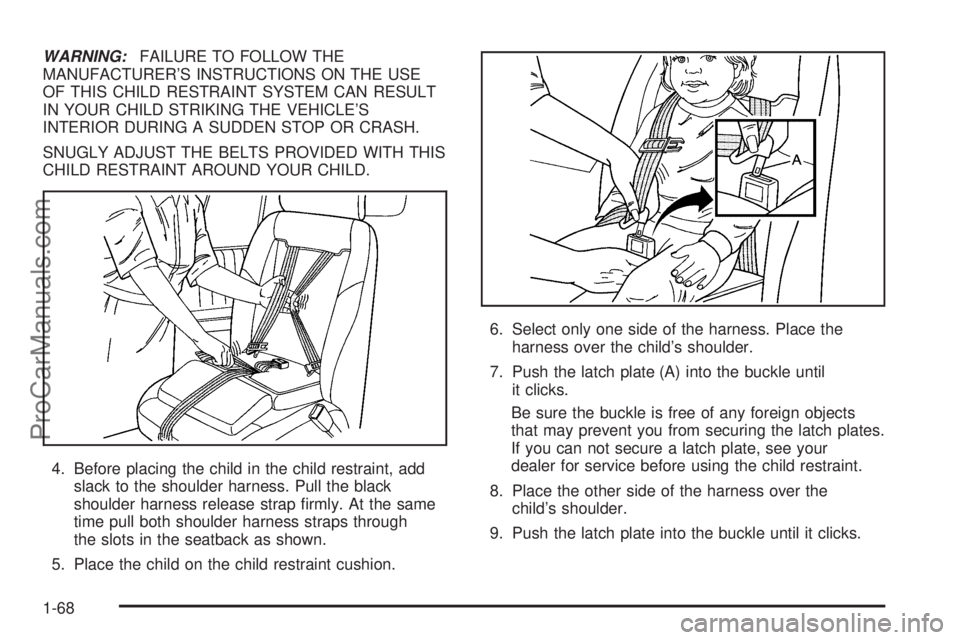
4. Before placing the child in the child restraint, add
slack to the shoulder harness. Pull the black
shoulder harness release strap rmly. At the same
time pull both shoulder harness straps through
the slots in the seatback as shown.
5. Place the child on the child restraint cushion.6. Select only one side of the harness. Place the
harness over the child’s shoulder.
7. Push the latch plate (A) into the buckle until
it clicks.
Be sure the buckle is free of any foreign objects
that may prevent you from securing the latch plates.
If you can not secure a latch plate, see your
dealer for service before using the child restraint.
8. Place the other side of the harness over the
child’s shoulder.
9. Push the latch plate into the buckle until it clicks.
1-68
ProCarManuals.com
Page 77 of 458
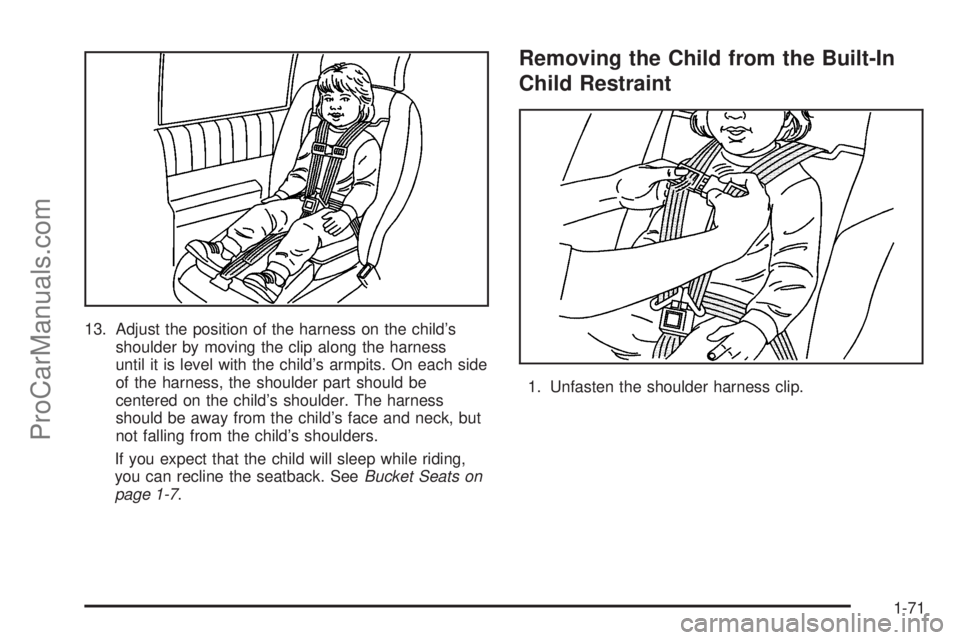
13. Adjust the position of the harness on the child’s
shoulder by moving the clip along the harness
until it is level with the child’s armpits. On each side
of the harness, the shoulder part should be
centered on the child’s shoulder. The harness
should be away from the child’s face and neck, but
not falling from the child’s shoulders.
If you expect that the child will sleep while riding,
you can recline the seatback. SeeBucket Seats on
page 1-7.
Removing the Child from the Built-In
Child Restraint
1. Unfasten the shoulder harness clip.
1-71
ProCarManuals.com