radiator CHEVROLET UPLANDER 2007 1.G User Guide
[x] Cancel search | Manufacturer: CHEVROLET, Model Year: 2007, Model line: UPLANDER, Model: CHEVROLET UPLANDER 2007 1.GPages: 592, PDF Size: 3.04 MB
Page 458 of 592
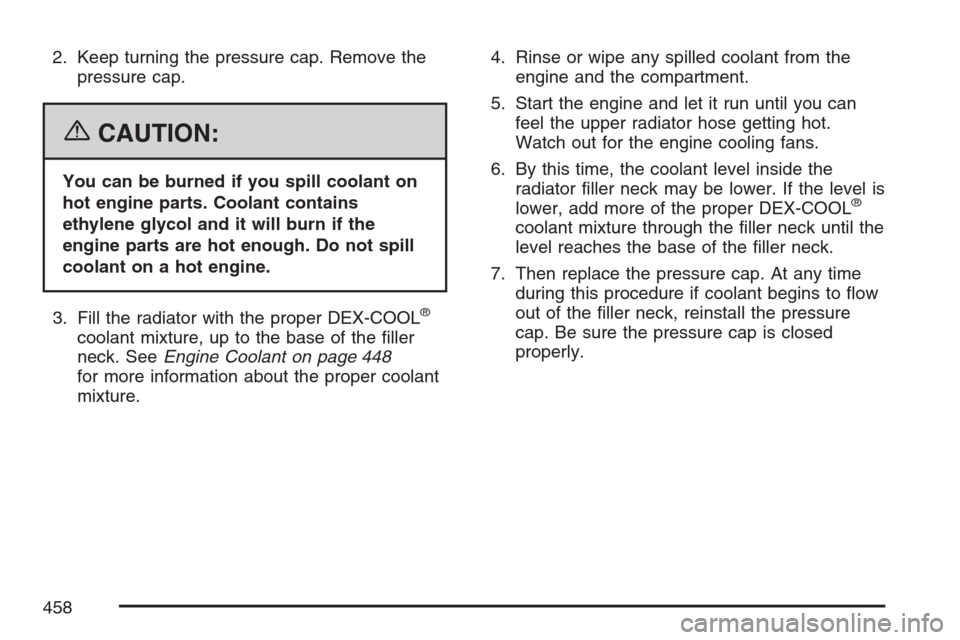
2. Keep turning the pressure cap. Remove the
pressure cap.
{CAUTION:
You can be burned if you spill coolant on
hot engine parts. Coolant contains
ethylene glycol and it will burn if the
engine parts are hot enough. Do not spill
coolant on a hot engine.
3. Fill the radiator with the proper DEX-COOL
®
coolant mixture, up to the base of the ller
neck. SeeEngine Coolant on page 448
for more information about the proper coolant
mixture.4. Rinse or wipe any spilled coolant from the
engine and the compartment.
5. Start the engine and let it run until you can
feel the upper radiator hose getting hot.
Watch out for the engine cooling fans.
6. By this time, the coolant level inside the
radiator ller neck may be lower. If the level is
lower, add more of the proper DEX-COOL
®
coolant mixture through the ller neck until the
level reaches the base of the ller neck.
7. Then replace the pressure cap. At any time
during this procedure if coolant begins to ow
out of the ller neck, reinstall the pressure
cap. Be sure the pressure cap is closed
properly.
458
Page 543 of 592
Maintenance Footnotes
#Lubricate the suspension, steering linkage,
transaxle shift linkage, and the underbody contact
points and linkage.
(a)Visually inspect brake lines and hoses for
proper hook-up, binding, leaks, cracks, chang,
etc. Inspect disc brake pads for wear and rotors for
surface condition. Inspect other brake parts,
including calipers, parking brake, etc. Check
parking brake adjustment.
(b)Visually inspect front and rear suspension and
steering system for damaged, loose, or missing
parts, signs of wear, or lack of lubrication. Inspect
power steering lines and hoses for proper
hook-up, binding, leaks, cracks, chang, etc.
(c)Visually inspect hoses and have them replaced
if they are cracked, swollen, or deteriorated.
Inspect all pipes, ttings and clamps; replace with
genuine GM parts as needed. To help ensure
proper operation, a pressure test of the cooling
system and pressure cap and cleaning the outside
of the radiator and air conditioning condenser is
recommended at least once a year.(d)Visually inspect wiper blades for wear or
cracking. Replace wiper blades that appear worn
or damaged or that streak or miss areas of
the windshield.
(e)Make sure the safety belt reminder light and all
your belts, buckles, latch plates, retractors, and
anchorages are working properly. If your vehicle
has a built-in child restraint, make sure the harness
straps, latch plates, buckle, clip, child head
restraint, and anchorages are working properly.
Look for any other loose or damaged safety
belt system parts. If you see anything that might
keep a safety belt system from doing its job, have
it repaired. Have any torn or frayed safety belts
replaced. Also look for any opened or broken
airbag coverings, and have them repaired
or replaced. The airbag system does not need
regular maintenance.
(f)Lubricate all key lock cylinders, hood latch
assemblies, secondary latches, pivots, spring
anchor and release pawl, hood and door hinges,
rear folding seats, liftgate hinges, fuel door
hinge, power sliding door cable, and sliding door
track(s). More frequent lubrication may be required
when exposed to a corrosive environment.
543
Page 544 of 592
Applying silicone grease on weatherstrips with a
clean cloth will make them last longer, seal better,
and not stick or squeak.
(g)If you drive regularly under dusty conditions,
inspect the lter at each engine oil change.
(h)Change automatic transaxle uid and lter if
the vehicle is mainly driven under one or more of
these conditions:
In heavy city traffic where the outside
temperature regularly reaches 90°F (32°C) or
higher.
In hilly or mountainous terrain.
When doing frequent trailer towing.
Uses such as found in taxi, police, or delivery
service.
(i)Drain, ush, and rell cooling system. See
Engine Coolant on page 448 for what to
use. Inspect hoses. Clean radiator, condenser,
pressure cap, and ller neck. Pressure test
the cooling system and pressure cap.(j)Check system for interference or binding and
for damaged or missing parts. Replace parts
as needed. Replace any components that have
high effort or excessive wear. Do not lubricate
accelerator or cruise control cables.
(k)A uid loss in any vehicle system could
indicate a problem. Have the system inspected
and repaired and the uid level checked. Add uid
if needed.
(l)If you drive regularly under dusty conditions,
the lter may require replacement more often.
(m)Visually inspect belt for fraying, excessive
cracks, or obvious damage. Replace belt if
necessary.
Owner Checks and Services
These owner checks and services should be
performed at the intervals specied to help ensure
the safety, dependability, and emission control
performance of your vehicle. Your GM
Goodwrench
®dealer can assist you with these
checks and services.
544
Page 587 of 592
PASS-Key®III ............................................. 148
PASS-Key®III Operation............................. 148
Power
Accessory Outlet(s).................................. 214
Door Locks.............................................. 129
Electrical System..................................... 527
Outlet 115 Volt Alternating Current........... 215
Rear Quarter Windows............................. 145
Retained Accessory (RAP)....................... 152
Seat.......................................................... 10
Sliding Door............................................. 134
Steering Fluid.......................................... 459
Windows.................................................. 144
Pretensioners, Safety Belt............................. 55
Programmable Automatic Door Unlock......... 131
Q
Questions and Answers About Safety Belts...... 36
R
Radiator Pressure Cap................................ 451
Radios........................................................ 284
Care of Your CD and DVD Player............ 369
Care of Your CDs and DVDs................... 369
Navigation/Radio System, see
Navigation Manual................................ 309
Radio with CD......................................... 286
Rear Seat Audio.............................340, 343
Setting the Time...................................... 285
Theft-Deterrent......................................... 367
Understanding Reception......................... 368
Rear Climate Control System.............224, 226
Rear Reading Lamps.................................. 209
Rear Safety Belt Comfort Guides.................. 52
Rear Seat Audio (RSA)......................340, 343
Rear Seat Entertainment System........309, 324
Rear Seat Operation..................................... 13
Rear Seat Passengers, Safety Belts.............. 48
Rear Windshield Washer/Wiper.................... 199
587