ECU CHEVROLET UPLANDER 2007 1.G Repair Manual
[x] Cancel search | Manufacturer: CHEVROLET, Model Year: 2007, Model line: UPLANDER, Model: CHEVROLET UPLANDER 2007 1.GPages: 592, PDF Size: 3.04 MB
Page 247 of 592
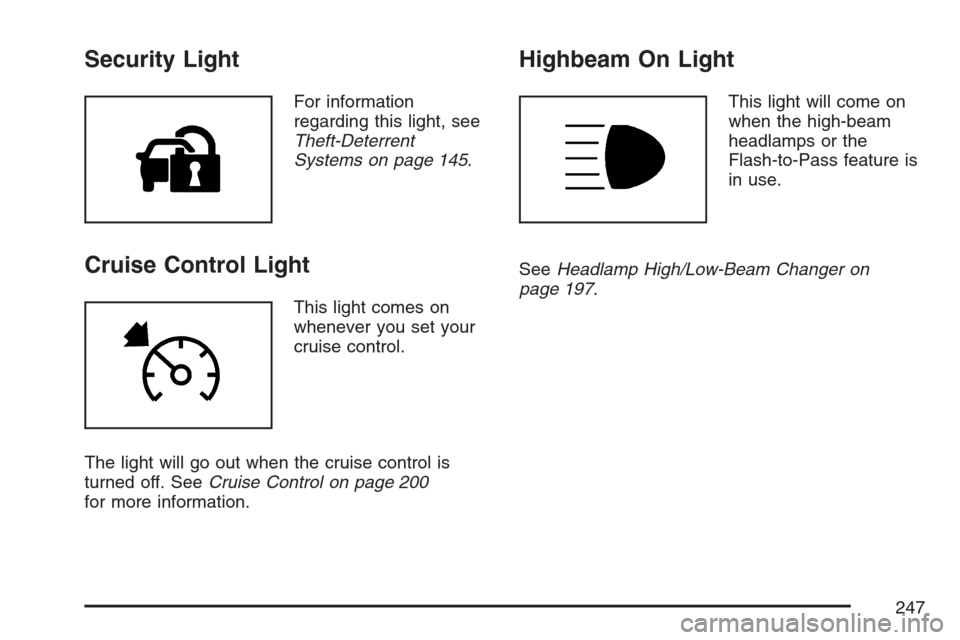
Security Light
For information
regarding this light, see
Theft-Deterrent
Systems on page 145.
Cruise Control Light
This light comes on
whenever you set your
cruise control.
The light will go out when the cruise control is
turned off. SeeCruise Control on page 200
for more information.
Highbeam On Light
This light will come on
when the high-beam
headlamps or the
Flash-to-Pass feature is
in use.
SeeHeadlamp High/Low-Beam Changer on
page 197.
247
Page 308 of 592
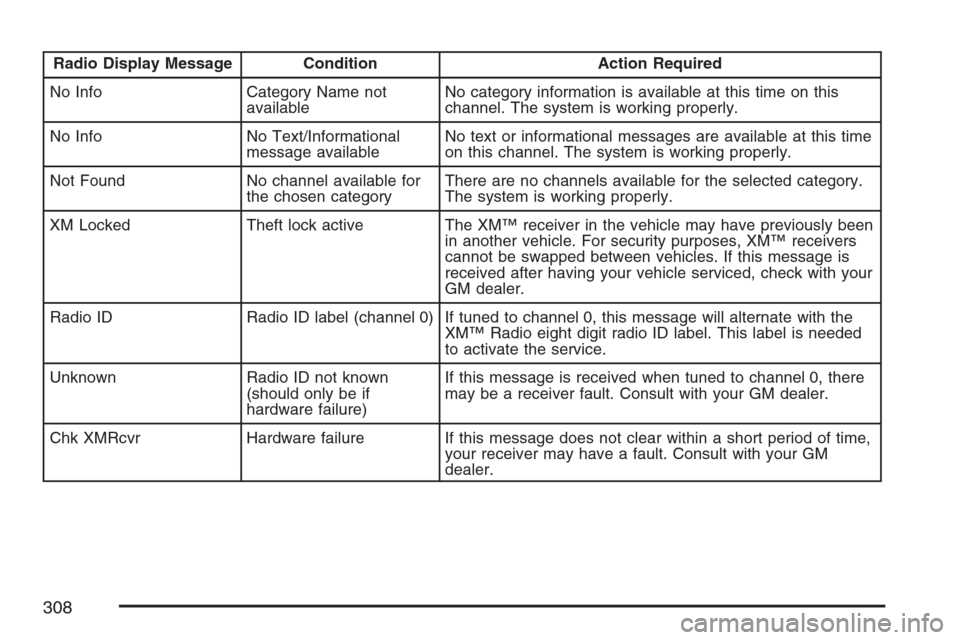
Radio Display Message Condition Action Required
No Info Category Name not
availableNo category information is available at this time on this
channel. The system is working properly.
No Info No Text/Informational
message availableNo text or informational messages are available at this time
on this channel. The system is working properly.
Not Found No channel available for
the chosen categoryThere are no channels available for the selected category.
The system is working properly.
XM Locked Theft lock active The XM™ receiver in the vehicle may have previously been
in another vehicle. For security purposes, XM™ receivers
cannot be swapped between vehicles. If this message is
received after having your vehicle serviced, check with your
GM dealer.
Radio ID Radio ID label (channel 0) If tuned to channel 0, this message will alternate with the
XM™ Radio eight digit radio ID label. This label is needed
to activate the service.
Unknown Radio ID not known
(should only be if
hardware failure)If this message is received when tuned to channel 0, there
may be a receiver fault. Consult with your GM dealer.
Chk XMRcvr Hardware failure If this message does not clear within a short period of time,
your receiver may have a fault. Consult with your GM
dealer.
308
Page 399 of 592
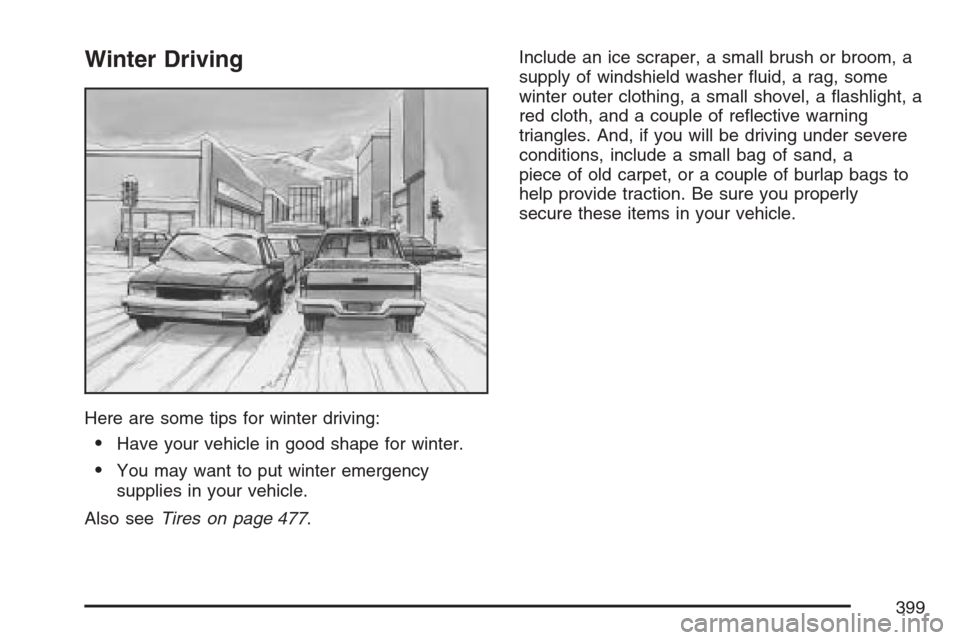
Winter Driving
Here are some tips for winter driving:
Have your vehicle in good shape for winter.
You may want to put winter emergency
supplies in your vehicle.
Also seeTires on page 477.Include an ice scraper, a small brush or broom, a
supply of windshield washer uid, a rag, some
winter outer clothing, a small shovel, a ashlight, a
red cloth, and a couple of reective warning
triangles. And, if you will be driving under severe
conditions, include a small bag of sand, a
piece of old carpet, or a couple of burlap bags to
help provide traction. Be sure you properly
secure these items in your vehicle.
399
Page 409 of 592
Notice:Overloading your vehicle may cause
damage. Repairs would not be covered by your
warranty. Do not overload your vehicle.
If you put things inside your vehicle — like
suitcases, tools, packages, or anything else, they
will go as fast as the vehicle goes. If you have
to stop or turn quickly, or if there is a crash, they
will keep going.
{CAUTION:
Things you put inside your vehicle can
strike and injure people in a sudden stop
or turn, or in a crash.
Put things in the cargo area of your
vehicle. Try to spread the weight
evenly.
Never stack heavier things, like
suitcases, inside the vehicle so that
some of them are above the tops of
the seats.
Do not leave an unsecured child
restraint in your vehicle.
When you carry something inside the
vehicle, secure it whenever you can.
Do not leave a seat folded down
unless you need to.
409
Page 420 of 592
Before you start, check all trailer hitch parts and
attachments, safety chains, electrical connector,
lamps, tires, and mirror adjustment. If the
trailer has electric brakes, start your vehicle and
trailer moving and then apply the trailer brake
controller by hand to be sure the brakes are
working. This lets you check your electrical
connection at the same time.
During your trip, check occasionally to be sure
that the load is secure, and that the lamps and any
trailer brakes are still working.
Following Distance
Stay at least twice as far behind the vehicle ahead
as you would when driving your vehicle without
a trailer. This can help you avoid situations
that require heavy braking and sudden turns.
Passing
You will need more passing distance up ahead
when you are towing a trailer. And, because
you are a good deal longer, you will need to go
much farther beyond the passed vehicle
before you can return to your lane.
Backing Up
Hold the bottom of the steering wheel with one
hand. Then, to move the trailer to the left, just move
that hand to the left. To move the trailer to the right,
move your hand to the right. Always back up slowly
and, if possible, have someone guide you.
Making Turns
Notice:Making very sharp turns while
trailering could cause the trailer to come in
contact with the vehicle. Your vehicle could be
damaged. Avoid making very sharp turns
while trailering.
When you are turning with a trailer, make wider
turns than normal. Do this so your trailer will
not strike soft shoulders, curbs, road signs, trees,
or other objects. Avoid jerky or sudden
maneuvers. Signal well in advance.
420
Page 445 of 592
5. Align the tabs located on the bottom of the
panel with the slots at the bottom of the
housing.
6. Latch the hooks to secure the panel in place.
If the panel moves easily, check that the tabs
are seated correctly in the slots.
7. Put the duct back on and reinstall the clamps.
{CAUTION:
Operating the engine with the air
cleaner/lter off can cause you or others
to be burned. The air cleaner not only
cleans the air; it helps to stop ames if
the engine backres. If it is not there and
the engine backres, you could be
burned. Do not drive with it off, and be
careful working on the engine with the air
cleaner/lter off.Notice:If the air cleaner/lter is off, a backre
can cause a damaging engine re. And, dirt
can easily get into your engine, which will
damage it. Always have the air cleaner/lter in
place when you are driving.
Automatic Transaxle Fluid
When to Check and Change Automatic
Transaxle Fluid
A good time to check your automatic transaxle
uid level is when the engine oil is changed.
Change the uid and lter at the intervals listed in
Additional Required Services on page 542, and
be sure to use the transaxle uid listed in
Recommended Fluids and Lubricants on page 548.
445
Page 472 of 592
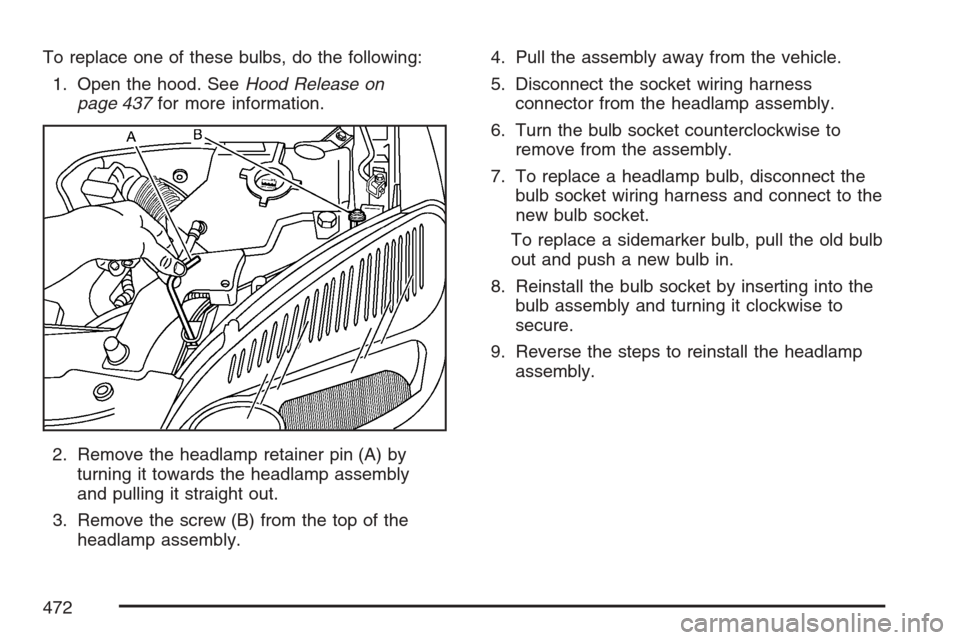
To replace one of these bulbs, do the following:
1. Open the hood. SeeHood Release on
page 437for more information.
2. Remove the headlamp retainer pin (A) by
turning it towards the headlamp assembly
and pulling it straight out.
3. Remove the screw (B) from the top of the
headlamp assembly.4. Pull the assembly away from the vehicle.
5. Disconnect the socket wiring harness
connector from the headlamp assembly.
6. Turn the bulb socket counterclockwise to
remove from the assembly.
7. To replace a headlamp bulb, disconnect the
bulb socket wiring harness and connect to the
new bulb socket.
To replace a sidemarker bulb, pull the old bulb
out and push a new bulb in.
8. Reinstall the bulb socket by inserting into the
bulb assembly and turning it clockwise to
secure.
9. Reverse the steps to reinstall the headlamp
assembly.
472
Page 473 of 592
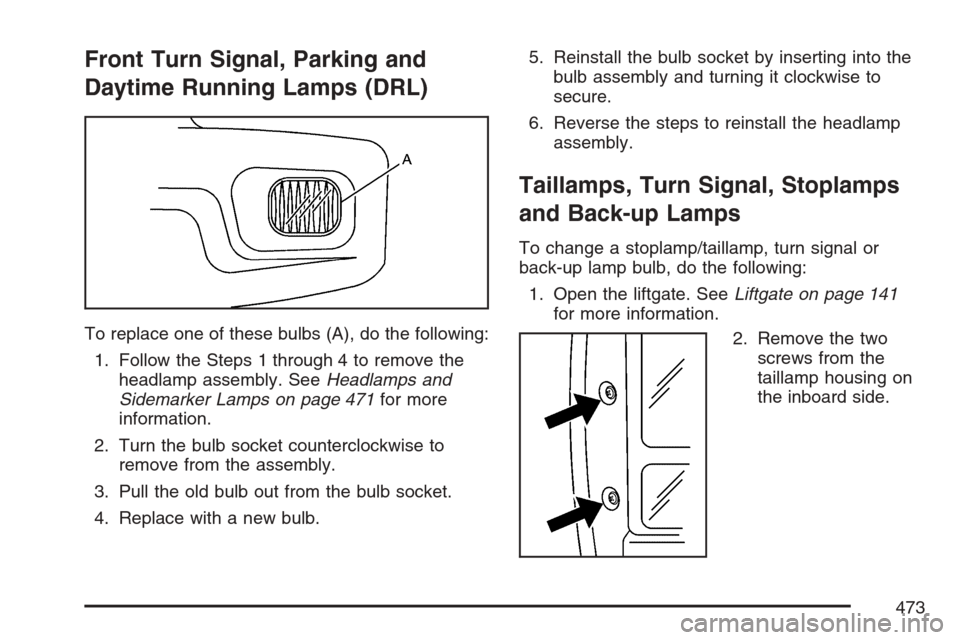
Front Turn Signal, Parking and
Daytime Running Lamps (DRL)
To replace one of these bulbs (A), do the following:
1. Follow the Steps 1 through 4 to remove the
headlamp assembly. SeeHeadlamps and
Sidemarker Lamps on page 471for more
information.
2. Turn the bulb socket counterclockwise to
remove from the assembly.
3. Pull the old bulb out from the bulb socket.
4. Replace with a new bulb.5. Reinstall the bulb socket by inserting into the
bulb assembly and turning it clockwise to
secure.
6. Reverse the steps to reinstall the headlamp
assembly.
Taillamps, Turn Signal, Stoplamps
and Back-up Lamps
To change a stoplamp/taillamp, turn signal or
back-up lamp bulb, do the following:
1. Open the liftgate. SeeLiftgate on page 141
for more information.
2. Remove the two
screws from the
taillamp housing on
the inboard side.
473
Page 474 of 592
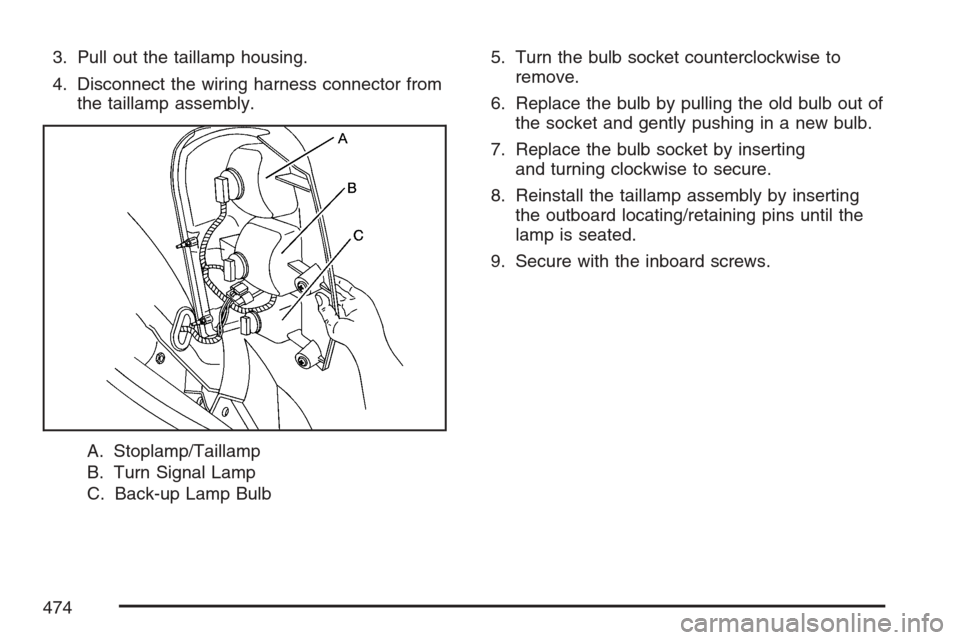
3. Pull out the taillamp housing.
4. Disconnect the wiring harness connector from
the taillamp assembly.
A. Stoplamp/Taillamp
B. Turn Signal Lamp
C. Back-up Lamp Bulb5. Turn the bulb socket counterclockwise to
remove.
6. Replace the bulb by pulling the old bulb out of
the socket and gently pushing in a new bulb.
7. Replace the bulb socket by inserting
and turning clockwise to secure.
8. Reinstall the taillamp assembly by inserting
the outboard locating/retaining pins until the
lamp is seated.
9. Secure with the inboard screws.
474
Page 476 of 592
Windshield Wiper Blade
Replacement
Windshield wiper blades should be inspected for
wear and cracking. SeeScheduled Maintenance
on page 539for more information.
Replacement blades come in different types and
are removed in different ways. For proper type and
length, seeNormal Maintenance Replacement
Parts on page 550.
To replace the windshield wiper blade assembly
do the following:
1. Lift the wiper arm and turn the blade until it is
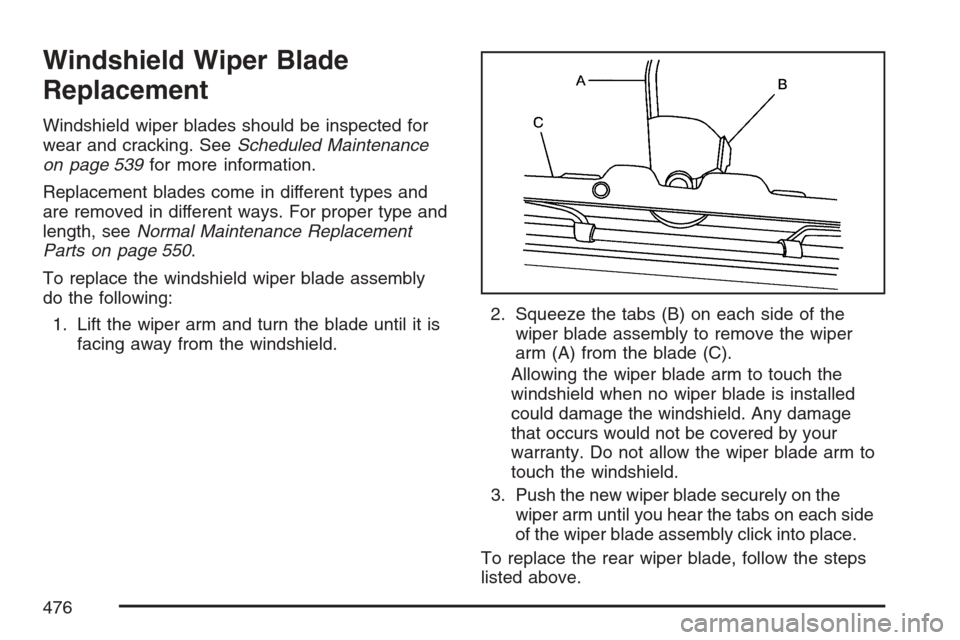
facing away from the windshield.2. Squeeze the tabs (B) on each side of the
wiper blade assembly to remove the wiper
arm (A) from the blade (C).
Allowing the wiper blade arm to touch the
windshield when no wiper blade is installed
could damage the windshield. Any damage
that occurs would not be covered by your
warranty. Do not allow the wiper blade arm to
touch the windshield.
3. Push the new wiper blade securely on the
wiper arm until you hear the tabs on each side
of the wiper blade assembly click into place.
To replace the rear wiper blade, follow the steps
listed above.
476