ECU CHEVROLET VEGA 1976 1.G Owners Manual
[x] Cancel search | Manufacturer: CHEVROLET, Model Year: 1976, Model line: VEGA, Model: CHEVROLET VEGA 1976 1.GPages: 87, PDF Size: 32.36 MB
Page 7 of 87
Downloaded from www.Manualslib.com manuals search engine Door Locks
Front side doors can be locked
from the inside by depressing the
passenger guard door lock buttons
located
on the upper door panel.
All doors can be locked from the
outside by first depressing the door
lock button and closing the door.
The doors can also be locked by
using the key.
All models have as a standard
safety feature overriding door locks.
When the doors are locked, the door
latch mechanism
is inoperative, pre
venting inadvertent opening of the
door by movement of the inside
handle.
Adjustable Front Seat Back
-Driver's Side
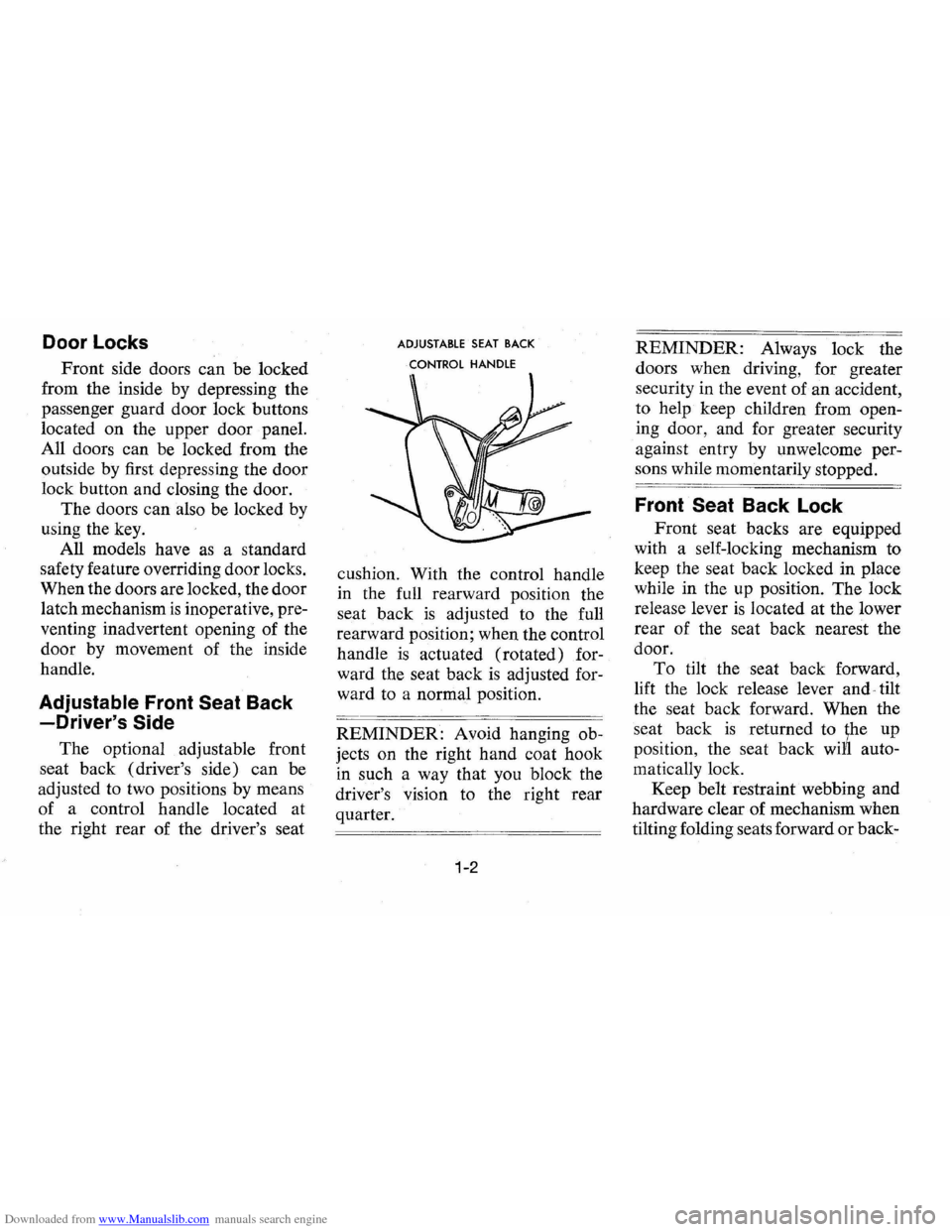
The optional adjustable front
seat back (driver's side) can be
adjusted to two positions by means
of a control handle located at
the right rear of the driver's seat
ADJUSTABLE SEAT BACK
CONTROL HANDLE
cushion. With the control handle
in the full rearward position the
seat back
is adjusted to the full
rearward position; when the control
handle
is actuated (rotated) for
ward the seat back
is adjusted for
ward to a normal position.
REMINDER: Avoid hanging ob
jects on the right hand coat hook
in such a way that you block the
driver's
VISIOn to the right rear
quarter.
1-2
REMINDER: Always lock the
doors when driving, for greater
security in the event of an accident,
to help keep children from open
ing door, and for greater security
against entry by unwelcome per
sons while momentarily stopped.
Front Seat Back Lock
Front seat backs are equipped
with a self-locking mechanism to
keep the seat back locked in place
while in the up position.
The lock
release lever
is located at the lower
rear of the seat back nearest the
door.
To tilt the seat back forward,
lift the lock release lever
and" tilt
the seat back forward. When the
seat back
is returned to ~he up
position, the seat back
wn1 auto
matically lock.
Keep belt restraint webbing and
hardware clear
of mechanism when
tilting folding seats forward
or back-
Page 9 of 87
Downloaded from www.Manualslib.com manuals search engine Occupant Restraint Belts
Lap and shoulder belts provide
added security and comfort for you
and your passengers.
Proper use
and care of these belts will assure
continuance of this security.
Belt Restraint -
Reminder
System
This vehicle has a light /buzzer
reminder system designed
to remind
the driver to fasten his belt restraint.
• When the ignition key is turned
to
ON or START, a reminder
light
is designed to come on for
four-to-eight
secends to remind
the driver to fasten
his belt re
straint.
• If the driver has not buckled his
belt restraint prior
to turning the
key to
ON or START, a buzzer
is designed to sound for four-to
eight seconds to remind him to
do
so.
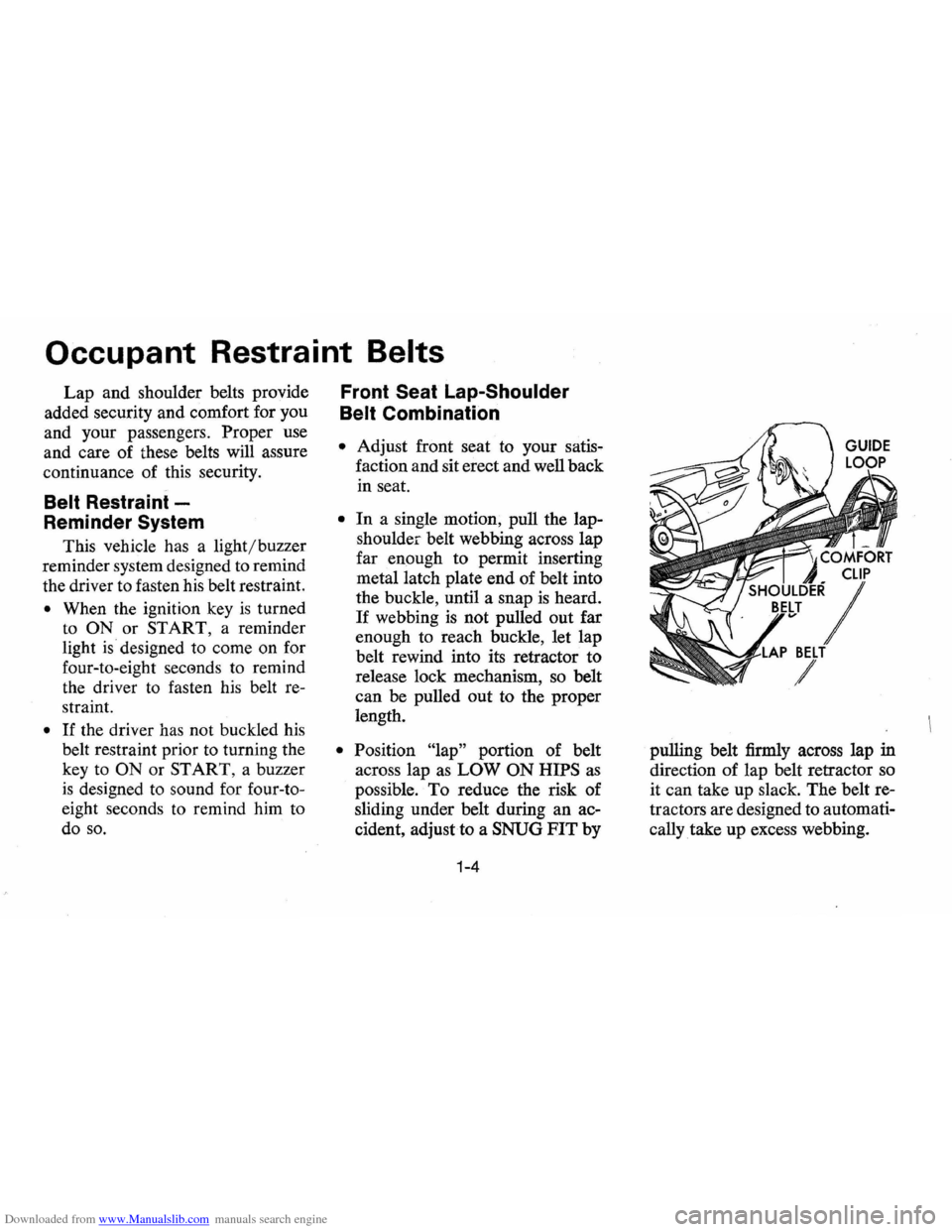
Front Seat Lap-Shoulder
Belt
Combination
• Adjust front seat to your satis
faction and sit erect and well back
in seat.
• In a single motion, pull the lap
shoulder belt webbing across lap
far enough to permit inserting
metal latch plate end of belt into
the buckle, until a snap
is heard.
If webbing is not pulled out far
enough to reach buckle, let lap
belt rewind into its retractor to
release lock mechanism,
so belt
can be pulled out to the proper
length.
• Position "lap" portion of belt
across lap
as LOW ON HIPS as
possible. To reduce the risk of
sliding under belt during an ac
cident, adjustto a
SNUG FIT by
1-4
COMFORT
"7 BELT
/
pulling belt firmly across lap in
direction of lap belt retractor so
it can take up slack. The belt re
tractors are designed to automati
cally .take
up excess webbing.
Page 11 of 87
Downloaded from www.Manualslib.com manuals search engine by allowing them to rewind into
their retractors. The comfort clip
can be adjusted when removing
belts,
so shoulder belt slack can
be taken up by retractor.
NOTE: Take care not to let the
"lap" portion of the belt twist while
it
is being rewound into the retrac
tor. The bulk of the twisted belt may
cause the retractor to jam
so it will
not rewind further while at the same
time the retractor's locking mecha
nism may prevent the belt from be
ing withdrawn.
If a belt should
become jammed, you may be able to
release it by working the belt in and
out until the belt rewinds far enough
to unlock.
If lap belt portion remains
jammed, or
other parts of the re
straint system do not operate prop
erly take the vehicle to your dealer
for service.
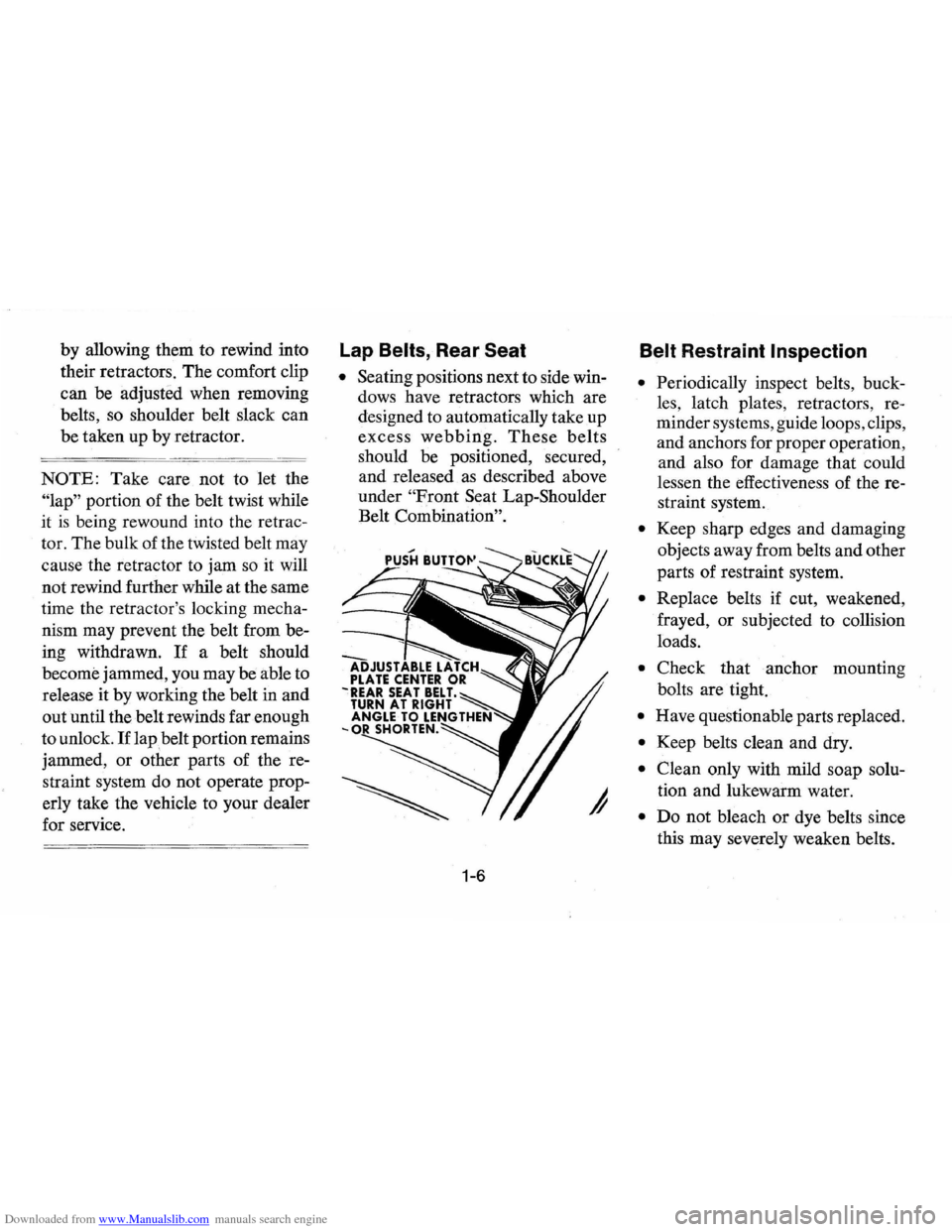
Lap Belts, Rear Seat
• Seating positions next to side win
dows have retractors which are
designed to automatically take up
excess
webbing. These belts
should be positioned, secured,
and released
as described above
under
"Front Seat Lap-Shoulder
Belt
Combination".
1-6
Belt Restraint Inspection
• Periodically inspect belts, buck
les, latch plates, retractors, re
minder systems, guide loops, clips,
and anchors for proper operation,
and also for damage that could
lessen the effectiveness of the re
straint system.
• Keep sharp edges and damaging
objects away from belts and other
parts of restraint system.
• Replace belts if cut, weakened,
frayed,
or subjected to collision
loads.
• Check that anchor mounting
bolts are tight.
• Have questionable parts replaced.
• Keep belts clean and dry.
• Clean only with mild soap solu
tion and lukewarm water.
• Do not bleach or dye belts since
this may severely weaken belts.
Page 12 of 87
Downloaded from www.Manualslib.com manuals search engine Child Restraint
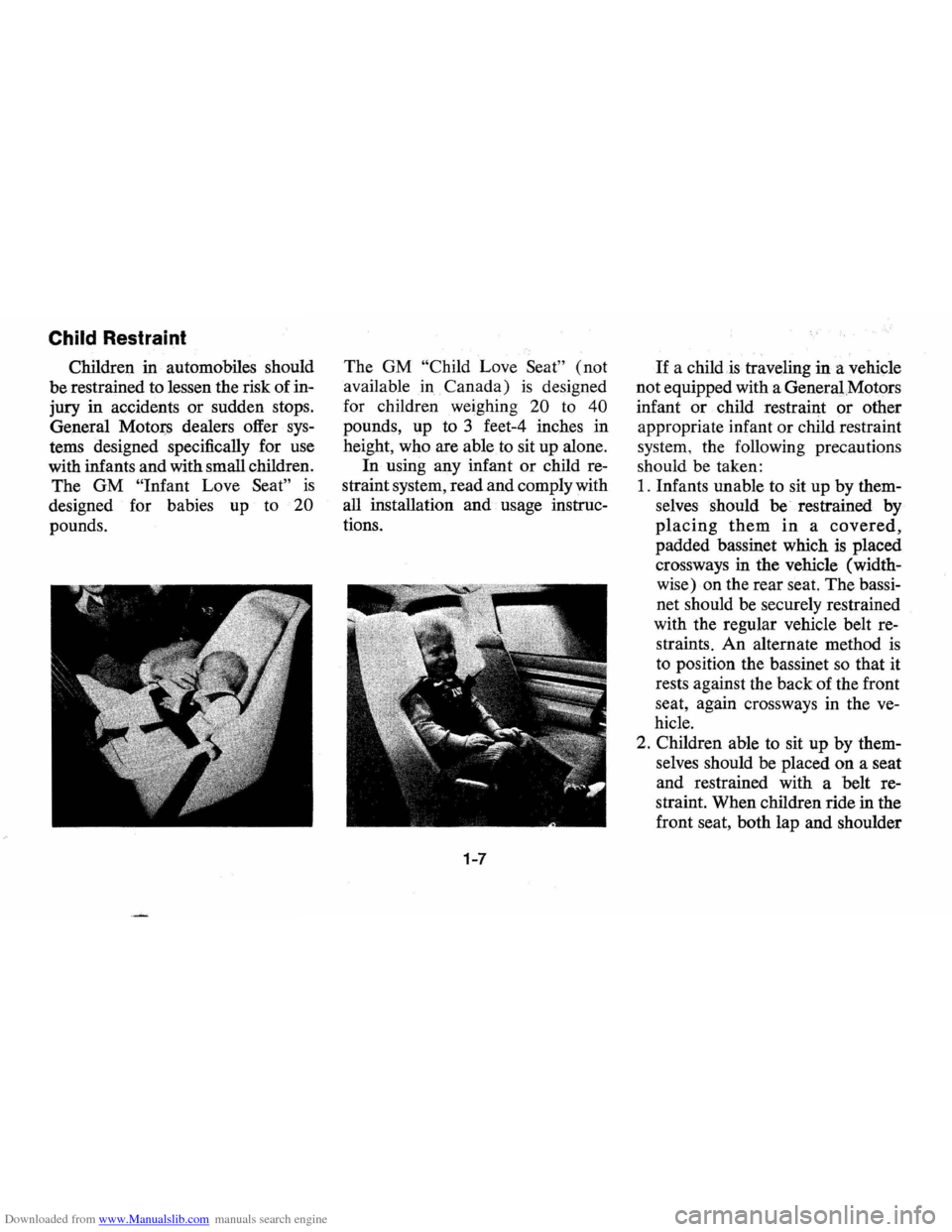
Children in automobiles should
be restrained to lessen the risk of in
jury in accidents
or sudden stops.
General
MotOl:S dealers offer sys
tems designed specifically for use
with infants and with small children.
The GM
"Infant Love Seat" is
designed for babies up to 20
pounds. The
GM
"Child Love Seat" (not
available in Canada)
is designed
for children weighing
20 to 40
pounds, up to 3 feet-4 inches in
height, who are
ableto sit up alone.
In using any infant
or child re
straint system, read and comply with
all installation and usage instruc
tions.
1-7
If a child,is traveling in a vehi<;:le
not equipped with a General Motors
infant
or child restraint or other
appropriate infant or child restraint
system , the following precautions
should be taken:
1 . Infants unable to sit up by them
selves should
be· restrained by
placing them in a covered,
padded bassinet which is placed
crossways in the vehicle (width
wise
)on the rear seat. The bassi
net should be securely restrained
with the regular vehicle belt re
straints. An alternate method
is
to position the bassinet so that it
rests against the back of the front
seat, again crossways in the ve
hicle.
2. Children able to sit up by them
selves should be placed on a seat
and restrained with a belt re
straint. When children ride in the
front seat, both lap and shoulder