service CHEVROLET VEGA 1976 1.G Owners Manual
[x] Cancel search | Manufacturer: CHEVROLET, Model Year: 1976, Model line: VEGA, Model: CHEVROLET VEGA 1976 1.GPages: 87, PDF Size: 32.36 MB
Page 3 of 87
Downloaded from www.Manualslib.com manuals search engine A WORD TO VEGA OWNERS ...
This manual has been prepared to acquaint you with the operation and maintenance of your 1976 Vega, and to provide
important safety information. It is supplemented by two convenient folders which provide additional information on
vehicle maintenance and warranties. We urge you to read these publications carefully and follow the recommenda
tions to help assure the most enjoyable and troublefree operation of your vehicle.
When it comes to service, remember that your Chevrolet dealer knows your vehicle best and is interested in your complete satisfaction. Return to him for Guardian Maintenance Service and any other assistance you may require.
To assist dealers in handling your needs, Chevrolet maintains a number of Zone Offices throughout the country. Should you have a problem that cannot be handled through normal channels, follow the procedure presented in
Section 6 of this manual under the heading, "Owner Assistance".
We would like to take this opportunity to thank you for choosing a Chevrolet product-and assure you of our con
tinuing interest in your motoring pleasure and satisfaction.
FOR CONTINUING SATISFACTION, KEEP YOUR
GM CAR ALL GM. GENERAL MOTORS PARTS ARE
IDENTIFIED BY ONE OF THESE TRADEMARKS:
"NOTE TO CANADIAN OWNERS :
If preferred, a French Owner's Manual can be obtained from either your Dealer or by writing to General Motors of Canada Limited, Owner Relations Department, Oshawa, Ontario L1J 5Z6."
Chevrolet Motor Division
GM
"
" '"
-nelCO
Aux proprietaires canadiens
On peut se procurer un exemplaire de ce Guide en francais aupres du concessionnaire ou du service
des relations avec la clientele, General Motors of
Canada Limited, Oshawa, Ontario L1J 5Z6.
Page 4 of 87
Downloaded from www.Manualslib.com manuals search engine ------------------------:----------~ ... --,;,.._J,,; ......,.-~ ....
1976 VEGA 2'300
OWNER'S
MANUAL
This manual should be considered a perma
nent part of the vehicle, and must remain
with the vehicle at time of resale.
CHEVROLET MOTOR
DIVISION
GENERAL MOTORS
CORPORATION
DETROIT, MICHIGAN 48202
All information, illustrations and specifications con
tained in this manual are based on the latest product
information available at the time of publication. The right is reserved to make changes at any time without
notice.
For vehicles sold in Canada, substitute the name
General Motors of Canada Limited, wherever the name
Chevrolet Motor Car Division appears in this manual.
ST 303-76
"'General Motors Corporation 1976
Section
1
2
3
4
5
Table of Contents
Page
Before Driving Your Vega ............................. 1-1
Starting and Operating .. ;-............................ 2-1
Steering
Column Controls .......................... , 2-2
Floor Controls ...................................... 2-10
Instrument PaneL .................................. 2-13
Other Controls and Features ........................ , 2-27
In Case of Emergency ................................. 3-1
Appearance
Care... . . . . . . . . . . . . . . . . . . . . . . . . . . . . . . . . . .. 4-1 I
Service and Maintenance....... ...... . . . . ............ 5-1
6 Specifications,
Owner Assistance, Service
Manuals, Index, Gas Station
Information
........................................ 6-1
Applicable to CALIFORNIA Sales Only This vehicle as delivered by ,6 M Chevrolet Division is equipped with a bumper energy
absorption system meeting California S.B.42 (1971) as set forth in Sec. 34715 Vehicle Code.
Applicable to FLORIDA Sales Only This vehicle as delivered by GM Chevrolet Division is equipped with a bumper energy
absorption system meeting section 501.125, Florida Statutes, as amended June 10, 1974.
i
Page 11 of 87
Downloaded from www.Manualslib.com manuals search engine by allowing them to rewind into
their retractors. The comfort clip
can be adjusted when removing
belts,
so shoulder belt slack can
be taken up by retractor.
NOTE: Take care not to let the
"lap" portion of the belt twist while
it
is being rewound into the retrac
tor. The bulk of the twisted belt may
cause the retractor to jam
so it will
not rewind further while at the same
time the retractor's locking mecha
nism may prevent the belt from be
ing withdrawn.
If a belt should
become jammed, you may be able to
release it by working the belt in and
out until the belt rewinds far enough
to unlock.
If lap belt portion remains
jammed, or
other parts of the re
straint system do not operate prop
erly take the vehicle to your dealer
for service.
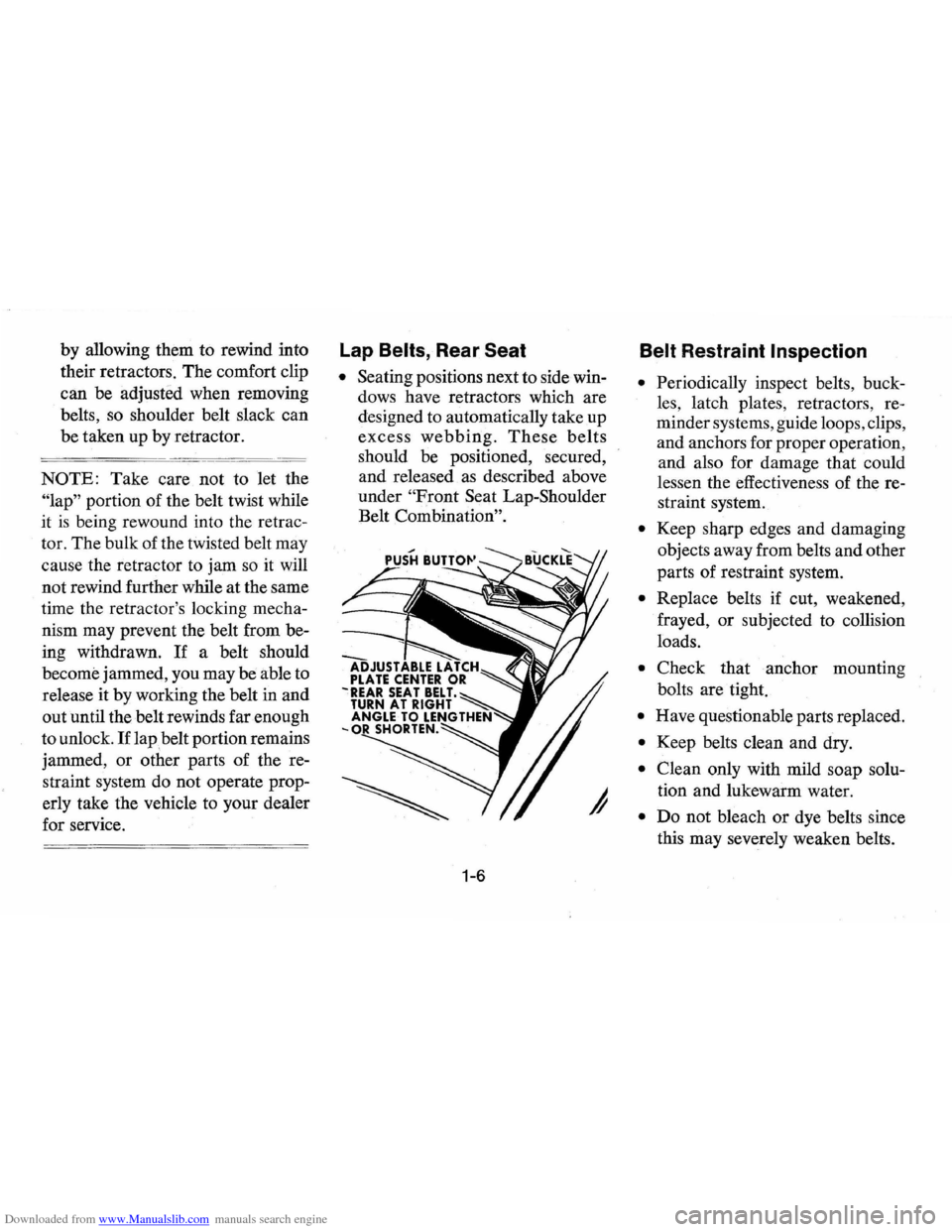
Lap Belts, Rear Seat
• Seating positions next to side win
dows have retractors which are
designed to automatically take up
excess
webbing. These belts
should be positioned, secured,
and released
as described above
under
"Front Seat Lap-Shoulder
Belt
Combination".
1-6
Belt Restraint Inspection
• Periodically inspect belts, buck
les, latch plates, retractors, re
minder systems, guide loops, clips,
and anchors for proper operation,
and also for damage that could
lessen the effectiveness of the re
straint system.
• Keep sharp edges and damaging
objects away from belts and other
parts of restraint system.
• Replace belts if cut, weakened,
frayed,
or subjected to collision
loads.
• Check that anchor mounting
bolts are tight.
• Have questionable parts replaced.
• Keep belts clean and dry.
• Clean only with mild soap solu
tion and lukewarm water.
• Do not bleach or dye belts since
this may severely weaken belts.
Page 16 of 87
Downloaded from www.Manualslib.com manuals search engine Operation Foreign Countries • In
Your car is designed to operate
on unleaded fuel of approximately
91 research octane number.
If you plan to operate your car
outside the Continental limits of
the United
States or Canada, there
is a possibility that the best fuels
available in some countries are so
low in octane rating that excessive
knocking and serious engine
dam
age may result from their use. Also ,
if leaded fuels are used in vehicles
designed for unleaded fuels, it may result
in the deactivation of the
catalytic converter, if the vehicle
is
so equipped, and possibly other
related problems.
The use of leaded
fuel in a vehicle designed
for un
leaded fuel will require different
maintenance intervals.
To obtain in
formation on the octane rating and
availability of non-leaded fuels
available in the countries in which
you plan to travel, and a mainte
nance schedule to be used when
operating on leaded fuel, write to
Chevrolet Motor Division,
Service
Department, Detroit, Michigan
48202, (or in Canada write to
General Motors of Canada Limited,
Owner Relations Department,
Oshawa, Ontario LlJ 5Z6), giving:
1-11
• The vehicle identification num
ber (on plate on instrument
panel ahead of the steering wheel
and visible through the wind
shield,
or from registration slip
or title),.
• The country or countries in which
you plan to travel.
It is recommended that you not
operate your car in any country not
having fuels meeting the require
ments of your car's engine
as these
may cause engine damage for which
Chevrolet
is not responsible under
the terms of the Chevrolet New
Vehicle Warranty or Emission
Control Systems Warranty.
Page 26 of 87
Downloaded from www.Manualslib.com manuals search engine Parking Your Car
Always engage the parking brake
and place the automatic transmis
sion selector lever in
"Park" posi- tion
when leaving your
car un
attended. Also with automatic
transmissions, never park for pro
longed periods with engine idling
and transmission in gear, especially
FLOOR CONTROLS
Braking System
The service brake system is de
signed for braking performance
under a wide range of driving con
ditions even when the vehicle
is
loaded to its full rated vehicle load.
NOTE: Operation of the brake
system warning light
is covered on
page 2-15 in the section on
"In
strument Panel."
Power Brakes
• On cars with power brakes, if
power assist to the brakes
is in
terrupted due to a stalled engine
or some malfunction, two or
more brake applications nor
mally can be made using reserve
power.
• If the brake pedal is held down,
2-10
if your car is equipped with air
conditioning. This practice
is detri
mental to the transmission, due
to
overheating.
the system
is designed to bring
the car to a full stop on reserve
power. However, the reserve
power
is partially depleted each
time the brake pedal
is applied
and released. Do not pump
brakes when brake power assist
has been interrupted, except
when necessary in order to main
tain steering control on slippery
surfaces.
• When reserve power is exhausted,
the vehicle can still be stopped
by applying greater force to the
pedal.
Page 31 of 87
Downloaded from www.Manualslib.com manuals search engine Generator Indicator Light
The red light will go on when
the ignition key
is in the "on" posi
tion, but before the engine
is started.
After the engine starts, the light
should go out and remain out.
If
the light remains on when engine
is running, have your Authorized
Chevrolet Dealer locate and correct
the trouble
as soon as possible.
Temp. Pressure Indicator
Light
This indicator light is provided
in the instrument cluster to quickly
warn of an overheated engine
and/or extreme low oil pressure
or oil supply. This light will be on
when the ignition switch is turned
"ON" and should go out after the
engine
is started. Occasionally the
light may be seen to flicker momen
tarily, but this will do no harm. Ex
treme low oil pressure or oil supply
will prevent the electric fuel pump from
operating and under this con
dition the engine will not run.
If the light comes on during ex
treme driving conditions, such
as an
extended idle, turn off the air con
ditioner (if used) and run the en
gine slightly faster than idle speed
with the transmission in
neutral
gear. If the light does not go off
within a short period of time (1-2
minutes), then turn the engine off
until the cause of
the overheating is
corrected. Glance at the instrument
cluster frequently
as you drive to
see if this light is on.
Add Coolant Indicator Light
This indicator light is provided to
warn of a low coolant condition in
the radiator.
If coolant level is low
the yellow
"Add Coolant" warning
light will glow. Coolant level in the
coolant recovery tank, and radiator,
should be checked at the first oppor
tunity.
If necessary add sufficient
2-15
coolant to both the radiator and
coolant recovery tank.
(See Service
and Maintenance, Section 5, for
proper procedure) .
If frequent
additions are required, see your
dealer for a complete cooling sys
tem check.
Brake System Warning
Light
The service brake system is a dual
system designed so that one part will
provide some braking action in the
event of loss of hydraulic pressure
in the other part of the system.
If the
warning light labeled
"Brake" lo
cated in the speedometer face comes
on and stays
on when the ignition is
on and after the brakes have been
firmly applied
it may indicate that
there
is a malfunction in one part of
the brake system.
• As a reminder, the light is de
signed to come
on with the park
ing brake applied and the igni
tion on.
Page 32 of 87
Downloaded from www.Manualslib.com manuals search engine • The light is also designed to come
on during engine starting to
verify that the bulb
is operating
properly.
• Have system repaired if light does
not come
on during check.
• This warning light is not a substi
tute for the visual check of brake
fluid level required
as part of
normal maintenance.
If the light comes on:
• The parking brake control is not
fully released, or,
• The service brake system is par
tially inoperative.
What to do:
1. Check that parking brake is re
leased.
If it is . . .
2.
Pull off the road and stop, care
fully-remembering that:
• Stopping distances may be
greater.
• Greater pedal effort may be re
quired.
• Pedal travel may be greater. 3.
Try out brake operation by start
ing and s,topping on road shoul
der-then:
• If you judge such operation to
be safe, proceed cautiously at
a safe speed to nearest dealer
for repair.
• Or have car towed to dealer for
repair.
Continued operation of the car in this
condition
is dangerous.
Headlight Beam Indicator
Light
The headlights of your car have
high and
low beams to provide you
with proper night-time visibility
for most driving conditions. The
"low" beams are used during most
city driving. The
"high" beams are
PARKING LAMPS MARKER LAMPS TAIL AND INSTRUMENT LIGHTS
TURN KNOB TO VARY INSTRUMENT LIGHTS FULLY COUNTER CLOCKWISE FOR DOME LIGHTS
2-16
HEADLIGHTS PARKING LAMPS MARKER LAMPS
Page 33 of 87
Downloaded from www.Manualslib.com manuals search engine especially useful when driving on
dark roads since they provide ex
cellent long range illumination. The
headlight beam indicator will be on
whenever the high beams or
"brights" are in use. The Headlight
Beam
Switch controls the headlight
beams (see Page
2-12).
Light Switch
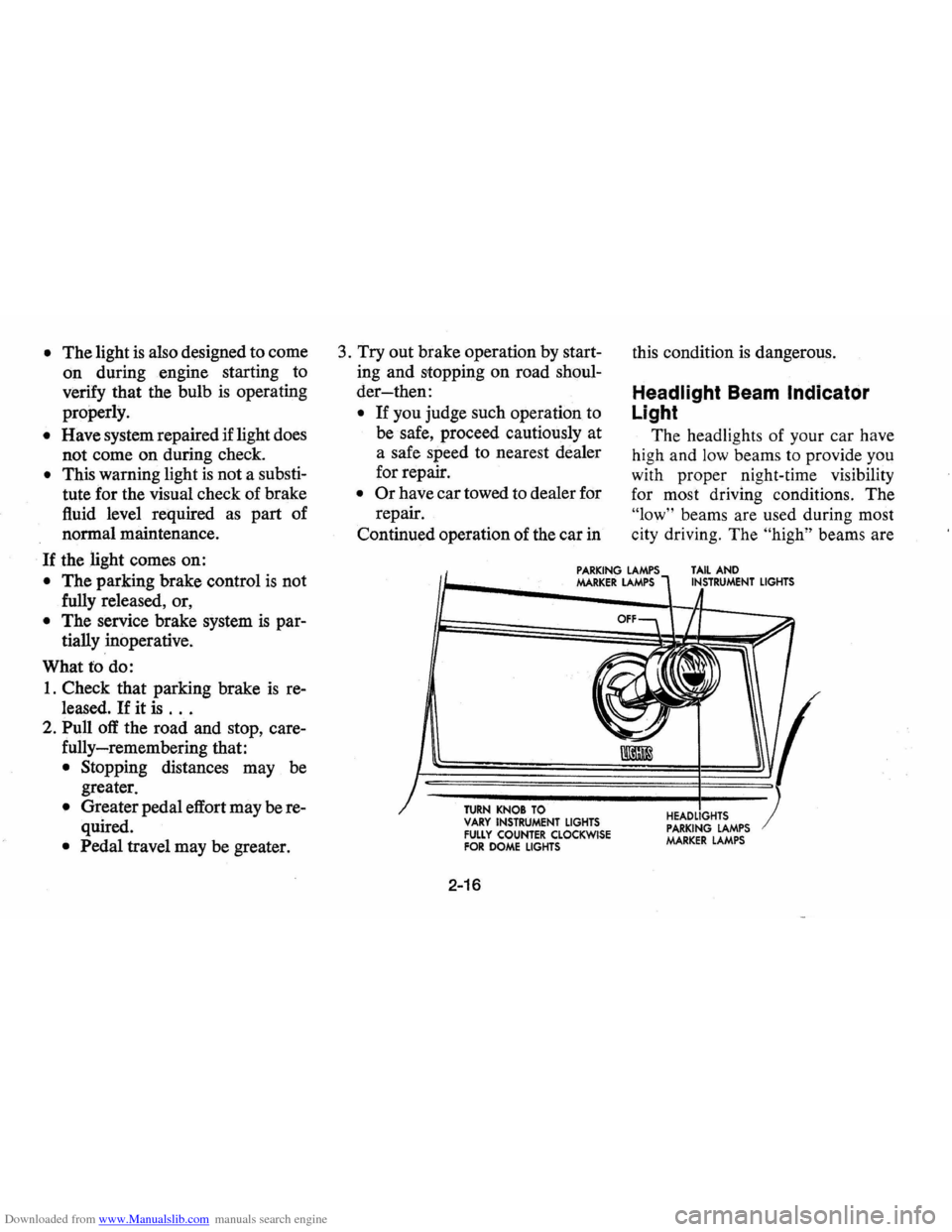
The three position light switch
controls the headlights, taillights,
parking lights, side marker lights,
instrument lights and dome lights
as shown. The headlamp circuit
is protected by a circuit breaker in
the light switch.
An overload on
the breaker will cause the lamps to
"flicker" on and off. If this condi
tion develops, have your headlamp
wiring checked immediately.
Clock
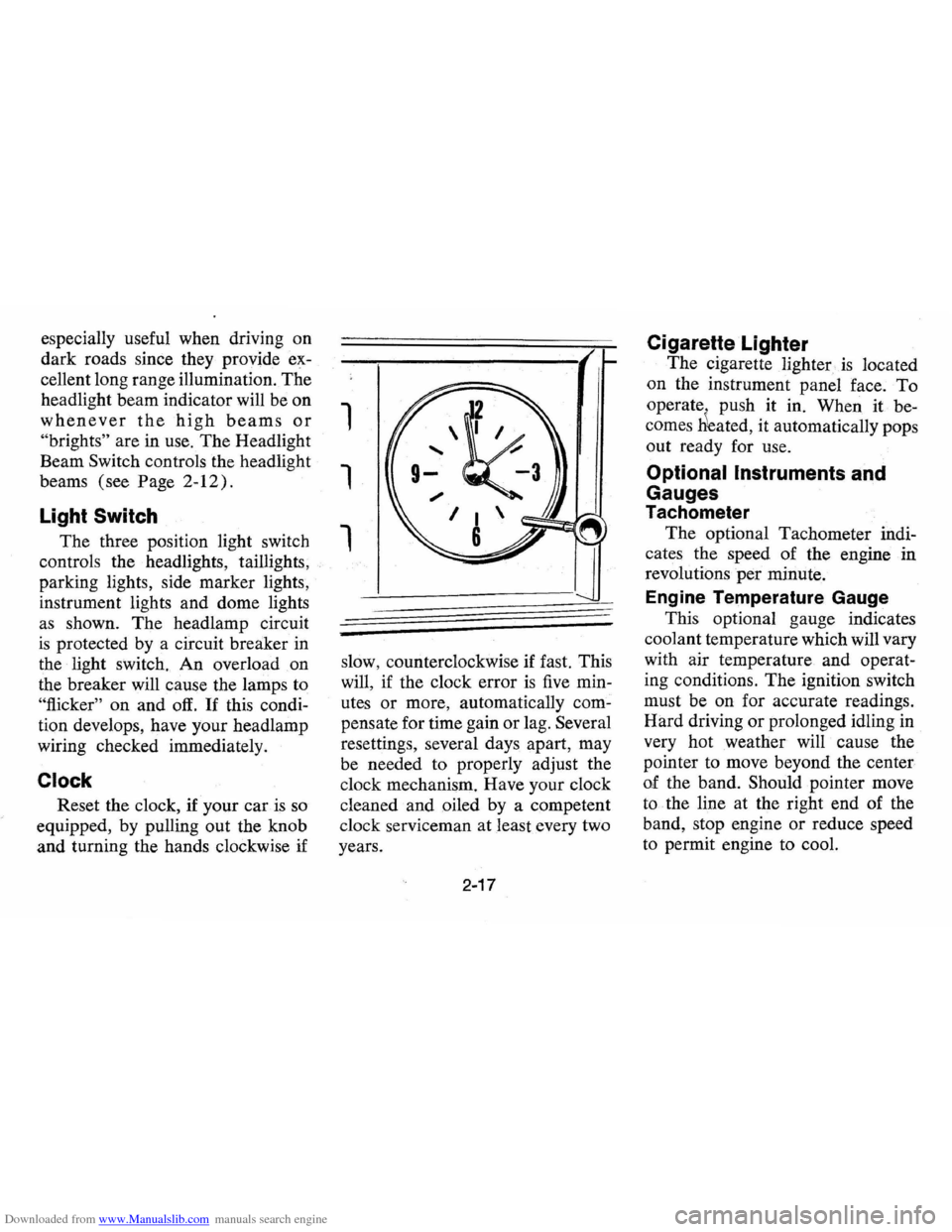
Reset the clock, if your car is so
equipped, by pulling out the knob
and turning the hands clockwise if
1
1
1
slow, counterclockwise if fast. This
will,
if the clock error is five min
utes
or more, automatically com
pensate for time gain or lag. Several
resettings, several days apart, may
be needed to properly adjust the
clock mechanism. Have your clock
cleaned and oiled by a competent
clock serviceman at least every two
years.
2-17
Cigarette Lighter
The cigarette lighter is located
on the instrument panel
face. To
operate . push it in. When it be
comes
Heated, it automatically pops
out ready for use.
Optional Instruments and
Gauges
Tachometer
The optional Tachometer indi
cates the speed of the engine in
revolutions
per minute.
Engine Temperature Gauge
This optional gauge indicates
coolant temperature which will vary
with air temperature and operat
ing conditions.
The ignition switch
must be on for accurate readings.
Hard driving
or prolonged idling in
very hot weather will cause the
pointer to move beyond the center
of the band. Should pointer move
to the line at the right end of the
band, stop engine or reduce speed
to permit engine to cool.
Page 59 of 87
Downloaded from www.Manualslib.com manuals search engine SERVICE AND MAINTENANCE
The time or mileage intervals on
the following pages are intended
as a guide for establishing regular
maintenance and lubrication per
iods for your car. Sustained heavy
duty or high speed operations
or
operation under adverse conditions
may necessitate more frequent ser
vicing .
To determine specific rec
ommendations for conditions un-
Fuel
Requirements
Your Chevrolet engine is de
signed to operate only on unleaded
gasoline. Unleaded gasoline
is essen
tial for proper emission control
system operation, and it will mini
mize spark plug fouling. The
use of der
which you
.use your car, con
sult your authorized Chevrolet
Dealer.
Maintenance Schedule
For owner convenience, a sepa
rate maintenance folder has been
provided with your car which con
tains a complete schedule
and brief
explanation of the safety , emission
"-leaded gasoline can damage or
severely reduce the effectiveness of
the emission control system and
re
sult in loss of warranty coverage.
Use unleaded gasoline meeting
the minimum octane specifications
established
by the Federal govern
ment. In compliance with Federal
regulations, pumps dispensing such
gasoline are labeled with the word
5-1
control, lubrication and general
maintenance it requires. The main
tenance folder information
is sup
plemented
by this section of the
Owner's Manual, as well as a
Warranty Information folder also
furnished with your car. Read all
three publications for a full under
standing of vehicle maintenance
requirements.
UNLEADED and are equipped
with dispensing nozzles which
fit
the filler neck of your car's gaso
line tank.
Supplementary gasoline addi
tives which contain lead and or
phosphorus should not
be used
under any circumstances: Such
additives can severely reduce the
effectiveness of your catalytic con
verter.
Page 63 of 87
Downloaded from www.Manualslib.com manuals search engine TRANSMISSION ITEMS
Automatic Traiismission
Fluid Level
Recommendations
Use automatic transmission
fluids identified with the mark
DEXRON®-II available from your
Chevrolet dealer or local service
station.
Check the fluid level at each en
gine oil change period.
Automatic transmissions are fre
quently overfilled because the fluid
level
is checked when the fluid is
cold and the dipsick indicates fluid
should
be added. However, the low
reading may be normal since the
fluid level will rise
as the fluid tem
perature increases. A level change
of over
% inch will occur as fluid
temperature rises from
60° F. to
180° F. (16° C. to 82° C.)
Overfilling can cause foaming
and loss of fluid through the vent.
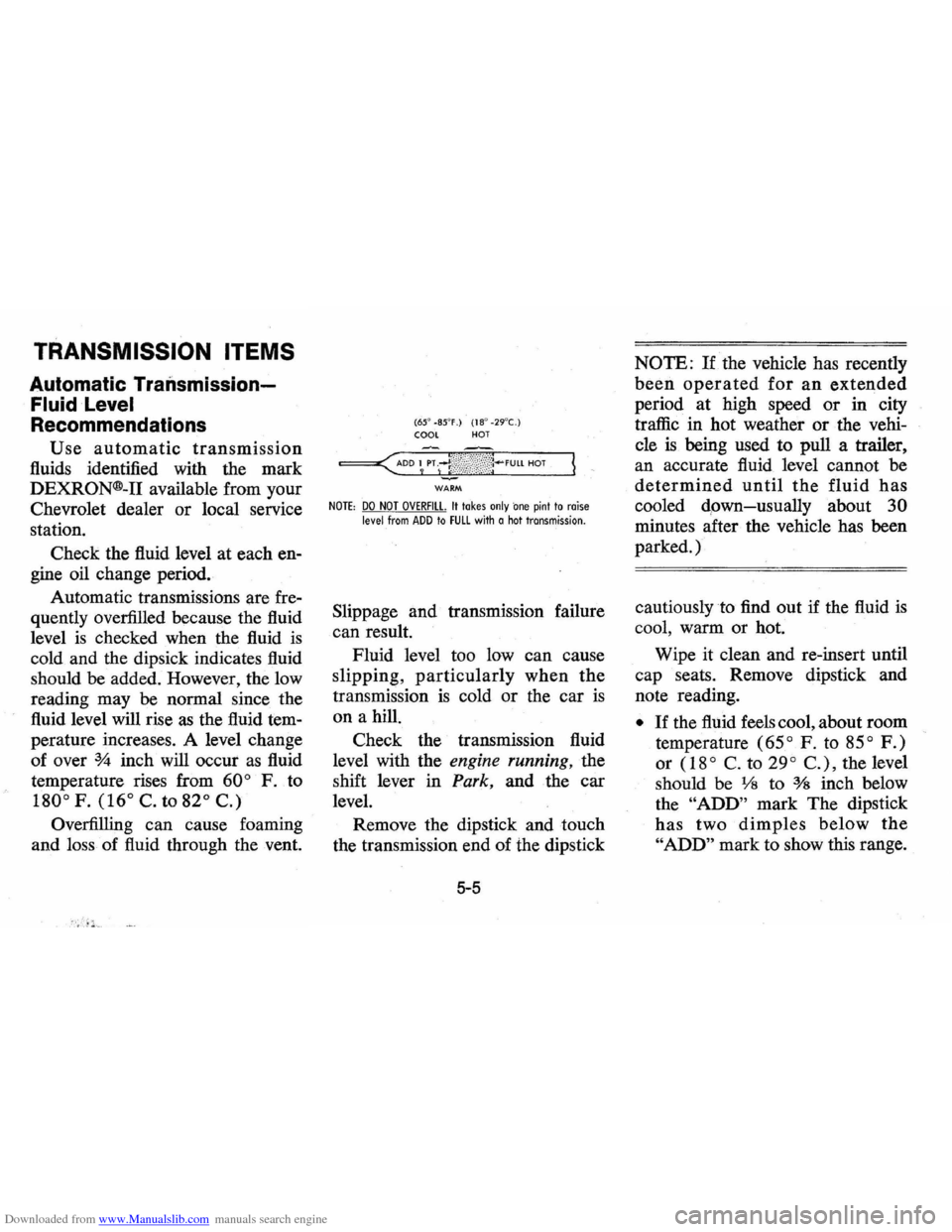
(65' -85'F .) (18 ' -29'C.) COOl HOT
WARM
NOTE: DO NOT OVERFill. It takes only 'one pint to raise level from ADD to FUll with a hot transmission.
Slippage and transmission failure
can result.
Fluid level too low can cause
slipping,
particularly when the
transmission is cold or the car is
on a hill.
Check the transmission fluid
level with the
engine running, the
shift lever in
Park, and the car
level.
Remove the dipstick and touch
the transmission end of the dipstick
NOTE: If the vehicle has recently
been operated for an extended
period at high speed or in city
traffic in hot weather
or the vehi
cle
is being used to pull a trailer,
an accurate fluid level cannot be
determined until the fluid has
cooled dpwn-usually about 30
minutes after the vehicle has been
parked.)
cautiously to find out if the fluid
is
cool, warm or hot.
Wipe it clean and re-insert until
cap seats. Remove dipstick and
note reading.
• If the fluid feels cool, about room
temperature
(65° F. to 85° F.)
or (18° C. to 29° C.), the level
should be
Vs to % inch below
the
"ADD" mark The dipstick
has two dimples below the
"ADD" mark to show this range.