fuse CHEVROLET VENTURE 1998 User Guide
[x] Cancel search | Manufacturer: CHEVROLET, Model Year: 1998, Model line: VENTURE, Model: CHEVROLET VENTURE 1998Pages: 474, PDF Size: 25.26 MB
Page 306 of 474
A vehicle can fall from a car carrier if it isn’t
adequately secured. This can cause a collision,
serious personal injury and vehicle damage. The
vehicle should be tightly secured with chains or
steel cables before it is transported.
Don’t use substitutes (ropes, leather straps,
canvas webbing, etc.) that can be cut
by sharp
edges underneath the towed vehicle. Always use
T-hooks inserted in the T-hook slots. Never use
J-hooks. They will damage drivetrain and
suspension components.
~~
NOTICE:
If you are using car-carrier equipment, you must
pull the Electronic Level Control (ELC) fuse, in
the instrument panel fuse block, before securing
the vehicle.
Damage to the shocks or leveling system may
occur if the Electronic Level Control (ELC) fuse
is not disabled.
When your vehicle is being towed, have the ignition key
in
OFF. The steering wheel should be clamped in a
straight-ahead position, with a clamping device
designed for towing service.
Do not use the vehicle’s
steering column lock for this. For front towing, the
transaxle should be in
PARK (P) and the parking brake
released. For rear towing, the transaxle should be in
NEUTRAL (N) and the parking brake engaged.
5-9
ProCarManuals.com
Page 338 of 474
Fuel
L
You can be injured and your ve :le could be
damaged if you try to do service work on a
vehicle without knowing enough about
it.
Be sure you have sufficient knowledge,
experience, the proper replacement parts
and tools before you attempt any vehicle
maintenance task.
Be sure to use the proper nuts, bolts and
other fasteners, “English” and “metric”
fasteners can be easily confused.
If you use
the wrong fasteners, parts can later break
or fall
off. You could be hurt.
Adding Equipment to the - hide of
Your Vehicle
Things you might add to the outside of your vehicIe can
affect the airflow around
it. This may cause wind noise
and affect windshield washer performance. Check with
your dealer before adding equipment to the outside
of
your vehicle. Use regular unleaded gasoline rated at
87 octane
or
higher. At
a minimum, it should meet specifications
ASTM
D4814 in the United States and CGSB 3.5-M93
in Canada. Improved gasoline specifications have been
developed by the American Automobile Manufacturers
Association (AAMA) for better vehicle performance
and engine protection. Gasolines meeting the
AAMA
specification could provide improved driveability
and emission control system protection compared to
other gasolines.
Be sure the posted octane is at least 87. If the octane is
less than 87,
you may get a heavy knocking noise when
you drive. If it’s bad enough, it can damage your engine.
If you’re using fuel rated at
87 octane or higher and you
hear heavy knocking, your engine needs service. But
don’t worry if you hear a little pinging noise when
you’re accelerating or driving up
a hill. That’s normal,
and you don’t have
to buy a higher octane fuel to get rid
of pinging. It’s the heavy, constant knock that means
you have
a problem.
ProCarManuals.com
Page 345 of 474
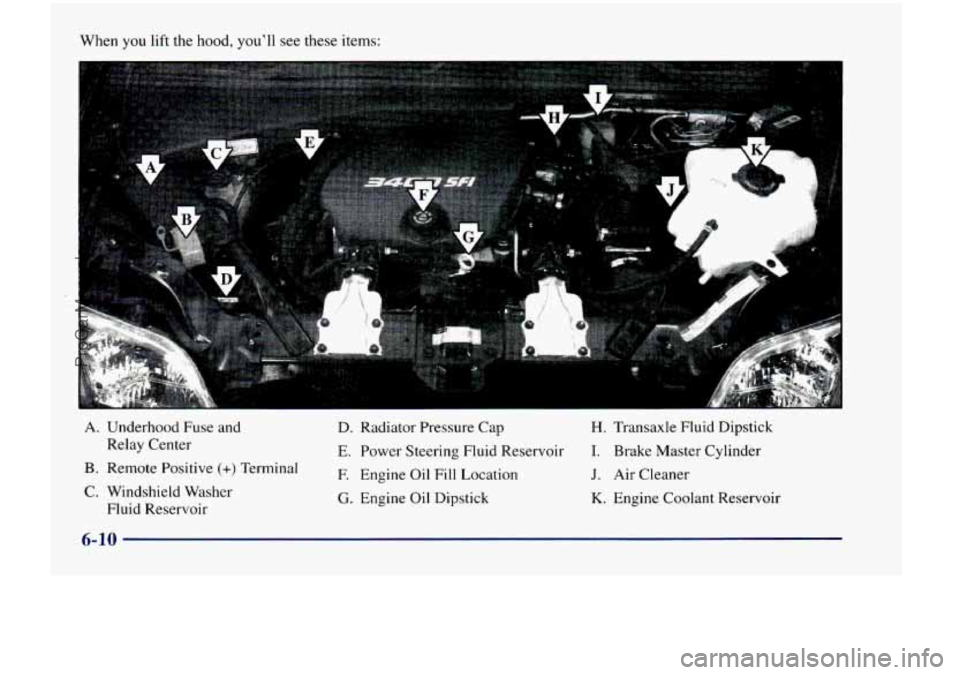
When you lift the hood, you'll see these items:
rn
A. Underhood Fuse and D. Radiator Pressure Cap H. Transaxle Fluid Dipstick
B. Remote Positive (+) Terminal
C. Windshield Washer
Fluid Reservoir Relay Center
E. Power Steering Fluid Reservoir I. Brake Master Cylinder
E Engine Oil Fill Location J. Air Cleaner
G. Engine Oil Dipstick K. Engine Coolant Reservoir
6-10
ProCarManuals.com
Page 360 of 474
When to Check Power Steering Fluid
It is not necessary to regularly check power steering
fluid unless you suspect there is a leak in the system or
you hear an unusual noise. A fluid
loss in this system
could indicate a problem. Have the system inspected
and repaired.
How To Check Power Steering Fluid
When the engine compartment is cool, wipe the cap and
the top of the reservoir clean, then unscrew the cap and
wipe the dipstick with a clean rag. Replace the cap and
completely tighten it. Then remove the cap again and
look at the fluid level on the dipstick.
When the engine compartment
is hot, the level should
be at the
H mark. When it’s cold, the level should be at
the
C mark. If the fluid is at the ADD mark, you should
add fluid.
What to Use
To determine what kind of fluid to use, see
“Recommended Fluids and Lubricants” in the Index.
Always
use the proper fluid. Failure to use the proper
fluid can cause leaks and damage hoses and seals.
Windshield Washer Fluid
What to Use
When you need windshield washer fluid, be sure to read
the manufacturer’s instructions before use. If you will be
operating your vehicle in an area where the temperature may fall below freezing, use
a fluid that has sufficient
protection against freezing.
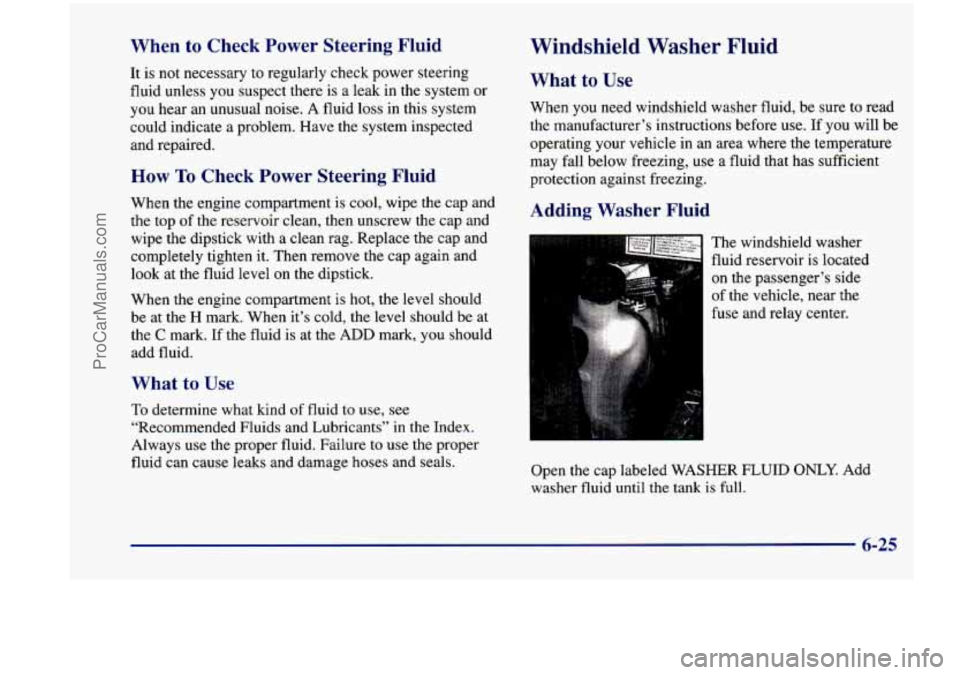
Adding Washer Fluid
on the passenger’s side
of the vehicle, near the
fuse and relay center.
Open the cap labeled WASHER FLUID
ONLY. Add
washer fluid until the tank is full.
6-25
ProCarManuals.com
Page 392 of 474
Electrical System
Add-on Electrical Equipment
NOTICE:
Don’t add anything electrical to your vehicle
unless you check with your dealer first. Some
electrical equipment can damage your vehicle
and the damage wouldn’t be covered by your
warranty. Some add-on electrical equipment
can keep other components from working as
they should.
Your vehicle has an air bag system. Before attempting to
add anything electrical to your vehicle, see “Servicing
Your Air Bag-Equipped Vehicle” in the Index.
Headlamp Wiring
The headlamp wiring is protected by an internal circuit
breaker in the
IfP fuse panel. An electrical overload will
cause the lamps to
go on and off, or in some cases to
remain
off. If this happens, have your headlamp wiring
checked right away.
Windshield Wipers
The windshield wiper motor is protected by an internal
circuit breaker and a fuse. If the motor overheats due to
heavy snow, etc., the wiper will stop until the motor
cools. If the overload is caused by some electrical
problem, be sure to get
it fixed.
Power Windows and Other Power Options
Circuit breakers in the ID? fuse panel protect the power
windows and other power accessories. When the current
load is too heavy, the circuit breaker opens
and closes,
protecting
the circuit until the problem is fixed.
6-57
ProCarManuals.com
Page 393 of 474
Fuses and Circuit Breakers
The wiring circuits in your vehicle are protected from
short circuits by a combination of fuses, circuit breakers
and fusible thermal links.
Look at the silver-colored band inside the fuse. If
the
band is broken or melted, replace the fuse. Be sure you
replace a bad fuse with a new one of the identical size
and rating.
If you ever have a problem on the road and don’t have
a spare fuse, you can borrow one that has the same
amperage or use one of the spare fuses in the underhood
fuse and relay center. Just pick some feature of your
vehicle that you can get along without
-- like the radio
or cigarette lighter -- and use its fuse, if it is the right
amperage. Replace it as
soon as you can.
There are two fuse blocks in your vehicle: the
instrument panel fuse block and the underhood fuse
and relay center.
Instrument Panel Fuse Block
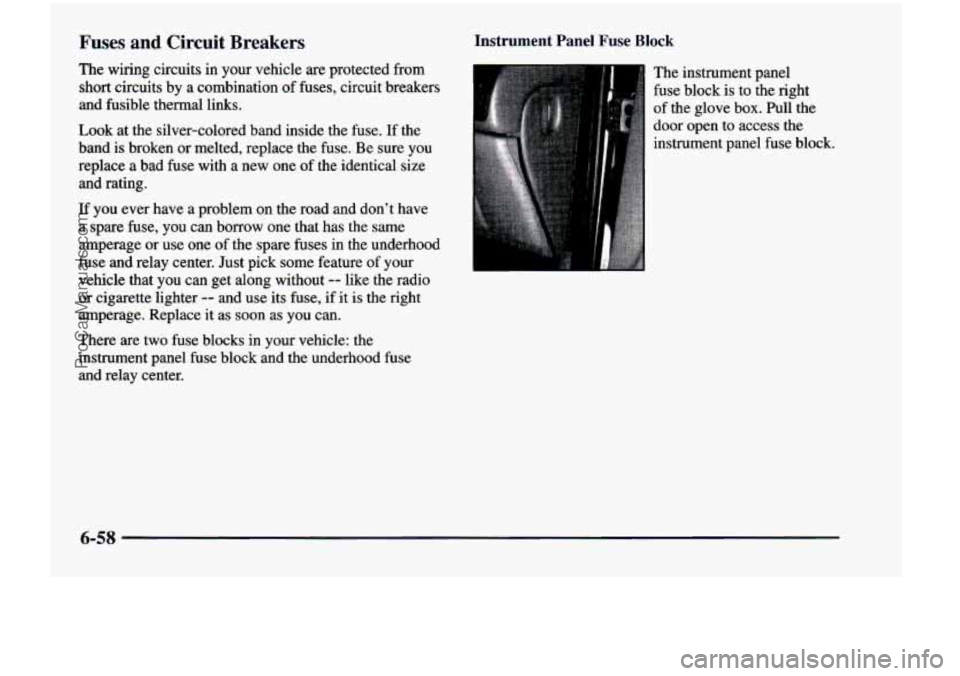
The instrument panel
fuse block is to the right
of the glove box. Pull the
door open to access the
instrument panel fuse block.
6-58
ProCarManuals.com
Page 394 of 474
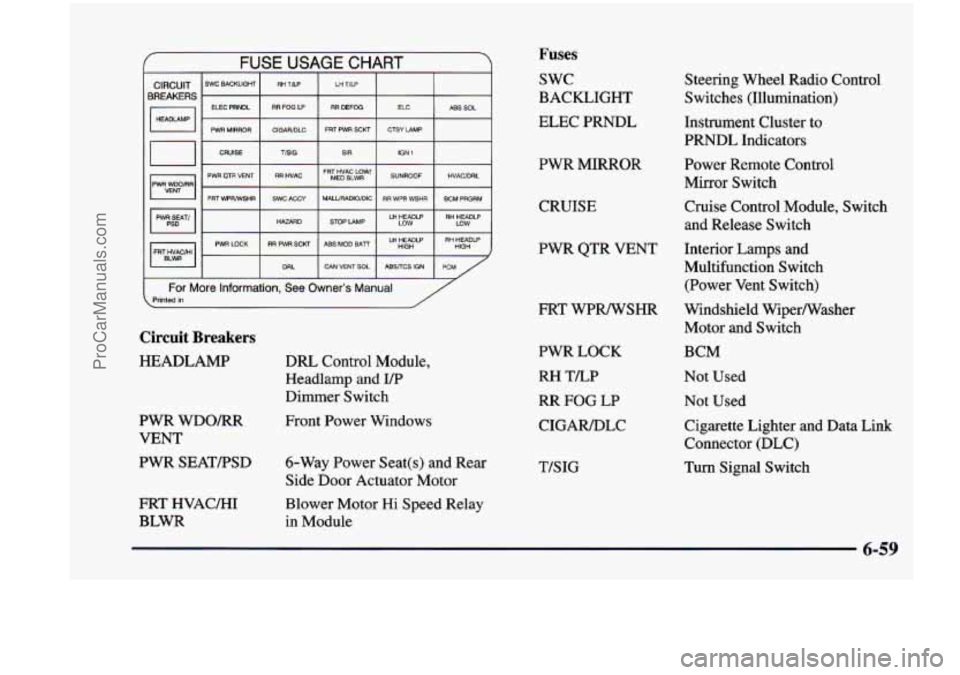
CIRCUIT BREAKERS
FUSE USAGE CHART
SWC BACKLIGHT RH TLP LH TILP
ELEC PRNDL RR
FOG LP RR DEFOG ELC ABS SOL
PWR
MIRROR ClGARiDLC FRT PWR SCU CTSY LAMP
CRUISE TBIG
SIR IGN 1
PWR am VENT RR HVAC MED BLWR SUNROOF HVACIDRL FRT HVAC Low’
FRT WRNSHR SWC ACCY MALURADIO/DIC RR WPR WSHR BCM PRGRM I I I I
HAZARD LAMP LH HEADLP RH HEADLP
LOW LOW
I I I I I
I- I DRL 1 CAN VENTSOL I ABSflCS IGN I PCM /
For More Information, See Owner’s Manual Printed in /
Circuit Breakers
HEADLAMP
PWR
WDOm
VENT
PWR SEATPSD
FRT HVAC/HI
BLWR DRL
Control Module,
Headlamp and
UP
Dimmer Switch
Front Power Windows
6-Way Power Seat(s) and Rear
Side Door Actuator Motor
Blower Motor
Hi Speed Relay
in Module
Fuses
swc
BACKLIGHT
ELEC PRNDL
PWR MIRROR
CRUISE Steering Wheel
Radio Control
Switches (Illumination)
Instrument Cluster to
PRNDL Indicators
Power Remote Control
Mirror Switch
Cruise Control Module, Switch
and Release Switch
PWR QTR VENT Interior Lamps and
Multifunction Switch
(Power Vent Switch)
Motor
and Switch
FRT
WPWSHR Windshield Wiperwasher
PWR LOCK
RH TLP
RR FOG LP
CIGAR/DLC
T/SIG BCM
Not Used
Not Used
Cigarette Lighter and Data Link
Connector
(DLC)
Turn Signal Switch
ProCarManuals.com
Page 395 of 474
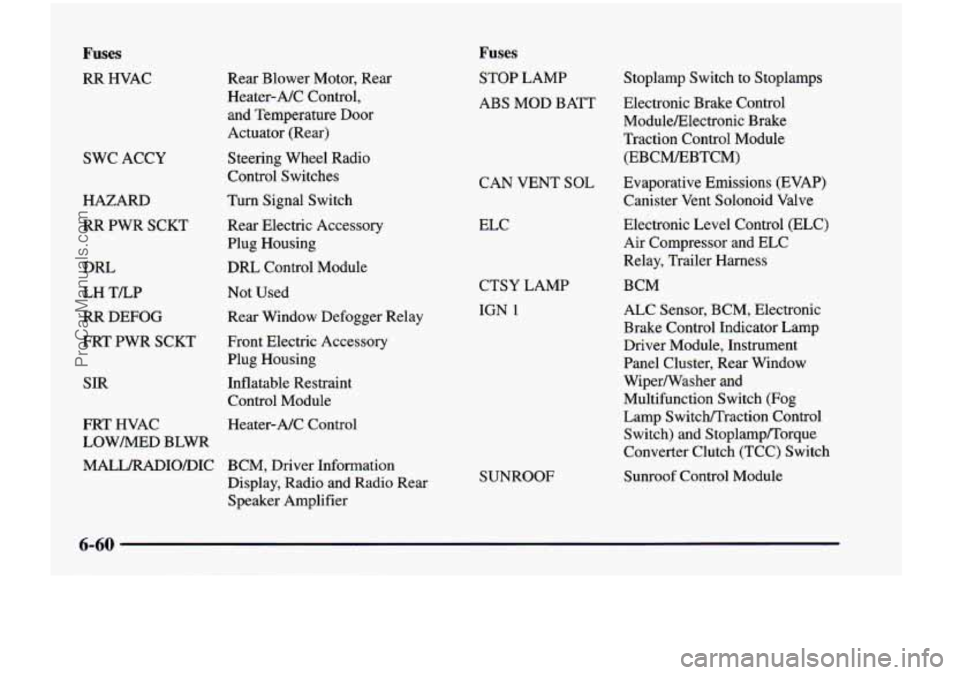
Fuses
RR HVAC
SWC ACCY
HAZARD
RR PWR SCKT
DRL
LH TLP
RR DEFOG
FRT PWR SCKT
SIR
FRT HVAC
LOWMED BLWR
MALL/RADIO/DIC Rear Blower Motor,
Rear
Heater-NC
Control,
and Temperature Door
Actuator (Rear)
Steering Wheel Radio
Control Switches
Turn Signal Switch
Rear Electric Accessory
Plug Housing
DRL Control Module
Not Used
Rear Window Defogger Relay
Front Electric Accessory
Plug Housing
Inflatable Restraint
Control Module
Heater-A/C Control
BCM, Driver Information
Display, Radio
and Radio Rear
Speaker Amplifier
Fuses
STOP LAMP
ABS MOD BATT
CAN VENT
SOL
ELC
CTSY LAMP
IGN 1
SUNROOF
Stoplamp Switch to Stoplamps
Electronic Brake Control
ModuleElectronic Brake
Traction Control Module
(EBCMEBTCM)
Evaporative Emissions (EVAP)
Canister Vent Solonoid Valve
Electronic Level Control (ELC)
Air Compressor and ELC
Relay, Trailer Harness
BCM
ALC Sensor, BCM, Electronic
Brake Control Indicator Lamp
Driver Module, Instrument
Panel Cluster, Rear Window
Wipermasher and
Multifunction Switch (Fog Lamp SwitcWTraction Control Switch) and Stoplamp/Torque
Converter Clutch (TCC) Switch
Sunroof Control Module
6-60
ProCarManuals.com
Page 396 of 474
Fuses
RR WPR WSHR Rear Window Wiper Motor,
Rear Window Wipermasher
and Multifunction Switch (Rear
Window Wipermasher Switch)
LH HEADLP LOW Not Used
LH HEADLP HIGH Not Used ABS/TCS IGN Electronic Brake Control ModuleElectronic Brake
Traction Control Module
(EBCMEBTCM)
ABS
SOL
HVACDRL LH and
RH Front Brake
Solenoid Valve
Air Inlet Actuator, DRL Control
Module, Heater-A/C Control,
Temperature Door Actuator (Front) and Rear Window
Defogger Relay
BCM PRGRM Body Control Module (BCM)
RH HEADLP LOW Not Used
RH HEADLP HIGH Not Used
PCM
IGN MAIN Relay and PCM
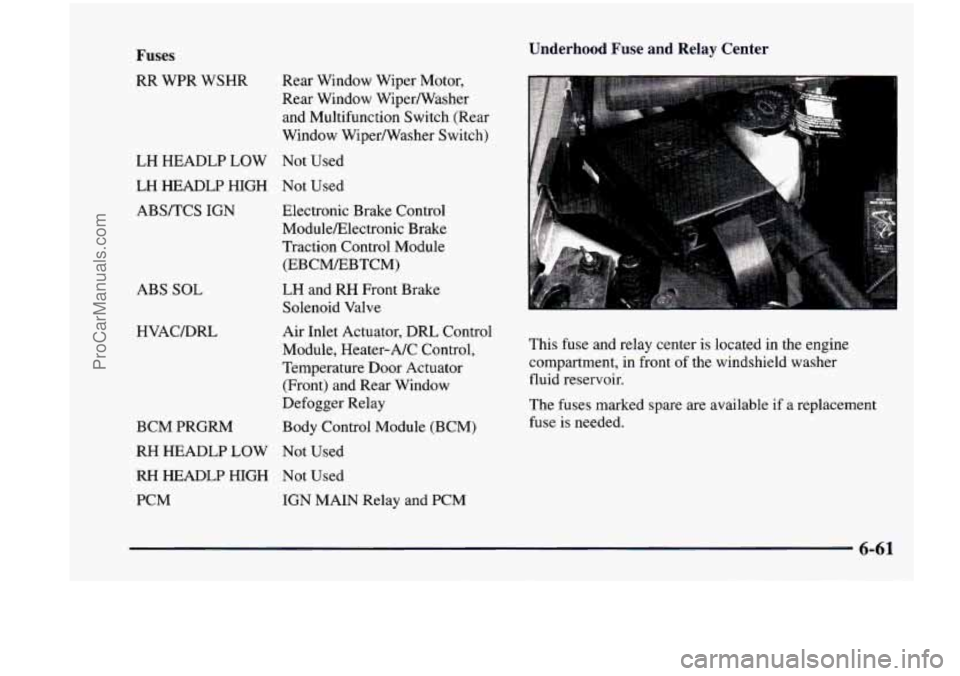
Underhood Fuse and Relay Center
This fuse and relay center is located in the engine
compartment, in front of the windshield washer
fluid reservoir.
The fuses marked spare are available if
a replacement
fuse is needed.
6-61
ProCarManuals.com
Page 397 of 474
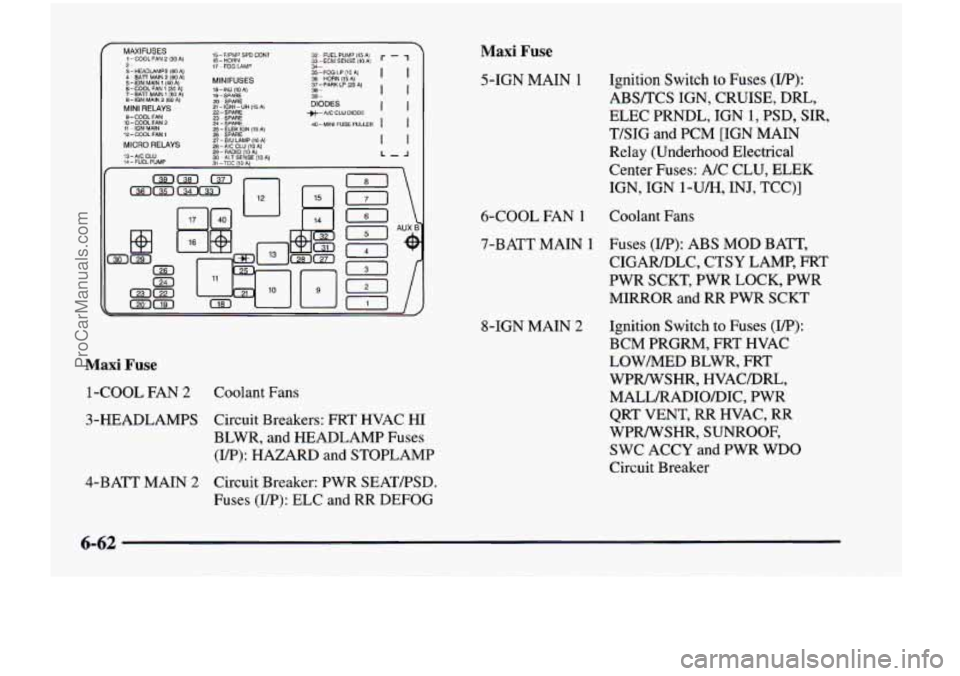
Maxi Fuse
5-IGN MAIN 1 Ignition Switch to Fuses (VP):
ABS/TCS IGN, CRUISE, DRL,
ELEC PRNDL, IGN
1, PSD, SIR,
T/SIG and PCM [IGN MAIN
Relay (Underhood Electrical
Center Fuses:
A/C CLU, ELEK
IGN, IGN
l-U/H, INJ, TCC)]
8-IGN MAIN
2
Maxi Fuse
1-COOL FAN 2 Coolant Fans
3-HEADLAMPS Circuit Breakers: FRT HVAC
HI
BLWR, and HEADLAMP Fuses
(UP): HAZARD and STOPLAMP
4-BATT MAIN
2 Circuit Breaker: PWR SEATPSD.
Fuses
(VP): ELC and RR DEFOG 6-COOL
FAN
1 Coolant Fans
7-BATT MAIN
1 Fuses (UP): ABS MOD BATT,
CIGARDLC, CTSY LAMP, FRT
PWR SCKT, PWR LOCK, PWR MIRROR and RR PWR SCKT
Ignition Switch to Fuses
(VP):
BCM PRGRM, FRT HVAC
LOWMED BLWR, FRT
WPWSHR, HVACDRL,
MALL/RADIO/DIC, PWR QRT
VENT, RR HVAC, RR
WPWSHR, SUNROOF,
SWC ACCY and PWR WDO
Circuit Breaker
6-62
ProCarManuals.com