lights CHEVROLET VENTURE 1998 User Guide
[x] Cancel search | Manufacturer: CHEVROLET, Model Year: 1998, Model line: VENTURE, Model: CHEVROLET VENTURE 1998Pages: 474, PDF Size: 25.26 MB
Page 203 of 474
Warning Lights, Gages
and Indicators
This part describes the warning lights and gages that
may be on your vehicle. The pictures will help you
locate them.
Warning lights and gages can signal that something is
wrong before it becomes serious enough to cause an
expensive repair or replacement. Paying attention to
your warning lights and gages could also save you or
others from injury.
Warning lights come on when there may be or is a
problem with one of your vehicle’s functions.
As you
will see in the details on the next few pages, some
warning lights come on briefly when you start
the
engine just to let you know they’re working. If you are
familiar with this section, you should not be alarmed
when
this happens.
Gages can indicate when there may be or
is a problem
with one
of your vehicle’s functions. Often gages and
warning lights work together
to let you know when
there’s a problem with your vehicle. When
one
of the warning lights comes on and stays on
when you are driving, or when one of the gages shows
there may be a problem, check the section that tells you
what to do about
it. Please follow this manual’s advice.
Waiting to do repairs can be costly
-- and even
dangerous.
So please get to know your warning lights
and gages. They’re a big help.
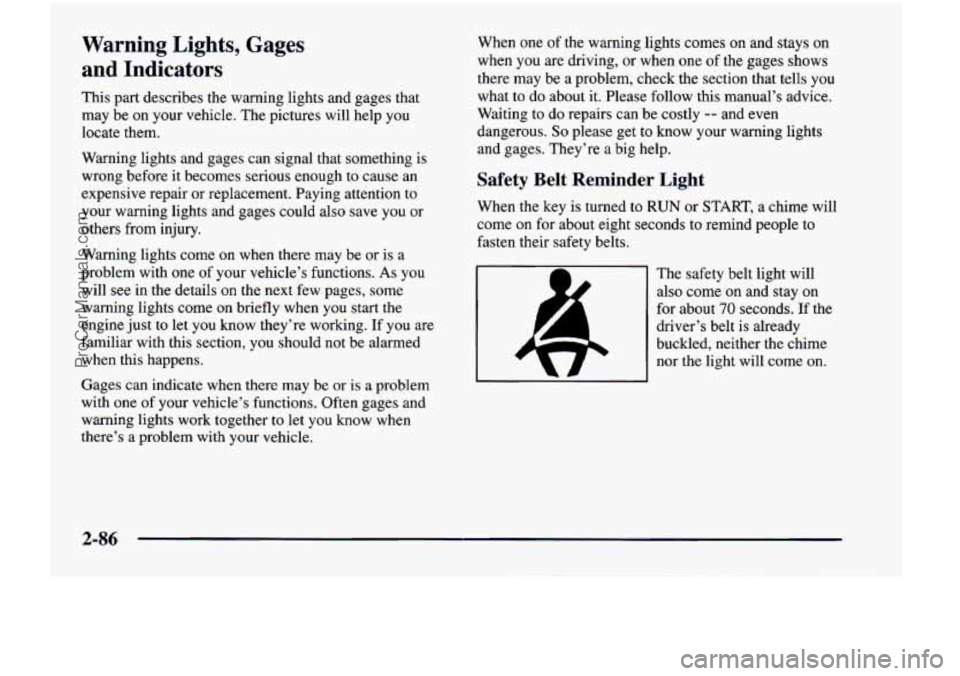
Safety Belt Reminder Light
When the key is turned to RUN or START, a chime will
come
on for about eight seconds to remind people to
fasten their safety belts.
The safety belt light will
also come on and stay on
for about
70 seconds. If the
driver’s belt is already
buckled, neither the chime
nor the light will come on.
2-86
ProCarManuals.com
Page 222 of 474
w.
+# DEFOG: This setting directs air to the windshield
and through the floor ducts. This mode is particularly
useful during cold or inclement weather because of your
vehicle’s larger windshield area.
the windshield and side window vents.
DEFROST: This setting directs most of the air to
Mode Buttons
e RECIRC: Press this button (the light will glow)
to limit the amount
of fresh air entering your vehicle by
recirculating much of the air inside your vehicle. You
may use this setting to limit odors entering your vehicle.
Press the OUTSIDE AIR button (the light on the RECIRC button will go
off) to let outside air circulate
into the vehicle.
OUTSIDE AIR: Press this button (the light will
glow) to send outside air into your vehicle. Using this
setting while trying to defrost or defog the windows will
help clear the vents of moisture. Press the RECIRC
button (the light on the
OUTSIDE AIR button will go
off) to limit outside air entering the vehicle. When the
DEFOG
or DEFROST setting is selected, the system
will automatically go to OUTSIDE AIR mode.
Air Conditioning
On very hot days, your vehicle will cool down more
quickly and economically if you open the windows long
enough to let hot, inside air escape. For all settings,
adjust the temperature control knob and fan speed
as desired.
To get maximum cooling or a quick cool-down on very
hot days, press the A/C and RECIRC buttons (the lights
will glow) and turn the temperature knob to the left
(toward the blue area). Adjust the mode
knob to direct
the air to the desired location. This setting should not be
used for long periods
of time because the air may
become too cold and dry. Push the A/C button again (the
light will go off) to turn
off the air conditioning.
When the air conditioner compressor is on, you may sometimes notice slight changes
in your vehicle’s engine
performance and power. This is normal. The system
is
designed to help fuel economy while it maintains the
desired cooling level.
The air conditioner removes moisture from the air,
so
you may sometimes notice water dripping from under
your vehicle’s engine compartment when it is idling or
after it has been turned off. This is normal.
3-3
ProCarManuals.com
Page 270 of 474
Night Vision
No one can see as well at night as in the daytime. But as
we get older these differences increase.
A 50-year-old
driver may require at least twice as much light to see the
same thing at night as a 20-year-old.
What you do in the daytime can also affect your night
vision. For example, if you spend the day in bright
sunshine you are wise to wear sunglasses. Your eyes will
have less trouble adjusting to night. But if you’re
driving, don’t wear sunglasses at night. They may cut
down on glare from headlamps, but they also make a lot
of things invisible.
You can be temporarily blinded by approaching
headlamps. It can take a second or two,
or even several
seconds, for your eyes to readjust to the dark. When you
are faced with severe glare (as from a driver who
doesn’t lower the high beams, or a vehicle with
misaimed headlamps), slow down
a little. Avoid staring
directly into the approaching headlamps. Keep your windshield and all the glass on your vehicle
clean
-- inside and out.
Glare at night is made much
worse by dirt on the glass. Even the inside of the glass
can build up a film caused by dust. Dirty glass makes
lights dazzle and flash more than clean glass would,
making the pupils
of your eyes contract repeatedly.
Remember that your headlamps light up far less of
a
roadway when you are in a turn or curve. Keep your
eyes moving; that way, it’s easier to pick out dimly
lighted objects. Just as your headlamps should be
checked regularly for proper aim,
so should your eyes
be examined regularly. Some drivers suffer from night
blindness
-- the inability to see in dim light -- and
aren’t even aware of it.
4-17
ProCarManuals.com
Page 356 of 474
Engine Coolant
The cooling s stem in your vehicle is filled with
DEX-COOL engine coolant. This coolant is designed
to remain
in your vehicle for 5 years or 150,000 miles
(240 000 km) whichever occurs first, if you add only
DEX-COOLd extended life coolant.
J
The following explains your cooling system and how
to add coolant
when it is low. If you have a problem
with engine overheating, see “Engine Overheating”
in the Index.
A 50/50 mixture of water and DEX-COOL@
coolant will:
0 Give freezing protection down to -34°F (-37°C).
Give boiling protection up to 265 OF ( 129 O C).
Protect against rust and corrosion.
Help keep the proper engine temperature.
0 Let the warning lights and gages work as
they should.
~
~
NOTICE:
When adding coolant, it is important that you
use
only DEX-COOL@ (silicate-free) coolant.
If coolant other than DEX-COOL is added to the
system, premature engine, heater core or
radiator corrosion may result. In addition, the
engine coolant will require change sooner
-- at
30,000 miles (50 000 km) or 24 months,
whichever occurs
first. Damage caused by the
use
of coolant other than DEX-COOL@ is not
covered by your new vehicle warranty.
6-21
ProCarManuals.com
Page 463 of 474
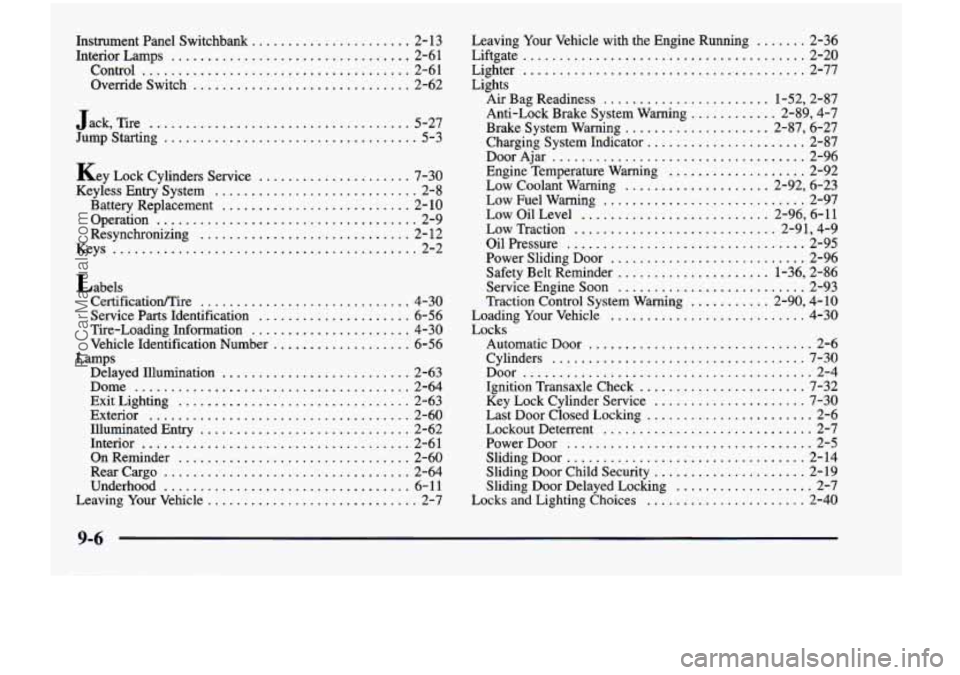
Instrument Panel Switchbank ...................... 2- 13
Interior Lamps ................................. 2-61
Control
..................................... 2-6 1
Override Switch .............................. 2-62
Jack. Tire
.................................... 5-27
Jump Starting
................................... 5-3
Key Lock Cylinders Service
..................... 7-30
Keyless Entry System
............................ 2-8
Battery Replacement
.......................... 2-10
Operation
.................................... 2-9
Resynchronizing
............................. 2- 12
Keys
.......................................... 2-2
Labels CertificatiodTire
............................. 4-30
Service
Parts Identification ..................... 6-56
Tire-Loading Information
...................... 4-30
Vehicle Identification Number
................... 6-56
Delayed Illumination
.......................... 2-63
Dome
...................................... 2-64
Exit Lighting
................................ 2-63
Exterior
.................................... 2-60
Illuminated Entry
............................. 2-62
Interior
..................................... 2-61
OnReminder
................................ 2-60
Rearcargo
.................................. 2-64
Underhood
.................................. 6-11
Leaving Your Vehicle
............................. 2-7
Lamps
Leaving Your Vehicle with the Engine Running ....... 2-36
Liftgate
....................................... 2-20
Lights Lighter
....................................... 2-77
Air Bag Readiness
....................... 1.52. 2.87
Anti-Lock Brake System Warning
............ 2.89. 4.7
Brake System Warning .................... 2.87. 6.27
Charging System Indicator
...................... 2-87
DoorAjar
................................... 2-96
Engine Temperature Warning
................... 2-92
Low Coolant Warning
.................... 2-92, 6-23
Low Fuel Warning
............................ 2-97
Low Oil Level
.......................... 2-96, 6-11
Low Traction
............................ 2-91, 4-9
Oil Pressure ................................. 2-95
Power Sliding Door
........................... 2-96
Safety Belt Reminder
..................... 1-36, 2-86
Service Engine
Soon .......................... 2-93
Traction Control System Warning
........... 2-90, 4-10
Loading Your Vehicle
........................... 4-30
Locks
Automatic Door
............................... 2-6
Cylinders
................................... 7-30
Door
........................................ 2-4
Ignition Transaxle Check
....................... 7-32
Key Lock Cylinder Service
..................... 7-30
Lockout Deterrent
............................. 2-7
PowerDoor
.................................. 2-5
Sliding Door Child Security
..................... 2-19
Sliding Door Delayed Locking
................... 2-7
Locks
and Lighting Choices ...................... 2-40
Last Door Closed Locking
....................... 2-6
Sliding Door
................................. 2-14
9-6
. _._-___- .
ProCarManuals.com
Page 469 of 474
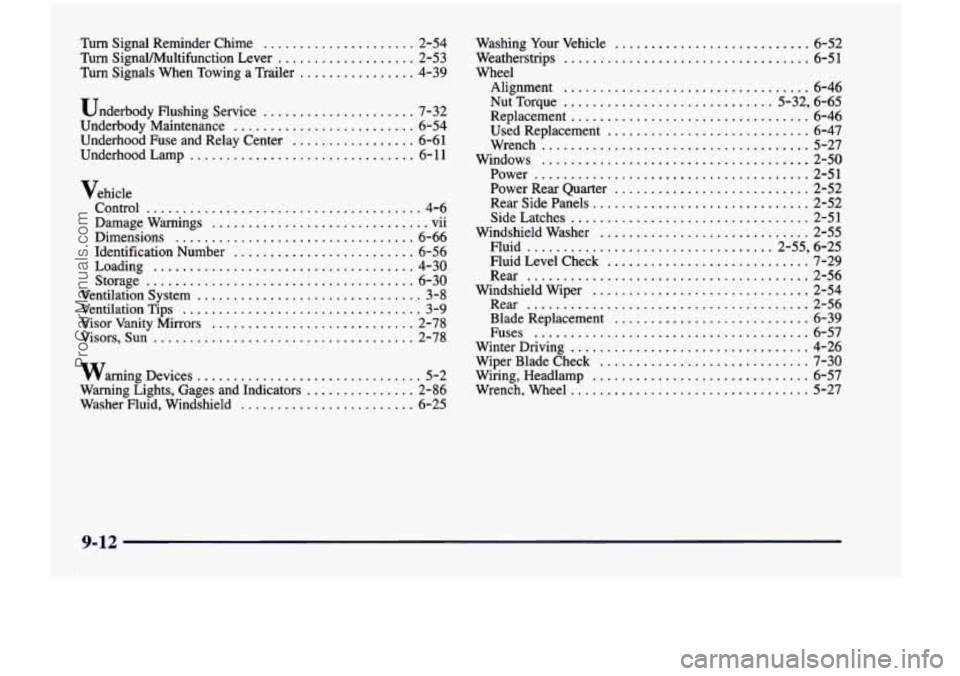
Turn Signal Reminder Chime ..................... 2-54
Turn SignaVMultifunction Lever ................... 2-53
Turn Signals When Towing a Trailer ................ 4-39
Underbody Flushing Service ..................... 7-32
Underbody Maintenance ......................... 6-54
Underhood Fuse and Relay Center ................. 6-61
Underhood Lamp ............................... 6-11
Vehicle
Control
...................................... 4-6
Damage Warnings .............................. vii
Dimensions
................................. 6-66
Identification Number ......................... 6-56
Loading .................................... 4-30
Storage ..................................... 6-30
Ventilation System ............................... 3-8
Ventilation Tips ................................. 3-9
Visor Vanity Mirrors ............................ 2-78
Visors. Sun .................................... 2-78
warning Devices ............................... 5-2
Warning Lights. Gages and Indicators ............... 2-86
Washer Fluid. Windshield ........................ 6-25
Washing Your Vehicle ........................... 6-52
Weatherstrips .................................. 6-51
Wheel
Alignment
.................................. 6-46
Nut Torque ............................. 5.32. 6.65
Replacement ................................. 6-46
Used Replacement ............................ 6-47
Wrench ..................................... 5-27
Windows ..................................... 2-50
Power ...................................... 2-51
Power Rear Quarter ........................... 2-52
Rear Side Panels .............................. 2-52
SideLatches ................................. 2-51
Windshield Washer ............................. 2-55
Fluid .................................. 2-55. 6-25
Fluid Level Check ............................ 7-29
Rear ....................................... 2-56
Windshield Wiper .............................. 2-54
Rear ....................................... 2-56
Blade Replacement ........................... 6-39
Fuses ...................................... 6-57
Winter Driving ................................. 4-26
Wiper Blade Check ............................. 7-30
Wiring. Headlamp .............................. 6-57
Wrench. Wheel ................................. 5-27
9-12
.. ..
ProCarManuals.com