tow CHEVROLET VENTURE 1998 User Guide
[x] Cancel search | Manufacturer: CHEVROLET, Model Year: 1998, Model line: VENTURE, Model: CHEVROLET VENTURE 1998Pages: 474, PDF Size: 25.26 MB
Page 68 of 474
In any particular crash, no one can say whether an air How does an air bag restrain?
bag should have inflated simply because of the damage
In moderate to severe frontal or near frontal collisions,
to a vehicle or because of what the repair costs were. For even belted occupants can contact the steering wheel or
frontal air bags, inflation is determined by the angle of
the impact and how quickly the vehicle slows down in the instrument panel. In moderate to severe side
collisions, even belted occupants can contact the inside
frontal and near-frontal impacts. For side impact air
of the vehicle. The air bag supplements the protection
bags, inflation is determined by the location of the
provided by safety belts. Air bags distribute the force
of
and how quickly the side Of the deforms* the impact more evenly over the occupant’s upper body,
What makes an air bag inflate?
In an impact of sufficient severity, the air bag sensing
system detects that the vehicle is in a crash. For both
frontal and side impact air bags, the sensing system
triggers a release
of gas from the inflator, which inflates
the air bag. The inflator, air bag and related hardware
are all part
of the air bag modules inside the steering
wheel, instrument panel and the side
of the front
seatbacks closest to the door. stopping
the occupant more gradually But the frontal air
bags would not help you in many types of collisions,
including rollovers, rear impacts, and side impacts,
primarily because an occupant’s motion is not toward
the air bag. Side impact air bags would not help you in
many types of collisions, including frontal or near
frontal collisions, rollovers, and rear impacts, primarily
because an occupant’s motion is not toward those air
bags. Air bags should never be regarded as anything
more than a supplement to safety belts, and then only in
moderate to severe frontal or near-frontal collisions for
the driver’s and right front passenger’s frontal air bags,
and only in moderate
to severe side collisions for the
driver’s and right front passenger’s side impact air bags.
1-55
ProCarManuals.com
Page 70 of 474
NOTICE:
If you damage the covering for the driver’s or the
right front passenger’s air bag, or the air bag
covering on the driver’s and right front
passenger’s seatback, the bag may not work
properly. You may have to replace the air bag
module in the steering wheel, both the air bag
module and the instrument panel for the right
front passenger’s air bag, or both the air bag
module and seatback for the driver’s and right
front passenger’s side impact air bag.
Do not
open or break the air bag coverings.
If your vehicle ever gets into a lot of water -- such as
water up to the carpeting or higher
-- or if water enters
your vehicle and soaks the carpet, the air bag controller
can
be soaked and ruined. If this ever happens, and then
you
start your vehicle, the damage could make the
frontal and side impact air bags inflate and safety belt
pretensioners activate, even if there’s no crash.
You
would have to replace the air bags, all the sensors and
related parts, parts of the safety belt system and parts
of
the driver and right front passenger’s seatbacks. If your
vehicle is ever
in a flood, or if it’s exposed to water that
soaks the carpet, you can avoid needless repair costs by
turning
off the vehicle immediately. Don’t let anyone
start the vehicle, even to tow it, unless the battery cables
are first disconnected.
ProCarManuals.com
Page 96 of 474
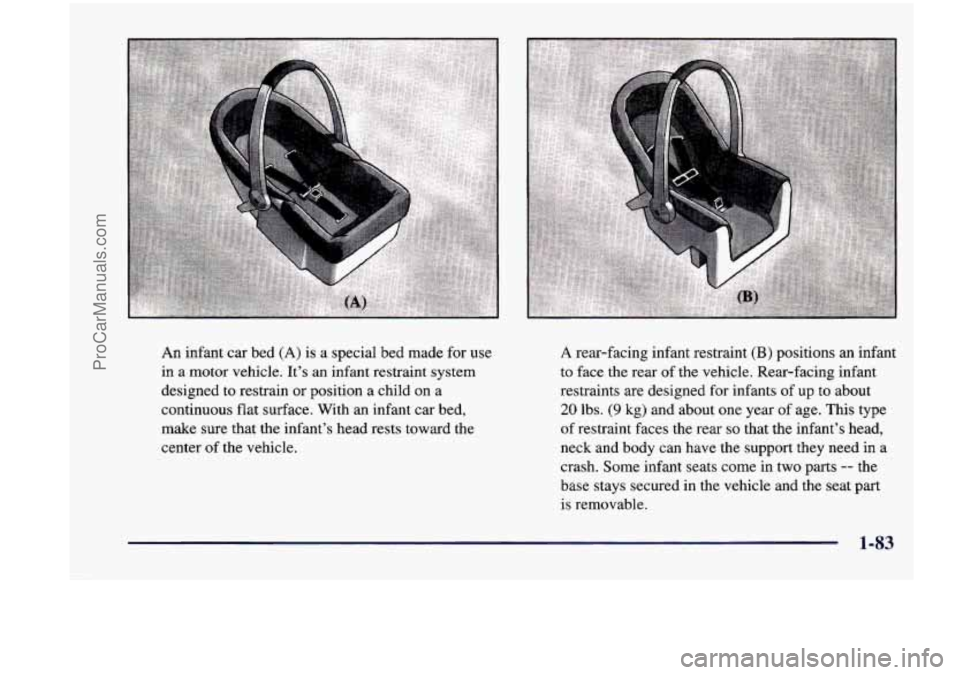
An infant car bed (A) is a special bed made for use
in
a motor vehicle. It’s an infant restraint system
designed
to restrain or position a child on a
continuous flat surface. With an infant car bed,
make sure that the infant’s head rests toward the
center of the vehicle.
A rear-facing infant restraint (B) positions an infant
to face the rear
of the vehicle. Rear-facing infant
restraints are designed for infants of up to about
20 lbs. (9 kg) and about one year of age. This type
of restraint faces the rear so that the infant’s head,
neck and body can have the support they need in a
crash. Some infant seats come in two parts
-- the
base stays secured in the vehicle and the seat part
is removable.
1-83
ProCarManuals.com
Page 112 of 474
.
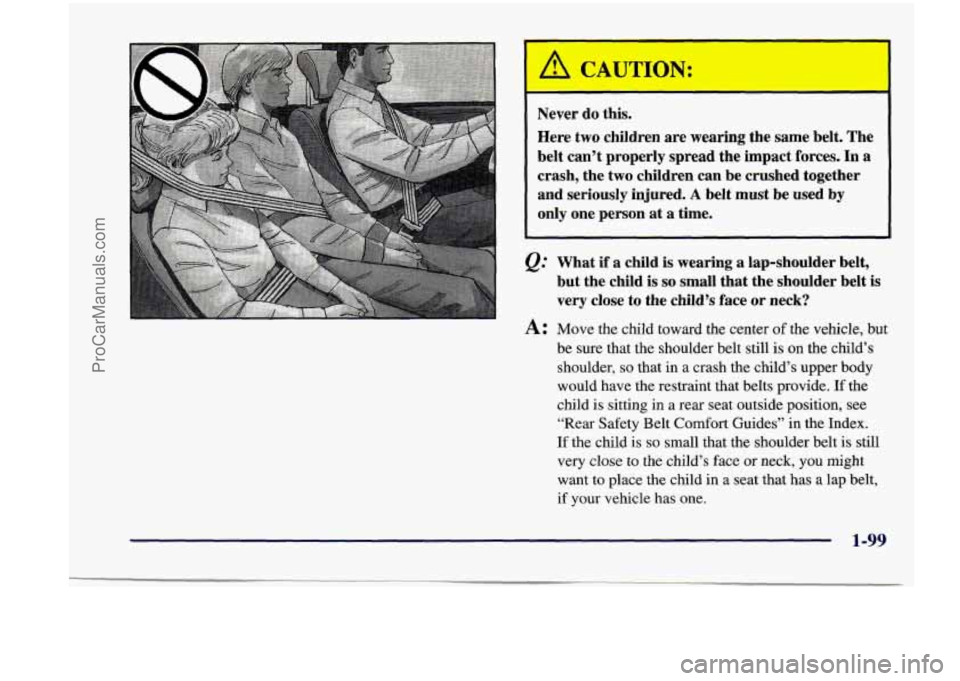
Never do this.
Here two children are wearing the same belt. The
belt can’t properly spread the impact forces.
In a
crash, the two children can be crushed together
and seriously injured.
A belt must be used by
only one person at a time.
What
if a child is wearing a lap-shoulder belt,
but the child is
so small that the shoulder belt is
very close to the child’s face or neck?
A: Move the child toward the center of the vehicle, but
be sure that the shoulder belt still is
on the child’s
shoulder,
so that in a crash the child’s upper body
would have the restraint that belts provide.
If the
child is sitting in a rear seat outside position, see
“Rear Safety Belt
Comfort Guides” in the Index.
If the child is so small that the shoulder belt is still
very close to the child’s face or neck,
you might
want to place the child in a seat that has a lap belt,
if
your vehicle has one.
1-99
ProCarManuals.com
Page 121 of 474
Door Locks
I A CAUTION:
Unlocked doors can be dangerous.
Passengers
-- especially children -- can easily
open the doors and fall out. When
a door is
locked, the inside handle won’t open it.
Outsiders can easily enter through an unlocked
door when you slow down or stop your vehicle.
This may not be
so obvious: You increase the
chance of being thrown out
of the vehicle in a
crash if the doors aren’t locked. Wear safety belts
properly, lock your doors, and you will be far
better
off whenever you drive your vehicle. There are several ways
to lock and unlock your vehicle.
From the outside,
use your key or the remote keyless
entry transmitter (if your vehicle has this option).
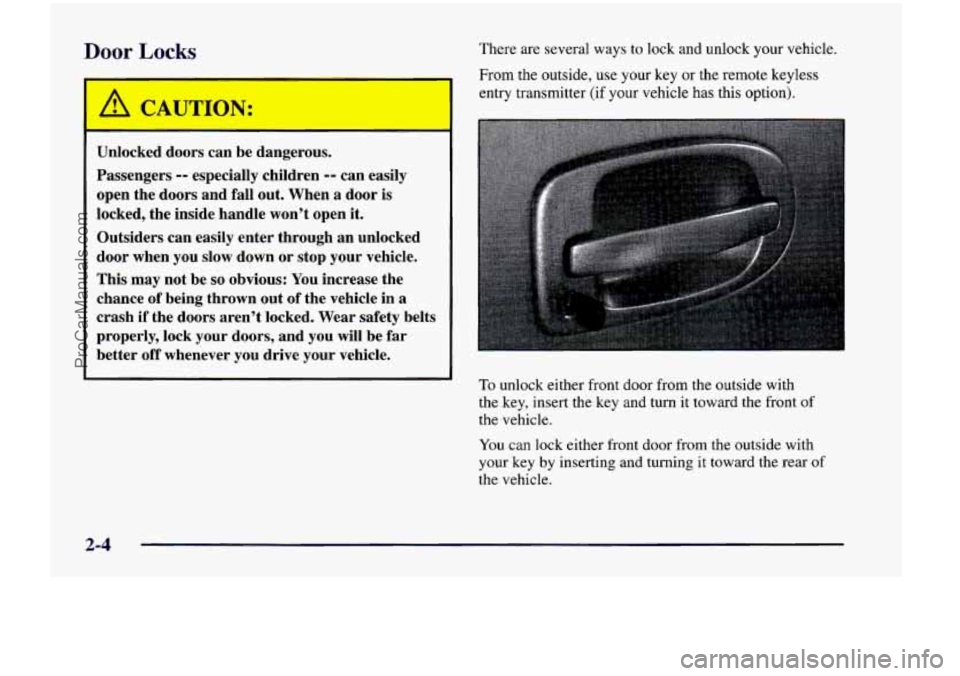
To unlock either front door from the outside with
the key, insert the key and turn
it toward the front of
the vehicle.
You can lock either front door from the outside with
your key by inserting and turning
it toward the rear of
the vehicle.
2-4
ProCarManuals.com
Page 130 of 474
Instrument Panel Switchbank Sliding Door
IF, L
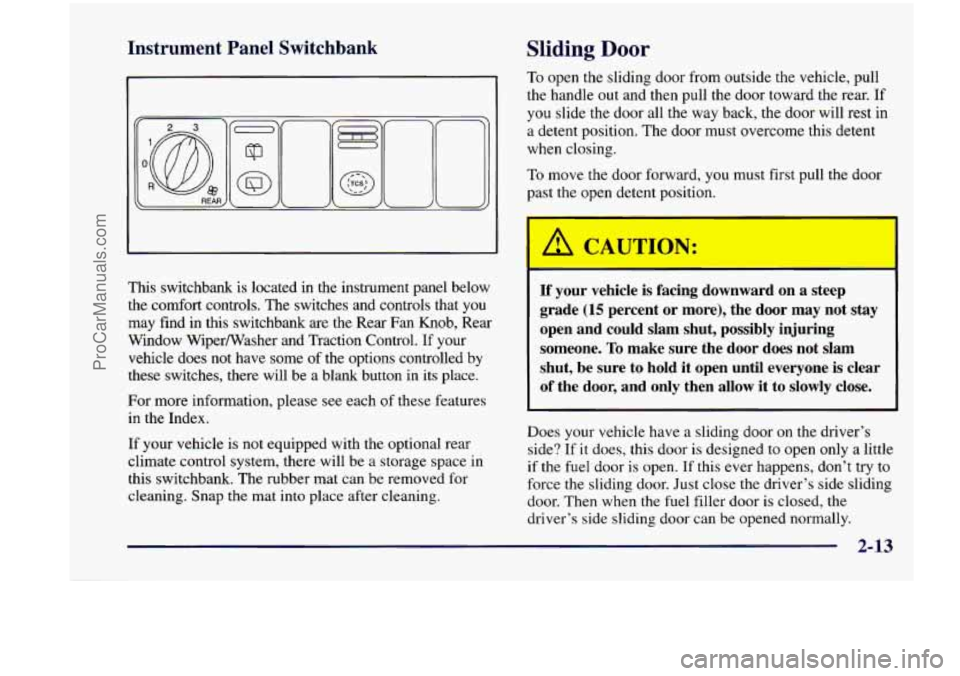
This switchbank is located in the instrument panel below the comfort controls. The switches and controls that you
may find
in this switchbank are the Rear Fan Knob, Rear
Window WiperNasher and Traction Control.
If your
vehicle does not have some
of the options controlled by
these switches, there will be a blank button in its place.
For more information, please
see each of these features
in the Index.
If your vehicle is not equipped with the optional rear
climate control system, there will be
a storage space in
this switchbank. The rubber mat can be removed for
cleaning. Snap the mat into place after cleaning.
To open the sliding door from outside the vehicle, pull
the handle out and then pull the door toward the rear.
If
you slide the door all the way back, the door will rest in
a detent position. The door must overcome this detent
when closing.
To move the door forward, you must first pull the door
past the open detent position.
I I CAUTION:
If your vehicle is facing downward on a steep
grade
(15 percent or more), the door may not stay
open and could slam shut, possibly injuring someone.
To make sure the door does not slam
shut, be sure to hold it open until everyone is clear
of the door, and only then allow it to slowly close.
Does your vehicle have a sliding door on the driver’s
side?
If it does, this door is designed to open only a little
if the fuel door
is open. If this ever happens, don’t try to
force the sliding door, Just close the driver’s side sliding
door. Then when the
fuel filler door is closed, the
driver’s side sliding door can be opened normally.
2-13
ProCarManuals.com
Page 135 of 474
-
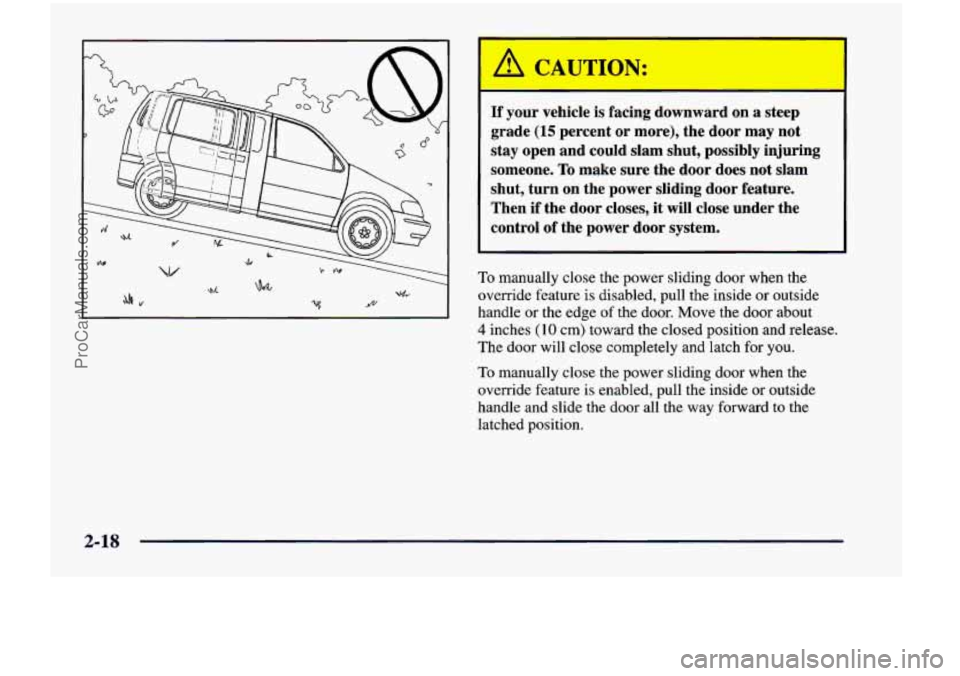
TIf your vehicle is facing downward on a steep
grade
(15 percent or more), the door may not
stay open and could slam shut, possibly injuring
someone.
To make sure the door does not slam
shut, turn on the power sliding door feature.
Then if the door closes, it will close under the
control
of the power door system.
I
To manually close the power sliding door when the
override feature is disabled, pull the inside or outside
handle or the edge of the door. Move the door about
4 inches (10 cm) toward the closed position and release.
The door will close completely and latch
for you.
To manually close the power sliding door when the
override feature is enabled, pull the inside or outside
handle and slide the door
all the way forward to the
latched position.
2-18
ProCarManuals.com
Page 142 of 474
Nuisance Alarms
If you experience nuisance alarms (alarms which are
not caused by the opening of a door or the liftgate and
are not desirable), you may need to reduce the damage
detection sensitivity. Try programming the Content
Theft-Deterrent to Mode
1.
If you continue to experience nuisance alarms, you
may want to try turning off damage detection by
programming your Content Theft-Deterrent to Mode
2.
If you are still having trouble with nuisance alarms,
you can turn off the Content Theft-Deterrent system by
programming your Content Theft-Deterrent to Mode
3.
See “Locks and Lighting Choices” in the Index for more
information. See your dealer or qualified technician
for service.
New Vehicle 4LBreak-In’’
NOTICE:
Your vehicle doesn’t need an elaborate
“break-in.” But it will perform better in the long
run
if you follow these guidelines:
0 Don’t drive at any one speed -- fast or
slow
-- for the first 500 miles (805 km).
Don’t make full-throttle starts.
200 miles (322 km) or so. During this time
your new brake linings aren’t yet broken
in. Hard stops with new linings can mean
premature wear and earlier replacement.
Follow this breaking-in guideline every
time you get new brake linings.
See “Towing a ’Ikailer” in the Index for
more information.
Avoid making hard stops for the first
0 Don’t tow a trailer during break-in.
2-25
ProCarManuals.com
Page 143 of 474
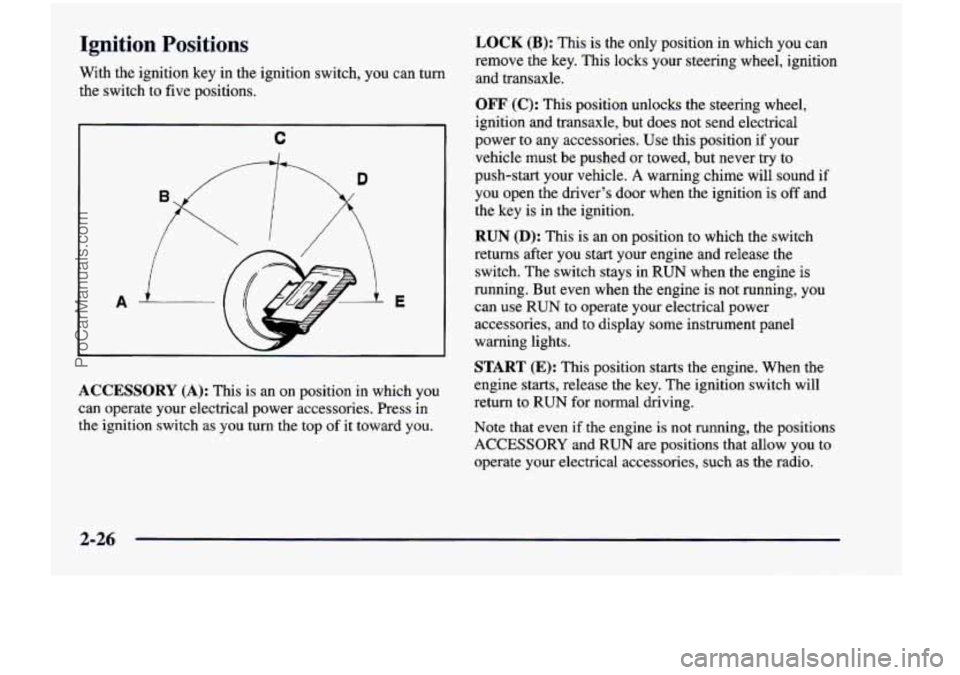
Ignition Positions
With the ignition key in the ignition switch, you can turn
the switch to five positions.
C
A E
ACCESSORY
(A): This is an on position in which you
can operate your electrical power accessories. Press in
the ignition switch as you
turn the top of it toward you.
LOCK (B): This is the only position in which you can
remove the key. This locks your steering wheel, ignition
and transaxle.
OFF (C): This position unlocks the steering wheel,
ignition and transaxle, but does not send electrical
power to any accessories. Use this position if your
vehicle must be pushed or towed, but never try to
push-start your vehicle.
A warning chime will sound if
you open the driver’s door when the ignition is off and
the key is
in the ignition.
RUN (D): This is an on position to which the switch
returns after you start your engine and release
the
switch. The switch stays in RUN when the engine is
running. But even when the engine
is not running, you
can use
RUN to operate your electrical power
accessories, and
to display some instrument panel
warning lights.
START (E): This position starts the engine. When the
engine starts, release
the key. The ignition switch will
return
to RUN for normal driving.
Note that even if
the engine is not running, the positions
ACCESSORY and RUN are positions that allow you to
operate your electrical accessories, such as the radio.
2-26
ProCarManuals.com
Page 145 of 474
2. If it doesn’t start right away, hold your key in
START. If it doesn’t start in three seconds (or starts
but then stops), push the accelerator pedal about
one-quarter
of the way down for 12 more seconds,
or until it starts.
3. If your engine still won’t start (or starts but then
stops),
it could be flooded with too much gasoline.
Try this:
Wait
15 seconds to let the starter motor cool down.
Then push your accelerator pedal all the way to the
floor. Hold it there. Then hold the key in
START.
This clears the extra gasoline from the engine. When
the engine starts, let go of the key and the accelerator
pedal. If the engine still doesn’t start, wait another
15 seconds and repeat this step.
NOTICE:
Your engine is designed to work with the
electronics in your vehicle.
If you add electrical
parts or accessories,
you could change the way
the engine operates. Before adding electrical
equipment, check with your dealer.
If you don’t,
your engine might not perform properly.
If you ever have to have your vehicle towed, see
the part
of this manual that tells how to do it
without damaging your vehicle. See “Towing
Your Vehicle” in the Index.
I
2-28
ProCarManuals.com