coolant CHEVROLET VENTURE 1998 Owner's Manual
[x] Cancel search | Manufacturer: CHEVROLET, Model Year: 1998, Model line: VENTURE, Model: CHEVROLET VENTURE 1998Pages: 474, PDF Size: 25.26 MB
Page 357 of 474
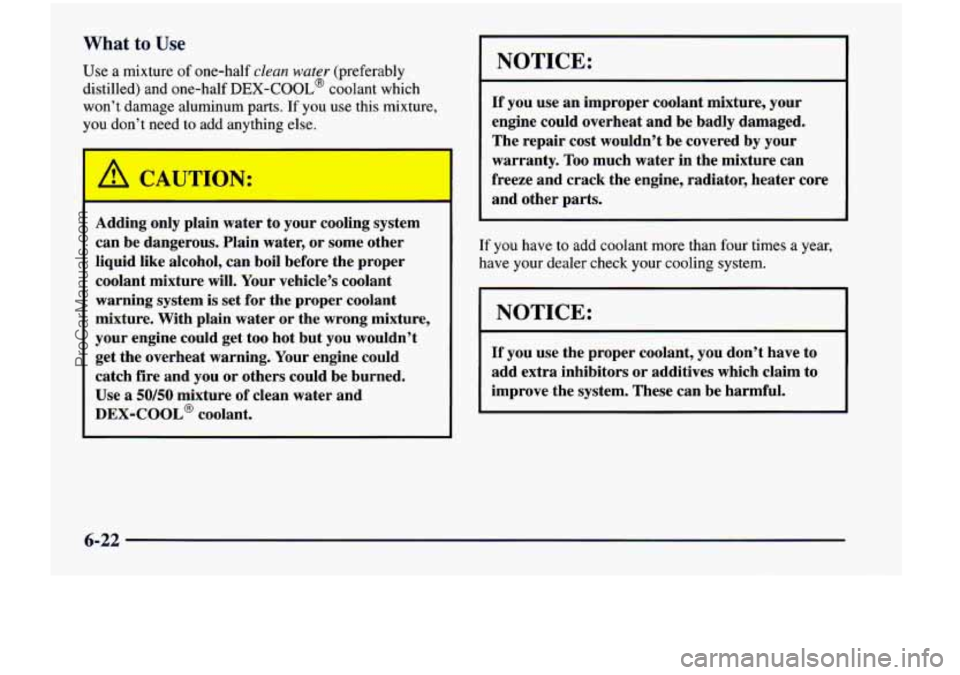
What to Use
Use a mixture of one-half clean water (preferably
distilled) and one-half
DEX-COOL@ coolant which
won’t damage aluminum
parts. If you use this mixture,
you don’t need to add anything else.
I
I
Adding only plain water to your cooling system
can be dangerous. Plain water, or some other
liquid like alcohol, can boil before the proper
coolant mixture will. Your vehicle’s coolant
warning system is set for
the proper coolant
mixture. With plain water or the wrong mixture,
your engine could get too hot but you wouldn’t
get the overheat warning. Your engine could
catch fire and you or others could be burned.
Use
a 50/50 mixture of clean water and
DEX-COOL@ coolant.
NOTICE:
If you use an improper coolant mixture, your
engine could overheat and be badly damaged.
The repair cost wouldn’t be covered by your
warranty.
Too much water in the mixture can
freeze and crack the engine, radiator, heater
core
and other parts.
If you have to add coolant more than four times a year,
have your dealer check your cooling system.
NOTICE:
If you use the proper coolant, you don’t have to
add extra inhibitors or additives which claim
to
improve the system. These can be harmful.
6-22
ProCarManuals.com
Page 358 of 474
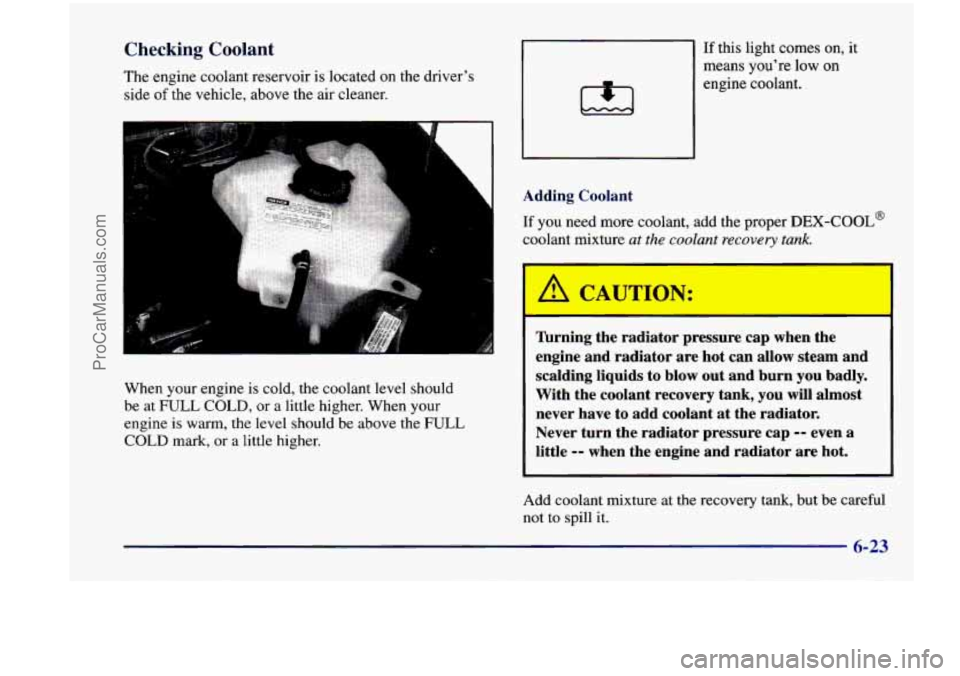
Checking Coolant If this light comes on, it
The engine coolant reservoir
is located on the driver’s
side
of the vehicle, above the air cleaner. means you’re low
on
engine coolant.
Adding Coolant
If you need more coolant, add the proper DEX-COOL@
coolant mixture
at the coolant recovery tank.
When your engine is cold, the coolant level should
be at FULL COLD, or a little higher. When your engine is warm, the level should
be above the FULL
COLD mark, or a little higher.
Add coolant mixture at the recovery tank, but be careful
not to spill it. ’hrning the radiator pressure cap
when the
engine and radiator
are hot can allow steam and
scalding liquids to blow out and burn you badly.
With the coolant recovery tank, you will almost
never have to add coolant
at the radiator.
Never turn the radiator pressure cap
-- even a
little -- when the engine and radiator are hot.
6-23
ProCarManuals.com
Page 359 of 474
Thermostat
Engine coolant temperature is controlled by a thermostat
in the engine coolant system. The thermostat stops the
flow
of coolant through the radiator until the coolant
reaches a preset temperature.
You
can be burned if you spill coolant on hot
engine parts, Coolant contains ethylene glycol,
and
it will burn if the engine parts are hot
enough. Don't spill coolant on
a hot engine.
Radiator I ressure Cap
NOTICE:
Your radiator cap is a 15 psi (105 kPa)
pressure-type cap and must be tightly installed to
prevent coolant
loss and possible engine damage
from overheating. Be sure the arrows on the cap
line up with the overflow tube on the radiator
filler neck.
When you replace your radiator pressure cap,
a GM cap
is recommended. When you replace your thermostat, a
GM thermostat
is recommended.
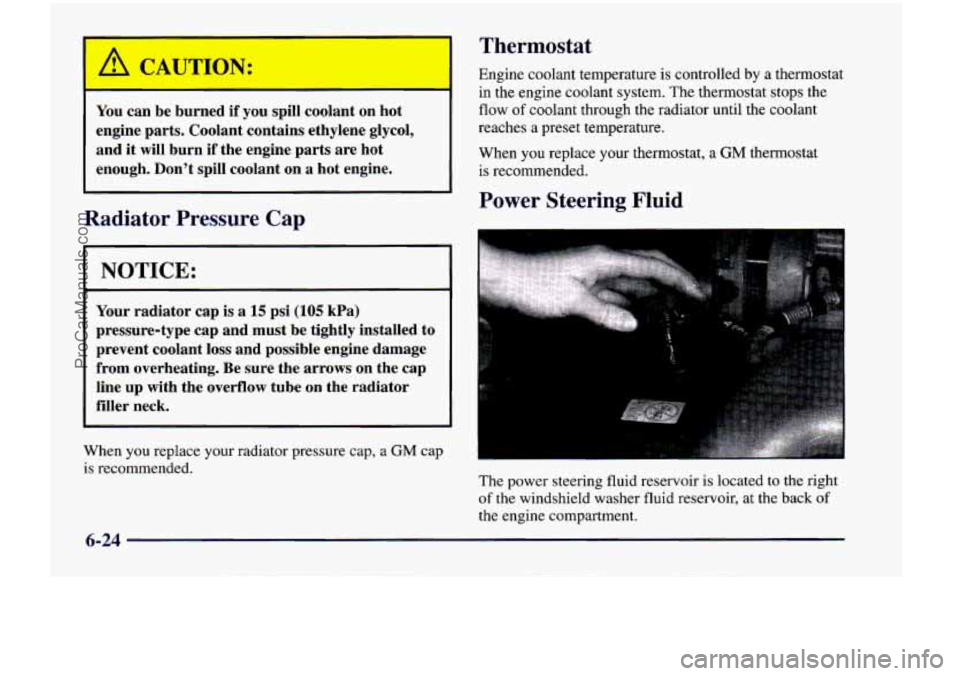
Power
Steering Fluid
'l'kv Gower steering fluid reservoir is located to the right
of the windshield washer fluid reservoir, at the back of
the engine compartment.
ProCarManuals.com
Page 361 of 474
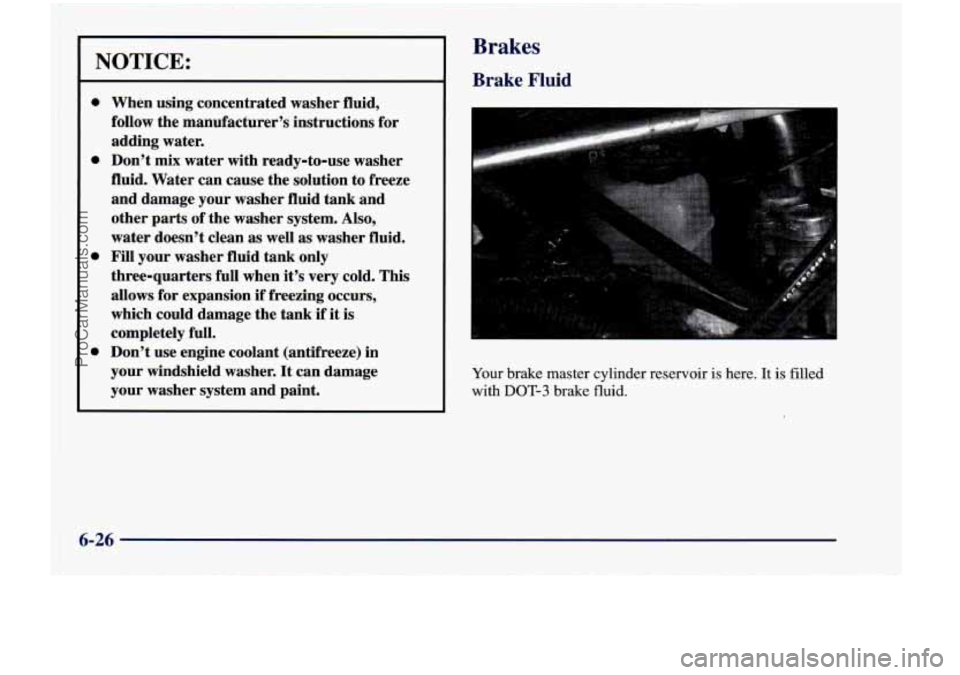
Brakes
Brake Fluid
0
0
0
When using concentrated washer fluid,
follow the manufacturer’s instructions for
adding water.
Don’t
mix water with ready-to-use washer
fluid. Water can cause the solution to freeze
and damage your washer fluid tank and
other parts of the washer system. Also,
water doesn’t clean
as well as washer fluid.
Fill your washer fluid tank only
three-quarters full when it’s very cold. This
allows for expansion
if freezing occurs.
which could damage the tank
if it is
completely full.
Don’t use engine coolant (antifreeze) in
your windshield washer.
It can damage
your washer system and paint. Your brake master cylinder reservoir
is here. It is filled
with DOT-3 brake fluid.
6-26
ProCarManuals.com
Page 397 of 474
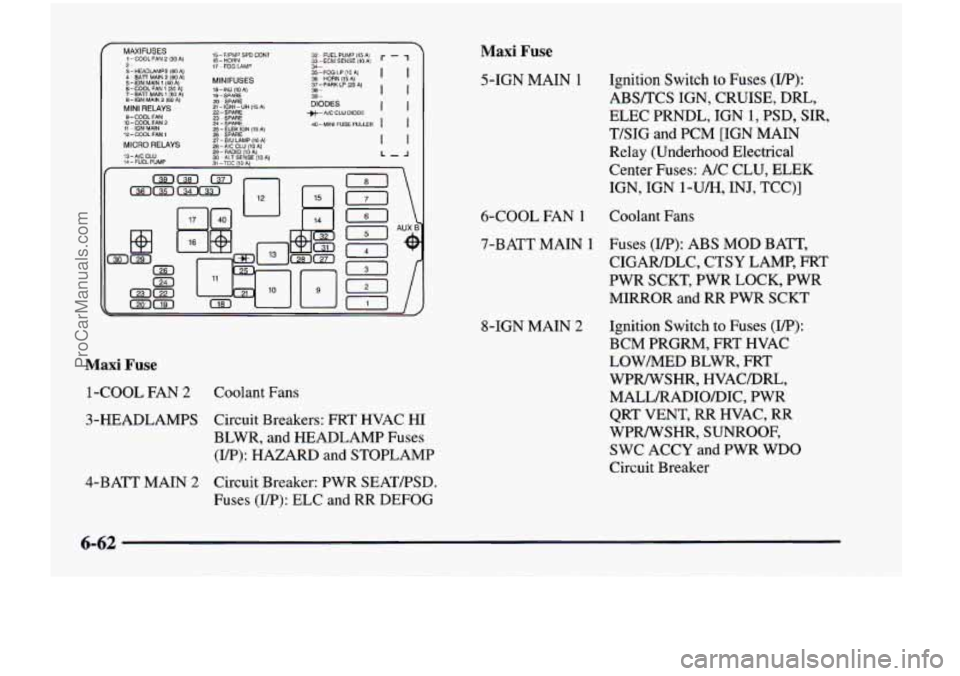
Maxi Fuse
5-IGN MAIN 1 Ignition Switch to Fuses (VP):
ABS/TCS IGN, CRUISE, DRL,
ELEC PRNDL, IGN
1, PSD, SIR,
T/SIG and PCM [IGN MAIN
Relay (Underhood Electrical
Center Fuses:
A/C CLU, ELEK
IGN, IGN
l-U/H, INJ, TCC)]
8-IGN MAIN
2
Maxi Fuse
1-COOL FAN 2 Coolant Fans
3-HEADLAMPS Circuit Breakers: FRT HVAC
HI
BLWR, and HEADLAMP Fuses
(UP): HAZARD and STOPLAMP
4-BATT MAIN
2 Circuit Breaker: PWR SEATPSD.
Fuses
(VP): ELC and RR DEFOG 6-COOL
FAN
1 Coolant Fans
7-BATT MAIN
1 Fuses (UP): ABS MOD BATT,
CIGARDLC, CTSY LAMP, FRT
PWR SCKT, PWR LOCK, PWR MIRROR and RR PWR SCKT
Ignition Switch to Fuses
(VP):
BCM PRGRM, FRT HVAC
LOWMED BLWR, FRT
WPWSHR, HVACDRL,
MALL/RADIO/DIC, PWR QRT
VENT, RR HVAC, RR
WPWSHR, SUNROOF,
SWC ACCY and PWR WDO
Circuit Breaker
6-62
ProCarManuals.com
Page 423 of 474
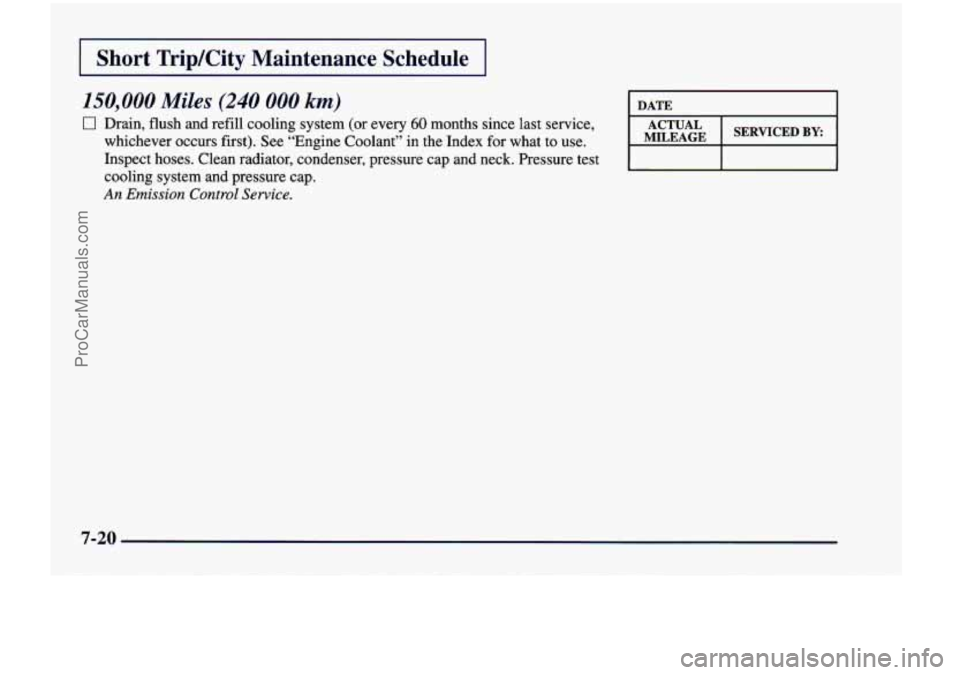
I Short Trip/City Maintenance Schedule I
150,000 Miles (240 000 km)
0 Drain, flush and refill cooling system (or every 60 months since last service,
whichever occurs first). See “Engine Coolant” in the Index for what to use.
Inspect hoses. Clean radiator, condenser, pressure cap and neck. Pressure test
cooling system and pressure cap.
An Emission Control Sewice.
MILEAGE ACTUAL I SERVICED BY:
7-20
ProCarManuals.com
Page 431 of 474
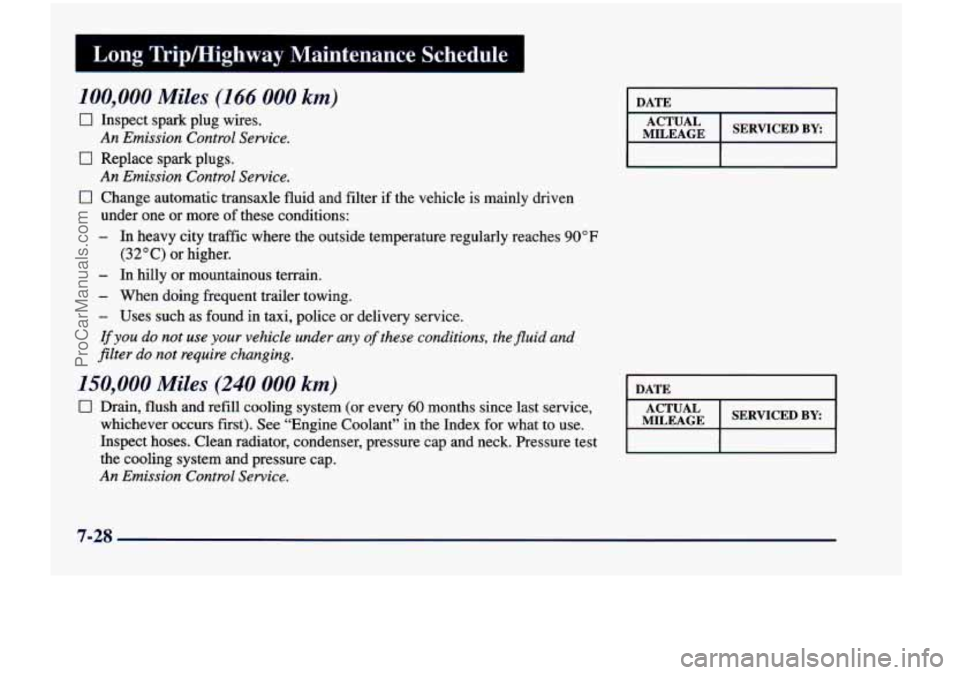
I Long Tripmfghway Maintenance Schedule I
100,000 Miles (166 000 km)
0 Inspect spark plug wires.
0 Replace spark plugs.
0 Change automatic transaxle fluid and filter if the vehicle is mainly driven
An Emission Control Service.
An Emission Control Service.
under one or more of these conditions:
- In heavy city traffic where the outside temperature regularly reaches 90°F
- In hilly or mountainous terrain.
(32°C) or higher.
- When doing frequent trailer towing.
- Uses such as found in taxi, police or delivery service.
If you do not use your vehicle under any of these conditions, the fluid and
filter
do not require changing.
150,000 Miles (240 000 km)
0 Drain, flush and refill cooling system (or every 60 months since last service,
whichever occurs first).
See “Engine Coolant” in the Index for what to use.
Inspect hoses. Clean radiator, condenser, pressure cap and neck. Pressure test
the cooling system and pressure cap.
An Emission Control Service.
DATE I
MILEAGE
I DATE I
I MILEAGE ACTUAL I SERVICEDBY I
7-28
ProCarManuals.com
Page 432 of 474
Part B: Owner Checks and Services
Listed below are owner checks and services which
should be performed at the intervals specified to help
ensure the safety, dependability and emission control
performance of your vehicle.
Be sure any necessary repairs are completed at once.
Whenever any fluids or lubricants are added to your
vehicle, make sure they are the proper ones, as shown in
Part D.
At Each Fuel Fill
It is important for you or a service station attendant to
pe@orm these underhood checks at each fuel
fill.
Engine Oil Level Check
Check the engine oil level and add the proper oil if
necessary. See “Engine Oil” in the Index for
further details.
Engine Coolant Level Check
Check the engine coolant level and add DEX-COOL’
coolant mixture if necessary. See “Engine Coolant” in
the Index for hrther details.
Windshield Washer Fluid Level Check
Check the windshield washer fluid level in the
windshield washer tank and add the proper fluid
if
necessary. See “Windshield Washer Fluid” in the Index
for further details.
At Least Once a Month
Tire Inflation Check
Make sure tires are inflated to the correct pressures. See
“Tires” in the Index for further details.
Cassette Deck Service
Clean cassette deck. Cleaning should be done every
50 hours of tape play. See “Audio Systems” in the
Index for further details.
7-29
ProCarManuals.com
Page 437 of 474
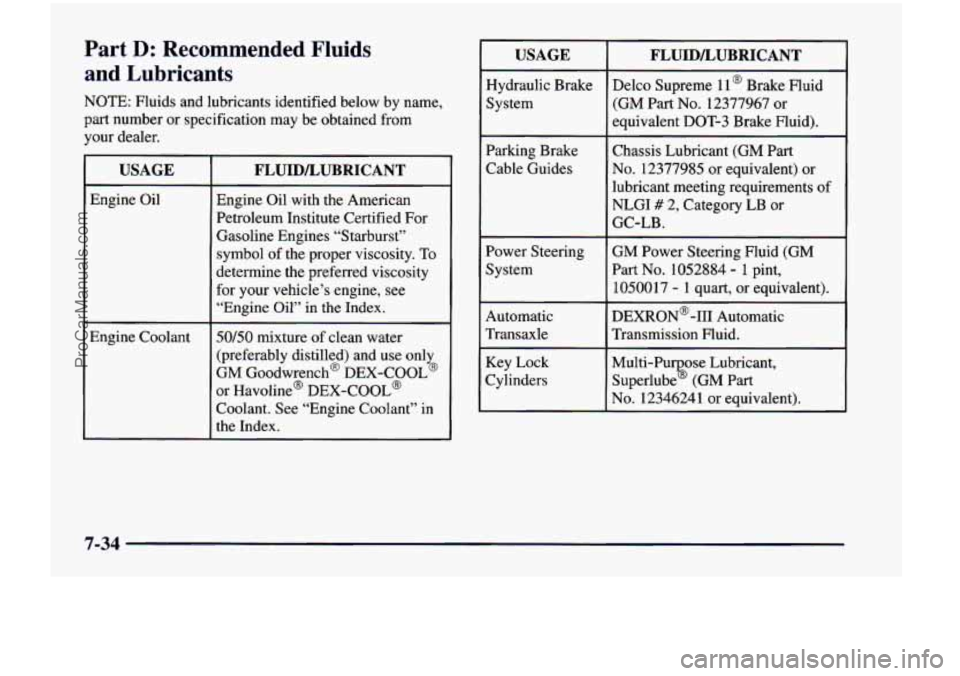
Part D: Recommended Fluids
and Lubricants
NOTE: Fluids and lubricants identified below by name,
part number or specification may be obtained from your dealer.
USAGE FLUIDLUBRICANT
Engine Oil Engine Oil with the American
Petroleum Institute Certified For
Gasoline Engines “Starburst” symbol of the proper viscosity.
To
determine the preferred viscosity
for your vehicle’s engine, see
“Engine Oil” in the Index.
Engine Coolant
50/50 mixture of clean water
(preferably distilled) and use only
GM Goodwrench@
DEX-COOL@
or Havoline@ DEX-COOL@
Coolant. See “Engine Coolant” in
the Index.
USAGE
Hydraulic Brake
System
Parking Brake
Cable Guides
Power Steering
System Automatic
Transaxle
Key Lock
Cylinders
FLUIDLUBRICANT
Delco Supreme ll@ Brake Fluid
(GM Part
No. 12377967 or
equivalent DOT-3 Brake Fluid).
Chassis Lubricant (GM Part
No. 12377985 or equivalent) or
lubricant meeting requirements
of
NLGI # 2, Category LB or
GC-LB.
GM Power Steering Fluid (GM
Part
No. 1052884 - 1 pint,
1050017
- 1 quart, or equivalent).
DEXRON@-111 Automatic
Transmission fluid.
Multi-Pu ose Lubricant,
Superlube
% (GM Part
No. 1234624 1 or equivalent).
7-34
ProCarManuals.com
Page 460 of 474
Glass ................................... 6-51
Inside
of Your Vehicle ......................... 6-48
InstrumentPanel
............................. 6-50
Outside of
Your Vehicle ........................ 6-52
Special Problems
............................. 6-49
Stains
...................................... 6-49
Tires
....................................... 6-53
Vinyl
....................................... 6-50
Wheels
..................................... 6-53
Windshield, Backglass and Wiper Blades
.......... 6-51
WiperBlades
................................ 6-51
Climate Control System
........................... 3-2
Clock, Settingthe
................................ 3-9
Coinholder
.................................... 2-70
Comfort Controls
................................ 3-2
Compact Disc Care
............................. 3-31
Compact Disc Player
............................ 3-19
Care
....................................... 3-32
Errors
................................. 3-22, 3-25
Remote
..................................... 3-25
Compact Overhead Console
...................... 2-67
Compact Spare Tire
............................. 5-34
Content Theft-Deterrent
......................... 2-23
Control of a Vehicle
.............................. 4-6
Convenience Net Side
....................................... 2-73
Convex Outside Mirror
.......................... 2-66
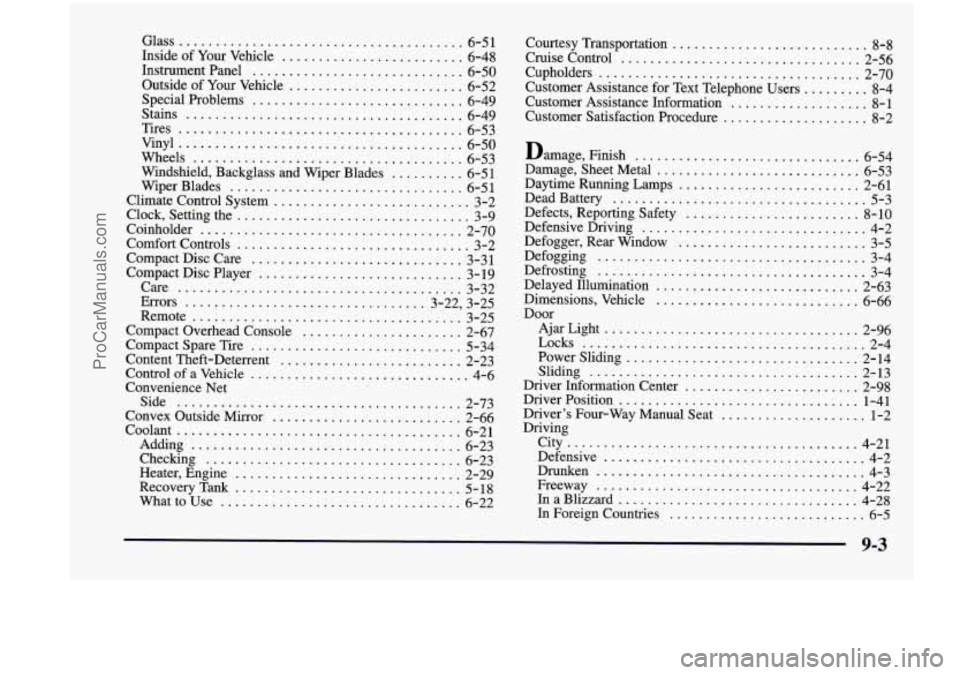
Coolant
....................................... 6-21
Adding
..................................... 6-23
Checking
................................... 6-23
Heater, Engine
............................... 2-29
RecoveryTank
............................... 5-18
Whattouse
................................. 6-22 Courtesy Transportation
........................... 8-8
Cruise Control ................................. 2-56
Cupholders
.................................... 2-70
Customer Assistance Information
................... 8-1
Customer Satisfaction Procedure
.................... 8-2
Customer Assistance for Text Telephone Users ......... 8-4
Damage. Finish
............................... 6-54
Damage. Sheet Metal
............................ 6-53
Damme Running Lamps
......................... 2-61
Dead Battery
................................... 5-3
Defects. Reporting Safety
........................ 8-10
Defensive Driving ............................... 4-2
Defogger. Rear Window
.......................... 3-5
Defrosting
..................................... 3-4
Delayed Illumination
............................ 2-63
Dimensions, Vehicle
............................ 6-66
Door AjarLight
................................... 2-96
Locks
....................................... 2-4
Power Sliding
................................ 2-14
Sliding
..................................... 2-13
Driver Information Center
........................ 2-98
DriverPosition
................................. 1-41
Driver’s Four-Way Manual Seat
.................... 1-2
Driving
City
........................................ 4-21
Defensive
.................................... 4-2
Drunken
..................................... 4-3
Freeway
.................................... 4-22
InaBlizzard
................................. 4-28
In Foreign Countries
........................... 6-5
Defogging
..................................... 3-4
9-3
ProCarManuals.com