towing CHEVROLET VENTURE 1998 Owner's Manual
[x] Cancel search | Manufacturer: CHEVROLET, Model Year: 1998, Model line: VENTURE, Model: CHEVROLET VENTURE 1998Pages: 474, PDF Size: 25.26 MB
Page 305 of 474
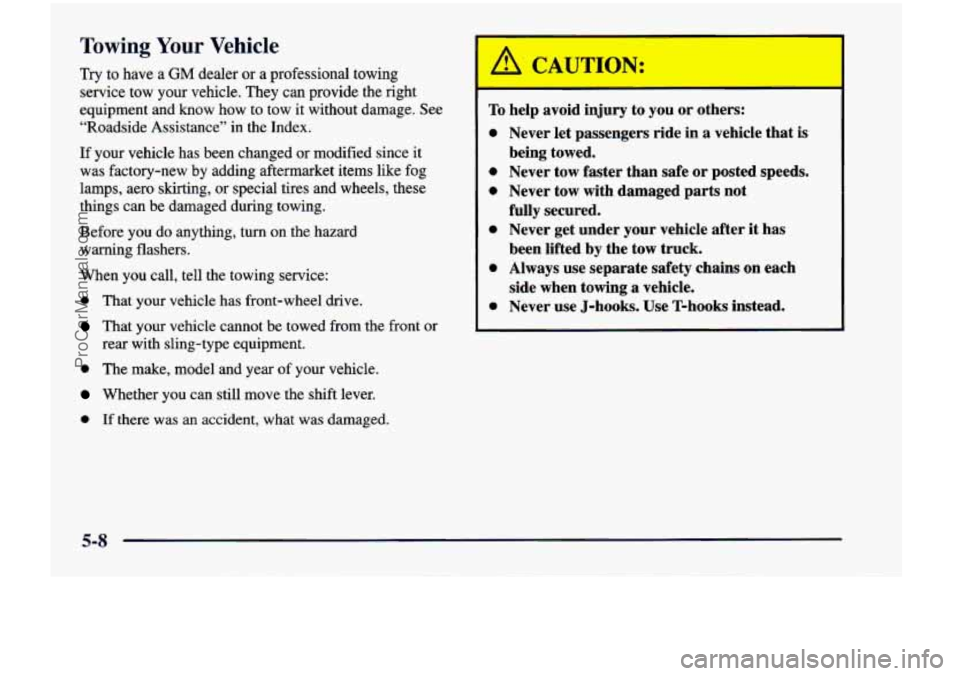
Towing Your Vehicle
Try to have a GM dealer or a professional towing
service tow your vehicle. They can provide the right
equipment and know how to tow it without damage. See
“Roadside Assistance” in the Index.
If your vehicle has been changed or modified since it
was factory-new
by adding aftermarket items like fog
lamps, aero skirting,
or special tires and wheels, these
things can be damaged during towing.
Before you do anything, turn on the hazard
warning flashers.
When you call, tell
the towing service:
0 That your vehicle has front-wheel drive.
That your vehicle cannot be towed from the front or
0 The make, model and year of your vehicle.
Wether you can still move the shift lever.
0 If there was an accident, what was damaged.
rear with sling-type
equipment.
To
0
0
e
0
0
0
help avoid
injury to you or others:
Never let passengers ride in a vehicle that is
being towed.
Never tow faster than safe
or posted speeds.
Never tow with damaged parts not
fully secured.
Never get under your vehicle after it has
been lifted by the tow truck.
Always use separate safety chains on each
side when towing a vehicle.
Never use J-hooks. Use T-hooks instead.
5-8
ProCarManuals.com
Page 306 of 474
A vehicle can fall from a car carrier if it isn’t
adequately secured. This can cause a collision,
serious personal injury and vehicle damage. The
vehicle should be tightly secured with chains or
steel cables before it is transported.
Don’t use substitutes (ropes, leather straps,
canvas webbing, etc.) that can be cut
by sharp
edges underneath the towed vehicle. Always use
T-hooks inserted in the T-hook slots. Never use
J-hooks. They will damage drivetrain and
suspension components.
~~
NOTICE:
If you are using car-carrier equipment, you must
pull the Electronic Level Control (ELC) fuse, in
the instrument panel fuse block, before securing
the vehicle.
Damage to the shocks or leveling system may
occur if the Electronic Level Control (ELC) fuse
is not disabled.
When your vehicle is being towed, have the ignition key
in
OFF. The steering wheel should be clamped in a
straight-ahead position, with a clamping device
designed for towing service.
Do not use the vehicle’s
steering column lock for this. For front towing, the
transaxle should be in
PARK (P) and the parking brake
released. For rear towing, the transaxle should be in
NEUTRAL (N) and the parking brake engaged.
5-9
ProCarManuals.com
Page 307 of 474
I NOTICE:
Your vehicle has front-wheel drive; do not have it
towed with the front wheels in contact with the
ground or vehicle damage may occur.
A dolly
must be used under the front wheels when towing
from the rear or the vehicle must be transported
on a flat bed carrier.
I NOTICE:
Do not have your vehicle towed with the front
wheels in contact with the ground. This will
damage the transaxle.
If the vehicle must be towed on the front wheels,
it cannot be towed more than a total of 500 miles
(800 km) for the lifetime of the vehicle.
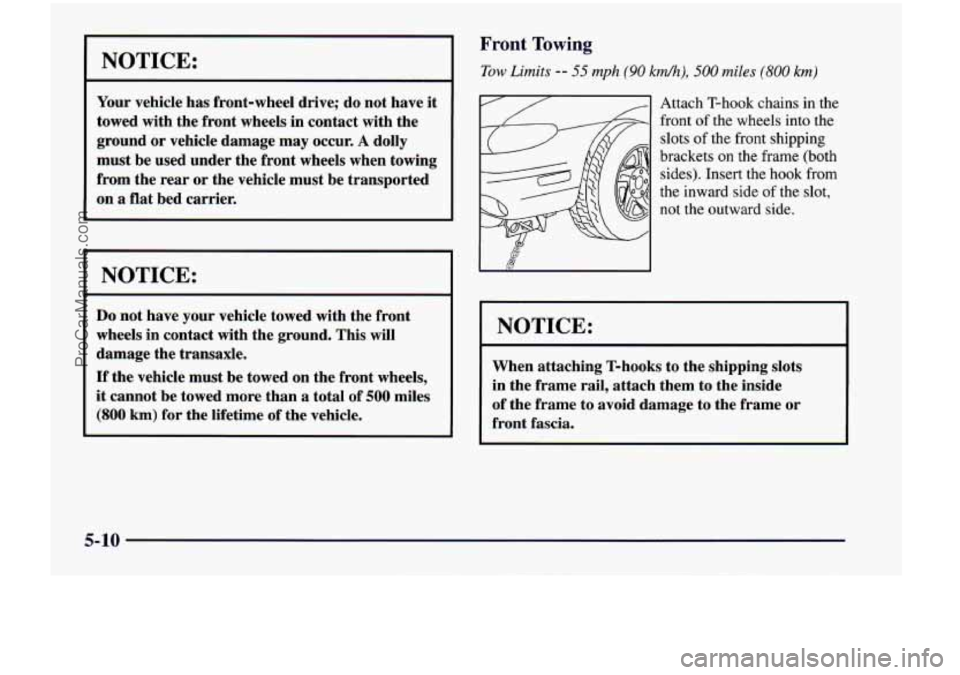
Front Towing
Tow Limits -- 55 mph (90 km/h), 500 miles (800 km)
Attach T-hook chains in the
front of the wheels into the
slots
of the front shipping
brackets
on the frame (both
sides). Insert the hook from
the inward side of the slot,
not the outward side.
I NOTICE:
When attaching T-hooks to the shipping slots
in the frame rail, attach them to the inside
of the frame to avoid damage to the frame or
front fascia.
5-10
ProCarManuals.com
Page 308 of 474
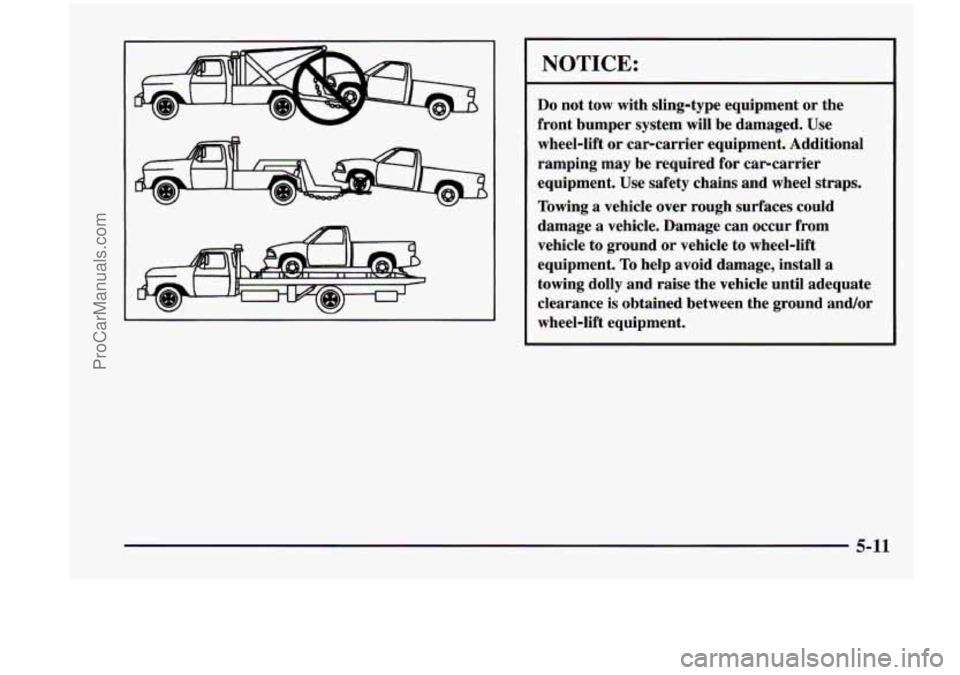
NOTICE:
Do not tow with sling-type equipment or the
front bumper system will be damaged. Use
wheel-lift or car-carrier equipment. Additional
ramping may be required for car-carrier
equipment. Use safety chains and wheel straps.
Towing
a vehicle over rough surfaces could
damage
a vehicle. Damage can occur from
vehicle to ground or vehicle to wheel-lift
equipment.
To help avoid damage, install a
towing dolly and raise the vehicle until adequate
clearance
is obtained between the ground and/or
wheel-lift equipment.
5-11
ProCarManuals.com
Page 309 of 474
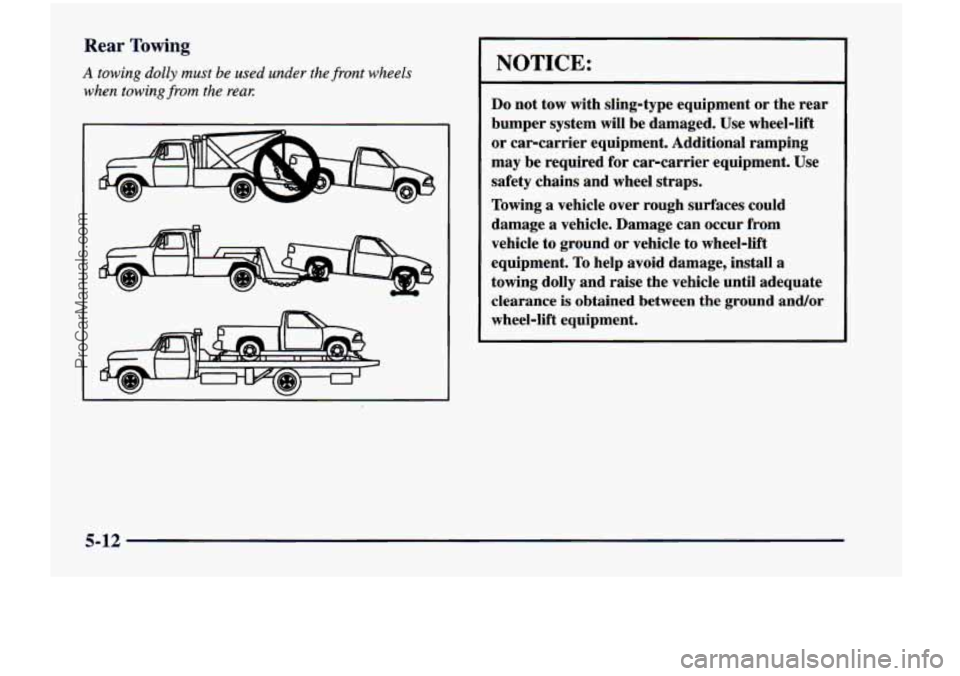
Rear Towing
A towing dolly must be used under the front wheels
when towing
from the reay:
NOTICE:
Do not tow with sling-type equipment or the rear
bumper system will be damaged. Use wheel-lift
or car-carrier equipment. Additional ramping
may be required for car-carrier equipment. Use
safety chains and wheel straps.
Towing
a vehicle over rough surfaces could
damage a vehicle. Damage can occur from
vehicle to ground
or vehicle to wheel-lift
equipment.
To help avoid damage, install a
towing dolly and raise the vehicle until adequate
clearance is obtained between the ground and/or
wheel-lift equipment.
5-12
ProCarManuals.com
Page 310 of 474
Engine Overheating
You will find a coolant temperature gage on your
vehicle’s instrument panel.
See “Engine Coolant
Temperature Gage” in the Index.
You also have a low
coolant level light on your instrument panel. See “Low
Coolant Light’’ in the Index.
Overheated Engine Protection
Operating
Mode
Should an overheated engine condition exist, an
overheat protection mode which alternates firing groups
of three cylinders helps prevent engine damage. In this
mode, you will notice a significant loss in power and
engine performance. The low coolant light may come
on
and the temperature gage will indicate an overheat
condition exists. This emergency operating mode allows
your vehicle to be driven to a safe place in an
emergency. Towing
a trailer in the overheat protection
mode should be avoided.
NOTICE:
I
After driving in the overheated engine protection
operating mode, to avoid engine damage, allow
the engine to cool before attempting any repair.
The engine oil will be severely degraded. Repair
the cause of coolant loss and change the
oil. See
“Engine Oil, When
to Change” in the Index.
5-13
ProCarManuals.com
Page 333 of 474
NOTICE:
~
Spinning your wheels can destroy parts of your
vehicle as well
as the tires. If you spin the wheels
too fast while shifting your transaxle back and
forth, you can destroy your transaxle.
For information about using tire chains on your vehicle,
see “Tire Chains”
in the Index.
Rocking Your Vehicle To Get It Out
First, turn your steering wheel left and right. That will
clear the area around your front wheels. If your vehicle
has traction control, you should turn your traction
control system off. (See “Traction Control System” in
the Index.) Then shift back and forth between
REVERSE (R) and a forward gear, spinning the wheels as little as possible. Release the accelerator pedal while
you shift, and press lightly on the accelerator pedal
when the transaxle is in gear. If that doesn’t get you out\
after a few tries, you may need to be towed out. If you
do need to be towed out, see “Towing Your Vehicle’’ in
the Index.
5-36
ProCarManuals.com
Page 353 of 474
Automatic Transaxle Fluid
When to Check and Change
A good time to check your automatic transaxle fluid
level is when the engine oil is changed.
Change both the fluid and filter every
50,000 miles
(83 000 km) if the vehicle is mainly driven under one
or more of these conditions:
In heavy city traffic where the outside temperature
In hilly or mountainous terrain.
When doing frequent trailer towing.
Uses such as found in taxi, police or delivery service.
regularly reaches
90°F (32 O C) or higher.
If you do
not use your vehicle under any of these
conditions, the fluid and filter do not require changing.
See “Scheduled Maintenance Services’’ in the Index.
How to Check
Because this operation can be a little difficult, you may
choose to have this done at
your Chevrolet dealership
Service Department.
If you do it yourself, be sure to follow all the
instructions here, or you could get a false reading
on the dipstick.
NOTICE:
Too much or too little fluid can damage your
transaxle.
Too much can mean that some of the
fluid could come out and fall on hot engine parts
or exhaust system parts, starting a fire. Be sure to
get an accurate reading if you check your
transaxle fluid.
6-18
ProCarManuals.com
Page 409 of 474
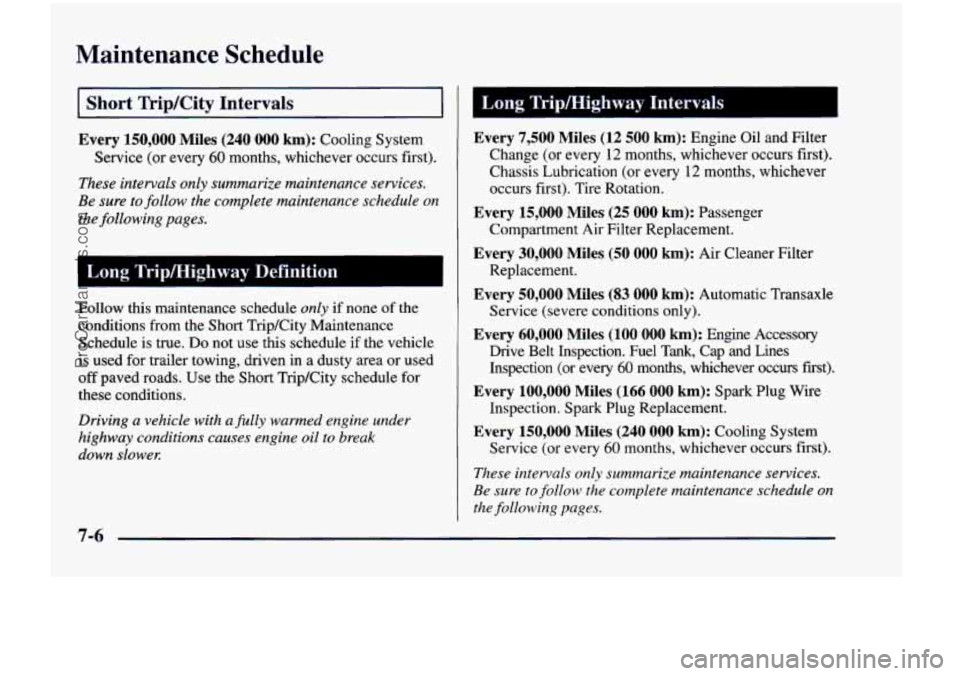
Maintenance Schedule
I Short TripKity Intervals
Every 150,000 Miles (240 000 km): Cooling System
Service (or every
60 months, whichever occurs first).
These intervals only summarize maintenance services.
Be sure to follow the complete maintenance schedule on
the following pages.
Follow this maintenance schedule only if none of the
conditions from the Short TripKity Maintenance
Schedule is true.
Do not use this schedule if the vehicle
is used for trailer towing, driven in
a dusty area or used
off paved roads. Use the Short TripKity schedule for
these conditions.
Driving a vehicle with afully warmed engine under
highway conditions causes engine oil
to break
down slower:
Long Tripmighway Intervals
Every 7,500 Miles (12 500 km): Engine Oil and Filter
Change (or every
12 months, whichever occurs first).
Chassis Lubrication (or every
12 months, whichever
occurs first). Tire Rotation,
Compartment Air Filter Replacement.
Replacement. Service (severe conditions only).
Drive Belt Inspection. Fuel Tank, Cap and Lines
Inspection (or every
60 months, whichever occurs first).
Every 100,000 Miles (166 000 km): Spark Plug Wire
Inspection. Spark Plug Replacement.
Every 150,000 Miles (240 000 km): Cooling System
Service (or every
60 months, whichever occurs first).
These intervals only summarize maintenance services.
Be sure
to follow the complete maintenance schedule on
the following pages.
Every 15,000 Miles (25 000 km): Passenger
Every 30,000 Miles (50 000 km): Air Cleaner Filter
Every 50,000 Miles (83 000 km): Automatic Transaxle
Every 60,000 Miles (100 000 km): Engine Accessory
ProCarManuals.com
Page 416 of 474
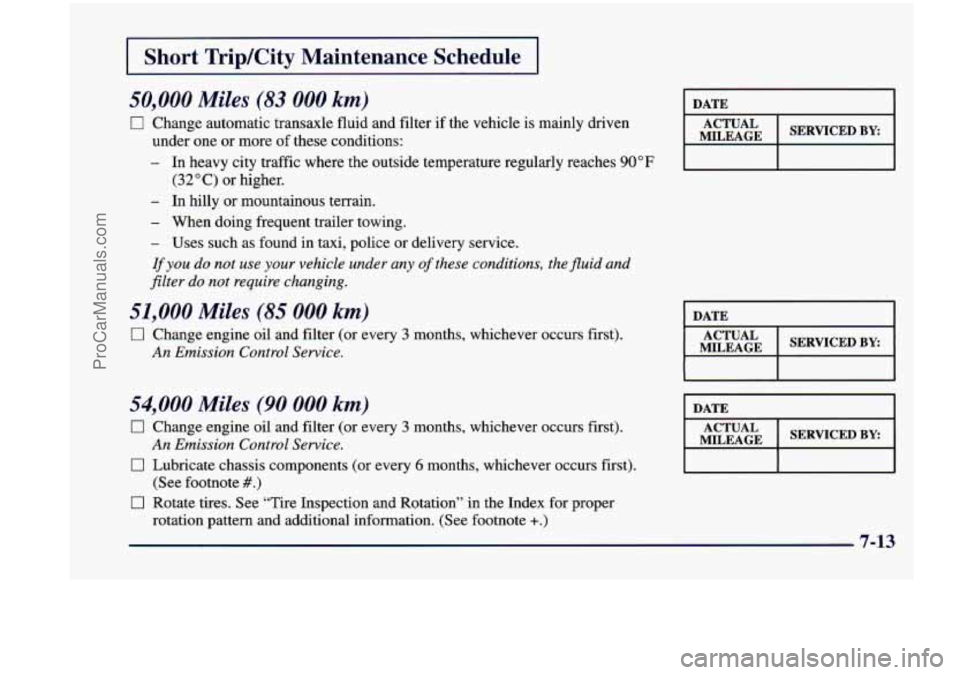
1 Short TripKity Maintenance Schedule I
50,000 Miles (83 000 km)
0 Change automatic transaxle fluid and filter if the vehicle is mainly driven
under one or more of these conditions:
- In heavy city traffic where the outside temperature regularly reaches 90°F
- In hilly or mountainous terrain.
- When doing frequent trailer towing.
- Uses such as found in taxi, police or delivery service.
If you do not use your vehicle under any of these conditions, the fluid and
filter
do not require changing.
(32°C) or higher.
51,000 Miles (85 000 km)
0 Change engine oil and filter (or every 3 months, whichever occurs first).
An Emission Control Service.
54,000 Miles (90 000 km)
0 Change engine oil and filter (or every 3 months, whichever occurs fiist).
0 Lubricate chassis components (or every 6 months, whichever occurs first).
An Emission Control Service.
(See footnote #.)
DATE I
1
MILEAGE ACTUAL SERVICED BY:
DATE
DATE
I
I MILEAGE ACTUAL I SERVICEDBY: I
0 Rotate tires. See “Tire Inspection and Rotation’’ in the Index for proper
rotation pattern and additional information. (See footnote
+.)
7-13
ProCarManuals.com