ignition CHEVROLET VENTURE 1998 Workshop Manual
[x] Cancel search | Manufacturer: CHEVROLET, Model Year: 1998, Model line: VENTURE, Model: CHEVROLET VENTURE 1998Pages: 474, PDF Size: 25.26 MB
Page 246 of 474
When THEFTLOCK is activated, the radio will display
LOC to indicate a locked condition anytime battery
power has been interrupted. If your battery loses power
for any reason, you must unlock the radio with the secret
code before it will operate.
Activating the Theft-Deterrent Feature
The instructions which follow explain how to enter your
secret code to activate the THEFTLOCK system. It is
recommended that you read through all nine steps
before starting the procedure.
NOTE: If you allow more than
15 seconds to elapse
between any steps, the radio automatically reverts to
time and you must start the procedure over at Step
4.
1. Write down any three or four-digit number from
000 to 1999 and keep it in a safe place separate from
the vehicle.
2. Turn the ignition to ACCESSORY or RUN.
3. Turn the radio off.
4. Press the 1 and 4 buttons together. Hold them down
until
--- shows on the display. Next you will use the
secret code number which you have written down.
5. Press MN and 000 will appear on the display.
6. Press MN again to make the last two digits agree
with your code.
7. Press HR to make the first one or two digits agree
with your code.
code matches the secret code you have written down.
The display will
show REP to let you know that you
need to repeat Steps
5 through 7 to confirm your
secret code.
8. Press AM-FM after you have confirmed that the
9. Press AM-FM and this time the display will show
SEC to let you know that your radio is secure. The
indicator by the volume control will begin flashing
when the ignition
is turned off.
Unlocking the Theft-Deterrent Feature After a
Power
Loss
Enter your secret code as follows; pause no more than
15 seconds between steps:
1. LOC appears when the ignition is on.
2. Press MN and 000 will appear on the display.
3. Press MN again to make the last two digits agree
with your code.
4. Press HR to make the first one or two digits agree
with your code.
3-27
ProCarManuals.com
Page 247 of 474
5. Press AM-FM after you have confirmed that the
code matches the secret code you have written down.
The display will show
SEC, indicating the radio is
now operable and secure.
If you enter the wrong code eight times, INOP will
appear
on the display. You will have to wait an hour
with the ignition on before you can try again. When you
try again, you will only have three chances to enter the
correct code before INOP appears.
If you lose or forget your code, contact your dealer.
Disabling the Theft-Deterrent Feature
Enter your secret code as follows; pause no more than
15 seconds between steps:
1. Turn the ignition to ACCESSORY or RUN.
2. Turn the radio off.
3. Press the 1 and 4 buttons together. Hold them down
until
SEC shows on the display.
4. Press MN and 000 will appear on the display.
5. Press MN again to make the last two digits agree
with your code.
6. Press HR to make the first one or two digits agree
with your code.
7. Press AM-FM after you have confirmed that the
code matches the secret code you have written down.
The display will show
---, indicating that the radio is
no longer secured.
If the code entered is incorrect, SEC will appear on the
display. The radio will remain secured until the correct
code is entered.
When battery power is removed and later applied
to a
secured radio, the radio won’t turn on and
LOC will
appear on the display.
To unlock a secured radio, see “Unlocking the
Theft-Deterrent Feature After a Power
Loss” earlier in
this section.
3-28
ProCarManuals.com
Page 249 of 474
Care of Your Cassette Tape Player
A tape player that is not cleaned regularly can cause
reduced sound quality, ruined cassettes or a damaged
mechanism. Cassette tapes should be stored in their
cases away from contaminants, direct sunlight and
extreme heat.
If they aren’t, they may not operate
properly or may cause failure of the tape player.
Your tape player should be cleaned regularly after every
50 hours of use. Your radio may display CLN to indicate
that you have used your tape player for
50 hours without
resetting the tape clean timer.
If this message appears on
the display, your cassette tape player needs to be cleaned. It will still play tapes, but you should clean it as\
soon as possible to prevent damage to your tapes and
player.
If you notice a reduction in sound quality, try a
known good cassette to see if it is the tape or the tape
player at fault.
If this other cassette has no improvement
in sound quality, clean the tape player.
The recommended cleaning method for your cassette
tape player
is the use of a scrubbing action,
non-abrasive cleaning cassette with pads which scrub
the tape head as the hubs of the cleaner cassette
turn.
The recommended cleaning cassette is available through
your dealership
(GM Part No. 12344789).
When using a scrubbing action, non-abrasive cleaning
cassette, it is normal for the cassette to eject because
your unit is equipped
with a cut tape detection feature
and a cleaning cassette may appear as a broken tape. To
prevent the cleaning cassette from being ejected,
use the
following steps.
If your vehicle is equipped with the
AM-FM Stereo with
Cassette Tape Player:
1. Turn the ignition to RUN or ACCESSORY.
2. Turn the radio on.
3. Insert the scrubbing action cleaning cassette.
4. Within five seconds, press and hold the REV and
FWD buttons at the same time for three seconds. The
tape symbol on the display will flash, showing that
the cut tape detection feature is no longer active.
5. Eject the cleaning cassette after the manufacturer’s
recommended cleaning time.
3-30
ProCarManuals.com
Page 250 of 474
If your vehicle is equipped with the AM-FM Stereo with
Cassette Tape Player and Automatic Tone Control:
1. Turn the ignition to RUN or ACCESSORY.
2. Turn the radio off.
3. Press and hold the TAPE AUX button for five
seconds. The tape symbol on the display will flash
for two seconds.
4. Insert the scrubbing action cleaning cassette.
5. Eject the cleaning cassette after the manufacturer’s
recommended cleaning time.
When the cleaning cassette has been ejected, the cut tape detection feature is active again.
You may also choose a non-scrubbing action, wet-type
cleaner which uses a cassette with a fabric belt to clean
the tape head. This type of cleaning cassette will not
eject on its own.
A non-scrubbing action cleaner may
not clean as thoroughly as the scrubbing type cleaner.
The use of
a non-scrubbing action, dry-type cleaning
cassette is not recommended. After you clean the player, press and hold EJECT
for
five seconds to reset the CLN indicator. The radio will
display
--- to show the indicator was reset.
Cassettes are subject to wear and the sound quality may degrade over time. Always make sure
the cassette
tape is
in good condition before you have your tape
player serviced.
Care of Your Compact Discs
Handle discs carefully. Store them in their original cases
or other protective cases and away from direct sunlight
and dust. If the surface of a disc is soiled, dampen a
clean, soft cloth
in a mild, neutral detergent solution and
clean
it, wiping from the center to the edge.
Be sure never to touch the signal surface when handling
discs. Pick up discs by grasping the outer edges or the
edge of the hole and the outer edge.
3-31
ProCarManuals.com
Page 260 of 474
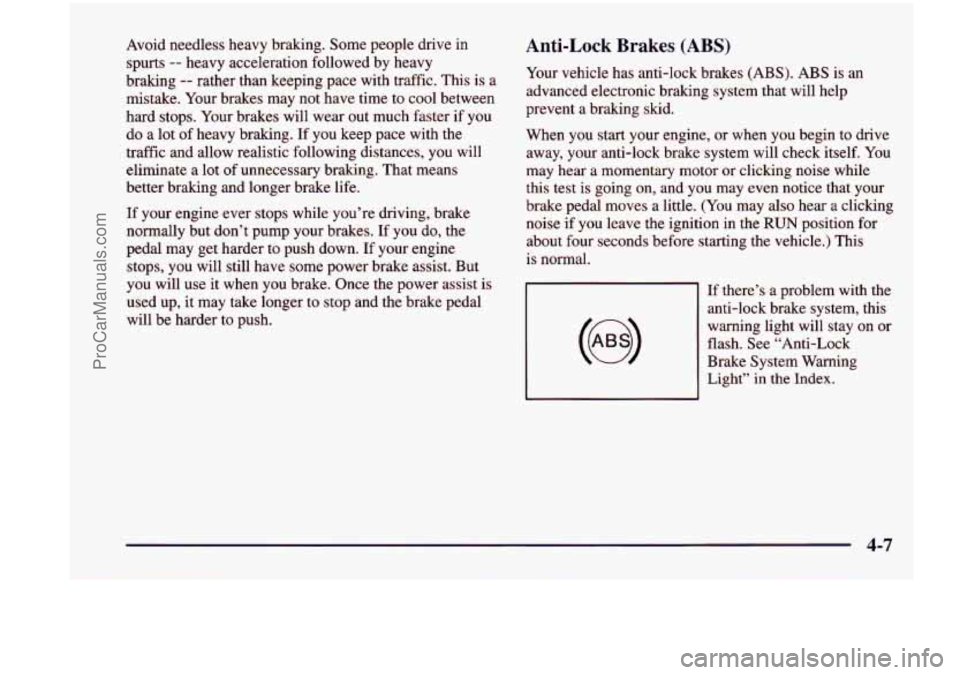
Avoid needless heavy braking. Some people drive in
spurts
-- heavy acceleration followed by heavy
braking
-- rather than keeping pace with traffic. This is a
mistake. Your brakes may not have time to cool between
hard stops. Your brakes
will wear out much faster if you
do a lot of heavy braking. If you keep pace with the
traffic and allow realistic following distances, you will
eliminate a lot
of unnecessary braking. That means
better braking and longer brake life.
If your engine ever stops while you’re driving, brake
normally but don’t pump your brakes. If you do, the
pedal may get harder to push down. If your engine
stops, you will still have some power brake assist. But
you will use it when you brake. Once the power assist is
used up, it may take longer to stop and the brake pedal
will be harder to push.
I - .Lock P
rour vehicle has anti-lock brakes (ABS). ABS is an
advanced electronic braking system that will help
prevent a braking skid.
When you start your engine, or when you begin
to drive
away, your anti-lock brake system will check itself. You
may hear a momentary motor or clicking noise while
this test is going on, and you may even notice that your
brake pedal moves a little. (You may
also hear a clicking
noise if you leave the ignition in the
RUN position for
about four seconds before starting the vehicle.) This
is normal.
‘;es (ABS)
If there’s a problem with the
anti-lock brake system, this
warning light will stay on or
flash. See “Anti-Lock
Brake System Warning
Light”
in the Index.
4-7
ProCarManuals.com
Page 278 of 474
If you drive regularly in steep country, or if you’re
planning to visit there, here are some tips that can make
your trips safer and more enjoyable.
0 Keep your vehicle in good sk -le. Check all fluid ~
levels and also the brakes, tires, cooling system
and transaxle. These parts can work hard on
mountain roads.
0 Know how to go down hills. The most important
thing
to know is this: let your engine do some of the
slowing down. Shift to a lower gear when you go
down a steep or long hill.
,A CAUTION:
If you don’t shift down, your brakes could
get
so hot that they wouldn’t work well. You
would then have poor braking or even none going
down a hill. You could crash. Shift down to let
your engine assist your brakes on
a steep
downhill slope.
Joasting downhill in NEUTRAL (N) or with the
ignition
off is dangerous. Your brakes will have to
do all the work of slowing down. They could get so
hot that they wouldn’t work well. You would then
have poor braking or even none going
down a hill.
You could crash. Always have your engine running
and your vehicle
in gear when you go downhill.
0
0
0
0
Know how to go uphill. You may want to shift down
to a lower gear. The lower gears help cool your engine
and transaxle, and you can climb the hill better.
Stay in your own lane when driving on two-lane
roads in hills or mountains. Don’t swing wide or cut
across the center
of the road. Drive at speeds that let
you stay in your own lane.
As you go over the top of a hill, be alert. There could be
something in your lane, like a stalled car or
an accident.
You may see highway signs on mountains that warn of
special problems. Examples are long grades, passing or
no-passing zones, a falling
rocks area or winding
roads. Be alert to these and take appropriate action.
ProCarManuals.com
Page 301 of 474
2. Get the vehicles close enough so the jumper cables
can reach, but be sure the vehicles aren’t touching
each other.
If they are, it could cause a ground
connection
you don’t want. You wouldn’t be able to
start your vehicle, and the bad grounding could
damage the electrical systems.
I NOTICE:
To avoid the possibility of the vehicles rolling, set
the parking brake firmly on both vehicles
involved in the jump
start procedure. Put an
automatic transaxle in PARK
(P).
NOTICE:
If you leave your radio on, it could be badly
damaged. The repairs wouldn’t be covered by
your warranty.
3. Turn off the ignition on both vehicles. Unplug
unnecessary accessories plugged into the cigarette
lighter or the accessory power outlet. Turn
off all
lamps that aren’t needed as well as radios. This will
avoid sparks and help save both batteries. In
addition, it could save your radio!
4. Open the hoods and locate the batteries. Find
the positive
(+) and negative (-) terminals on
each battery.
I CAUTION:
An electric fan can start up even when the engine
is not running and can injure you. Keep hands,
clothing and tools
away from any underhood
electric fan.
5-4
ProCarManuals.com
Page 306 of 474
A vehicle can fall from a car carrier if it isn’t
adequately secured. This can cause a collision,
serious personal injury and vehicle damage. The
vehicle should be tightly secured with chains or
steel cables before it is transported.
Don’t use substitutes (ropes, leather straps,
canvas webbing, etc.) that can be cut
by sharp
edges underneath the towed vehicle. Always use
T-hooks inserted in the T-hook slots. Never use
J-hooks. They will damage drivetrain and
suspension components.
~~
NOTICE:
If you are using car-carrier equipment, you must
pull the Electronic Level Control (ELC) fuse, in
the instrument panel fuse block, before securing
the vehicle.
Damage to the shocks or leveling system may
occur if the Electronic Level Control (ELC) fuse
is not disabled.
When your vehicle is being towed, have the ignition key
in
OFF. The steering wheel should be clamped in a
straight-ahead position, with a clamping device
designed for towing service.
Do not use the vehicle’s
steering column lock for this. For front towing, the
transaxle should be in
PARK (P) and the parking brake
released. For rear towing, the transaxle should be in
NEUTRAL (N) and the parking brake engaged.
5-9
ProCarManuals.com
Page 374 of 474
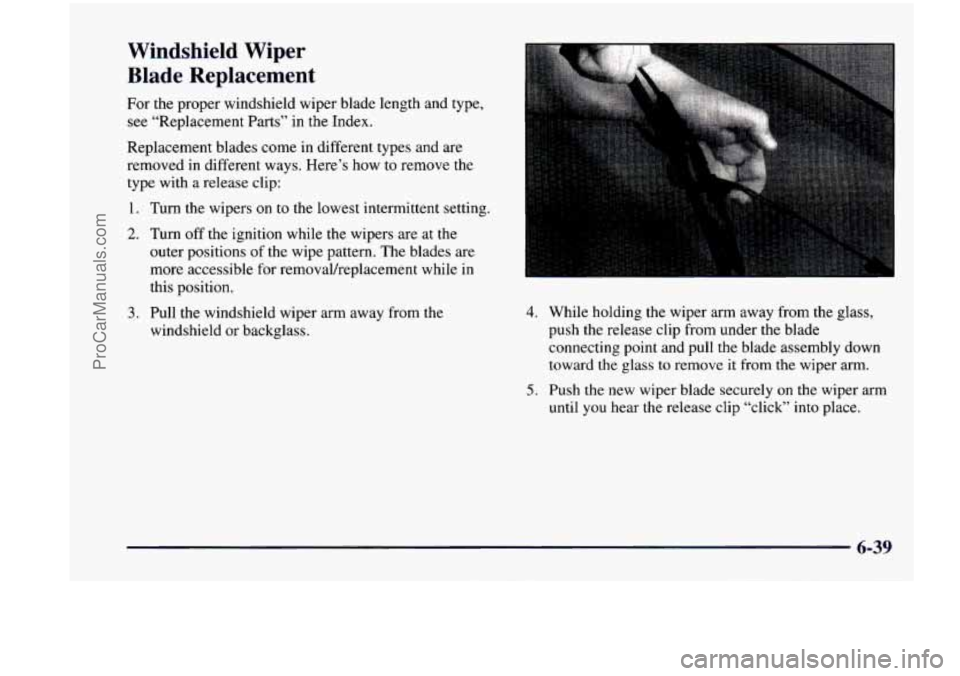
Windshield Wiper
Blade Replacement
For the proper windshield wiper blade length and type,
see “Replacement Parts” in the Index.
Replacement blades come in different types and are
removed in different ways. Here’s how to remove the type with a release clip:
1. Turn the wipers on to the lowest intermittent setting.
2. Turn off the ignition while the wipers are at the
outer positions of the wipe pattern. The blades are
more accessible for removaVreplacement while in
this position.
3. Pull the windshield wiper arrn away from the
windshield or backglass. 4. While holding the wiper arm away from the glass,
push the release clip from under the blade
connecting point and pull the blade assembly down
toward the glass
to remove it from the wiper arm.
5. Push the new wiper blade securely on the wiper arm
until you hear the release clip “click” into place.
6-39
ProCarManuals.com
Page 397 of 474
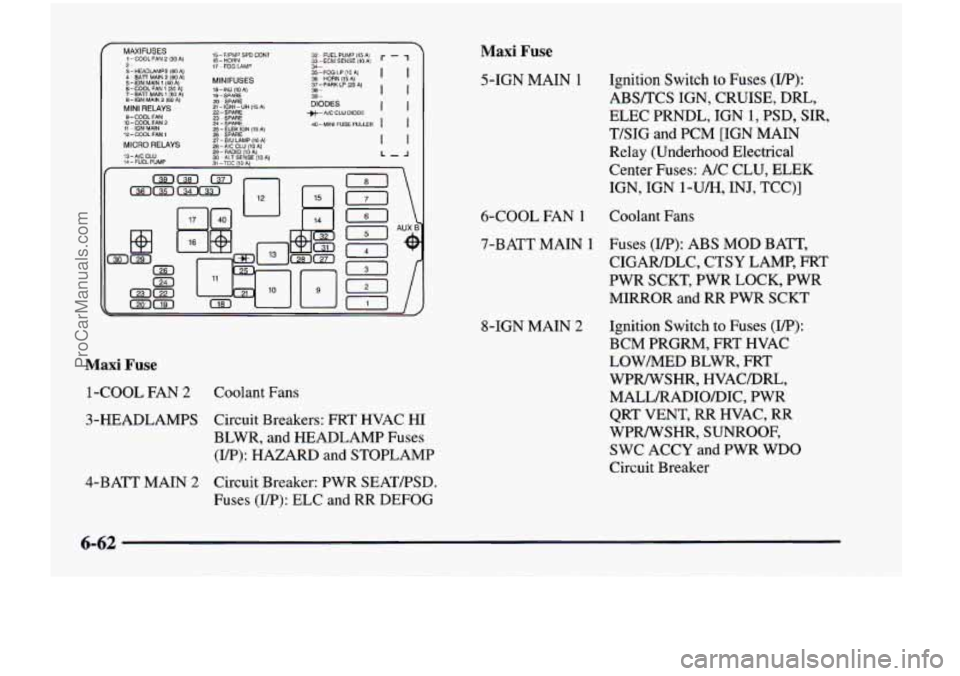
Maxi Fuse
5-IGN MAIN 1 Ignition Switch to Fuses (VP):
ABS/TCS IGN, CRUISE, DRL,
ELEC PRNDL, IGN
1, PSD, SIR,
T/SIG and PCM [IGN MAIN
Relay (Underhood Electrical
Center Fuses:
A/C CLU, ELEK
IGN, IGN
l-U/H, INJ, TCC)]
8-IGN MAIN
2
Maxi Fuse
1-COOL FAN 2 Coolant Fans
3-HEADLAMPS Circuit Breakers: FRT HVAC
HI
BLWR, and HEADLAMP Fuses
(UP): HAZARD and STOPLAMP
4-BATT MAIN
2 Circuit Breaker: PWR SEATPSD.
Fuses
(VP): ELC and RR DEFOG 6-COOL
FAN
1 Coolant Fans
7-BATT MAIN
1 Fuses (UP): ABS MOD BATT,
CIGARDLC, CTSY LAMP, FRT
PWR SCKT, PWR LOCK, PWR MIRROR and RR PWR SCKT
Ignition Switch to Fuses
(VP):
BCM PRGRM, FRT HVAC
LOWMED BLWR, FRT
WPWSHR, HVACDRL,
MALL/RADIO/DIC, PWR QRT
VENT, RR HVAC, RR
WPWSHR, SUNROOF,
SWC ACCY and PWR WDO
Circuit Breaker
6-62
ProCarManuals.com