key CHEVROLET VENTURE 1998 Owners Manual
[x] Cancel search | Manufacturer: CHEVROLET, Model Year: 1998, Model line: VENTURE, Model: CHEVROLET VENTURE 1998Pages: 474, PDF Size: 25.26 MB
Page 21 of 474
Second Row Solid Bench Seats
Folding the Seatback
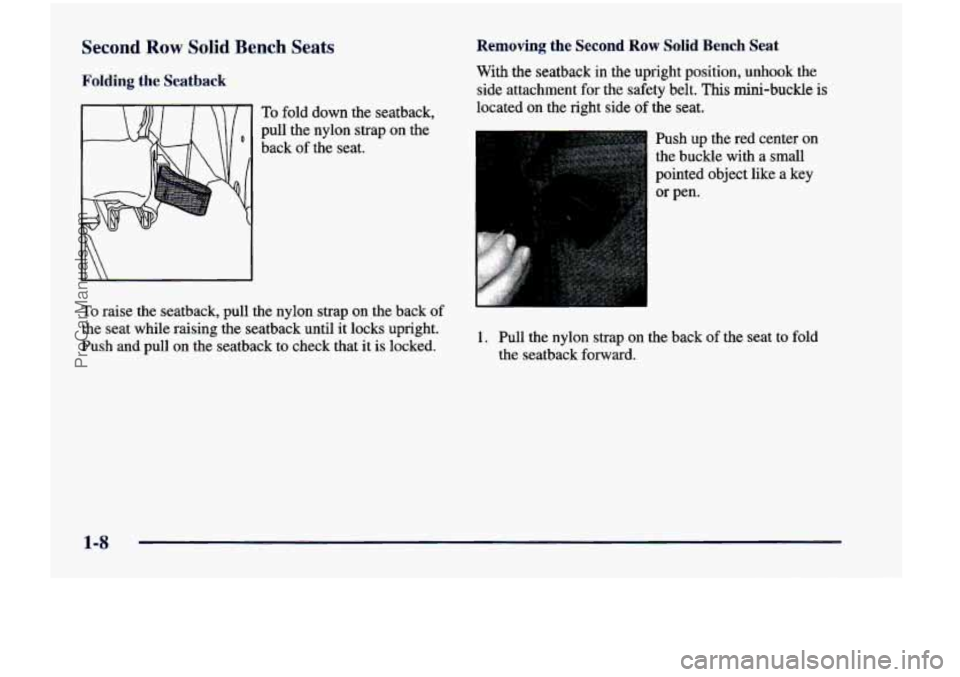
To fold down the seatback,
pull the nylon strap on the
back of the seat.
Removing the Second Row Solid Bench Seat
With the seatback in the upright position, unhook the
side attachment for the safety belt.
This mini-buckle is
located on the right side
of the seat.
Push up the red center on
the buckle with a small
pointed object like a key
or pen.
To raise the seatback, pull the nylon strap on the back of
the seat while raising the seatback until it locks upright.
Push and pull on the seatback to check that it is locked. 1. Pull the nylon strap on the back of the seat to fold
the seatback forward.
ProCarManuals.com
Page 33 of 474
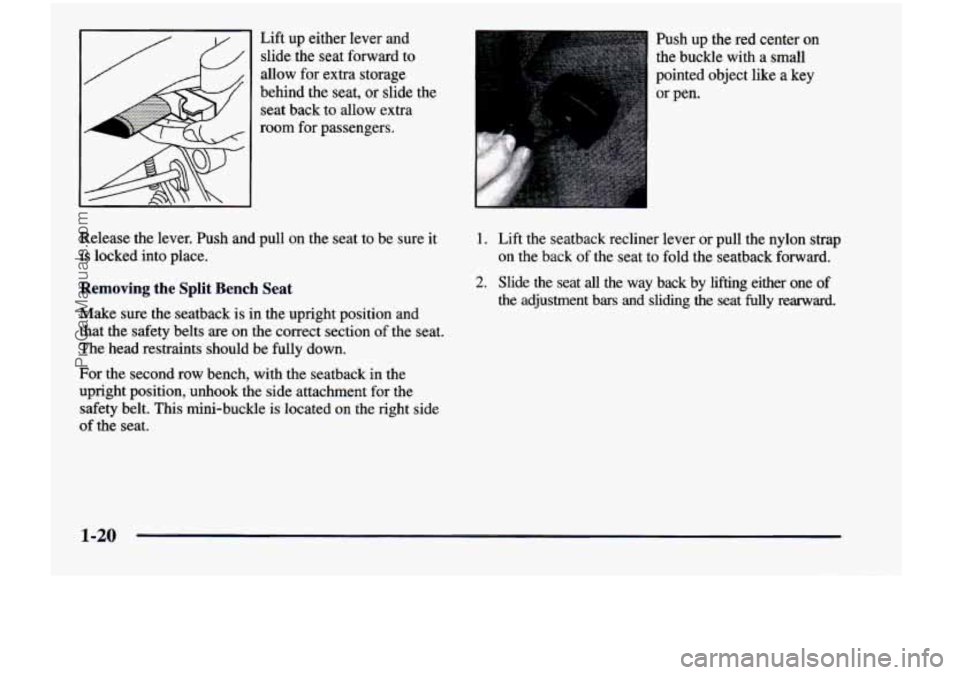
Lift up either lever and
slide the seat forward to
allow for extra storage
seat back to allow extra
room for passengers.
~ behind the seat, or slide the
Release the lever. Push and pull on the seat to be sure it
is locked into place.
Removing the Split Bench Seat
Make sure the seatback is in the upright position and
that the safety belts are on the correct section
of the seat.
The head restraints should be fully down.
For the second row bench, with the seatback in the
upright position, unhook the side attachment for the
safety belt. This mini-buckle is located on the right side
of the seat. Push up the red center on
the buckle with a small
pointed object like
a key
or pen.
1. Lift the seatback recliner lever or pull the nylon strap
on the back of the seat to fold the seatback forward.
2. Slide the seat all the way back by lifting either one of
the adjustment bars and sliding the seat fully rearward.
1-20
ProCarManuals.com
Page 63 of 474
The best way to protect the fetus is to protect the mother.
When a safety belt is worn properly, it’s more likely that the
fetus won’t be hurt
in a crash. For pregnant women, as for
anyone,
the key to making safety belts effective is wearing
them properly.
Right Front Passenger Position
To learn how to wear the right front passenger’s safety belt
properly, see “Driver Position” earlier
in this section.
The right front passenger’s safety belt works the same way \
as
the driver’s safety belt
-- except for one thing. If you ever pull
the shoulder portion of the belt out all the way, you will
engage the
child restraint locking feature. If this happens, just
let the belt go back all the way and start again.
Air Bag Systems
This part explains the frontal and side impact air bag systems.
Your vehicle has four air bags -- a “Next Generation”
reduced-force frontal
air bag for the driver, another “Next
Generation” reduced-force
frontal air bag for the right front
passenger, a side impact
air bag for the driver, and
another side impact
air bag for the right front passenger.
Reduced-force frontal
air bags are designed to help reduce
the
risk of injury from the force of an inflating air bag. But
even these
air bags must inflate very quickly if they are to do
their job and comply with federal regulations. Here
are the most important things to know
about the -ir
bag systems:
CAUTION:
You can be severely injd or killed in a crash if
you aren’t wearing your safety belt -- even if you
have
air bags. Wearing your safety belt during a
crash helps reduce your chance of hitting things
inside the vehicle or being ejected from it.
Air bags
are “supplemental restraints”
to the safety belts.
All air bags -- even reduced-force air bags -- are
designed to work with safety belts but don’t
replace them.
Reduced-force frontal
air bags for the driver and
right front passenger are designed to work only
in
moderate to severe crashes where the front of your
vehicle
hits something. They aren’t designed to
inflate
at all in rollover, rem, side or low-speed
frontal crashes. And, for unrestrained occupants,
reduced-force frontal
air bags may provide less
protection in frontal crashes than more forceful
air
bags have provided in the past. The side impact air
CAUTION: (Continued)
1-50
ProCarManuals.com
Page 71 of 474
Servicing Your Air Bag-Equipped Vehicle
Air bags affect how your vehicle should be serviced.
There are
parts of the air bag systems in several places
around your vehicle. Your dealer and the Venture
Service Manual have information about servicing your
vehicle
and the air bag systems. To purchase a service
manual, see “Service and Owner Publications” in
the Index.
I I
For up to 10 minutes after the ignition key is
turned off and the battery is disconnected, an air
bag can still inflate during improper service. You
can be injured
if you are close to an air bag when
it inflates. Avoid wires wrapped with yellow tape
or yellow connectors. They are probably part
of
the air bag systems. Be sure to follow proper
service procedures, and make sure the person performing work for you
is qualified to do so.
I
The air bag systems do not need regular maintenance.
Rear Seat Passengers
It’s very important for rear seat passengers to buckle up!
Accident statistics show that unbelted people in the rear
seat are
hurt more often in crashes than those who are
wearing safety belts.
Rear passengers who aren’t safety belted can be thrown
out of the vehicle in a crash. And they can strike others
in the vehicle who are wearing safety belts.
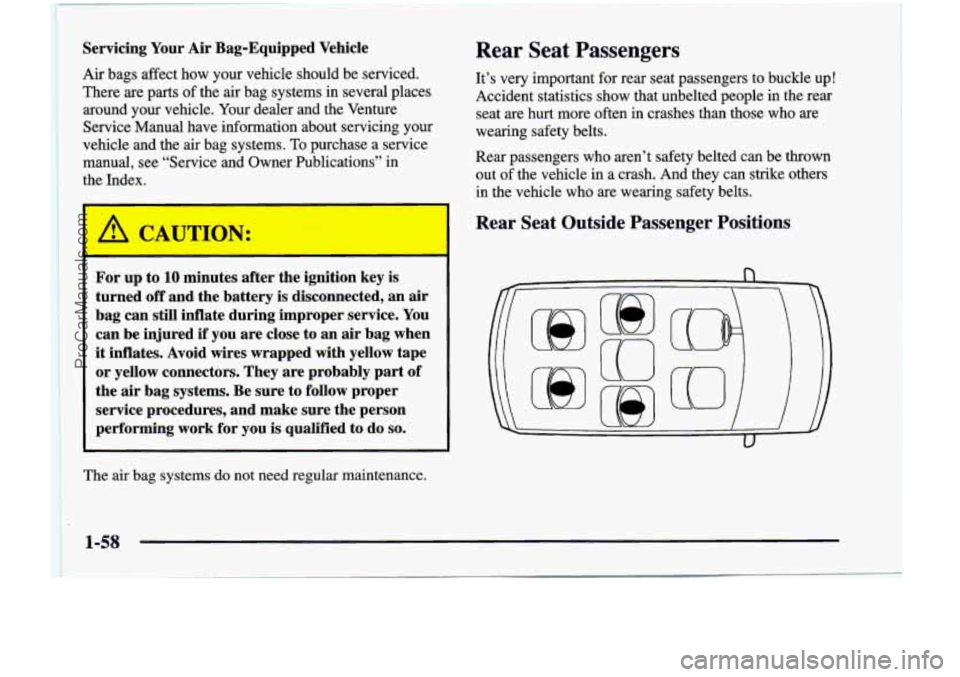
Rear Seat Outside Passenger Positions
1-58
ProCarManuals.com
Page 118 of 474

0 Section 2 Features and Controls
Here you can learn about the many standard and optional features on your vehicle, and i\
nformation on starting,
shifting and braking. Also explained are the instrument panel and the warning systems that tell you if everything is
working properly
-- and what to do if you have a problem.
2-2
2-4
2-8
2-12
2-13
2- 14
2-20
2-22
2-23
2-25 2-26
2-27
2-29
2-30
2-34
2-35
2-37 Keys
Door Locks
Keyless Entry System (Option)
Switchbanks
Sliding Door
Power Sliding Door (Option)
Liftgate
Theft
Content Theft-Deterrent (Option)
New Vehicle “Break-In”
Ignition Positions
Starting Your Engine
Engine Coolant Heater (If Equipped)
Automatic Transaxle Operation
Parking Brake Shifting Into PARK
(P)
Shifting Out of PARK (P) 2-38
2-38
2-39
2-40
2-50
2-53
2-60
2-6 1
2-65
2-66
2-78
2-7
8
2-80 2-82
2-86
2-98 Parking
Over Things That Burn
Engine Exhaust
Running Your Engine While You’re Parked
Locks and Lighting Choices
Windows Turn SignaVMultifunction Lever
Exterior Lamps
Interior Lamps
Mirrors
Storage Compartments
Sun Visors
Accessory Inflator System (Option)
Accessory Power Outlet Instrument Panel
Warning Lights, Gages and Indicators
Driver Information Center (DIC) (Option)
2-1
ProCarManuals.com
Page 119 of 474
Keys
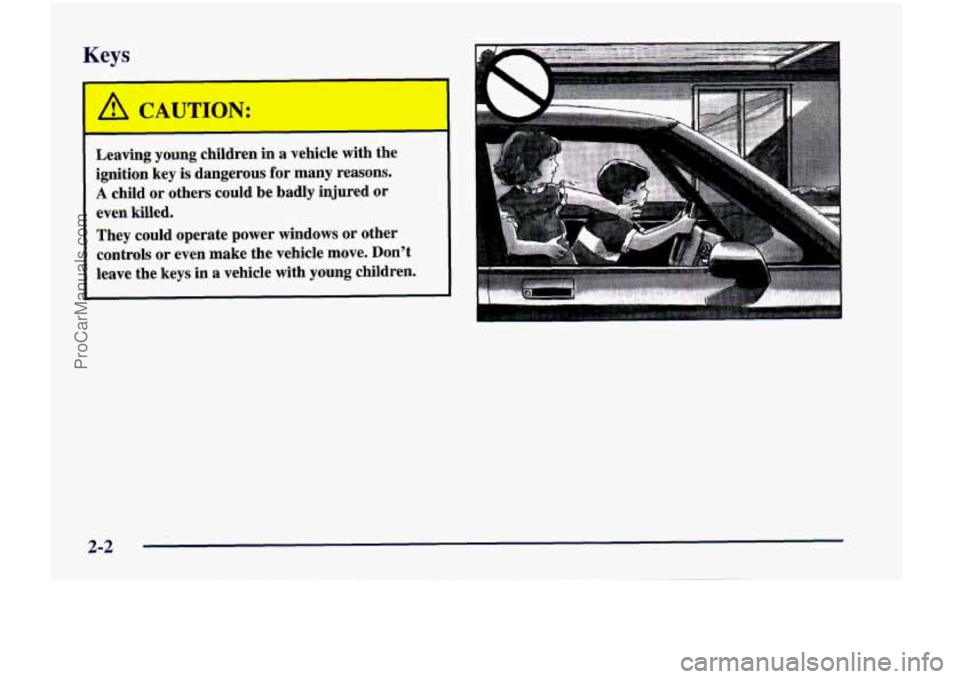
A CAUTION:
Leaving young children in a vehicle with the
ignition key is dangerous for many reasons.
A child or others could be badly injured or
even killed.
They could operate power windows
or other
controls or even make the vehicle move. Don't
leave the keys in
a vehicle with young children.
2-2
ProCarManuals.com
Page 120 of 474
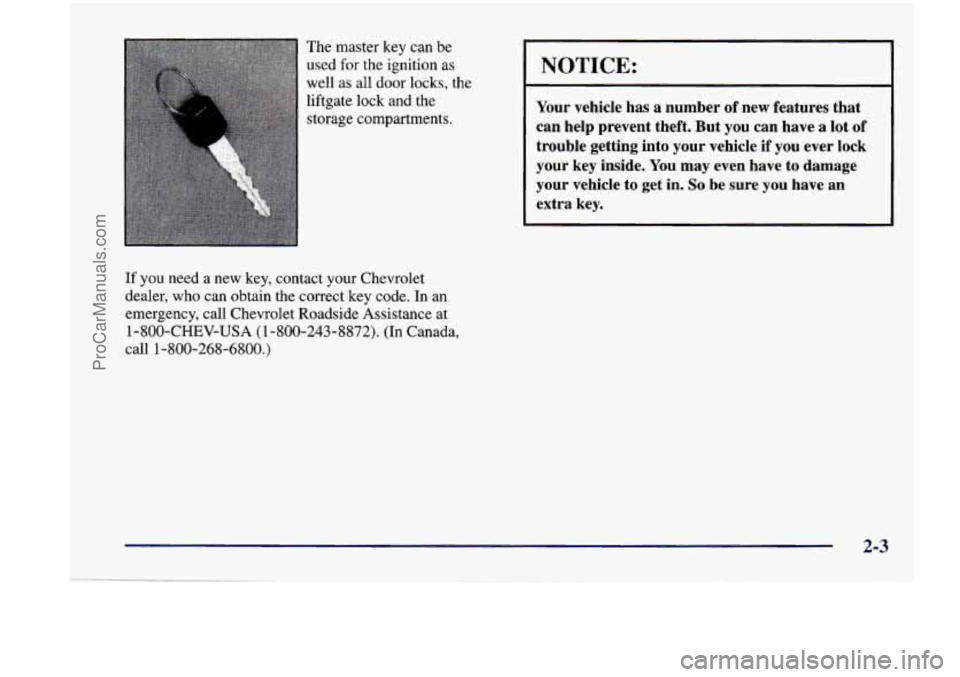
The master key can be
used
for the ignition as
well as all door locks, the
liftgate lock and the
storage compartments.
If you need a new key, contact your Chevrolet
dealer, who can obtain the correct key code. In an
emergency, call Chevrolet Roadside Assistance at
1-800-CHEV-USA (1-800-243-8872). (In Canada,
call 1-800-268-6800.)
NOTICE:
Your vehicle has a number of new features that
can help prevent theft. But you can have
a lot of
trouble getting into your vehicle if you ever lock
your key inside. You may even have to damage
your vehicle to get in.
So be sure you have an
extra key.
2-3
ProCarManuals.com
Page 121 of 474
Door Locks
I A CAUTION:
Unlocked doors can be dangerous.
Passengers
-- especially children -- can easily
open the doors and fall out. When
a door is
locked, the inside handle won’t open it.
Outsiders can easily enter through an unlocked
door when you slow down or stop your vehicle.
This may not be
so obvious: You increase the
chance of being thrown out
of the vehicle in a
crash if the doors aren’t locked. Wear safety belts
properly, lock your doors, and you will be far
better
off whenever you drive your vehicle. There are several ways
to lock and unlock your vehicle.
From the outside,
use your key or the remote keyless
entry transmitter (if your vehicle has this option).
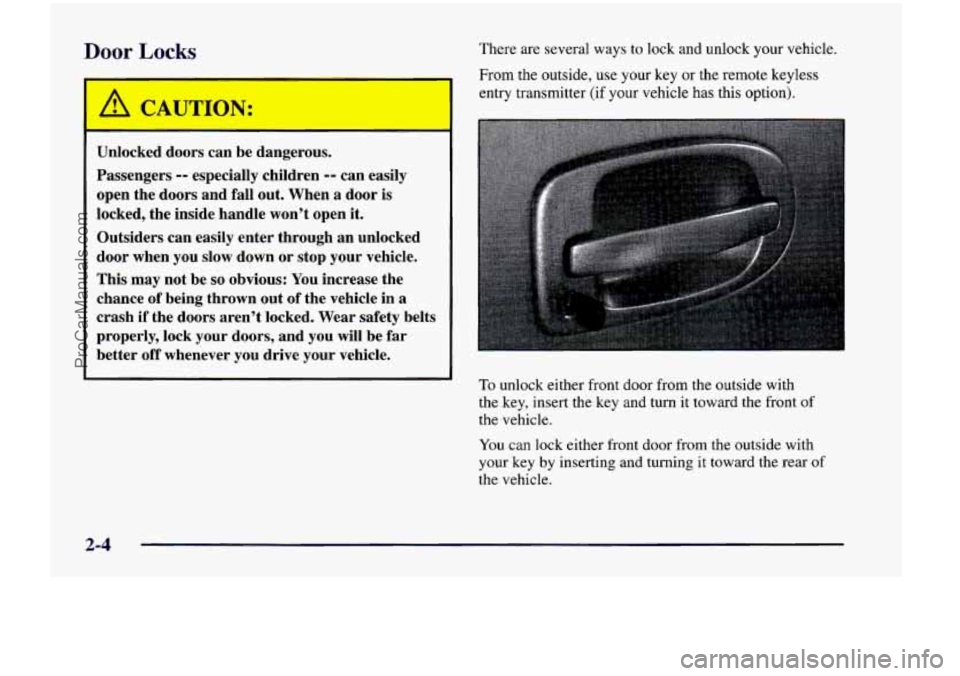
To unlock either front door from the outside with
the key, insert the key and turn
it toward the front of
the vehicle.
You can lock either front door from the outside with
your key by inserting and turning
it toward the rear of
the vehicle.
2-4
ProCarManuals.com
Page 123 of 474
You can lock all doors and the liftgate from the inside
by pressing the rear
of the power lock switch on either
front door. If your vehicle is equipped with the Content
Theft-Deterrent system, the power door lock switch may
cause the system to
arm. See “Content Theft-Deterrent”
in the Index for more details.
To unlock any door or the liftgate from the outside with
your key,
turn the key to the unlock position and release.
This will only unlock that door or the liftgate. You can
unlock all the doors and the liftgate by holding the key
cylinder in the unlock position for one second.
With power door locks, you can lock all the doors from
the outside by inserting the key and turning the key
cylinder to the lock position.
With power locks, when the doors are locked, the inside
as well as the outside door handle cannot open the doors.
This safety feature prevents a door from being accidentally
opened from the inside by moving the handle.
To override this safety feature, move the locking lever to
the unlock position on the door you want to open.
When the liftgate has been unlocked with the power door
locks, you won’t need the key to open it. Simply squeeze
the handle above the license plate. This is also true if you
use the optional remote keyless entry transmitter. See “Keyless Entry System” later
in this section.
Automatic Door Locks
All of the doors will lock automatically when you move
your shift lever out of PARK
(P). All doors will unlock
automatically when the ignition is turned off while the
shift lever is
in PARK (P).
You can program the Automatic Door Locks to operate
with
the remote keyless entry system and to lock and
unlock automatically to suit your needs. See “Locks and
Lighting Choices” in the Index.
With the Automatic Door Locks feature, you can still
lock or unlock the doors at any time, either manually
or with the power door lock switches.
Last Door Closed Locking
The Last Door Closed Locking feature makes it easier to
use your power door locks to lock all the doors and the
liftgate when leaving your vehicle.
When any door or the liftgate
is open, the first time
you attempt
to lock the doors using the power lock
switch or the remote keyless entry transmitter
(if
equipped), will result in three chimes to signal that
Last Door Closed Locking is being used. All doors
and the liftgate can be opened for five seconds from
the time the last door is closed.
2-6
ProCarManuals.com
Page 124 of 474
Five seconds after the last door is closed, all the doors
will lock. You can lock the doors immediately by
using the power door lock switch or the remote
keyless entry transmitter.
If the ignition is in RUN or ACCESSORY, this feature
will not lock the doors.
To turn the Last Door Closed Locking feature off or on,
see “Locks and Lighting Choices” in the Index.
Sliding Door Delayed Locking
If the sliding door is open when you use your power
door locks to lock the vehicle, the sliding door is
not locked. Normally the Last Door Closed Locking
feature will be used to lock the sliding door after it
has been closed.
When the ignition
is on or if the Last Door Closed
Locking feature
has been overridden or programmed to
be
off, the Sliding Door Delayed Locking feature will
lock your sliding door for you. Three seconds after the
sliding door is closed, all the doors will lock. If you
have the dual sliding doors, all doors
will lock three
seconds after both sliding doors are closed.
Lockout Deterrent
The Lockout Deterrent feature makes it difficult for you
to lock your keys in your vehicle. If the driver’s door
is
open while the keys are in the ignition, you will not be
able to use your power door lock
to lock the vehicle.
If you don’t leave the keys in the ignition or if you
use the manual door lock, you could still lock your keys
in your vehicle. Always remember to take your keys
with you.
To turn this feature off or on, see “Locks and Lighting
Choices” in the Index.
T IQ= - lg Your Vehicle
If you are leaving the vehicle, take your keys, open your
door and set the locks from the inside. Then get out and
close the door.
2-7
ProCarManuals.com