weight CHEVROLET VOLT 2011 User Guide
[x] Cancel search | Manufacturer: CHEVROLET, Model Year: 2011, Model line: VOLT, Model: CHEVROLET VOLT 2011Pages: 516, PDF Size: 6.61 MB
Page 319 of 516
Black plate (17,1)Chevrolet Volt Owner Manual - 2011
Driving and Operating 9-17
Refer to the vehicle's Tire and
Loading Information label for
specific information about the
vehicle's capacity weight and
seating positions. The combined
weight of the driver, passengers,
and cargo should never exceed
the vehicle's capacity weight.Certification Label
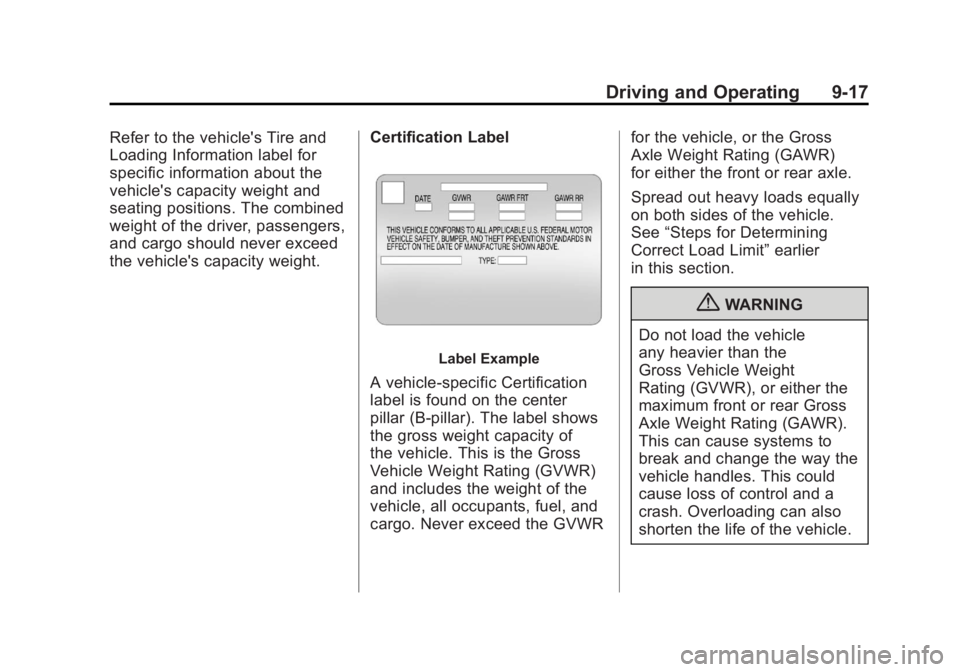
Label Example
A vehicle-specific Certification
label is found on the center
pillar (B-pillar). The label shows
the gross weight capacity of
the vehicle. This is the Gross
Vehicle Weight Rating (GVWR)
and includes the weight of the
vehicle, all occupants, fuel, and
cargo. Never exceed the GVWRfor the vehicle, or the Gross
Axle Weight Rating (GAWR)
for either the front or rear axle.
Spread out heavy loads equally
on both sides of the vehicle.
See
“Steps for Determining
Correct Load Limit” earlier
in this section.
{WARNING
Do not load the vehicle
any heavier than the
Gross Vehicle Weight
Rating (GVWR), or either the
maximum front or rear Gross
Axle Weight Rating (GAWR).
This can cause systems to
break and change the way the
vehicle handles. This could
cause loss of control and a
crash. Overloading can also
shorten the life of the vehicle.
Page 320 of 516
Black plate (18,1)Chevrolet Volt Owner Manual - 2011
9-18 Driving and Operating
If you put things inside the
vehicle—like suitcases,
tools, packages, or anything
else —they will go as fast as
the vehicle goes. If you have to
stop or turn quickly, or if there is
a crash, they will keep going.
{WARNING
Things inside the vehicle can
strike and injure people in a
sudden stop or turn, or in a
crash.
.Put things in the cargo
area of the vehicle. In the
cargo area, put them as
far forward as possible.
Try to spread the weight
evenly.
(Continued)
WARNING (Continued)
.Never stack heavier
things, like suitcases,
inside the vehicle so that
some of them are above
the tops of the seats.
.Do not leave an
unsecured child restraint
in the vehicle.
.Secure loose items in the
vehicle.
.Do not leave a seat folded
down unless needed.
Starting and
Operating
New Vehicle Break-In
Notice: The vehicle does not
require a break-in period. Vehicle
break‐in is performed during
manufacturing.
Power Button
The vehicle has an electronic
push‐button start. The POWER
O
button light flashes when the driver
door is open and the vehicle is not
Page 325 of 516
Black plate (23,1)Chevrolet Volt Owner Manual - 2011
Driving and Operating 9-23
Leaving the Vehicle with the
Propulsion System On
{WARNING
It can be dangerous to leave
the vehicle with the propulsion
system on. The vehicle could
move suddenly if the shift lever
is not fully in P (Park) with the
parking brake firmly set. And,
if you leave the vehicle with the
propulsion system on, it could
overheat and even catch fire.
You or others could be injured.
Do not leave the vehicle with
the propulsion system on.
If you have to leave the vehicle with
the propulsion system on, be sure
the vehicle is in P (Park) and the
parking brake is firmly set before
you leave it. After you have moved the shift lever into P (Park), hold
down the regular brake pedal.
See if you can move the shift lever
away from P (Park) without first
pulling it toward you. If you can,
it means that the shift lever was
not fully locked into P (Park).
Torque Lock
Torque lock is when the weight of
the vehicle puts too much force on
the parking pawl in the electric drive
unit. This happens when parking
on a hill and shifting the electric
drive unit into P (Park) is not done
properly and then it is difficult to
shift out of P (Park). To prevent
torque lock, set the parking brake
and then shift into P (Park).
If torque lock does occur, your
vehicle may need to be pushed
uphill by another vehicle to relieve
the parking pawl pressure, so you
can shift out of P (Park).
Shifting out of Park
To shift out of P (Park), the vehicle
must be in ON/RUN, the brake
pedal must be applied, and the
charge cord must be unplugged.
The vehicle has an electronic shift
lock release system. The shift lock
release is designed to:
.Prevent the vehicle from turning
off unless the shift lever is in
P (Park).
.Prevent moving the shift lever
out of P (Park), unless the
vehicle is in ON/RUN, the brake
pedal is applied, and the charge
cord is unplugged.
The shift lock is always functional
except in the case of an uncharged
or low charged 12‐volt battery
(less than 9 volts).
If the vehicle has an uncharged
12‐volt battery or a 12‐volt battery
with low voltage, try charging or
jump starting the 12‐volt battery.
See Jump Starting on page 10‑79.
Page 417 of 516
Black plate (51,1)Chevrolet Volt Owner Manual - 2011
Vehicle Care 10-51
(B) Tire Width:The three‐digit
number indicates the tire section
width in millimeters from
sidewall to sidewall.
(C) Aspect Ratio
:A two‐digit
number that indicates the tire
height‐to‐width measurements.
For example, if the tire size
aspect ratio is 60, as shown in
item C of the illustration, it would
mean that the tire's sidewall is
60 percent as high as it is wide.
(D) Construction Code
:A
letter code is used to indicate
the type of ply construction in
the tire. The letter R means
radial ply construction; the
letter D means diagonal or
bias ply construction; and the
letter B means belted‐bias ply
construction.
(E) Rim Diameter
:Diameter of
the wheel in inches. (F) Service Description
:These
characters represent the load
index and speed rating of the
tire. The load index represents
the load carrying capacity a tire
is certified to carry. The speed
rating is the maximum speed a
tire is certified to carry a load.
Tire Terminology and
Definitions
Air Pressure:The amount
of air inside the tire pressing
outward on each square
inch of the tire. Air pressure is
expressed in kPa (kilopascal)
or psi (pounds per square inch).
Accessory Weight
:The
combined weight of optional
accessories. Some examples
of optional accessories are,
automatic electric drive unit,
power steering, power brakes,
power windows, power seats,
and air conditioning. Aspect Ratio
:The relationship
of a tire's height to its width.
Belt
:A rubber coated layer of
cords that is located between
the plies and the tread. Cords
may be made from steel or other
reinforcing materials.
Bead
:The tire bead contains
steel wires wrapped by steel
cords that hold the tire onto
the rim.
Bias Ply Tire
:A pneumatic
tire in which the plies are laid
at alternate angles less than
90 degrees to the centerline
of the tread.
Cold Tire Pressure
:The
amount of air pressure in a tire,
measured in kPa (kilopascal)
or psi (pounds per square inch)
before a tire has built up heat
from driving. See Tire Pressure
on page 10‑54.
Page 418 of 516
Black plate (52,1)Chevrolet Volt Owner Manual - 2011
10-52 Vehicle Care
Curb Weight:The weight of a
motor vehicle with standard and
optional equipment including the
maximum capacity of fuel, oil,
and coolant, but without
passengers and cargo.
DOT Markings
:A code
molded into the sidewall of
a tire signifying that the tire
is in compliance with the U.S.
Department of Transportation
(DOT) Motor Vehicle Safety
Standards. The DOT code
includes the Tire Identification
Number (TIN), an alphanumeric
designator which can also
identify the tire manufacturer,
production plant, brand, and
date of production.
GVWR
:Gross Vehicle Weight
Rating. See Vehicle Load Limits
on page 9‑14. GAWR FRT
:Gross Axle
Weight Rating for the front axle.
See Vehicle Load Limits on
page 9‑14.
GAWR RR
:Gross Axle
Weight Rating for the rear axle.
See Vehicle Load Limits on
page 9‑14.
Intended Outboard Sidewall
:
The side of an asymmetrical tire,
that must always face outward
when mounted on a vehicle.
Kilopascal (kPa)
:The metric
unit for air pressure.
Light Truck (LT‐Metric) Tire
:A
tire used on light duty trucks and
some multipurpose passenger
vehicles.
Load Index
:An assigned
number ranging from 1 to 279
that corresponds to the load
carrying capacity of a tire. Maximum Inflation Pressure
:
The maximum air pressure to
which a cold tire can be inflated.
The maximum air pressure is
molded onto the sidewall.
Maximum Load Rating
:
The load rating for a tire at the
maximum permissible inflation
pressure for that tire.
Maximum Loaded Vehicle
Weight
:The sum of curb
weight, accessory weight,
vehicle capacity weight, and
production options weight.
Normal Occupant Weight
:
The number of occupants a
vehicle is designed to seat
multiplied by 68 kg (150 lbs).
See Vehicle Load Limits on
page 9‑14.
Occupant Distribution
:
Designated seating positions.
Page 420 of 516
Black plate (54,1)Chevrolet Volt Owner Manual - 2011
10-54 Vehicle Care
Vehicle Capacity Weight:
The number of designated
seating positions multiplied by
68 kg (150 lbs) plus the rated
cargo load. SeeVehicle Load
Limits on page 9‑14.
Vehicle Maximum Load on the
Tire
:Load on an individual tire
due to curb weight, accessory
weight, occupant weight, and
cargo weight.
Vehicle Placard
:A label
permanently attached to a
vehicle showing the vehicle's
capacity weight and the
original equipment tire size
and recommended inflation
pressure. See “Tire and Loading
Information Label” underVehicle
Load Limits on page 9‑14.
Tire Pressure
Tires need the correct amount
of air pressure to operate
effectively.
Notice: Neither tire
underinflation nor
overinflation is good.
Underinflated tires, or
tires that do not have
enough air, can result in:
.Tire overloading and
overheating which could
lead to a blowout.
.Premature or
irregular wear.
.Poor handling.
.Reduced fuel economy. Overinflated tires, or tires
that have too much air, can
result in:
.Unusual wear.
.Poor handling.
.Rough ride.
.Needless damage from
road hazards.
The Tire and Loading
Information label on the
vehicle indicates the original
equipment tires and the correct
cold tire inflation pressures.
The recommended pressure
is the minimum air pressure
needed to support the vehicle's
maximum load carrying capacity.
Page 421 of 516
Black plate (55,1)Chevrolet Volt Owner Manual - 2011
Vehicle Care 10-55
For additional information
regarding how much weight
the vehicle can carry, and an
example of the Tire and Loading
Information label, seeVehicle
Load Limits on page 9‑14.
How the vehicle is loaded
affects vehicle handling and
ride comfort. Never load the
vehicle with more weight than
it was designed to carry.
When to Check
Check the tires once a month
or more.
How to Check
Use a good quality pocket-type
gauge to check tire pressure.
Proper tire inflation cannot be
determined by looking at the tire.
Check the tire inflation pressure
when the tires are cold, meaning the vehicle has not been driven
for at least three hours or no
more than 1.6 km (1 mi).
Remove the valve cap from the
tire valve stem. Press the tire
gauge firmly onto the valve to
get a pressure measurement.
If the cold tire inflation pressure
matches the recommended
pressure on the Tire and
Loading Information label, no
further action is necessary.
If the inflation pressure is low,
add air until the recommended
pressure is reached. If the
inflation pressure is high, press
the metal stem in the center
of the tire valve to release air.
Re‐check the tire pressure
with the tire gauge.
Return the valve caps on the
valve stems to prevent leaks
and keep out dirt and moisture.Tire Pressure Monitor
System
The Tire Pressure Monitor System
(TPMS) uses radio and sensor
technology to check tire pressure
levels. The TPMS sensors monitor
the air pressure in your tires and
transmit tire pressure readings to
a receiver located in the vehicle.
Each tire, including the spare
(if provided), should be checked
monthly when cold and inflated to
the inflation pressure recommended
by the vehicle manufacturer on
the vehicle placard or tire inflation
pressure label. (If your vehicle has
tires of a different size than the size
indicated on the vehicle placard or
tire inflation pressure label, you
should determine the proper tire
inflation pressure for those tires.)
Page 429 of 516
Black plate (63,1)Chevrolet Volt Owner Manual - 2011
Vehicle Care 10-63
The rubber in tires ages over time.
This also applies to the spare tire,
if the vehicle has one, even if it is
never used. Multiple conditions
including temperatures, loading
conditions, and inflation pressure
maintenance affect how fast aging
takes place. Tires will typically
need to be replaced due to wear
before they may need to be
replaced due to age. Consult the tire
manufacturer for more information
on when tires should be replaced.Vehicle Storage
Tires age when stored normally
mounted on a parked vehicle.
Park a vehicle that will be stored
for at least a month in a cool, dry,
clean area away from direct sunlight
to slow aging. This area should be
free of grease, gasoline, or other
substances that can deteriorate
rubber.
Parking for an extended period
can cause flat spots on the tires
that may result in vibrations while
driving. When storing a vehicle for
at least a month, remove the tires
or raise the vehicle to reduce the
weight from the tires.
Buying New Tires
GM has developed and matched
specific tires for the vehicle.
The original equipment tires
installed on the vehicle, when
it was new, were designed to meet
General Motors Tire Performance
Criteria Specification (TPC Spec)
system rating. When replacement
tires are needed, GM strongly
recommends buying tires with the
same TPC Spec rating. This way,
the vehicle will continue to have
tires that are designed to give the
same performance and vehicle
safety, during normal use, as the
original tires.
Page 496 of 516
Black plate (20,1)Chevrolet Volt Owner Manual - 2011
13-20 Customer Information
DISCLAIMER OF WARRANTY
THE DATABASE IS PROVIDED
ON AN“AS IS” AND“WITH ALL
FAULTS BASIS” AND DENSO AND
TANA (AND THEIR LICENSORS
AND SUPPLIERS) EXPRESSLY
DISCLAIM ALL OTHER
WARRANTIES, EXPRESS
OR IMPLIED, INCLUDING
BUT NOT LIMITED TO, THE
IMPLIED WARRANTIES
OF NON-INFRINGEMENT,
MERCHANTABILITY,
SATISFACTORY QUALITY,
ACCURACY, TITLE AND FITNESS
FOR A PARTICULAR PURPOSE.
NO ORAL OR WRITTEN ADVICE
OR INFORMATION PROVIDED BY
DENSO OR TANA (OR ANY OF
THEIR LICENSORS, AGENTS,
EMPLOYEES OR THIRD PARTY
PROVIDERS) SHALL CREATE
A WARRANTY, AND YOU ARE
NOT ENTITLED TO RELY
ON ANY SUCH ADVICE
OR INFORMATION. THIS DISCLAIMER OF
WARRANTIES IS AN ESSENTIAL
CONDITION OF THIS
AGREEMENT.
LIMITATION OF LIABILITY
IN NO EVENT SHALL DENSO OR
TANA (OR THEIR LICENSORS OR
SUPPLIERS) BE LIABLE FOR ANY
INCIDENTAL, CONSEQUENTIAL,
SPECIAL, INDIRECT OR
EXEMPLARY DAMAGES ARISING
OUT OF THIS AGREEMENT OR
YOUR USE OF THE DATABASE,
INCLUDING, WITHOUT
LIMITATION, LOST PROFITS OR
COSTS OF COVER, LOSS OF USE
OR BUSINESS INTERRUPTION
OR THE LIKE, REGARDLESS
OF WHETHER THE PARTY WAS
ADVISED OF THE POSSIBILITY
OF SUCH DAMAGES.
IN NO EVENT WILL THE TOTAL
LIABILITY OF DENSO OR TANA
(OR THEIR LICENSORS OR
SUPPLIERS) EXCEED THE
AMOUNTS PAID BY YOU
FOR THE DATABASE.WARNINGS
The DATABASE comprises facts
and information from government
and other sources reflecting
circumstances in existence before
you received the DATABASE, which
may contain errors and omissions.
Accordingly, the DATABASE may
contain inaccurate or incomplete
information due to the passage
of time, changing circumstances,
and due to the nature of the
sources used. The DATABASE
does not include or reflect
information relating to, among
other things, neighborhood safety;
law enforcement; emergency
assistance; construction work; road
or lane closures; vehicle or speed
restrictions; road slope or grade;
bridge height, weight or other limits;
road or traffic conditions; special
events; traffic congestion; or
travel time.