check engine CHEVROLET VOLT 2012 1.G Owner's Manual
[x] Cancel search | Manufacturer: CHEVROLET, Model Year: 2012, Model line: VOLT, Model: CHEVROLET VOLT 2012 1.GPages: 454, PDF Size: 7.89 MB
Page 322 of 454
Black plate (18,1)Chevrolet Volt Owner Manual - 2012
10-18 Vehicle Care
Engine Coolant
The engine cooling system in the
vehicle is filled with DEX-COOL
engine coolant. The coolant needs
to be replaced every 5 years or
240 000 km (150,000 mi), whichever
occurs first.
The following explains the cooling
system and how to check and add
coolant when it is low. If there is a
problem with engine overheating,
seeEngine Overheating on
page 10‑21.
What to Use
{WARNING
Adding only plain water or some
other liquid to the cooling system
can be dangerous. Plain water
and other liquids, can boil before
the proper coolant mixture will.
The coolant warning system is set
for the proper coolant mixture.
With plain water or the wrong
mixture, the engine could get too
hot but you would not get the
overheat warning. The engine
could catch fire and you or others
could be burned. Use a
50/50 mixture of deionized water
and DEX-COOL coolant. Use a 50/50 mixture of deionized
water and DEX-COOL coolant.
If using this mixture, nothing else
needs to be added. This mixture:.Gives freezing protection down
to
−37°C (−34°F), outside
temperature.
.Gives boiling protection up to
129°C (265°F), engine
temperature.
.Protects against rust and
corrosion.
.Will not damage aluminum parts.
.Helps keep the proper engine
temperature.
Notice: If an improper coolant
mixture is used, the engine could
overheat and be badly damaged.
The repair cost would not be
covered by the vehicle warranty.
Too much water in the mixture
can freeze and crack the engine,
radiator, heater core, and other
parts.
Page 323 of 454
Black plate (19,1)Chevrolet Volt Owner Manual - 2012
Vehicle Care 10-19
Never dispose of engine coolant by
putting it in the trash, pouring it on
the ground, or into sewers, streams,
or bodies of water. Have the coolant
changed by an authorized service
center, familiar with legal
requirements regarding used
coolant disposal. This will help
protect the environment and your
health.
Checking Coolant
The vehicle must be on a level
surface when checking the coolant
level.
Check to see if coolant is visible in
the coolant surge tank. If the coolant
inside the coolant surge tank is
boiling, do not do anything else until
it cools down. If coolant is visible
but the coolant level is not at or
above the cold fill mark, add a
50/50 mixture of deionized water
and DEX-COOL coolant at the
coolant surge tank, but be sure thecooling system is cool before this is
done. See
Engine Overheating on
page 10‑21 for more information.
The coolant reservoir is located on
the passenger side of the engine
compartment. See Engine
Compartment Overview on
page 10‑8 for more information on
location.
The coolant level should be at or
above the cold fill line on the
coolant surge tank. If it is not, there
could be a leak in the cooling
system.
How to Add Coolant to the
Coolant Surge Tank
{WARNING
You can be burned if you spill
coolant on hot engine parts.
Coolant contains ethylene glycol
and it will burn if the engine parts
are hot enough. Do not spill
coolant on a hot engine. Notice:
This vehicle has a
specific coolant fill procedure.
Failure to follow this procedure
could cause the engine to
overheat and be severely
damaged.
{WARNING
The electric fans under the hood
can start up even when the
engine is not running and can
cause injury. Keep hands,
clothing, and tools away from any
underhood electric fan.
Page 325 of 454
Black plate (21,1)Chevrolet Volt Owner Manual - 2012
Vehicle Care 10-21
Engine Overheating
The vehicle has an indicator to warn
of engine overheating.
If the decision is made not to lift the
hood when this warning appears,
get service help right away. See
Roadside Assistance Program on
page 13‑6.
If the decision is made to lift the
hood, make sure the vehicle is
parked on a level surface.
Then check to see if the engine
cooling fans are running. If the
engine is overheating, the fans
should be running. If they are not,
do not continue to run the vehicle
and have the vehicle serviced.
Notice:Engine damage from
running the engine without
coolant is not covered by the
warranty.
Washer Fluid
What to Use
When adding windshield washer
fluid to the vehicle, be sure to read
the manufacturer's instructions
before use. If operating the vehicle
in an area where the temperature
may fall below freezing, use a fluid
that has sufficient protection against
freezing.
Adding Washer Fluid
The WASHER FLUID LOW ADD
FLUID message will appear on the
Driver Information Center (DIC)
when the fluid level is low. See
Driver Information Center (DIC) on
page 5‑45 for more information.
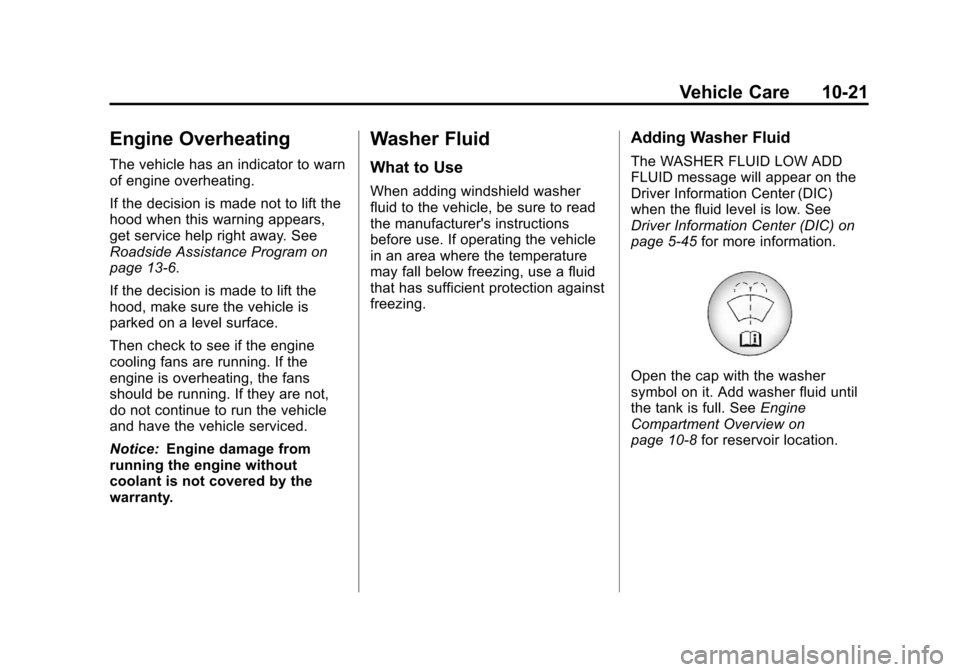
Open the cap with the washer
symbol on it. Add washer fluid until
the tank is full. See Engine
Compartment Overview on
page 10‑8 for reservoir location.
Page 328 of 454
Black plate (24,1)Chevrolet Volt Owner Manual - 2012
10-24 Vehicle Care
Do not top off the brake fluid.
Adding fluid does not correct a leak.
If fluid is added when the linings are
worn, there will be too much fluid
when new brake linings are
installed. Add or remove brake fluid,
as necessary, only when work is
done on the brake hydraulic system.
{WARNING
If too much brake fluid is added, it
can spill on the engine and burn,
if the engine is hot enough. You
or others could be burned, and
the vehicle could be damaged.
Add brake fluid only when work is
done on the brake hydraulic
system.
When the brake fluid falls to a low
level, the brake warning light comes
on. See Brake System Warning
Light on page 5‑22. Checking Brake Fluid
Check brake fluid by looking at the
brake fluid reservoir. See
Engine
Compartment Overview on
page 10‑8.
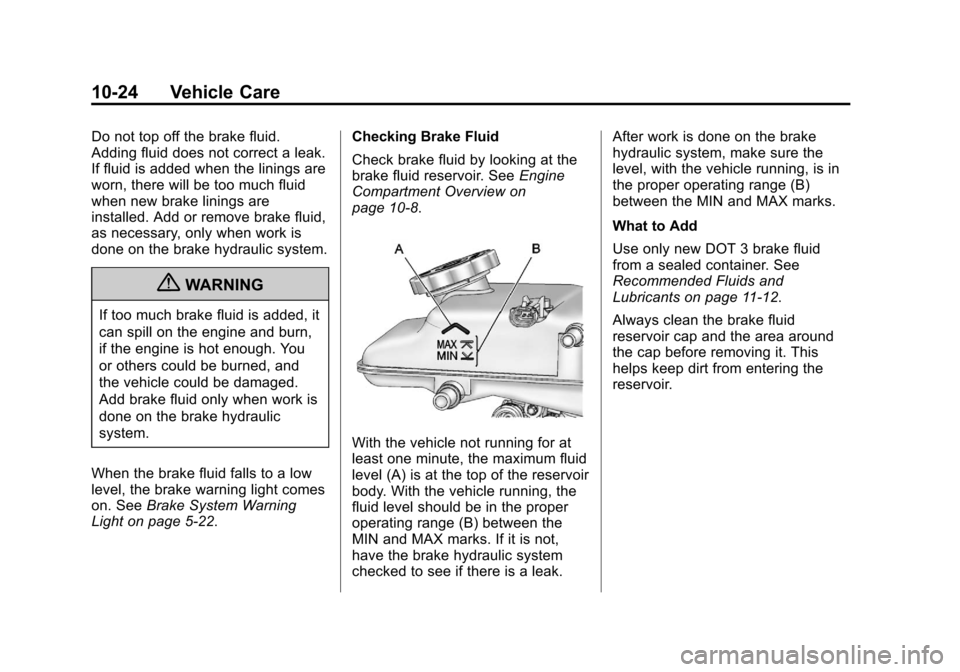
With the vehicle not running for at
least one minute, the maximum fluid
level (A) is at the top of the reservoir
body. With the vehicle running, the
fluid level should be in the proper
operating range (B) between the
MIN and MAX marks. If it is not,
have the brake hydraulic system
checked to see if there is a leak. After work is done on the brake
hydraulic system, make sure the
level, with the vehicle running, is in
the proper operating range (B)
between the MIN and MAX marks.
What to Add
Use only new DOT 3 brake fluid
from a sealed container. See
Recommended Fluids and
Lubricants on page 11‑12.
Always clean the brake fluid
reservoir cap and the area around
the cap before removing it. This
helps keep dirt from entering the
reservoir.
Page 383 of 454
Black plate (79,1)Chevrolet Volt Owner Manual - 2012
Vehicle Care 10-79
3. Turn off both vehicles. Turn offthe radio, all lamps, and
accessories that are not needed
in both vehicles. Unplug
accessories from the cigarette
lighter or the accessory power
outlets. This avoids sparks and
helps save both batteries and
accessories.
4. Locate the positive (+) and negative (−) terminals on the
vehicle with the run‐down
battery.
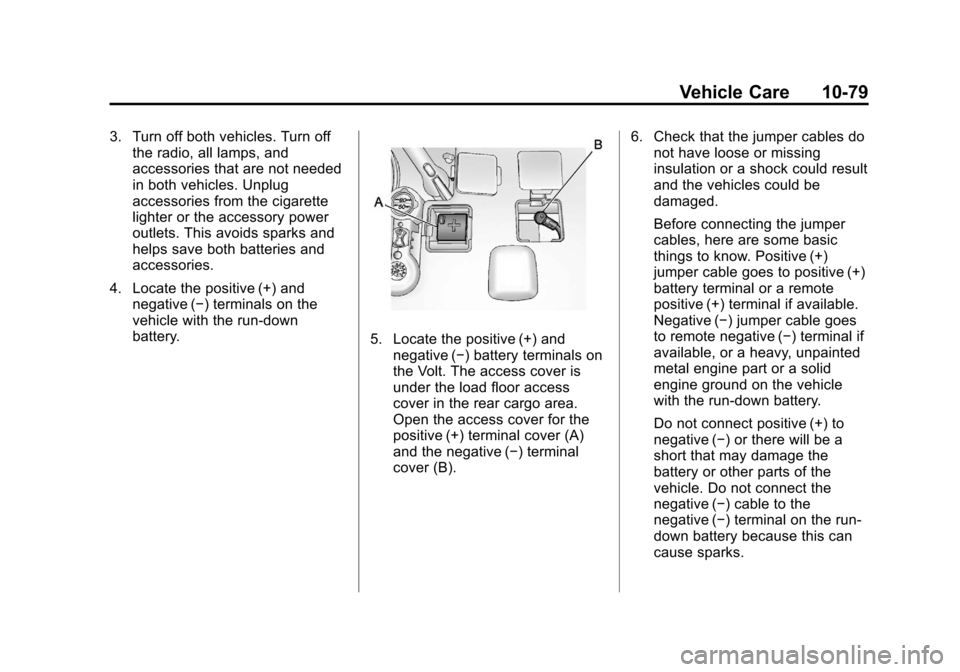
5. Locate the positive (+) andnegative (−) battery terminals on
the Volt. The access cover is
under the load floor access
cover in the rear cargo area.
Open the access cover for the
positive (+) terminal cover (A)
and the negative (−) terminal
cover (B). 6. Check that the jumper cables do
not have loose or missing
insulation or a shock could result
and the vehicles could be
damaged.
Before connecting the jumper
cables, here are some basic
things to know. Positive (+)
jumper cable goes to positive (+)
battery terminal or a remote
positive (+) terminal if available.
Negative (−) jumper cable goes
to remote negative (−) terminal if
available, or a heavy, unpainted
metal engine part or a solid
engine ground on the vehicle
with the run‐down battery.
Do not connect positive (+) to
negative (−) or there will be a
short that may damage the
battery or other parts of the
vehicle. Do not connect the
negative (−) cable to the
negative (−) terminal on the run‐
down battery because this can
cause sparks.
Page 399 of 454
Black plate (3,1)Chevrolet Volt Owner Manual - 2012
Service and Maintenance 11-3
Maintenance
Schedule
Owner Checks and Services
At Each Fuel Stop
.Check the engine oil level. See
Engine Oil on page 10‑9.
Once a Month
.Check the tire inflation
pressures. See Tire Pressure on
page 10‑50.
.Inspect the tires for wear. See
Tire Inspection on page 10‑57.
.Check the windshield washer
fluid level. See Washer Fluid on
page 10‑21.
.Engine, power electronics, and
high voltage battery pack
coolant level checks. See
Cooling System (Engine) on
page 10‑15 orCooling System
(High Voltage Battery) on
page 10‑16 orCooling System
(Power Electronics and Charger
Modules) on page 10‑17 for
more information.
Engine Oil Change
Every 24 months or when the
CHANGE ENGINE OIL SOON
message displays, change the
engine oil and filter as soon as
possible, within the next 1 000 km/
600 mi. The engine oil and filter
must be changed at least once
every 24 months. After each oil and
filter change, the oil life system must
be reset. See Engine Oil Life
System on page 10‑12. More
frequent changes may be required
when the vehicle is exposed to a
corrosive environment, such as
areas of high humidity, along an
ocean coast, and/or areas that
apply road salt during winter. Your trained dealer technician can
perform this work. If the engine oil
life system is reset accidentally,
service the vehicle within 5 000 km/
3,000 mi since the last service.
Reset the oil life system when the
oil is changed.
Tire Rotation and Required
Services Every 12 000 km/
7,500 mi
Rotate the tires, if recommended for
the vehicle, and perform the
following services. See
Tire
Rotation on page 10‑57.
.Check engine oil level and oil
life percentage. If needed,
change engine oil and filter, and
reset oil life system. See Engine
Oil on page 10‑9 andEngine Oil
Life System on page 10‑12.
.Check engine coolant level. See
Engine Coolant on page 10‑18.
.Check windshield washer fluid
level. See Washer Fluid on
page 10‑21.
Page 400 of 454

Black plate (4,1)Chevrolet Volt Owner Manual - 2012
11-4 Service and Maintenance
.Visually inspect windshield wiper
blades for wear, cracking,
or contamination. SeeExterior
Care on page 10‑85. Replace
worn or damaged wiper blades.
See Wiper Blade Replacement
on page 10‑28.
.Check tire inflation pressures.
See Tire Pressure on
page 10‑50.
.Inspect tire wear. See Tire
Inspection on page 10‑57.
.Visually check for fluid leaks.
.Inspect engine air cleaner filter.
See Engine Air Cleaner/Filter on
page 10‑13.
.Inspect brake system.
.Visually inspect steering,
suspension, and chassis
components for damaged, loose,
or missing parts or signs of
wear. See Exterior Care on
page 10‑85.
.Check restraint system
components. See Safety System
Check on page 3‑17.
.Visually inspect fuel system for
damage or leaks.
.Visually inspect exhaust system
and nearby heat shields for
loose or damaged parts.
.Lubricate body components. See
Exterior Care on page 10‑85.
.Check electrical drive unit shift
lock control function. See
Electric Drive Unit Shift Lock
Control Function Check on
page 10‑27.
.Check parking brake and
automatic transmission park
mechanism. See Park Brake and
P (Park) Mechanism Check on
page 10‑27.
.Check accelerator pedal for
damage, high effort, or binding.
Replace if needed.
.Visually inspect gas strut for
signs of wear, cracks, or other
damage. Check the hold open
ability of the strut. See your
dealer if service is required.
.Check tire sealant expiration
date, if equipped. See Tire
Sealant and Compressor Kit on
page 10‑67.
Page 402 of 454
Black plate (6,1)Chevrolet Volt Owner Manual - 2012
11-6 Service and Maintenance
Footnotes—Maintenance
Schedule Additional Required
Services —Normal
a) Check all fuel and vapor lines
and hoses for proper hook‐up,
routing, and condition. Check that
the purge valve, if the vehicle has
one, works properly. Replace as
needed.
b) Or every four years, whichever
comes first.
c) Or every five years, whichever
comes first. See Cooling System
(Engine) on page 10‑15 orCooling
System (High Voltage Battery) on
page 10‑16 orCooling System
(Power Electronics and Charger
Modules) on page 10‑17.
d) Or every 10 years, whichever
comes first. Inspect for fraying,
excessive cracking, or damage;
replace, if needed.
Page 404 of 454
Black plate (8,1)Chevrolet Volt Owner Manual - 2012
11-8 Service and Maintenance
Footnotes—Maintenance
Schedule Additional Required
Services —Severe
a) Check all fuel and vapor lines
and hoses for proper hook‐up,
routing, and condition. Check that
the purge valve, if the vehicle has
one, works properly. Replace as
needed.
b) Or every four years, whichever
comes first. c)
Or every five years, whichever
comes first. See Cooling System
(Engine) on page 10‑15 orCooling
System (High Voltage Battery) on
page 10‑16 orCooling System
(Power Electronics and Charger
Modules) on page 10‑17.
d) Or every 10 years, whichever
comes first. Inspect for fraying,
excessive cracking, or damage;
replace, if needed.Special Application
Services
.Severe Commercial Use
Vehicles Only: Lubricate chassis
components every 5 000 km/
3,000 mi.
.Have underbody flushing service
performed once a year.
.Have air conditioning system
flushed and refilled and
desiccant replaced every ten
years.
Page 405 of 454
Black plate (9,1)Chevrolet Volt Owner Manual - 2012
Service and Maintenance 11-9
Additional
Maintenance and Care
Your vehicle is an important
investment and caring for it properly
may help to avoid future costly
repairs. To maintain vehicle
performance, additional
maintenance services may be
required. It is recommended that
your dealer perform these
services—their trained dealer
technicians know your vehicle best.
Your dealer can also perform a
thorough assessment with a
multi‐point inspection to recommend
when your vehicle may need
attention. The following list is
intended to explain the services and
conditions to look for that may
indicate services are required. Battery
The battery supplies power to start
the engine and operate any
additional electrical accessories.
.To avoid break‐down or failure to
start the vehicle, maintain a
battery with full cranking power.
.Trained dealer technicians have
the diagnostic equipment to test
the battery and ensure that the
connections and cables are
corrosion‐free.
Belts
.Belts may need replacing if they
squeak or show signs of
cracking or splitting.
.Trained dealer technicians
can inspect the belts and
recommend replacement when
necessary. Brakes
Brakes stop the vehicle and are
crucial to safe driving.
.Signs of brake wear may include
chirping, grinding, or squealing
noises, or difficulty stopping.
.Trained dealer technicians have
access to tools and equipment
to inspect the brakes and
recommend quality parts
engineered for the vehicle.
Fluids
Proper fluid levels and approved
fluids protect the vehicle’s systems
and components. See
Recommended Fluids and
Lubricants on page 11‑12 for GM
approved fluids.
.Engine oil and windshield
washer fluid levels should be
checked at every fuel fill.
.Instrument cluster lights may
come on to indicate that fluids
may be low and need to be
filled.