steering CHRYSLER 200 2013 1.G Owner's Guide
[x] Cancel search | Manufacturer: CHRYSLER, Model Year: 2013, Model line: 200, Model: CHRYSLER 200 2013 1.GPages: 517, PDF Size: 3.4 MB
Page 425 of 517
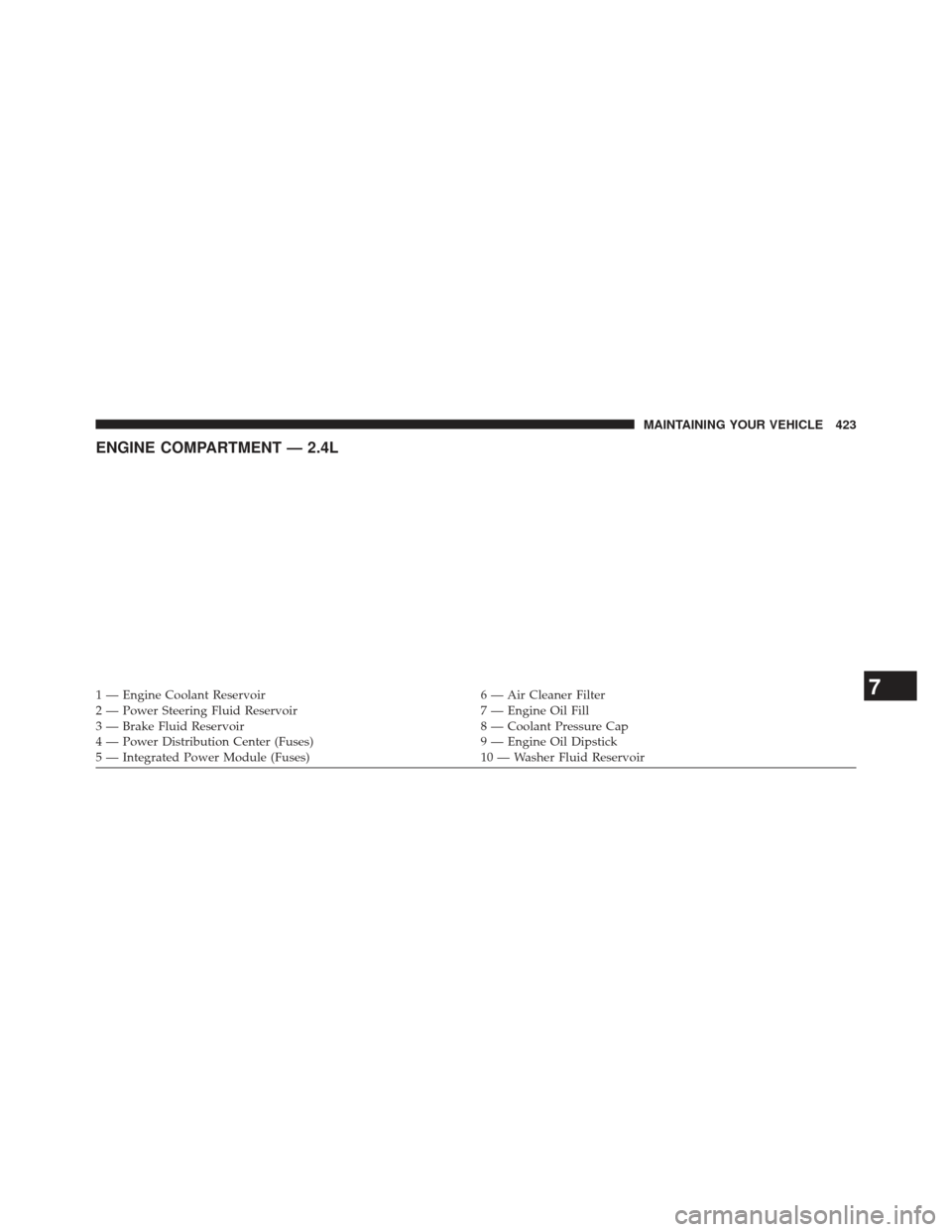
ENGINE COMPARTMENT — 2.4L
1 — Engine Coolant Reservoir6 — Air Cleaner Filter
2 — Power Steering Fluid Reservoir 7 — Engine Oil Fill
3 — Brake Fluid Reservoir 8 — Coolant Pressure Cap
4 — Power Distribution Center (Fuses) 9 — Engine Oil Dipstick
5 — Integrated Power Module (Fuses) 10 — Washer Fluid Reservoir7
MAINTAINING YOUR VEHICLE 423
Page 426 of 517
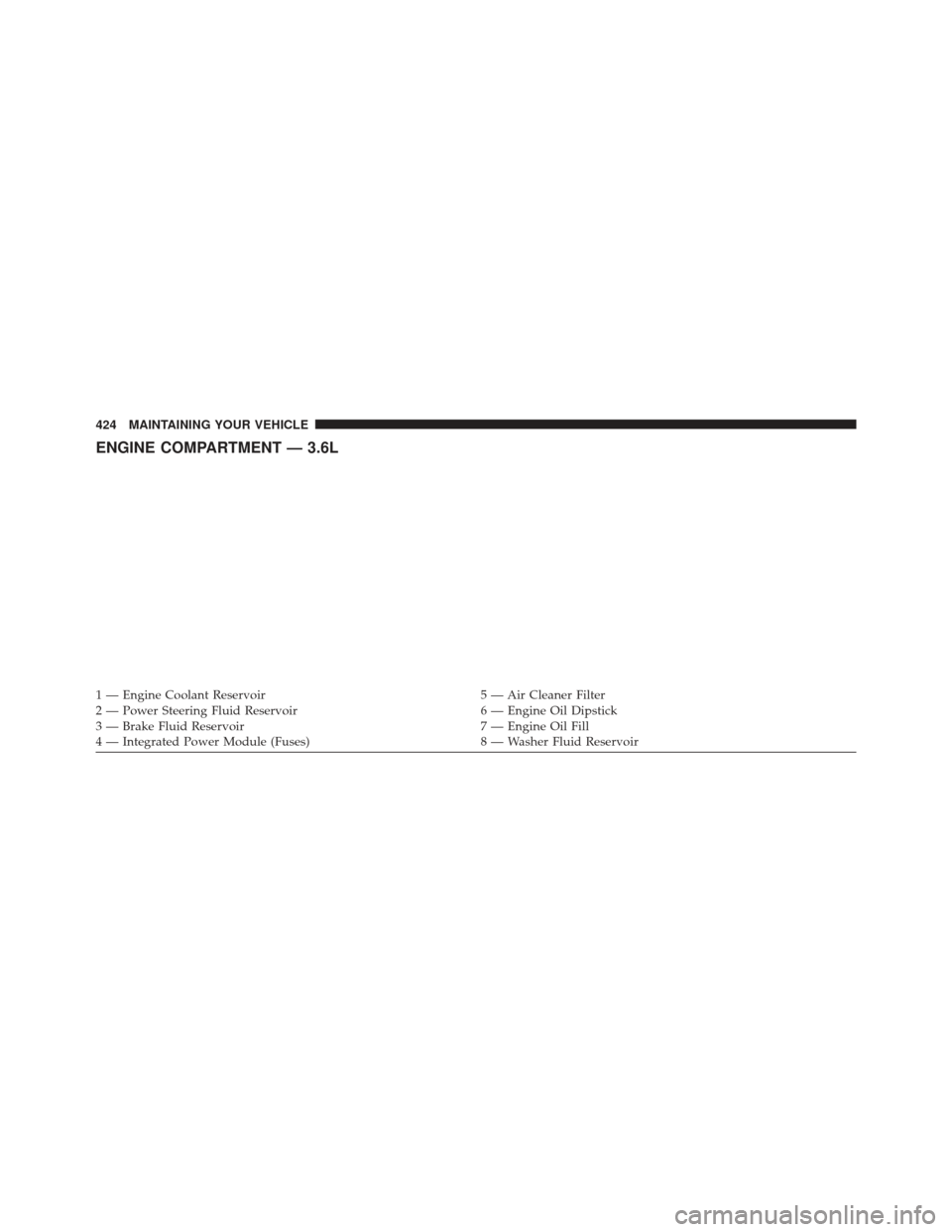
ENGINE COMPARTMENT — 3.6L
1 — Engine Coolant Reservoir5 — Air Cleaner Filter
2 — Power Steering Fluid Reservoir 6 — Engine Oil Dipstick
3 — Brake Fluid Reservoir 7 — Engine Oil Fill
4 — Integrated Power Module (Fuses) 8 — Washer Fluid Reservoir
424 MAINTAINING YOUR VEHICLE
Page 431 of 517
CAUTION!(Continued)
•Your vehicle has been built with improved fluids
that protect the performance and durability of your
vehicle and also allow extended maintenance inter-
vals. Do not use chemical flushes in these compo-
nents as the chemicals can damage your engine,
transmission, power steering or air conditioning.
Such damage is not covered by the New Vehicle
Limited Warranty. If a flush is needed because of
component malfunction, use only the specified
fluid for the flushing procedure.
Engine Oil
Checking Oil Level
To assure proper engine lubrication, the engine oil must
be maintained at the correct level. Check the oil level at
regular intervals, such as every fuel stop. The best time to check the engine oil level is about five minutes after a
fully warmed engine is shut off. Do not check oil level
before starting the engine after it has sat overnight.
Checking engine oil level when the engine is cold will
give you an incorrect reading.
Checking the oil while the vehicle is on level ground and
only when the engine is hot, will improve the accuracy of
the oil level readings. Maintain the oil level between the
range markings on the dipstick. Either the range mark-
ings consist of a crosshatch zone marked SAFE or a
crosshatch zone marked with MIN at the low end of the
range and MAX at the high end of the range. Adding one
quart of oil when the reading is at the low end of the
range marking will raise the oil level to the high end of
the range marking.
7
MAINTAINING YOUR VEHICLE 429
Page 436 of 517
To access the battery, turn the steering wheel fully to the
right and remove the inner fender shield.
WARNING!
•Battery fluid is a corrosive acid solution and can
burn or even blind you. Do not allow battery fluid
to contact your eyes, skin, or clothing. Do not lean
over a battery when attaching clamps. If acid
splashes in eyes or on skin, flush the area imme-
diately with large amounts of water.
• Battery gas is flammable and explosive. Keep
flame or sparks away from the battery. Do not use
a booster battery or any other booster source with
an output greater than 12 Volts. Do not allow cable
clamps to touch each other.
• Battery posts, terminals, and related accessories
contain lead and lead compounds. Wash hands
after handling.
CAUTION!
• It is essential when replacing the cables on the
battery that the positive cable is attached to the
positive post and the negative cable is attached to
the negative post. Battery posts are marked posi-
tive (+) and negative (-) and are identified on the
battery case. Cable clamps should be tight on the
terminal posts and free of corrosion.
• If a “fast charger” is used while the battery is in the
vehicle, disconnect both vehicle battery cables be-
fore connecting the charger to the battery. Do not
use a “fast charger” to provide starting voltage.
434 MAINTAINING YOUR VEHICLE
Page 464 of 517
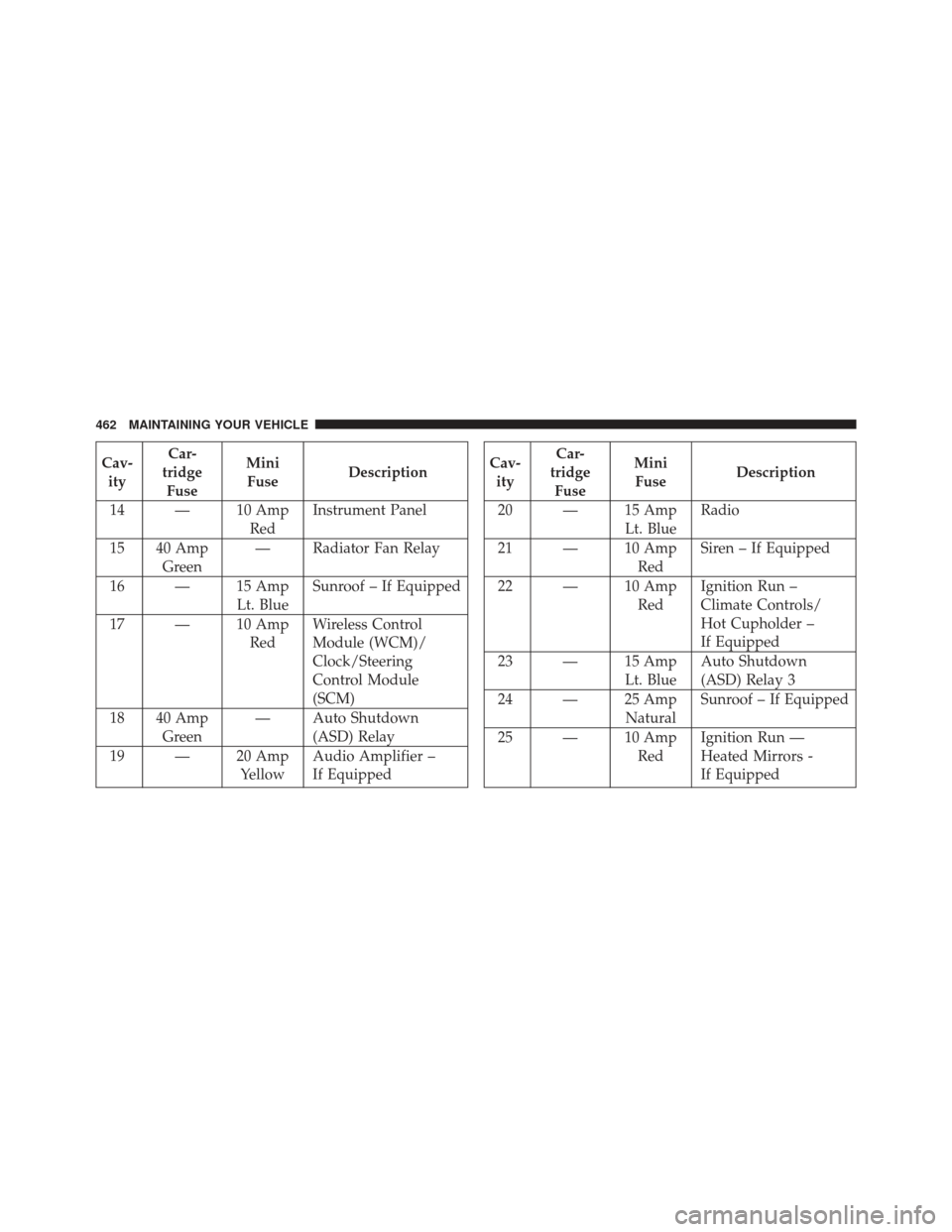
Cav-ity Car-
tridge Fuse Mini
Fuse Description
14 — 10 Amp RedInstrument Panel
15 40 Amp Green — Radiator Fan Relay
16 — 15 Amp Lt. BlueSunroof – If Equipped
17 — 10 Amp RedWireless Control
Module (WCM)/
Clock/Steering
Control Module
(SCM)
18 40 Amp Green — Auto Shutdown
(ASD) Relay
19 — 20 Amp YellowAudio Amplifier –
If EquippedCav-
ity Car-
tridge Fuse Mini
Fuse Description
20 — 15 Amp Lt. BlueRadio
21 — 10 Amp RedSiren – If Equipped
22 — 10 Amp RedIgnition Run –
Climate Controls/
Hot Cupholder –
If Equipped
23 — 15 Amp Lt. BlueAuto Shutdown
(ASD) Relay 3
24 — 25 Amp NaturalSunroof – If Equipped
25 — 10 Amp RedIgnition Run —
Heated Mirrors -
If Equipped
462 MAINTAINING YOUR VEHICLE
Page 471 of 517
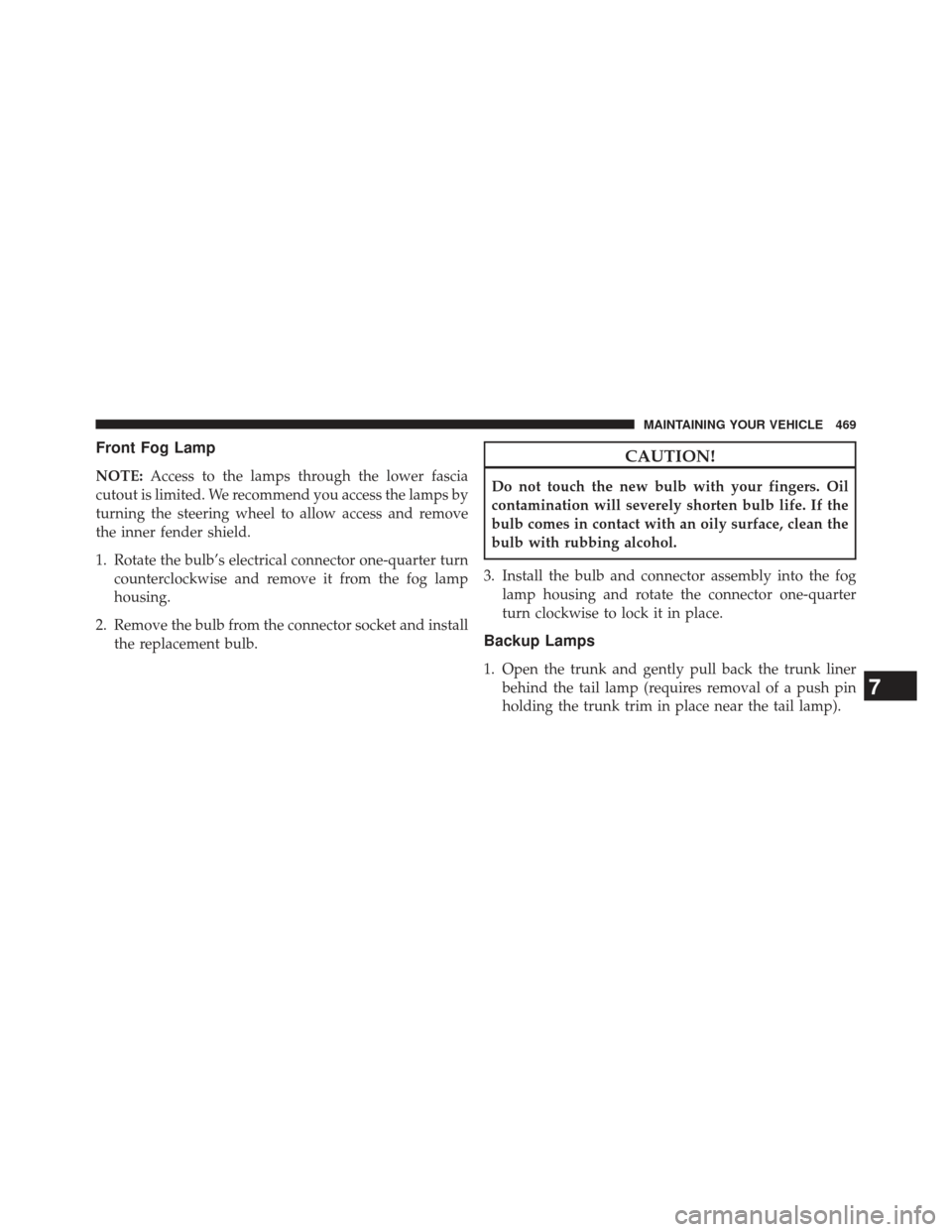
Front Fog Lamp
NOTE:Access to the lamps through the lower fascia
cutout is limited. We recommend you access the lamps by
turning the steering wheel to allow access and remove
the inner fender shield.
1. Rotate the bulb’s electrical connector one-quarter turn counterclockwise and remove it from the fog lamp
housing.
2. Remove the bulb from the connector socket and install the replacement bulb.
CAUTION!
Do not touch the new bulb with your fingers. Oil
contamination will severely shorten bulb life. If the
bulb comes in contact with an oily surface, clean the
bulb with rubbing alcohol.
3. Install the bulb and connector assembly into the fog lamp housing and rotate the connector one-quarter
turn clockwise to lock it in place.
Backup Lamps
1. Open the trunk and gently pull back the trunk linerbehind the tail lamp (requires removal of a push pin
holding the trunk trim in place near the tail lamp).
7
MAINTAINING YOUR VEHICLE 469
Page 476 of 517
![CHRYSLER 200 2013 1.G Owners Guide ComponentFluid, Lubricant, or Genuine Part
Spark Plugs – 3.6L Engine We recommend you use MOPAR® Spark Plugs (Gap 0.043 in [1.1 mm]).
Fuel Selection 87 Octane
* PZEV = Partial Zero Emission Vehicle](/img/25/8396/w960_8396-475.png "CHRYSLER 200 2013 1.G Owners Guide ComponentFluid, Lubricant, or Genuine Part
Spark Plugs – 3.6L Engine We recommend you use MOPAR® Spark Plugs (Gap 0.043 in [1.1 mm]).
Fuel Selection 87 Octane
* PZEV = Partial Zero Emission Vehicle")
ComponentFluid, Lubricant, or Genuine Part
Spark Plugs – 3.6L Engine We recommend you use MOPAR® Spark Plugs (Gap 0.043 in [1.1 mm]).
Fuel Selection 87 Octane
* PZEV = Partial Zero Emission Vehicle
Chassis
Component Fluid, Lubricant, or Genuine Part
Automatic Transmission We recommend youONLYuse MOPAR® ATF+4® Automatic Transmission
Fluid. Failure to use ATF+4® fluid may affect the function or performance
of your transmission.
Brake Master Cylinder We recommend you use MOPAR® DOT 3 and SAE J1703. If DOT 3 brake
fluid is not available, then DOT 4 is acceptable.
Power Steering Reservoir We recommend you use MOPAR® Power Steering Fluid +4, MOPAR®
ATF+4® Automatic Transmission Fluid.
474 MAINTAINING YOUR VEHICLE
Page 479 of 517
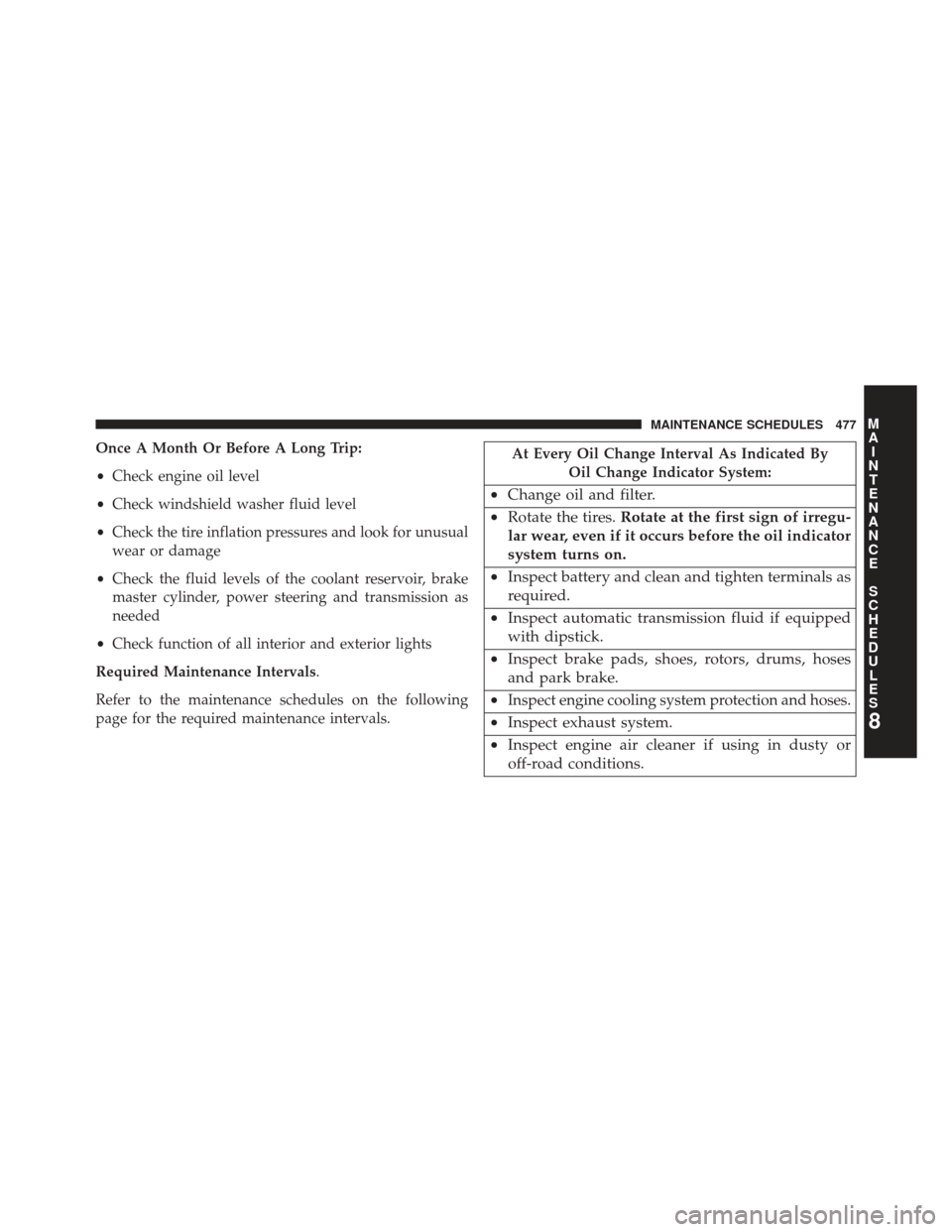
Once A Month Or Before A Long Trip:
•Check engine oil level
• Check windshield washer fluid level
• Check the tire inflation pressures and look for unusual
wear or damage
• Check the fluid levels of the coolant reservoir, brake
master cylinder, power steering and transmission as
needed
• Check function of all interior and exterior lights
Required Maintenance Intervals.
Refer to the maintenance schedules on the following
page for the required maintenance intervals.At Every Oil Change Interval As Indicated By Oil Change Indicator System:
•Change oil and filter.
• Rotate the tires. Rotate at the first sign of irregu-
lar wear, even if it occurs before the oil indicator
system turns on.
• Inspect battery and clean and tighten terminals as
required.
• Inspect automatic transmission fluid if equipped
with dipstick.
• Inspect brake pads, shoes, rotors, drums, hoses
and park brake.
•
Inspect engine cooling system protection and hoses.
• Inspect exhaust system.
• Inspect engine air cleaner if using in dusty or
off-road conditions.8
M
A I
N T
E
N
A
N
C E
S
C
H E
D
U L
E
SMAINTENANCE SCHEDULES 477
Page 503 of 517
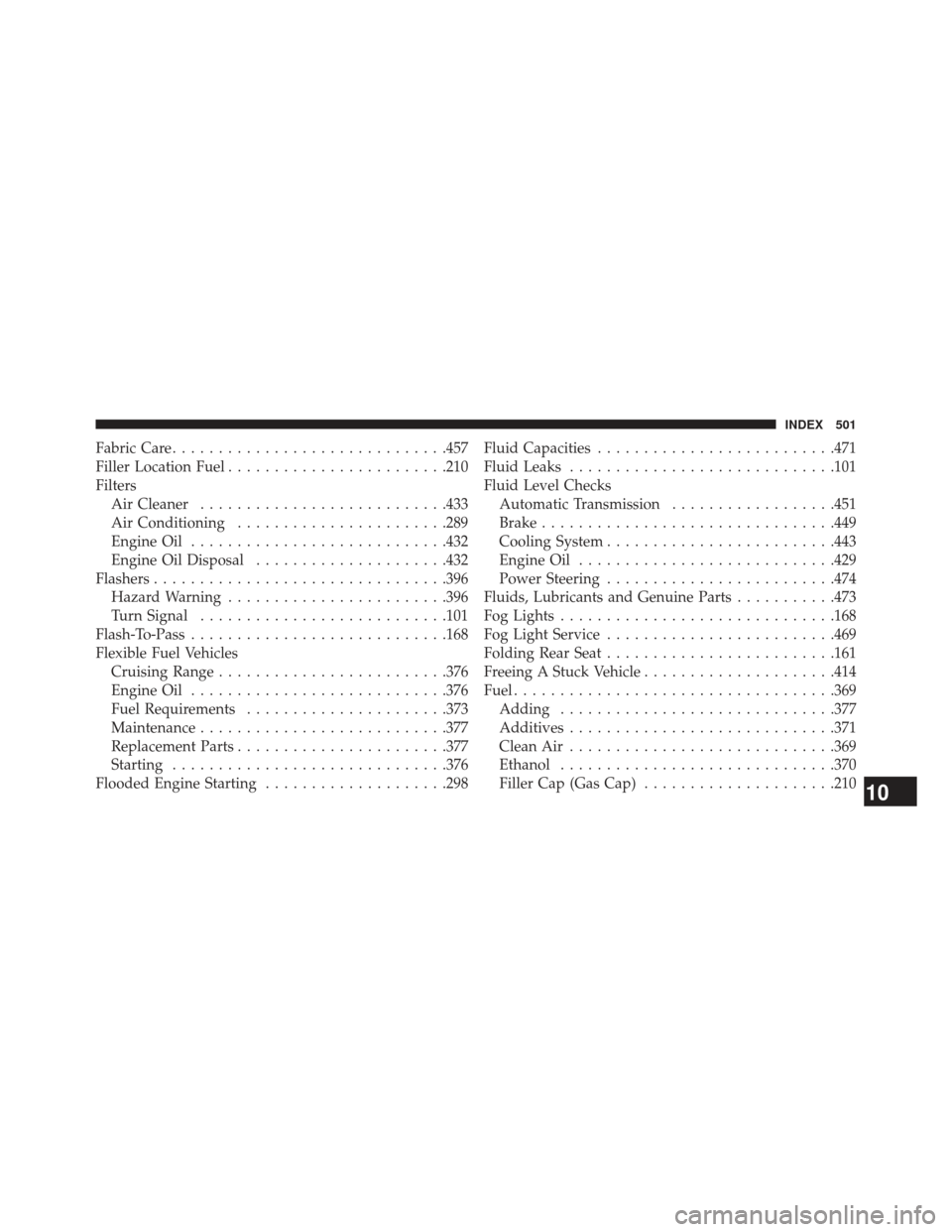
Fabric Care............................. .457
Filler Location Fuel ....................... .210
Filters Air Cleaner .......................... .433
Air Conditioning ...................... .289
Engine Oil ........................... .432
Engine Oil Disposal .....................432
Flashers ............................... .396
Hazard Warning ....................... .396
Turn Signal .......................... .101
Flash-To-Pass ........................... .168
Flexible Fuel Vehicles Cruising Range ........................ .376
Engine Oil ........................... .376
Fuel Requirements ..................... .373
Maintenance .......................... .377
Replacement Parts ...................... .377
Starting ............................. .376
Flooded Engine Starting ....................298 Fluid Capacities
......................... .471
Fluid Leaks ............................ .101
Fluid Level Checks Automatic Transmission ..................451
Brake ............................... .449
Cooling System ........................ .443
Engine Oil ........................... .429
Power Steering ........................ .474
Fluids, Lubricants and Genuine Parts ...........473
Fog Lights ............................. .168
Fog Light Service ........................ .469
Folding Rear Seat ........................ .161
Freeing A Stuck Vehicle .....................414
Fuel .................................. .369
Adding ............................. .377
Additives ............................ .371
Clean Air ............................ .369
Ethanol ............................. .370
Filler
Cap (Gas Cap) .....................210
10
INDEX 501
Page 509 of 517
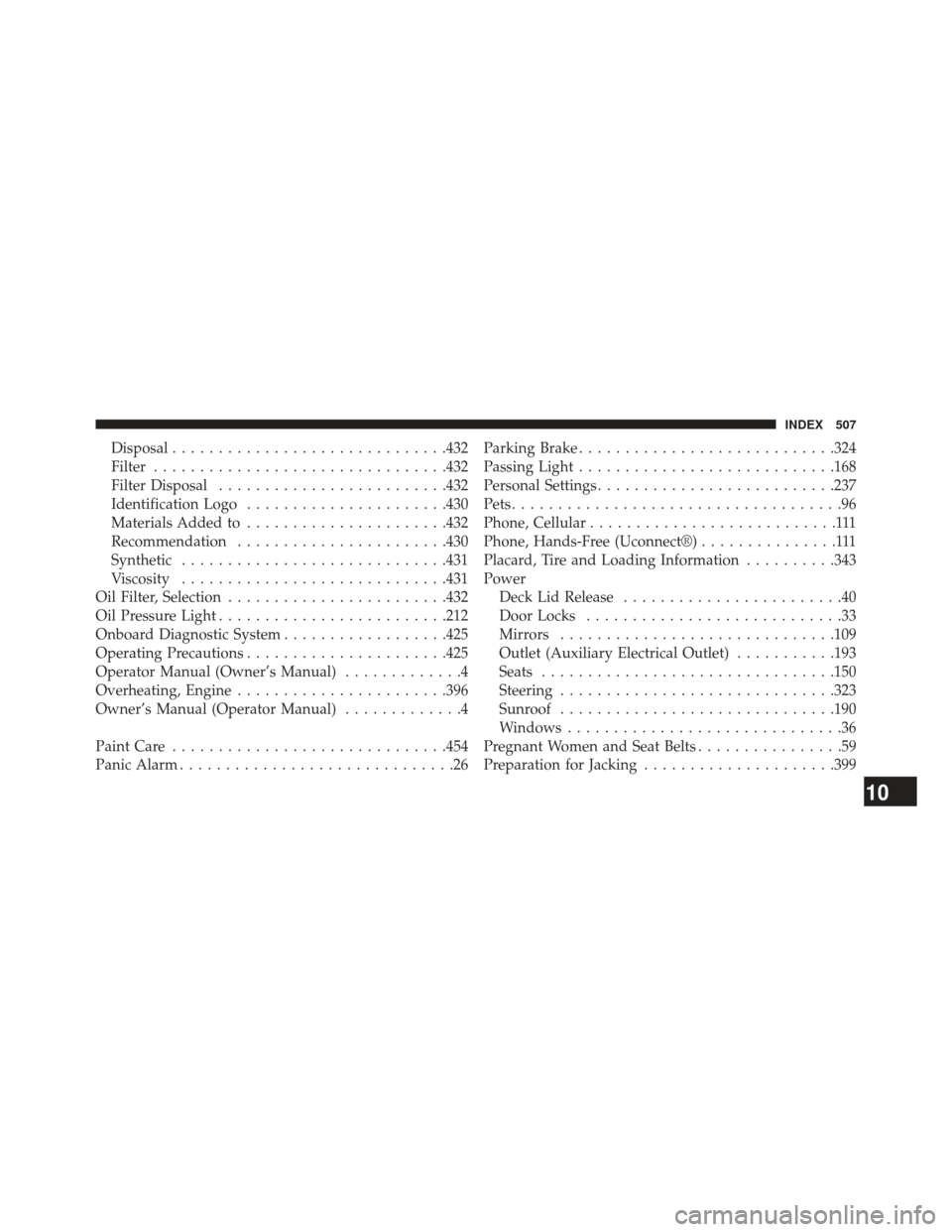
Disposal............................. .432
Filter ............................... .432
Filter Disposal ........................ .432
Identification Logo ..................... .430
Materials Added to ..................... .432
Recommendation ...................... .430
Synthetic ............................ .431
Viscosity ............................ .431
Oil Filter, Selection ....................... .432
Oil Pressure Light ........................ .212
Onboard Diagnostic System ..................425
Operating Precautions ..................... .425
Operator Manual (Owner’s Manual) .............4
Overheating, Engine ...................... .396
Owner’s Manual (Operator Manual) .............4
Paint Care ............................. .454
Panic Alarm ..............................26 Parking Brake
........................... .324
Passing Light ........................... .168
Personal Settings ......................... .237
Pets ....................................96
Phone, Cellular ...........................111
Phone, Hands-Free (Uconnect®) ...............111
Placard, Tire and Loading Information ..........343
Power Deck Lid Release ........................40
Door Locks ............................33
Mirrors ............................. .109
Outlet (Auxiliary Electrical Outlet) ...........193
Seats ............................... .150
Steering ............................. .323
Sunroof ............................. .190
Windows ..............................36
Pregnant Women and Seat Belts ................59
Preparation for Jacking .....................399
10
INDEX 507