brake light CHRYSLER 200 2014 1.G User Guide
[x] Cancel search | Manufacturer: CHRYSLER, Model Year: 2014, Model line: 200, Model: CHRYSLER 200 2014 1.GPages: 516, PDF Size: 3.52 MB
Page 323 of 516
possible. To release the parking brake, pull the lever up
slightly, press the center button, then lower the lever
completely.
When the parking brake is applied with the ignition
switch ON, the “Brake Warning Light” in the instrument
cluster will illuminate.
NOTE:
•When the parking brake is applied and the transmis-
sion is placed in gear, the “Brake Warning Light” will
flash. If vehicle speed is detected, a chime will sound
to alert the driver. Fully release the parking brake
before attempting to move the vehicle.
•
This light only shows that the parking brake is applied. It
does not show the degree of brake application.
When parking on a hill, it is important to turn the front
wheels toward the curb on a downhill grade and away
from the curb on an uphill grade. Apply the parking brake before placing the shift lever in PARK, otherwise
the load on the transmission locking mechanism may
make it difficult to move the shift lever out of PARK. The
parking brake should always be applied whenever the
driver is not in the vehicle.
WARNING!
•
Never use the PARK position as a substitute for the
parking brake. Always apply the parking brake
fully when parked to guard against vehicle move-
ment and possible injury or damage.
• When leaving the vehicle, always remove the Key
Fob from the ignition and lock your vehicle.
(Continued)
5
STARTING AND OPERATING 321
Page 324 of 516
WARNING!(Continued)
•Never leave children alone in a vehicle, or with
access to an unlocked vehicle. Allowing children to
be in a vehicle unattended is dangerous for a
number of reasons. A child or others could be
seriously or fatally injured. Children should be
warned not to touch the parking brake, brake pedal
or the shift lever.
• Do not leave the Key Fob in or near the vehicle, or
in a location accessible to children. A child could
operate power windows, other controls, or move
the vehicle.
• Be sure the parking brake is fully disengaged
before driving; failure to do so can lead to brake
failure and a collision.
(Continued)
WARNING! (Continued)
•Always fully apply the parking brake when leav-
ing your vehicle or it may roll and cause damage or
injury. Also, be certain to leave the transmission in
PARK. Failure to do so may cause the vehicle to roll
and cause damage or injury.
CAUTION!
If the “Brake Warning Light” remains on with the
parking brake released, a brake system malfunction
is indicated. Have the brake system serviced by an
authorized dealer immediately.
ANTI-LOCK BRAKE SYSTEM (ABS)
The Anti-Lock Brake System (ABS) provides increased
vehicle stability and brake performance under most
braking conditions. The system operates with a separate
322 STARTING AND OPERATING
Page 325 of 516
computer to modulate the hydraulic pressure to prevent
wheel lock-up and avoid skidding on slippery surfaces.
WARNING!
•Pumping of the anti-lock brakes will diminish
their effectiveness and may lead to a collision.
Pumping makes the stopping distance longer. Just
press firmly on your brake pedal when you need to
slow down or stop.
• The ABS cannot prevent the natural laws of phys-
ics from acting on the vehicle, nor can it increase
braking or steering efficiency beyond that afforded
by the condition of the vehicle brakes and tires or
the traction afforded.
• The ABS cannot prevent collisions, including those
resulting from excessive speed in turns, following
another vehicle too closely, or hydroplaning.
(Continued)
WARNING! (Continued)
•The capabilities of an ABS-equipped vehicle must
never be exploited in a reckless or dangerous
manner, which could jeopardize the user’s safety or
the safety of others.
The “Anti-Lock Brake Warning Light” moni-
tors the Anti-Lock Brake System. The light will
come on when the ignition switch is turned to
the ON position and may stay on for as long as
four seconds.
If the “Anti-Lock Brake Warning Light” remains on or
comes on while driving, it indicates that the anti-lock
portion of the brake system is not functioning and that
service is required. However, the conventional brake
system will continue to operate normally if the “Brake
Warning Light” is not on.
5
STARTING AND OPERATING 323
Page 326 of 516
If the “Anti-Lock Brake Warning Light” is on, the brake
system should be serviced as soon as possible to restore
the benefits of anti-lock brakes. If the “Anti-Lock Brake
Warning Light” does not come on when the ignition
switch is turned to the ON position, have the bulb
repaired as soon as possible.
If both the “Brake Warning Light” and the “Anti-Lock
Brake Warning Light” remain on, the Anti-Lock Brake
(ABS) and Electronic Brake Force Distribution (EBD)
Systems are not functioning. Immediate repair to the ABS
system is required. See your authorized dealer.
When the vehicle is driven over 7 mph (11 km/h), you
may hear a slight clicking sound as well as some related
motor noises. These noises are the system performing its
self-check cycle to ensure that the ABS system is working
properly. This self check occurs each time the vehicle is
started and accelerated past 7 mph (11 km/h).ABS is activated during braking under certain road or
stopping conditions. ABS-inducing conditions can in-
clude ice, snow, gravel, bumps, railroad tracks, loose
debris, or panic stops.
You also may experience the following when the brake
system goes into anti-lock:
•
The ABS motor running (it may continue to run for a
short time after the stop).
• The clicking sound of solenoid valves.
• Brake pedal pulsations.
• A slight drop or fall away of the brake pedal at the end
of the stop.
These are all normal characteristics of ABS.
324 STARTING AND OPERATING
Page 388 of 516
CAUTION!
If the trailer weighs more than 1,000 lbs (454 kg)
loaded, it should have its own brakes and they
should be of adequate capacity. Failure to do this
could lead to accelerated brake lining wear, higher
brake pedal effort, and longer stopping distances.
Towing Requirements — Trailer Lights And Wiring
Whenever you pull a trailer, regardless of the trailer size,
stop lights and turn signals on the trailer are required for
motoring safety.
The Trailer Tow Package may include a four-pin and
seven-pin wiring harness. Use a factory approved trailer
harness and connector.
NOTE:Do not cut or splice wiring into the vehicle’s
wiring harness. The electrical connections are all complete to the vehicle,
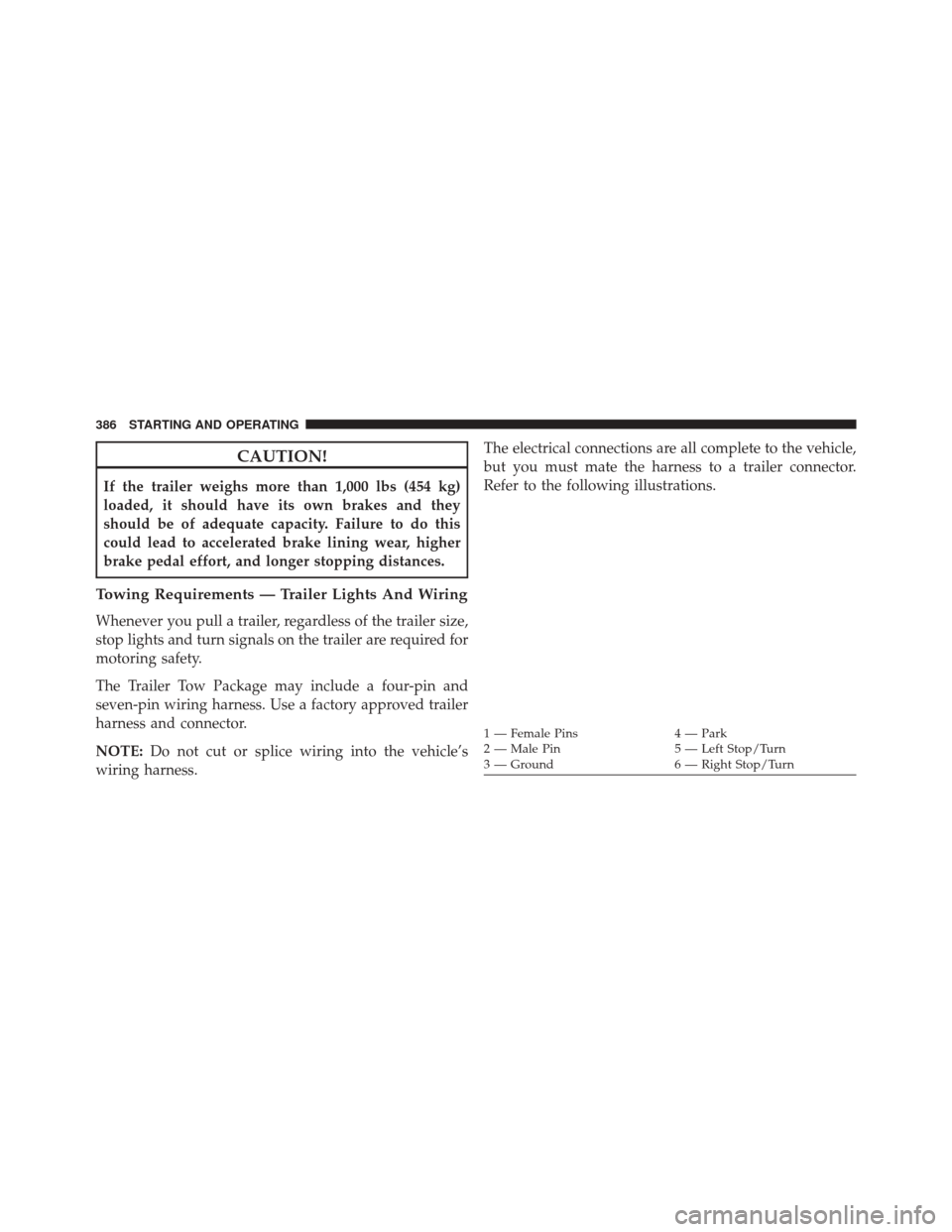
but you must mate the harness to a trailer connector.
Refer to the following illustrations.
1 — Female Pins
4 — Park
2 — Male Pin 5 — Left Stop/Turn
3 — Ground 6 — Right Stop/Turn
386 STARTING AND OPERATING
Page 446 of 516
•Keep the front of the radiator clean. If your vehicle is
equipped with air conditioning, keep the front of the
condenser clean.
•
Do not change the thermostat for Summer or Winter
operation. If replacement is ever necessary, install ONLY
the correct type thermostat. Other designs may result in
unsatisfactory engine coolant (antifreeze) performance,
poor gas mileage, and increased emissions.
Brake System
In order to assure brake system performance, all brake
system components should be inspected periodically.
Refer to the “Maintenance Schedule” for the proper
maintenance intervals.
WARNING!
Riding the brakes can lead to brake failure and
possibly a collision. Driving with your foot resting or
riding on the brake pedal can result in abnormally
high brake temperatures, excessive lining wear, and
possible brake damage. You would not have your full
braking capacity in an emergency.
Master Cylinder — Brake Fluid Level Check
Check the fluid level in the master cylinder immediately if
the brake system warning light indicates system failure.
Check the fluid level in the master cylinder when per-
forming underhood services.
Clean the top of the master cylinder area before removing
the cap. If necessary, add fluid to bring the fluid level up to
the requirements described on the brake fluid reservoir.
444 MAINTAINING YOUR VEHICLE
Page 460 of 516
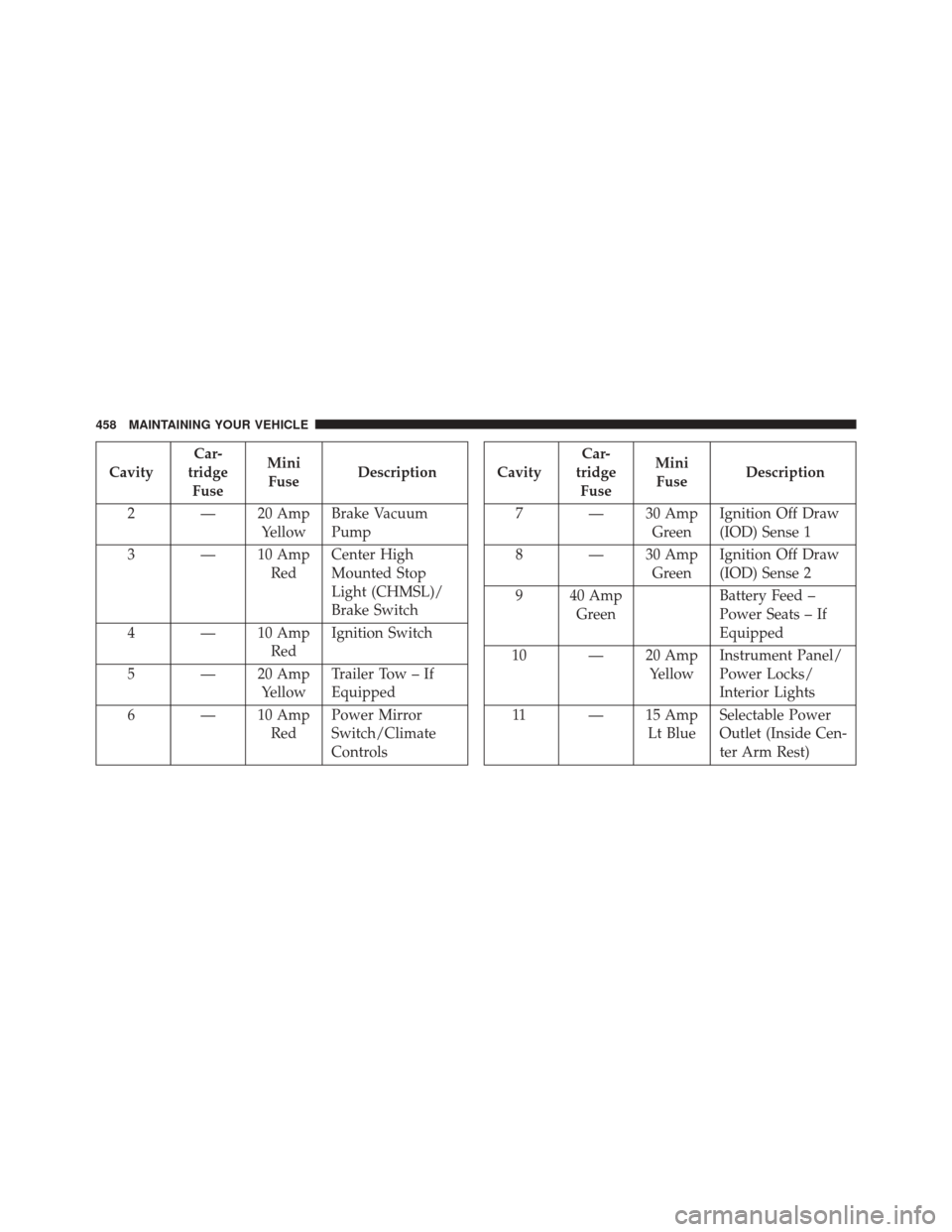
CavityCar-
tridge Fuse Mini
Fuse Description
2 — 20 Amp YellowBrake Vacuum
Pump
3 — 10 Amp RedCenter High
Mounted Stop
Light (CHMSL)/
Brake Switch
4 — 10 Amp RedIgnition Switch
5 — 20 Amp YellowTrailer Tow – If
Equipped
6 — 10 Amp RedPower Mirror
Switch/Climate
ControlsCavity Car-
tridge Fuse Mini
Fuse Description
7 — 30 Amp GreenIgnition Off Draw
(IOD) Sense 1
8 — 30 Amp GreenIgnition Off Draw
(IOD) Sense 2
9 40 Amp Green Battery Feed –
Power Seats – If
Equipped
10 — 20 Amp YellowInstrument Panel/
Power Locks/
Interior Lights
11 — 15 Amp Lt BlueSelectable Power
Outlet (Inside Cen-
ter Arm Rest)
458 MAINTAINING YOUR VEHICLE
Page 479 of 516
•Check tire pressure and look for unusual wear or
damage. Rotate tires at the first sign of irregular wear,
even if it occurs before the oil indicator system turns
on.
• Check the fluid levels of the coolant reservoir, brake
master cylinder, power steering and transmission
(four-speed only) and fill as needed.
• Check function of all interior and exterior lights.
Required Maintenance Intervals
Refer to the maintenance schedules on the following
page for the required maintenance intervals.
At Every Oil Change Interval As Indicated By Oil Change Indicator System:
•Change oil and filter.
At Every Oil Change Interval As Indicated By Oil
Change Indicator System:
•Rotate the tires. Rotate at the first sign of irregu-
lar wear, even if it occurs before the oil indicator
system turns on.
• Inspect battery and clean and tighten terminals as
required.
• Inspect automatic transmission fluid if equipped
with dipstick.
• Inspect brake pads, shoes, rotors, drums, hoses
and park brake.
• Inspect engine cooling system protection and
hoses.
• Inspect exhaust system.
• Inspect engine air cleaner if using in dusty or
off-road conditions.
8
M
A I
N T
E
N
A
N
C E
S
C
H E
D
U L
E
SMAINTENANCE SCHEDULES 477
Page 496 of 516
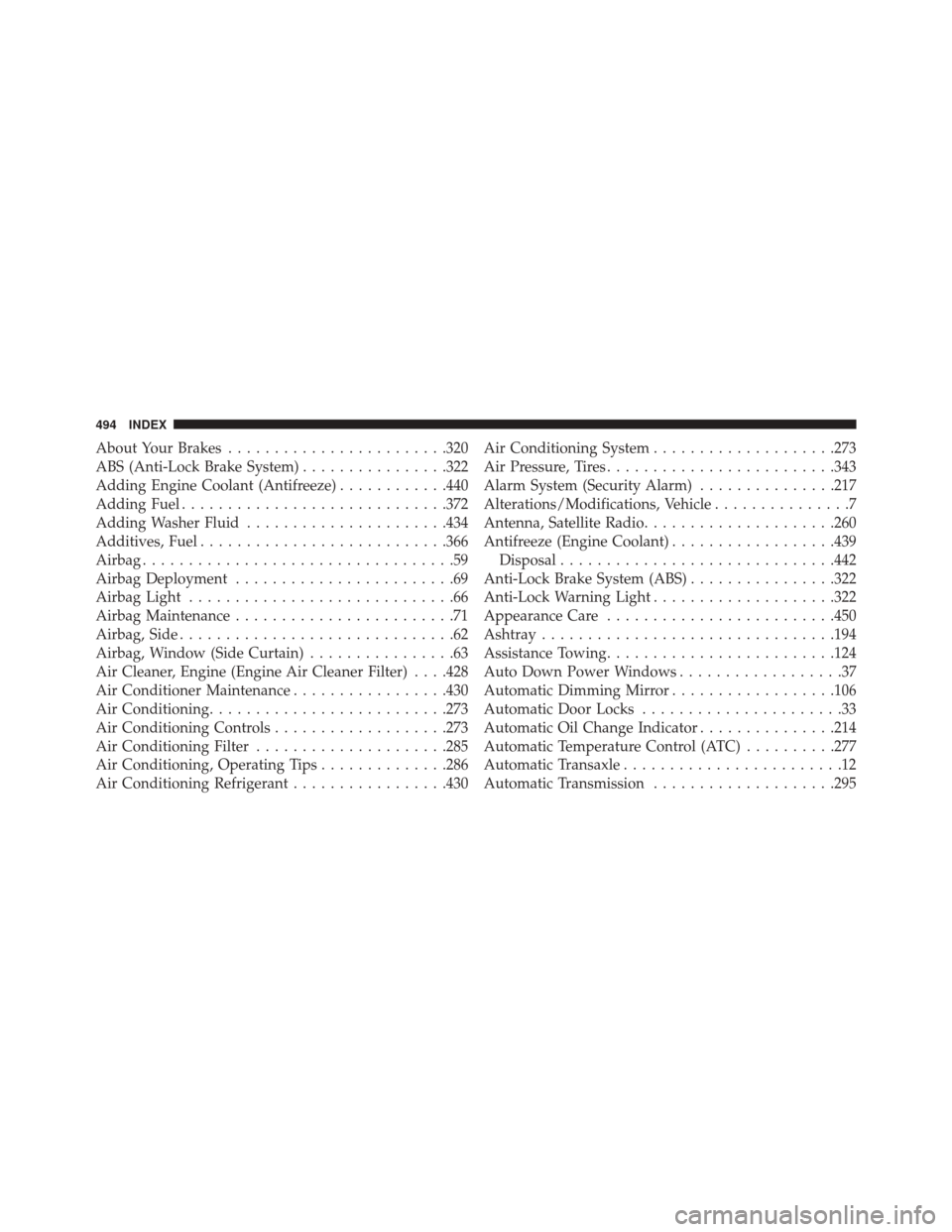
About Your Brakes....................... .320
ABS (Anti-Lock Brake System) ................322
Adding Engine Coolant (Antifreeze) ............440
Adding Fuel ............................ .372
Adding Washer Fluid ..................... .434
Additives, Fuel .......................... .366
Airbag ..................................59
Airbag Deployment ........................69
Airbag Light .............................66
Airbag Maintenance ........................71
Airbag, Side ..............................62
Airbag, Window (Side Curtain) ................63
Air Cleaner, Engine (Engine Air Cleaner Filter) . . . .428
Air Conditioner Maintenance .................430
Air Conditioning ......................... .273
Air Conditioning Controls ...................273
Air Conditioning Filter .....................285
Air Conditioning, Operating Tips ..............286
Air Conditioning Refrigerant .................430Air Conditioning System
....................273
Air Pressure, Tires ........................ .343
Alarm System (Security Alarm) ...............217
Alterations/Modifications, Vehicle ...............7
Antenna, Satellite Radio .....................260
Antifreeze (Engine Coolant) ..................439
Disposal ............................. .442
Anti-Lock Brake System (ABS) ................322
Anti-Lock Warning Light ....................322
Appearance Care ........................ .450
Ashtray ............................... .194
Assistance Towing ........................ .124
Auto Down Power Windows ..................37
Automatic Dimming Mirror ..................106
Automatic Door Locks ......................33
Automatic Oil Change Indicator ...............214
Automatic Temperature Control (ATC) ..........277
Automatic Transaxle ........................12
Automatic Transmission ....................295
494 INDEX
Page 497 of 516
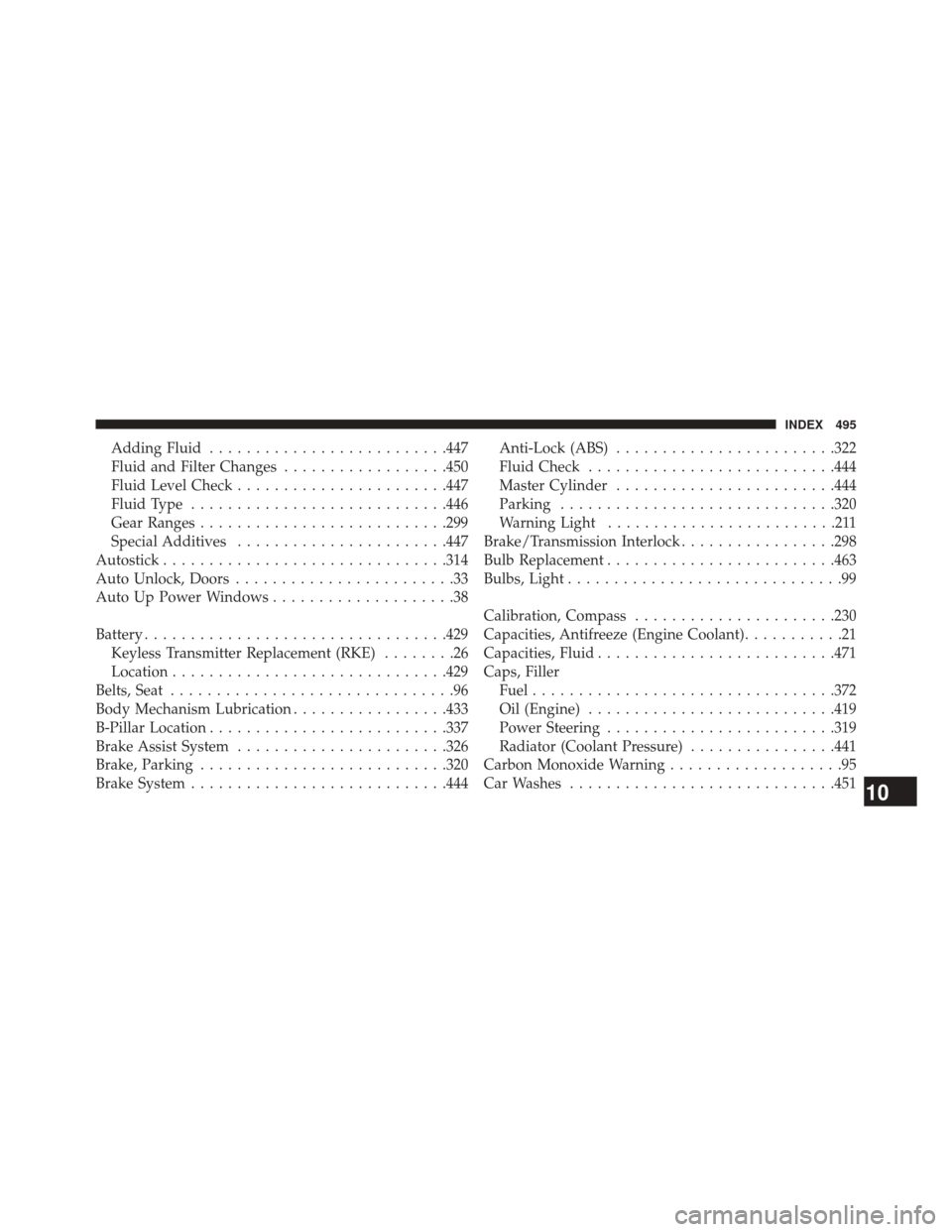
Adding Fluid......................... .447
Fluid and Filter Changes ..................450
Fluid Level Check ...................... .447
Fluid Type ........................... .446
Gear Ranges .......................... .299
Special Additives ...................... .447
Autostick .............................. .314
Auto Unlock, Doors ........................33
Auto Up Power Windows ....................38
Battery ................................ .429
Keyless Transmitter Replacement (RKE) ........26
Location ............................. .429
Belts, Seat ...............................96
Body Mechanism Lubrication .................433
B-Pillar Location ......................... .337
Brake Assist System ...................... .326
Brake, Parking .......................... .320
Brake System ........................... .444Anti-Lock (ABS)
....................... .322
Fluid Check .......................... .444
Master Cylinder ....................... .444
Parking ............................. .320
Warning Light .........................211
Brake/Transmission Interlock .................298
Bulb Replacement ........................ .463
Bulbs, Light ..............................99
Calibration, Compass ..................... .230
Capacities, Antifreeze (Engine Coolant) ...........21
Capacities, Fluid ......................... .471
Caps, Filler Fuel ................................ .372
Oil (Engine) .......................... .419
Power Steering ........................ .319
Radiator (Coolant Pressure) ................441
Carbon Monoxide Warning ...................95
Car Washes ............................ .451
10
INDEX 495