radio CHRYSLER 200 2015 2.G Owner's Guide
[x] Cancel search | Manufacturer: CHRYSLER, Model Year: 2015, Model line: 200, Model: CHRYSLER 200 2015 2.GPages: 698, PDF Size: 5.12 MB
Page 430 of 698

Uconnect® 5.0 RadioUconnect® 8.4A/8.4AN Radio
428 UNDERSTANDING YOUR INSTRUMENT PANEL
Page 443 of 698
Additional Information
© 2014 Chrysler Group LLC. All rights reserved. Mopar
and Uconnect are registered trademarks and Mopar
Owner Connect is a trademark of Chrysler Group LLC.
Android is a trademark of Google Inc. SiriusXM and all
related marks and logos are trademarks of SiriusXM
Radio Inc. Yelp, Yelp logo, Yelp burst and related marks
are registered trademarks of Yelp.
DriveUconnect.com
DriveUconnect.caUconnect® System Support:
•
U.S. residents call 1-877-855-8400
• Canadian residents call 1-800-465-2001 (English) or
1-800-387-9983 (French)
Mon. – Fri., 7:00 am – 12:00 am, ET
Sat., 8:00 am – 10:00 pm, ET
Sun., 9:00 am – 5:00 pm, ET
Uconnect® Access Services Support 1-855-792-4241.
Please have your Uconnect® Security PIN ready when
you call.
4
UNDERSTANDING YOUR INSTRUMENT PANEL 441
Page 486 of 698
When the vehicle is driven over 7 mph (11 km/h), you
may hear a slight clicking sound as well as some related
motor noises. These noises are the system performing its
self-check cycle to ensure that the ABS system is working
properly. This self check occurs each time the vehicle is
started and accelerated past 7 mph (11 km/h).
ABS is activated during braking under certain road or
stopping conditions. ABS inducing conditions can in-
clude ice, snow, gravel, bumps, railroad tracks, loose
debris, or panic stops.
You also may experience the following when the brake
system goes into anti-lock:
•The ABS motor running (it may continue to run for a
short time after the stop).
• The clicking sound of solenoid valves.
• Brake pedal pulsations. •
A slight drop or fall away of the brake pedal at the end
of the stop.
These are all normal characteristics of ABS.
WARNING!
The Anti-Lock Brake System contains sophisticated
electronic equipment that may be susceptible to
interference caused by improperly installed or high
output radio transmitting equipment. This interfer-
ence can cause possible loss of anti-lock braking
capability. Installation of such equipment should be
performed by qualified professionals.
All vehicle wheels and tires must be the same size and
type, and tires must be properly inflated to produce
accurate signals for the computer.
484 STARTING AND OPERATING
Page 526 of 698
NOTE:When filling warm tires, the tire pressure may
need to be increased up to an additional 4 psi (30 kPa)
above the recommended cold placard pressure in order
to turn the Tire Pressure Monitoring Telltale Light off.
The vehicle may need to be driven for up to 20 minutes
above 15 mph (24 km/h) in order for the TPMS to receive
this information.
Service TPMS Warning
When a system fault is detected, the “Tire Pressure
Monitoring Telltale Light” will flash on and off for 75
seconds and then remain on solid. The system fault will
also sound a chime. If the ignition is cycled, this sequence
will repeat, providing the system fault still exists. The
“Tire Pressure Monitoring Telltale Light” will turn off
when the fault condition no longer exists. A system fault
can occur due to any of the following: 1. Jamming due to electronic devices or driving next to
facilities emitting the same radio frequencies as the
TPMS sensors.
2. Installing some form of aftermarket window tinting that affects radio wave signals.
3. Lots of snow or ice around the wheels or wheel housings.
4. Using tire chains on the vehicle.
5. Using wheels/tires not equipped with TPMS sensors.
Vehicles With Matching Full-Size Spare
1. The matching full-size spare wheel and tire assembly has a tire pressure monitoring sensor that can be
monitored by the TPMS.
2. If you install the matching full-size spare in place of a road tire that has a pressure below the low-pressure
warning limit, a chime will sound and the “TPMS
524 STARTING AND OPERATING
Page 530 of 698
If the ignition is cycled, this sequence will repeat, pro-
viding the system fault still exists. If the system fault no
longer exists, the “Tire Pressure Monitoring Telltale
Light” will no longer flash, and the “SERVICE SYSTEMmessage will no longer display, and a pressure value will
display in place of the dashes. A system fault can occur
due to any of the following:
1. Jamming due to electronic devices or driving next to
facilities emitting the same radio frequencies as the
TPMS sensors.
2. Installing some form of aftermarket window tinting that affects radio wave signals.
3. Lots of snow or ice around the wheels or wheel housings.
4. Using tire chains on the vehicle.
5. Using wheels/tires not equipped with TPMS sensors.
Tire Pressure Monitoring Service Warning
528 STARTING AND OPERATING
Page 551 of 698
HAZARD WARNING FLASHERS
The Hazard Warning flasher switch is located in the
switch bank below the radio screen.Press the switch to turn on the Hazard Warning
flasher. When the switch is activated, all direc-
tional turn signals will flash on and off to warn oncoming
traffic of an emergency. Press the switch a second time to
turn off the Hazard Warning flashers.
This is an emergency warning system and it should not
be used when the vehicle is in motion. Use it when your
vehicle is disabled and it is creating a safety hazard for
other motorists.
When you must leave the vehicle to seek assistance, the
Hazard Warning flashers will continue to operate even
though the ignition is placed in the OFF position.
NOTE: With extended use the Hazard Warning flashers
may wear down your battery.
IF YOUR ENGINE OVERHEATS
In any of the following situations, you can reduce the
potential for overheating by taking the appropriate action.
• On the highways — slow down.
• In city traffic — while stopped, place the transmission
in NEUTRAL, but do not increase the engine idle
speed.
NOTE: There are steps that you can take to slow down
an impending overheat condition:
• If your air conditioner (A/C) is on, turn it off. The A/C
system adds heat to the engine cooling system and
turning the A/C off can help remove this heat.
•
You can also turn the temperature control to maximum
heat, the mode control to floor and the blower control to
high. This allows the heater core to act as a supplement
to the radiator and aids in removing heat from the
engine cooling system.
6
WHAT TO DO IN EMERGENCIES 549
Page 579 of 698
WARNING!
•Take care to avoid the radiator cooling fan when-
ever the hood is raised. It can start anytime the
ignition switch is ON. You can be injured by
moving fan blades.
• Remove any metal jewelry such as rings, watch
bands and bracelets that could make an inadvertent
electrical contact. You could be seriously injured.
• Batteries contain sulfuric acid that can burn your
skin or eyes and generate hydrogen gas which is
flammable and explosive. Keep open flames or
sparks away from the battery.
1. Set the parking brake, shift the automatic transmission into PARK and turn the ignition to LOCK.
2. Turn off the heater, radio, and all unnecessary electri- cal accessories.
1 — Positive Battery Post
2 — Negative Battery Post
6
WHAT TO DO IN EMERGENCIES 577
Page 626 of 698
Cleaning Headlights
Your vehicle is equipped with plastic headlights and fog
lights that are lighter and less susceptible to stone break-
age than glass headlights.
Plastic is not as scratch resistant as glass and therefore
different lens cleaning procedures must be followed.
To minimize the possibility of scratching the lenses and
reducing light output, avoid wiping with a dry cloth. To
remove road dirt, wash with a mild soap solution fol-
lowed by rinsing.
Do not use abrasive cleaning components, solvents, steel
wool or other aggressive material to clean the lenses.
Glass Surfaces
All glass surfaces should be cleaned on a regular basis
with MOPAR® Glass Cleaner, or any commercial
household-type glass cleaner. Never use an abrasive typecleaner. Use caution when cleaning the inside rear win-
dow equipped with electric defrosters or the right rear
quarter window equipped with the radio antenna. Do
not use scrapers or other sharp instrument that may
scratch the elements.
When cleaning the rear view mirror, spray cleaner on the
towel or rag that you are using. Do not spray cleaner
directly on the mirror.
Cleaning Plastic Instrument Cluster Lenses
The lenses in front of the instruments in this vehicle are
molded in clear plastic. When cleaning the lenses, care
must be taken to avoid scratching the plastic.
1. Clean with a wet soft rag. A mild soap solution may be
used, but do not use high alcohol content or abrasive
cleaners. If soap is used, wipe clean with a clean damp
rag.
2. Dry with a soft cloth.
624 MAINTAINING YOUR VEHICLE
Page 635 of 698
CavityBlade Fuse Cartridge Fuse Description
F77 10 Amp Red –UCI Port/Brake Pedal Switch
F78 10 Amp Red –Diagnostic Port/Steering Column Control
Module (SCCM)
F79 10 Amp Red –Integrated Center Stack (ICS)/Switch Bank/
Instrument Panel Cluster (IPC)/EPB SW
F80 20 Amp Yellow – Radio
F81 – – Not Used
F82 – – Not Used
F83 –20 Amp Blue Engine Control Module (ECM)
F84 –30 Amp Pink Electric Park Brake (EPB) – Left
F85 – – Not Used
F86 20 Amp Yellow –Horns – If Equipped With Stop/Start Engine
Option
F87A 20 Amp Yellow –HID Headlamp Left – If Equipped Stop/Start
Only
7
MAINTAINING YOUR VEHICLE 633
Page 688 of 698
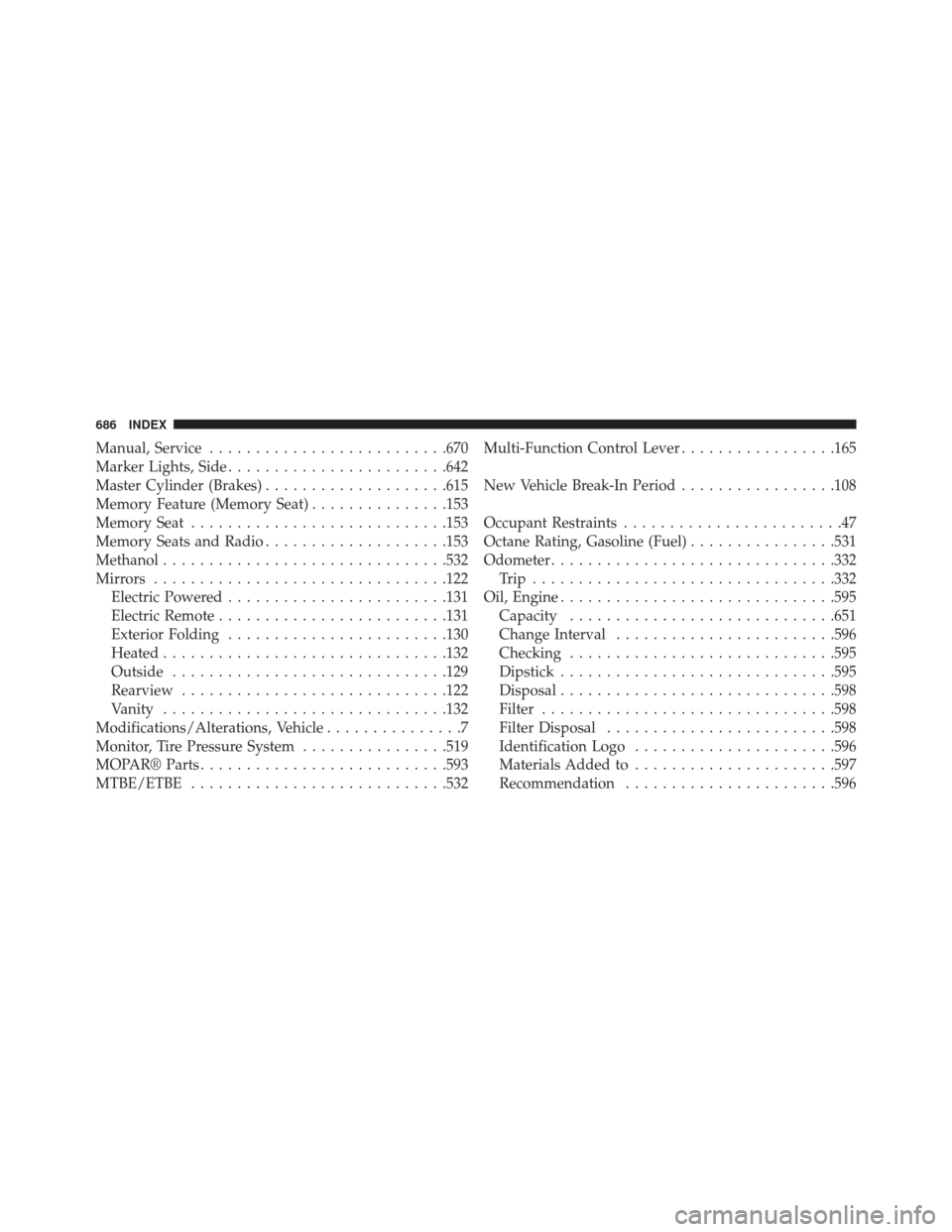
Manual, Service......................... .670
Marker Lights, Side ....................... .642
Master Cylinder (Brakes) ....................615
Memory Feature (Memory Seat) ...............153
Memory Seat ........................... .153
Memory Seats and Radio ....................153
Methanol .............................. .532
Mirrors ............................... .122
Electric Powered ....................... .131
Electric Remote ........................ .131
Exterior Folding ....................... .130
Heated .............................. .132
Outside ............................. .129
Rearview ............................ .122
Vanity .............................. .132
Modifications/Alterations, Vehicle ...............7
Monitor, Tire Pressure System ................519
MOPAR® Parts .......................... .593
MTBE/ETBE ........................... .532Multi-Function Control Lever
.................165
New Vehicle Break-In Period .................108
Occupant Restraints ........................47
Octane Rating, Gasoline (Fuel) ................531
Odometer .............................. .332
Trip ................................ .332
Oil, Engine ............................. .595
Capacity ............................ .651
Change Interval ....................... .596
Checking ............................ .595
Dipstick ............................. .595
Disposal ............................. .598
Filter ............................... .598
Filter Disposal ........................ .598
Identification Logo ..................... .596
Materials Added to ..................... .597
Recommendation ...................... .596
686 INDEX