climate control CHRYSLER 200 2016 2.G Owner's Manual
[x] Cancel search | Manufacturer: CHRYSLER, Model Year: 2016, Model line: 200, Model: CHRYSLER 200 2016 2.GPages: 702, PDF Size: 5.13 MB
Page 425 of 702
Get Started
All you need to control your Uconnect system with your
voice are the buttons on your steering wheel.
1. VisitUconnectPhone.com to check mobile device and
feature compatibility and to find phone pairing in-
structions.
2.
Reduce background noise. Wind and passenger conversa-
tions are examples of noise that may impact recognition.
3. Speak clearly at a normal pace and volume while facing straight ahead. The microphone is positioned
on the rearview mirror and aimed at the driver.
4. Each time you give a Voice Command, you must first push either the VR or Phone button, wait until after
the beep, then say your Voice Command.
5. You can interrupt the help message or system prompts by pushing the VR or Phone button and saying a Voice
Command from current category.
Uconnect Voice Command Buttons
1 — Push To Initiate Or To Answer A Phone Call, Send Or Re-
ceive A Text
2 — For All Radios: Push To Begin Radio Or Media functions. For
8.4A/8.4AN Only: Push To Begin Navigation, Apps And Climate
Functions.
3 — Push To End Call
4
UNDERSTANDING YOUR INSTRUMENT PANEL 423
Page 433 of 702
TIP:Voice Text Reply is not compatible with iPhone, but
if your vehicle is equipped with Siri Eyes Free, you can
use your voice to send a text message.
Climate (8.4A/8.4AN)
Too hot? Too cold? Adjust vehicle temperatures hands-
free and keep everyone comfortable while you keep
moving ahead. (If vehicle is equipped with climate
control.)
Push the VR button
. After the beep, say one of the
following commands:
• Set driver temperature to 70degrees
• Set passenger temperature to 70degreesiPhone Notification Settings
1 — Select “Settings”
2 — Select “Bluetooth”
3 — Select the (i) for the paired vehicle
4 — Turn on “Show Notifications”
4
UNDERSTANDING YOUR INSTRUMENT PANEL 431
Page 483 of 702
For vehicles not equipped with the EVIC/DID, perform
the following steps:
1. Center the steering wheel (front wheels pointingstraight forward).
2. Shift the transmission into PARK.
3. Apply the parking brake.
4. Start the engine.
5. Rotate the steering wheel slightly more than one-half turn to the left.
6. Push the “ESC Off” button located in the lower switch bank below the climate control four times within
twenty seconds. The “ESC Off Indicator Light” should
turn on and turn off two times.
7. Rotate the steering wheel back to center and then an additional slighty more than one-half turn to the right. 8. Turn the ignition switch to the OFF position and then
back to the ON position. If the sequence was com-
pleted properly, the “ESC Off Indicator Light” will
blink several times to confirm HSA is disabled.
9. Repeat these steps if you want to return this feature to its previous setting.
Traction Control System (TCS)
This system monitors the amount of wheel spin of each of
the driven wheels. If wheel spin is detected, the TCS may
apply brake pressure to the spinning wheel(s) and/or
reduce engine power to provide enhanced acceleration
and stability. A feature of the TCS, Brake Limited Differ-
ential (BLD), functions similar to a limited slip differen-
tial and controls the wheel spin across a driven axle. If
one wheel on a driven axle is spinning faster than the
other, the system will apply the brake of the spinning
wheel. This will allow more engine torque to be applied
5
STARTING AND OPERATING 481
Page 634 of 702
Cavity Cartridge FuseBlade FuseDescription
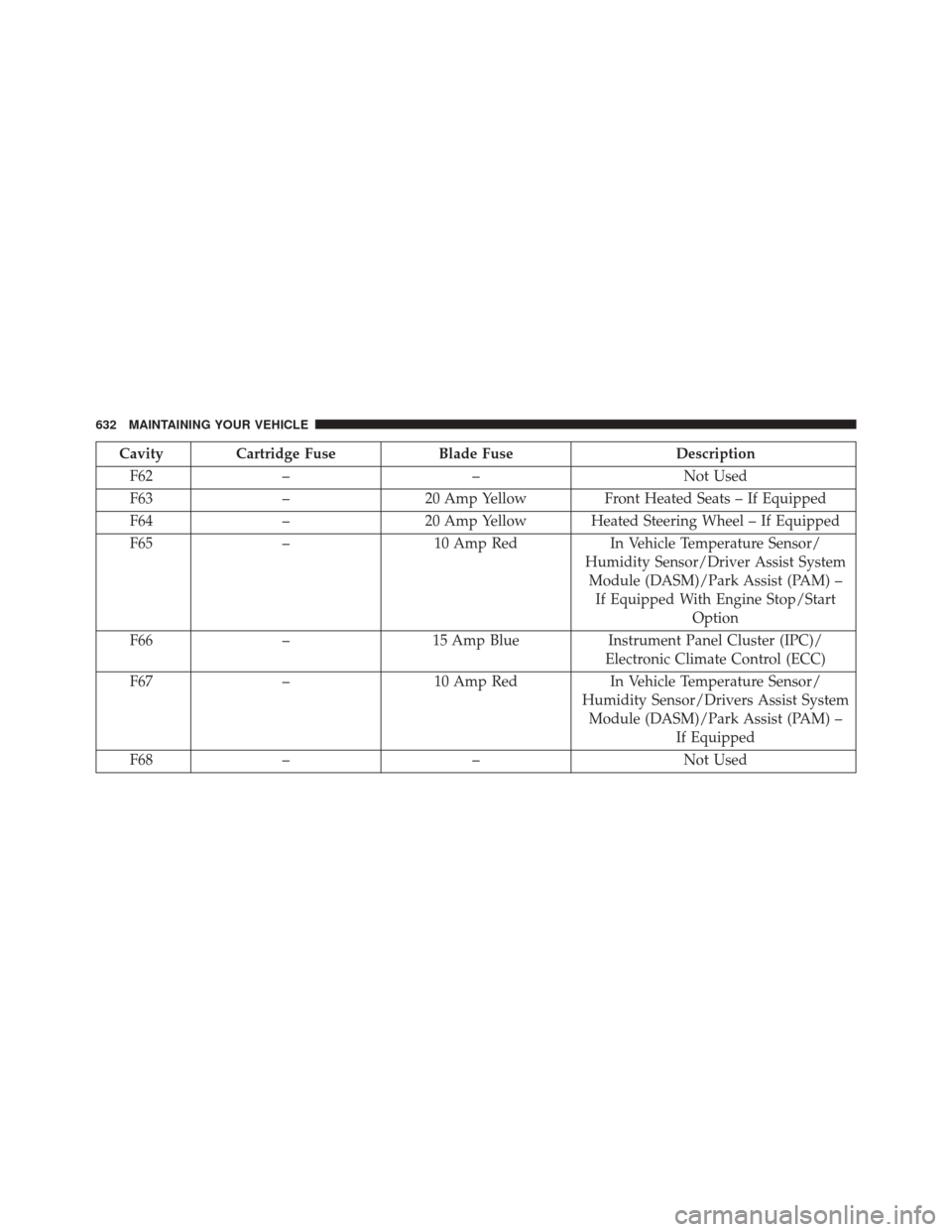
F62 – – Not Used
F63 –20 Amp Yellow Front Heated Seats – If Equipped
F64 –20 Amp Yellow Heated Steering Wheel – If Equipped
F65 –10 Amp Red In Vehicle Temperature Sensor/
Humidity Sensor/Driver Assist System Module (DASM)/Park Assist (PAM) – If Equipped With Engine Stop/Start Option
F66 –15 Amp Blue Instrument Panel Cluster (IPC)/
Electronic Climate Control (ECC)
F67 –10 Amp Red In Vehicle Temperature Sensor/
Humidity Sensor/Drivers Assist System Module (DASM)/Park Assist (PAM) – If Equipped
F68 – – Not Used
632 MAINTAINING YOUR VEHICLE
Page 676 of 702
significantly from the norm due to variations in driving
habits, service practices, and differences in road charac-
teristics and climate.
Traction Grades
The Traction grades, from highest to lowest, are AA, A, B,
and C. These grades represent the tire’s ability to stop on
wet pavement, as measured under controlled conditions
on specified government test surfaces of asphalt and
concrete. A tire marked C may have poor traction perfor-
mance.
WARNING!
The traction grade assigned to this tire is based on
straight-ahead braking traction tests, and does not
include acceleration, cornering, hydroplaning, or
peak traction characteristics.
Temperature Grades
The temperature grades are A (the highest), B, and C,
representing the tire’s resistance to the generation of heat
and its ability to dissipate heat, when tested under
controlled conditions on a specified indoor laboratory
test wheel. Sustained high temperature can cause the
material of the tire to degenerate and reduce tire life, and
excessive temperature can lead to sudden tire failure. The
grade C corresponds to a level of performance, which all
passenger vehicle tires must meet under the Federal
Motor Vehicle Safety Standard No. 109. Grades B and A
represent higher levels of performance on the laboratory
test wheel, than the minimum required by law.
674 IF YOU NEED CONSUMER ASSISTANCE
Page 683 of 702
Child Restraints.........................86
Child Seat Installation .................102, 104
How To Stow An Unused ALR Seat Belt .......101
Infants And Child Restraints ................88
Install A LATCH-Compatible Child Restraint ....99
Installing Child Restraints Using The Vehicle
Seat Belt ............................. .102
LATCH Positions ........................94
Locating The LATCH Anchorages ............97
Lower Anchors And Tethers For Children .......93
Older Children And Child Restraints ..........89
Seating Positions ........................92
Using The Top Tether Anchorage ............105
Child Safety Locks .........................34
Clean Air Gasoline ....................... .525
Cleaning Wheels .............................. .620
Climate Control ......................... .398
Coin Holder ............................ .300Cold Weather Operation
....................448
Compact Spare Tire ....................... .507
Console, Floor .......................... .300
Console, Overhead ....................... .271
Contract, Service ......................... .669
Coolant Pressure Cap (Radiator Cap) ...........612
Cooling System .......................... .609
Adding Coolant (Antifreeze) ...............611
Coolant Capacity ...................... .653
Coolant Level ......................... .613
Disposal Of Used Coolant .................613
Drain, Flush, And Refill ...................610
Inspection ........................ .609, 613
Points To Remember .....................614
Pressure Cap ......................... .612
Radiator Cap ......................... .612
Selection Of Coolant (Antifreeze) ......610, 653, 654
Corrosion Protection ...................... .618
Cruise Control (Speed Control) ............182, 371
10
INDEX 681