child restraint CHRYSLER 200 2016 2.G Owner's Guide
[x] Cancel search | Manufacturer: CHRYSLER, Model Year: 2016, Model line: 200, Model: CHRYSLER 200 2016 2.GPages: 702, PDF Size: 5.13 MB
Page 108 of 702
2. Rotate or lift the cover to access the anchor directlybehind the seat where you are placing the child
restraint.
3. Route the tether strap to provide the most direct path for the strap between the anchor and the child seat. If
your vehicle is equipped with adjustable rear head
restraints, raise the head restraint, and where possible,
route the tether strap under the head restraint and
between the two posts. If not possible, lower the head
restraint and pass the tether strap around the outboard
side of the head restraint.
4. Attach the tether strap hook of the child restraint tothe top tether anchorage as shown in the diagram.
Tether Strap Mounting
1 — Cover
3 — Attaching StrapA — Tether Strap Hook
B — Tether Anchor
106 THINGS TO KNOW BEFORE STARTING YOUR VEHICLE
Page 109 of 702
5. Remove slack in the tether strap according to the childrestraint manufacturer ’s instructions.
WARNING!
•An incorrectly anchored tether strap could lead to
increased head motion and possible injury to the
child. Use only the anchorage position directly
behind the child seat to secure a child restraint top
tether strap.
• If your vehicle is equipped with a split rear seat,
make sure the tether strap does not slip into the
opening between the seatbacks as you remove
slack in the strap.
Transporting Pets
Air Bags deploying in the front seat could harm your pet.
An unrestrained pet will be thrown about and possibly
injured, or injure a passenger during panic braking or in
a collision.
Pets should be restrained in the rear seat in pet harnesses
or pet carriers that are secured by seat belts.
ENGINE BREAK-IN RECOMMENDATIONS
A long break-in period is not required for the engine and
drivetrain (transmission and axle) in your vehicle.
Drive moderately during the first 300 miles (500 km).
After the initial 60 miles (100 km), speeds up to 50 or
55 mph (80 or 90 km/h) are desirable.
2
THINGS TO KNOW BEFORE STARTING YOUR VEHICLE 107
Page 155 of 702
WARNING!
•Be certain that the seatback is securely locked into
position. If the seatback is not securely locked into
position the seat will not provide the proper stabil-
ity for child seats and/or passengers. An improp-
erly latched seat could cause serious injury.
• The rear cargo area of the vehicle (with the rear
seatbacks in the locked-up or folded down posi-
tion) should not be used as a play area by children.
They could be seriously injured in a collision.
Children should be seated and using the proper
restraint system.
DRIVER MEMORY SEAT — IF EQUIPPED
This feature allows the driver to store up to two different
memory profiles, for easy recall through a memory
switch. Each memory profile contains desired position
settings for the driver seat and side mirrors and a set of
desired radio station presets.
The memory switch is located on the driver’s side door
panel. The switch contains 3 buttons, a S (SET) button to
activate the memory save function, the number (1)
memory button and the number (2) memory button. The
memory switch allows the driver to recall either of the
two pre-programmed memory profiles by pushing the
appropriate number button on the switch.
3
UNDERSTANDING THE FEATURES OF YOUR VEHICLE 153
Page 308 of 702
WARNING!
•Be certain that the seatback is securely locked into
position. If the seatback is not securely locked into
position, the seat will not provide the proper sta-
bility for child seats and/or passengers. An improp-
erly latched seat could cause serious injury.
• The cargo area in the rear of the vehicle (with the
rear seatbacks in the locked-up or folded down
position) should not be used as a play area by
children when the vehicle is in motion. They could
be seriously injured in a collision. Children should
be seated and using the proper restraint system.
• To help protect against personal injury, passengers
should not be seated in the rear cargo area. The rear
cargo space is intended for load carrying purposes
only, not for passengers, who should sit in seats
and use seat belts.
WARNING!
The weight and position of cargo and passengers can
change the vehicle center of gravity and vehicle
handling. To avoid loss of control resulting in per-
sonal injury, follow these guidelines for loading your
vehicle:
• Always place cargo evenly on the cargo floor. Put
heavier objects as low and as far forward as pos-
sible.
• Place as much cargo as possible in front of the rear
axle. Too much weight or improperly placed weight
over or behind the rear axle can cause the rear of
the vehicle to sway.
• Do not pile luggage or cargo higher than the top of
the seatback. This could impair visibility or be-
come a dangerous projectile in a sudden stop or
collision.
306 UNDERSTANDING THE FEATURES OF YOUR VEHICLE
Page 682 of 702
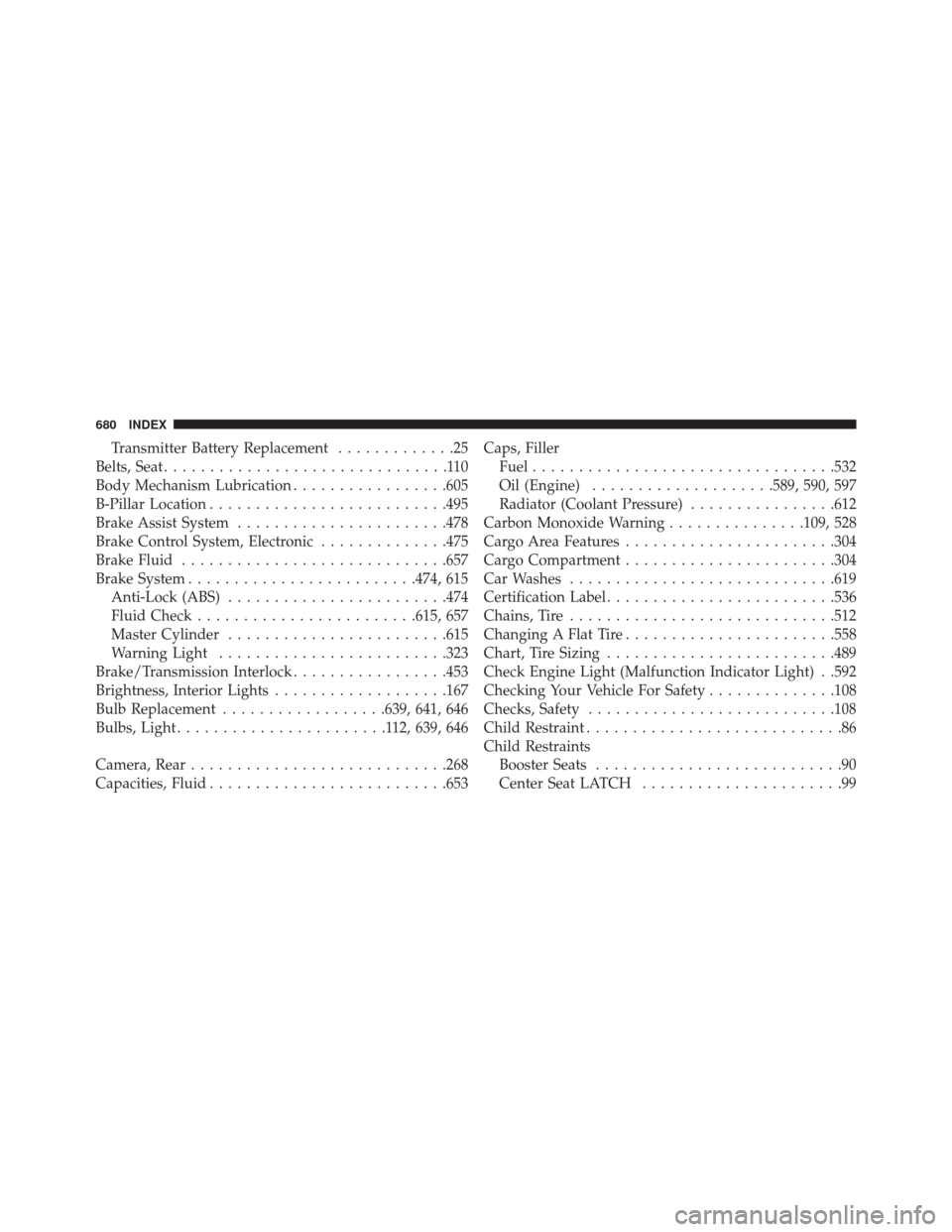
Transmitter Battery Replacement.............25
Belts, Seat ...............................110
Body Mechanism Lubrication .................605
B-Pillar Location ......................... .495
Brake Assist System ...................... .478
Brake Control System, Electronic ..............475
Brake Fluid ............................ .657
Brake System ........................ .474, 615
Anti-Lock (ABS) ....................... .474
Fluid Check ....................... .615, 657
Master Cylinder ....................... .615
Warning Light ........................ .323
Brake/Transmission Interlock .................453
Brightness, Interior Lights ...................167
Bulb Replacement ..................639, 641, 646
Bulbs, Light .......................112, 639, 646
Camera, Rear ........................... .268
Capacities, Fluid ......................... .653Caps, Filler
Fuel ................................ .532
Oil (Engine) ....................589, 590, 597
Radiator (Coolant Pressure) ................612
Carbon Monoxide Warning ...............109, 528
Cargo Area Features ...................... .304
Cargo Compartment ...................... .304
Car Washes ............................ .619
Certification Label ........................ .536
Chains, Tire ............................ .512
Changing A Flat Tire ...................... .558
Chart, Tire Sizing ........................ .489
Check Engine Light (Malfunction Indicator Light) . .592
Checking Your Vehicle For Safety ..............108
Checks, Safety .......................... .108
Child Restraint ............................86
Child Restraints Booster Seats ...........................90
Center Seat LATCH ......................99
680 INDEX
Page 683 of 702
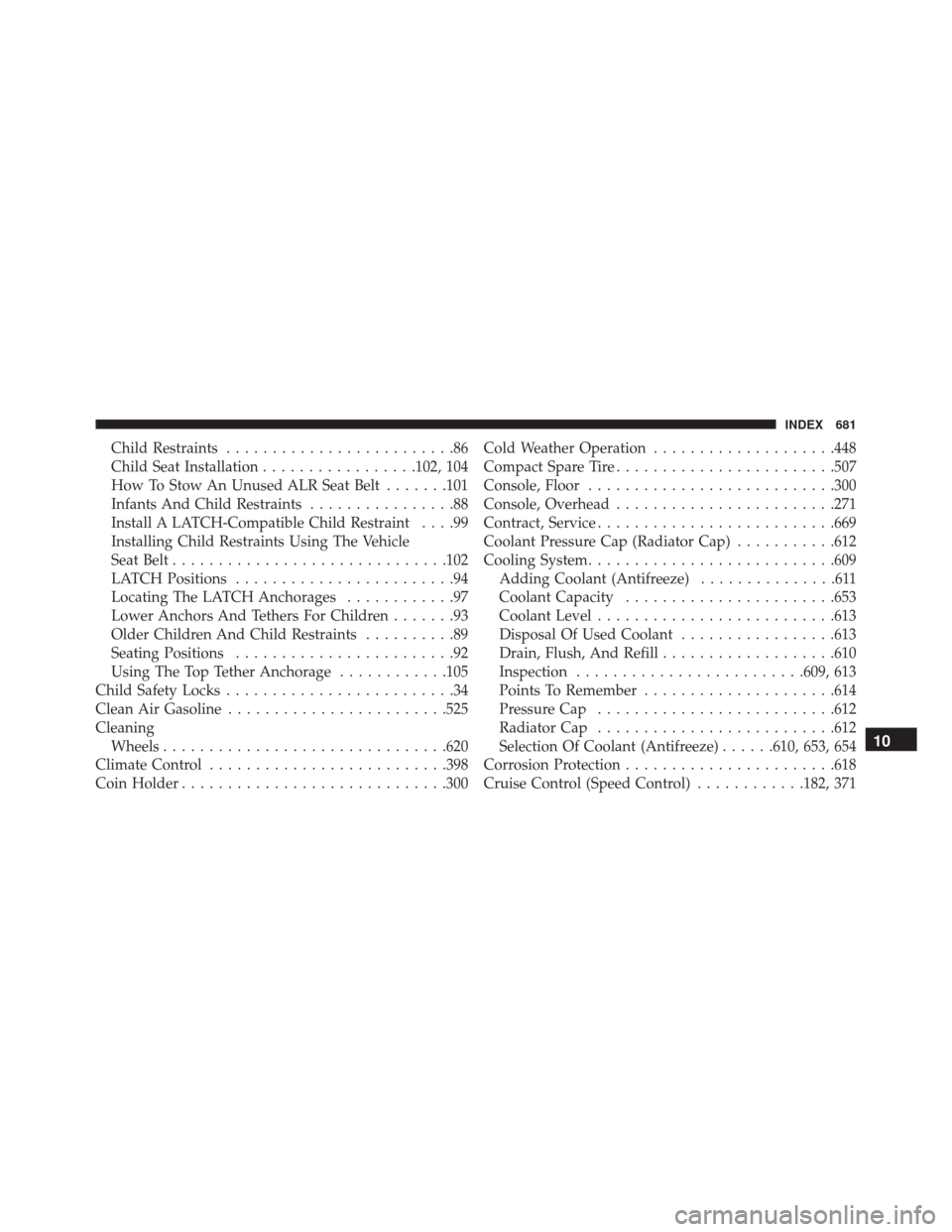
Child Restraints.........................86
Child Seat Installation .................102, 104
How To Stow An Unused ALR Seat Belt .......101
Infants And Child Restraints ................88
Install A LATCH-Compatible Child Restraint ....99
Installing Child Restraints Using The Vehicle
Seat Belt ............................. .102
LATCH Positions ........................94
Locating The LATCH Anchorages ............97
Lower Anchors And Tethers For Children .......93
Older Children And Child Restraints ..........89
Seating Positions ........................92
Using The Top Tether Anchorage ............105
Child Safety Locks .........................34
Clean Air Gasoline ....................... .525
Cleaning Wheels .............................. .620
Climate Control ......................... .398
Coin Holder ............................ .300Cold Weather Operation
....................448
Compact Spare Tire ....................... .507
Console, Floor .......................... .300
Console, Overhead ....................... .271
Contract, Service ......................... .669
Coolant Pressure Cap (Radiator Cap) ...........612
Cooling System .......................... .609
Adding Coolant (Antifreeze) ...............611
Coolant Capacity ...................... .653
Coolant Level ......................... .613
Disposal Of Used Coolant .................613
Drain, Flush, And Refill ...................610
Inspection ........................ .609, 613
Points To Remember .....................614
Pressure Cap ......................... .612
Radiator Cap ......................... .612
Selection Of Coolant (Antifreeze) ......610, 653, 654
Corrosion Protection ...................... .618
Cruise Control (Speed Control) ............182, 371
10
INDEX 681
Page 695 of 702
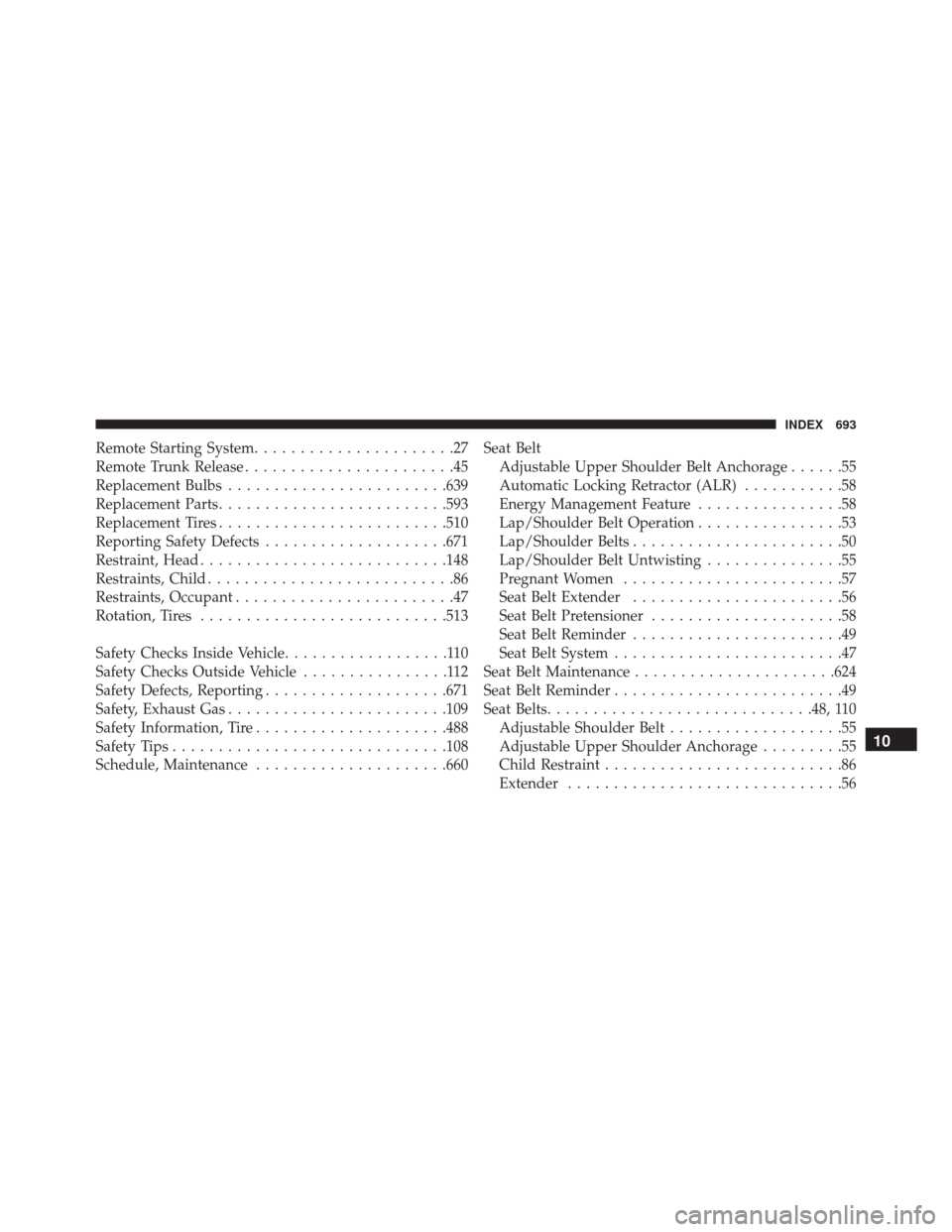
Remote Starting System......................27
Remote Trunk Release .......................45
Replacement Bulbs ....................... .639
Replacement Parts ........................ .593
Replacement Tires ........................ .510
Reporting Safety Defects ....................671
Restraint, Head .......................... .148
Restraints, Child ...........................86
Restraints, Occupant ........................47
Rotation, Tires .......................... .513
Safety Checks Inside Vehicle ..................110
Safety Checks Outside Vehicle ................112
Safety Defects, Reporting ....................671
Safety, Exhaust Gas ....................... .109
Safety Information, Tire .....................488
Safety Tips ............................. .108
Schedule, Maintenance .....................660 Seat Belt
Adjustable Upper Shoulder Belt Anchorage ......55
Automatic Locking Retractor (ALR) ...........58
Energy Management Feature ................58
Lap/Shoulder Belt Operation ................53
Lap/Shoulder Belts .......................50
Lap/Shoulder Belt Untwisting ...............55
Pregnant Women ........................57
Seat Belt Extender .......................56
Seat Belt Pretensioner .....................58
Seat Belt Reminder .......................49
Seat Belt System .........................47
Seat Belt Maintenance ..................... .624
Seat Belt Reminder .........................49
Seat Belts ............................ .48, 110
Adjustable Shoulder Belt ...................55
Adjustable Upper Shoulder Anchorage .........55
Child Restraint ..........................86
Extender ..............................56
10
INDEX 693