belt CHRYSLER 200 2016 2.G Repair Manual
[x] Cancel search | Manufacturer: CHRYSLER, Model Year: 2016, Model line: 200, Model: CHRYSLER 200 2016 2.GPages: 702, PDF Size: 5.13 MB
Page 357 of 702
Secondary Method Of Navigating To The Oil Life
Screen In The DID And Holding OK
1. Without pushing the brake pedal, push the ENGINESTART/STOP button and cycle the ignition to the
ON/RUN position (do not start the engine).
2. Push and release the DOWNarrow button to scroll
downward through the main menu to “Vehicle Info.”
3. Push and release the RIGHTarrow button to access
the “Oil Life” screen.
4. Push and hold the OKbutton to reset of the Oil Life.
5. Push and release the UParrow button to exit the
screen.
NOTE: If the indicator message illuminates when you
start the vehicle, the oil change indicator system did not
reset. If necessary, repeat this procedure.Instrument Cluster Messages For (EVIC) And
(DID)
• Front Seatbelts Unbuckled
• Driver Seatbelt Unbuckled
• Passenger Seatbelt Unbuckled
• Service Airbag System
• Traction Control Off
• Washer Fluid Low
• Oil Pressure Low
• Oil Change Due
• Fuel Low
• Service Antilock Brake System
• Service Electronic Throttle Control
4
UNDERSTANDING YOUR INSTRUMENT PANEL 355
Page 369 of 702
OKbutton. To reset the oil change indicator system (after
performing the scheduled maintenance), refer to the
following procedure.
1. Without pushing the brake pedal, push the ENGINE START/STOP button and cycle the ignition to the
ON/RUN position (do not start the engine).
2. Fully push the accelerator pedal, slowly, three times within 10 seconds.
3. Without pushing the brake pedal, push the ENGINE START/STOP button once to return the ignition to the
OFF/LOCK position.
Secondary Method Of Navigating To The Oil Life
Screen In The DID And Holding OK
1. Without pushing the brake pedal, push the ENGINE START/STOP button and cycle the ignition to the
ON/RUN position (do not start the engine). 2. Push and release the
DOWNarrow button to scroll
downward through the main menu to “Vehicle Info.”
3. Push and release the RIGHTarrow button to access
the “Oil Life” screen.
4. Push and hold the OKbutton to reset of the Oil Life.
5. Push and release the UParrow button to exit the
screen.
NOTE: If the indicator message illuminates when you
start the vehicle, the oil change indicator system did not
reset. If necessary, repeat this procedure.
Instrument Cluster Messages For (EVIC) And
(DID)
• Front Seatbelts Unbuckled
• Driver Seatbelt Unbuckled
• Passenger Seatbelt Unbuckled
4
UNDERSTANDING YOUR INSTRUMENT PANEL 367
Page 449 of 702
STARTING PROCEDURES
Before starting your vehicle, adjust your seat, adjust both
inside and outside mirrors, and fasten your seat belts.
WARNING!
•When leaving the vehicle, always remove the Key
Fob from the ignition and lock your vehicle.
• Never leave children alone in a vehicle, or with
access to an unlocked vehicle.
• Allowing children to be in a vehicle unattended is
dangerous for a number of reasons. A child or
others could be seriously or fatally injured. Chil-
dren should be warned not to touch the parking
brake, brake pedal or the gear selector/shift lever.
• Do not leave the Key Fob in or near the vehicle, or
in a location accessible to children, and do not
leave the ignition of a vehicle equipped with
(Continued)
WARNING! (Continued)
Keyless Enter-N-Go in the ACC or ON/RUN mode.
A child could operate power windows, other con-
trols, or move the vehicle.
Start the engine with the shift lever in the NEUTRAL or
PARK position. Apply the brake before shifting to any
driving range.
Normal Starting
NOTE: Normal starting of either a cold or a warm engine
is obtained without pumping or pressing the accelerator
pedal.
Cycle the ignition switch to the START position and
release when the engine starts. If the engine fails to start
within 10 seconds, cycle the ignition switch to the
LOCK/OFF position, wait 10 to 15 seconds, then repeat
the “Normal Starting” procedure.
5
STARTING AND OPERATING 447
Page 472 of 702
The park brake will release automatically when the
ignition is cycled to the RUN position, the transmission is
in DRIVE or REVERSE, the driver seat belt is buckled,
and an attempt is made to drive away by pressing the
accelerator pedal.
To release the parking brake manually, the ignition
switch must be in the RUN position. Press on the brake
pedal, then push the park brake switch down momen-
tarily. You may hear a slight whirring sound from the
back of the vehicle while the parking brake disengages.
You may also notice a small amount of movement in the
brake pedal. Once the park brake is fully disengaged, The
BRAKE warning lamp in the instrument cluster and the
LED indicator on the switch will extinguish.NOTE:
When parking on a hill, it is important to turn the
front wheels toward the curb on a downhill grade and
away from the curb on an uphill grade. Apply the park
brake before placing the shift lever in PARK, otherwise
the load on the transmission locking mechanism may
make it difficult to move the shift lever out of PARK. The
park brake should always be applied whenever the
driver is not in the vehicle.
WARNING!
• Never use the PARK position as a substitute for the
parking brake. Always apply the parking brake
fully when parked to guard against vehicle move-
ment and possible injury or damage.
• When leaving the vehicle, always make sure the
ignition is in the OFF mode, remove the Key Fob
from the vehicle, and lock your vehicle.
(Continued)
470 STARTING AND OPERATING
Page 475 of 702
the vehicle is left unsecured. If the automatic transmis-
sion is not in PARK, the seat belt is unbuckled, the driver
door is open, the vehicle is at a standstill, and there is no
attempt to depress the brake pedal or accelerator pedal,
the park brake will automatically engage to prevent the
vehicle from rolling.
SafeHold can be temporarily bypassed by pressing the
Electric Park Brake Switch to the release position while
the driver door is open. Once manually bypassed, Safe-
Hold will be enabled again once the vehicle reaches
12 mph (20 km/h) or the ignition is cycled to the OFF
position and back to ON again.
Brake Service Mode
We recommend having your brakes serviced by your
authorized dealer. You should only make repairs for
which you have the knowledge and the right equipment.
You should only enter Brake Service Mode during brake
service.When servicing your rear brakes, it may be necessary for
you or your technician push the rear piston into the rear
caliper bore. With the Electric Park Brake system, this can
only be done after retracting the Electric Park Brake
actuator. Fortunately, actuator retraction can be done
easily by entering the Brake Service Mode through EVIC
(Electronic Vehicle Information Center), Driver Informa-
tion Display (DID) or the Uconnect Settings in your
vehicle. This menu based system will guide you through
the steps necessary to retract the EPB actuator in order to
perform rear brake service.
Service Mode has requirements that must be met in order
to be activated:
•
The vehicle must be at a standstill.
• The park brake must be unapplied.
• The transmission must be in PARK or NEUTRAL.
5
STARTING AND OPERATING 473
Page 603 of 702
Air Conditioner Maintenance
For best possible performance, your air conditioner
should be checked and serviced by an authorized dealer
at the start of each warm season. This service should
include cleaning of the condenser fins and a performance
test. Drive belt tension should also be checked at this
time.
WARNING!
•Use only refrigerants and compressor lubricants
approved by the manufacturer for your air condi-
tioning system. Some unapproved refrigerants are
flammable and can explode, injuring you. Other
unapproved refrigerants or lubricants can cause the
system to fail, requiring costly repairs. Refer to
Warranty Information Book, located on the DVD,
for further warranty information.
(Continued)
WARNING! (Continued)
•The air conditioning system contains refrigerant
under high pressure. To avoid risk of personal
injury or damage to the system, adding refrigerant
or any repair requiring lines to be disconnected
should be done by an experienced technician.
CAUTION!
Do not use chemical flushes in your air conditioning
system as the chemicals can damage your air condi-
tioning components. Such damage is not covered by
the New Vehicle Limited Warranty.
Refrigerant Recovery And Recycling HFO 1234yf
HFO 1234yf Air Conditioning Refrigerant is a hydro-
fluoolefine HFO that is endorsed by the Environmental
Protection Agency and is an ozone-saving product. The
7
MAINTAINING YOUR VEHICLE 601
Page 626 of 702
Cleaning Plastic Instrument Cluster Lenses
The lenses in front of the instruments in this vehicle are
molded in clear plastic. When cleaning the lenses, care
must be taken to avoid scratching the plastic.
1. Clean with a wet soft cloth. A mild soap solution maybe used, but do not use high alcohol content or
abrasive cleaners. If soap is used, wipe clean with a
clean damp cloth.
2. Dry with a soft cloth.
Seat Belt Maintenance
Do not bleach, dye or clean the belts with chemical
solvents or abrasive cleaners. This will weaken the fabric.
Sun damage can also weaken the fabric. If the belts need cleaning, use a mild soap solution or
lukewarm water. Do not remove the belts from the
vehicle to wash them. Dry with a soft cloth.
Replace the belts if they appear frayed or worn or if the
buckles do not work properly.
WARNING!
A frayed or torn belt could rip apart in a collision and
leave you with no protection. Inspect the belt system
periodically, checking for cuts, frays, or loose parts.
Damaged parts must be replaced immediately. Do
not disassemble or modify the system. Seat belt
assemblies must be replaced after a collision if they
have been damaged (i.e., bent retractor, torn web-
bing, etc.).
624 MAINTAINING YOUR VEHICLE
Page 664 of 702
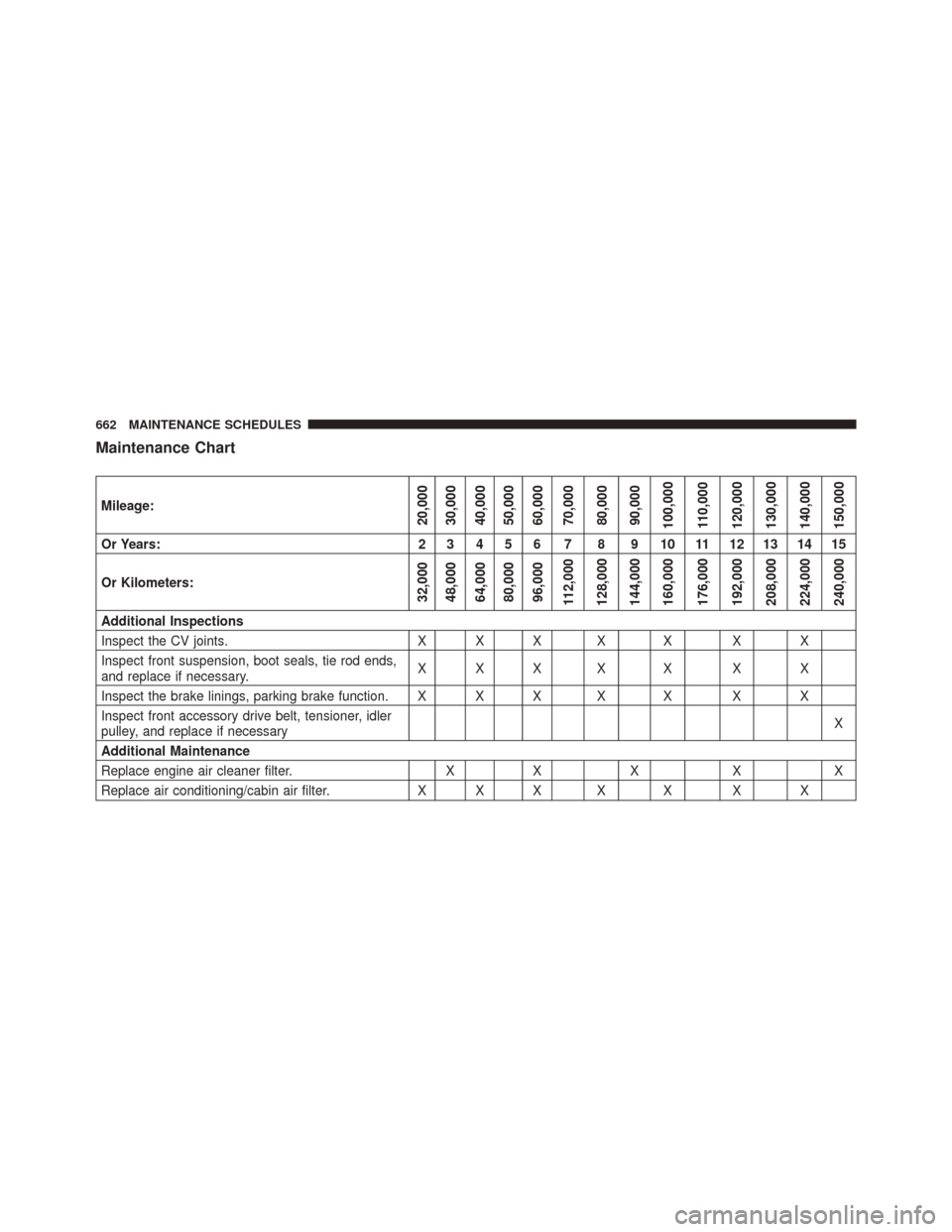
Maintenance Chart
Mileage:20,000
30,000
40,000
50,000
60,000
70,000
80,000
90,000
100,000
110,000
120,000
130,000
140,000
150,000
Or Years: 2 3 4 5 6 7 8 9 10 11 12 13 14 15
Or Kilometers:
32,000
48,000
64,000
80,000
96,000
112,000
128,000
144,000
160,000
176,000
192,000
208,000
224,000
240,000
Additional Inspections
Inspect the CV joints. X X X X X X X
Inspect front suspension, boot seals, tie rod ends,
and replace if necessary. XXX X X X X
Inspect the brake linings, parking brake function. X X X X X X X
Inspect front accessory drive belt, tensioner, idler
pulley, and replace if necessary X
Additional Maintenance
Replace engine air cleaner filter. XX X XX
Replace air conditioning/cabin air filter. X X X X X X X
662 MAINTENANCE SCHEDULES
Page 682 of 702
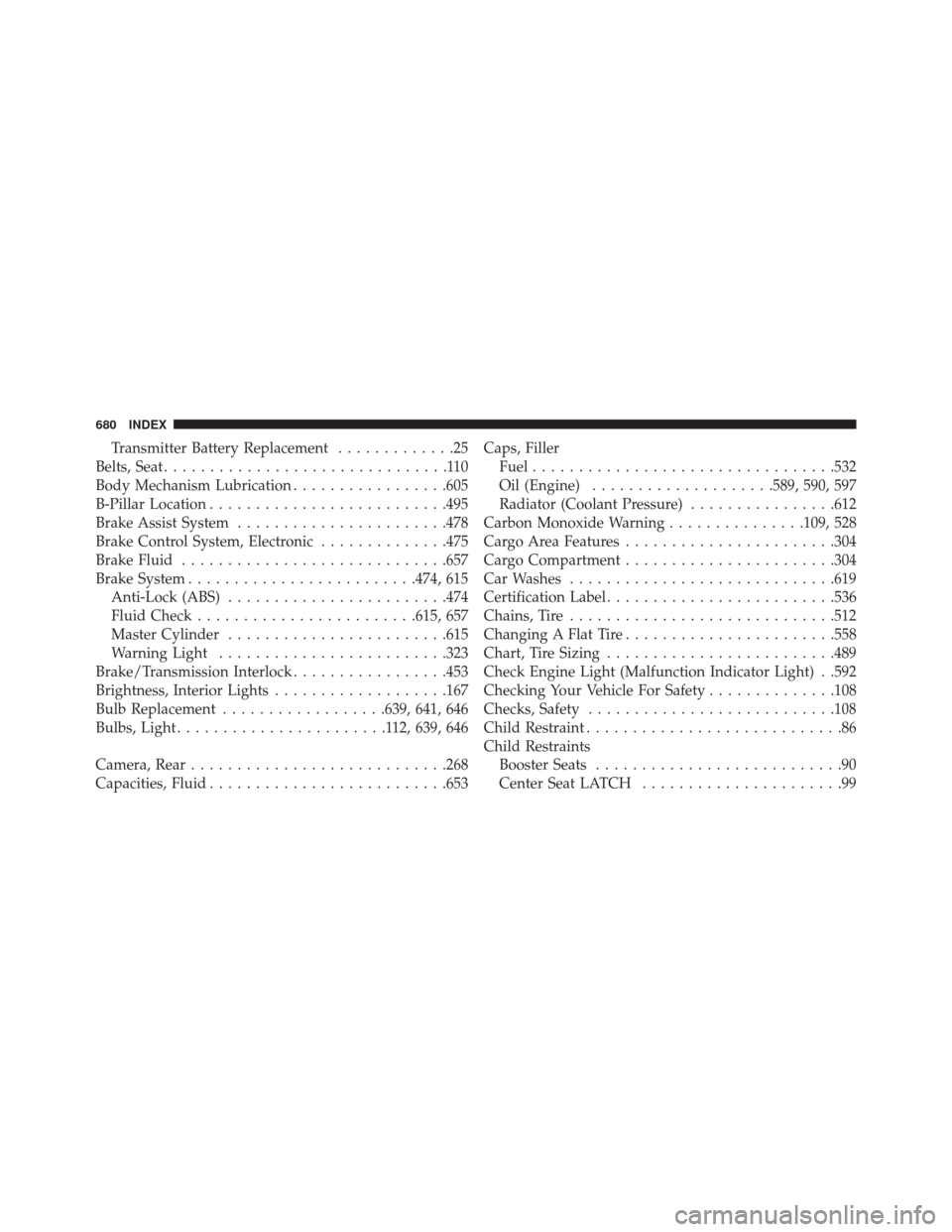
Transmitter Battery Replacement.............25
Belts, Seat ...............................110
Body Mechanism Lubrication .................605
B-Pillar Location ......................... .495
Brake Assist System ...................... .478
Brake Control System, Electronic ..............475
Brake Fluid ............................ .657
Brake System ........................ .474, 615
Anti-Lock (ABS) ....................... .474
Fluid Check ....................... .615, 657
Master Cylinder ....................... .615
Warning Light ........................ .323
Brake/Transmission Interlock .................453
Brightness, Interior Lights ...................167
Bulb Replacement ..................639, 641, 646
Bulbs, Light .......................112, 639, 646
Camera, Rear ........................... .268
Capacities, Fluid ......................... .653Caps, Filler
Fuel ................................ .532
Oil (Engine) ....................589, 590, 597
Radiator (Coolant Pressure) ................612
Carbon Monoxide Warning ...............109, 528
Cargo Area Features ...................... .304
Cargo Compartment ...................... .304
Car Washes ............................ .619
Certification Label ........................ .536
Chains, Tire ............................ .512
Changing A Flat Tire ...................... .558
Chart, Tire Sizing ........................ .489
Check Engine Light (Malfunction Indicator Light) . .592
Checking Your Vehicle For Safety ..............108
Checks, Safety .......................... .108
Child Restraint ............................86
Child Restraints Booster Seats ...........................90
Center Seat LATCH ......................99
680 INDEX
Page 683 of 702
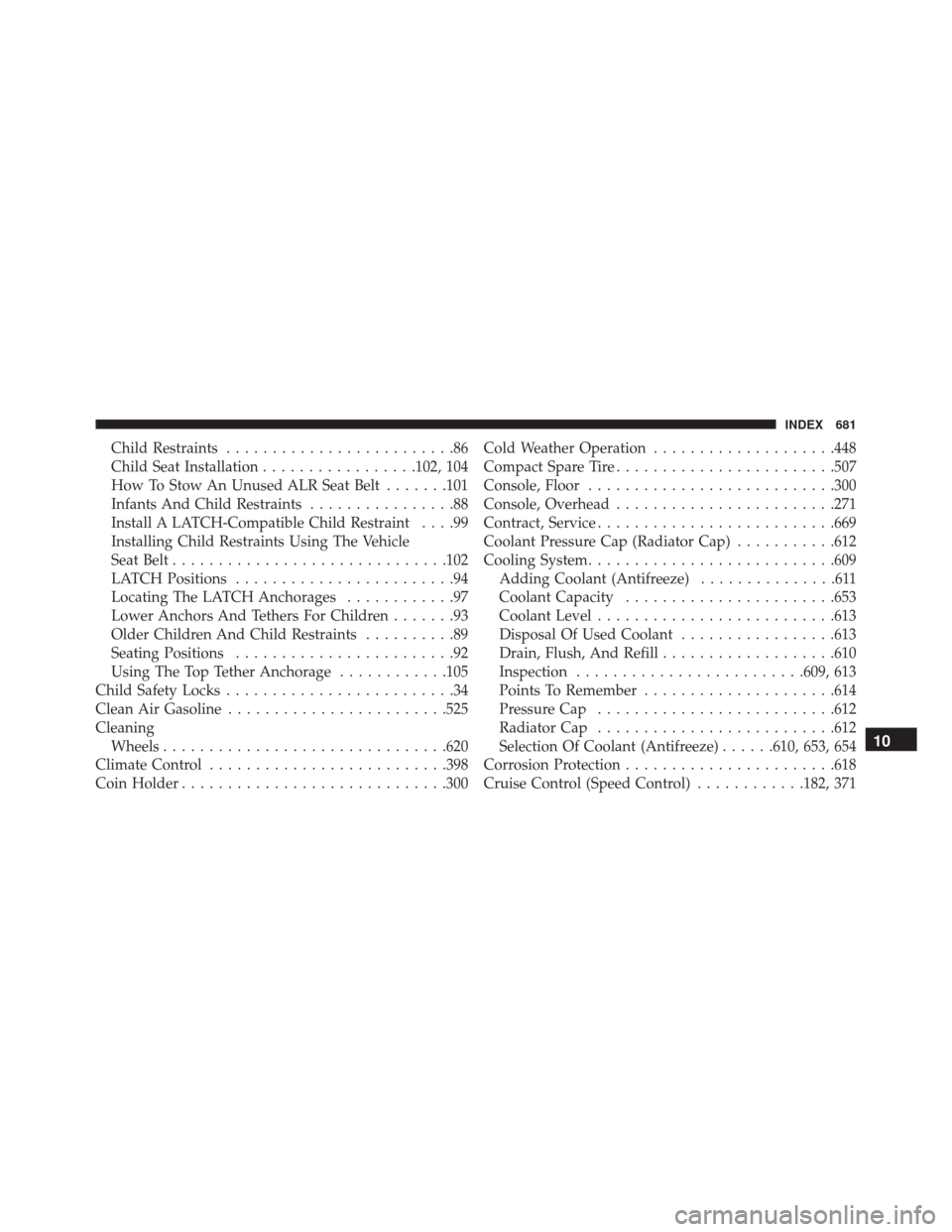
Child Restraints.........................86
Child Seat Installation .................102, 104
How To Stow An Unused ALR Seat Belt .......101
Infants And Child Restraints ................88
Install A LATCH-Compatible Child Restraint ....99
Installing Child Restraints Using The Vehicle
Seat Belt ............................. .102
LATCH Positions ........................94
Locating The LATCH Anchorages ............97
Lower Anchors And Tethers For Children .......93
Older Children And Child Restraints ..........89
Seating Positions ........................92
Using The Top Tether Anchorage ............105
Child Safety Locks .........................34
Clean Air Gasoline ....................... .525
Cleaning Wheels .............................. .620
Climate Control ......................... .398
Coin Holder ............................ .300Cold Weather Operation
....................448
Compact Spare Tire ....................... .507
Console, Floor .......................... .300
Console, Overhead ....................... .271
Contract, Service ......................... .669
Coolant Pressure Cap (Radiator Cap) ...........612
Cooling System .......................... .609
Adding Coolant (Antifreeze) ...............611
Coolant Capacity ...................... .653
Coolant Level ......................... .613
Disposal Of Used Coolant .................613
Drain, Flush, And Refill ...................610
Inspection ........................ .609, 613
Points To Remember .....................614
Pressure Cap ......................... .612
Radiator Cap ......................... .612
Selection Of Coolant (Antifreeze) ......610, 653, 654
Corrosion Protection ...................... .618
Cruise Control (Speed Control) ............182, 371
10
INDEX 681