engine overheat CHRYSLER 200 2017 2.G User Guide
[x] Cancel search | Manufacturer: CHRYSLER, Model Year: 2017, Model line: 200, Model: CHRYSLER 200 2017 2.GPages: 539, PDF Size: 5.18 MB
Page 441 of 539
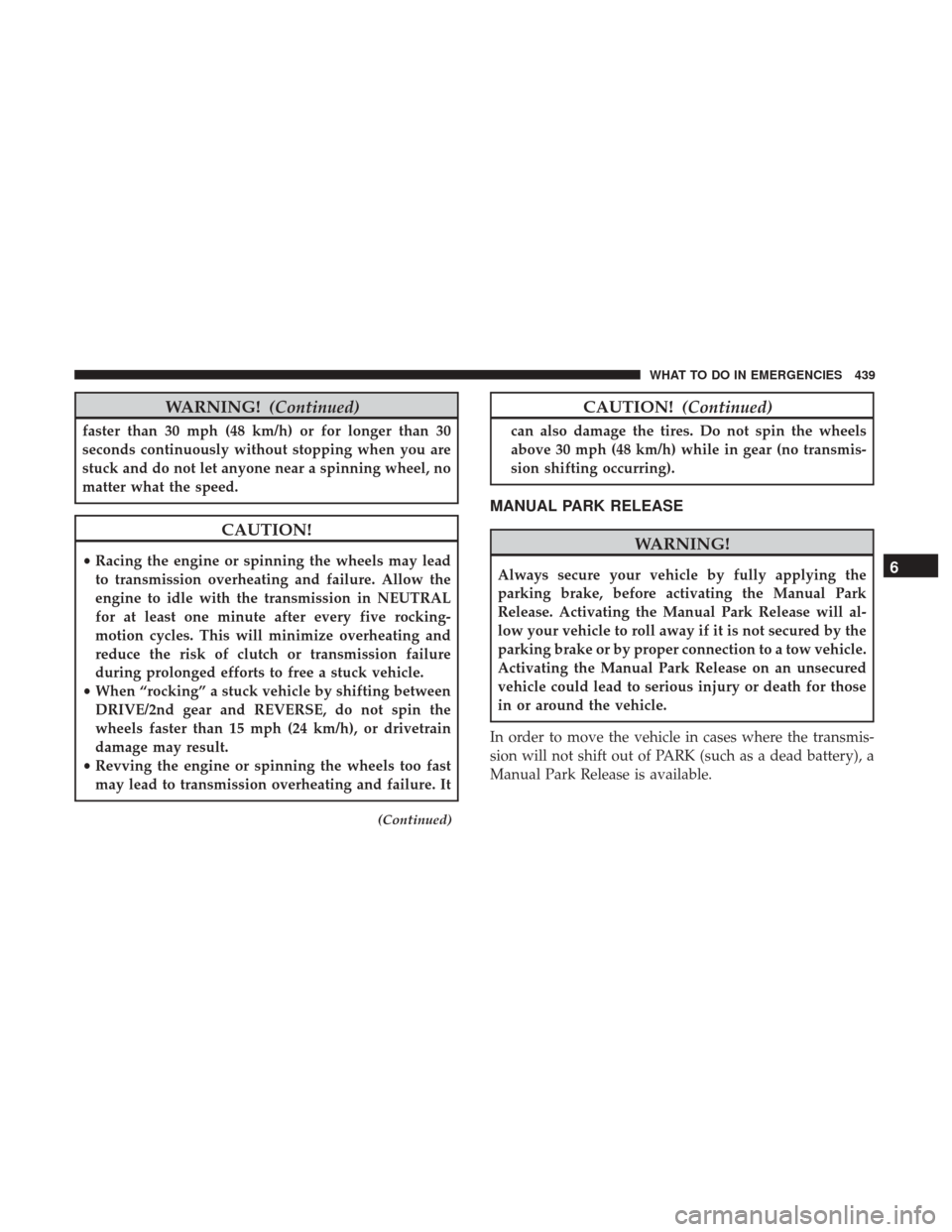
WARNING!(Continued)
faster than 30 mph (48 km/h) or for longer than 30
seconds continuously without stopping when you are
stuck and do not let anyone near a spinning wheel, no
matter what the speed.
CAUTION!
•Racing the engine or spinning the wheels may lead
to transmission overheating and failure. Allow the
engine to idle with the transmission in NEUTRAL
for at least one minute after every five rocking-
motion cycles. This will minimize overheating and
reduce the risk of clutch or transmission failure
during prolonged efforts to free a stuck vehicle.
• When “rocking” a stuck vehicle by shifting between
DRIVE/2nd gear and REVERSE, do not spin the
wheels faster than 15 mph (24 km/h), or drivetrain
damage may result.
• Revving the engine or spinning the wheels too fast
may lead to transmission overheating and failure. It
(Continued)
CAUTION! (Continued)
can also damage the tires. Do not spin the wheels
above 30 mph (48 km/h) while in gear (no transmis-
sion shifting occurring).
MANUAL PARK RELEASE
WARNING!
Always secure your vehicle by fully applying the
parking brake, before activating the Manual Park
Release. Activating the Manual Park Release will al-
low your vehicle to roll away if it is not secured by the
parking brake or by proper connection to a tow vehicle.
Activating the Manual Park Release on an unsecured
vehicle could lead to serious injury or death for those
in or around the vehicle.
In order to move the vehicle in cases where the transmis-
sion will not shift out of PARK (such as a dead battery), a
Manual Park Release is available.6
WHAT TO DO IN EMERGENCIES 439
Page 466 of 539
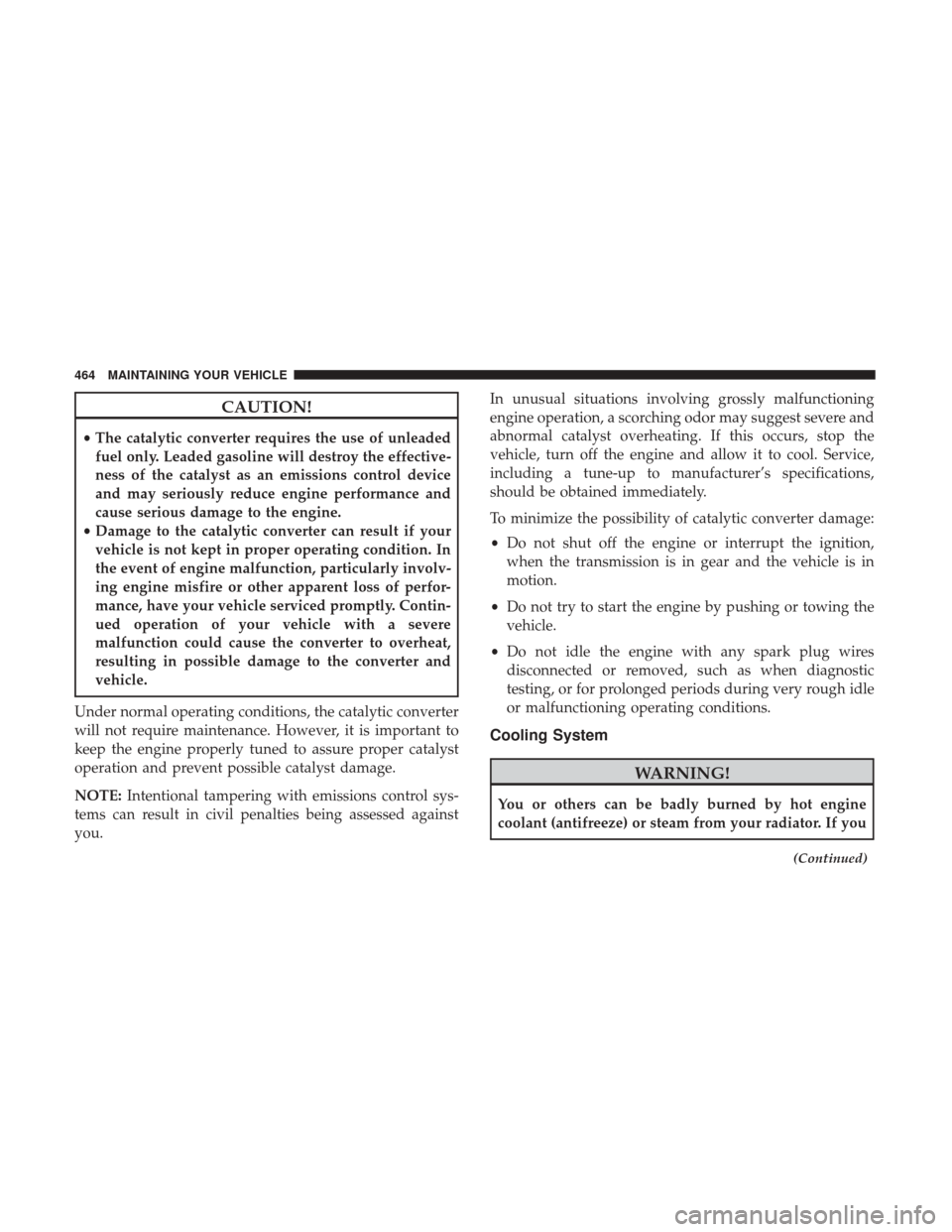
CAUTION!
•The catalytic converter requires the use of unleaded
fuel only. Leaded gasoline will destroy the effective-
ness of the catalyst as an emissions control device
and may seriously reduce engine performance and
cause serious damage to the engine.
• Damage to the catalytic converter can result if your
vehicle is not kept in proper operating condition. In
the event of engine malfunction, particularly involv-
ing engine misfire or other apparent loss of perfor-
mance, have your vehicle serviced promptly. Contin-
ued operation of your vehicle with a severe
malfunction could cause the converter to overheat,
resulting in possible damage to the converter and
vehicle.
Under normal operating conditions, the catalytic converter
will not require maintenance. However, it is important to
keep the engine properly tuned to assure proper catalyst
operation and prevent possible catalyst damage.
NOTE: Intentional tampering with emissions control sys-
tems can result in civil penalties being assessed against
you. In unusual situations involving grossly malfunctioning
engine operation, a scorching odor may suggest severe and
abnormal catalyst overheating. If this occurs, stop the
vehicle, turn off the engine and allow it to cool. Service,
including a tune-up to manufacturer’s specifications,
should be obtained immediately.
To minimize the possibility of catalytic converter damage:
•
Do not shut off the engine or interrupt the ignition,
when the transmission is in gear and the vehicle is in
motion.
• Do not try to start the engine by pushing or towing the
vehicle.
• Do not idle the engine with any spark plug wires
disconnected or removed, such as when diagnostic
testing, or for prolonged periods during very rough idle
or malfunctioning operating conditions.
Cooling System
WARNING!
You or others can be badly burned by hot engine
coolant (antifreeze) or steam from your radiator. If you
(Continued)
464 MAINTAINING YOUR VEHICLE
Page 470 of 539
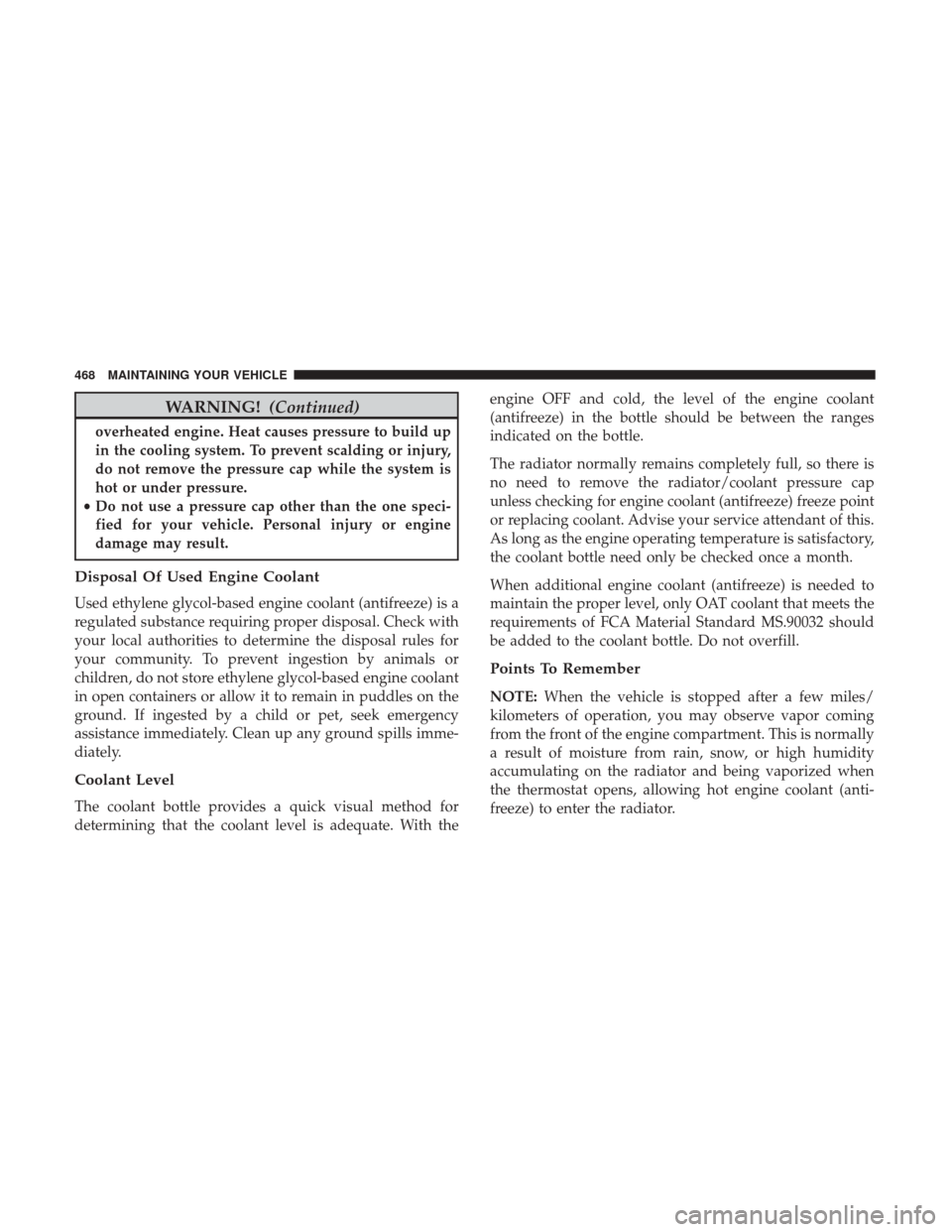
WARNING!(Continued)
overheated engine. Heat causes pressure to build up
in the cooling system. To prevent scalding or injury,
do not remove the pressure cap while the system is
hot or under pressure.
• Do not use a pressure cap other than the one speci-
fied for your vehicle. Personal injury or engine
damage may result.
Disposal Of Used Engine Coolant
Used ethylene glycol-based engine coolant (antifreeze) is a
regulated substance requiring proper disposal. Check with
your local authorities to determine the disposal rules for
your community. To prevent ingestion by animals or
children, do not store ethylene glycol-based engine coolant
in open containers or allow it to remain in puddles on the
ground. If ingested by a child or pet, seek emergency
assistance immediately. Clean up any ground spills imme-
diately.
Coolant Level
The coolant bottle provides a quick visual method for
determining that the coolant level is adequate. With the engine OFF and cold, the level of the engine coolant
(antifreeze) in the bottle should be between the ranges
indicated on the bottle.
The radiator normally remains completely full, so there is
no need to remove the radiator/coolant pressure cap
unless checking for engine coolant (antifreeze) freeze point
or replacing coolant. Advise your service attendant of this.
As long as the engine operating temperature is satisfactory,
the coolant bottle need only be checked once a month.
When additional engine coolant (antifreeze) is needed to
maintain the proper level, only OAT coolant that meets the
requirements of FCA Material Standard MS.90032 should
be added to the coolant bottle. Do not overfill.
Points To Remember
NOTE:
When the vehicle is stopped after a few miles/
kilometers of operation, you may observe vapor coming
from the front of the engine compartment. This is normally
a result of moisture from rain, snow, or high humidity
accumulating on the radiator and being vaporized when
the thermostat opens, allowing hot engine coolant (anti-
freeze) to enter the radiator.
468 MAINTAINING YOUR VEHICLE
Page 526 of 539
Emergency, In Case OfHazard Warning Flasher ...................414
Jacking ............................... .425
Jump Starting .......................... .435
Overheating ........................... .414
Towing ............................... .442
Emergency Trunk Release .....................35
Emission Control System Maintenance ............452
Engine .............................. .449, 450
Air Cleaner ............................ .457
Block Heater ........................... .346
Break-In Recommendations ..................81
Checking Oil Level ...................... .454
Coolant (Antifreeze) ..................... .501
Cooling .............................. .464
Exhaust Gas Caution ...................82, 403
Fails To Start ........................... .345
Flooded, Starting ........................ .345
Fuel Requirements ....................... .400
Jump Starting .......................... .435
Oil ........................... .454, 500, 501
Oil Filler Cap .....................449, 450, 456
Oil Filter .............................. .457
Oil Selection ........................ .455, 500
Oil Synthetic ........................... .456Overheating
........................... .414
Starting .............................. .344
Engine Oil Viscosity ........................ .456
Engine Oil Viscosity Chart ....................456
Enhanced Accident Response Feature ..........63, 445
Entry System, Illuminated .....................16
Ethanol ............................. .400, 403
Exhaust Gas Caution .....................82, 403
Exhaust System ........................ .82, 463
Exterior Lighting ....................... .122, 494
Exterior Lights ......................... .85, 494
Filters Air
Cleaner ............................ .457
Air Conditioning .....................320, 459
Engine Oil ......................... .457, 501
Engine Oil Disposal ...................... .457
Flashers Hazard Warning ........................ .414
Turn Signal ....................85, 126, 267, 492
Flash-To-Pass ............................ .127
Flexible Fuel Vehicles Cruising Range ......................... .405
Engine Oil ............................ .404
Fuel Requirements ....................403, 404
524 INDEX
Page 531 of 539
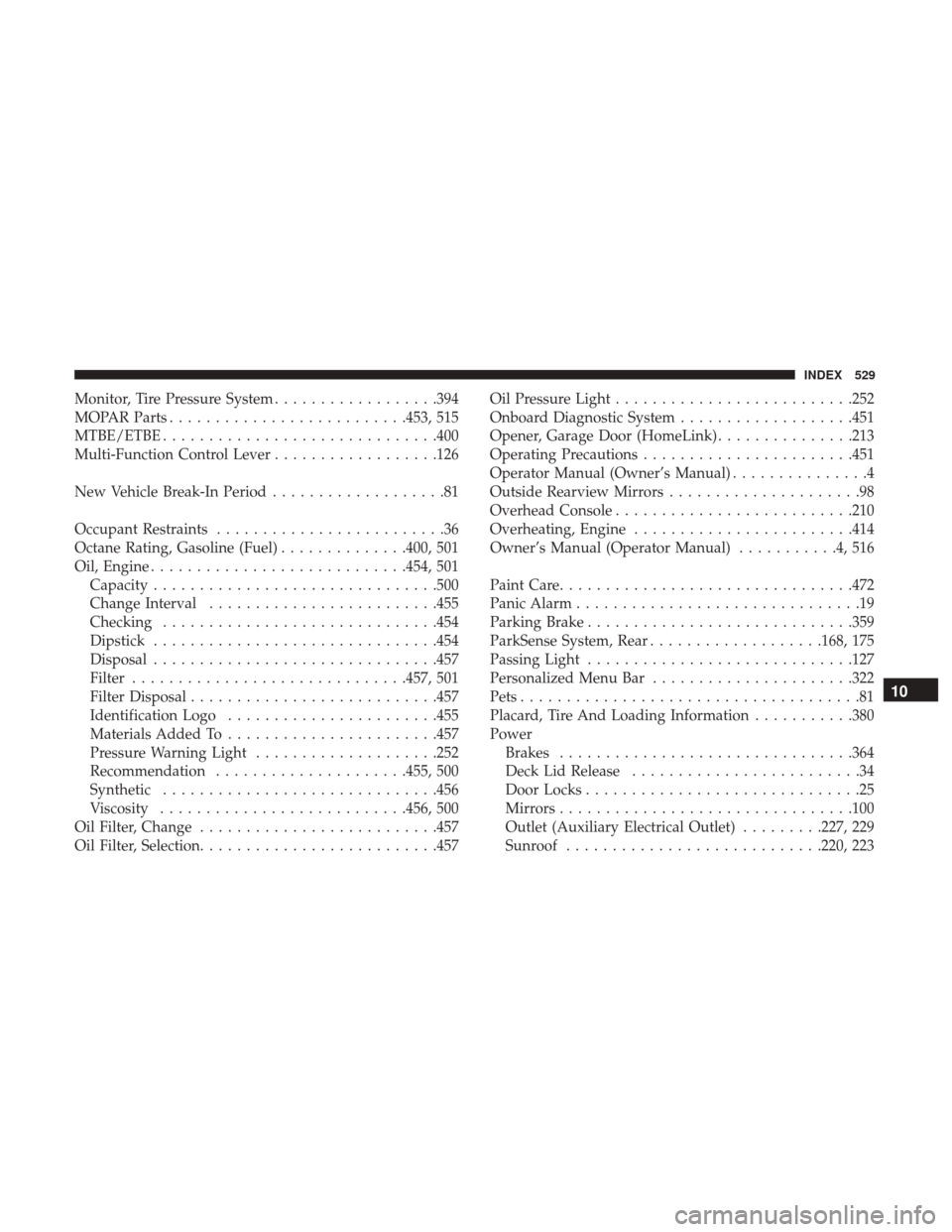
Monitor, Tire Pressure System..................394
MOPAR Parts ......................... .453, 515
MTBE/ETBE ............................. .400
Multi-Function Control Lever ..................126
New Vehicle Break-In Period ...................81
Occupant Restraints .........................36
Octane Rating, Gasoline (Fuel) ..............400, 501
Oil, Engine ........................... .454, 501
Capacity .............................. .500
Change Interval ........................ .455
Checking ............................. .454
Dipstick .............................. .454
Disposal .............................. .457
Filter ............................. .457, 501
Filter Disposal .......................... .457
Identification Logo ...................... .455
Materials Added To ...................... .457
Pressure Warning Light ....................252
Recommendation .....................455, 500
Synthetic ............................. .456
Viscosity .......................... .456, 500
Oil Filter, Change ......................... .457
Oil Filter, Selection ......................... .457Oil Pressure Light
......................... .252
Onboard Diagnostic System ...................451
Opener, Garage Door (HomeLink) ...............213
Operating Precautions ...................... .451
Operator Manual (Owner’s Manual) ...............4
Outside Rearview Mirrors .....................98
Overhead Console ......................... .210
Overheating, Engine ....................... .414
Owner’s Manual (Operator Manual) ...........4,516
Paint Care ............................... .472
Panic Alarm ...............................19
Parking Brake ............................ .359
ParkSense System, Rear .................. .168, 175
Passing
Light ............................ .127
Personalized Menu Bar ..................... .322
Pets .....................................81
Placard, Tire And Loading Information ...........380
Power Brakes ............................... .364
Deck Lid Release .........................34
Door Locks ..............................25
Mirrors ............................... .100
Outlet (Auxiliary Electrical Outlet) .........227, 229
Sunroof ........................... .220, 223
10
INDEX 529