engine oil CHRYSLER 200 2017 2.G Owner's Manual
[x] Cancel search | Manufacturer: CHRYSLER, Model Year: 2017, Model line: 200, Model: CHRYSLER 200 2017 2.GPages: 539, PDF Size: 5.18 MB
Page 459 of 539
Synthetic engine oils which do not have both the engine oil
certification mark and the correct SAE viscosity grade
number should not be used.
Materials Added To Engine Oil
The manufacturer strongly recommends against the addi-
tion of any additives (other than leak detection dyes) to the
engine oil. Engine oil is an engineered product and its
performance may be impaired by supplemental additives.
Disposing Of Used Engine Oil And Oil Filters
Care should be taken in disposing of used engine oil and
oil filters from your vehicle. Used oil and oil filters,
indiscriminately discarded, can present a problem to the
environment. Contact your authorized dealer, service sta-
tion or governmental agency for advice on how and where
used oil and oil filters can be safely discarded in your area.
Engine Oil Filter
The engine oil filter should be replaced with a new filter at
every engine oil change.
Engine Oil Filter Selection
This manufacturer’s engines have a full-flow type dispos-
able oil filter. Use a filter of this type for replacement. The
quality of replacement filters varies considerably. Onlyhigh quality filters should be used to assure most efficient
service. MOPAR engine oil filters are high quality oil filters
and are recommended.
Engine Air Cleaner Filter
Refer to the “Maintenance Schedule” for the proper main-
tenance intervals.
NOTE:
Be sure to follow the “Severe Duty Conditions”
maintenance interval if applicable.
WARNING!
The air induction system (air cleaner, hoses, etc.) can
provide a measure of protection in the case of engine
backfire. Do not remove the air induction system (air
cleaner, hoses, etc.) unless such removal is necessary
for repair or maintenance. Make sure that no one is
near the engine compartment before starting the ve-
hicle with the air induction system (air cleaner, hoses,
etc.) removed. Failure to do so can result in serious
personal injury.
Engine Air Cleaner Filter Selection
The quality of replacement engine air cleaner filters varies
considerably. Only high quality filters should be used to
7
MAINTAINING YOUR VEHICLE 457
Page 464 of 539
Refer to the “Maintenance Schedule” for the proper main-
tenance intervals.
Body Lubrication
Locks and all body pivot points, including such items as
seat tracks, door hinge pivot points and rollers, liftgate,
tailgate, decklid, sliding doors and hood hinges, should be
lubricated periodically with a lithium based grease, such as
MOPAR Spray White Lube to assure quiet, easy operation
and to protect against rust and wear. Prior to the applica-
tion of any lubricant, the parts concerned should be wiped
clean to remove dust and grit; after lubricating excess oil
and grease should be removed. Particular attention should
also be given to hood latching components to ensure
proper function. When performing other underhood ser-
vices, the hood latch, release mechanism and safety catch
should be cleaned and lubricated.
The external lock cylinders should be lubricated twice a
year, preferably in the Fall and Spring. Apply a small
amount of a high quality lubricant, such as MOPAR Lock
Cylinder Lubricant directly into the lock cylinder.
Windshield Wiper Blades
Clean the rubber edges of the wiper blades and the
windshield periodically with a sponge or soft cloth and a
mild nonabrasive cleaner. This will remove accumulations
of salt or road film.
Operation of the wipers on dry glass for long periods may
cause deterioration of the wiper blades. Always use washer
fluid when using the wipers to remove salt or dirt from a
dry windshield.
Avoid using the wiper blades to remove frost or ice from
the windshield. Keep the blade rubber out of contact with
petroleum products such as engine oil, gasoline, etc.
NOTE:Life expectancy of wiper blades varies depending
on geographical area and frequency of use. Poor perfor-
mance of blades may be present with chattering, marks,
water lines or wet spots. If any of these conditions are
present, clean the wiper blades or replace as necessary.
Adding Washer Fluid
The fluid reservoir is located in the front of the engine
compartment. Be sure to check the fluid level in the
462 MAINTAINING YOUR VEHICLE
Page 465 of 539
reservoir at regular intervals. Fill the reservoir with wind-
shield washer solvent (not radiator antifreeze) and operate
the system for a few seconds to flush out the residual
water.
When refilling the washer fluid reservoir, take some
washer fluid and apply it to a cloth or towel and wipe clean
the wiper blades, this will help blade performance.
To prevent freeze-up of your windshield washer system in
cold weather, select a solution or mixture that meets or
exceeds the temperature range of your climate. This rating
information can be found on most washer fluid containers.
WARNING!
Commercially available windshield washer solvents
are flammable. They could ignite and burn you. Care
must be exercised when filling or working around the
washer solution.
Exhaust System
The best protection against carbon monoxide entry into the
vehicle body is a properly maintained engine exhaust
system.If you notice a change in the sound of the exhaust system;
or if the exhaust fumes can be detected inside the vehicle;
or when the underside or rear of the vehicle is damaged;
have an authorized technician inspect the complete ex-
haust system and adjacent body areas for broken, dam-
aged, deteriorated, or mispositioned parts. Open seams or
loose connections could permit exhaust fumes to seep into
the passenger compartment. In addition, have the exhaust
system inspected each time the vehicle is raised for lubri-
cation or oil change. Replace as required.
WARNING!
•Exhaust gases can injure or kill. They contain carbon
monoxide (CO), which is colorless and odorless.
Breathing it can make you unconscious and can even-
tually poison you. To avoid breathing CO, refer to
“Safety Tips/Exhaust Gas” in “Things To Know Before
Starting Your Vehicle” for further information.
• A hot exhaust system can start a fire if you park over
materials that can burn. Such materials might be
grass or leaves coming into contact with your exhaust
system. Do not park or operate your vehicle in areas
where your exhaust system can contact anything that
can burn.
7
MAINTAINING YOUR VEHICLE 463
Page 472 of 539
level up to the requirements described on the brake fluid
reservoir. With disc brakes, fluid level can be expected to
fall as the brake pads wear. Brake fluid level should be
checked when pads are replaced. However, low fluid level
may be caused by a leak and a checkup may be needed.
Use only manufacturer’s recommended brake fluid. Refer
to “Fluids, Lubricants, And Genuine Parts” in “Maintain-
ing Your Vehicle” for further information.
WARNING!
•Use only manufacturer’s recommended brake fluid.
Refer to “Fluids, Lubricants, And Genuine Parts” in
“Maintaining Your Vehicle” for further information.
Using the wrong type of brake fluid can severely
damage your brake system and/or impair its perfor-
mance. The proper type of brake fluid for your
vehicle is also identified on the original factory
installed hydraulic master cylinder reservoir.
• To avoid contamination from foreign matter or mois-
ture, use only new brake fluid or fluid that has been
in a tightly closed container. Keep the master cylin-
der reservoir cap secured at all times. Brake fluid in
a open container absorbs moisture from the air
(Continued)
WARNING! (Continued)
resulting in a lower boiling point. This may cause it
to boil unexpectedly during hard or prolonged brak-
ing, resulting in sudden brake failure. This could
result in a collision.
• Overfilling the brake fluid reservoir can result in
spilling brake fluid on hot engine parts, causing the
brake fluid to catch fire. Brake fluid can also damage
painted and vinyl surfaces, care should be taken to
avoid its contact with these surfaces.
• Do not allow petroleum based fluid to contaminate
the brake fluid. Brake seal components could be
damaged, causing partial or complete brake failure.
This could result in a collision.
Automatic Transmission
Selection Of Lubricant
It is important to use the proper transmission fluid to
ensure optimum transmission performance and life. Use
only the manufacturer’s specified transmission fluid. Refer
to “Fluids, Lubricants, And Genuine Parts” in this section
for fluid specifications. It is important to maintain the
transmission fluid at the correct level using the recom-
mended fluid.
470 MAINTAINING YOUR VEHICLE
Page 480 of 539
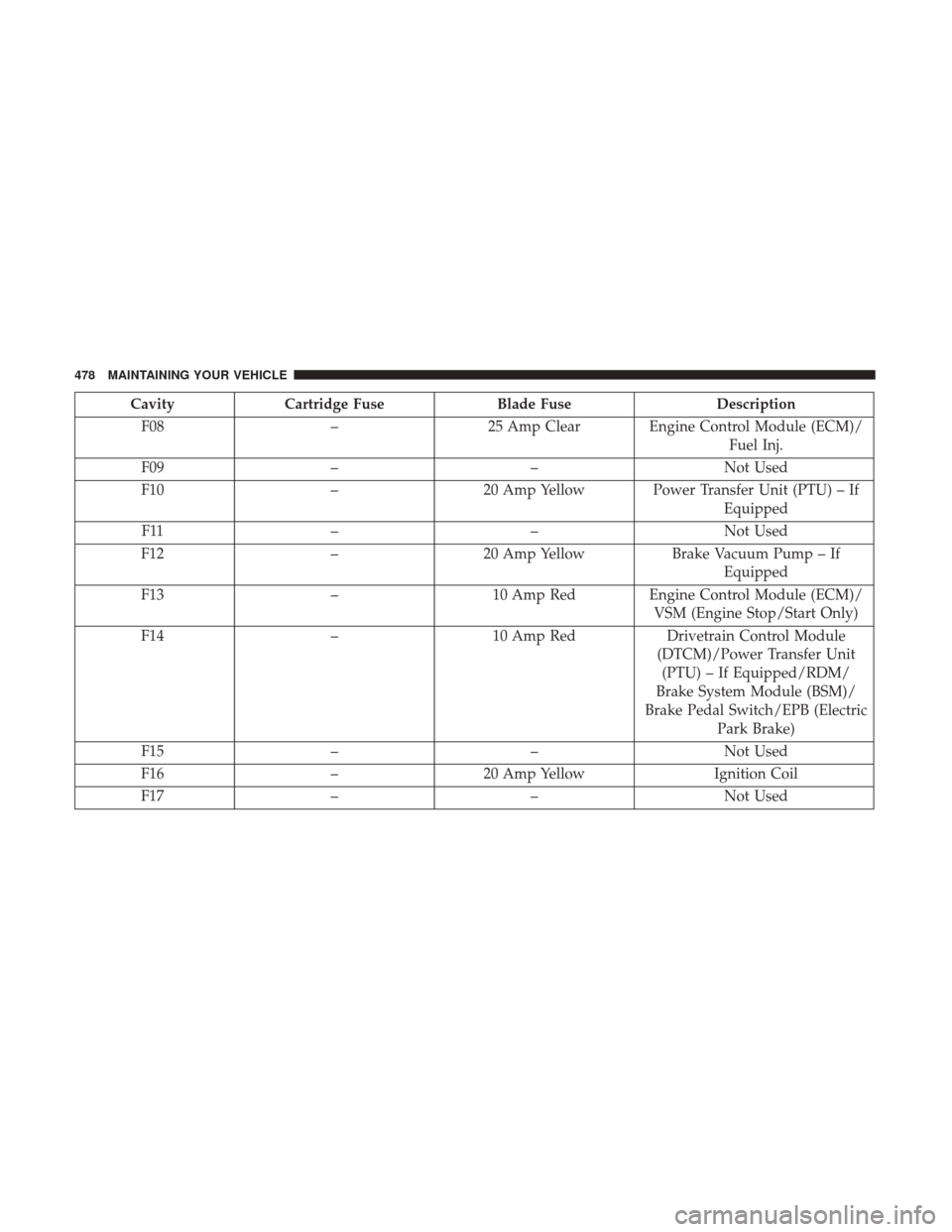
CavityCartridge Fuse Blade Fuse Description
F08 –25 Amp Clear Engine Control Module (ECM)/
Fuel Inj.
F09 – –Not Used
F10 –20 Amp Yellow Power Transfer Unit (PTU) – If
Equipped
F11 – –Not Used
F12 –20 Amp Yellow Brake Vacuum Pump – If
Equipped
F13 –10 Amp Red Engine Control Module (ECM)/
VSM (Engine Stop/Start Only)
F14 –10 Amp Red Drivetrain Control Module
(DTCM)/Power Transfer Unit (PTU) – If Equipped/RDM/
Brake System Module (BSM)/
Brake Pedal Switch/EPB (Electric Park Brake)
F15 – –Not Used
F16 –20 Amp Yellow Ignition Coil
F17 – –Not Used
478 MAINTAINING YOUR VEHICLE
Page 502 of 539
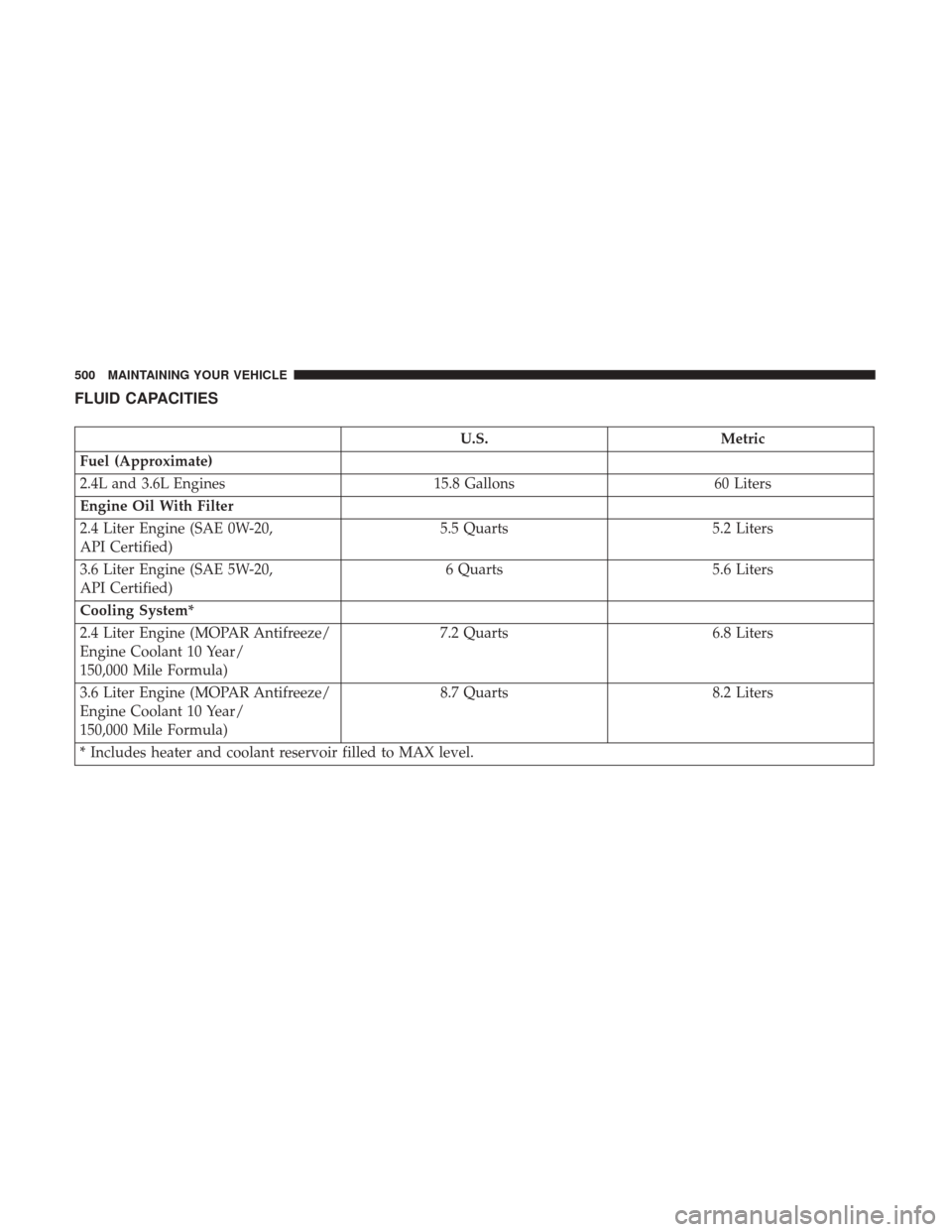
FLUID CAPACITIES
U.S.Metric
Fuel (Approximate)
2.4L and 3.6L Engines 15.8 Gallons60 Liters
Engine Oil With Filter
2.4 Liter Engine (SAE 0W-20,
API Certified) 5.5 Quarts
5.2 Liters
3.6 Liter Engine (SAE 5W-20,
API Certified) 6 Quarts
5.6 Liters
Cooling System*
2.4 Liter Engine (MOPAR Antifreeze/
Engine Coolant 10 Year/
150,000 Mile Formula) 7.2 Quarts
6.8 Liters
3.6 Liter Engine (MOPAR Antifreeze/
Engine Coolant 10 Year/
150,000 Mile Formula) 8.7 Quarts
8.2 Liters
* Includes heater and coolant reservoir filled to MAX level.
500 MAINTAINING YOUR VEHICLE
Page 503 of 539
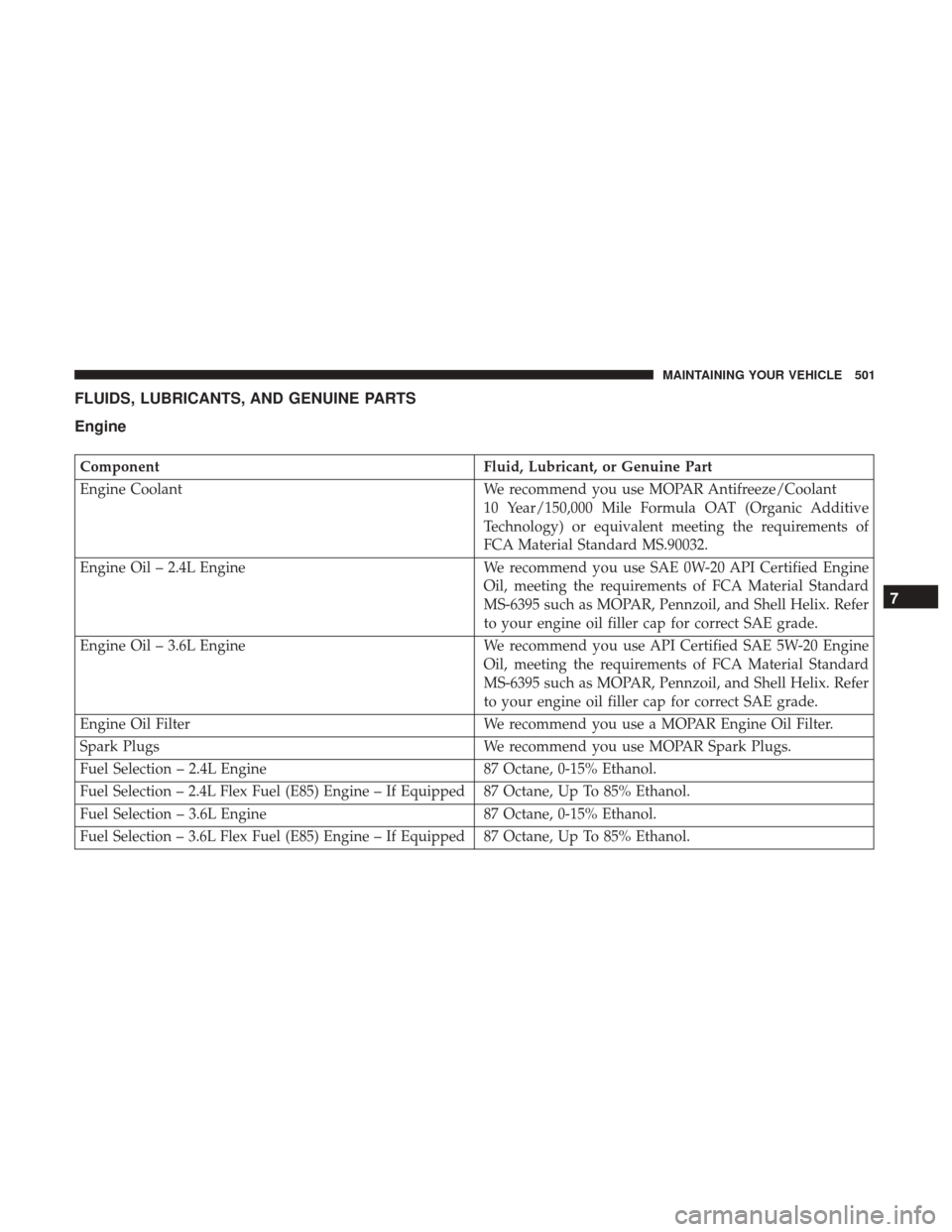
FLUIDS, LUBRICANTS, AND GENUINE PARTS
Engine
ComponentFluid, Lubricant, or Genuine Part
Engine Coolant We recommend you use MOPAR Antifreeze/Coolant
10 Year/150,000 Mile Formula OAT (Organic Additive
Technology) or equivalent meeting the requirements of
FCA Material Standard MS.90032.
Engine Oil – 2.4L Engine We recommend you use SAE 0W-20 API Certified Engine
Oil, meeting the requirements of FCA Material Standard
MS-6395 such as MOPAR, Pennzoil, and Shell Helix. Refer
to your engine oil filler cap for correct SAE grade.
Engine Oil – 3.6L Engine We recommend you use API Certified SAE 5W-20 Engine
Oil, meeting the requirements of FCA Material Standard
MS-6395 such as MOPAR, Pennzoil, and Shell Helix. Refer
to your engine oil filler cap for correct SAE grade.
Engine Oil Filter We recommend you use a MOPAR Engine Oil Filter.
Spark Plugs We recommend you use MOPAR Spark Plugs.
Fuel Selection – 2.4L Engine 87 Octane, 0-15% Ethanol.
Fuel Selection – 2.4L Flex Fuel (E85) Engine – If Equipped 87 Octane, Up To 85% Ethanol.
Fuel Selection – 3.6L Engine 87 Octane, 0-15% Ethanol.
Fuel Selection – 3.6L Flex Fuel (E85) Engine – If Equipped 87 Octane, Up To 85% Ethanol.
7
MAINTAINING YOUR VEHICLE 501
Page 508 of 539
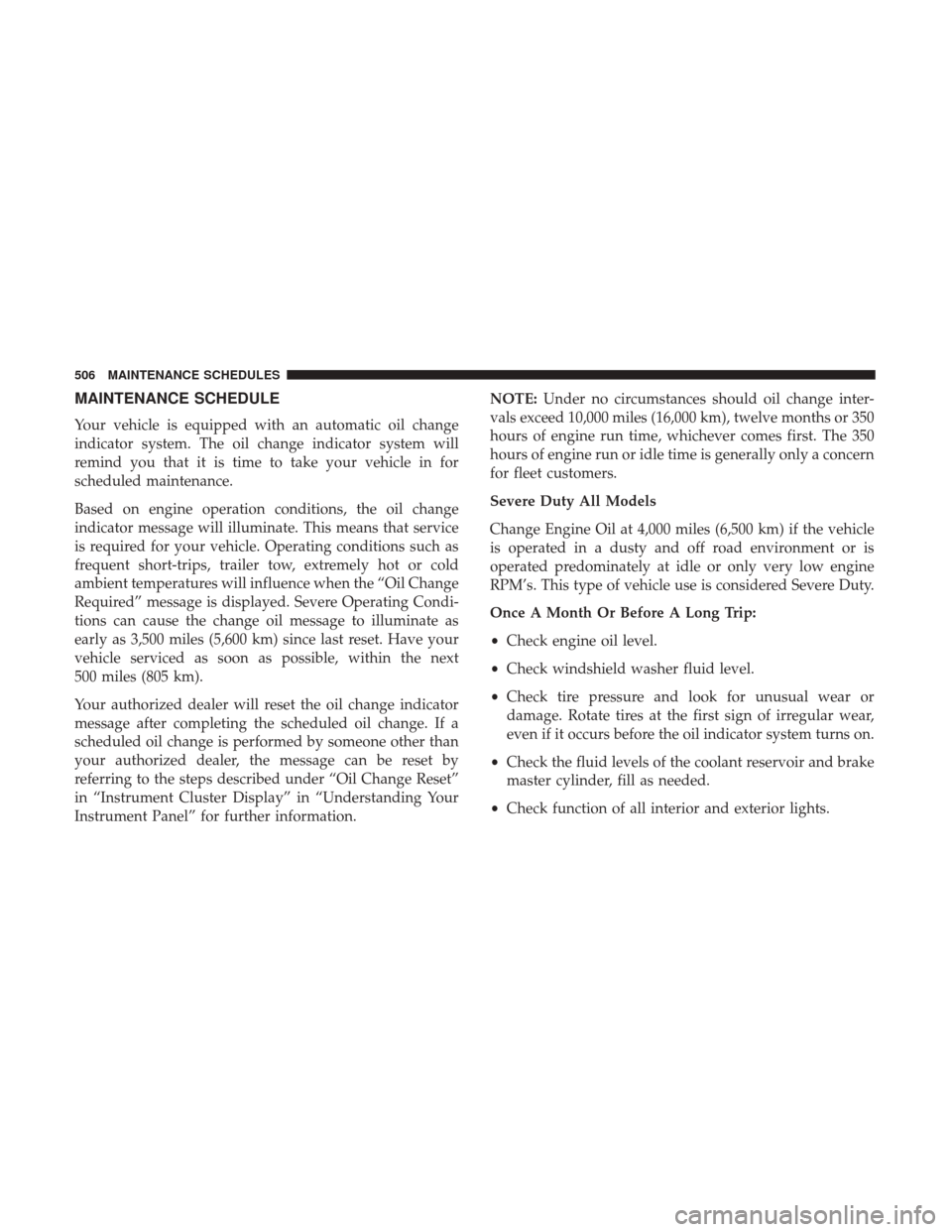
MAINTENANCE SCHEDULE
Your vehicle is equipped with an automatic oil change
indicator system. The oil change indicator system will
remind you that it is time to take your vehicle in for
scheduled maintenance.
Based on engine operation conditions, the oil change
indicator message will illuminate. This means that service
is required for your vehicle. Operating conditions such as
frequent short-trips, trailer tow, extremely hot or cold
ambient temperatures will influence when the “Oil Change
Required” message is displayed. Severe Operating Condi-
tions can cause the change oil message to illuminate as
early as 3,500 miles (5,600 km) since last reset. Have your
vehicle serviced as soon as possible, within the next
500 miles (805 km).
Your authorized dealer will reset the oil change indicator
message after completing the scheduled oil change. If a
scheduled oil change is performed by someone other than
your authorized dealer, the message can be reset by
referring to the steps described under “Oil Change Reset”
in “Instrument Cluster Display” in “Understanding Your
Instrument Panel” for further information.NOTE:
Under no circumstances should oil change inter-
vals exceed 10,000 miles (16,000 km), twelve months or 350
hours of engine run time, whichever comes first. The 350
hours of engine run or idle time is generally only a concern
for fleet customers.
Severe Duty All Models
Change Engine Oil at 4,000 miles (6,500 km) if the vehicle
is operated in a dusty and off road environment or is
operated predominately at idle or only very low engine
RPM’s. This type of vehicle use is considered Severe Duty.
Once A Month Or Before A Long Trip:
• Check engine oil level.
• Check windshield washer fluid level.
• Check tire pressure and look for unusual wear or
damage. Rotate tires at the first sign of irregular wear,
even if it occurs before the oil indicator system turns on.
• Check the fluid levels of the coolant reservoir and brake
master cylinder, fill as needed.
• Check function of all interior and exterior lights.
506 MAINTENANCE SCHEDULES
Page 509 of 539
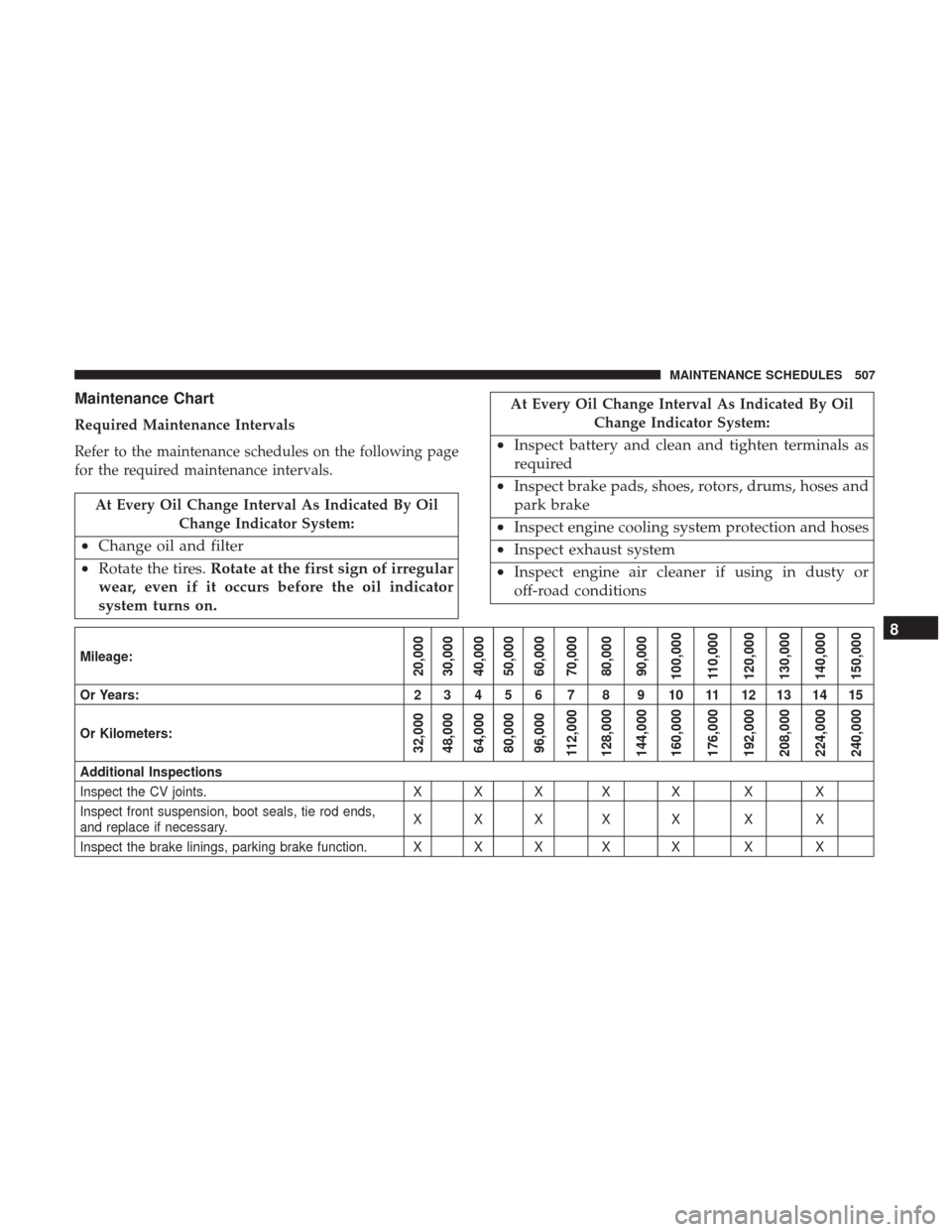
Maintenance Chart
Required Maintenance Intervals
Refer to the maintenance schedules on the following page
for the required maintenance intervals.
At Every Oil Change Interval As Indicated By OilChange Indicator System:
•Change oil and filter
• Rotate the tires. Rotate at the first sign of irregular
wear, even if it occurs before the oil indicator
system turns on.
At Every Oil Change Interval As Indicated By Oil Change Indicator System:
•Inspect battery and clean and tighten terminals as
required
• Inspect brake pads, shoes, rotors, drums, hoses and
park brake
• Inspect engine cooling system protection and hoses
• Inspect exhaust system
• Inspect engine air cleaner if using in dusty or
off-road conditions
Mileage:20,000
30,000
40,000
50,000
60,000
70,000
80,000
90,000
100,000
110,000
120,000
130,000
140,000
150,000
Or Years: 2 3 4 5 6 7 8 9 10 11 12 13 14 15
Or Kilometers:
32,000
48,000
64,000
80,000
96,000
112,000
128,000
144,000
160,000
176,000
192,000
208,000
224,000
240,000
Additional Inspections
Inspect the CV joints. X X X X X X X
Inspect front suspension, boot seals, tie rod ends,
and replace if necessary. XXX X X X X
Inspect the brake linings, parking brake function. X X X X X X X
8
MAINTENANCE SCHEDULES 507
Page 523 of 539
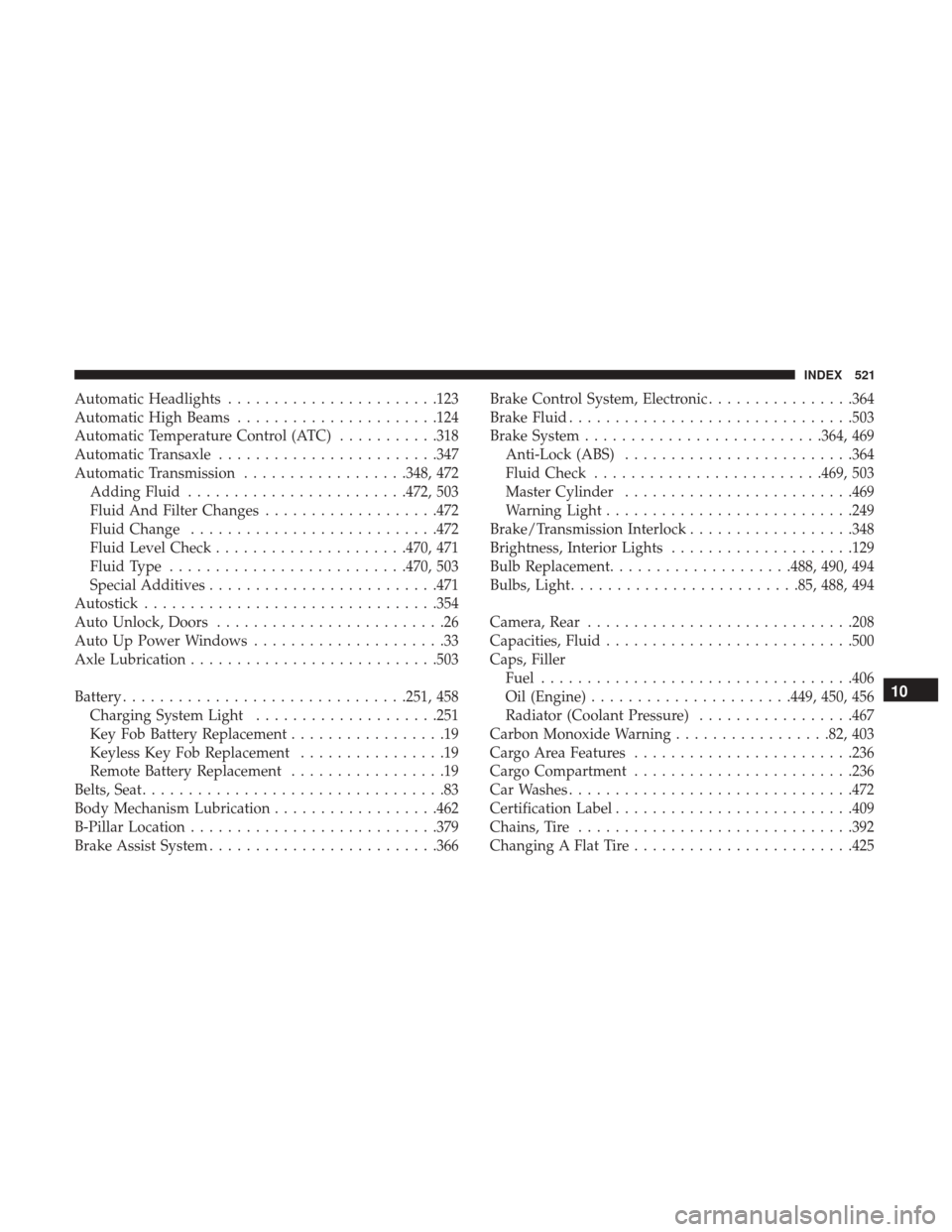
Automatic Headlights...................... .123
Automatic High Beams ..................... .124
Automatic Temperature Control (ATC) ...........318
Automatic Transaxle ....................... .347
Automatic Transmission ..................348, 472
Adding Fluid ....................... .472, 503
Fluid And Filter Changes ...................472
Fluid Change .......................... .472
Fluid Level Check .....................470, 471
Fluid Type ......................... .470, 503
Special Additives ........................ .471
Autostick ............................... .354
Auto Unlock, Doors .........................26
Auto Up Power Windows .....................33
Axle Lubrication .......................... .503
Battery .............................. .251, 458
Charging System Light ....................251
Key Fob Battery Replacement .................19
Keyless Key Fob Replacement ................19
Remote Battery Replacement .................19
Belts, Seat .................................83
Body Mechanism Lubrication ..................462
B-Pillar Location .......................... .379
Brake Assist System ........................ .366Brake Control System, Electronic
................364
Brake Fluid .............................. .503
Brake System ......................... .364, 469
Anti-Lock (ABS) ........................ .364
Fluid Check ........................ .469, 503
Master Cylinder ........................ .469
Warning Light .......................... .249
Brake/Transmission Interlock ..................348
Brightness, Interior Lights ....................129
Bulb Replacement ....................488, 490, 494
Bulbs, Light ........................ .85, 488, 494
Camera, Rear ............................ .208
Capacities,
Fluid .......................... .500
Caps, Filler Fuel ................................. .406
Oil (Engine) ..................... .449, 450, 456
Radiator (Coolant Pressure) .................467
Carbon Monoxide Warning .................82, 403
Cargo Area Features ....................... .236
Cargo Compartment ....................... .236
Car Washes .............................. .472
Certification Label ......................... .409
Chains, Tire ............................. .392
Changing A Flat Tire ....................... .425
10
INDEX 521