air condition CHRYSLER 200 2017 2.G Owner's Guide
[x] Cancel search | Manufacturer: CHRYSLER, Model Year: 2017, Model line: 200, Model: CHRYSLER 200 2017 2.GPages: 539, PDF Size: 5.18 MB
Page 471 of 539
If an examination of your engine compartment shows no
evidence of radiator or hose leaks, the vehicle may be
safely driven. The vapor will soon dissipate.
•Do not overfill the coolant expansion bottle.
• Check the coolant freeze point in the radiator and in the
coolant expansion bottle. If engine coolant (antifreeze)
needs to be added, the contents of the coolant expansion
bottle must also be protected against freezing.
• If frequent engine coolant (antifreeze) additions are
required, the cooling system should be pressure tested
for leaks.
• Maintain engine coolant (antifreeze) concentration at a
minimum of 50% OAT coolant (conforming to
MS.90032) and distilled water for proper corrosion pro-
tection of your engine which contains aluminum com-
ponents.
• Make sure that the coolant expansion bottle overflow
hoses are not kinked or obstructed.
• Keep the front of the radiator clean. If your vehicle is
equipped with air conditioning, keep the front of the
condenser clean.
• Do not change the thermostat for Summer or Winter
operation. If replacement is ever necessary, install ONLY the correct type thermostat. Other designs may result in
unsatisfactory engine coolant (antifreeze) performance,
poor gas mileage, and increased emissions.
Brake System
In order to assure brake system performance, all brake
system components should be inspected periodically. Refer
to the “Maintenance Schedule” for the proper maintenance
intervals.
WARNING!
Riding the brakes can lead to brake failure and possi-
bly a collision. Driving with your foot resting or riding
on the brake pedal can result in abnormally high brake
temperatures, excessive lining wear, and possible
brake damage. You would not have your full braking
capacity in an emergency.
Brake Master Cylinder
The fluid in the master cylinder should be checked when
performing under hood services or immediately if the
“Brake Warning Light” is illuminated.
Be sure to clean the top of the master cylinder area before
removing the cap. If necessary, add fluid to bring the fluid
7
MAINTAINING YOUR VEHICLE 469
Page 473 of 539
NOTE:No chemical flushes should be used in any trans-
mission; only the approved lubricant should be used.
CAUTION!
Using a transmission fluid other than the manufactur-
er ’s recommended fluid may cause deterioration in
transmission shift quality and/or torque converter
shudder. Refer to “Fluids, Lubricants, And Genuine
Parts” in this section for fluid specifications.
Special Additives
The manufacturer strongly recommends against using any
special additives in the transmission. Automatic Transmis-
sion Fluid (ATF) is an engineered product and its perfor-
mance may be impaired by supplemental additives. There-
fore, do not add any fluid additives to the transmission.
Avoid using transmission sealers as they may adversely
affect seals.
CAUTION!
Do not use chemical flushes in your transmission as
the chemicals can damage your transmission compo-
nents. Such damage is not covered by the New Vehicle
Limited Warranty.
Fluid Level Check
The fluid level is preset at the factory and does not require
adjustment under normal operating conditions. Routine
fluid level checks are not required, therefore the transmission
has no dipstick. Your authorized dealer can check your
transmission fluid level using special service tools. If you
notice fluid leakage or transmission malfunction, visit your
authorized dealer immediately to have the transmission fluid
level checked. Operating the vehicle with an improper fluid
level can cause severe transmission damage.
CAUTION!
If a transmission fluid leak occurs, visit your autho-
rized dealer immediately. Severe transmission damage
may occur. Your authorized dealer has the proper tools
to adjust the fluid level accurately.
7
MAINTAINING YOUR VEHICLE 471
Page 474 of 539
Fluid And Filter Changes
Under normal operating conditions, the fluid installed at
the factory will provide satisfactory lubrication for the life
of the vehicle.
Routine fluid and filter changes are not required. However,
change the fluid and filter if the fluid becomes contami-
nated (with water, etc.), or if the transmission is disas-
sembled for any reason.
Appearance Care And Protection From Corrosion
Protection Of Body And Paint From Corrosion
Vehicle body care requirements vary according to geo-
graphic locations and usage. Chemicals that make roads
passable in snow and ice and those that are sprayed on
trees and road surfaces during other seasons are highly
corrosive to the metal in your vehicle. Outside parking,
which exposes your vehicle to airborne contaminants, road
surfaces on which the vehicle is operated, extreme hot or
cold weather and other extreme conditions will have an
adverse effect on paint, metal trim, and underbody protec-
tion.
The following maintenance recommendations will enable
you to obtain maximum benefit from the corrosion resis-
tance built into your vehicle.
What Causes Corrosion?
Corrosion is the result of deterioration or removal of paint
and protective coatings from your vehicle.
The most common causes are:
•Road salt, dirt and moisture accumulation.
• Stone and gravel impact.
• Insects, tree sap and tar.
• Salt in the air near seacoast localities.
• Atmospheric fallout/industrial pollutants.
Washing
•Wash your vehicle regularly. Always wash your vehicle
in the shade using MOPAR Car Wash, or a mild car wash
soap, and rinse the panels completely with clear water.
• If insects, tar, or other similar deposits have accumulated
on your vehicle, use MOPAR Super Kleen Bug and Tar
Remover to remove.
• Use a high quality cleaner wax, such as MOPAR Cleaner
Wax to remove road film, stains and to protect your
paint finish. Take care never to scratch the paint.
472 MAINTAINING YOUR VEHICLE
Page 477 of 539
ammonia-based cleaners to clean your leather upholstery.
Application of a leather conditioner is not required to
maintain the original condition.
NOTE:Power washing is not allowed inside the vehicle
(both passenger and cargo area).
WARNING!
Do not use volatile solvents for cleaning purposes.
Many are potentially flammable, and if used in closed
areas they may cause respiratory harm.
CAUTION!
Direct contact of air fresheners, insect repellents, sun-
tan lotions, or hand sanitizers to the plastic, painted, or
decorated surfaces of the interior may cause permanent
damage. Wipe away immediately.
CAUTION!
Damage caused by these type of products may not be
covered by your New Vehicle Limited Warranty.
CAUTION!
Do not use Alcohol and Alcohol-based and/or Keton
based cleaning products to clean leather seats, as
damage to the seat may result.
Cleaning Headlights
Your vehicle is equipped with plastic headlights and fog
lights that are lighter and less susceptible to stone breakage
than glass headlights.
Plastic is not as scratch resistant as glass and therefore
different lens cleaning procedures must be followed.
To minimize the possibility of scratching the lenses and
reducing light output, avoid wiping with a dry cloth. To
remove road dirt, wash with a mild soap solution followed
by rinsing.
Do not use abrasive cleaning components, solvents, steel
wool or other aggressive material to clean the lenses.
Glass Surfaces
All glass surfaces should be cleaned on a regular basis with
MOPAR Glass Cleaner, or any commercial household-type
glass cleaner. Never use an abrasive type cleaner. Use
caution when cleaning the inside rear window equipped
7
MAINTAINING YOUR VEHICLE 475
Page 490 of 539
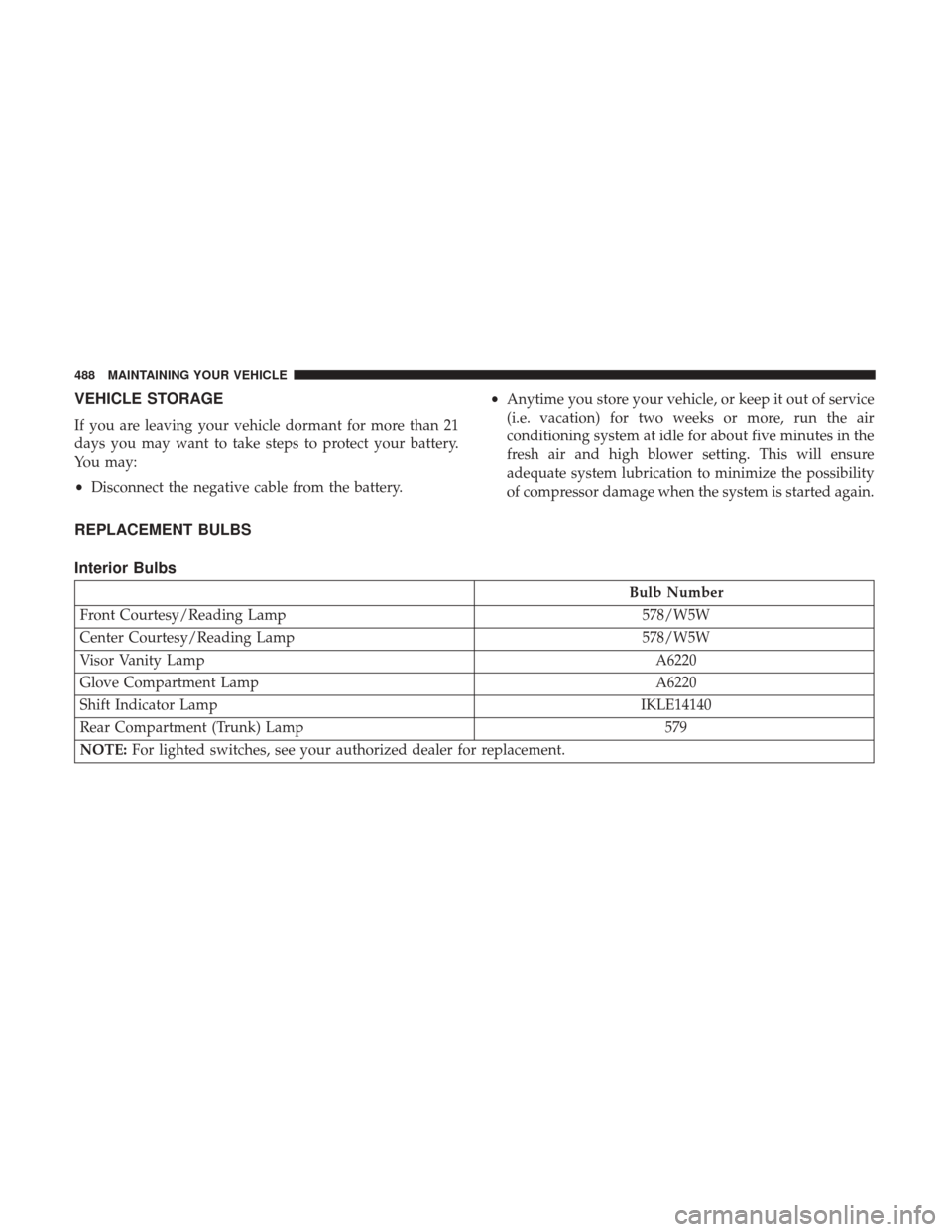
VEHICLE STORAGE
If you are leaving your vehicle dormant for more than 21
days you may want to take steps to protect your battery.
You may:
•Disconnect the negative cable from the battery. •
Anytime you store your vehicle, or keep it out of service
(i.e. vacation) for two weeks or more, run the air
conditioning system at idle for about five minutes in the
fresh air and high blower setting. This will ensure
adequate system lubrication to minimize the possibility
of compressor damage when the system is started again.
REPLACEMENT BULBS
Interior Bulbs
Bulb Number
Front Courtesy/Reading Lamp 578/W5W
Center Courtesy/Reading Lamp 578/W5W
Visor Vanity Lamp A6220
Glove Compartment Lamp A6220
Shift Indicator Lamp IKLE14140
Rear Compartment (Trunk) Lamp 579
NOTE: For lighted switches, see your authorized dealer for replacement.
488 MAINTAINING YOUR VEHICLE
Page 509 of 539
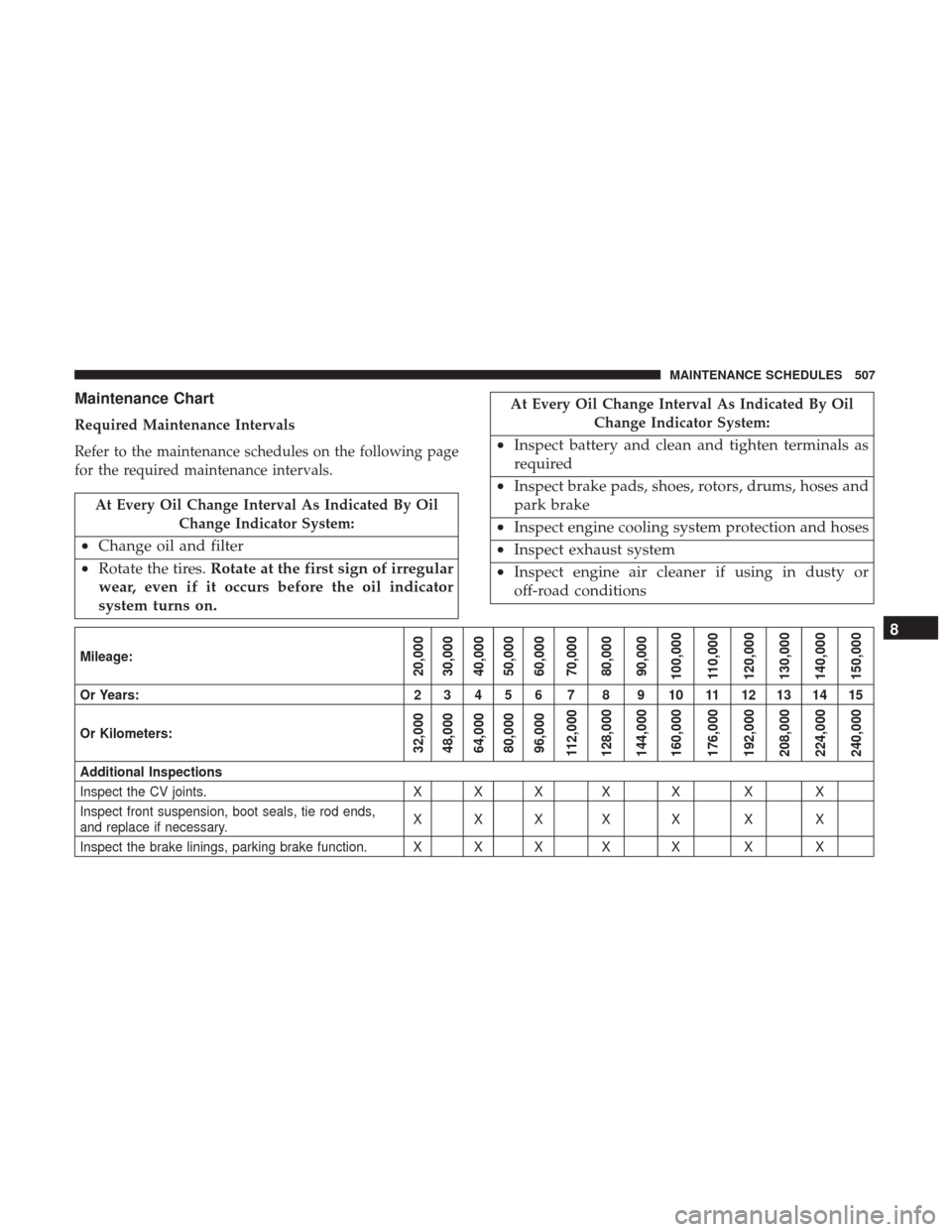
Maintenance Chart
Required Maintenance Intervals
Refer to the maintenance schedules on the following page
for the required maintenance intervals.
At Every Oil Change Interval As Indicated By OilChange Indicator System:
•Change oil and filter
• Rotate the tires. Rotate at the first sign of irregular
wear, even if it occurs before the oil indicator
system turns on.
At Every Oil Change Interval As Indicated By Oil Change Indicator System:
•Inspect battery and clean and tighten terminals as
required
• Inspect brake pads, shoes, rotors, drums, hoses and
park brake
• Inspect engine cooling system protection and hoses
• Inspect exhaust system
• Inspect engine air cleaner if using in dusty or
off-road conditions
Mileage:20,000
30,000
40,000
50,000
60,000
70,000
80,000
90,000
100,000
110,000
120,000
130,000
140,000
150,000
Or Years: 2 3 4 5 6 7 8 9 10 11 12 13 14 15
Or Kilometers:
32,000
48,000
64,000
80,000
96,000
112,000
128,000
144,000
160,000
176,000
192,000
208,000
224,000
240,000
Additional Inspections
Inspect the CV joints. X X X X X X X
Inspect front suspension, boot seals, tie rod ends,
and replace if necessary. XXX X X X X
Inspect the brake linings, parking brake function. X X X X X X X
8
MAINTENANCE SCHEDULES 507
Page 510 of 539
Mileage:20,000
30,000
40,000
50,000
60,000
70,000
80,000
90,000
100,000
110,000
120,000
130,000
140,000
150,000
Or Years: 2 3 4 5 6 7 8 9 10 11 12 13 14 15
Or Kilometers:
32,000
48,000
64,000
80,000
96,000
112,000
128,000
144,000
160,000
176,000
192,000
208,000
224,000
240,000
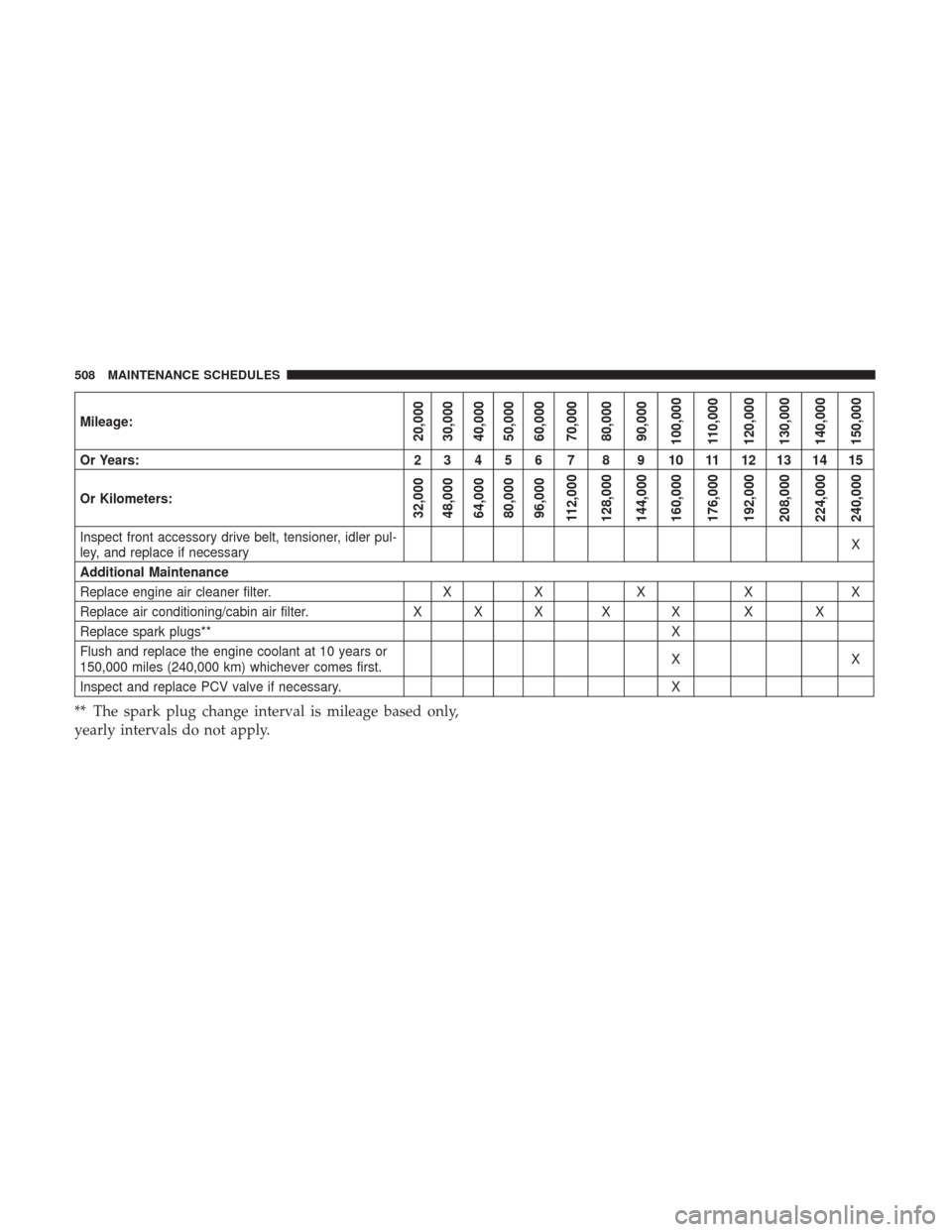
Inspect front accessory drive belt, tensioner, idler pul-
ley, and replace if necessary X
Additional Maintenance
Replace engine air cleaner filter. XX X XX
Replace air conditioning/cabin air filter. X X X X X X X
Replace spark plugs** X
Flush and replace the engine coolant at 10 years or
150,000 miles (240,000 km) whichever comes first. XX
Inspect and replace PCV valve if necessary. X
** The spark plug change interval is mileage based only,
yearly intervals do not apply.
508 MAINTENANCE SCHEDULES
Page 522 of 539
About Your Brakes........................ .364
Adaptive Cruise Control (ACC) (Cruise Control) . . . .139
Adding Engine Coolant (Antifreeze) .............466
Additives, Fuel ........................... .402
Adjust Down ................................ .109
Forward .............................. .108
Rearward ............................. .108
Up.................................. .109
AirBag ..................................48 Air Bag Operation .........................50
Air Bag Warning Light ...................51, 64
Driver Knee Air Bag .......................58
Enhanced Accident Response ..............63, 445
Event Data Recorder (EDR) .................445
FrontAirBag ............................51
If A Deployment Occurs ....................62
Knee Impact Bolsters .......................57
Maintaining Your Air Bag System ..............65
Redundant Air Bag Warning Light .............65
Side Air Bags ............................58
Transporting Pets .........................81
Air Bag Light ....................... .64, 83, 248
Air Bag Maintenance .........................65
Air Cleaner, Engine (Engine Air Cleaner Filter) ......457Air Conditioner Maintenance
..................458
Air Conditioning Filter ...................320, 459
Air Conditioning, Operating Tips ............319, 321
Air Conditioning Refrigerant ...............458, 459
Air Conditioning System ..................318, 458
Air Filter ............................... .457
Air Pressure, Tires ......................... .384
Alarm Arm The System ..........................14
Disarm The System ........................15
Rearming The System ......................14
Tamper Alert ............................16
Vehicle Security Alarm .....................14
Alarm, Panic ...............................19
Alarm (Security Alarm) ..................... .250
All Wheel Drive (AWD) ..................... .356
Alterations/Modifications, Vehicle ................6
Antifreeze (Engine Coolant) ................466, 500
Disposal .............................. .468
Anti-Lock
Brake System (ABS) .................365
Anti-Lock Warning Light .....................262
Appearance Care .......................... .472
Assist, Hill Start .......................... .367
Auto Down Power Windows ...................33
Automatic Door Locks ........................26
520 INDEX
Page 526 of 539
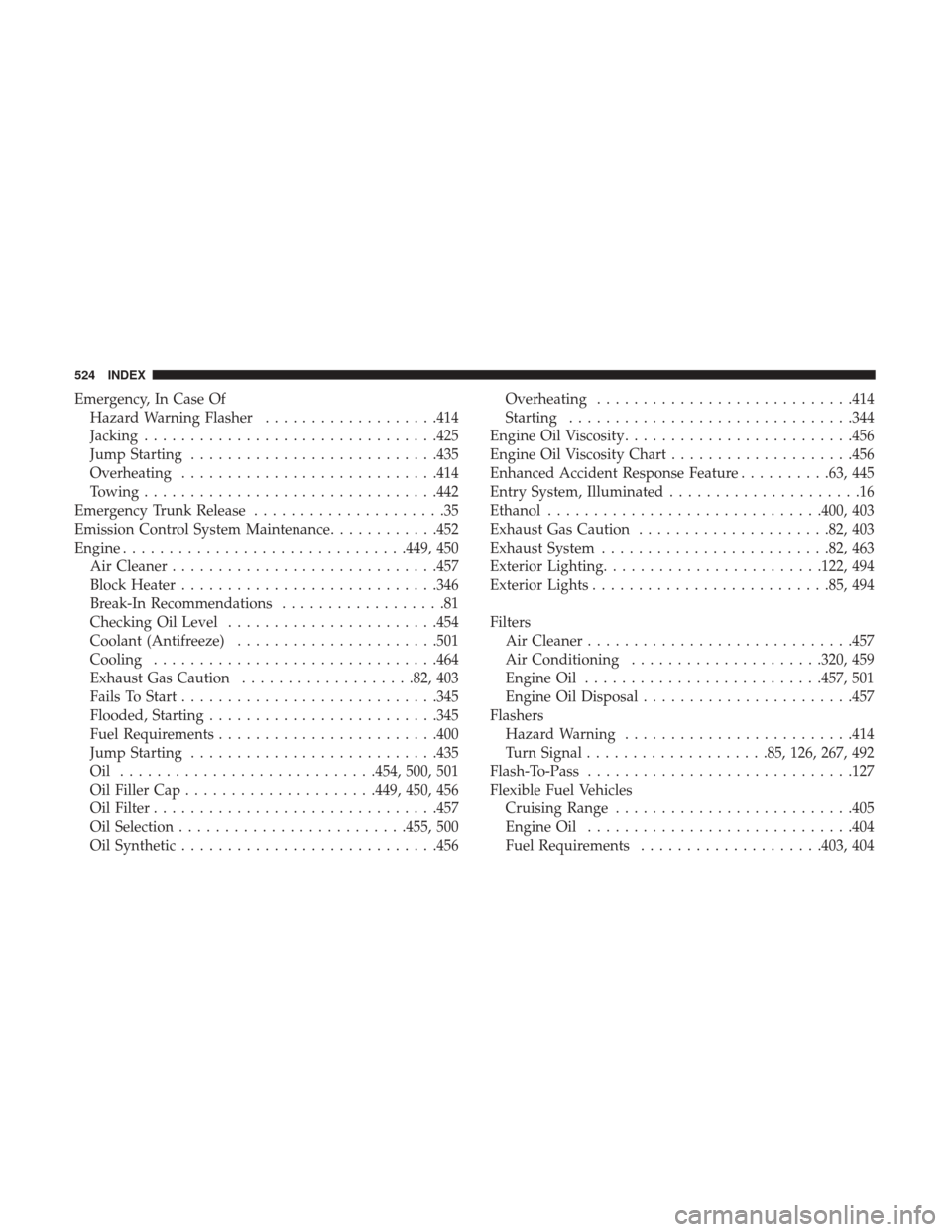
Emergency, In Case OfHazard Warning Flasher ...................414
Jacking ............................... .425
Jump Starting .......................... .435
Overheating ........................... .414
Towing ............................... .442
Emergency Trunk Release .....................35
Emission Control System Maintenance ............452
Engine .............................. .449, 450
Air Cleaner ............................ .457
Block Heater ........................... .346
Break-In Recommendations ..................81
Checking Oil Level ...................... .454
Coolant (Antifreeze) ..................... .501
Cooling .............................. .464
Exhaust Gas Caution ...................82, 403
Fails To Start ........................... .345
Flooded, Starting ........................ .345
Fuel Requirements ....................... .400
Jump Starting .......................... .435
Oil ........................... .454, 500, 501
Oil Filler Cap .....................449, 450, 456
Oil Filter .............................. .457
Oil Selection ........................ .455, 500
Oil Synthetic ........................... .456Overheating
........................... .414
Starting .............................. .344
Engine Oil Viscosity ........................ .456
Engine Oil Viscosity Chart ....................456
Enhanced Accident Response Feature ..........63, 445
Entry System, Illuminated .....................16
Ethanol ............................. .400, 403
Exhaust Gas Caution .....................82, 403
Exhaust System ........................ .82, 463
Exterior Lighting ....................... .122, 494
Exterior Lights ......................... .85, 494
Filters Air
Cleaner ............................ .457
Air Conditioning .....................320, 459
Engine Oil ......................... .457, 501
Engine Oil Disposal ...................... .457
Flashers Hazard Warning ........................ .414
Turn Signal ....................85, 126, 267, 492
Flash-To-Pass ............................ .127
Flexible Fuel Vehicles Cruising Range ......................... .405
Engine Oil ............................ .404
Fuel Requirements ....................403, 404
524 INDEX