warning light CHRYSLER 200 2017 2.G Manual PDF
[x] Cancel search | Manufacturer: CHRYSLER, Model Year: 2017, Model line: 200, Model: CHRYSLER 200 2017 2.GPages: 539, PDF Size: 5.18 MB
Page 437 of 539
8. After 25 miles (40 km) check the wheel bolt torque witha torque wrench to ensure that all wheel bolts are
properly seated against the wheel.
Road Tire Installation
1. Mount the road tire on the axle.
2. Install the remaining wheel bolts and lightly tighten.
WARNING!
To avoid the risk of forcing the vehicle off the jack, do
not tighten the lug nuts fully until the vehicle has been
lowered. Failure to follow this warning may result in
serious injury.
3. Lower the vehicle to the ground by turning the jack handle counterclockwise.
4. Finish tightening the wheel bolts. Push down on the wrench while at the end of the handle for increased
leverage. Tighten the wheel bolts in a star pattern until
each wheel bolt has been tightened twice. Refer to
“Torque Specifications” in this section for the proper lug
bolt torque. If in doubt about the correct tightness, have
them checked with a torque wrench by your authorized
dealer or service station. 5. Lower the jack until it is free. Remove the wheel chocks.
Reassemble the lug wrench to the jack assembly and
stow it in the spare tire area. Secure the assembly using
the means provided. Release the parking brake before
driving the vehicle.
6. After 25 miles (40 km) check the wheel bolt torque with a torque wrench to ensure that all wheel bolts are
properly seated against the wheel.
JUMP-STARTING PROCEDURES
If your vehicle has a discharged battery it can be jump-
started using a set of jumper cables and a battery in another
vehicle or by using a portable battery booster pack. Jump-
starting can be dangerous if done improperly so please
follow the procedures in this section carefully.
NOTE: When using a portable battery booster pack follow
the manufacturer ’s operating instructions and precautions.
WARNING!
Do not attempt jump-starting if the battery is frozen. It
could rupture or explode and cause personal injury.
6
WHAT TO DO IN EMERGENCIES 435
Page 438 of 539
CAUTION!
Do not use a portable battery booster pack or any other
booster source with a system voltage greater than 12
Volts or damage to the battery, starter motor, alternator
or electrical system may occur.
Preparations For Jump-Start
The battery in your vehicle is located in the front of the
engine compartment, behind the left headlight assembly.
WARNING!
•Take care to avoid the radiator cooling fan whenever
the hood is raised. It can start anytime the ignition
switch is ON. You can be injured by moving fan
blades.
• Remove any metal jewelry such as rings, watch
bands and bracelets that could make an inadvertent
electrical contact. You could be seriously injured.
• Batteries contain sulfuric acid that can burn your
skin or eyes and generate hydrogen gas which is
flammable and explosive. Keep open flames or
sparks away from the battery.
1. Set the parking brake, shift the automatic transmission into PARK and turn the ignition to LOCK.
2. Turn off the heater, radio, and all unnecessary electrical accessories.
3. If using another vehicle to jump-start the battery, park the vehicle within the jumper cables reach, set the
parking brake and make sure the ignition is OFF.
1 — Positive Battery Post
2 — Negative Battery Post 436 WHAT TO DO IN EMERGENCIES
Page 453 of 539
ONBOARD DIAGNOSTIC SYSTEM — OBD II
Your vehicle is equipped with a sophisticated Onboard
Diagnostic system called OBD II. This system monitors the
performance of the emissions, engine, and automatic trans-
mission control systems. When these systems are operating
properly, your vehicle will provide excellent performance
and fuel economy, as well as engine emissions well within
current government regulations.
If any of these systems require service, the OBD II system
will turn on the Malfunction Indicator Light (MIL). It will
also store diagnostic codes and other information to assist
your service technician in making repairs. Although your
vehicle will usually be drivable and not need towing, see
your authorized dealer for service as soon as possible.
CAUTION!
•Prolonged driving with the MIL on could cause
further damage to the emission control system. It
could also affect fuel economy and driveability. The
vehicle must be serviced before any emissions tests
can be performed.
(Continued)
CAUTION! (Continued)
•If the MIL is flashing while the engine is running,
severe catalytic converter damage and power loss
will soon occur. Immediate service is required.
Onboard Diagnostic System (OBD II) Cybersecurity
Your vehicle is required to have an Onboard Diagnostic
system (OBD II) and a connection port to allow access to
information related to the performance of your emissions
controls. Authorized service technicians may need to ac-
cess this information to assist with the diagnosis and
service of your vehicle and emissions system.
WARNING!
• ONLY an authorized service technician should con-
nect equipment to the OBD II connection port in
order to diagnose or service your vehicle.
• If unauthorized equipment is connected to the OBD
II connection port, such as a driver-behavior tracking
device, it may:
• Be possible that vehicle systems, including safety
related systems, could be impaired or a loss of
(Continued)
7
MAINTAINING YOUR VEHICLE 451
Page 454 of 539
WARNING!(Continued)
vehicle control could occur that may result in an
accident involving serious injury or death.
• Access, or allow others to access, information
stored in your vehicle systems, including personal
information.
For further information, refer to “Privacy Practices — If
Equipped With Uconnect 8.4 Radio” and “Uconnect Cy-
berSecurity” in “All About Uconnect Access” in your
Owner ’s Manual Radio Supplement and “Cybersecurity”
in “Understanding Your Instrument Panel”.
Loose Fuel Filler Cap Message
If the vehicle diagnostic system determines that the fuel
filler cap is loose, improperly installed, or damaged, a
“CHECK GASCAP” message will be displayed in the
instrument cluster. Refer to “Instrument Cluster Display”
in “Understanding Your Instrument Panel” for further
information. Tighten the fuel filler cap until a “clicking”
sound is heard. This is an indication that the fuel filler cap
is properly tightened. Refer to “Onboard Diagnostic
System” in “Maintaining Your Vehicle” for further infor-
mation.
EMISSIONS INSPECTION AND MAINTENANCE
PROGRAMS
In some localities, it may be a legal requirement to pass an
inspection of your vehicle’s emissions control system.
Failure to pass could prevent vehicle registration. For states that require an Inspection and Mainte-
nance (I/M), this check verifies the “Malfunction
Indicator Light (MIL)” is functioning and is not on
when the engine is running, and that the OBD II system is
ready for testing.
Normally, the OBD II system will be ready. The OBD II
system may notbe ready if your vehicle was recently
serviced, recently had a dead battery or a battery replace-
ment. If the OBD II system should be determined not ready
for the I/M test, your vehicle may fail the test.
Your vehicle has a simple ignition actuated test, which you
can use prior to going to the test station. To check if your
vehicle’s OBD II system is ready, you must do the following:
1. Cycle the ignition switch to the ON position, but do not crank or start the engine.
NOTE: If you crank or start the engine, you will have to
start this test over.
452 MAINTAINING YOUR VEHICLE
Page 471 of 539
If an examination of your engine compartment shows no
evidence of radiator or hose leaks, the vehicle may be
safely driven. The vapor will soon dissipate.
•Do not overfill the coolant expansion bottle.
• Check the coolant freeze point in the radiator and in the
coolant expansion bottle. If engine coolant (antifreeze)
needs to be added, the contents of the coolant expansion
bottle must also be protected against freezing.
• If frequent engine coolant (antifreeze) additions are
required, the cooling system should be pressure tested
for leaks.
• Maintain engine coolant (antifreeze) concentration at a
minimum of 50% OAT coolant (conforming to
MS.90032) and distilled water for proper corrosion pro-
tection of your engine which contains aluminum com-
ponents.
• Make sure that the coolant expansion bottle overflow
hoses are not kinked or obstructed.
• Keep the front of the radiator clean. If your vehicle is
equipped with air conditioning, keep the front of the
condenser clean.
• Do not change the thermostat for Summer or Winter
operation. If replacement is ever necessary, install ONLY the correct type thermostat. Other designs may result in
unsatisfactory engine coolant (antifreeze) performance,
poor gas mileage, and increased emissions.
Brake System
In order to assure brake system performance, all brake
system components should be inspected periodically. Refer
to the “Maintenance Schedule” for the proper maintenance
intervals.
WARNING!
Riding the brakes can lead to brake failure and possi-
bly a collision. Driving with your foot resting or riding
on the brake pedal can result in abnormally high brake
temperatures, excessive lining wear, and possible
brake damage. You would not have your full braking
capacity in an emergency.
Brake Master Cylinder
The fluid in the master cylinder should be checked when
performing under hood services or immediately if the
“Brake Warning Light” is illuminated.
Be sure to clean the top of the master cylinder area before
removing the cap. If necessary, add fluid to bring the fluid
7
MAINTAINING YOUR VEHICLE 469
Page 477 of 539
ammonia-based cleaners to clean your leather upholstery.
Application of a leather conditioner is not required to
maintain the original condition.
NOTE:Power washing is not allowed inside the vehicle
(both passenger and cargo area).
WARNING!
Do not use volatile solvents for cleaning purposes.
Many are potentially flammable, and if used in closed
areas they may cause respiratory harm.
CAUTION!
Direct contact of air fresheners, insect repellents, sun-
tan lotions, or hand sanitizers to the plastic, painted, or
decorated surfaces of the interior may cause permanent
damage. Wipe away immediately.
CAUTION!
Damage caused by these type of products may not be
covered by your New Vehicle Limited Warranty.
CAUTION!
Do not use Alcohol and Alcohol-based and/or Keton
based cleaning products to clean leather seats, as
damage to the seat may result.
Cleaning Headlights
Your vehicle is equipped with plastic headlights and fog
lights that are lighter and less susceptible to stone breakage
than glass headlights.
Plastic is not as scratch resistant as glass and therefore
different lens cleaning procedures must be followed.
To minimize the possibility of scratching the lenses and
reducing light output, avoid wiping with a dry cloth. To
remove road dirt, wash with a mild soap solution followed
by rinsing.
Do not use abrasive cleaning components, solvents, steel
wool or other aggressive material to clean the lenses.
Glass Surfaces
All glass surfaces should be cleaned on a regular basis with
MOPAR Glass Cleaner, or any commercial household-type
glass cleaner. Never use an abrasive type cleaner. Use
caution when cleaning the inside rear window equipped
7
MAINTAINING YOUR VEHICLE 475
Page 492 of 539
BULB REPLACEMENT
NOTE:Lens fogging can occur under certain atmospheric
conditions. This will usually clear as atmospheric condi-
tions change to allow the condensation to change back into
a vapor. Turning the lamps on will usually accelerate the
clearing process.
Low Beam And High Beam Headlamps
Bi-Xenon High Intensity Discharge (HID)
Headlamps — If Equipped
The headlamps contain a type of high voltage discharge
light source. High voltage can remain in the circuit even
with the headlamp switch off. Because of this, you should
not attempt to service a HID headlamp light source your-
self. If an HID headlamp light source fails, take your
vehicle to an authorized dealer for service.
NOTE: On vehicles equipped with HID headlamps, when
the headlamps are turned on, there is a blue hue to the
lights. This diminishes and becomes more white after
approximately 10 seconds, as the system charges.
WARNING!
A transient high voltage occurs at the bulb sockets of
HID headlamps when the headlamp switch is turned
ON. It may cause serious electrical shock or electrocu-
tion if not serviced properly. See your authorized
dealer for service.
Bi-Halogen Headlamps
1. Remove the top pushpin on the headlamp access door in the wheel liner to access the headlamp assembly.
Access Door
490 MAINTAINING YOUR VEHICLE
Page 522 of 539
About Your Brakes........................ .364
Adaptive Cruise Control (ACC) (Cruise Control) . . . .139
Adding Engine Coolant (Antifreeze) .............466
Additives, Fuel ........................... .402
Adjust Down ................................ .109
Forward .............................. .108
Rearward ............................. .108
Up.................................. .109
AirBag ..................................48 Air Bag Operation .........................50
Air Bag Warning Light ...................51, 64
Driver Knee Air Bag .......................58
Enhanced Accident Response ..............63, 445
Event Data Recorder (EDR) .................445
FrontAirBag ............................51
If A Deployment Occurs ....................62
Knee Impact Bolsters .......................57
Maintaining Your Air Bag System ..............65
Redundant Air Bag Warning Light .............65
Side Air Bags ............................58
Transporting Pets .........................81
Air Bag Light ....................... .64, 83, 248
Air Bag Maintenance .........................65
Air Cleaner, Engine (Engine Air Cleaner Filter) ......457Air Conditioner Maintenance
..................458
Air Conditioning Filter ...................320, 459
Air Conditioning, Operating Tips ............319, 321
Air Conditioning Refrigerant ...............458, 459
Air Conditioning System ..................318, 458
Air Filter ............................... .457
Air Pressure, Tires ......................... .384
Alarm Arm The System ..........................14
Disarm The System ........................15
Rearming The System ......................14
Tamper Alert ............................16
Vehicle Security Alarm .....................14
Alarm, Panic ...............................19
Alarm (Security Alarm) ..................... .250
All Wheel Drive (AWD) ..................... .356
Alterations/Modifications, Vehicle ................6
Antifreeze (Engine Coolant) ................466, 500
Disposal .............................. .468
Anti-Lock
Brake System (ABS) .................365
Anti-Lock Warning Light .....................262
Appearance Care .......................... .472
Assist, Hill Start .......................... .367
Auto Down Power Windows ...................33
Automatic Door Locks ........................26
520 INDEX
Page 523 of 539
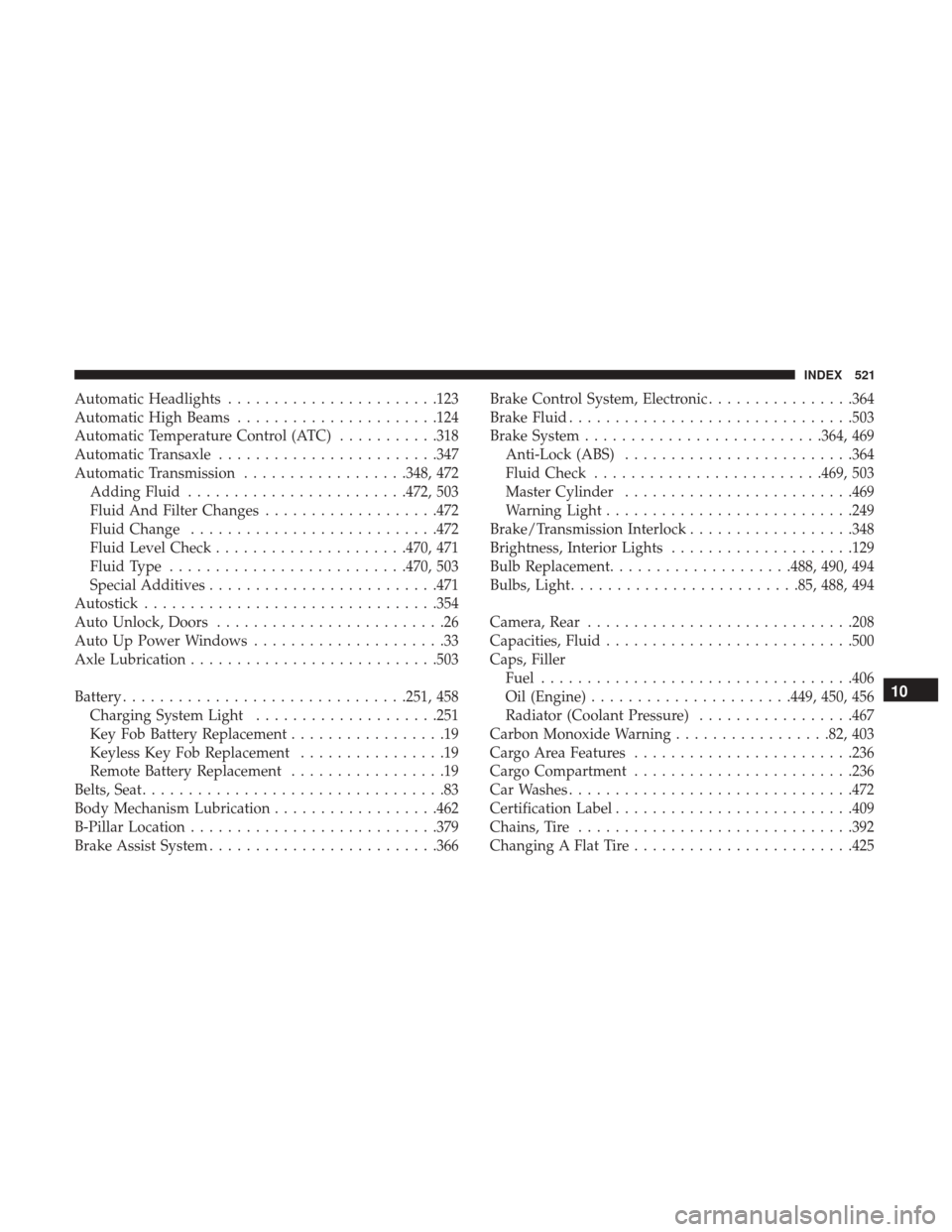
Automatic Headlights...................... .123
Automatic High Beams ..................... .124
Automatic Temperature Control (ATC) ...........318
Automatic Transaxle ....................... .347
Automatic Transmission ..................348, 472
Adding Fluid ....................... .472, 503
Fluid And Filter Changes ...................472
Fluid Change .......................... .472
Fluid Level Check .....................470, 471
Fluid Type ......................... .470, 503
Special Additives ........................ .471
Autostick ............................... .354
Auto Unlock, Doors .........................26
Auto Up Power Windows .....................33
Axle Lubrication .......................... .503
Battery .............................. .251, 458
Charging System Light ....................251
Key Fob Battery Replacement .................19
Keyless Key Fob Replacement ................19
Remote Battery Replacement .................19
Belts, Seat .................................83
Body Mechanism Lubrication ..................462
B-Pillar Location .......................... .379
Brake Assist System ........................ .366Brake Control System, Electronic
................364
Brake Fluid .............................. .503
Brake System ......................... .364, 469
Anti-Lock (ABS) ........................ .364
Fluid Check ........................ .469, 503
Master Cylinder ........................ .469
Warning Light .......................... .249
Brake/Transmission Interlock ..................348
Brightness, Interior Lights ....................129
Bulb Replacement ....................488, 490, 494
Bulbs, Light ........................ .85, 488, 494
Camera, Rear ............................ .208
Capacities,
Fluid .......................... .500
Caps, Filler Fuel ................................. .406
Oil (Engine) ..................... .449, 450, 456
Radiator (Coolant Pressure) .................467
Carbon Monoxide Warning .................82, 403
Cargo Area Features ....................... .236
Cargo Compartment ....................... .236
Car Washes .............................. .472
Certification Label ......................... .409
Chains, Tire ............................. .392
Changing A Flat Tire ....................... .425
10
INDEX 521
Page 525 of 539
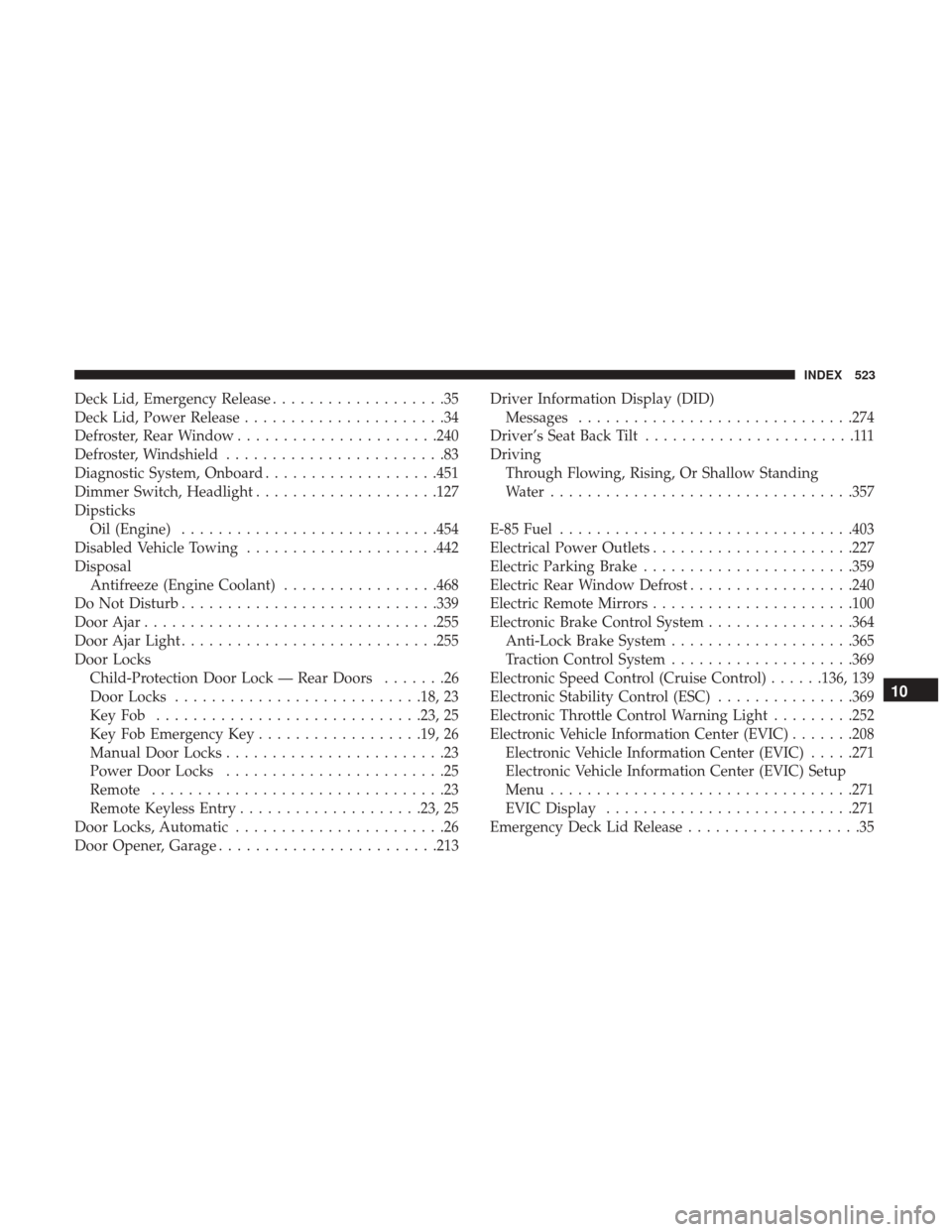
Deck Lid, Emergency Release...................35
Deck Lid, Power Release ......................34
Defroster, Rear Window ..................... .240
Defroster, Windshield ........................83
Diagnostic System, Onboard ...................451
Dimmer Switch, Headlight ....................127
Dipsticks Oil (Engine) ........................... .454
Disabled Vehicle Towing .....................442
Disposal Antifreeze (Engine Coolant) .................468
Do Not Disturb ........................... .339
Door Ajar ............................... .255
Door Ajar Light ........................... .255
Door Locks Child-Protection Door Lock — Rear Doors .......26
Door Locks .......................... .18, 23
KeyFob ............................ .23, 25
Key Fob Emergency Key ..................19, 26
Manual Door Locks ........................23
Power Door Locks ........................25
Remote ................................23
Remote Keyless Entry ....................23, 25
Door Locks, Automatic .......................26
Door Opener, Garage ....................... .213Driver Information Display (DID)
Messages ............................. .274
Driver’s Seat Back Tilt .......................111
Driving Through Flowing, Rising, Or Shallow Standing
Water ................................ .357
E-85 Fuel ............................... .403
Electrical Power Outlets ..................... .227
Electric Parking Brake ...................... .359
Electric Rear Window Defrost ..................240
Electric Remote Mirrors ..................... .100
Electronic Brake Control System ................364
Anti-Lock Brake System ....................365
Traction Control System ....................369
Electronic Speed Control (Cruise Control) ......136, 139
Electronic Stability Control (ESC) ...............369
Electronic Throttle Control Warning Light .........252
Electr
onic Vehicle Information Center (EVIC) .......208
Electronic Vehicle Information Center (EVIC) .....271
Electronic Vehicle Information Center (EVIC) Setup
Menu ................................ .271
EVIC Display .......................... .271
Emergency Deck Lid Release ...................35
10
INDEX 523