check engine CHRYSLER 200 CONVERTIBLE 2013 1.G Owner's Manual
[x] Cancel search | Manufacturer: CHRYSLER, Model Year: 2013, Model line: 200 CONVERTIBLE, Model: CHRYSLER 200 CONVERTIBLE 2013 1.GPages: 519, PDF Size: 8.65 MB
Page 444 of 519
Coolant Checks
Check engine coolant (antifreeze) protection every 12
months (before the onset of freezing weather, where
applicable). If the engine coolant (antifreeze) is dirty or
rusty in appearance, the system should be drained,
flushed, and refilled with fresh engine coolant (anti-
freeze). Check the front of the A/C condenser for any
accumulation of bugs, leaves, etc. If dirty, clean by gently
spraying water from a garden hose vertically down the
face of the condenser.
Check the coolant recovery bottle tubing for brittle rub-
ber, cracking, tears, cuts, and tightness of the connection
at the bottle and radiator. Inspect the entire system for
leaks.
Cooling System – Drain, Flush, And Refill
If the engine coolant (antifreeze) is dirty or contains a
considerable amount of sediment, clean and flush with a
reliable cooling system cleaner. Follow with a thorough
rinsing to remove all deposits and chemicals. Properly
dispose of the old engine coolant (antifreeze) solution.
Refer to the “Maintenance Schedule” for the proper
maintenance intervals.
Selection Of Coolant
Refer to “Fluids, Lubricants, and Genuine Parts” in
“Maintaining Your Vehicle” for further information.
442 MAINTAINING YOUR VEHICLE
Page 447 of 519
WARNING!
•The warning words “DO NOT OPEN HOT” on the
cooling system pressure cap are a safety precaution.
Never add engine coolant (antifreeze) when the
engine is overheated. Do not loosen or remove the
cap to cool an overheated engine. Heat causes
pressure to build up in the cooling system. To
prevent scalding or injury, do not remove the
pressure cap while the system is hot or under
pressure.
•Do not use a pressure cap other than the one
specified for your vehicle. Personal injury or en-
gine damage may result.
Disposal Of Used Engine Coolant
Used ethylene glycol-based engine coolant (antifreeze) is
a regulated substance requiring proper disposal. Check
with your local authorities to determine the disposalrules for your community. To prevent ingestion by ani-
mals or children, do not store ethylene glycol-based
engine coolant in open containers or allow it to remain in
puddles on the ground. If ingested by a child or pet, seek
emergency assistance immediately. Clean up any ground
spills immediately.
Coolant Level
Four-Cylinder Engines –the coolant bottle provides a
quick visual method for determining that the engine
coolant (antifreeze) level is adequate. With the engine
idling and warm to normal operating temperature, the
level of the engine coolant (antifreeze) in the bottle
should be between the “ADD” and “FULL” lines, shown
on the bottle.
Six-Cylinder Engines –the level of the engine coolant
(antifreeze) in the pressurized coolant bottle should be
between the “COLD” and “FULL” range on the bottle
when the engine is cold.
7
MAINTAINING YOUR VEHICLE 445
Page 448 of 519
The radiator normally remains completely full, so there is
no need to remove the radiator cap unless checking for
engine coolant (antifreeze) freeze point or replacing cool-
ant. Advise your service attendant of this. As long as the
engine operating temperature is satisfactory, the coolant
bottle need only be checked once a month. When addi-
tional engine coolant (antifreeze) is needed to maintain
the proper level, it should be added to the coolant bottle.
Do not overfill.
Points To Remember
NOTE:When the vehicle is stopped after a few miles/
kilometers of operation, you may observe vapor coming
from the front of the engine compartment. This is nor-
mally a result of moisture from rain, snow, or high
humidity accumulating on the radiator and being vapor-
ized when the thermostat opens, allowing hot engine
coolant (antifreeze) to enter the radiator.If an examination of your engine compartment shows no
evidence of radiator or hose leaks, the vehicle may be
safely driven. The vapor will soon dissipate.
•Do not overfill the coolant expansion bottle.
•Check the coolant freeze point in the radiator and in
the coolant expansion bottle. If engine coolant (anti-
freeze) needs to be added, the contents of the coolant
expansion bottle must also be protected against
freezing.
•If frequent engine coolant (antifreeze) additions are
required, the cooling system should be pressure tested
for leaks.
•Maintain engine coolant (antifreeze) concentration at
50% OAT engine coolant (antifreeze) (minimum) and
distilled water for proper corrosion protection of your
engine which contains aluminum components.
446 MAINTAINING YOUR VEHICLE
Page 449 of 519
•Make sure that the coolant expansion bottle overflow
hoses are not kinked or obstructed.
•Keep the front of the radiator clean. If your vehicle is
equipped with air conditioning, keep the front of the
condenser clean.
•Do not change the thermostat for Summer or Winter
operation. If replacement is ever necessary, install
ONLY the correct type thermostat. Other designs may
result in unsatisfactory engine coolant (antifreeze)
performance, poor gas mileage, and increased emis-
sions.
Brake System
In order to assure brake system performance, all brake
system components should be inspected periodically.
Refer to the “Maintenance Schedule” for the proper
maintenance intervals.
WARNING!
Riding the brakes can lead to brake failure and
possibly a collision. Driving with your foot resting or
riding on the brake pedal can result in abnormally
high brake temperatures, excessive lining wear, and
possible brake damage. You would not have your full
braking capacity in an emergency.
Master Cylinder – Brake Fluid Level Check
Check the fluid level in the master cylinder immediately
if the brake system warning light indicates system fail-
ure.
Check the fluid level in the master cylinder when per-
forming underhood services.
7
MAINTAINING YOUR VEHICLE 447
Page 453 of 519
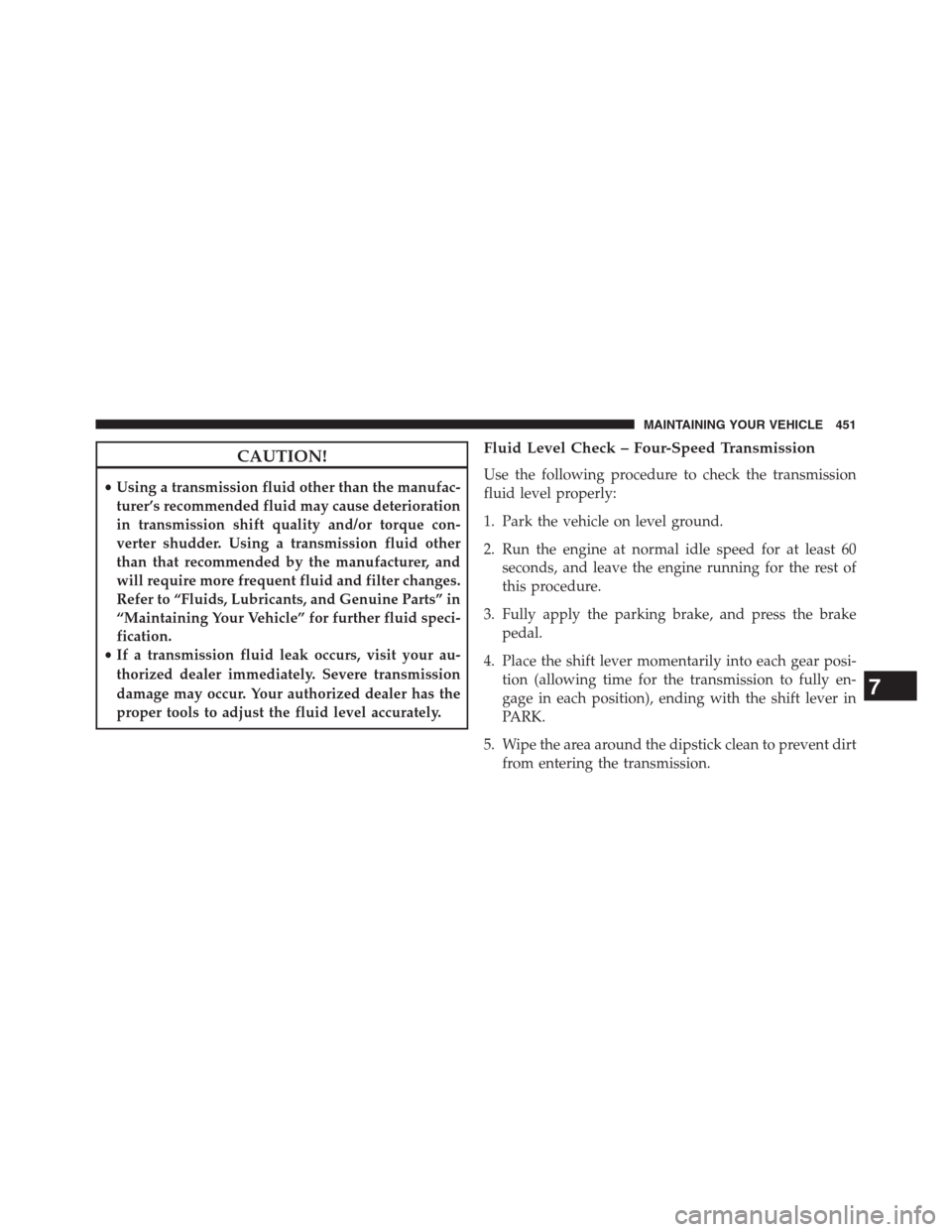
CAUTION!
•Using a transmission fluid other than the manufac-
turer’s recommended fluid may cause deterioration
in transmission shift quality and/or torque con-
verter shudder. Using a transmission fluid other
than that recommended by the manufacturer, and
will require more frequent fluid and filter changes.
Refer to “Fluids, Lubricants, and Genuine Parts” in
“Maintaining Your Vehicle” for further fluid speci-
fication.
•If a transmission fluid leak occurs, visit your au-
thorized dealer immediately. Severe transmission
damage may occur. Your authorized dealer has the
proper tools to adjust the fluid level accurately.
Fluid Level Check – Four-Speed Transmission
Use the following procedure to check the transmission
fluid level properly:
1. Park the vehicle on level ground.
2. Run the engine at normal idle speed for at least 60
seconds, and leave the engine running for the rest of
this procedure.
3. Fully apply the parking brake, and press the brake
pedal.
4. Place the shift lever momentarily into each gear posi-
tion (allowing time for the transmission to fully en-
gage in each position), ending with the shift lever in
PARK.
5. Wipe the area around the dipstick clean to prevent dirt
from entering the transmission.
7
MAINTAINING YOUR VEHICLE 451
Page 482 of 519
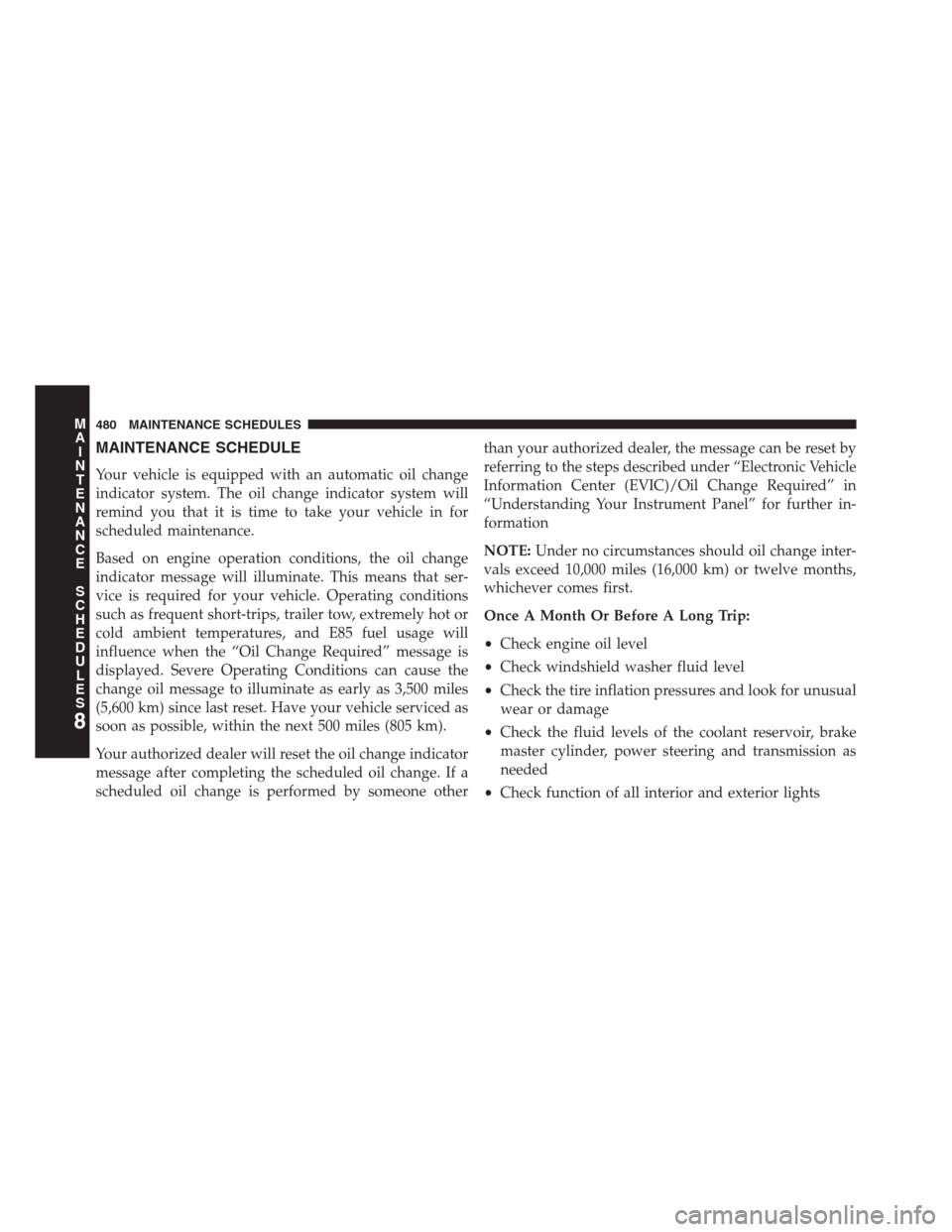
MAINTENANCE SCHEDULE
Your vehicle is equipped with an automatic oil change
indicator system. The oil change indicator system will
remind you that it is time to take your vehicle in for
scheduled maintenance.
Based on engine operation conditions, the oil change
indicator message will illuminate. This means that ser-
vice is required for your vehicle. Operating conditions
such as frequent short-trips, trailer tow, extremely hot or
cold ambient temperatures, and E85 fuel usage will
influence when the “Oil Change Required” message is
displayed. Severe Operating Conditions can cause the
change oil message to illuminate as early as 3,500 miles
(5,600 km) since last reset. Have your vehicle serviced as
soon as possible, within the next 500 miles (805 km).
Your authorized dealer will reset the oil change indicator
message after completing the scheduled oil change. If a
scheduled oil change is performed by someone otherthan your authorized dealer, the message can be reset by
referring to the steps described under “Electronic Vehicle
Information Center (EVIC)/Oil Change Required” in
“Understanding Your Instrument Panel” for further in-
formation
NOTE:Under no circumstances should oil change inter-
vals exceed 10,000 miles (16,000 km) or twelve months,
whichever comes first.
Once A Month Or Before A Long Trip:
•Check engine oil level
•Check windshield washer fluid level
•Check the tire inflation pressures and look for unusual
wear or damage
•Check the fluid levels of the coolant reservoir, brake
master cylinder, power steering and transmission as
needed
•Check function of all interior and exterior lights
8
M
A
I
N
T
E
N
A
N
C
E
S
C
H
E
D
U
L
E
S480 MAINTENANCE SCHEDULES
Page 501 of 519
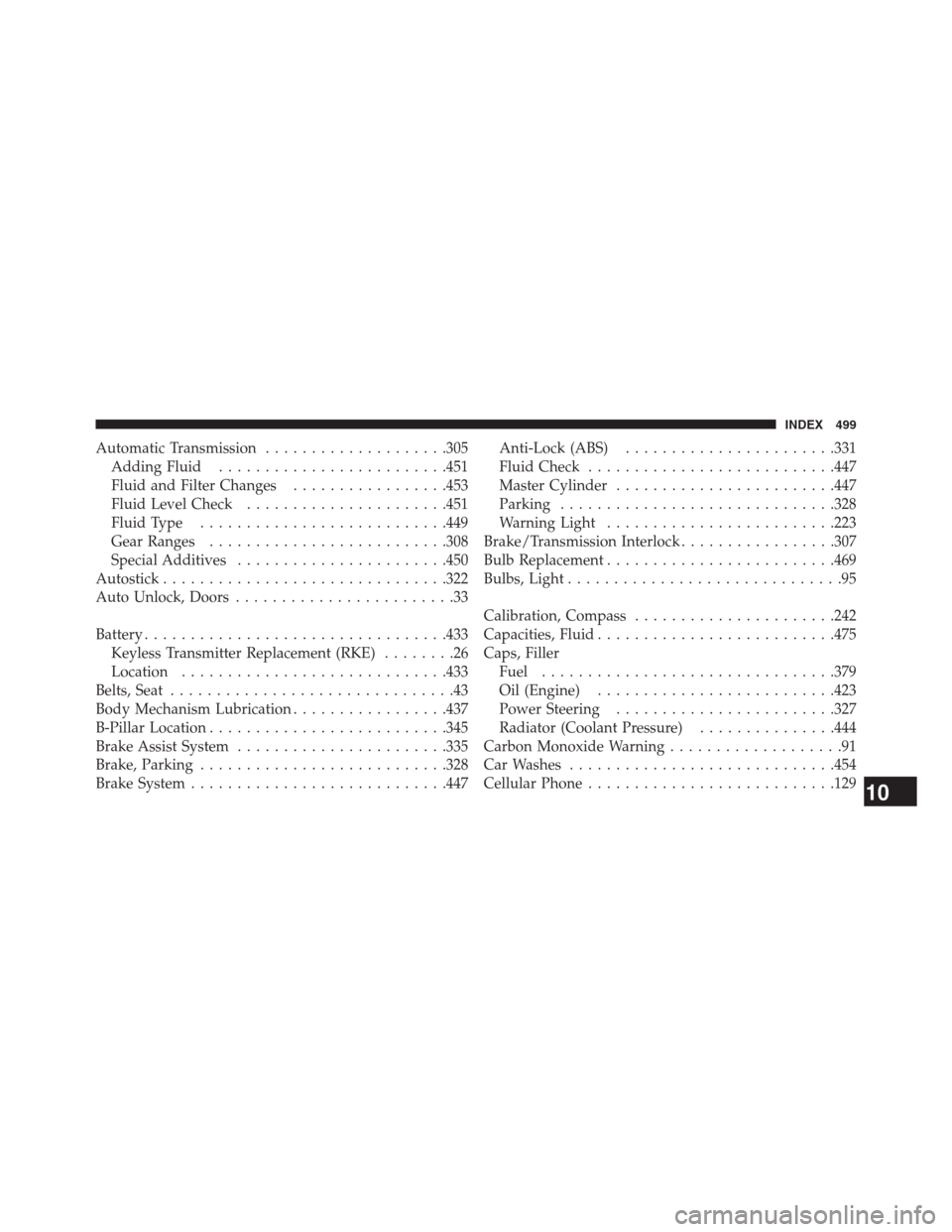
Automatic Transmission....................305
Adding Fluid.........................451
Fluid and Filter Changes.................453
Fluid Level Check......................451
Fluid Type...........................449
Gear Ranges..........................308
Special Additives.......................450
Autostick...............................322
Auto Unlock, Doors........................33
Battery.................................433
Keyless Transmitter Replacement (RKE)........26
Location.............................433
Belts, Seat...............................43
Body Mechanism Lubrication.................437
B-Pillar Location..........................345
Brake Assist System.......................335
Brake, Parking...........................328
Brake System............................447Anti-Lock (ABS).......................331
Fluid Check...........................447
Master Cylinder........................447
Parking..............................328
Warning Light.........................223
Brake/Transmission Interlock.................307
Bulb Replacement.........................469
Bulbs, Light..............................95
Calibration, Compass......................242
Capacities, Fluid..........................475
Caps, Filler
Fuel................................379
Oil (Engine)..........................423
Power Steering........................327
Radiator (Coolant Pressure)...............444
Carbon Monoxide Warning...................91
Car Washes.............................454
Cellular Phone...........................129
10
INDEX 499
Page 502 of 519
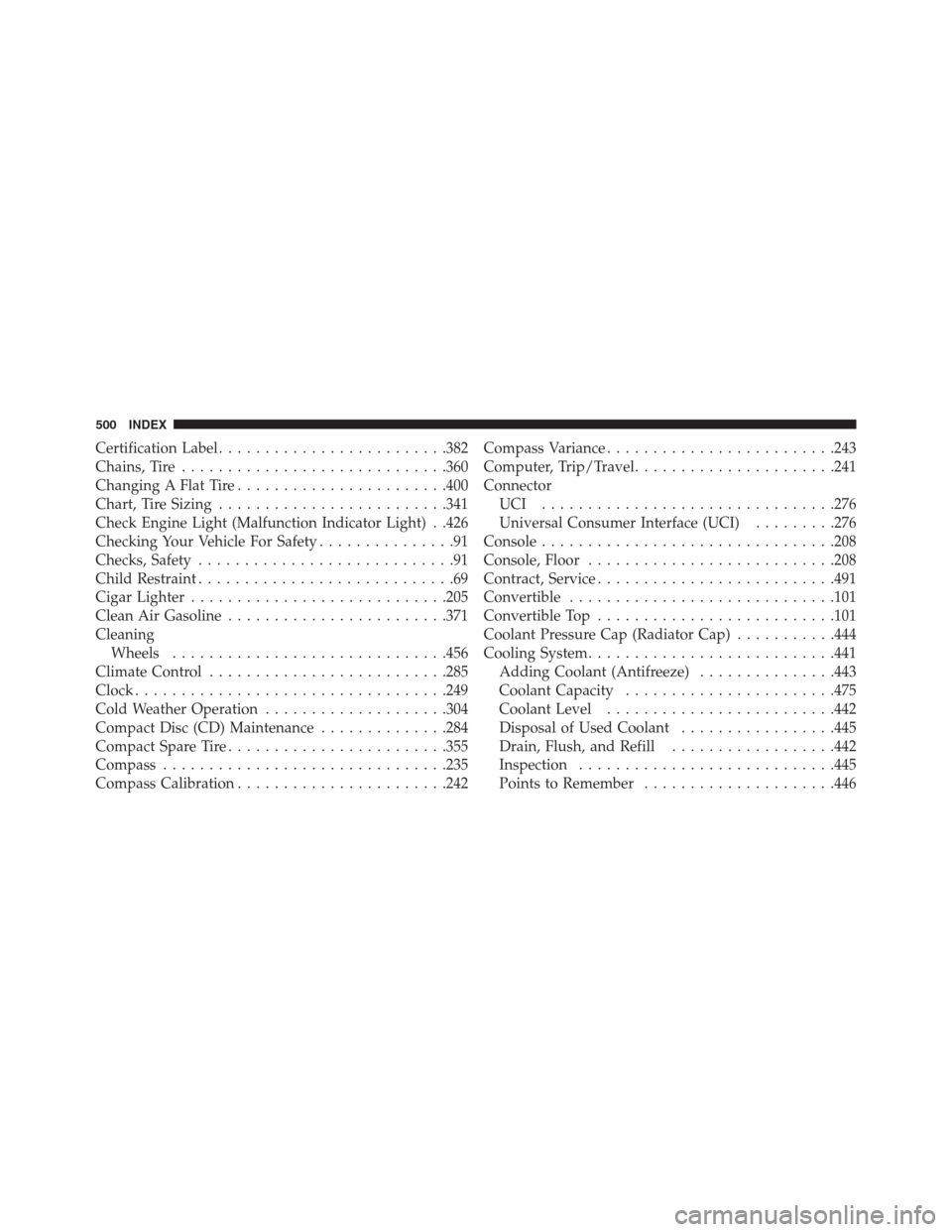
Certification Label.........................382
Chains, Tire.............................360
Changing A Flat Tire.......................400
Chart, Tire Sizing.........................341
Check Engine Light (Malfunction Indicator Light) . .426
Checking Your Vehicle For Safety...............91
Checks, Safety............................91
Child Restraint............................69
Cigar Lighter............................205
Clean Air Gasoline........................371
Cleaning
Wheels..............................456
Climate Control..........................285
Clock..................................249
Cold Weather Operation....................304
Compact Disc (CD) Maintenance..............284
Compact Spare Tire........................355
Compass...............................235
Compass Calibration.......................242Compass Variance.........................243
Computer, Trip/Travel......................241
Connector
UCI ................................276
Universal Consumer Interface (UCI).........276
Console................................208
Console, Floor...........................208
Contract, Service..........................491
Convertible.............................101
Convertible Top..........................101
Coolant Pressure Cap (Radiator Cap)...........444
Cooling System...........................441
Adding Coolant (Antifreeze)...............443
Coolant Capacity.......................475
Coolant Level.........................442
Disposal of Used Coolant.................445
Drain, Flush, and Refill..................442
Inspection............................445
Points to Remember
.....................446
500 INDEX
Page 504 of 519

Electronic Stability Control (ESC)..............336
Electronic Vehicle Information Center (EVIC)......236
Emergency, In Case of
Jacking..............................400
Jump Starting.........................410
Towing..............................417
Emission Control System Maintenance..........426
Engine.................................423
Air Cleaner...........................432
Block Heater..........................304
Break-In Recommendations................90
Checking Oil Level.....................429
Compartment.........................424
Compartment Identification...............424
Coolant (Antifreeze).....................442
Cooling..............................441
Exhaust Gas Caution.....................91
Fuel Requirements......................370
Jump Starting.........................410Oil .................................429
Oil Change Interval.....................227
Oil Filler Cap.........................423
Oil Selection..........................430
Oil Synthetic..........................431
Overheating..........................398
Starting..............................303
Temperature Gauge.....................220
Engine Oil Viscosity.......................431
Engine Oil Viscosity Chart...................431
Enhanced Accident Response Feature............64
Entry System, Illuminated....................21
Ethanol................................371
Event Data Recorder........................68
Exhaust Gas Caution........................91
Exhaust System...........................91
Extender, Seat Belt.........................56
Exterior Lights............................95
502 INDEX
Page 505 of 519
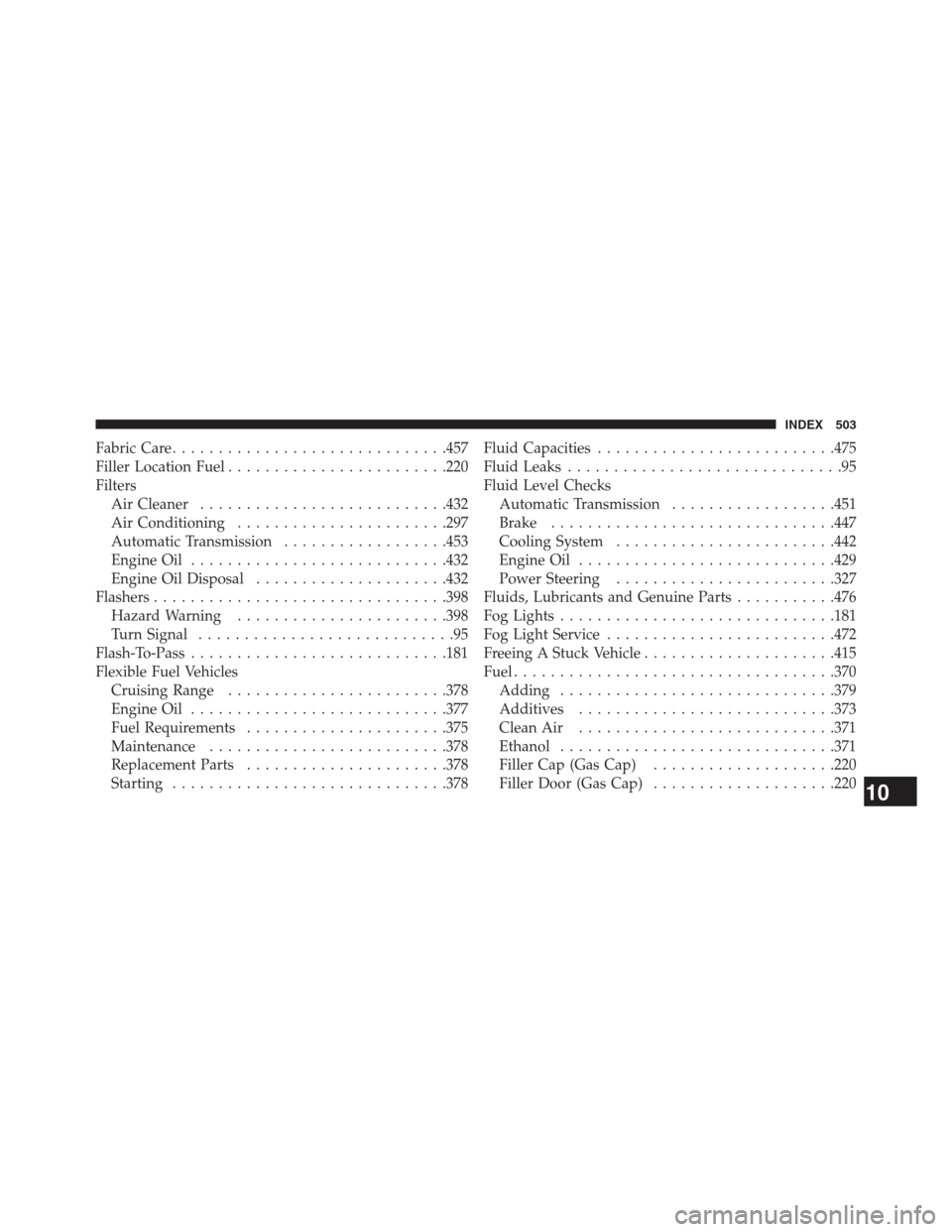
Fabric Care..............................457
Filler Location Fuel........................220
Filters
Air Cleaner...........................432
Air Conditioning.......................297
Automatic Transmission..................453
Engine Oil............................432
Engine Oil Disposal.....................432
Flashers................................398
Hazard Warning.......................398
Turn Signal............................95
Flash-To-Pass............................181
Flexible Fuel Vehicles
Cruising Range........................378
Engine Oil............................377
Fuel Requirements......................375
Maintenance..........................378
Replacement Parts......................378
Starting..............................378Fluid Capacities..........................475
Fluid Leaks..............................95
Fluid Level Checks
Automatic Transmission..................451
Brake...............................447
Cooling System........................442
Engine Oil............................429
Power Steering........................327
Fluids, Lubricants and Genuine Parts...........476
Fog Lights..............................181
Fog Light Service.........................472
Freeing A Stuck Vehicle.....................415
Fuel...................................370
Adding..............................379
Additives............................373
Clean Air............................371
Ethanol..............................371
Filler Cap (Gas Cap)
....................220
Filler Door (Gas Cap)....................220
10
INDEX 503