trunk CHRYSLER 300 2005 1.G User Guide
[x] Cancel search | Manufacturer: CHRYSLER, Model Year: 2005, Model line: 300, Model: CHRYSLER 300 2005 1.GPages: 374, PDF Size: 6.8 MB
Page 254 of 374

²Do not inhale exhaust gases. They contain carbon
monoxide, a colorless and odorless gas which can kill.
Never run the engine in a closed area, such as a
garage, and never sit in a parked vehicle with the
engine running for an extended period. If the vehicle is
stopped in an open area with the engine running for
more than a short period, adjust the ventilation system
to force fresh, outside air into the vehicle.
²Guard against carbon monoxide with proper mainte-
nance. Have the exhaust system inspected every time
the vehicle is raised. Have any abnormal conditions
repaired promptly. Until repaired, drive with all side
windows fully open.
²Keep the trunk closed when driving your vehicle to
prevent carbon monoxide and other poisonous ex-
haust gases from entering the vehicle.
ADDING FUEL
Fuel Filler Cap (Gas Cap)
The gas cap is located behind the fuel filler door on the
left side of the vehicle. Push in on the left side (near the
edge) of the fuel filler door to access the fuel filler cap. If
the gas cap is lost or damaged, be sure the replacement
cap is for use with this vehicle.
254 STARTING AND OPERATING
Page 267 of 374

Jack Location
The jack is stowed under an access cover in the trunk.
Follow these steps to access the jack.
NOTE:The spare tire must be removed in order to
access the jack.
²Open the trunk.
²Lift the access cover using the pull strap.
²Remove the fastener securing the spare tire.
WHAT TO DO IN EMERGENCIES 267
6
Page 268 of 374

²Remove the spare tire.
²Remove the fastener securing the jack.
Spare Tire Stowage
The spare tire is stowed under an access cover in the
trunk. Follow these steps to access the spare tire.
²Open the trunk.
²Lift the access cover using the pull strap.
268 WHAT TO DO IN EMERGENCIES
Page 274 of 374
WARNING!
²Do not attempt to push or tow your vehicle to get it
started. Vehicles equipped with an automatic trans-
mission cannot be started this way. Unburned fuel
could enter the catalytic converter and once the
engine has started, ignite and damage the converter
and vehicle. If the vehicle has a discharged battery,
booster cables may be used to obtain a start from
another vehicle. This type of start can be dangerous
if done improperly, so follow this procedure care-
fully.
²Battery fluid is a corrosive acid solution; do not
allow battery fluid to contact eyes, skin or clothing.
Don't lean over battery when attaching clamps or
allow the clamps to touch each other. If acid splashes
in eyes or on skin, flush contaminated area immedi-
ately with large quantities of water.
²A battery generates hydrogen gas which is flam-
mable and explosive. Keep flame or spark away from
the vent holes. Do not use a booster battery or any
other booster source with an output that exceeds 12
volts.
NOTE:The battery is stored under an access cover in
the trunk. Remote battery terminals are located in the
engine compartment for jump starting.
NOTE:The battery in this vehicle has a vent hose that
should not be disconnected and should only be replaced
with a battery of the same type (vented).
1. Wear eye protection and remove any metal jewelry
such as watch bands or bracelets that might make an
inadvertent electrical contact.
2. When boost is provided by a battery in another
vehicle, park that vehicle within booster cable reach and
without letting the vehicles touch. Set the parking brake,
place the automatic transmission in PARK and turn the
ignition switch to the OFF (or LOCK) position for both
vehicles.
3. Turn off the heater, radio and all unnecessary electrical
loads.
274 WHAT TO DO IN EMERGENCIES
Page 298 of 374
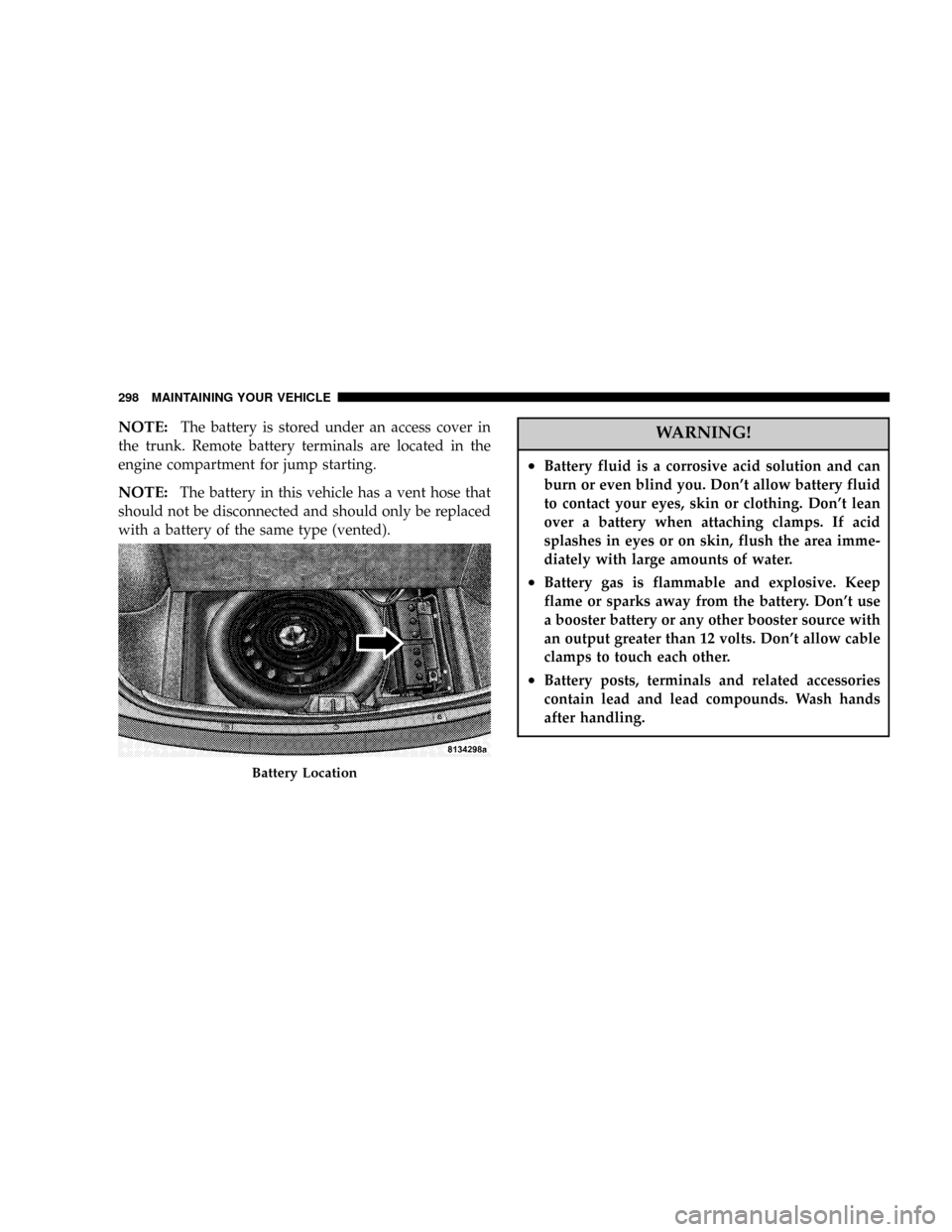
NOTE:The battery is stored under an access cover in
the trunk. Remote battery terminals are located in the
engine compartment for jump starting.
NOTE:The battery in this vehicle has a vent hose that
should not be disconnected and should only be replaced
with a battery of the same type (vented).
WARNING!
²Battery fluid is a corrosive acid solution and can
burn or even blind you. Don't allow battery fluid
to contact your eyes, skin or clothing. Don't lean
over a battery when attaching clamps. If acid
splashes in eyes or on skin, flush the area imme-
diately with large amounts of water.
²Battery gas is flammable and explosive. Keep
flame or sparks away from the battery. Don't use
a booster battery or any other booster source with
an output greater than 12 volts. Don't allow cable
clamps to touch each other.
²Battery posts, terminals and related accessories
contain lead and lead compounds. Wash hands
after handling.
Battery Location
298 MAINTAINING YOUR VEHICLE
Page 301 of 374

Front & Rear Suspension Ball Joints
The suspension ball joints should be inspected for exter-
nal leakage or damage when other maintenance is per-
formed.
Steering Linkage
The tie rod end ball joints should be inspected for
external leakage or damage when other maintenance is
performed.
Drive Shaft Universal Joints
Your vehicle has constant velocity universal joints. Peri-
odic lubrication of these joints is not required. However,
the joint boots should be inspected for external leakage or
damage when other maintenance is performed. If leakage
or damage is evident, the universal joint boot and grease
should be replaced immediately.
Continued operation could result in failure of the univer-
sal joint due to water and dirt contamination of the
grease. This would require complete replacement of the
joint assembly.
Body Lubrication
Locks and all body pivot points, including such items as
seat tracks, doors, trunk and hood hinges, should be
lubricated periodically to assure quiet, easy operation
and to protect against rust and wear. Prior to the appli-
cation of any lubricant, the parts concerned should be
wiped clean to remove dust and grit; after lubricating
excess oil and grease should be removed. Particular
attention should also be given to hood latching compo-
nents to insure proper function. When performing other
underhood services, the hood latch, release mechanism
and safety catch should be cleaned and lubricated.
The external lock cylinders should be lubricated twice a
year, preferably in the fall and spring. Apply a small
amount of a high quality lubricant such as MopartLock
Cylinder Lubricant directly into the lock cylinder.
Windshield Wiper Blades
The rubber edges of the wiper blades and the windshield
should be cleaned periodically with a sponge or soft cloth
and a mild nonabrasive cleaner. This will remove accu-
mulations of salt or road film.
MAINTAINING YOUR VEHICLE 301
7
Page 312 of 374

What Causes Corrosion?
Corrosion is the result of deterioration or removal of
paint and protective coatings from your vehicle.
The most common causes are:
²Road salt, dirt and moisture accumulation.
²Stone and gravel impact.
²Insects, tree sap and tar.
²Salt in the air near seacoast localities.
²Atmospheric fallout/industrial pollutants.
Washing
²
Wash your vehicle regularly. Always wash your ve-
hicle in the shade using a mild car wash soap, and
rinse the panels completely with clear water.
²If insects, tar or other similar deposits have accumu-
lated on your vehicle, wash it as soon as possible.
²Use Mopar auto polish to remove road film and stains
and to polish your vehicle. Take care never to scratch
the paint.
²Avoid using abrasive compounds and power buffing
that may diminish the gloss or thin out the paint
finish.
CAUTION!
Do not use abrasive or strong cleaning materials
such as steel wool or scouring powder, which will
scratch metal and painted surfaces.
Special Care
²
If you drive on salted or dusty roads or if you drive
near the ocean, hose off the undercarriage at least once
a month.
²It is important that the drain holes in the lower edges
of the doors, rocker panels and trunk be kept clear and
open.
²If you detect any stone chips or scratches in the paint,
touch them up immediately. The cost of such repairs is
considered the responsibility of the owner.
312 MAINTAINING YOUR VEHICLE
Page 318 of 374

Rear Power Distribution Center
There is also a power distribution center located in the
trunk under the spare tire access panel. This center
contains fuses and relays.
318 MAINTAINING YOUR VEHICLE
Page 320 of 374
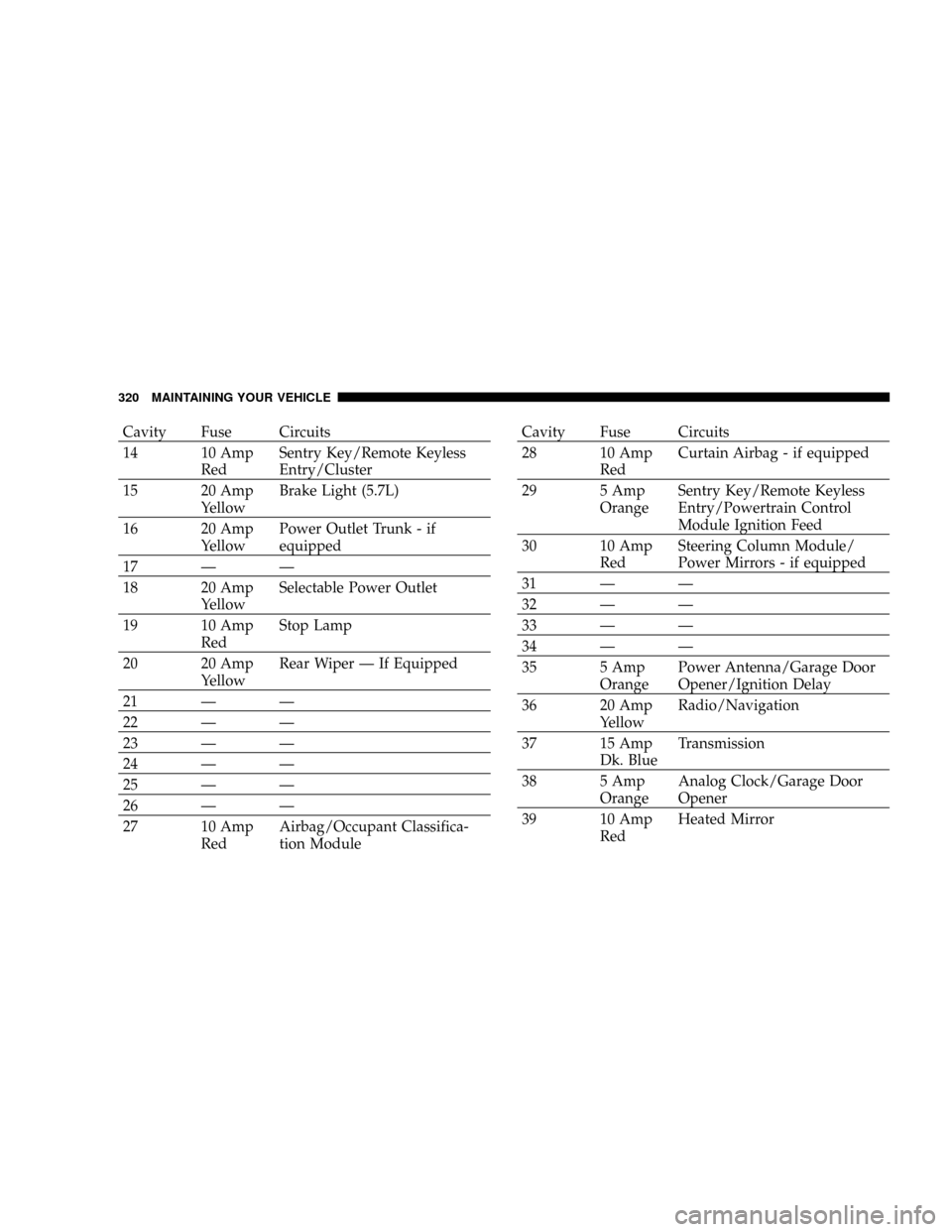
Cavity Fuse Circuits
14 10 Amp
RedSentry Key/Remote Keyless
Entry/Cluster
15 20 Amp
YellowBrake Light (5.7L)
16 20 Amp
YellowPower Outlet Trunk - if
equipped
17ÐÐ
18 20 Amp
YellowSelectable Power Outlet
19 10 Amp
RedStop Lamp
20 20 Amp
YellowRear Wiper Ð If Equipped
21ÐÐ
22ÐÐ
23ÐÐ
24ÐÐ
25ÐÐ
26ÐÐ
27 10 Amp
RedAirbag/Occupant Classifica-
tion ModuleCavity Fuse Circuits
28 10 Amp
RedCurtain Airbag - if equipped
29 5 Amp
OrangeSentry Key/Remote Keyless
Entry/Powertrain Control
Module Ignition Feed
30 10 Amp
RedSteering Column Module/
Power Mirrors - if equipped
31ÐÐ
32ÐÐ
33ÐÐ
34ÐÐ
35 5 Amp
OrangePower Antenna/Garage Door
Opener/Ignition Delay
36 20 Amp
YellowRadio/Navigation
37 15 Amp
Dk. BlueTransmission
38 5 Amp
OrangeAnalog Clock/Garage Door
Opener
39 10 Amp
RedHeated Mirror
320 MAINTAINING YOUR VEHICLE
Page 322 of 374

REPLACEMENT LIGHT BULBS
LIGHT BULBS Ð Interior Bulb Number
Rear Courtesy/Reading Lights.............. W5W
Rear Compartment (Trunk) Light............. 579
Overhead Console Reading Lights............. 578
Visor Vanity Lights.....................A6220
Glove Box Light......................... 194
Door Courtesy.......................... 562
Shift Indicator Light.................JKLE14140
NOTE:For lighted switches, see your dealer for re-
placement instructions.
All of the interior bulbs are glass wedge base or glass
cartridge types. Aluminum base bulbs are not approved
and should not be used for replacement.
LIGHT BULBS Ð Exterior (300, 300 Touring) Bulb
Number
Low Beam Headlamp.....................9006
High Beam Headlamp....................9005
Front Park/Turn Lamp.................3757AK
Front Inner Park Lamp..................194NA
Front Outer Park Lamp..................194NAFront Fog LampÐIf Equipped...........9145/H10
(Serviced at Dealer)
Front Sidemarker......... W5W(Serviced at Dealer)
Tail/Stop/Turn Lamp.....................3057
Rear Sidemarker......................... 168
Backup Lamp..........................3057
Center High Mount Stop Lamp (CHMSL)....... LED
License................................ 168
LIGHT BULBS Ð Exterior (300C) Bulb Number
Low Beam Headlamp (Standard Halogen)....9006XS
Low Beam Headlamp ± High Intensity
Discharge (HID)........... D1S(Serviced at Dealer)
High Beam Headlamp....................9005
Front Park/Turn Lamp.................3157AK
Front Fog Lamp.......9145/H10 (Serviced at Dealer)
Front Sidemarker......... W5W(Serviced at Dealer)
Tail/Stop Lamp.........................3057
Tail Lamp.............................3057
Turn Signal Lamp.......................3057
Backup Lamp..........................3057
Center High Mount Stop Lamp (CHMSL)....... LED
License.............................. W5W
322 MAINTAINING YOUR VEHICLE