tow CHRYSLER 300 2012 2.G Workshop Manual
[x] Cancel search | Manufacturer: CHRYSLER, Model Year: 2012, Model line: 300, Model: CHRYSLER 300 2012 2.GPages: 576, PDF Size: 15.25 MB
Page 459 of 576
•Refer to “Compact Spare Tire” and to “Limited-Use
Spare” under “Tires—General Information” in “Start-
ing and Operating” for additional warnings, cautions,
and information about the spare tire, its use, and
operation.
8. Install the lug nuts with the cone shaped end of the lug
nut toward the wheel. Lightly tighten the lug nuts.
WARNING!
To avoid the risk of forcing the vehicle off the jack,
do not tighten the wheel nuts fully until the vehicle
has been lowered. Failure to follow this warning may
result in personal injury.
9. Lower the vehicle to the ground by turning the jack
handle counterclockwise.
10. Finish tightening the lug nuts. Push down on the
wrench while at the end of the handle for increasedleverage. Tighten the lug nuts in a star pattern until each
nut has been tightened twice. The correct tightness of
each lug nut is 110 ft/lb. (150 N·m). If in doubt about the
correct tightness, have them checked with a torque
wrench by your authorized dealer or at a service station.
11. Stow the jack, tools and flat tire. Make sure the base
of the jack faces the front of the vehicle before tightening
down the fastener.WARNING!
•A loose tire or jack thrown forward in a collision
or hard stop could endanger the occupants of the
vehicle. Always stow the jack parts and the spare
tire in the places provided.
•Have the deflated (flat) tire repaired or replaced
immediately.
6
WHAT TO DO IN EMERGENCIES 457
Page 460 of 576
Road Tire Installation
1. Mount the road tire on the axle.
2. Install the remaining lug nuts with the cone shaped
end of the nut toward the wheel. Lightly tighten the lug
nuts.
WARNING!
To avoid the risk of forcing the vehicle off the jack,
do not tighten the wheel nuts fully until the vehicle
has been lowered. Failure to follow this warning may
result in personal injury.
3. Lower the vehicle to the ground by turning the jack
handle counterclockwise.
4. Finish tightening the lug nuts. Push down on the
wrench while at the end of the handle for increased
leverage. Tighten the lug nuts in a star pattern until eachnut has been tightened twice. The correct tightness of
each lug nut is 110 ft/lbs (150 N·m). If in doubt about the
correct tightness, have them checked with a torque
wrench by your authorized dealer or service station.
5. After 25 miles (40 km) check the lug nut torque with a
torque wrench to ensure that all lug nuts are properly
seated against the wheel.JUMP-STARTING PROCEDURES
If your vehicle has a discharged battery it can be jump-
started using a set of jumper cables and a battery in
another vehicle or by using a portable battery booster
pack. Jump-starting can be dangerous if done improperly
so please follow the procedures in this section carefully.
NOTE:When using a portable battery booster pack
follow the manufacturer ’s operating instructions and
precautions.
458 WHAT TO DO IN EMERGENCIES
Page 467 of 576
MANUAL PARK RELEASE — 8 SPEED
TRANSMISSION (3.6L Engine)
WARNING!
Always secure your vehicle by fully applying the
parking brake, before activating the Manual Park
Release. Activating the Manual Park Release will
allow your vehicle to roll away if it is not secured by
the parking brake or by proper connection to a tow
vehicle. Activating the Manual Park Release on an
unsecured vehicle could lead to serious injury or
death for those in or around the vehicle.
In order to push or tow the vehicle in cases where the
transmission will not shift out of PARK (such as a dead
battery), a Manual Park Release is available.
Follow these steps to use the Manual Park Release:NOTE:To prevent the vehicle from rolling unintention-
ally, firmly apply the parking brake.
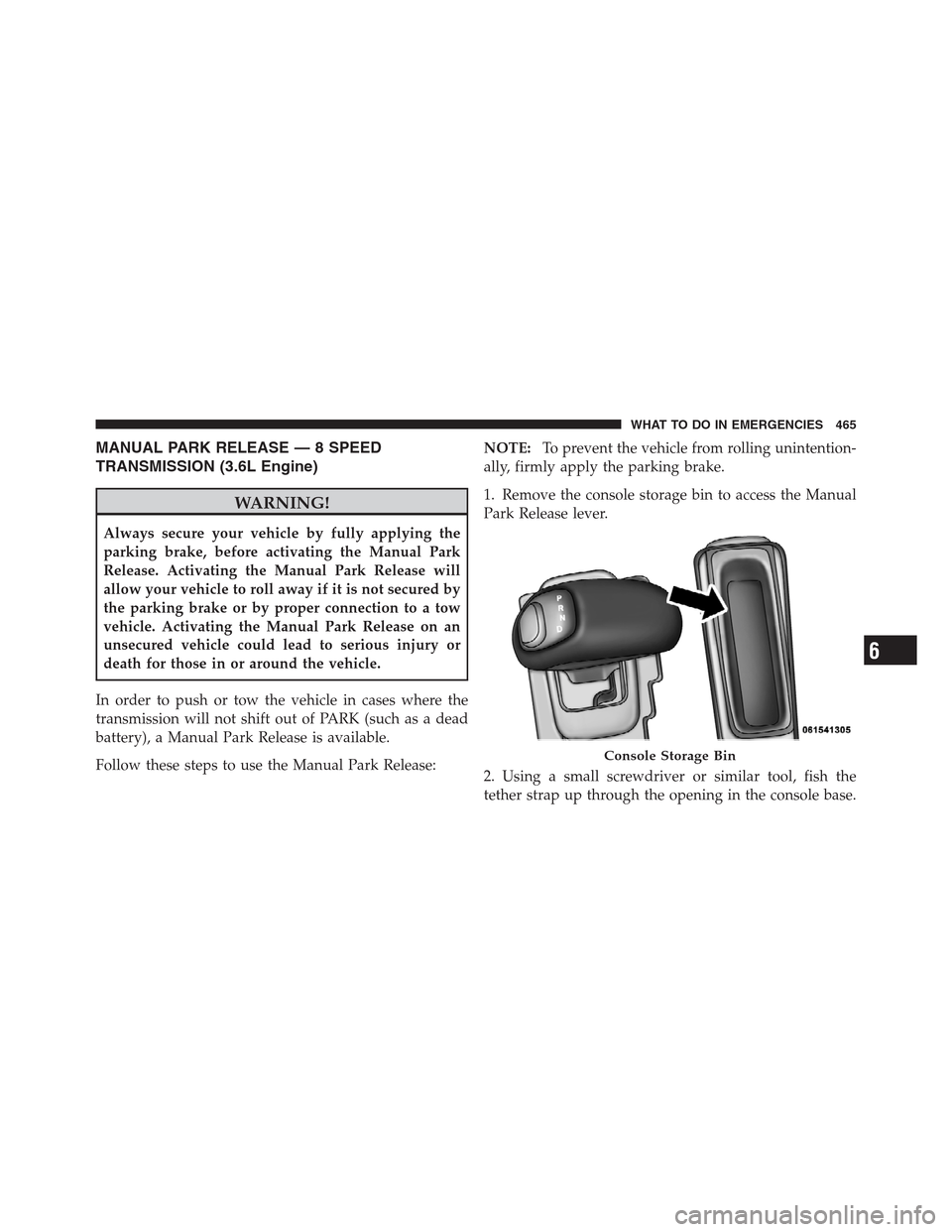
1. Remove the console storage bin to access the Manual
Park Release lever.
2. Using a small screwdriver or similar tool, fish the
tether strap up through the opening in the console base.
Console Storage Bin
6
WHAT TO DO IN EMERGENCIES 465
Page 468 of 576
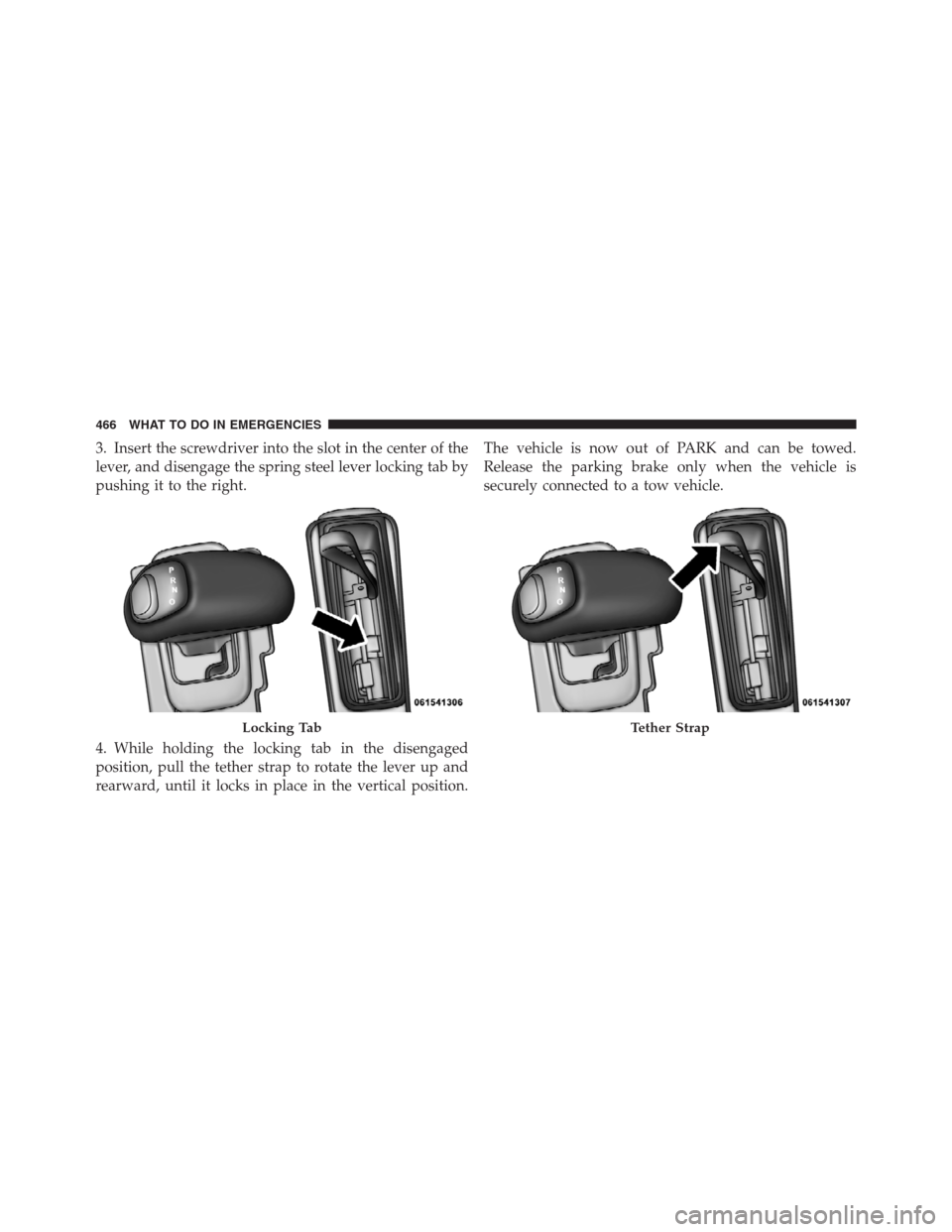
3. Insert the screwdriver into the slot in the center of the
lever, and disengage the spring steel lever locking tab by
pushing it to the right.
4. While holding the locking tab in the disengaged
position, pull the tether strap to rotate the lever up and
rearward, until it locks in place in the vertical position.The vehicle is now out of PARK and can be towed.
Release the parking brake only when the vehicle is
securely connected to a tow vehicle.
Locking TabTether Strap
466 WHAT TO DO IN EMERGENCIES
Page 469 of 576
To Reset The Manual Park Release:
1. Push the latch (at the base of the lever, on the rear side)
rearward (away from the lever) to unlatch the lever.
2. Rotate the Manual Park Release lever forward and
down, to its original position, until the locking tab snaps
into place to secure the lever.3. Pull up gently on the tether strap to confirm that the
lever is locked in its stowed position.
4. Tuck the tether strap into the base of the console.
Reinstall the console storage bin.
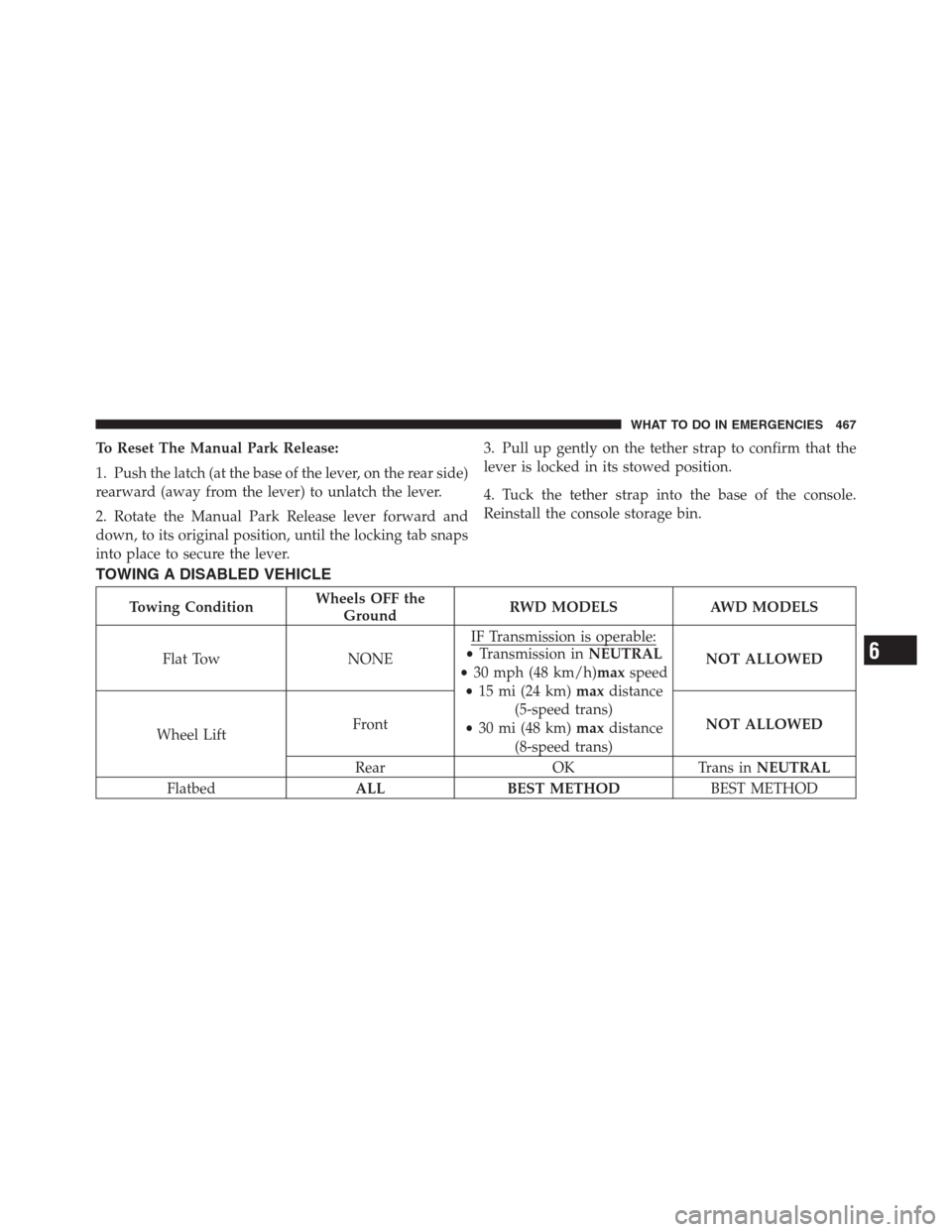
TOWING A DISABLED VEHICLE
Towing ConditionWheels OFF the
GroundRWD MODELS AWD MODELS
Flat Tow NONEIF Transmission is operable:
•Transmission inNEUTRAL
•30 mph (48 km/h)maxspeed
•15 mi (24 km)maxdistance
(5-speed trans)
•30 mi (48 km)maxdistance
(8-speed trans)NOT ALLOWED
Wheel LiftFrontNOT ALLOWED
Rear OK Trans inNEUTRAL
FlatbedALL BEST METHODBEST METHOD6
WHAT TO DO IN EMERGENCIES 467
Page 470 of 576
Proper towing or lifting equipment is required to prevent
damage to your vehicle. Use only tow bars and other
equipment designed for the purpose, following equip-
ment manufacturer ’s instructions. Use of safety chains is
mandatory. Attach a tow bar or other towing device to
main structural members of the vehicle, not to bumpers
or associated brackets. State and local laws applying to
vehicles under tow must be observed.
If you must use the accessories (wipers, defrosters, etc.)
while being towed, the ignition must be in the ON/RUN
position, not the ACC position.
If the vehicle’s battery is discharged, see “Manual Park
Release” or “Shift Lever Override” in “What To Do In
Emergencies” for instructions on shifting the automatic
transmission out of the PARK position for towing.CAUTION!
•Do not use sling type equipment when towing.
Damage to the fascia will occur.
•When securing the vehicle to a flatbed truck, do
not attach to the front or rear suspension compo-
nents. Damage to your vehicle may result from
improper towing.
•Do not push or tow this vehicle with another
vehicle as damage to the bumper fascia and trans-
mission may result.
•The manufacturer does not recommend that you
tow this vehicle on a tow dolly. Vehicle damage
may occur.
Flatbed towing is recommended.DO NOTtow an AWD
vehicle with the rear wheels on the ground.
468 WHAT TO DO IN EMERGENCIES
Page 471 of 576
If the transmission is operable, vehicles WITHOUT AWD
may be towed (with rear wheels on the ground) under
the following conditions:
•The shift lever must be in NEUTRAL.
•The towing speed must not exceed 30 mph (48 km/h).
•The towing distance must not exceed 15 miles (24 km)
for 5-speed transmission, or 30 miles (48 km) for
8-speed transmission.
If the transmission is not operable, or the vehicle must be
towed faster than 30 mph (48 km/h) or farther than
15 miles (24 km) for 5-speed transmission, or 30 miles
(48 km) for 8-speed transmission, tow with the rear
wheels OFF the ground (on a flatbed, or with the rear
wheels raised using a wheel lift and the transmission in
NEUTRAL).
CAUTION!
Failure to follow these towing methods can cause
severe transmission damage. Such damage is not
covered by the New Vehicle Limited Warranty.
Vehicles equipped with AWD can be towed with the
transmission in NEUTRAL and the rear wheels OFF the
ground with no limitation on speed or distance.
Without The Ignition Key Fob
Special care must be taken when the vehicle is towed
with the ignition in the OFF position. The only approved
method of towing without the ignition key fob is with a
flatbed truck. Proper towing equipment is necessary to
prevent damage to the vehicle.6
WHAT TO DO IN EMERGENCIES 469
Page 477 of 576
ONBOARD DIAGNOSTIC SYSTEM — OBD II
Your vehicle is equipped with a sophisticated onboard
diagnostic system called OBD II. This system monitors
the performance of the emissions, engine, and automatic
transmission control systems. When these systems are
operating properly, your vehicle will provide excellent
performance and fuel economy, as well as engine emis-
sions well within current government regulations.
If any of these systems require service, the OBD II system
will turn on the “Malfunction Indicator Light (MIL).” It
will also store diagnostic codes and other information to
assist your service technician in making repairs. Al-
though your vehicle will usually be drivable and not
need towing, see your authorized dealer for service as
soon as possible.CAUTION!
•Prolonged driving with the MIL on could cause
further damage to the emissions control system. It
could also affect fuel economy and driveability.
The vehicle must be serviced before any emissions
tests can be performed.
•If the MIL is flashing while the engine is running,
severe catalytic converter damage and power loss
will soon occur. Immediate service is required.
EMISSIONS INSPECTION AND MAINTENANCE
PROGRAMS
In some localities, it may be a legal requirement to pass
an inspection of your vehicle’s emissions control system.
Failure to pass could prevent vehicle registration.
For states that require an Inspection and Mainte-
nance (I/M), this check verifies the “Malfunction7
MAINTAINING YOUR VEHICLE 475
Page 489 of 576
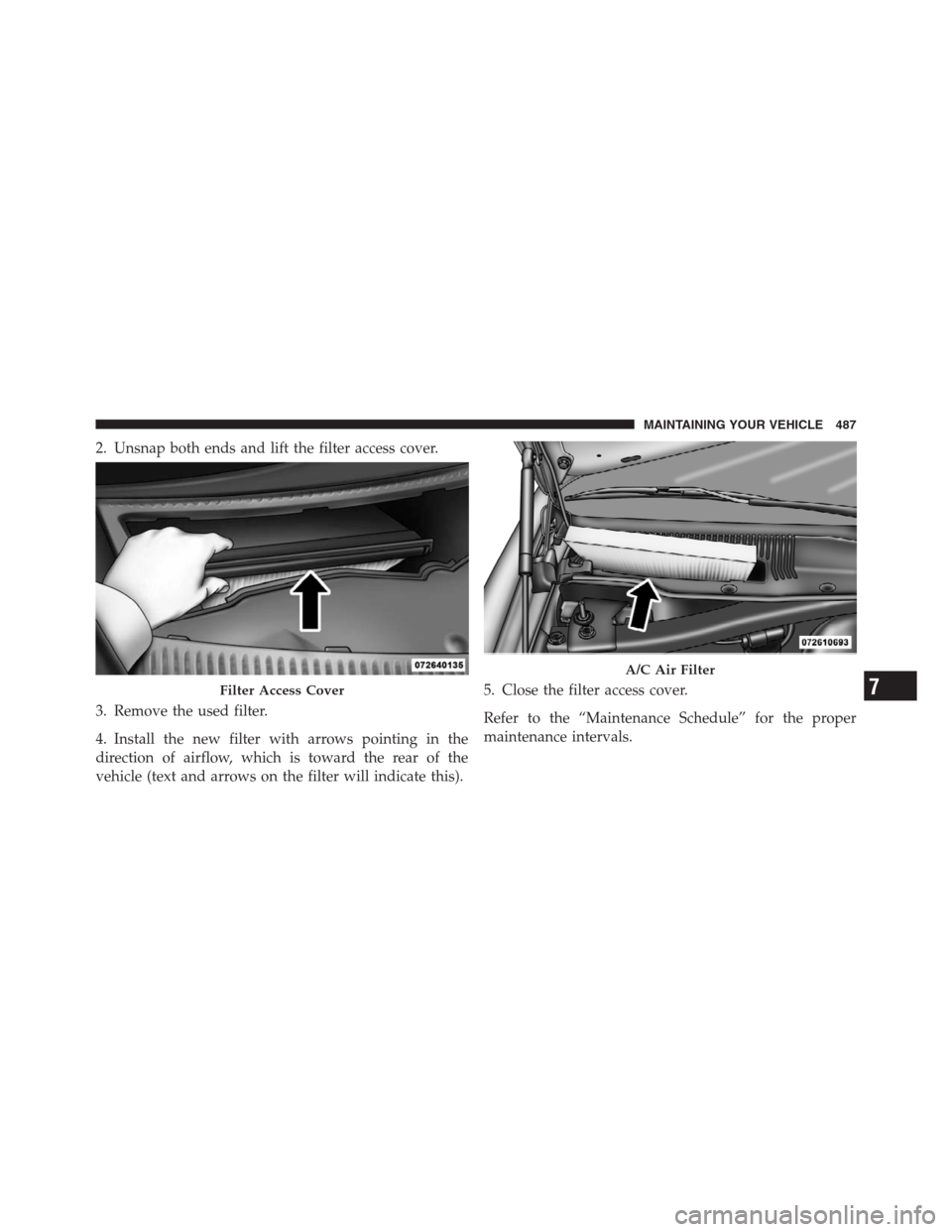
2. Unsnap both ends and lift the filter access cover.
3. Remove the used filter.
4. Install the new filter with arrows pointing in the
direction of airflow, which is toward the rear of the
vehicle (text and arrows on the filter will indicate this).5. Close the filter access cover.
Refer to the “Maintenance Schedule” for the proper
maintenance intervals.
Filter Access Cover
A/C Air Filter
7
MAINTAINING YOUR VEHICLE 487
Page 491 of 576
Adding Washer Fluid
The windshield washer fluid reservoir is located in the
front of the engine compartment. Be sure to check the fluid
level at regular intervals. Fill the reservoir with windshield
washer solvent (not radiator antifreeze) and operate the
system for a few seconds to flush out the residual water.
When refilling the washer fluid reservoir, apply some
washer fluid to a cloth or towel and wipe the wiper
blades clean. This will help blade performance.
To prevent freeze-up of your windshield washer system in
cold weather, select a solution or mixture that meets or
exceeds the temperature range of your climate. This rating
information can be found on most washer fluid containers.
The fluid reservoir will hold nearly 1 gal (4 L) of washer
fluid when the message “Low Washer Fluid” appears in the
Electronic Vehicle Information Center (EVIC) (if equipped).
WARNING!
Commercially available windshield washer solvents
are flammable. They could ignite and burn you. Care
must be exercised when filling or working around
the washer solution.
Exhaust System
The best protection against carbon monoxide entry into
the vehicle body is a properly maintained engine exhaust
system.
If you notice a change in the sound of the exhaust system;
or if the exhaust fumes can be detected inside the vehicle;
or when the underside or rear of the vehicle is damaged;
have an authorized technician inspect the complete ex-
haust system and adjacent body areas for broken, dam-
aged, deteriorated, or mispositioned parts. Open seams
or loose connections could permit exhaust fumes to seep
7
MAINTAINING YOUR VEHICLE 489