power steering CHRYSLER 300 2013 2.G User Guide
[x] Cancel search | Manufacturer: CHRYSLER, Model Year: 2013, Model line: 300, Model: CHRYSLER 300 2013 2.GPages: 592, PDF Size: 4.48 MB
Page 398 of 592
NOTE:
•Even if power steering assistance is no longer opera-
tional, it is still possible to steer the vehicle. Under
these conditions there will be a substantial increase in
steering effort, especially at very low vehicle speeds
and during parking maneuvers.
• If the condition persists, see your authorized dealer for
service.
FUEL SAVER TECHNOLOGY 5.7L ENGINE ONLY
– IF EQUIPPED
This feature offers improved fuel economy by shutting
off four of the engine’s eight cylinders during light load
and cruise conditions. The system is automatic with no
driver inputs or additional driving skills required.
NOTE: This system may take some time to return to full
functionality after a battery disconnect.
PARKING BRAKE
Before leaving the vehicle, make sure that the parking
brake is fully applied and place the shift lever in the
PARK position.
The foot operated parking brake is located below the
lower left corner of the instrument panel. To apply the
park brake, firmly push the park brake pedal fully. To
release the parking brake, press the park brake pedal a
second time and let your foot up as you feel the brake
disengage.
396 STARTING AND OPERATING
Page 405 of 592
power may also be reduced to assist in counteracting the
condition of oversteer or understeer and help the vehicle
maintain the desired path.
The ESC uses sensors in the vehicle to determine the path
that the driver intends to steer the vehicle and compares
it to the actual path of the vehicle. When the actual path
does not match the intended path, the ESC applies the
brake of the appropriate wheel to assist in counteracting
the condition of oversteer or understeer.
•Oversteer - when the vehicle is turning more than
appropriate for the steering wheel position.
• Understeer - when the vehicle is turning less than
appropriate for the steering wheel position.ESC Operating Modes
The ESC system has two available operating modes:
ESC On
This is the normal operating mode for the ESC. When-
ever the vehicle is started, the ESC system will be in this
mode. This mode should be used for most driving
conditions. The ESC should only be turned OFF for
specific reasons as noted in the following paragraphs.
Partial Off
The “Partial Off” mode is intended for times when a
more spirited driving experience is desired. It is also
intended for driving in deep snow, sand, or gravel. This
mode disables the TCS portion of the ESC and raises the
threshold for ESC activation, which allows for more
wheel spin than what ESC normally allows.
5
STARTING AND OPERATING 403
Page 410 of 592
flashes when TCS is active. If the “ESC Activation/
Malfunction Indicator Light” begins to flash during ac-
celeration, ease up on the accelerator and apply as little
throttle as possible. Be sure to adapt your speed and
driving to the prevailing road conditions.
NOTE:
•Each time the ignition is cycled ON, the ESC system
will be ON even if it was cycled off previously.
• The ESC system will make buzzing or clicking sounds
when it is active. This is normal; the sounds will stop
when ESC becomes inactive following the maneuver
that caused the ESC activation.
The “ESC OFF Indicator Light” indicates the
Electronic Stability Control (ESC) is partially
offSynchronizing ESC
If the power supply is interrupted (battery
disconnected or discharged), the “ESC
Activation/Malfunction Indicator Light” may
illuminate with the engine running. If this
should occur, turn the steering wheel completely to the
left and then to the right. The “ESC Activation/
Malfunction Indicator Light” should go out. However, if
the light remains on, have the ESC and BAS checked at
your authorized dealer as soon as possible.
408 STARTING AND OPERATING
Page 487 of 592
8. Disconnect the positive(+)jumper cable from the
positive (+)post of the booster battery.
9. Disconnect the positive (+)end of the jumper cable
from the remote positive (+)post of the discharged
vehicle.
If frequent jump-starting is required to start your vehicle
you should have the battery and charging system in-
spected at your authorized dealer.
CAUTION!
Accessories plugged into the vehicle power outlets
draw power from the vehicle’s battery, even when not
in use (i.e., cellular phones, etc.). Eventually, if
plugged in long enough without engine operation,
the vehicle’s battery will discharge sufficiently to
degrade battery life and/or prevent the engine from
starting.
FREEING A STUCK VEHICLE
If your vehicle becomes stuck in mud, sand, or snow, it
can often be moved using a rocking motion. Turn the
steering wheel right and left to clear the area around the
front wheels. Then shift back and forth between DRIVE
and REVERSE while gently pressing the accelerator. Use
the least amount of accelerator pedal pressure that will
maintain the rocking motion, without spinning the
wheels or racing the engine.
CAUTION!
Racing the engine or spinning the wheels may lead to
transmission overheating and failure. Allow the en-
gine to idle with the transmission in NEUTRAL for at
least one minute after every five rocking-motion
cycles. This will minimize overheating and reduce
the risk of transmission failure during prolonged
efforts to free a stuck vehicle.
6
WHAT TO DO IN EMERGENCIES 485
Page 502 of 592
MAINTENANCE PROCEDURES
The pages that follow contain therequiredmaintenance
services determined by the engineers who designed your
vehicle.
Besides those maintenance items specified in the fixed
maintenance schedule, there are other components which
may require servicing or replacement in the future.
CAUTION!
• Failure to properly maintain your vehicle or per-
form repairs and service when necessary could
result in more costly repairs, damage to other
components or negatively impact vehicle perfor-
mance. Immediately have potential malfunctions
examined by an authorized dealer or qualified
repair center.
(Continued)
CAUTION! (Continued)
•Your vehicle has been built with improved fluids
that protect the performance and durability of your
vehicle and also allow extended maintenance inter-
vals. Do not use chemical flushes in these compo-
nents as the chemicals can damage your engine,
transmission, power steering or air conditioning.
Such damage is not covered by the New Vehicle
Limited Warranty. If a flush is needed because of
component malfunction, use only the specified
fluid for the flushing procedure.
500 MAINTAINING YOUR VEHICLE
Page 534 of 592
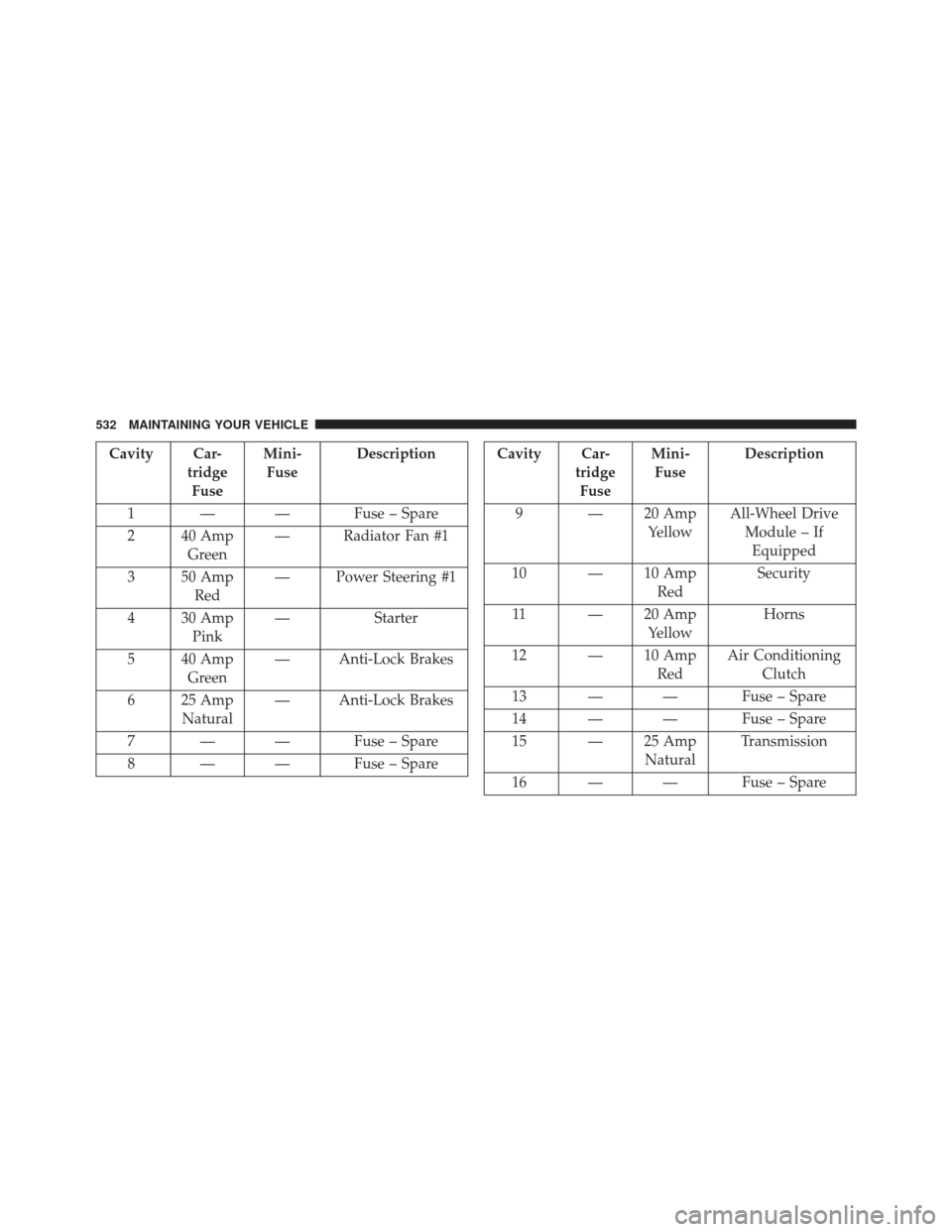
Cavity Car-tridgeFuse Mini-
Fuse Description
1 — — Fuse – Spare
2 40 Amp Green — Radiator Fan #1
3 50 Amp Red — Power Steering #1
4 30 Amp Pink — Starter
5 40 Amp Green — Anti-Lock Brakes
6 25 Amp Natural — Anti-Lock Brakes
7 — — Fuse – Spare
8 — — Fuse – SpareCavity Car- tridgeFuse Mini-
Fuse Description
9 — 20 Amp YellowAll-Wheel Drive
Module – IfEquipped
10 — 10 Amp RedSecurity
11 — 20 Amp YellowHorns
12 — 10 Amp RedAir Conditioning
Clutch
13 — — Fuse – Spare
14 — — Fuse – Spare
15 — 25 Amp NaturalTransmission
16 — — Fuse – Spare
532 MAINTAINING YOUR VEHICLE
Page 535 of 592
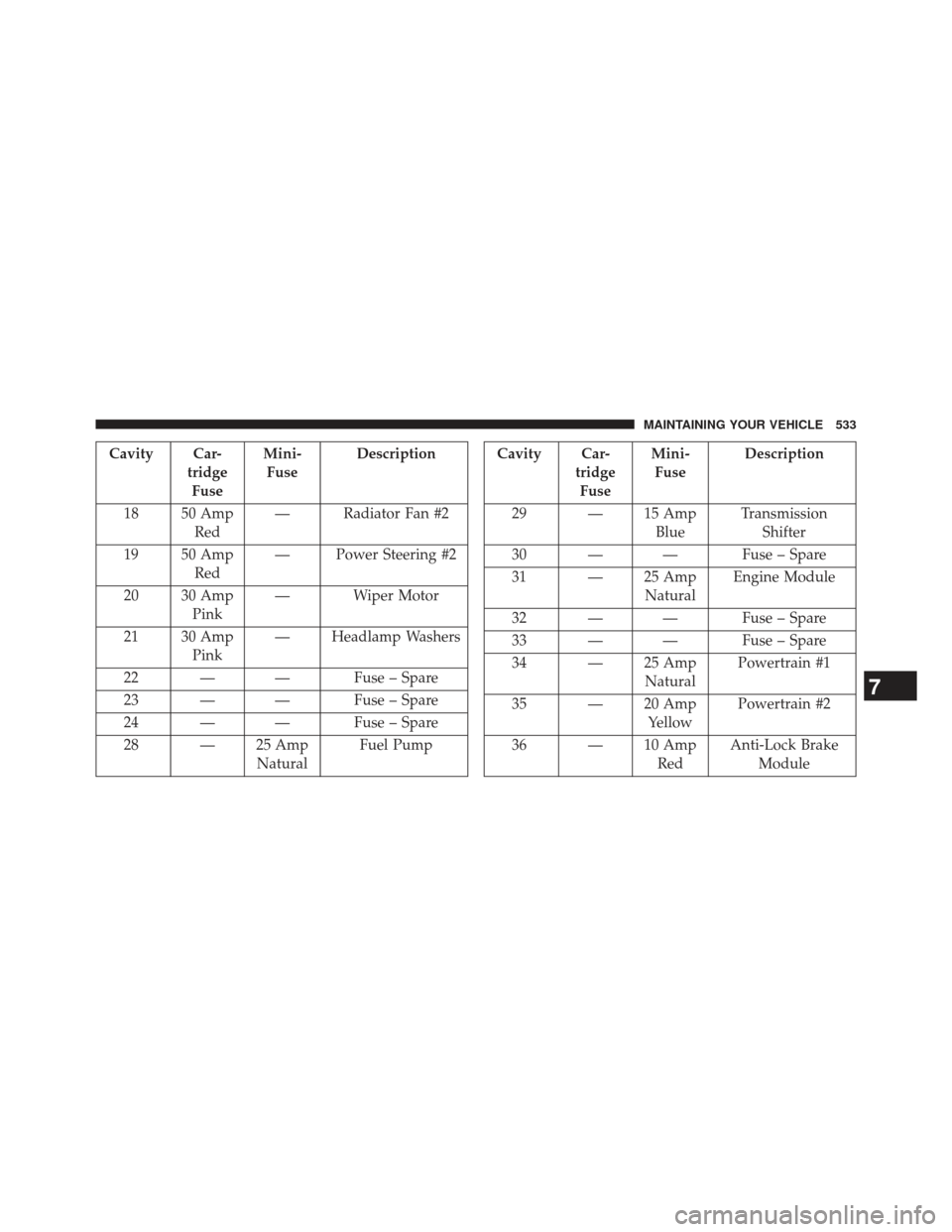
Cavity Car-tridgeFuse Mini-
Fuse Description
18 50 Amp Red — Radiator Fan #2
19 50 Amp Red — Power Steering #2
20 30 Amp Pink — Wiper Motor
21 30 Amp Pink — Headlamp Washers
22 — — Fuse – Spare
23 — — Fuse – Spare
24 — — Fuse – Spare
28 — 25 Amp NaturalFuel PumpCavity Car-
tridgeFuse Mini-
Fuse Description
29 — 15 Amp BlueTransmission
Shifter
30 — — Fuse – Spare
31 — 25 Amp NaturalEngine Module
32 — — Fuse – Spare
33 — — Fuse – Spare
34 — 25 Amp NaturalPowertrain #1
35 — 20 Amp YellowPowertrain #2
36 — 10 Amp RedAnti-Lock Brake
Module
7
MAINTAINING YOUR VEHICLE 533
Page 536 of 592
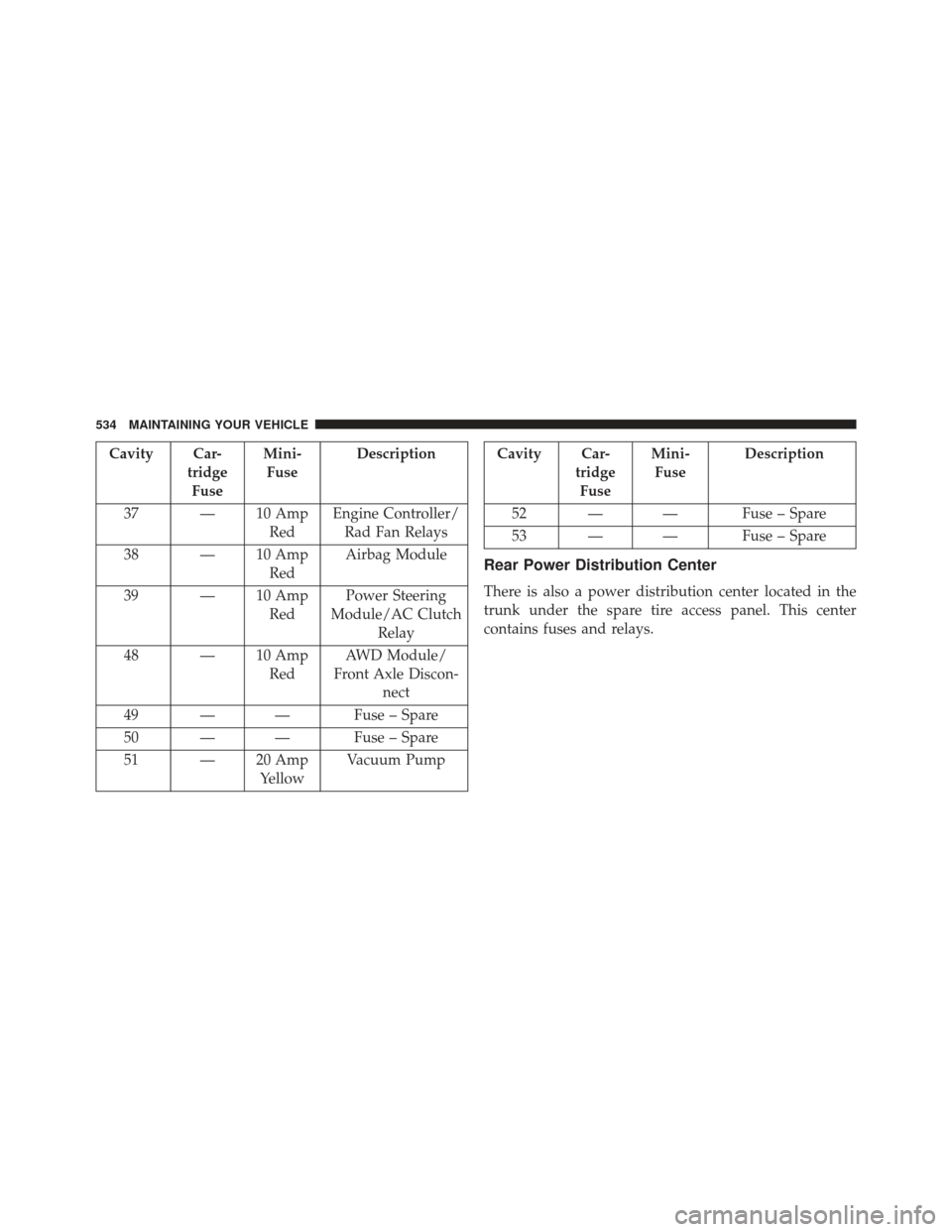
Cavity Car-tridgeFuse Mini-
Fuse Description
37 — 10 Amp RedEngine Controller/
Rad Fan Relays
38 — 10 Amp RedAirbag Module
39 — 10 Amp RedPower Steering
Module/AC Clutch Relay
48 — 10 Amp RedAWD Module/
Front Axle Discon- nect
49 — — Fuse – Spare
50 — — Fuse – Spare
51 — 20 Amp YellowVacuum PumpCavity Car-
tridgeFuse Mini-
Fuse Description
52 — — Fuse – Spare
53 — — Fuse – Spare
Rear Power Distribution Center
There is also a power distribution center located in the
trunk under the spare tire access panel. This center
contains fuses and relays.
534 MAINTAINING YOUR VEHICLE
Page 540 of 592
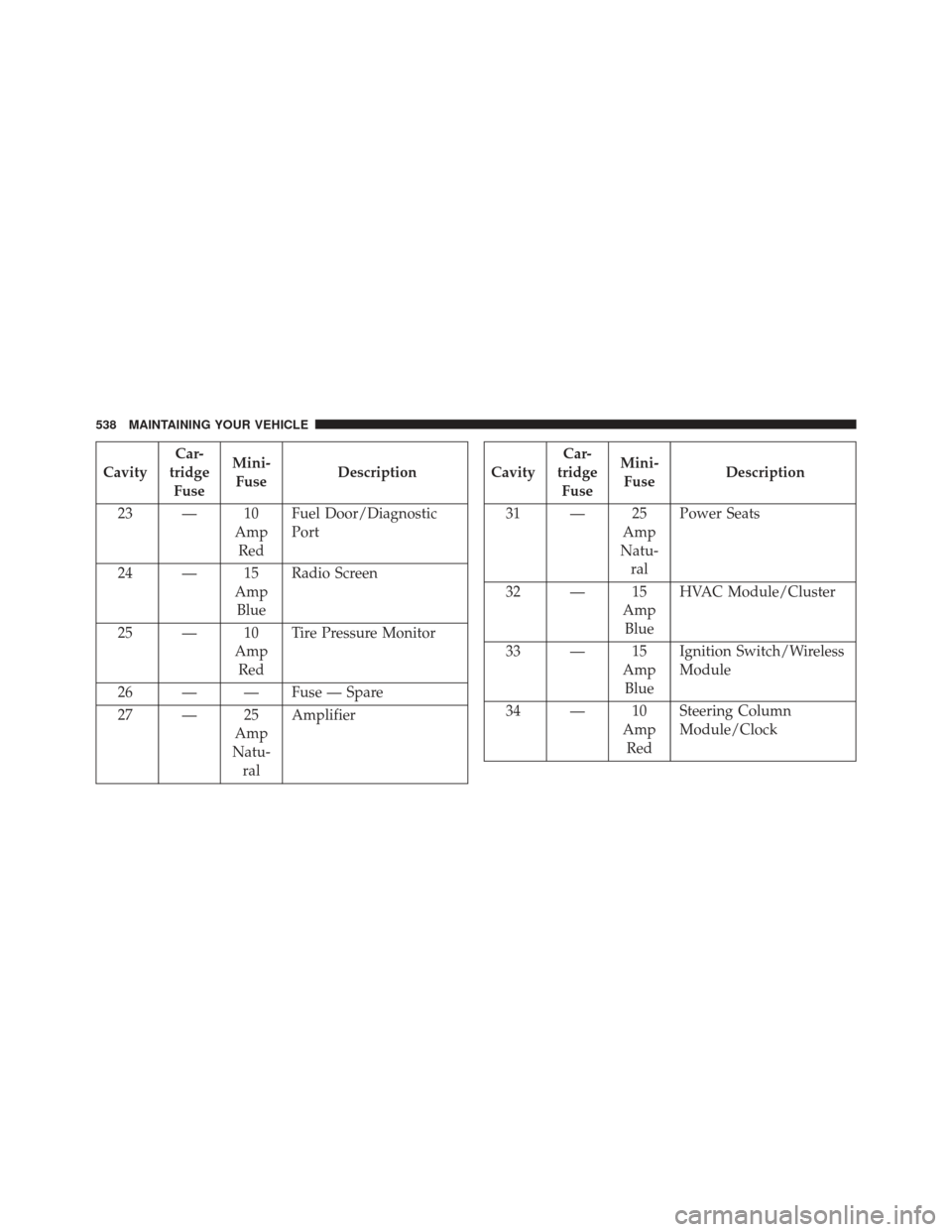
CavityCar-
tridge Fuse Mini-
Fuse Description
23 — 10 AmpRed Fuel Door/Diagnostic
Port
24 — 15 AmpBlue Radio Screen
25 — 10 AmpRed Tire Pressure Monitor
26 — — Fuse — Spare
27 — 25 Amp
Natu- ral AmplifierCavity
Car-
tridge Fuse Mini-
Fuse Description
31 — 25 Amp
Natu- ral Power Seats
32 — 15 AmpBlue HVAC Module/Cluster
33 — 15 AmpBlue Ignition Switch/Wireless
Module
34 — 10 AmpRed Steering Column
Module/Clock
538 MAINTAINING YOUR VEHICLE
Page 541 of 592
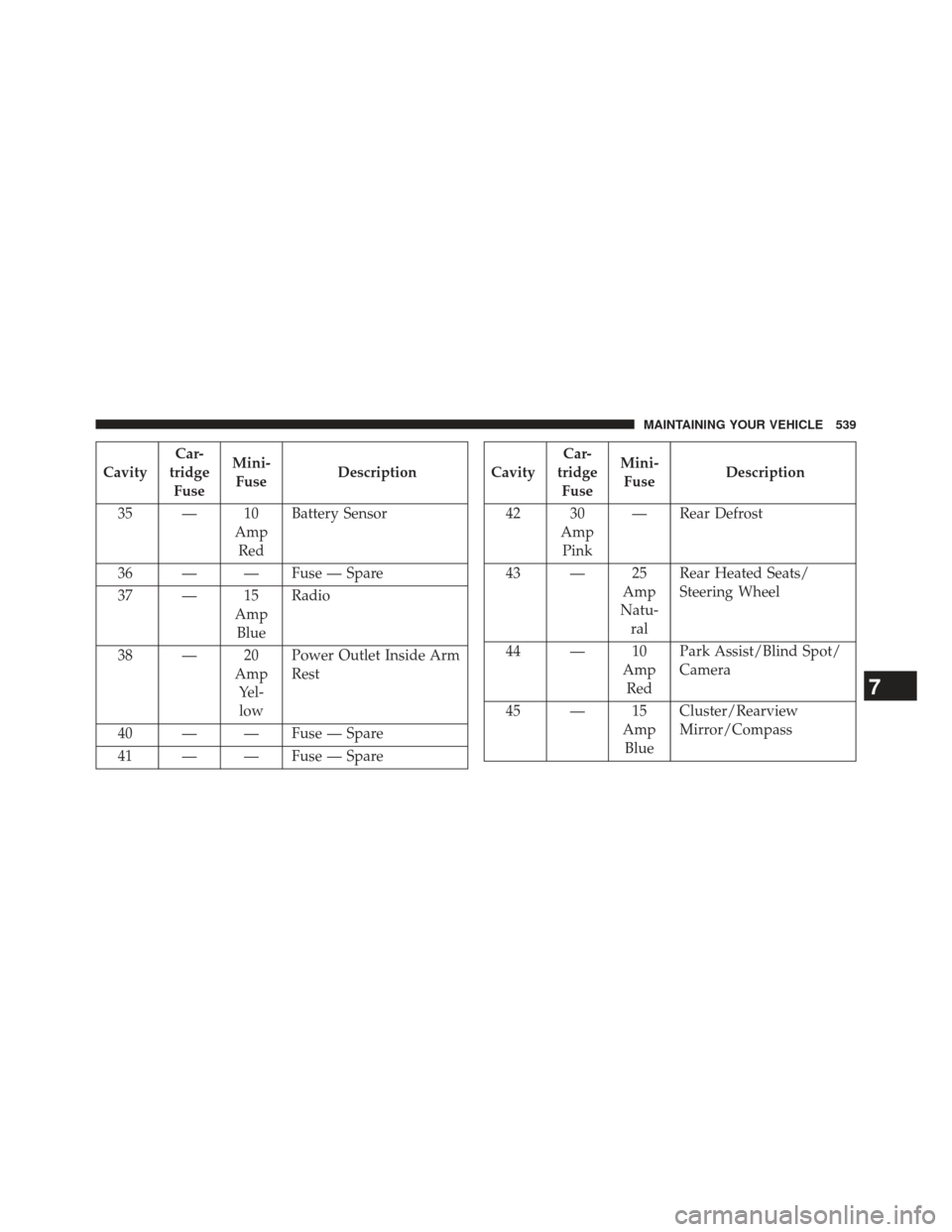
CavityCar-
tridge Fuse Mini-
Fuse Description
35 — 10 AmpRed Battery Sensor
36 — — Fuse — Spare
37 — 15 AmpBlue Radio
38 — 20 AmpYel-low Power Outlet Inside Arm
Rest
40 — — Fuse — Spare
41 — — Fuse — SpareCavity Car-
tridge Fuse Mini-
Fuse Description
42 30 AmpPink — Rear Defrost
43 — 25 Amp
Natu- ral Rear Heated Seats/
Steering Wheel
44 — 10 AmpRed Park Assist/Blind Spot/
Camera
45 — 15 AmpBlue Cluster/Rearview
Mirror/Compass
7
MAINTAINING YOUR VEHICLE 539