check engine CHRYSLER 300 2014 2.G Owner's Manual
[x] Cancel search | Manufacturer: CHRYSLER, Model Year: 2014, Model line: 300, Model: CHRYSLER 300 2014 2.GPages: 615, PDF Size: 4.44 MB
Page 529 of 615
Windshield Wiper Blades
Clean the rubber edges of the wiper blades and the
windshield periodically with a sponge or soft cloth and a
mild nonabrasive cleaner. This will remove accumula-
tions of salt or road film.
Operation of the wipers on dry glass for long periods
may cause deterioration of the wiper blades. Always use
washer fluid when using the wipers to remove salt or dirt
from a dry windshield.
Avoid using the wiper blades to remove frost or ice from
the windshield. Keep the blade rubber out of contact with
petroleum products such as engine oil, gasoline, etc.
NOTE:Life expectancy of wiper blades varies depend-
ing on geographical area and frequency of use. Poor
performance of blades may be present with chattering,
marks, water lines or wet spots. If any of these conditions
are present, clean the wiper blades or replace as neces-
sary.
Adding Washer Fluid
The windshield washer fluid reservoir is located in the
front of the engine compartment. Be sure to check the
fluid level at regular intervals. Fill the reservoir with
windshield washer solvent (not radiator antifreeze) and
operate the system for a few seconds to flush out the
residual water.
When refilling the washer fluid reservoir, apply some
washer fluid to a cloth or towel and wipe the wiper
blades clean. This will help blade performance.
To prevent freeze-up of your windshield washer system in
cold weather, select a solution or mixture that meets or
exceeds the temperature range of your climate. This rating
information can be found on most washer fluid containers.
The fluid reservoir will hold nearly 1 gal (4 L) of washer
fluid when the message “Low Washer Fluid” appears in
the Electronic Vehicle Information Center (EVIC) (if
equipped).
7
MAINTAINING YOUR VEHICLE 527
Page 533 of 615
Coolant Checks
Check engine coolant (antifreeze) protection every 12
months (before the onset of freezing weather, where
applicable). If the engine coolant (antifreeze) is dirty, the
system should be drained, flushed, and refilled with
fresh OAT coolant (conforming to MS-12106) only ac-
cording to Chrysler Service Manual procedure or by an
authorized dealer. Check the front of the radiator for any
accumulation of bugs, leaves, etc. If dirty, clean by gently
spraying water from a garden hose vertically down the
face of the condenser.
Check the coolant recovery bottle tubing for brittle rub-
ber, cracking, tears, cuts, and tightness of the connection
at the bottle and radiator. Inspect the entire system for
leaks.
With the engine at normal operating temperature (but
not running), check the cooling system pressure cap for
proper vacuum sealing by draining a small amount ofengine coolant (antifreeze) from the radiator drain cock.
If the cap is sealing properly, the engine coolant (anti-
freeze) will begin to drain from the coolant recovery
bottle. DO NOT REMOVE THE COOLANT PRESSURE
CAP WHEN THE COOLING SYSTEM IS HOT.
Cooling System — Drain, Flush And Refill
If the engine coolant (antifreeze) is dirty or contains visible
sediment, have an authorized dealer clean and flush with
OAT coolant (antifreeze) (conforming to MS-12106).
Refer to the “Maintenance Schedule” for the proper
maintenance intervals.
NOTE:
Some vehicles require special tools to add coolant
properly. Failure to fill these systems properly could lead
to severe internal engine damage. If any coolant is
needed to be added to the system please contact your
local authorized dealer.
7
MAINTAINING YOUR VEHICLE 531
Page 536 of 615
NOTE:
•Some vehicles require special tools to add coolant
properly. Failure to fill these systems properly could
lead to severe internal engine damage. If any coolant is
needed to be added to the system please contact your
local authorized dealer.
• Mixing engine coolant (antifreeze) types is not recom-
mended and can result in cooling system damage. If
HOAT and OAT coolant are mixed in an emergency,
have a authorized dealer drain, flush, and refill with
OAT coolant (conforming to MS-12106) as soon as
possible.
Cooling System Pressure Cap
The cap must be fully tightened to prevent loss of engine
coolant (antifreeze), and to ensure that engine coolant
(antifreeze) will return to the radiator from the coolant
recovery tank. The cap should be inspected and cleaned if there is any
accumulation of foreign material on the sealing surfaces.
WARNING!
•
Do not open hot engine cooling system. Never add
engine coolant (antifreeze) when the engine is
overheated. Do not loosen or remove the cap to cool
an overheated engine. Heat causes pressure to
build up in the cooling system. To prevent scalding
or injury, do not remove the pressure cap while the
system is hot or under pressure.
• Do not use a pressure cap other than the one
specified for your vehicle. Personal injury or en-
gine damage may result.
Disposal Of Used Engine Coolant
Used ethylene glycol-based engine coolant (antifreeze) is
a regulated substance requiring proper disposal. Check
534 MAINTAINING YOUR VEHICLE
Page 537 of 615
with your local authorities to determine the disposal
rules for your community. To prevent ingestion by ani-
mals or children, do not store ethylene glycol-based
engine coolant in open containers or allow it to remain in
puddles on the ground. If ingested by a child or pet, seek
emergency assistance immediately. Clean up any ground
spills immediately.
Coolant Level
The coolant bottle provides a quick visual method for
determining that the coolant level is adequate. With the
engine OFF and cold, the level of the engine coolant
(antifreeze) in the bottle should be between the ranges
indicated on the bottle.
The radiator normally remains completely full, so there is
no need to remove the radiator/coolant pressure cap
unless checking for engine coolant (antifreeze) freeze
point or replacing coolant. Advise your service attendantof this. As long as the engine operating temperature is
satisfactory, the coolant bottle need only be checked once
a month.
When additional engine coolant (antifreeze) is needed to
maintain the proper level, only OAT coolant that meets
the requirements of Chrysler Material Standard MS-
12106 should be added to the coolant bottle. Do not
overfill.Points To Remember
NOTE:
When the vehicle is stopped after a few miles/
kilometers of operation, you may observe vapor coming
from the front of the engine compartment. This is nor-
mally a result of moisture from rain, snow, or high
humidity accumulating on the radiator and being vapor-
ized when the thermostat opens, allowing hot engine
coolant (antifreeze) to enter the radiator.
7
MAINTAINING YOUR VEHICLE 535
Page 538 of 615
If an examination of your engine compartment shows no
evidence of radiator or hose leaks, the vehicle may be
safely driven. The vapor will soon dissipate.
•Do not overfill the coolant expansion bottle.
• Check the coolant freeze point in the radiator and in
the coolant expansion bottle. If engine coolant (anti-
freeze) needs to be added, the contents of the coolant
expansion bottle must also be protected against freez-
ing.
• If frequent engine coolant (antifreeze) additions are
required, the cooling system should be pressure tested
for leaks.
• Maintain engine coolant (antifreeze) concentration at a
minimum of 50% OAT coolant (conforming to MS-
12106) and distilled water for proper corrosion protec-
tion of your engine which contains aluminum compo-
nents. •
Make sure that the coolant expansion bottle overflow
hoses are not kinked or obstructed.
• Keep the front of the radiator clean. If your vehicle is
equipped with air conditioning, keep the front of the
condenser clean.
• Do not change the thermostat for Summer or Winter
operation. If replacement is ever necessary, install
ONLY the correct type thermostat. Other designs may
result in unsatisfactory engine coolant (antifreeze)
performance, poor gas mileage, and increased emis-
sions.
Brake System
In order to assure brake system performance, all brake
system components should be inspected periodically.
Refer to the “Maintenance Schedule” for the proper
maintenance intervals.
536 MAINTAINING YOUR VEHICLE
Page 542 of 615
Automatic Transmission Fluid (ATF) is an engineered
product and its performance may be impaired by supple-
mental additives. Therefore, do not add any fluid addi-
tives to the transmission. The only exception to this
policy is the use of special dyes for diagnosing fluid
leaks. Avoid using transmission sealers as they may
adversely affect seals.
CAUTION!
Do not use chemical flushes in your transmission as
the chemicals can damage your transmission compo-
nents. Such damage is not covered by the New
Vehicle Limited Warranty.
Fluid Level Check
The fluid level is preset at the factory and does not
require adjustment under normal operating conditions.
Routine fluid level checks are not required, therefore thetransmission has no dipstick. Your authorized dealer can
check your transmission fluid level using special service
tools.
If you notice fluid leakage or transmission malfunction,
visit your authorized dealer immediately to have the
transmission fluid level checked. Operating the vehicle
with an improper fluid level can cause severe transmis-
sion damage.
CAUTION!
If a transmission fluid leak occurs, visit your autho-
rized dealer immediately. Severe transmission dam-
age may occur. Your authorized dealer has the proper
tools to adjust the fluid level accurately.
Fluid And Filter Changes — 5-Speed Transmission
Refer to the “Maintenance Schedule” for the proper
maintenance intervals.
540 MAINTAINING YOUR VEHICLE
Page 575 of 615
Severe Duty All Models
Change Engine Oil at 4000 miles (6,500 km) if the vehicle
is operated in a dusty and off road environment. This
type of vehicle use is considered Severe Duty
Once A Month Or Before A Long Trip:
•Check engine oil level
• Check windshield washer fluid level
• Check tire pressure and look for unusual wear or
damage. Rotate tires at the first sign of irregular wear,
even if it occurs before your next scheduled service.
• Check the fluid levels of the coolant reservoir, brake
master cylinder, and power steering and fill as needed.
• Check function of all interior and exterior lights Required Maintenance Intervals.
Refer to the maintenance schedules on the following
page for the required maintenance intervals.
At Every Oil Change Interval As Indicated By Oil
Change Indicator System:
•Change oil and filter
• Rotate the tires.
Rotate at the first sign of irregular
wear, even if it occurs before your next scheduled
service
• Inspect battery and clean and tighten terminals as
required
• Inspect brake pads, shoes, rotors, drums, hoses
and park brake
•
Inspect engine cooling system protection and hoses
• Inspect exhaust system
• Inspect engine air cleaner if using in dusty or
off-road conditions8
M
A I
N T
E
N
A
N
C E
S
C
H E
D
U L
E
SMAINTENANCE SCHEDULES 573
Page 594 of 615
Fluid Check.......................... .537
Master Cylinder ....................... .537
Parking ............................. .400
Warning Light ........................ .310
Brake/Transmission Interlock .................374
Brightness, Interior Lights ...................204
Bulb Replacement ........................ .560
Bulbs, Light ............................ .103
Camera, Rear ........................... .258
Capacities, Fluid ......................... .566
Caps, Filler Oil (Engine) .......................... .519
Radiator (Coolant Pressure) ................534
Carbon Monoxide Warning ..................100
Cargo Area Features ...................... .292
Cargo Compartment ...................... .292
Cargo (Vehicle Loading) ....................462
Car Washes ............................ .543Cellular Phone
.......................... .350
Certification Label ........................ .463
Chains, Tire ............................ .437
Changing A Flat Tire ...................... .484
Chart, Tire Sizing ........................ .416
Check Engine Light (Malfunction Indicator Light) . .307
Checking Your Vehicle For Safety ...............99
Checks, Safety ............................99
Child Restraint ............................75
Child Restraints Child Seat Installation .....................93
Install A LATCH-compatible Child Restraint .....88
Installing Child Restraints Using The Vehicle Seat
Belt ..................................90
Lower Anchors And Tethers For Children .......82
Child Safety Locks .........................33
Clean Air Gasoline ....................... .452
Cleaning Wheels .............................. .544
592 INDEX
Page 597 of 615
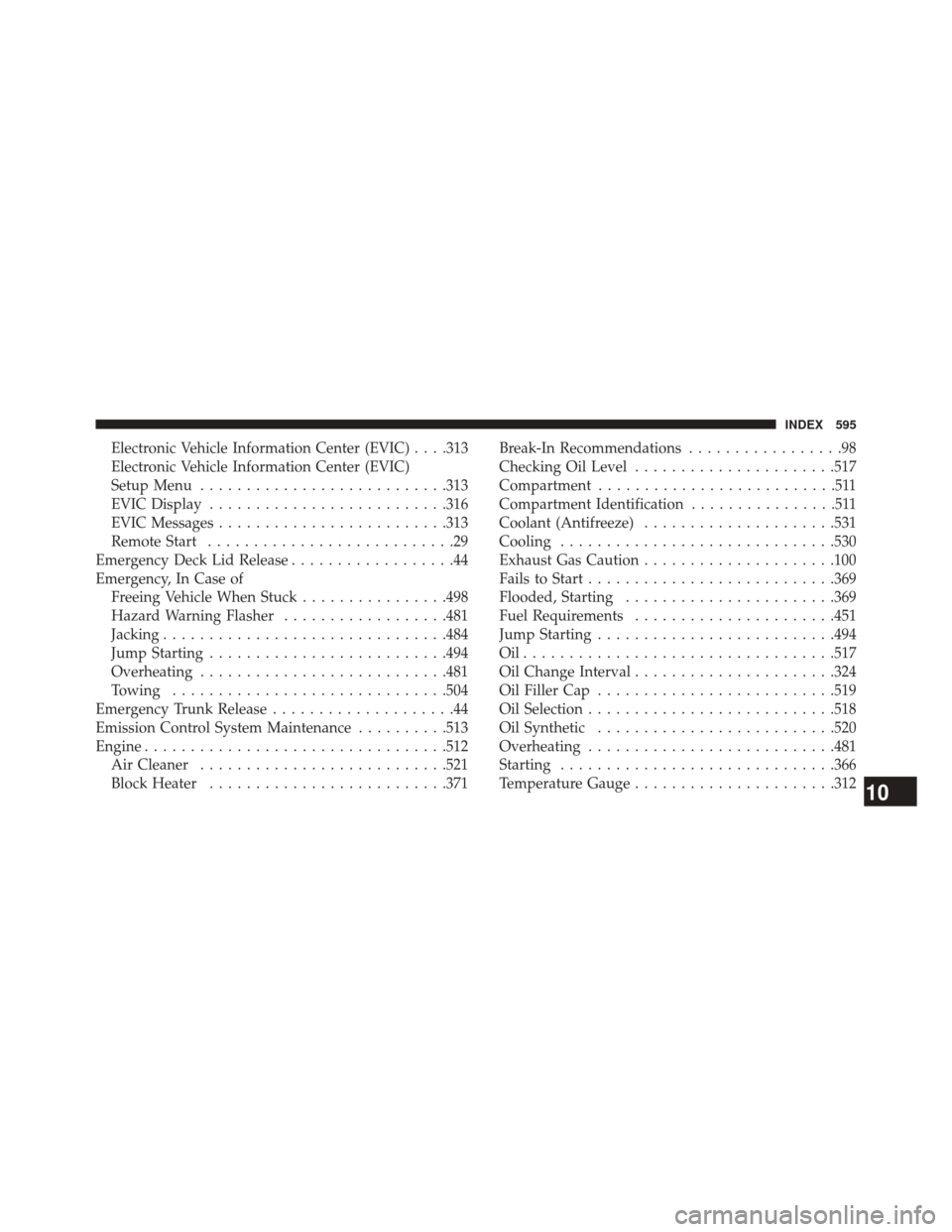
Electronic Vehicle Information Center (EVIC) . . . .313
Electronic Vehicle Information Center (EVIC)
Setup Menu.......................... .313
EVIC Display ......................... .316
EVIC Messages ........................ .313
Remote Start ...........................29
Emergency Deck Lid Release ..................44
Emergency, In Case of Freeing Vehicle When Stuck ................498
Hazard Warning Flasher ..................481
Jacking .............................. .484
Jump Starting ......................... .494
Overheating .......................... .481
Towing ............................. .504
Emergency Trunk Release ....................44
Emission Control System Maintenance ..........513
Engine ................................ .512
Air Cleaner .......................... .521
Block Heater ......................... .371Break-In Recommendations
.................98
Checking Oil Level ..................... .517
Compartment ..........................511
Compartment Identification ................511
Coolant (Antifreeze) .....................531
Cooling ............................. .530
Exhaust Gas Caution .....................100
Fails to Start .......................... .369
Flooded, Starting ...................... .369
Fuel Requirements ..................... .451
Jump Starting ......................... .494
Oil................................. .517
Oil Change Interval ..................... .324
Oil Filler Cap ......................... .519
Oil Selection .......................... .518
Oil Synthetic ......................... .520
Overheating .......................... .481
Starting ............................. .366
Temperature Gauge ..................... .312
10
INDEX 595
Page 598 of 615
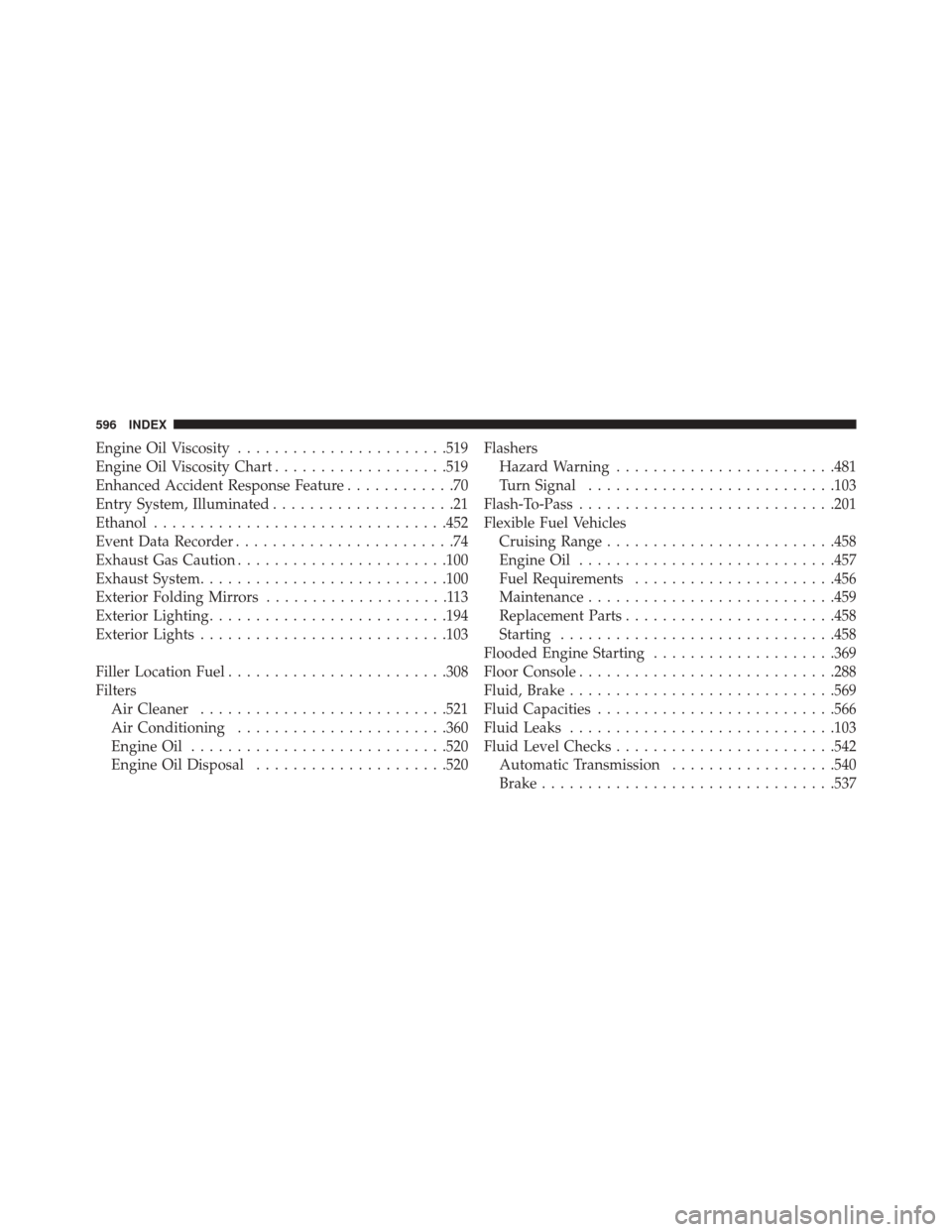
Engine Oil Viscosity...................... .519
Engine Oil Viscosity Chart ...................519
Enhanced Accident Response Feature ............70
Entry System, Illuminated ....................21
Ethanol ............................... .452
Event Data Recorder ........................74
Exhaust Gas Caution ...................... .100
Exhaust System .......................... .100
Exterior Folding Mirrors ....................113
Exterior Lighting ......................... .194
Exterior Lights .......................... .103
Filler Location Fuel ....................... .308
Filters Air Cleaner .......................... .521
Air Conditioning ...................... .360
Engine Oil ........................... .520
Engine Oil Disposal .....................520 Flashers
Hazard Warning ....................... .481
Turn Signal .......................... .103
Flash-To-Pass ........................... .201
Flexible Fuel Vehicles Cruising Range ........................ .458
Engine Oil ........................... .457
Fuel Requirements ..................... .456
Maintenance .......................... .459
Replacement Parts ...................... .458
Starting ............................. .458
Flooded Engine Starting ....................369
Floor Console ........................... .288
Fluid, Brake ............................ .569
Fluid Capacities ......................... .566
Fluid Leaks ............................ .103
Fluid Level Checks ....................... .542
Automatic Transmission ..................540
Brake ............................... .537
596 INDEX