weight CHRYSLER 300 2014 2.G Owner's Manual
[x] Cancel search | Manufacturer: CHRYSLER, Model Year: 2014, Model line: 300, Model: CHRYSLER 300 2014 2.GPages: 615, PDF Size: 4.44 MB
Page 469 of 615
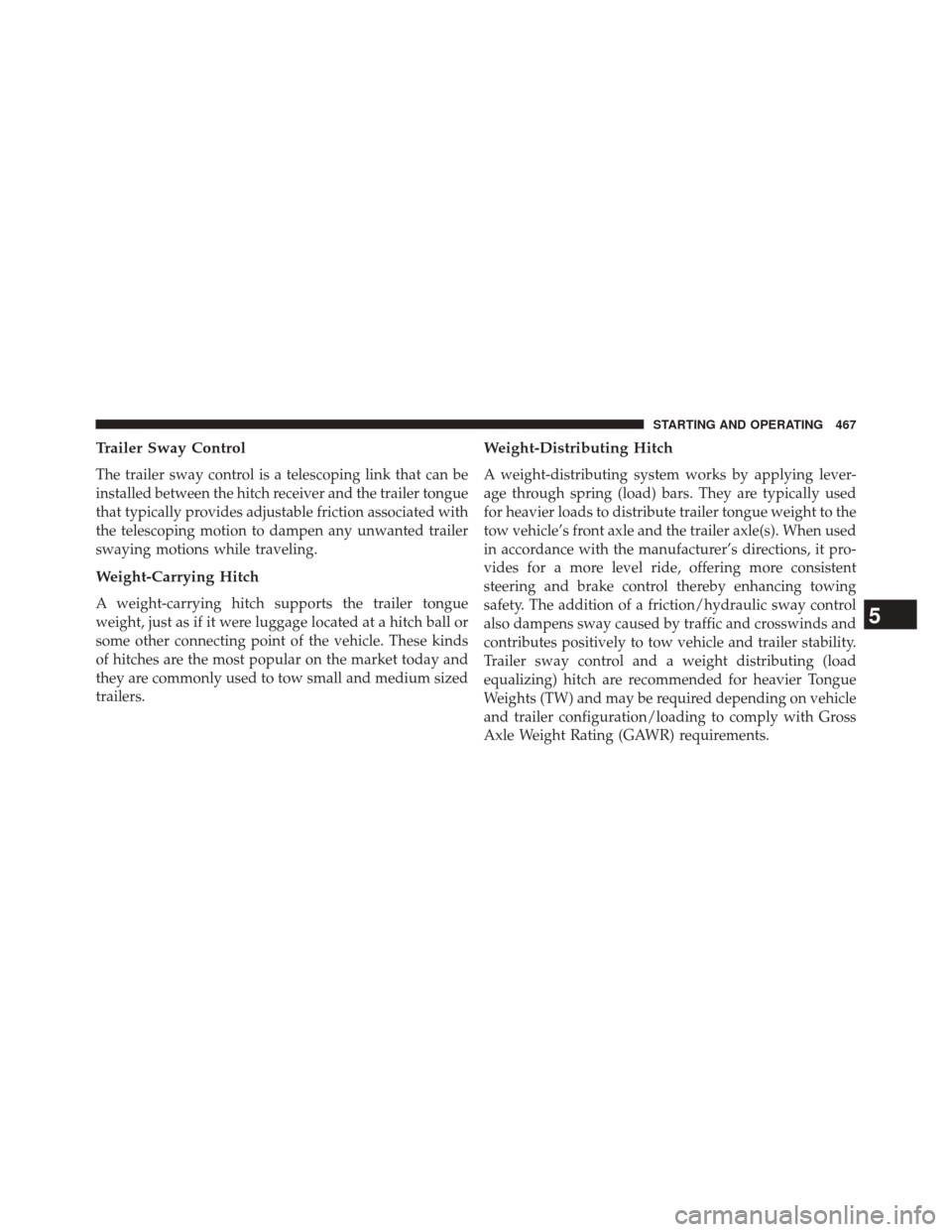
Trailer Sway Control
The trailer sway control is a telescoping link that can be
installed between the hitch receiver and the trailer tongue
that typically provides adjustable friction associated with
the telescoping motion to dampen any unwanted trailer
swaying motions while traveling.
Weight-Carrying Hitch
A weight-carrying hitch supports the trailer tongue
weight, just as if it were luggage located at a hitch ball or
some other connecting point of the vehicle. These kinds
of hitches are the most popular on the market today and
they are commonly used to tow small and medium sized
trailers.
Weight-Distributing Hitch
A weight-distributing system works by applying lever-
age through spring (load) bars. They are typically used
for heavier loads to distribute trailer tongue weight to the
tow vehicle’s front axle and the trailer axle(s). When used
in accordance with the manufacturer’s directions, it pro-
vides for a more level ride, offering more consistent
steering and brake control thereby enhancing towing
safety. The addition of a friction/hydraulic sway control
also dampens sway caused by traffic and crosswinds and
contributes positively to tow vehicle and trailer stability.
Trailer sway control and a weight distributing (load
equalizing) hitch are recommended for heavier Tongue
Weights (TW) and may be required depending on vehicle
and trailer configuration/loading to comply with Gross
Axle Weight Rating (GAWR) requirements.
5
STARTING AND OPERATING 467
Page 470 of 615
WARNING!
•An improperly adjusted Weight Distributing Hitch
system may reduce handling, stability, braking
performance, and could result in a collision.
• Weight Distributing Systems may not be compat-
ible with Surge Brake Couplers. Consult with your
hitch and trailer manufacturer or a reputable Rec-
reational Vehicle dealer for additional information.
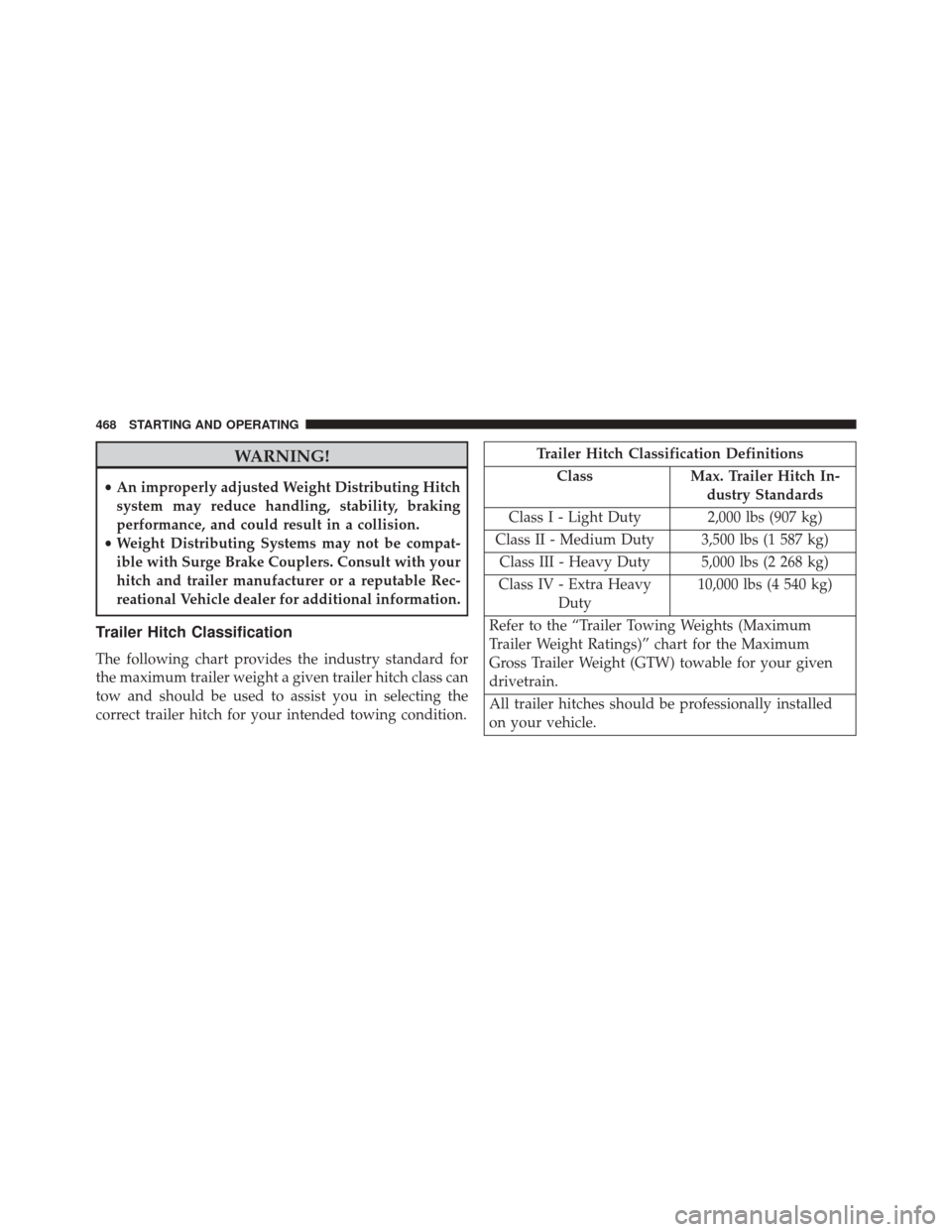
Trailer Hitch Classification
The following chart provides the industry standard for
the maximum trailer weight a given trailer hitch class can
tow and should be used to assist you in selecting the
correct trailer hitch for your intended towing condition.
Trailer Hitch Classification Definitions
Class Max. Trailer Hitch In-
dustry Standards
Class I - Light Duty 2,000 lbs (907 kg)
Class II - Medium Duty 3,500 lbs (1 587 kg) Class III - Heavy Duty 5,000 lbs (2 268 kg)
Class IV - Extra Heavy Duty 10,000 lbs (4 540 kg)
Refer to the “Trailer Towing Weights (Maximum
Trailer Weight Ratings)” chart for the Maximum
Gross Trailer Weight (GTW) towable for your given
drivetrain.
All trailer hitches should be professionally installed
on your vehicle.
468 STARTING AND OPERATING
Page 471 of 615
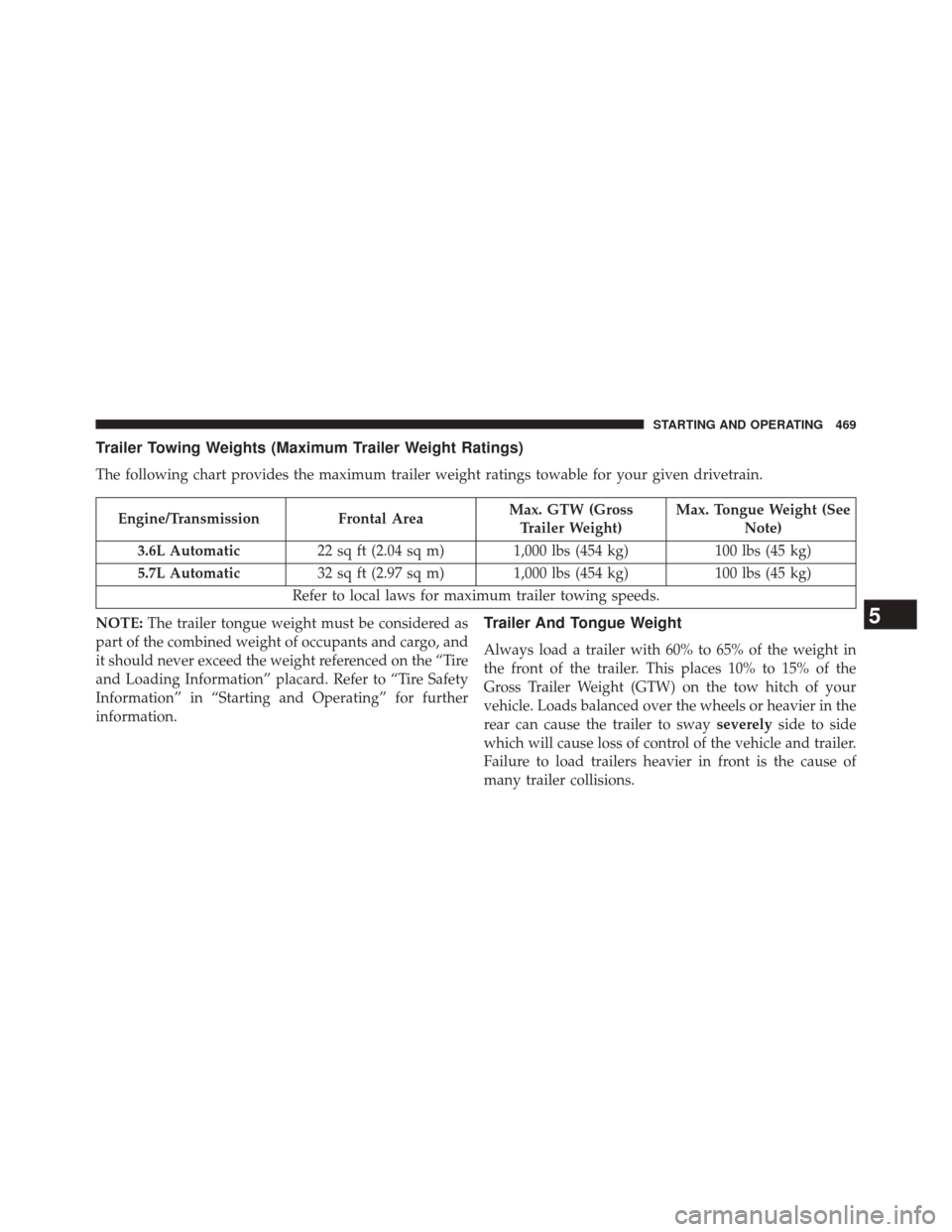
Trailer Towing Weights (Maximum Trailer Weight Ratings)
The following chart provides the maximum trailer weight ratings towable for your given drivetrain.
Engine/TransmissionFrontal AreaMax. GTW (Gross
Trailer Weight) Max. Tongue Weight (See
Note)
3.6L Automatic 22 sq ft (2.04 sq m) 1,000 lbs (454 kg) 100 lbs (45 kg)
5.7L Automatic 32 sq ft (2.97 sq m) 1,000 lbs (454 kg) 100 lbs (45 kg)
Refer to local laws for maximum trailer towing speeds.
NOTE: The trailer tongue weight must be considered as
part of the combined weight of occupants and cargo, and
it should never exceed the weight referenced on the “Tire
and Loading Information” placard. Refer to “Tire Safety
Information” in “Starting and Operating” for further
information.
Trailer And Tongue Weight
Always load a trailer with 60% to 65% of the weight in
the front of the trailer. This places 10% to 15% of the
Gross Trailer Weight (GTW) on the tow hitch of your
vehicle. Loads balanced over the wheels or heavier in the
rear can cause the trailer to sway severelyside to side
which will cause loss of control of the vehicle and trailer.
Failure to load trailers heavier in front is the cause of
many trailer collisions.
5
STARTING AND OPERATING 469
Page 472 of 615
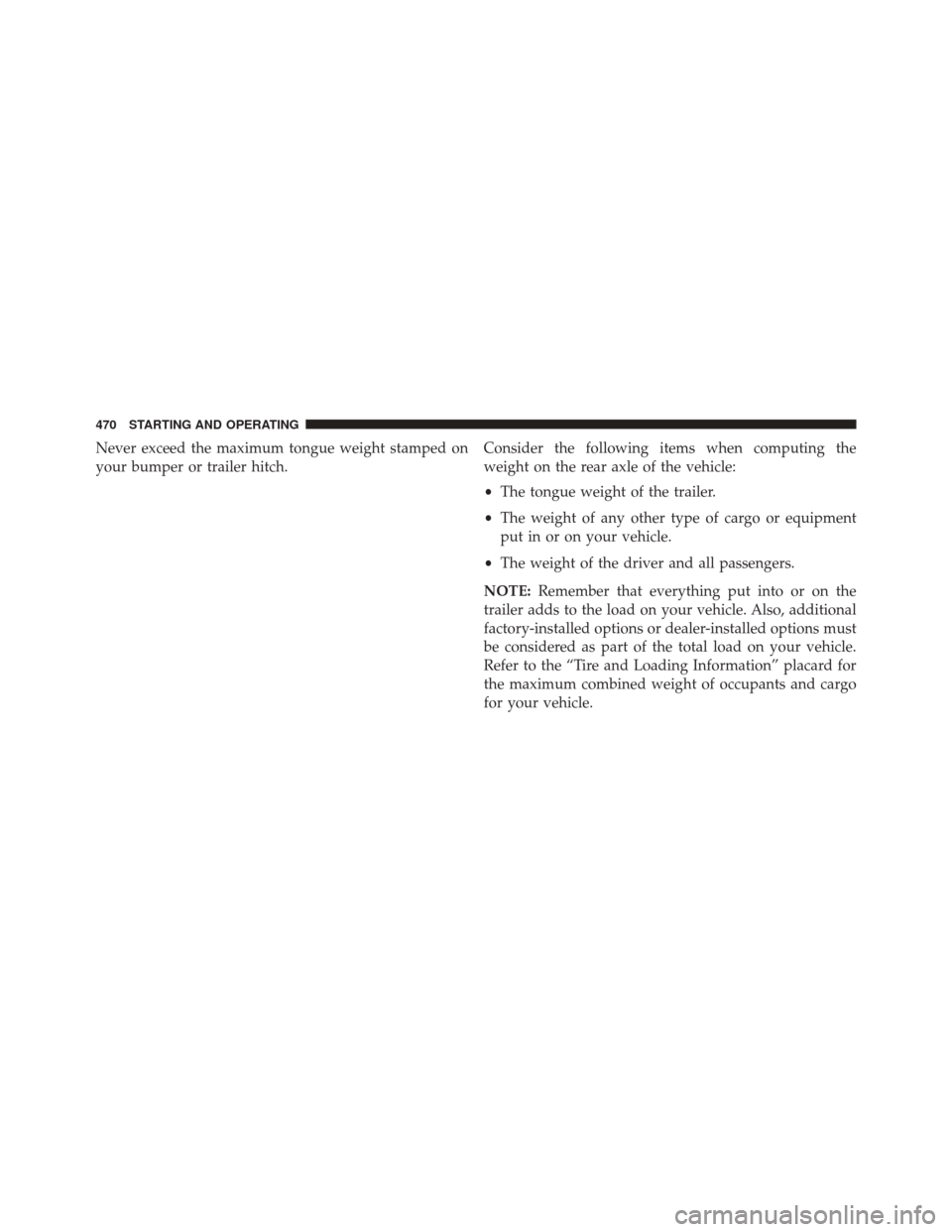
Never exceed the maximum tongue weight stamped on
your bumper or trailer hitch.Consider the following items when computing the
weight on the rear axle of the vehicle:
•
The tongue weight of the trailer.
• The weight of any other type of cargo or equipment
put in or on your vehicle.
• The weight of the driver and all passengers.
NOTE: Remember that everything put into or on the
trailer adds to the load on your vehicle. Also, additional
factory-installed options or dealer-installed options must
be considered as part of the total load on your vehicle.
Refer to the “Tire and Loading Information” placard for
the maximum combined weight of occupants and cargo
for your vehicle.
470 STARTING AND OPERATING
Page 474 of 615
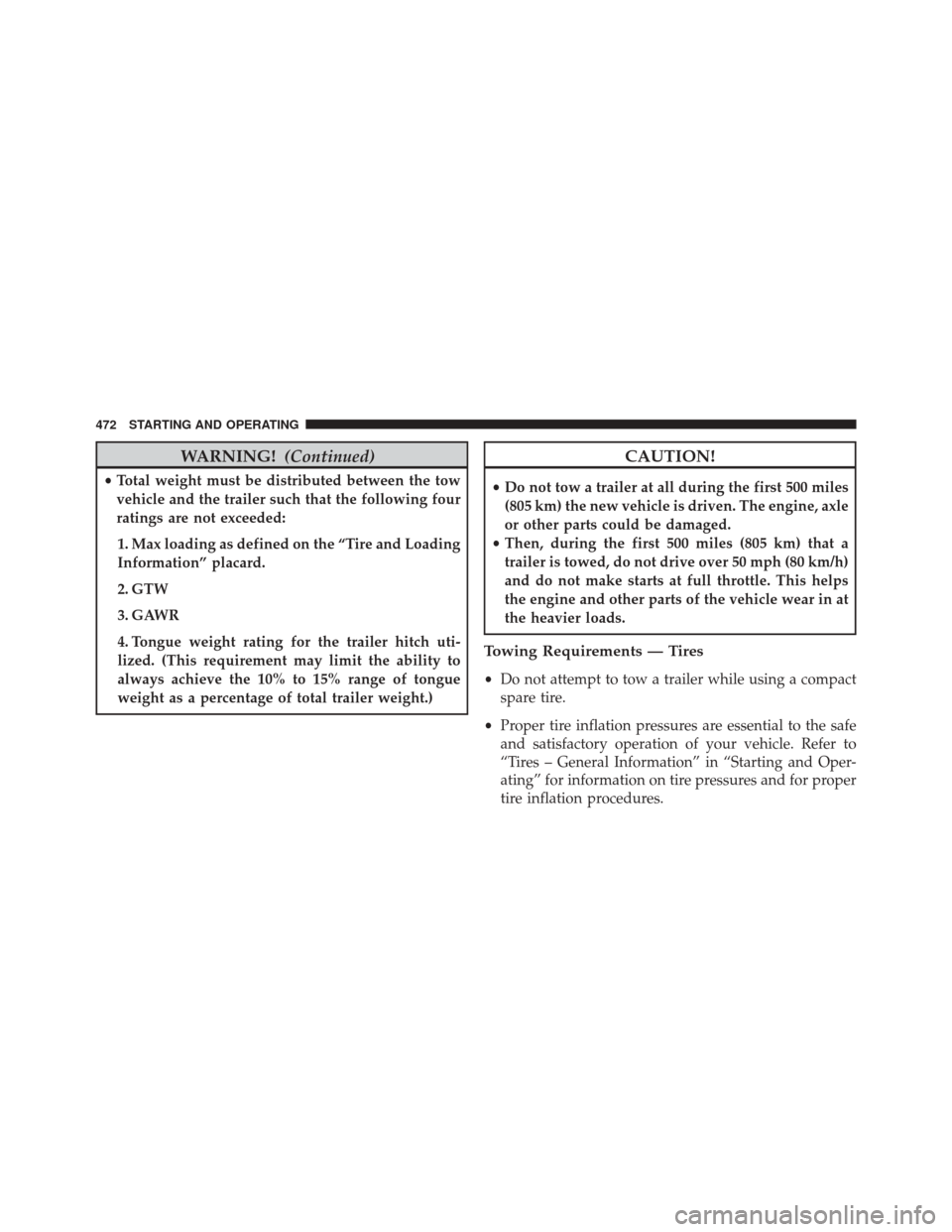
WARNING!(Continued)
•Total weight must be distributed between the tow
vehicle and the trailer such that the following four
ratings are not exceeded:
1. Max loading as defined on the “Tire and Loading
Information” placard.
2. GTW
3. GAWR
4. Tongue weight rating for the trailer hitch uti-
lized. (This requirement may limit the ability to
always achieve the 10% to 15% range of tongue
weight as a percentage of total trailer weight.)
CAUTION!
• Do not tow a trailer at all during the first 500 miles
(805 km) the new vehicle is driven. The engine, axle
or other parts could be damaged.
• Then, during the first 500 miles (805 km) that a
trailer is towed, do not drive over 50 mph (80 km/h)
and do not make starts at full throttle. This helps
the engine and other parts of the vehicle wear in at
the heavier loads.
Towing Requirements — Tires
• Do not attempt to tow a trailer while using a compact
spare tire.
• Proper tire inflation pressures are essential to the safe
and satisfactory operation of your vehicle. Refer to
“Tires – General Information” in “Starting and Oper-
ating” for information on tire pressures and for proper
tire inflation procedures.
472 STARTING AND OPERATING
Page 600 of 615
Tachometer........................... .304
Gear Ranges ............................ .377
Gear Select Lever Override ..................499
General Information ...................... .163
Glass Cleaning .......................... .546
Gross Axle Weight Rating ...................463
Gross Vehicle Weight Rating ..................463
GVWR ................................ .463
Hazard Driving Through Flowing, Rising, or Shallow
Standing Water ........................ .397
Hazard Warning Flasher ....................481
Headlights ............................. .562
Automatic ........................... .195
Cleaning ............................ .546
Delay ............................... .195
High Beam/Low Beam Select Switch .........201Lights On Reminder
.....................198
On With Wipers ....................... .195
Passing ............................. .201
Switch .............................. .194
Time Delay ........................... .195
Washers ............................. .527
Headlight Washers ....................... .527
Head Restraints ......................... .184
Head Rests ............................. .184
Heated Mirrors ...........................116
Heated Seats ............................ .181
Heater, Engine Block ...................... .371
High Beam/Low Beam Select (Dimmer) Switch . . . .201
Hill Start Assist .......................... .410
Hitches Trailer Towing ........................ .468
Holder, Coin ............................ .288
Hood Release ........................... .192
598 INDEX
Page 610 of 615
Temperature Control, Automatic (ATC)..........357
Temperature Gauge, Engine Coolant ............312
Tilt Steering Column ...................... .210
Time Delay, Headlight ..................... .195
Tire and Loading Information Placard ...........421
Tire Markings ........................... .414
Tires ................................. .103
Aging (Life of Tires) .....................435
Air Pressure .......................... .426
Chains .............................. .437
Changing ............................ .484
Compact Spare ........................ .432
General Information .....................426
High Speed .......................... .428
Inflation Pressures ...................... .427
Jacking .............................. .484
Life of Tires .......................... .435
Load Capacity ........................ .421
Pressure Monitor System (TPMS) ............440Pressure Warning Light
...................305
Quality Grading ....................... .587
Radial .............................. .429
Replacement .......................... .436
Rotation ............................. .439
Safety .............................. .414
Sizes ............................... .416
Snow Tires ........................... .430
Spare Tire ............................ .485
Spinning ............................ .434
Trailer Towing ........................ .472
Tread Wear Indicators ....................434
Tire Safety Information .....................414
Tongue Weight/Trailer Weight ................469
To Open Hood .......................... .192
Towing ............................... .465
Disabled
Vehicle....................... .504
Guide .............................. .469
Recreational .......................... .477
608 INDEX
Page 611 of 615
Weight.............................. .469
Towing Vehicle Behind a Motorhome ...........477
Traction ............................... .396
Traction Control ......................... .405
Trailer Towing .......................... .465
Cooling System Tips .....................477
Hitches ............................. .468
Minimum Requirements ..................471
Tips................................ .476
Trailer and Tongue Weight .................469
Wiring .............................. .474
Trailer Towing Guide ...................... .469
Trailer Weight ........................... .469
Transfer Case ........................... .541
Fluid ............................... .541
Maintenance .......................... .541
Transmission Automatic ........................... .372
Fluid ............................... .539Maintenance
.......................... .539
Shifting ............................. .372
Transmitter Battery Service (Remote Keyless Entry). . .25
Transmitter Programming (Remote Keyless Entry) . . .22
Transmitter, Remote Keyless Entry (RKE) .........22
Tread Wear Indicators ..................... .434
Trip Odometer .......................... .304
Trunk Lid (Deck Lid) .......................42
Trunk Release, Emergency ....................44
Trunk Release Remote Control .................42
Turn Signals ............................ .200
UCI Connector .......................... .347
Uconnect® Advanced Phone Connectivity ..............151
Customer Programmable Features ...........342
Operation ............................ .130
Phone Call Features .....................142
Phone Features ........................ .147
10
INDEX 609