flat tire CHRYSLER 300 2014 2.G Owner's Guide
[x] Cancel search | Manufacturer: CHRYSLER, Model Year: 2014, Model line: 300, Model: CHRYSLER 300 2014 2.GPages: 615, PDF Size: 4.44 MB
Page 475 of 615
•Check the trailer tires for proper tire inflation pres-
sures before trailer usage.
• Check for signs of tire wear or visible tire damage
before towing a trailer. Refer to “Tires – General
Information” in “Starting and Operating” for informa-
tion on tread wear indicators and for the proper
inspection procedure.
• When replacing tires, refer to “Tires – General Infor-
mation” in “Starting and Operating” for information
on replacement tires and for the proper tire replace-
ment procedures. Replacing tires with a higher load
carrying capacity will not increase the vehicle’s GVWR
and GAWR limits.
Towing Requirements — Trailer Brakes
• Do not interconnect the hydraulic brake system or
vacuum system of your vehicle with that of the trailer.
This could cause inadequate braking and possible
personal injury. •
An electronically actuated trailer brake controller is
required when towing a trailer with electronically
actuated brakes. When towing a trailer equipped with
a hydraulic surge actuated brake system, an electronic
brake controller is not required.
• Trailer brakes are recommended for trailers over
1,000 lbs (454 kg) and required for trailers in excess of
2,000 lbs (907 kg).
WARNING!
• Do not connect trailer brakes to your vehicle’s
hydraulic brake lines. It can overload your brake
system and cause it to fail. You might not have
brakes when you need them and could have a
collision.
(Continued)
5
STARTING AND OPERATING 473
Page 489 of 615
WARNING!
A loose tire or jack thrown forward in a collision or
hard stop could endanger the occupants of the ve-
hicle. Always stow the jack parts and the spare tire in
the places provided. Have the deflated (flat) tire
repaired or replaced immediately.
Preparations For Jacking
1. Park the vehicle on a firm, level surface as far from theedge of the roadway as possible. Avoid icy or slippery
areas.
WARNING!
Do not attempt to change a tire on the side of the
vehicle close to moving traffic, pull far enough off
the road to avoid being hit when operating the jack
or changing the wheel. 2. Turn on the Hazard Warning flasher.
3. Set the parking brake.
4. Place the shift lever into PARK.
5. Turn OFF the ignition.
6. Block both the front and rear of the wheel diagonally
opposite of the jacking position. For
example, if changing the right front
tire, block the left rear wheel.
NOTE: Passengers should not remain in the vehicle
when the vehicle is being jacked.
6
WHAT TO DO IN EMERGENCIES 487
Page 491 of 615
CAUTION!
Do not attempt to raise the vehicle by jacking on
locations other than those indicated in the Jacking
Instructions for this vehicle.1. Remove the spare tire, jack, and lug wrench.
2. If equipped with aluminum wheels where the center
cap covers the lug nuts, use the lug wrench to pry the
center cap off carefully before raising the vehicle.
3. Before raising the vehicle, use the lug wrench to loosen, but not remove, the lug nuts on the wheel with
the flat tire. Turn the lug nuts counterclockwise one
turn while the wheel is still on the ground.
4. Place the jack underneath the lift area that is closest to the flat tire. Turn the jack screw clockwise to firmly
engage the jack saddle with the lift area of the sill
flange.
NOTE: If the vehicle is too low for jack placement, slide
the jack on its side and rotate it up into position.
Jacking Locations
6
WHAT TO DO IN EMERGENCIES 489
Page 492 of 615
5. Raise the vehicle just enough to remove the flat tireand install the spare tire.
Front Jacking LocationRear Jacking Location
490 WHAT TO DO IN EMERGENCIES
Page 494 of 615
NOTE:•For vehicles so equipped, do not attempt to install a
center cap or wheel cover on the compact spare.
• Refer to “Compact Spare Tire” and to “Limited-Use
Spare” under “Tires—General Information” in
“Starting and Operating” for additional warnings,
cautions, and information about the spare tire, its
use, and operation.
8. Install the lug nuts with the cone shaped end of the lug nut toward the wheel. Lightly tighten the lug nuts.
WARNING!
To avoid the risk of forcing the vehicle off the jack,
do not tighten the lug nuts fully until the vehicle has
been lowered. Failure to follow this warning may
result in personal injury. 9. Lower the vehicle to the ground by turning the jack
handle counterclockwise.
10. Finish tightening the lug nuts. Push down on the wrench while at the end of the handle for increased
leverage. Tighten the lug nuts in a star pattern until
each nut has been tightened twice. For the correct lug
nut torque refer to Torque Specifications in this
section. If in doubt about the correct tightness, have
them checked with a torque wrench by your autho-
rized dealer or at a service station.
11. Stow the jack, tools and flat tire. Make sure the base of the jack faces the front of the vehicle before
tightening down the fastener.
492 WHAT TO DO IN EMERGENCIES
Page 495 of 615
WARNING!
A loose tire or jack thrown forward in a collision or
hard stop could endanger the occupants of the ve-
hicle. Always stow the jack parts and the spare tire in
the places provided. Have the deflated (flat) tire
repaired or replaced immediately.
Road Tire Installation
1. Mount the road tire on the axle.
2. Install the remaining lug nuts with the cone shapedend of the nut toward the wheel. Lightly tighten the
lug nuts.
WARNING!
To avoid the risk of forcing the vehicle off the jack,
do not tighten the lug nuts fully until the vehicle has
been lowered. Failure to follow this warning may
result in personal injury.
3. Lower the vehicle to the ground by turning the jack handle counterclockwise.
4. Refer to Torque Table for proper lug nut torque.
5. After 25 miles (40 km) check the lug nut torque with a torque wrench to ensure that all lug nuts are properly
seated against the wheel.
6
WHAT TO DO IN EMERGENCIES 493
Page 590 of 615
WARNING!
The traction grade assigned to this tire is based on
straight-ahead braking traction tests, and does not
include acceleration, cornering, hydroplaning, or
peak traction characteristics.
Temperature Grades
The temperature grades are A (the highest), B, and C,
representing the tire’s resistance to the generation of heat
and its ability to dissipate heat, when tested under
controlled conditions on a specified indoor laboratory
test wheel. Sustained high temperature can cause the
material of the tire to degenerate and reduce tire life, and
excessive temperature can lead to sudden tire failure. The
grade C corresponds to a level of performance, which all
passenger car tires must meet under the Federal MotorVehicle Safety Standard No. 109. Grades B and A repre-
sent higher levels of performance on the laboratory test
wheel, than the minimum required by law.
WARNING!
The temperature grade for this tire is established for
a tire that is properly inflated and not overloaded.
Excessive speed, under-inflation, or excessive load-
ing, either separately or in combination, can cause
heat buildup and possible tire failure.
588 IF YOU NEED CONSUMER ASSISTANCE
Page 594 of 615
Fluid Check.......................... .537
Master Cylinder ....................... .537
Parking ............................. .400
Warning Light ........................ .310
Brake/Transmission Interlock .................374
Brightness, Interior Lights ...................204
Bulb Replacement ........................ .560
Bulbs, Light ............................ .103
Camera, Rear ........................... .258
Capacities, Fluid ......................... .566
Caps, Filler Oil (Engine) .......................... .519
Radiator (Coolant Pressure) ................534
Carbon Monoxide Warning ..................100
Cargo Area Features ...................... .292
Cargo Compartment ...................... .292
Cargo (Vehicle Loading) ....................462
Car Washes ............................ .543Cellular Phone
.......................... .350
Certification Label ........................ .463
Chains, Tire ............................ .437
Changing A Flat Tire ...................... .484
Chart, Tire Sizing ........................ .416
Check Engine Light (Malfunction Indicator Light) . .307
Checking Your Vehicle For Safety ...............99
Checks, Safety ............................99
Child Restraint ............................75
Child Restraints Child Seat Installation .....................93
Install A LATCH-compatible Child Restraint .....88
Installing Child Restraints Using The Vehicle Seat
Belt ..................................90
Lower Anchors And Tethers For Children .......82
Child Safety Locks .........................33
Clean Air Gasoline ....................... .452
Cleaning Wheels .............................. .544
592 INDEX
Page 610 of 615
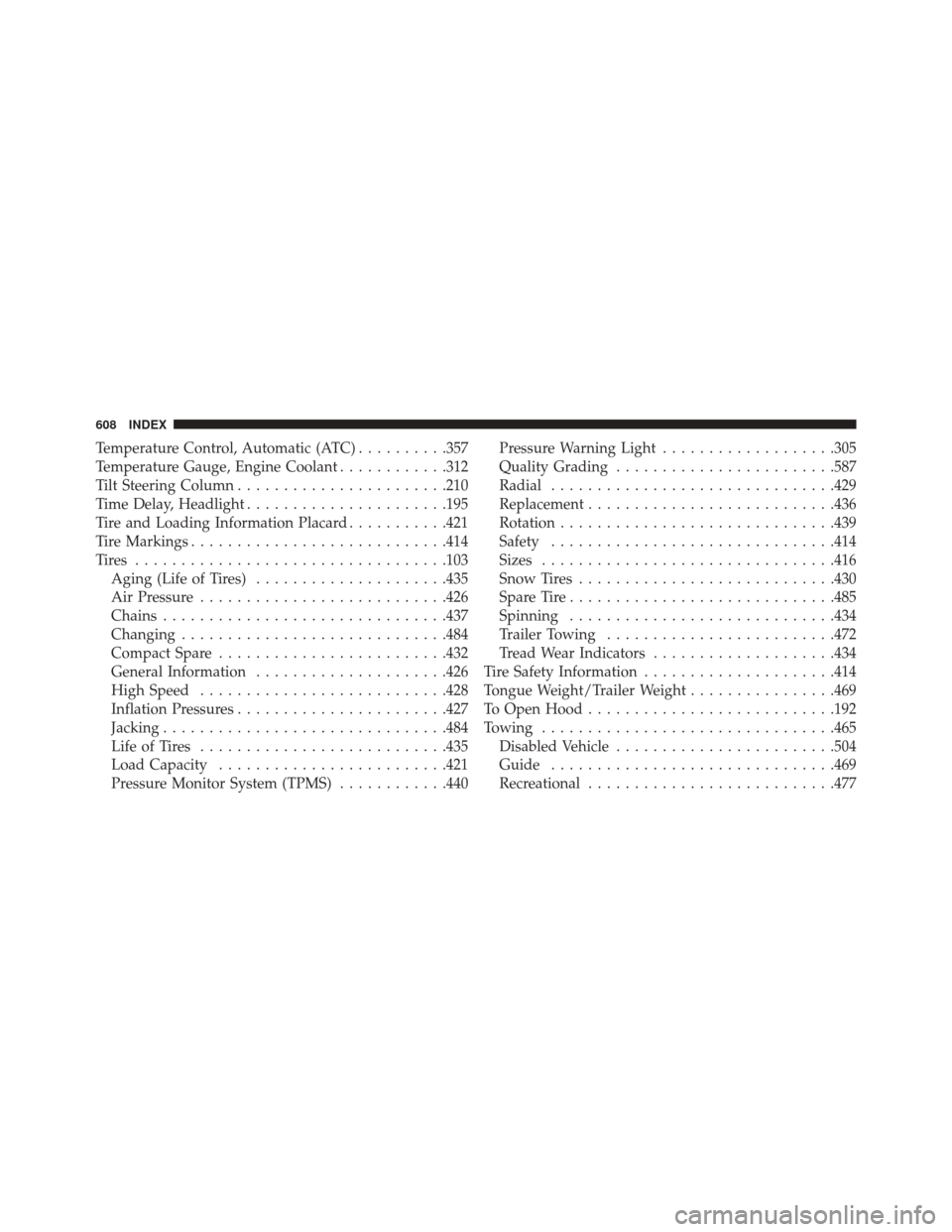
Temperature Control, Automatic (ATC)..........357
Temperature Gauge, Engine Coolant ............312
Tilt Steering Column ...................... .210
Time Delay, Headlight ..................... .195
Tire and Loading Information Placard ...........421
Tire Markings ........................... .414
Tires ................................. .103
Aging (Life of Tires) .....................435
Air Pressure .......................... .426
Chains .............................. .437
Changing ............................ .484
Compact Spare ........................ .432
General Information .....................426
High Speed .......................... .428
Inflation Pressures ...................... .427
Jacking .............................. .484
Life of Tires .......................... .435
Load Capacity ........................ .421
Pressure Monitor System (TPMS) ............440Pressure Warning Light
...................305
Quality Grading ....................... .587
Radial .............................. .429
Replacement .......................... .436
Rotation ............................. .439
Safety .............................. .414
Sizes ............................... .416
Snow Tires ........................... .430
Spare Tire ............................ .485
Spinning ............................ .434
Trailer Towing ........................ .472
Tread Wear Indicators ....................434
Tire Safety Information .....................414
Tongue Weight/Trailer Weight ................469
To Open Hood .......................... .192
Towing ............................... .465
Disabled
Vehicle....................... .504
Guide .............................. .469
Recreational .......................... .477
608 INDEX