coolant temperature CHRYSLER 300 2015 2.G Owners Manual
[x] Cancel search | Manufacturer: CHRYSLER, Model Year: 2015, Model line: 300, Model: CHRYSLER 300 2015 2.GPages: 574, PDF Size: 14.59 MB
Page 271 of 574
on, a continuous chime will sound to alert you to turn the
signals off. If either indicator flashes at a rapid rate, check
for a defective outside light bulb.
13. Rear Fog Light Indicator
This indicator will illuminate when the rear fog
lights are on.
14. Anti-Lock Brake (ABS) Light
This light monitors the Anti-Lock Brake System
(ABS). The light will turn on when the ignition
switch is turned to the ON/RUN position and
may stay on for as long as four seconds.
If the ABS light remains on or turns on while driving, it
indicates that the Anti-Lock portion of the brake system
is not functioning and that service is required. However,
the conventional brake system will continue to operate
normally if the BRAKE warning light is not on.
If the ABS light is on, the brake system should be serviced
as soon as possible to restore the benefits of Anti-Lock
brakes. If the ABS light does not turn on when the
ignition switch is turned to the ON/RUN position, have
the light inspected by an authorized dealer.
15. Fuel Door Reminder
The arrow in this symbol is a reminder that the
Fuel Filler Door is located on the left side of the
vehicle.
16. Fuel Gauge
The pointer shows the level of fuel in the fuel tank when
the ignition switch is in the ON/RUN position.
17. Temperature Gauge
The temperature gauge shows engine coolant tempera-
ture. Any reading within the normal range indicates that
the engine cooling system is operating satisfactorily.
4
UNDERSTANDING YOUR INSTRUMENT PANEL 269
Page 272 of 574
The gauge pointer will likely indicate a higher tempera-
ture when driving in hot weather, up mountain grades,
or when towing a trailer. It should not be allowed to
exceed the upper limits of the normal operating range.
CAUTION!
Driving with a hot engine cooling system could
damage your vehicle. If the temperature gauge reads
“H” pull over and stop the vehicle. Idle the vehicle
with the air conditioner turned off until the pointer
drops back into the normal range. If the pointer
remains on the “H” and you hear continuous chimes,
turn the engine off immediately and call an autho-
rized dealer for service.
WARNING!
A hot engine cooling system is dangerous. You or
others could be badly burned by steam or boiling
coolant. You may want to call an authorized dealer
for service if your vehicle overheats. If you decide to
look under the hood yourself, see “Maintaining Your
Vehicle”. Follow the warnings under the Cooling
System Pressure Cap paragraph.
18. Seat Belt Reminder Light
When the ignition switch is first turned to ON/
RUN, this light will turn on for four to eight
seconds as a bulb check. During the bulb check, if
the driver’s seat belt is unbuckled, a chime will sound.
After the bulb check or when driving, if the driver’s seat
belt remains unbuckled, the Seat Belt Reminder Light
will illuminate and the chime will sound. Refer to
“Occupant Restraints” in “Things To Know Before Start-
ing Your Vehicle” for further information.
270 UNDERSTANDING YOUR INSTRUMENT PANEL
Page 277 of 574
Speedometer
Push and release the OK button to toggle between MPH
and km/h.
Vehicle Info
The Vehicle Info consists of the following sub menu:
•Tire Pressure Monitor
•Coolant Temperature
•Transmission Oil Temperature
•Engine Oil Temperature
•Oil Pressure
•Oil Life
•Battery Voltage
•AWD Status — If Equipped
Driver Assist
Fuel Economy
Push and release the UP or DOWN arrow button until
the Fuel Economy Menu item is highlighted in the DID.
•Two sub menu pages one with Current value dis-
played and one without the Current Value displayed:
– Current Fuel Economy (MPG, L/100 km, or km/l)
– Range To Empty (miles or km)
– Average Fuel Economy (MPG, L/100 km, or km/l)
– The Max and Min values will correspond to the
particular engine requirements
•Lower end of gauge will be displayed in an amber
color and turn green as Fuel Economy improves.
•HoldOKto reset average fuel economy information.
4
UNDERSTANDING YOUR INSTRUMENT PANEL 275
Page 445 of 574
•You can also turn the temperature control to maximum
heat, the mode control to floor and the blower control
to high. This allows the heater core to act as a
supplement to the radiator and aids in removing heat
from the engine cooling system.
CAUTION!
Driving with a hot cooling system could damage
your vehicle. If the temperature gauge reads “H,”
pull over and stop the vehicle. Idle the vehicle with
the air conditioner turned off until the pointer drops
back into the normal range. If the pointer remains on
the “H,” turn the engine off immediately and call for
service.
WARNING!
You or others can be badly burned by hot engine
coolant (antifreeze) or steam from your radiator. If
you see or hear steam coming from under the hood,
do not open the hood until the radiator has had time
to cool. Never try to open a cooling system pressure
cap when the radiator or coolant bottle is hot.
WHEEL AND TIRE TORQUE SPECIFICATIONS
Proper lug nut/bolt torque is very important to ensure
that the wheel is properly mounted to the vehicle. Any
time a wheel has been removed and reinstalled on the
vehicle the lug nuts/bolts should be torqued using a
properly calibrated torque wrench.
6
WHAT TO DO IN EMERGENCIES 443
Page 493 of 574
Coolant Checks
Check engine coolant (antifreeze) protection every 12
months (before the onset of freezing weather, where
applicable). If the engine coolant (antifreeze) is dirty, the
system should be drained, flushed, and refilled with
fresh OAT coolant (conforming to MS.90032) by an
authorized dealer. Check the front of the radiator for any
accumulation of bugs, leaves, etc. If dirty, clean by gently
spraying water from a garden hose vertically down the
face of the condenser.
Check the coolant recovery bottle tubing for brittle rub-
ber, cracking, tears, cuts, and tightness of the connection
at the bottle and radiator. Inspect the entire system for
leaks.
With the engine at normal operating temperature (but
not running), check the cooling system pressure cap for
proper vacuum sealing by draining a small amount of
engine coolant (antifreeze) from the radiator drain cock.
If the cap is sealing properly, the engine coolant (anti-
freeze) will begin to drain from the coolant recovery
bottle. DO NOT REMOVE THE COOLANT PRESSURE
CAP WHEN THE COOLING SYSTEM IS HOT.
Cooling System — Drain, Flush And Refill
NOTE:Some vehicles require special tools to add coolant
properly. Failure to fill these systems properly could lead
to severe internal engine damage. If any coolant is
needed to be added to the system please contact your
local authorized dealer.
If the engine coolant (antifreeze) is dirty or contains
visible sediment, have an authorized dealer clean and
flush with OAT coolant (antifreeze) (conforming to
MS.90032).
Refer to the “Maintenance Schedule” for the proper
maintenance intervals.
7
MAINTAINING YOUR VEHICLE 491
Page 495 of 574
miles (240,000 km) before replacement. To prevent reduc-
ing this extended maintenance period, it is important that
you use the same engine coolant (OAT coolant conform-
ing to MS.90032) throughout the life of your vehicle.
Please review these recommendations for using Organic
Additive Technology (OAT) engine coolant (antifreeze)
that meets the requirements of Chrysler Material Stan-
dard MS.90032. When adding engine coolant (antifreeze):
•We recommend using MOPAR® Antifreeze/Coolant
10 Year/150,000 Mile Formula OAT (Organic Additive
Technology) that meets the requirements of Chrysler
Material Standard MS.90032.
•Mix a minimum solution of 50% OAT engine coolant
that meets the requirements of Chrysler Material Stan-
dard MS.90032 and distilled water. Use higher concen-
trations (not to exceed 70%) if temperatures below
−34° F (−37° C) are anticipated.
•Use only high purity water such as distilled or deion-
ized water when mixing the water/engine coolant
(antifreeze) solution. The use of lower quality water
will reduce the amount of corrosion protection in the
engine cooling system.
Please note that it is the owner’s responsibility to main-
tain the proper level of protection against freezing ac-
cording to the temperatures occurring in the area where
the vehicle is operated.
7
MAINTAINING YOUR VEHICLE 493
Page 497 of 574
with your local authorities to determine the disposal
rules for your community. To prevent ingestion by ani-
mals or children, do not store ethylene glycol-based
engine coolant in open containers or allow it to remain in
puddles on the ground. If ingested by a child or pet, seek
emergency assistance immediately. Clean up any ground
spills immediately.
Coolant Level
The coolant bottle provides a quick visual method for
determining that the coolant level is adequate. With the
engine OFF and cold, the level of the engine coolant
(antifreeze) in the bottle should be between the ranges
indicated on the bottle.
The radiator normally remains completely full, so there is
no need to remove the radiator/coolant pressure cap
unless checking for engine coolant (antifreeze) freeze
point or replacing coolant. Advise your service attendant
of this. As long as the engine operating temperature is
satisfactory, the coolant bottle need only be checked once
a month.
When additional engine coolant (antifreeze) is needed to
maintain the proper level, only OAT coolant that meets
the requirements of Chrysler Material Standard MS.90032
should be added to the coolant bottle. Do not overfill.
Points To Remember
NOTE:When the vehicle is stopped after a few miles/
kilometers of operation, you may observe vapor coming
from the front of the engine compartment. This is nor-
mally a result of moisture from rain, snow, or high
humidity accumulating on the radiator and being vapor-
ized when the thermostat opens, allowing hot engine
coolant (antifreeze) to enter the radiator.
7
MAINTAINING YOUR VEHICLE 495
Page 553 of 574
Alarm System (Security Alarm)................17
All Wheel Drive (AWD).....................355
Alterations/Modifications, Vehicle...............7
Antifreeze (Engine Coolant)..................492
Disposal..............................494
Anti-Lock Brake System (ABS)................364
Anti-Lock Warning Light....................263
Appearance Care.........................501
Arming System (Security Alarm)...............17
Assist, Hill Start..........................371
Auto Down Power Windows..................38
Automatic Door Locks......................30
Automatic Headlights......................146
Automatic High Beams.....................148
Automatic Temperature Control (ATC)..........303
Automatic Transmission....................345
Adding Fluid..........................500
Fluid And Filter Changes..................500
Fluid Change..........................500
Fluid Level Check.......................499
Fluid Type............................530
Gear Ranges...........................346
Special Additives.......................499
Auto Unlock, Doors........................30
Auto Up Power Windows....................38
Axle Fluid..............................530
Axle Lubrication..........................530
Battery.................................481
Keyless Transmitter Replacement (RKE)........22
Location..............................481
Remote Battery Replacement................22
Transmitter Battery Replacement.............22
Belts, Seat...............................96
Body Mechanism Lubrication.................486
B-Pillar Location..........................382
Brake Assist System.......................367
Brake Control System, Electronic..............364
10
INDEX 551
Page 559 of 574
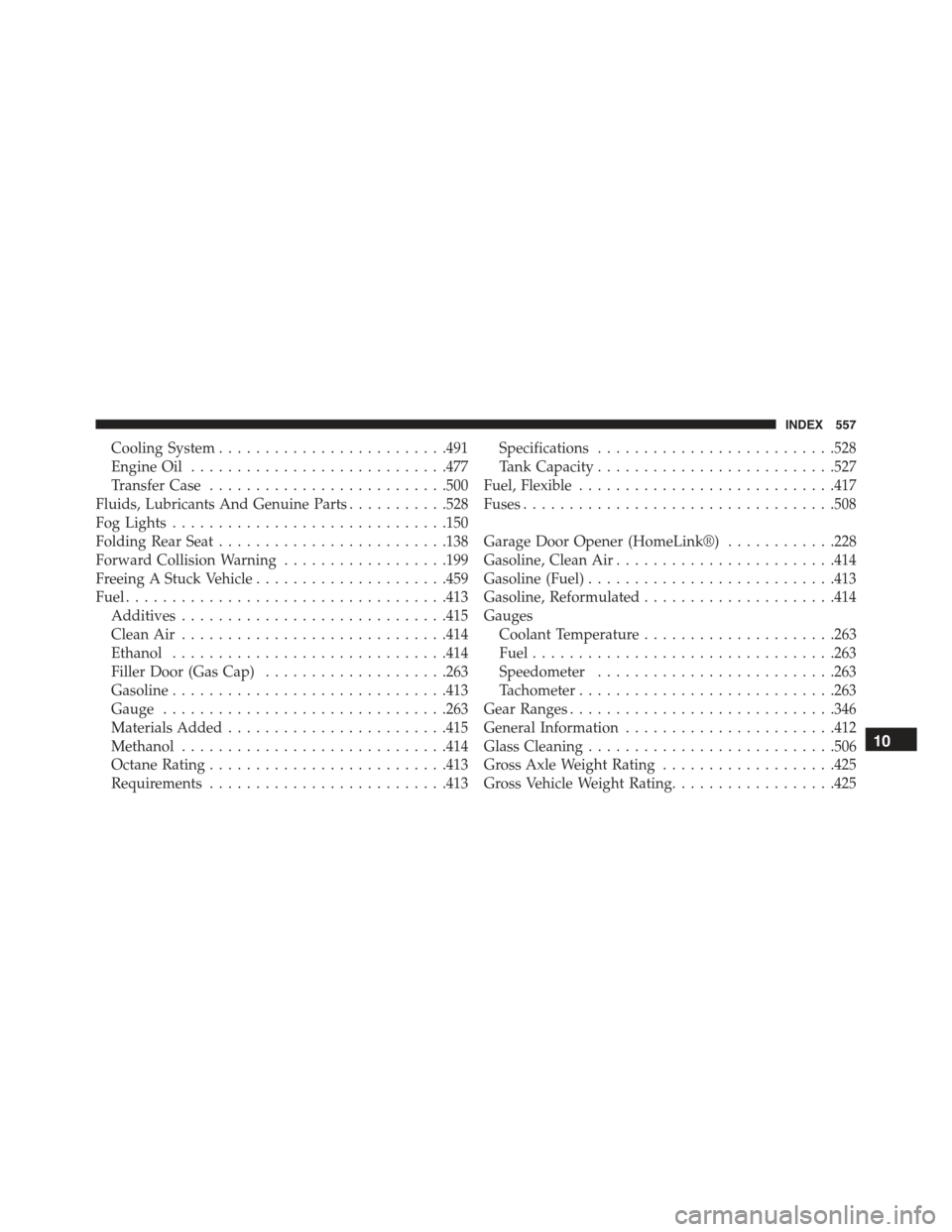
Cooling System.........................491
Engine Oil............................477
Transfer Case..........................500
Fluids, Lubricants And Genuine Parts...........528
Fog Lights..............................150
Folding Rear Seat.........................138
Forward Collision Warning..................199
Freeing A Stuck Vehicle.....................459
Fuel...................................413
Additives.............................415
Clean Air.............................414
Ethanol..............................414
Filler Door (Gas Cap)....................263
Gasoline..............................413
Gauge...............................263
Materials Added........................415
Methanol.............................414
Octane Rating..........................413
Requirements..........................413
Specifications..........................528
Tank Capacity..........................527
Fuel, Flexible............................417
Fuses..................................508
Garage Door Opener (HomeLink®)............228
Gasoline, Clean Air........................414
Gasoline (Fuel)...........................413
Gasoline, Reformulated.....................414
Gauges
Coolant Temperature.....................263
Fuel.................................263
Speedometer..........................263
Tachometer............................263
Gear Ranges.............................346
General Information.......................412
Glass Cleaning...........................506
Gross Axle Weight Rating...................425
Gross Vehicle Weight Rating..................425
10
INDEX 557
Page 569 of 574
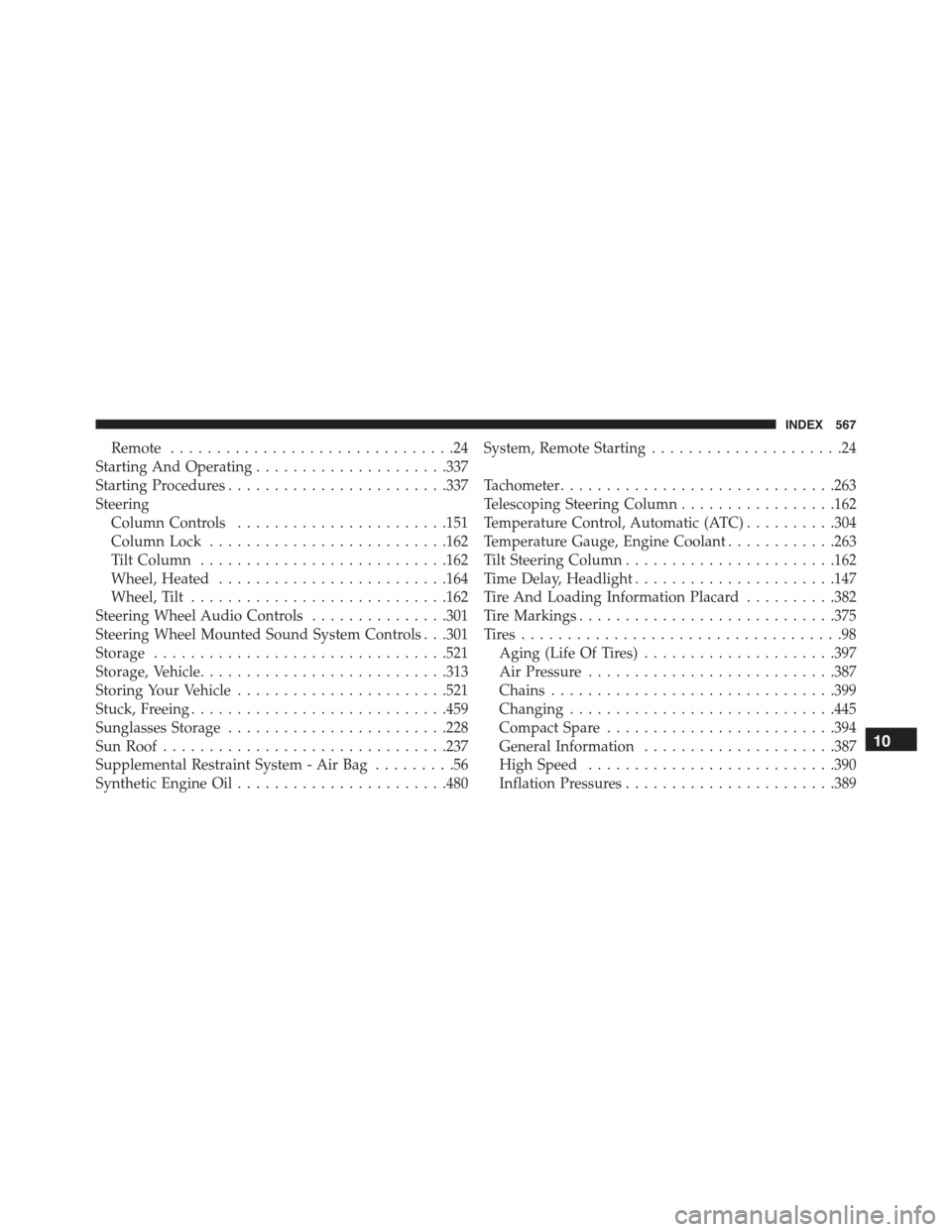
Remote...............................24
Starting And Operating.....................337
Starting Procedures........................337
Steering
Column Controls.......................151
Column Lock..........................162
Tilt Column...........................162
Wheel, Heated.........................164
Wheel, Tilt............................162
Steering Wheel Audio Controls...............301
Steering Wheel Mounted Sound System Controls . . .301
Storage................................521
Storage, Vehicle...........................313
Storing Your Vehicle.......................521
Stuck, Freeing............................459
Sunglasses Storage........................228
Sun Roof...............................237
Supplemental Restraint System - Air Bag.........56
Synthetic Engine Oil.......................480
System, Remote Starting.....................24
Tachometer..............................263
Telescoping Steering Column.................162
Temperature Control, Automatic (ATC)..........304
Temperature Gauge, Engine Coolant............263
Tilt Steering Column.......................162
Time Delay, Headlight......................147
Tire And Loading Information Placard..........382
Tire Markings............................375
Ti re s . . . . . . . . . . . . . . . . . . . . . . . . . . . . . . . . . . . 9 8
Aging (Life Of Tires).....................397
Air Pressure...........................387
Chains...............................399
Changing.............................445
Compact Spare.........................394
General Information.....................387
High Speed...........................390
Inflation Pressures.......................389
10
INDEX 567