brake light CHRYSLER 300 2016 2.G Owner's Manual
[x] Cancel search | Manufacturer: CHRYSLER, Model Year: 2016, Model line: 300, Model: CHRYSLER 300 2016 2.GPages: 620, PDF Size: 4.26 MB
Page 412 of 620
Traction Control System (TCS)
This system monitors the amount of wheel spin of each of
the driven wheels. If wheel spin is detected, the TCS may
apply brake pressure to the spinning wheel(s) and/or
reduce engine power to provide enhanced acceleration
and stability. A feature of the TCS, Brake Limited Differ-
ential (BLD), functions similar to a limited slip differen-
tial and controls the wheel spin across a driven axle. If
one wheel on a driven axle is spinning faster than the
other, the system will apply the brake of the spinning
wheel. This will allow more engine torque to be applied
to the wheel that is not spinning. BLD may remain
enabled even if TCS and ESC are in a reduced mode.
Electronic Stability Control (ESC)
This system enhances directional control and stability of
the vehicle under various driving conditions. ESC cor-
rects for oversteering or understeering of the vehicle by
applying the brake of the appropriate wheel(s) to assist incounteracting the oversteer or understeer condition. En-
gine power may also be reduced to help the vehicle
maintain the desired path.
ESC uses sensors in the vehicle to determine the vehicle
path intended by the driver and compares it to the actual
path of the vehicle. When the actual path does not match
the intended path, ESC applies the brake of the appro-
priate wheel to assist in counteracting the oversteer or
understeer condition.
•
Oversteer - when the vehicle is turning more than
appropriate for the steering wheel position.
• Understeer - when the vehicle is turning less than
appropriate for the steering wheel position.
The “ESC Activation/Malfunction Indicator Light” lo-
cated in the instrument cluster will start to flash as soon
as the ESC system becomes active. The “ESC Activation/
Malfunction Indicator Light” also flashes when the TCS
is active. If the “ESC Activation/Malfunction Indicator
410 STARTING AND OPERATING
Page 417 of 620
•Each time the ignition is turned ON, the ESC system
will be ON even if it was turned off previously.
• The ESC system will make buzzing or clicking sounds
when it is active. This is normal; the sounds will stop
when ESC becomes inactive following the maneuver
that caused the ESC activation.
The “ESC OFF Indicator Light” indicates the
customer has elected to have the Electronic
Stability Control (ESC) in a reduced mode.
Electronic Roll Mitigation (ERM)
This system anticipates the potential for wheel lift by
monitoring the driver ’s steering wheel input and the
speed of the vehicle. When ERM determines that the rate
of change of the steering wheel angle and vehicle’s speed
are sufficient to potentially cause wheel lift, it then
applies the appropriate brake and may also reduce engine power to lessen the chance that wheel lift will
occur. ERM can only reduce the chance of wheel lift
occurring during severe or evasive driving maneuvers; it
cannot prevent wheel lift due to other factors, such as
road conditions, leaving the roadway, or striking objects
or other vehicles.
NOTE:
ERM is disabled anytime the ESC is in “Full Off”
mode (if equipped). Refer to “Electronic Stability Control
(ESC)” in this section for a complete explanation of the
available ESC modes.
WARNING!
Many factors, such as vehicle loading, road condi-
tions and driving conditions, influence the chance
that wheel lift or rollover may occur. ERM cannot
prevent all wheel lift or roll overs, especially those
that involve leaving the roadway or striking objects
(Continued)
5
STARTING AND OPERATING 415
Page 469 of 620
WARNING!(Continued)
•Weight Distributing Systems may not be compat-
ible with Surge Brake Couplers. Consult with your
hitch and trailer manufacturer or a reputable Rec-
reational Vehicle dealer for additional information.
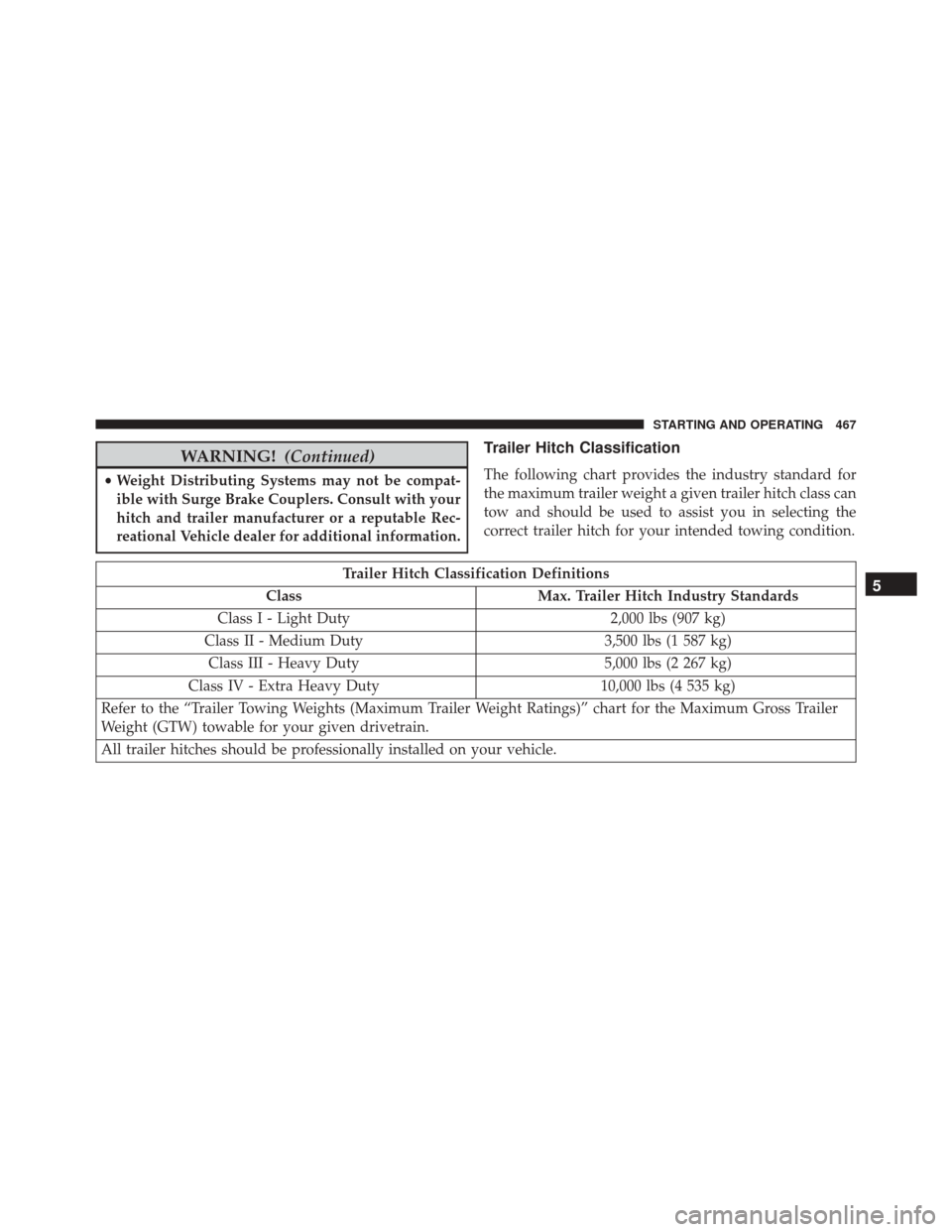
Trailer Hitch Classification
The following chart provides the industry standard for
the maximum trailer weight a given trailer hitch class can
tow and should be used to assist you in selecting the
correct trailer hitch for your intended towing condition.
Trailer Hitch Classification Definitions
Class Max. Trailer Hitch Industry Standards
Class I - Light Duty 2,000 lbs (907 kg)
Class II - Medium Duty 3,500 lbs (1 587 kg)
Class III - Heavy Duty 5,000 lbs (2 267 kg)
Class IV - Extra Heavy Duty 10,000 lbs (4 535 kg)
Refer to the “Trailer Towing Weights (Maximum Trailer Weight Ratings)” chart for the Maximum Gross Trailer
Weight (GTW) towable for your given drivetrain.
All trailer hitches should be professionally installed on your vehicle.5
STARTING AND OPERATING 467
Page 475 of 620
WARNING!
•Do not connect trailer brakes to your vehicle’s
hydraulic brake lines. It can overload your brake
system and cause it to fail. You might not have
brakes when you need them and could have a
collision.
• Towing any trailer will increase your stopping
distance. When towing you should allow for addi-
tional space between your vehicle and the vehicle
in front of you. Failure to do so could result in a
collision.
CAUTION!
If the trailer weighs more than 1,000 lbs (453 kg)
loaded, it should have its own brakes and they
should be of adequate capacity. Failure to do this
(Continued)
CAUTION! (Continued)
could lead to accelerated brake lining wear, higher
brake pedal effort, and longer stopping distances.
Towing Requirements — Trailer Lights And Wiring
Whenever you pull a trailer, regardless of the trailer size,
stoplights and turn signals on the trailer are required for
motoring safety.
The Trailer Tow Package may include a four- and seven-
pin wiring harness. Use a factory approved trailer har-
ness and connector.
NOTE:Do not cut or splice wiring into the vehicles
wiring harness.
The electrical connections are all complete to the vehicle
but you must mate the harness to a trailer connector.
Refer to the following illustrations.
5
STARTING AND OPERATING 473
Page 537 of 620
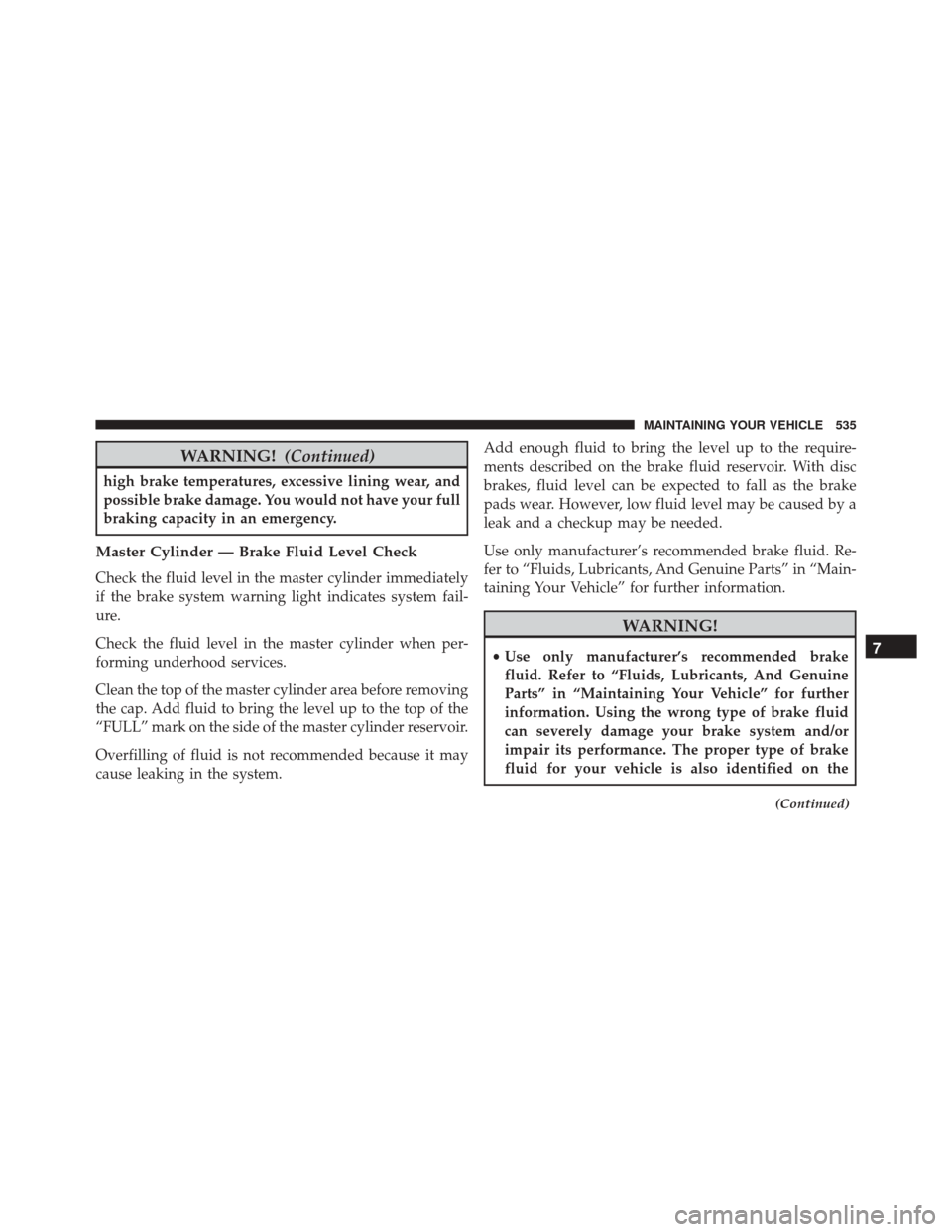
WARNING!(Continued)
high brake temperatures, excessive lining wear, and
possible brake damage. You would not have your full
braking capacity in an emergency.
Master Cylinder — Brake Fluid Level Check
Check the fluid level in the master cylinder immediately
if the brake system warning light indicates system fail-
ure.
Check the fluid level in the master cylinder when per-
forming underhood services.
Clean the top of the master cylinder area before removing
the cap. Add fluid to bring the level up to the top of the
“FULL” mark on the side of the master cylinder reservoir.
Overfilling of fluid is not recommended because it may
cause leaking in the system. Add enough fluid to bring the level up to the require-
ments described on the brake fluid reservoir. With disc
brakes, fluid level can be expected to fall as the brake
pads wear. However, low fluid level may be caused by a
leak and a checkup may be needed.
Use only manufacturer’s recommended brake fluid. Re-
fer to “Fluids, Lubricants, And Genuine Parts” in “Main-
taining Your Vehicle” for further information.
WARNING!
•
Use only manufacturer’s recommended brake
fluid. Refer to “Fluids, Lubricants, And Genuine
Parts” in “Maintaining Your Vehicle” for further
information. Using the wrong type of brake fluid
can severely damage your brake system and/or
impair its performance. The proper type of brake
fluid for your vehicle is also identified on the
(Continued)
7
MAINTAINING YOUR VEHICLE 535
Page 577 of 620
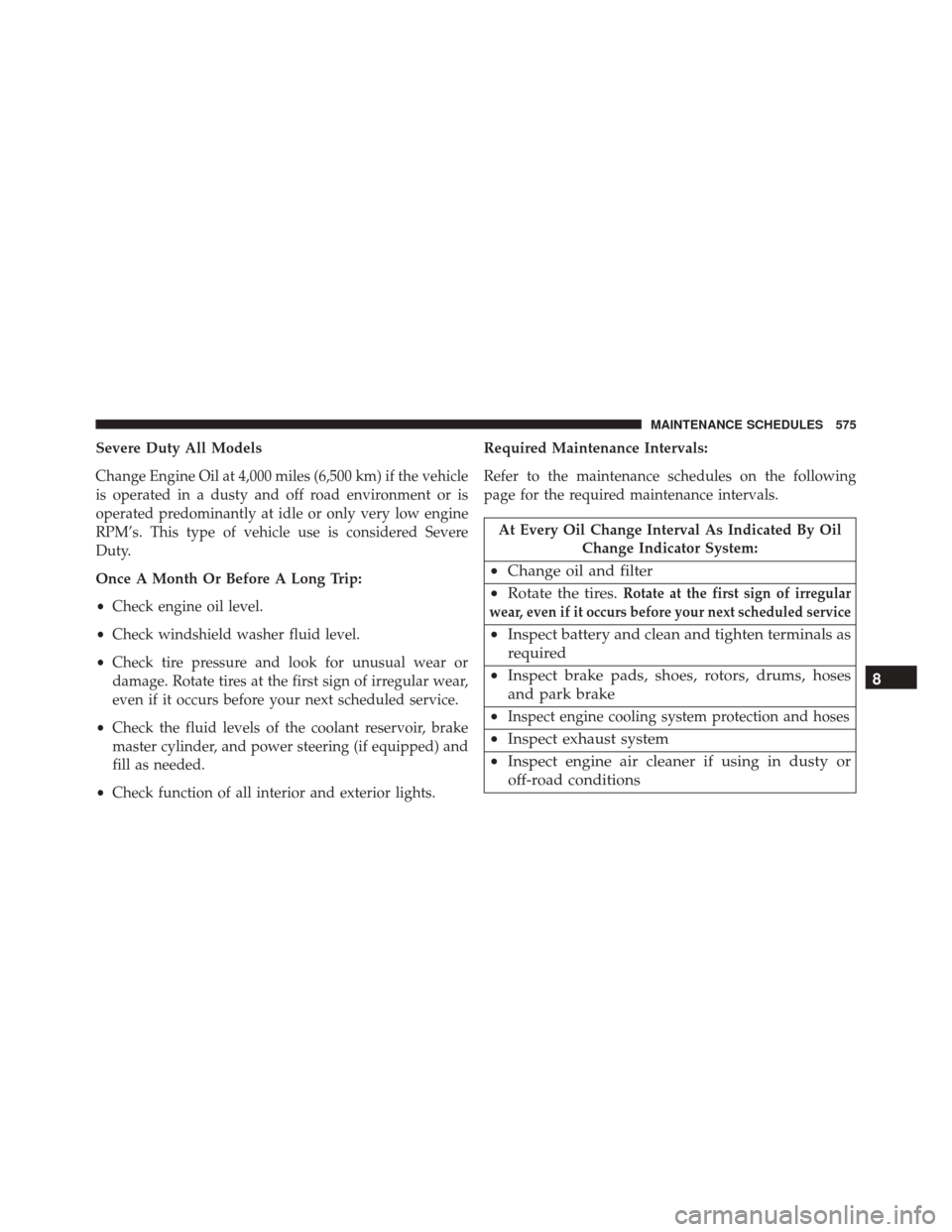
Severe Duty All Models
Change Engine Oil at 4,000 miles (6,500 km) if the vehicle
is operated in a dusty and off road environment or is
operated predominantly at idle or only very low engine
RPM’s. This type of vehicle use is considered Severe
Duty.
Once A Month Or Before A Long Trip:
•Check engine oil level.
• Check windshield washer fluid level.
• Check tire pressure and look for unusual wear or
damage. Rotate tires at the first sign of irregular wear,
even if it occurs before your next scheduled service.
• Check the fluid levels of the coolant reservoir, brake
master cylinder, and power steering (if equipped) and
fill as needed.
• Check function of all interior and exterior lights. Required Maintenance Intervals:
Refer to the maintenance schedules on the following
page for the required maintenance intervals.
At Every Oil Change Interval As Indicated By Oil
Change Indicator System:
•Change oil and filter
• Rotate the tires.
Rotate at the first sign of irregular
wear, even if it occurs before your next scheduled service
• Inspect battery and clean and tighten terminals as
required
• Inspect brake pads, shoes, rotors, drums, hoses
and park brake
•
Inspect engine cooling system protection and hoses
• Inspect exhaust system
• Inspect engine air cleaner if using in dusty or
off-road conditions 8
MAINTENANCE SCHEDULES 575
Page 596 of 620
About Your Brakes.....................400, 402
Adaptive Cruise Control (ACC) (Cruise Control) . . .178
Adding Engine Coolant (Antifreeze) ............530
Adding Fuel ............................ .458
Adding Washer Fluid ..................... .525
Additives, Fuel .......................... .452
Adjust Down .............................. .135
Forward ............................. .135
Rearward ............................ .135
Up ................................ .135
Adjustable Pedals ........................ .172
AirBag.................................61 Advance Front Air Bag .................61, 63
Air Bag Operation .......................64
Air Bag Warning Light ....................73
Driver Knee Air Bag ......................65
Enhanced Accident Response ................72
Event Data Recorder (EDR) .................76 FrontAirBag...........................61
If A Deployment Occurs
...................71
Knee Impact Bolsters .....................65
Maintaining Your Air Bag System ............75
Redundant Air Bag Warning Light ............74
Side Air Bags ...........................66
Transporting Pets ........................98
Air Bag Deployment ........................61
Air Bag Light ..................... .73, 101, 273
Air Bag Maintenance .......................75
Air Cleaner, Engine (Engine Air Cleaner Filter) . . . .519
Air Conditioner Maintenance .................521
Air Conditioning ......................... .338
Air Conditioning Filter ..................348, 522
Air Conditioning, Operating Tips ...........347, 349
Air Conditioning Refrigerant ..............521, 522
Air Conditioning System .................345, 521
Air Pressure, Tires ........................ .429
594 INDEX
Page 597 of 620
AlarmArm The System ........................20
Alarm, Panic .............................24
Alarm (Security Alarm) ..................19, 276
Alarm System (Security Alarm) ................19
All Wheel Drive Towing ............................. .501
All Wheel Drive (AWD) .................394, 538
Alterations/Modifications, Vehicle ...............7
Antifreeze (Engine Coolant) ...............530, 566
Disposal ............................. .532
Anti-Lock Brake System (ABS) ................404
Anti-Lock Warning Light ....................291
Appearance Care ........................ .539
Arming System (Security Alarm) ...............19
Assist, Hill Start ......................... .407
Auto Down Power Windows ..................42
Automatic Door Locks ......................34
Automatic Headlights ..................... .153Automatic High Beams
.....................154
Automatic Temperature Control (ATC) .......338, 345
Automatic Transmission .................384, 538
Adding Fluid ...................538, 568, 571
Fluid And Filter Changes ..................538
Fluid Change ......................... .538
Fluid Level Check ...................536, 537
Fluid Type ........................ .568, 571
Gear Ranges .......................... .385
Special Additives ...................... .537
Autostick Operation ............................ .391
Auto Unlock, Doors ........................34
Auto Up Power Windows ....................43
AW D Towing ............................. .501
Axle Fluid .......................... .568, 571
Axle Lubrication ..................... .568, 571
10
INDEX 595
Page 598 of 620
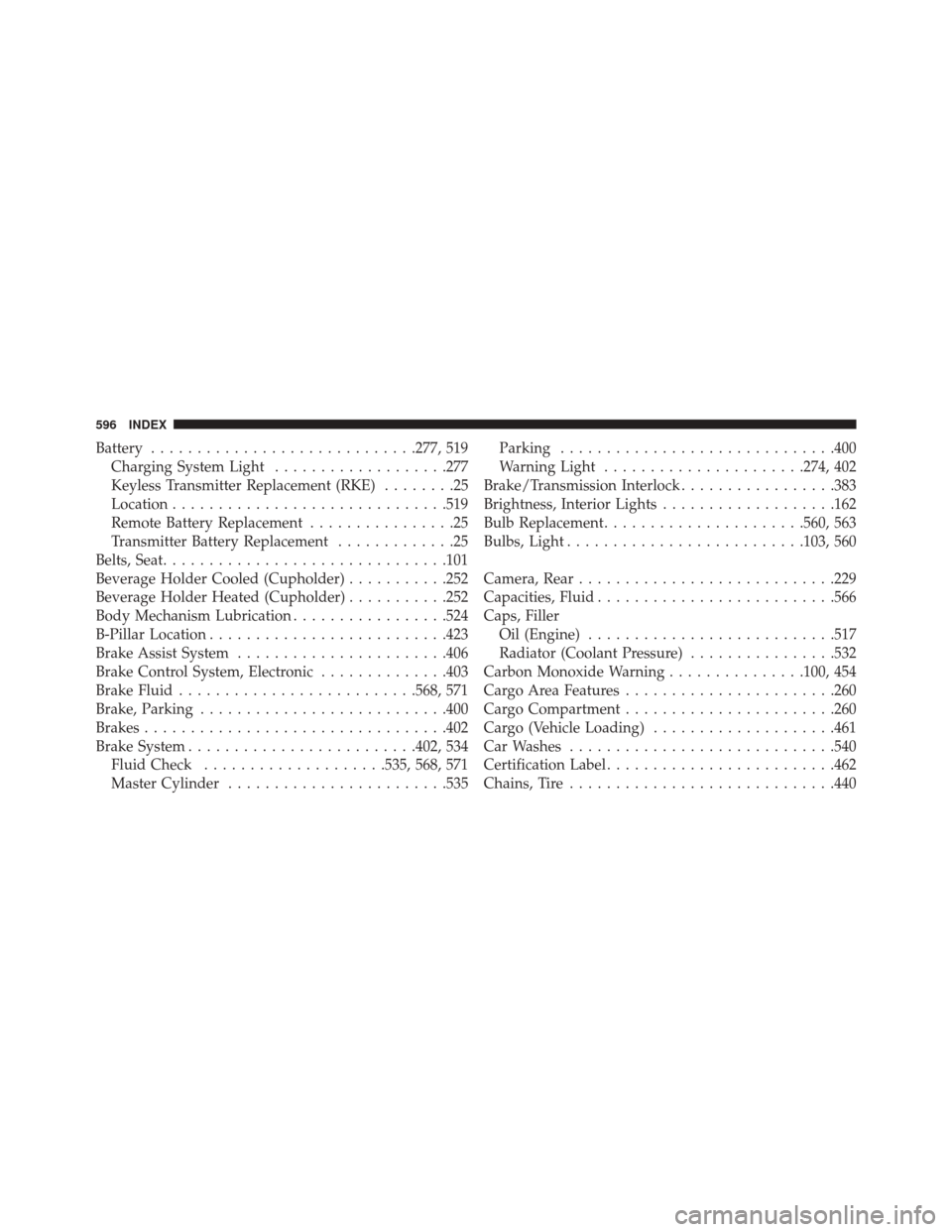
Battery............................ .277, 519
Charging System Light ...................277
Keyless Transmitter Replacement (RKE) ........25
Location ............................. .519
Remote Battery Replacement ................25
Transmitter Battery Replacement .............25
Belts, Seat .............................. .101
Beverage Holder Cooled (Cupholder) ...........252
Beverage Holder Heated (Cupholder) ...........252
Body Mechanism Lubrication .................524
B-Pillar Location ......................... .423
Brake Assist System ...................... .406
Brake Control System, Electronic ..............403
Brake Fluid ......................... .568, 571
Brake, Parking .......................... .400
Brakes ................................ .402
Brake System ........................ .402, 534
Fluid Check ....................535, 568, 571
Master Cylinder ....................... .535Parking
............................. .400
Warning Light ..................... .274, 402
Brake/Transmission Interlock .................383
Brightness, Interior Lights ...................162
Bulb Replacement ..................... .560, 563
Bulbs, Light ......................... .103, 560
Camera, Rear ........................... .229
Capacities, Fluid ......................... .566
Caps, Filler Oil (Engine) .......................... .517
Radiator (Coolant Pressure) ................532
Carbon Monoxide Warning ...............100, 454
Cargo Area Features ...................... .260
Cargo Compartment ...................... .260
Cargo (Vehicle Loading) ....................461
Car Washes ............................ .540
Certification Label ........................ .462
Chains,
Tire ............................ .440
596 INDEX
Page 601 of 620
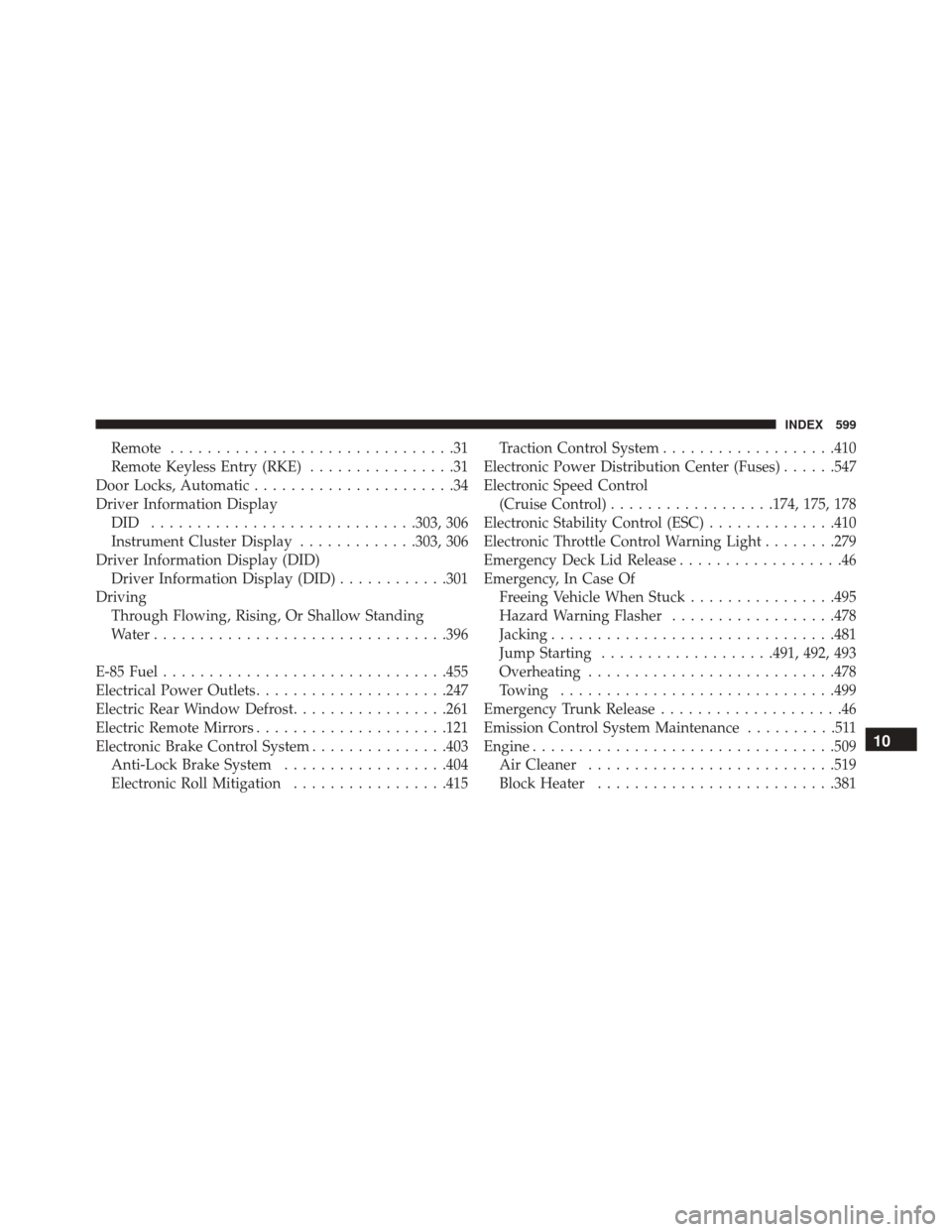
Remote...............................31
Remote Keyless Entry (RKE) ................31
Door Locks, Automatic ......................34
Driver Information Display DID ............................ .303, 306
Instrument Cluster Display .............303, 306
Driver Information Display (DID) Driver Information Display (DID) ............301
Driving Through Flowing, Rising, Or Shallow Standing
Water ............................... .396
E-85 Fuel .............................. .455
Electrical Power Outlets .....................247
Electric Rear Window Defrost .................261
Electric Remote Mirrors .....................121
Electronic Brake Control System ...............403
Anti-Lock Brake System ..................404
Electronic Roll Mitigation .................415 Traction Control System
...................410
Electronic Power Distribution Center (Fuses) ......547
Electronic Speed Control (Cruise Control) ..................174, 175, 178
Electronic Stability Control (ESC) ..............410
Electronic Throttle Control Warning Light ........279
Emergency Deck Lid Release ..................46
Emergency, In Case Of Freeing Vehicle When Stuck ................495
Hazard Warning Flasher ..................478
Jacking .............................. .481
Jump Starting ...................491, 492, 493
Overheating .......................... .478
Towing ............................. .499
Emergency Trunk Release ....................46
Emission Control System Maintenance ..........511
Engine ................................ .509
Air Cleaner .......................... .519
Block Heater ......................... .381
10
INDEX 599