traction control CHRYSLER 300 2017 2.G User Guide
[x] Cancel search | Manufacturer: CHRYSLER, Model Year: 2017, Model line: 300, Model: CHRYSLER 300 2017 2.GPages: 488, PDF Size: 4.3 MB
Page 326 of 488
ESC system becomes active. The “ESC Activation/
Malfunction Indicator Light” also flashes when the TCS is
active. If the “ESC Activation/Malfunction Indicator
Light” begins to flash during acceleration, ease up on the
accelerator and apply as little throttle as possible. Be sure to
adapt your speed and driving to the prevailing road
conditions.
WARNING!
•Electronic Stability Control (ESC) cannot prevent the
natural laws of physics from acting on the vehicle,
nor can it increase the traction afforded by prevailing
road conditions. ESC cannot prevent accidents, in-
cluding those resulting from excessive speed in
turns, driving on very slippery surfaces, or hydro-
planing. ESC also cannot prevent accidents resulting
from loss of vehicle control due to inappropriate
driver input for the conditions. Only a safe, attentive,
and skillful driver can prevent accidents. The capa-
bilities of an ESC equipped vehicle must never be
exploited in a reckless or dangerous manner which
could jeopardize the user ’s safety or the safety of
others.
(Continued)
WARNING! (Continued)
•Vehicle modifications, or failure to properly main-
tain your vehicle, may change the handling charac-
teristics of your vehicle, and may negatively affect
the performance of the ESC system. Changes to the
steering system, suspension, braking system, tire
type and size or wheel size may adversely affect ESC
performance. Improperly inflated and unevenly
worn tires may also degrade ESC performance. Any
vehicle modification or poor vehicle maintenance
that reduces the effectiveness of the ESC system can
increase the risk of loss of vehicle control, vehicle
rollover, personal injury and death.
ESC Operating Modes
NOTE: Depending upon model and mode of operation, the
ESC system may have multiple operating modes.
ESC On
This is the normal operating mode for the ESC. Whenever
the vehicle is started, the ESC system will be in this mode.
This mode should be used for most driving conditions.
Alternate ESC modes should only be used for specific
reasons as noted in the following paragraphs.
324 STARTING AND OPERATING
Page 328 of 488
ESC modes may also be affected by drive modes – if
equipped.
WARNING!
•In the ESC “Full Off” mode, the engine torque
reduction and stability features are disabled. There-
fore, enhanced vehicle stability offered by the ESC
system is unavailable. In an emergency evasive ma-
neuver, the ESC system will not engage to assist in
maintaining stability. ESC “Full Off” mode is in-
tended for off-highway or off-road use only.
• With the ESC switched off, the enhanced vehicle
stability offered by ESC is unavailable. In an emer-
gency evasive maneuver, the ESC system will not
engage to assist in maintaining stability. ESC “Full
Off” mode is only intended for off-highway or
off-road use.
• The Electronic Stability Control (ESC) cannot pre-
vent the natural laws of physics from acting on the
vehicle, nor can it increase the traction afforded by
prevailing road conditions. ESC cannot prevent all
(Continued)
WARNING! (Continued)
accidents, including those resulting from excessive
speed in turns, driving on very slippery surfaces, or
hydroplaning. ESC also cannot prevent collisions.
ESC Activation/Malfunction Indicator Light and ESC
OFF Indicator Light
The “ESC Activation/Malfunction Indicator
Light” in the instrument cluster will come on
when the ignition switch is turned to the ON
position. It should go out with the engine run-
ning. If the “ESC Activation/Malfunction Indicator Light”
comes on continuously with the engine running, a mal-
function has been detected in the ESC system. If this light
remains on after several ignition cycles, and the vehicle has
been driven several miles (kilometers) at speeds greater
than 30 mph (48 km/h), see your authorized dealer as soon
as possible to have the problem diagnosed and corrected.
The “ESC Activation/Malfunction Indicator Light” (lo-
cated in the instrument cluster) starts to flash as soon as the
tires lose traction and the ESC system becomes active. The
“ESC Activation/Malfunction Indicator Light” also flashes
when TCS is active. If the “ESC Activation/Malfunction
326 STARTING AND OPERATING
Page 344 of 488
Tire Types
All Season Tires — If Equipped
All season tires provide traction for all seasons (Spring,
Summer, Fall and Winter). Traction levels may vary be-
tween different all season tires. All season tires can be
identified by the M+S, M&S, M/S or MS designation on the
tire sidewall. Use all season tires only in sets of four; failure
to do so may adversely affect the safety and handling of
your vehicle.
Summer Or Three Season Tires — If Equipped
Summer tires provide traction in both wet and dry condi-
tions, and are not intended to be driven in snow or on ice.
If your vehicle is equipped with Summer tires, be aware
these tires are not designed for Winter or cold driving
conditions. Install Winter tires on your vehicle when am-
bient temperatures are less than 40°F (5°C) or if roads are
covered with ice or snow. For more information, contact an
authorized dealer.
Summer tires do not contain the all season designation or
mountain/snowflake symbol on the tire sidewall. Use
Summer tires only in sets of four; failure to do so may
adversely affect the safety and handling of your vehicle.
WARNING!
Do not use Summer tires in snow/ice conditions. You
could lose vehicle control, resulting in severe injury or
death. Driving too fast for conditions also creates the
possibility of loss of vehicle control.
Snow Tires
Some areas of the country require the use of snow tires
during the Winter. Snow tires can be identified by a
“mountain/snowflake” symbol on the tire sidewall.If you need snow tires, select tires
equivalent in size and type to the origi-
nal equipment tires. Use snow tires only
in sets of four; failure to do so may
adversely affect the safety and handling
of your vehicle.
Snow tires generally have lower speed ratings than what
was originally equipped with your vehicle and should not
be operated at sustained speeds over 75 mph (120 km/h).
For speeds above 75 mph (120 km/h), refer to original
equipment or an authorized tire dealer for recommended
safe operating speeds, loading and cold tire inflation
pressures.
342 STARTING AND OPERATING
Page 350 of 488
It is recommended you contact your authorized tire dealer
or original equipment dealer with any questions you may
have on tire specifications or capability. Failure to use
equivalent replacement tires may adversely affect the
safety, handling, and ride of your vehicle.
WARNING!
•Do not use a tire, wheel size or rating other than that
specified for your vehicle. Some combinations of
unapproved tires and wheels may change suspen-
sion dimensions and performance characteristics,
resulting in changes to steering, handling, and brak-
ing of your vehicle. This can cause unpredictable
handling and stress to steering and suspension com-
ponents. You could lose control and have a collision
resulting in serious injury or death. Use only the tire
and wheel sizes with load ratings approved for your
vehicle.
• Never use a tire with a smaller load index or capacity,
other than what was originally equipped on your
vehicle. Using a tire with a smaller load index could
result in tire overloading and failure. You could lose
control and have a collision.
(Continued)
WARNING! (Continued)
•Failure to equip your vehicle with tires having ad-
equate speed capability can result in sudden tire
failure and loss of vehicle control.
CAUTION!
Replacing original tires with tires of a different size
may result in false speedometer and odometer read-
ings.
TIRE CHAINS (TRACTION DEVICES)
Use of traction devices require sufficient tire-to-body clear-
ance. Follow these recommendations to guard against
damage.
• Traction device must be of proper size for the tire, as
recommended by the traction device manufacturer.
• Install on Rear Tires Only.
• Due to limited clearance for a Rear Wheel Drive (RWD)
vehicle, on P215/65R17, P225/60R18 and P235/55R18
tires with a Security Chain Company (SCC) Super Z6
low profile traction device or equivalent is recom-
mended.
348 STARTING AND OPERATING
Page 351 of 488
•Due to limited clearance for an All Wheel Drive (AWD)
vehicle, P235/55R19, 235/55R19 tires with the use of a
traction device that meets the SAE type “Class S”
specification is recommended.
• No other tire sizes are recommended for use with a tire
chain or traction device.
WARNING!
Using tires of different size and type (M+S, Snow)
between front and rear axles can cause unpredictable
handling. You could lose control and have a collision.
CAUTION!
To avoid damage to your vehicle or tires, observe the
following precautions:
•Because of restricted traction device clearance be-
tween tires and other suspension components, it is
important that only traction devices in good condi-
tion are used. Broken devices can cause serious
damage. Stop the vehicle immediately if noise occurs
that could indicate device breakage. Remove the
damaged parts of the device before further use.
(Continued)
CAUTION! (Continued)
•Install device as tightly as possible and then re-
tighten after driving about ½ mile (0.8 km).
• Do not exceed 30 mph (48 km/h).
• Drive cautiously and avoid severe turns and large
bumps, especially with a loaded vehicle.
• Do not drive for a prolonged period on dry pave-
ment.
• Observe the traction device manufacturer ’s instruc-
tions on the method of installation, operating speed,
and conditions for use. Always use the suggested
operating speed of the device manufacturer ’s if it is
less than 30 mph (48 km/h).
• Do not use traction devices on a compact spare tire.
TIRE ROTATION RECOMMENDATIONS
Tires on the front and rear axles of vehicles operate at
different loads and perform different steering, driving, and
braking functions. For these reasons, they wear at unequal
rates.
These effects can be reduced by timely rotation of tires. The
benefits of rotation are especially worthwhile with aggres-
sive tread designs such as those on all season type tires.
5
STARTING AND OPERATING 349
Page 352 of 488
Rotation will increase tread life, help to maintain mud,
snow and wet traction levels, and contribute to a smooth,
quiet ride.
Refer to the “Maintenance Schedule” for the proper main-
tenance intervals. The reasons for any rapid or unusual
wear should be corrected prior to rotation being per-
formed.
The suggested rotation method is the “rearward cross”
shown in the following diagram. This rotation pattern does
not apply to some directional tires that must not be
reversed.DEPARTMENT OF TRANSPORTATION UNIFORM
TIRE QUALITY GRADES
The following tire grading categories were established
by the National Highway Traffic Safety Administration.
The specific grade rating assigned by the tire’s manu-
facturer in each category is shown on the sidewall of the
tires on your vehicle.
All passenger vehicle tires must conform to Federal
safety requirements in addition to these grades.
Treadwear
The Treadwear grade is a comparative rating, based on
the wear rate of the tire when tested under controlled
conditions on a specified government test course. For
example, a tire graded 150 would wear one and one-half
times as well on the government course as a tire graded
100. The relative performance of tires depends upon the
actual conditions of their use, however, and may depart
significantly from the norm due to variations in driving
habits, service practices, and differences in road charac-
teristics and climate.
Tire Rotation
350 STARTING AND OPERATING
Page 353 of 488
Traction Grades
The Traction grades, from highest to lowest, are AA, A,
B, and C. These grades represent the tire’s ability to stop
on wet pavement, as measured under controlled condi-
tions on specified government test surfaces of asphalt
and concrete. A tire marked C may have poor traction
performance.
WARNING!
The traction grade assigned to this tire is based on
straight-ahead braking traction tests, and does not
include acceleration, cornering, hydroplaning, or
peak traction characteristics.
Temperature Grades
The temperature grades are A (the highest), B, and C,
representing the tire’s resistance to the generation of
heat and its ability to dissipate heat, when tested under
controlled conditions on a specified indoor laboratory
test wheel. Sustained high temperature can cause the
material of the tire to degenerate and reduce tire life,
and excessive temperature can lead to sudden tire
failure. The grade C corresponds to a level of perfor-
mance, which all passenger vehicle tires must meet under the Federal Motor Vehicle Safety Standard No.
109. Grades B and A represent higher levels of perfor-
mance on the laboratory test wheel, than the minimum
required by law.
WARNING!
The temperature grade for this tire is established for
a tire that is properly inflated and not overloaded.
Excessive speed, under-inflation, or excessive load-
ing, either separately or in combination, can cause
heat buildup and possible tire failure.
TIRE PRESSURE MONITOR SYSTEM (TPMS)
The Tire Pressure Monitor System (TPMS) will warn the
driver of a low tire pressure based on the vehicle recom-
mended cold placard pressure.
The tire pressure will vary with temperature by about 1 psi
(7 kPa) for every 12°F (6.5°C). This means that when the
outside temperature decreases, the tire pressure will de-
crease. Tire pressure should always be set based on cold
inflation tire pressure. This is defined as the tire pressure
after the vehicle has not been driven for at least three
hours, or driven less than 1 mile (1.6 km) after a three hour
period. The cold tire inflation pressure must not exceed the
5
STARTING AND OPERATING 351
Page 471 of 488
Inspection............................. .422
Points To Remember ..................... .422
Pressure Cap ............................421
Radiator Cap .......................... .421
Selection Of Coolant (Antifreeze) .419, 447, 449, 450, 451
Corrosion Protection ........................427
Cruise Control (Speed Control) .................135
Cruise Light ........................226, 227, 228
Cupholders .......................... .191, 432
Customer Assistance ........................460
Customer Programmable Features ...............242
Daytime Brightness, Interior Lights ..............125
Daytime Running Lights .....................120
Dealer Service ............................ .407
Deck Lid, Emergency Release ...................36
Deck Lid, Power Release ......................35
Defroster, Rear Window ..................... .198
Defroster, Windshield ........................77
Delay (Intermittent) Wipers ...................126
Diagnostic System, Onboard ...................405
Dimmer Switch, Headlight ....................121
Dipsticks Oil (Engine) ........................ .408, 409
Disabled Vehicle Towing .....................396 Disposal
Antifreeze (Engine Coolant) .................422
Door Ajar ............................... .214
Door Ajar Light ............................214
Door Locks Child-Protection Door Lock — Rear Doors .......27
Door Locks .......................... .20, 25
KeyFob................................25
Key Fob Emergency Key ....................21
Remote ................................25
Remote Keyless Entry ......................25
Door Locks, Automatic .......................27
Driving Through Flowing, Rising, Or Shallow Standing
Water .................................313
E-85 Fuel ............................... .361
Electrical Power Outlets ..................... .188
Electric Rear Window Defrost ..................198
Electric Remote
Mirrors .......................93
Electronic Brake Control System ................318
Anti-Lock Brake System ....................319
Electronic Roll Mitigation ...................327
Traction Control System ....................323
Electronic Power Distribution Center (Fuses) .......433
10
INDEX 469
Page 476 of 488
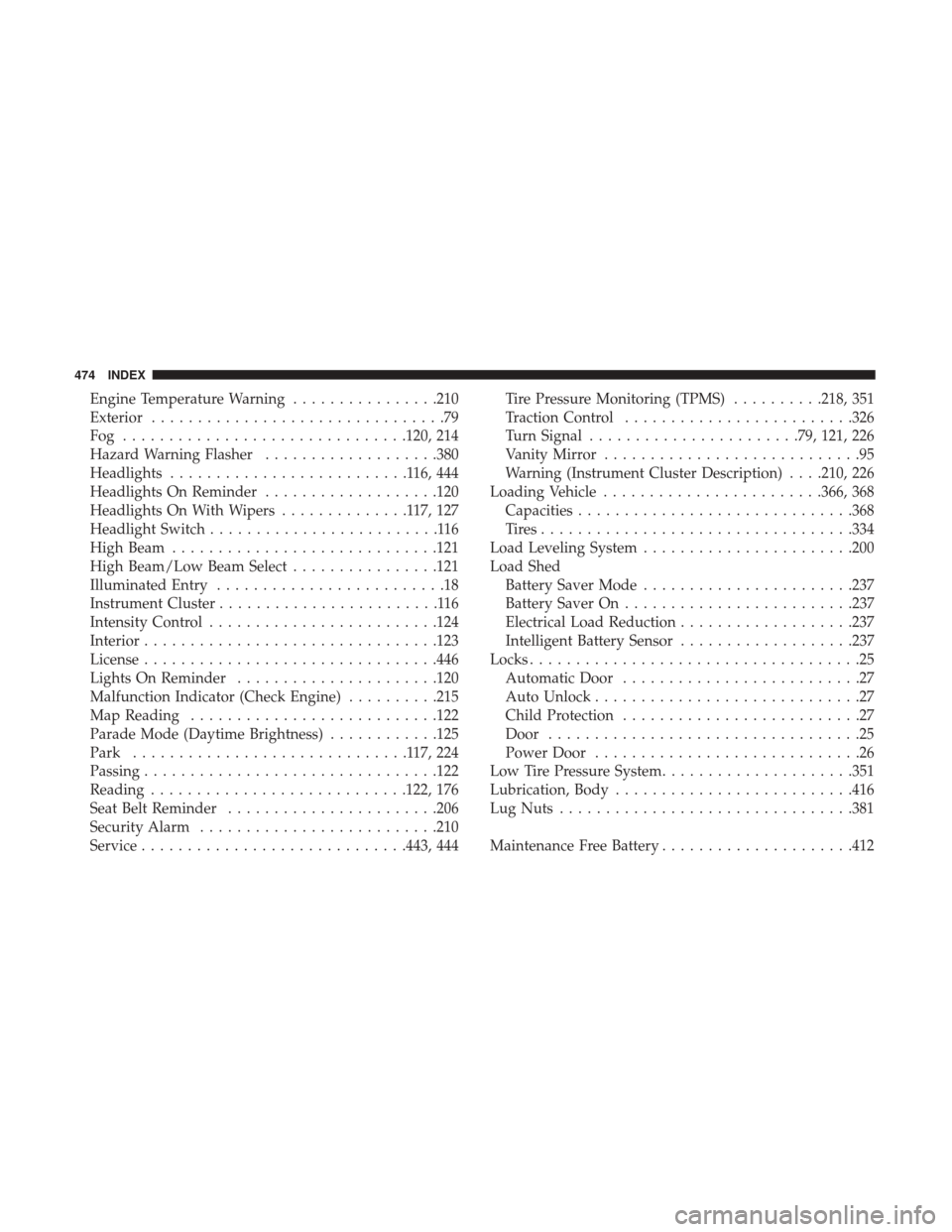
Engine Temperature Warning................210
Exterior ................................79
Fog ...............................120, 214
Hazard Warning Flasher ...................380
Headlights ..........................116,444
Headlights On Reminder ...................120
Headlights On With Wipers ..............117,127
Headlight Switch .........................116
High Beam ............................ .121
High Beam/Low Beam Select ................121
Illuminated Entry .........................18
Instrument Cluster ........................116
Intensity Control ........................ .124
Interior ............................... .123
License ............................... .446
Lights On Reminder ..................... .120
Malfunction Indicator (Check Engine) ..........215
Map Reading .......................... .122
Parade Mode (Daytime Brightness) ............125
Park ..............................117,224
Passing ............................... .122
Reading ............................122, 176
Seat Belt Reminder .......................206
Security Alarm ..........................210
Service ............................ .443, 444Tire Pressure Monitoring (TPMS)
..........218, 351
Traction Control ........................ .326
Turn Signal .......................79, 121, 226
Vanity Mirror ............................95
Warning (Instrument Cluster Description) . . . .210, 226
Loading Vehicle ........................366, 368
Capacities ............................. .368
Tires................................. .334
Load Leveling System .......................200
Load Shed Battery Saver Mode .......................237
Battery Saver On ........................ .237
Electrical Load Reduction ...................237
Intelligent Battery Sensor ...................237
Locks .................................... 2
5
Automatic Door ..........................27
Auto Unlock .............................27
Child Protection ..........................27
Door ..................................25
Power Door .............................26
Low Tire Pressure System .....................351
Lubrication, Body ..........................416
Lug Nuts ............................... .381
Maintenance Free Battery .....................412
474 INDEX
Page 482 of 488
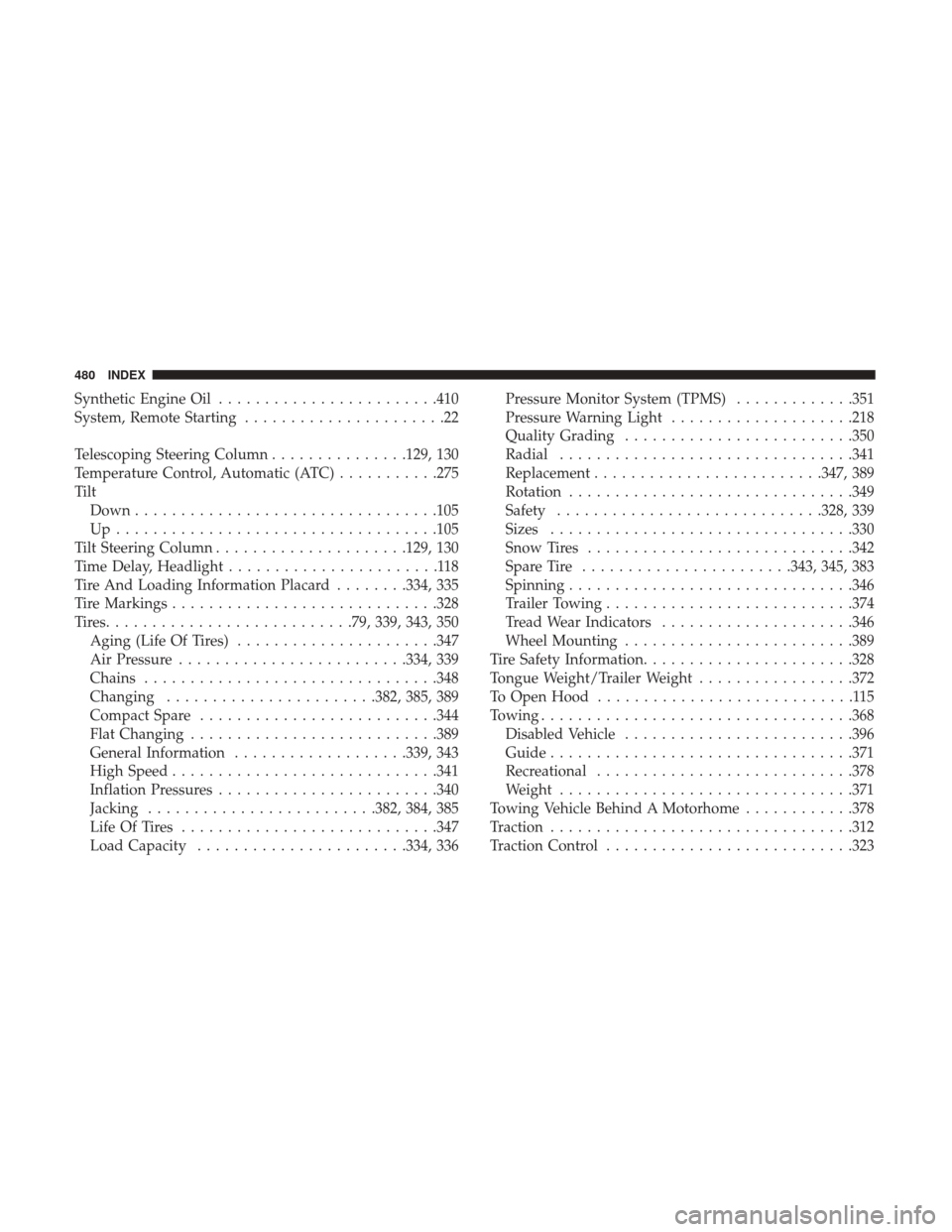
Synthetic Engine Oil........................410
System, Remote Starting ......................22
Telescoping Steering Column ...............129, 130
Temperature Control, Automatic (ATC) ...........275
Tilt Down .................................105
Up.................................. .105
Tilt Steering Column .....................129, 130
Time Delay, Headlight .......................118
Tire And Loading Information Placard ........334, 335
Tire Markings ............................ .328
Tires.......................... .79, 339, 343, 350
Aging (Life Of Tires) ..................... .347
Air Pressure ........................ .334, 339
Chains ............................... .348
Changing .......................382, 385, 389
Compact Spare ..........................344
Flat Changing .......................... .389
General Information ...................339, 343
High Speed ............................ .341
Inflation Pressures ........................340
Jacking ........................ .382, 384, 385
Life Of Tires ............................347
Load Capacity .......................334, 336 Pressure Monitor System (TPMS)
.............351
Pressure Warning Light ....................218
Quality Grading ........................ .350
Radial ............................... .341
Replacement ........................ .347, 389
Rotation ...............................349
Safety ............................ .328, 339
Sizes .................................330
Snow Tires ............................ .342
Spare Tire .......................343, 345, 383
Spinning ...............................346
Trailer Towing .......................... .374
T r
ead Wear Indicators .....................346
Wheel Mounting ........................ .389
Tire Safety Information .......................328
Tongue Weight/Trailer Weight .................372
To Open Hood ............................115
Towing ................................. .368
Disabled Vehicle ........................ .396
Guide .................................371
Recreational ............................378
Weight ............................... .371
Towing Vehicle Behind A Motorhome ............378
Traction .................................312
Traction Control .......................... .323
480 INDEX