transmission CHRYSLER 300 2017 2.G Workshop Manual
[x] Cancel search | Manufacturer: CHRYSLER, Model Year: 2017, Model line: 300, Model: CHRYSLER 300 2017 2.GPages: 488, PDF Size: 4.3 MB
Page 410 of 488
MAINTENANCE PROCEDURES
The pages that follow contain therequiredmaintenance
services determined by the engineers who designed your
vehicle.
Besides those maintenance items specified in the fixed
“Maintenance Schedule”, there are other components
which may require servicing or replacement in the future.
CAUTION!
• Failure to properly maintain your vehicle or perform
repairs and service when necessary could result in
more costly repairs, damage to other components or
negatively impact vehicle performance. Immediately
have potential malfunctions examined by an autho-
rized dealer or qualified repair center.
• Your vehicle has been built with improved fluids
that protect the performance and durability of your
vehicle and also allow extended maintenance inter-
vals. Do not use chemical flushes in these compo-
nents as the chemicals can damage your engine,
transmission, or air conditioning. Such damage is not
covered by the New Vehicle Limited Warranty. If a
(Continued)
CAUTION! (Continued)
flush is needed because of component malfunction,
use only the specified fluid for the flushing proce-
dure.
Engine Oil
Checking Oil Level — 3.6L Engine
To assure proper engine lubrication, the engine oil must be
maintained at the correct level. Check the oil level at
regular intervals, such as once a month. The best time to
check the engine oil level is about five minutes after a fully
warmed engine is shut off.
Checking the oil while the vehicle is on level ground will
improve the accuracy of the oil level readings. Maintain the
oil level between the MIN and MAX markings on the
dipstick. Adding 1.0 quart (1.0 liter) of oil when the reading
is at the MIN mark will result in a MAX reading on these
engines.
CAUTION!
Overfilling or underfilling will cause oil aeration or
loss of oil pressure. This could damage your engine.
408 MAINTAINING YOUR VEHICLE
Page 420 of 488
CAUTION!
•The catalytic converter requires the use of unleaded
fuel only. Leaded gasoline will destroy the effective-
ness of the catalyst as an emissions control device
and may seriously reduce engine performance and
cause serious damage to the engine.
• Damage to the catalytic converter can result if your
vehicle is not kept in proper operating condition. In
the event of engine malfunction, particularly involv-
ing engine misfire or other apparent loss of perfor-
mance, have your vehicle serviced promptly. Contin-
ued operation of your vehicle with a severe
malfunction could cause the converter to overheat,
resulting in possible damage to the converter and
vehicle.
Under normal operating conditions, the catalytic converter
will not require maintenance. However, it is important to
keep the engine properly tuned to assure proper catalyst
operation and prevent possible catalyst damage.
NOTE: Intentional tampering with emissions control sys-
tems can result in civil penalties being assessed against
you. In unusual situations involving grossly malfunctioning
engine operation, a scorching odor may suggest severe and
abnormal catalyst overheating. If this occurs, stop the
vehicle, turn off the engine and allow it to cool. Service,
including a tune-up to manufacturer’s specifications,
should be obtained immediately.
To minimize the possibility of catalytic converter damage:
•
Do not shut off the engine or interrupt the ignition when
the transmission is in gear and the vehicle is in motion.
• Do not try to start the engine by pushing or towing the
vehicle.
• Do not idle the engine with any spark plug wires
disconnected or removed, such as when diagnostic
testing, or for prolonged periods during very rough idle
or malfunctioning operating conditions.
NOTE: Your vehicle’s exhaust system may be equipped
with an Electronic Exhaust Valve (EEV) system, if the
exhaust system is replaced with aftermarket products a
Malfunction Indicator Lamp (MIL) will illuminate.
418 MAINTAINING YOUR VEHICLE
Page 426 of 488
fluid level can be expected to fall as the brake pads wear.
However, low fluid level may be caused by a leak and a
checkup may be needed.
Use only manufacturer’s recommended brake fluid. Refer
to “Fluids, Lubricants, And Genuine Parts” in “Maintain-
ing Your Vehicle” for further information.
WARNING!
•Use only manufacturer’s recommended brake fluid.
Refer to “Fluids, Lubricants, And Genuine Parts” in
“Maintaining Your Vehicle” for further information.
Using the wrong type of brake fluid can severely
damage your brake system and/or impair its perfor-
mance. The proper type of brake fluid for your
vehicle is also identified on the original factory
installed hydraulic master cylinder reservoir.
• To avoid contamination from foreign matter or mois-
ture, use only new brake fluid or fluid that has been
in a tightly closed container. Keep the master cylin-
der reservoir cap secured at all times. Brake fluid in
a open container absorbs moisture from the air
resulting in a lower boiling point. This may cause it
(Continued)
WARNING! (Continued)
to boil unexpectedly during hard or prolonged brak-
ing, resulting in sudden brake failure. This could
result in a collision.
• Overfilling the brake fluid reservoir can result in
spilling brake fluid on hot engine parts, causing the
brake fluid to catch fire. Brake fluid can also damage
painted and vinyl surfaces, care should be taken to
avoid its contact with these surfaces.
• Do not allow petroleum based fluid to contaminate
the brake fluid. Brake seal components could be
damaged, causing partial or complete brake failure.
This could result in a collision.
Use only brake fluid that has been in a tightly closed
container to avoid contamination from foreign matter or
moisture.
Automatic Transmission
Selection Of Lubricant
It is important to use the proper transmission fluid to
ensure optimum transmission performance and life. Use
only the manufacturer ’s specified transmission fluid. Refer
to “Fluids, Lubricants, And Genuine Parts” in this section
424 MAINTAINING YOUR VEHICLE
Page 427 of 488
for fluid specifications. It is important to maintain the
transmission fluid at the correct level using the recom-
mended fluid. No chemical flushes should be used in any
transmission; only the approved lubricant should be used.
CAUTION!
Using a transmission fluid other than the manufactur-
er ’s recommended fluid may cause deterioration in
transmission shift quality and/or torque converter
shudder. Refer to “Fluids, Lubricants, And Genuine
Parts” in this section for fluid specifications.
Special Additives
The manufacturer strongly recommends against using any
special additives in the transmission. Automatic Transmis-
sion Fluid (ATF) is an engineered product and its perfor-
mance may be impaired by supplemental additives. There-
fore, do not add any fluid additives to the transmission.
Avoid using transmission sealers as they may adversely
affect seals.
CAUTION!
Do not use chemical flushes in your transmission as
the chemicals can damage your transmission compo-
nents. Such damage is not covered by the New Vehicle
Limited Warranty.
Fluid Level Check
The fluid level is preset at the factory and does not require
adjustment under normal operating conditions. Routine
fluid level checks are not required, therefore the transmis-
sion has no dipstick. Your authorized dealer can check
your transmission fluid level using special service tools.
If you notice fluid leakage or transmission malfunction,
visit your authorized dealer immediately to have the
transmission fluid level checked. Operating the vehicle
with an improper fluid level can cause severe transmission
damage.
7
MAINTAINING YOUR VEHICLE 425
Page 428 of 488
CAUTION!
If a transmission fluid leak occurs, visit your autho-
rized dealer immediately. Severe transmission damage
may occur. Your authorized dealer has the proper tools
to adjust the fluid level accurately.
Fluid And Filter Changes — 8 Speed Transmission
Under normal operating conditions, the fluid installed at
the factory will provide satisfactory lubrication for the life
of the vehicle.
Routine fluid and filter changes are not required. However,
change the fluid and filter if the fluid becomes contami-
nated (with water, etc.), or if the transmission is disas-
sembled for any reason.
All Wheel Drive (AWD) — If Equipped
The all wheel drive system consists of a transfer case and
front differential. The exterior surface of these components
should be inspected for evidence of fluid leaks. Confirmed
leaks should be repaired as soon as possible.
The transfer case fluid fill/inspection plug is located in the
middle of the rear housing. To inspect the transfer casefluid level, remove the fill/inspection plug. The fluid level
should be even with the bottom of the hole. Use this plug
to add fluid as required.
The front differential fill plug is located on the outer cover
near the halfshaft attachment. To inspect the differential
fluid level, remove the fill plug. The fluid level should be
even with or slightly below the bottom of the hole.
Fluid Changes
Refer to the “Maintenance Schedule” for the proper main-
tenance intervals.
Rear Axle
For normal service, periodic fluid level checks are not
required. When the vehicle is serviced for other reasons the
exterior surfaces of the axle assembly should be inspected.
If gear oil leakage is suspected inspect the fluid level. Refer
to “Fluids, Lubricants, And Genuine Parts” in “Maintain-
ing Your Vehicle” for further information.
Fluid Level Check
Check the fluid level by removing the fill plug on the axle.
The fluid level should be at the bottom of the fill hole. Add
426 MAINTAINING YOUR VEHICLE
Page 437 of 488
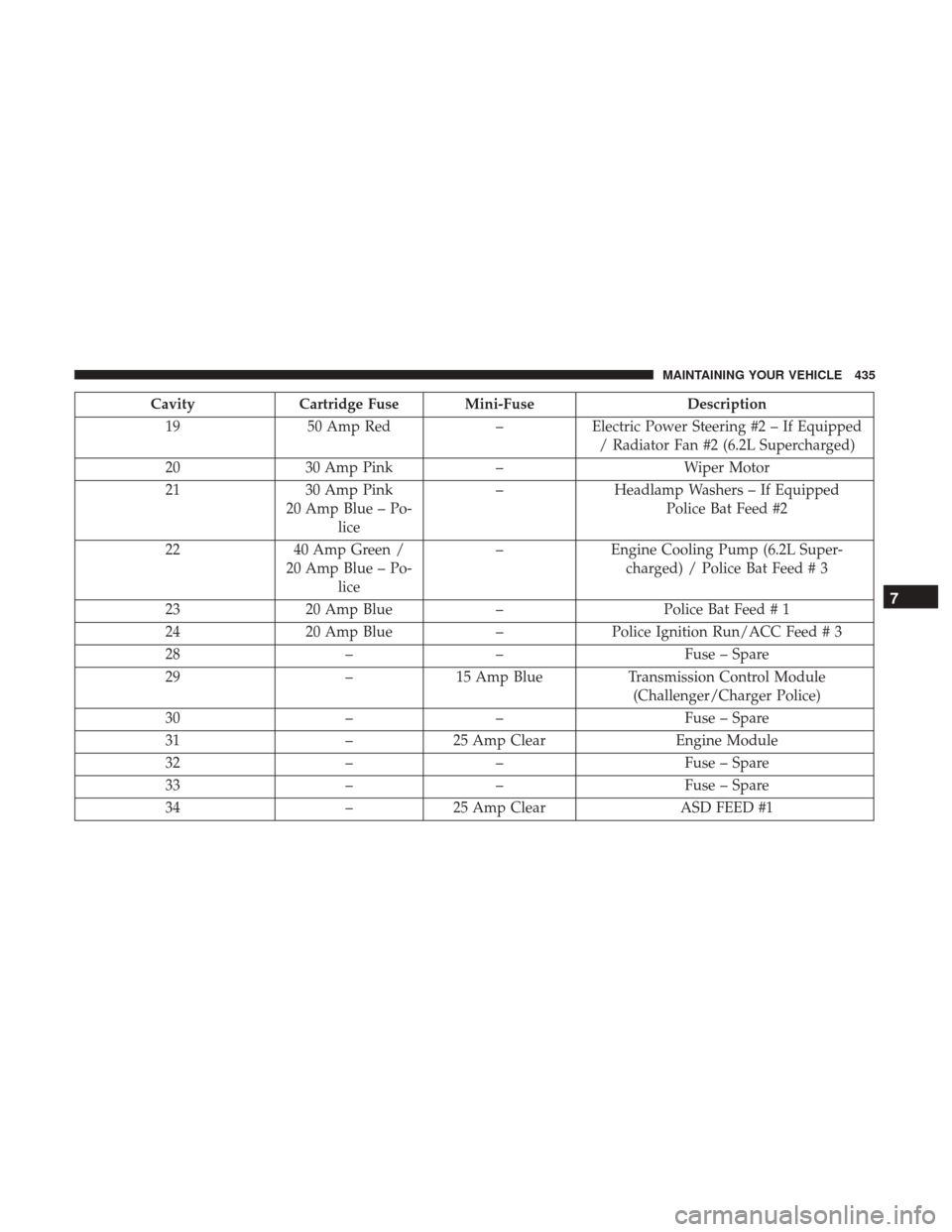
CavityCartridge Fuse Mini-Fuse Description
19 50 Amp Red –Electric Power Steering #2 – If Equipped
/ Radiator Fan #2 (6.2L Supercharged)
20 30 Amp Pink –Wiper Motor
21 30 Amp Pink
20 Amp Blue – Po- lice –
Headlamp Washers – If Equipped
Police Bat Feed #2
22 40 Amp Green /
20 Amp Blue – Po- lice –
Engine Cooling Pump (6.2L Super-
charged) / Police Bat Feed # 3
23 20 Amp Blue –Police Bat Feed # 1
24 20 Amp Blue –Police Ignition Run/ACC Feed # 3
28 –– Fuse – Spare
29 –15 Amp Blue Transmission Control Module
(Challenger/Charger Police)
30 –– Fuse – Spare
31 –25 Amp Clear Engine Module
32 –– Fuse – Spare
33 –– Fuse – Spare
34 –25 Amp Clear ASD FEED #1
7
MAINTAINING YOUR VEHICLE 435
Page 441 of 488
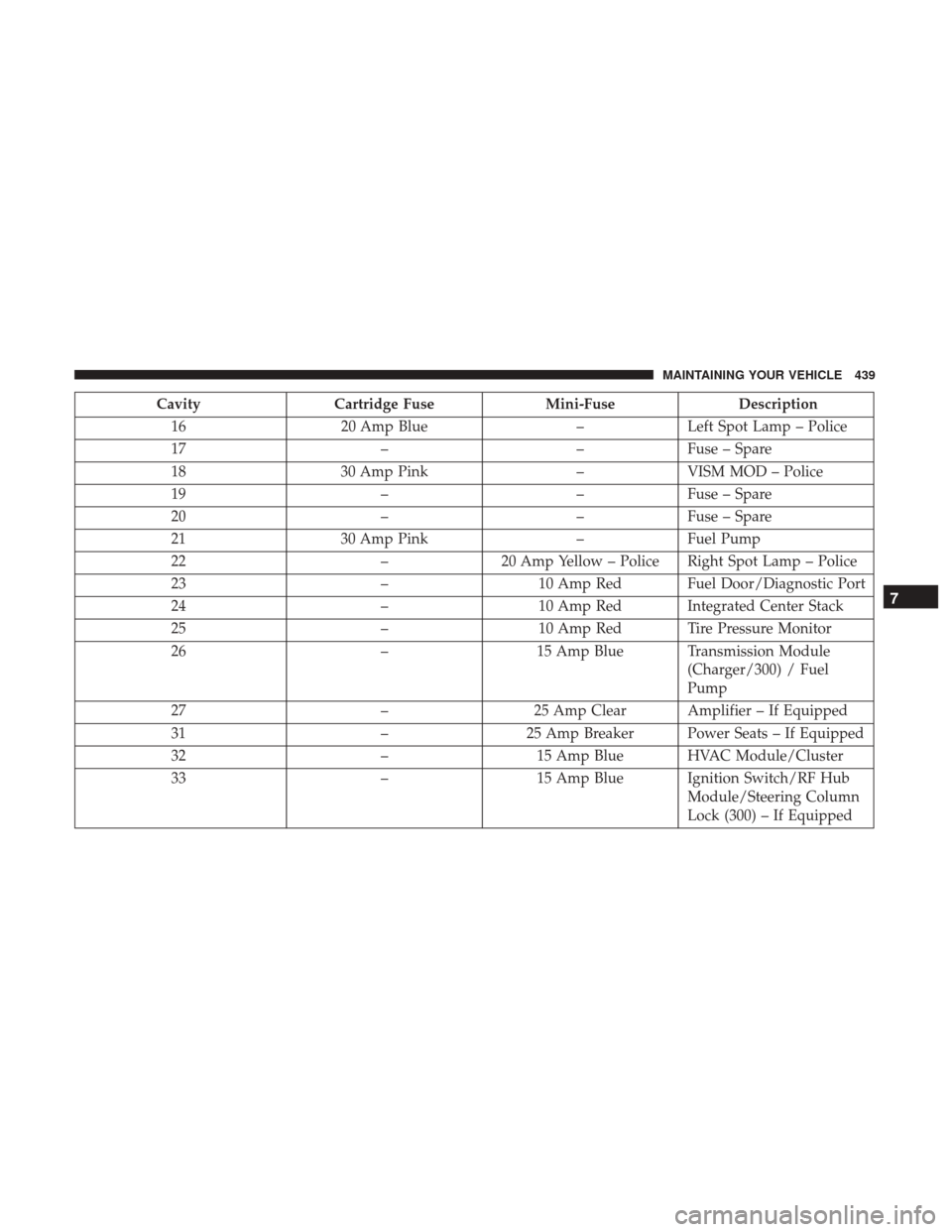
CavityCartridge Fuse Mini-FuseDescription
16 20 Amp Blue –Left Spot Lamp – Police
17 ––Fuse – Spare
18 30 Amp Pink –VISM MOD – Police
19 ––Fuse – Spare
20 ––Fuse – Spare
21 30 Amp Pink –Fuel Pump
22 –20 Amp Yellow – Police Right Spot Lamp – Police
23 –10 Amp Red Fuel Door/Diagnostic Port
24 –10 Amp Red Integrated Center Stack
25 –10 Amp Red Tire Pressure Monitor
26 –15 Amp Blue Transmission Module
(Charger/300) / Fuel
Pump
27 –25 Amp Clear Amplifier – If Equipped
31 –25 Amp Breaker Power Seats – If Equipped
32 –15 Amp Blue HVAC Module/Cluster
33 –15 Amp Blue Ignition Switch/RF Hub
Module/Steering Column
Lock (300) – If Equipped
7
MAINTAINING YOUR VEHICLE 439
Page 454 of 488
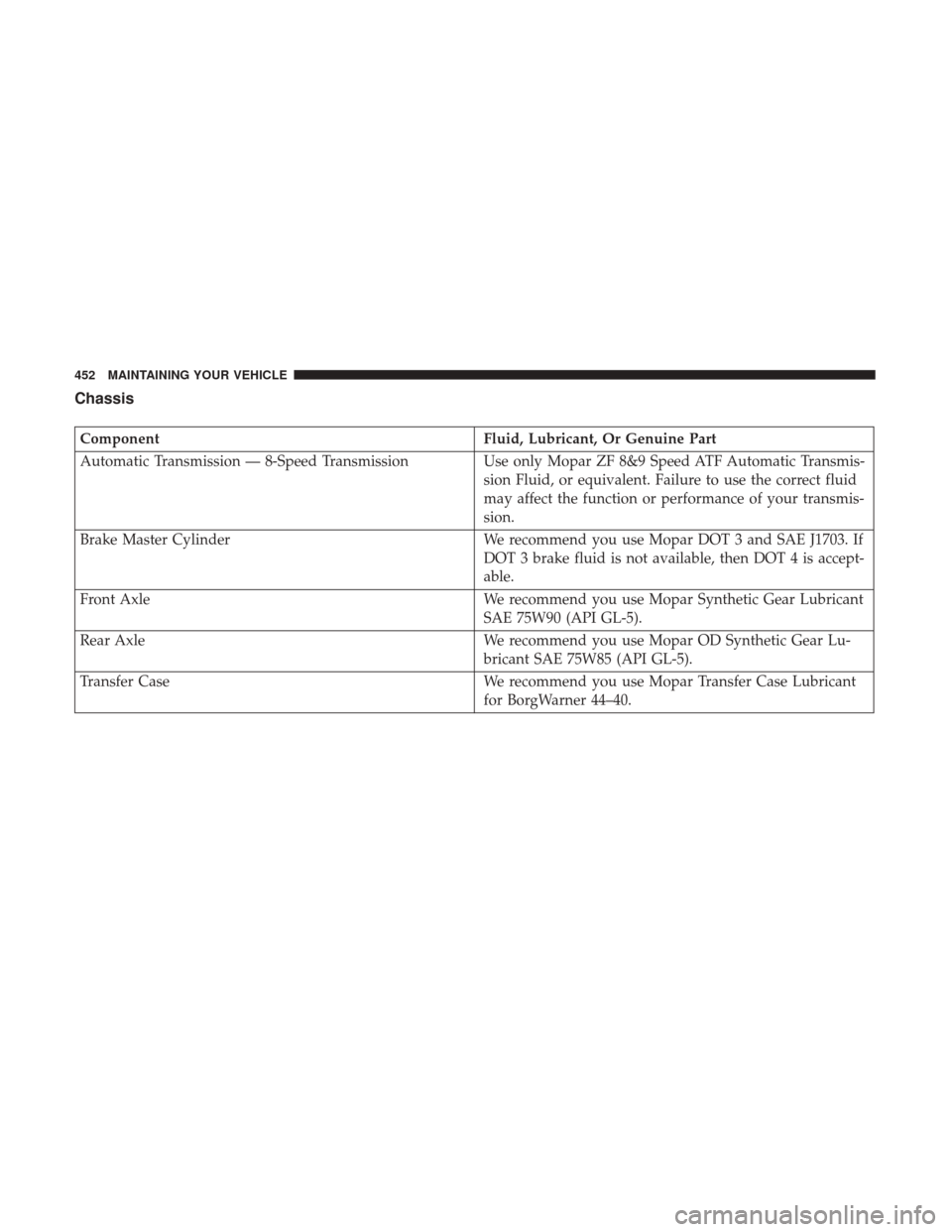
Chassis
ComponentFluid, Lubricant, Or Genuine Part
Automatic Transmission — 8-Speed Transmission Use only Mopar ZF 8&9 Speed ATF Automatic Transmis-
sion Fluid, or equivalent. Failure to use the correct fluid
may affect the function or performance of your transmis-
sion.
Brake Master Cylinder We recommend you use Mopar DOT 3 and SAE J1703. If
DOT 3 brake fluid is not available, then DOT 4 is accept-
able.
Front Axle We recommend you use Mopar Synthetic Gear Lubricant
SAE 75W90 (API GL-5).
Rear Axle We recommend you use Mopar OD Synthetic Gear Lu-
bricant SAE 75W85 (API GL-5).
Transfer Case We recommend you use Mopar Transfer Case Lubricant
for BorgWarner 44–40.
452 MAINTAINING YOUR VEHICLE
Page 469 of 488
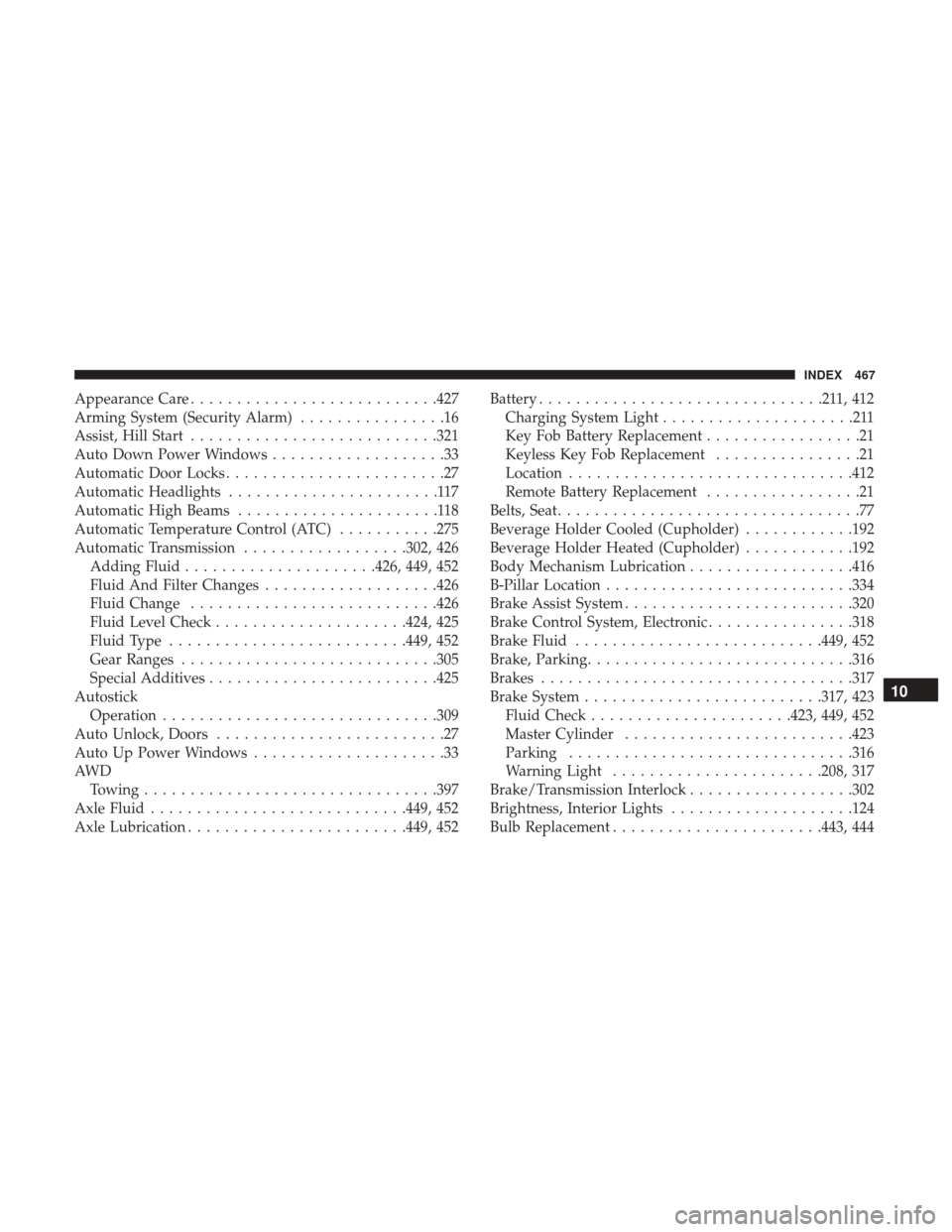
Appearance Care.......................... .427
Arming System (Security Alarm) ................16
Assist, Hill Start .......................... .321
Auto Down Power Windows ...................33
Automatic Door Locks ........................27
Automatic Headlights .......................117
Automatic High Beams ......................118
Automatic Temperature Control (ATC) ...........275
Automatic Transmission ..................302, 426
Adding Fluid .....................426, 449, 452
Fluid And Filter Changes ...................426
Fluid Change .......................... .426
Fluid Level Check .....................424, 425
Fluid Type ..........................449, 452
Gear Ranges ............................305
Special Additives ........................ .425
Autostick Operation ............................. .309
Auto Unlock, Doors .........................27
Auto Up Power Windows .....................33
AW D Towing ............................... .397
Axle Fluid ............................449, 452
Axle Lubrication ........................449, 452 Battery
...............................211,412
Charging System Light .....................211
Key Fob Battery Replacement .................21
Keyless Key Fob Replacement ................21
Location ...............................412
Remote Battery Replacement .................21
Belts, Seat .................................77
Beverage Holder Cooled (Cupholder) ............192
Beverage Holder Heated (Cupholder) ............192
Body Mechanism Lubrication ..................416
B-Pillar Location .......................... .334
Brake Assist System ........................ .320
Brake Control System, Electronic ................318
Brake Fluid .......................... .449, 452
Brake, Parking ............................ .316
Brakes ................................. .317
Brake System ..........................317,
423
Fluid Check ..................... .423, 449, 452
Master Cylinder ........................ .423
Parking ...............................316
Warning Light .......................208, 317
Brake/Transmission Interlock ..................302
Brightness, Interior Lights ....................124
Bulb Replacement .......................443, 44410
INDEX 467
Page 473 of 488
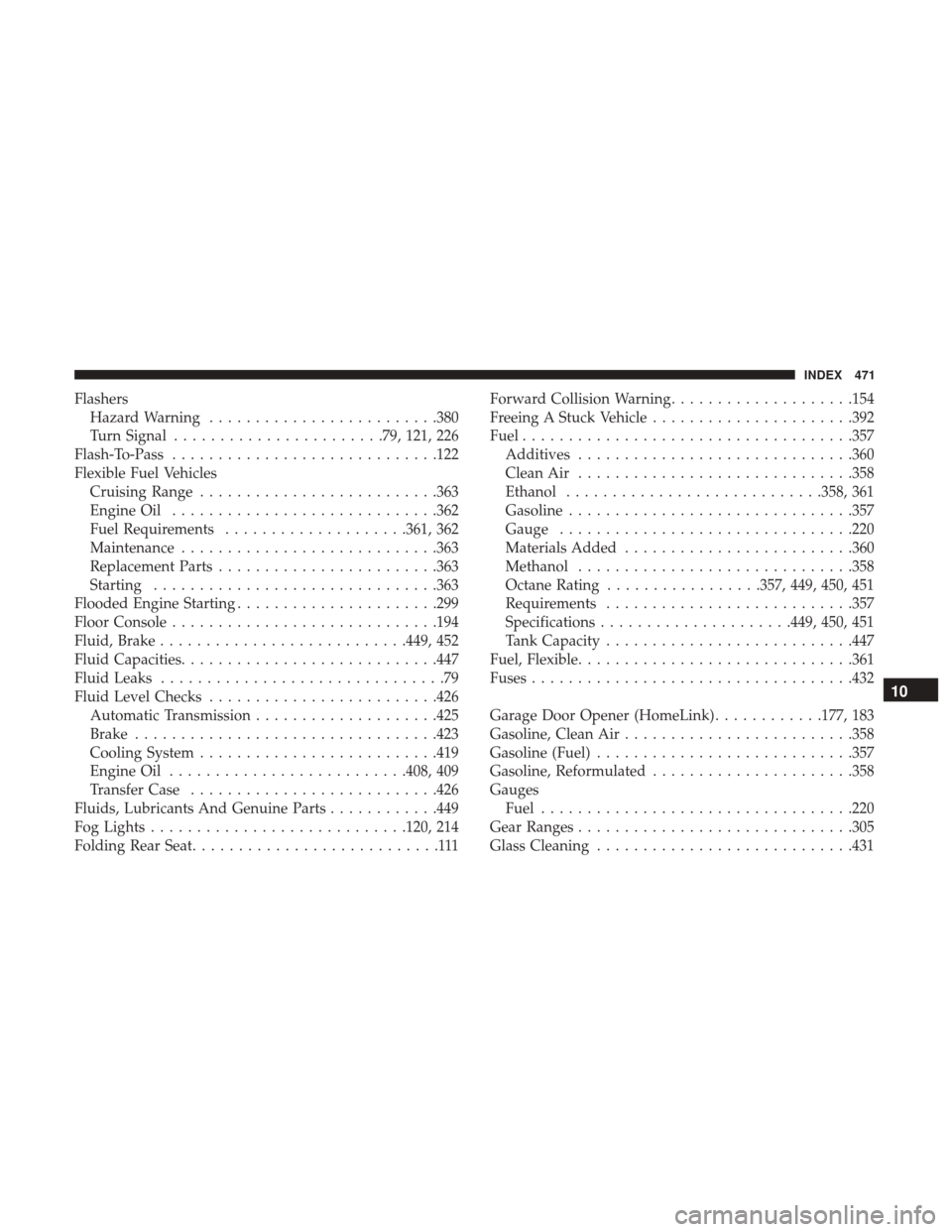
FlashersHazard Warning ........................ .380
Turn Signal .......................79, 121, 226
Flash-To-Pass ............................ .122
Flexible Fuel Vehicles Cruising Range ..........................363
Engine Oil ............................ .362
Fuel Requirements ....................361, 362
Maintenance ............................363
Replacement Parts ........................363
Starting ...............................363
Flooded Engine Starting ..................... .299
Floor Console ............................ .194
Fluid, Brake .......................... .449, 452
Fluid Capacities ............................447
Fluid Leaks ...............................79
Fluid Level Checks ........................ .426
Automatic Transmission ....................425
Brake .................................423
Cooling System ..........................419
Engine Oil ..........................408, 409
Transfer Case .......................... .426
Fluids, Lubricants And Genuine Parts ............449
Fog Lights ............................120, 214
Folding Rear Seat ...........................111 Forward Collision Warning
....................154
Freeing A Stuck Vehicle ..................... .392
Fuel ................................... .357
Additives ............................. .360
Clean Air ............................. .358
Ethanol ............................358, 361
Gasoline ...............................357
Gauge ............................... .220
Materials Added ........................ .360
Methanol ............................. .358
Octane Rating .................357, 449, 450, 451
Requir ements .......................... .357
Specifications ....................
.449, 450, 451
Tank Capacity .......................... .447
Fuel, Flexible ............................. .361
Fuses .................................. .432
Garage Door Opener (HomeLink) ............177, 183
Gasoline, Clean Air ........................ .358
Gasoline (Fuel) ............................357
Gasoline, Reformulated ..................... .358
Gauges Fuel ................................. .220
Gear Ranges ............................. .305
Glass Cleaning ............................431
10
INDEX 471