heater CHRYSLER 300 2018 User Guide
[x] Cancel search | Manufacturer: CHRYSLER, Model Year: 2018, Model line: 300, Model: CHRYSLER 300 2018Pages: 492, PDF Size: 6.67 MB
Page 334 of 492
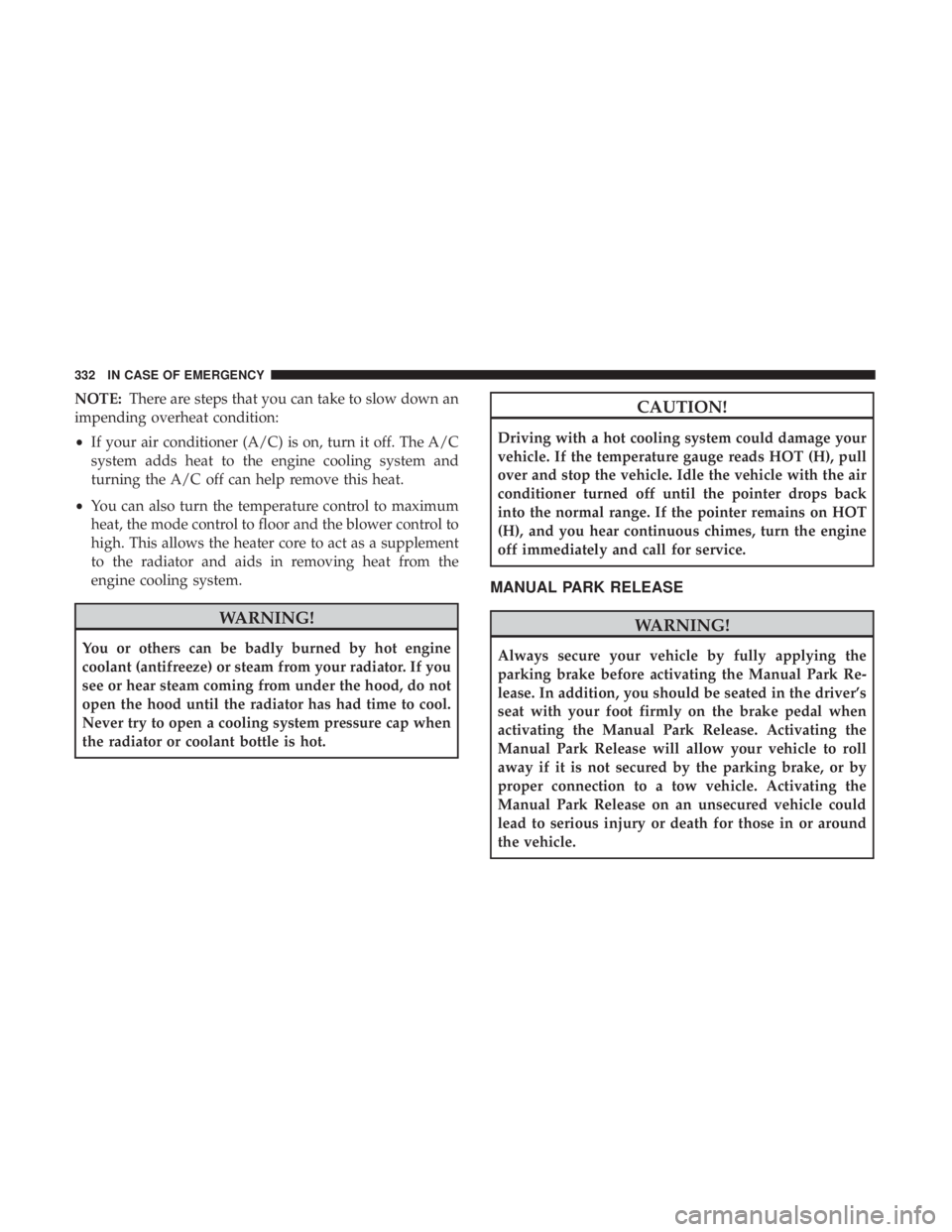
NOTE:There are steps that you can take to slow down an
impending overheat condition:
• If your air conditioner (A/C) is on, turn it off. The A/C
system adds heat to the engine cooling system and
turning the A/C off can help remove this heat.
• You can also turn the temperature control to maximum
heat, the mode control to floor and the blower control to
high. This allows the heater core to act as a supplement
to the radiator and aids in removing heat from the
engine cooling system.
WARNING!
You or others can be badly burned by hot engine
coolant (antifreeze) or steam from your radiator. If you
see or hear steam coming from under the hood, do not
open the hood until the radiator has had time to cool.
Never try to open a cooling system pressure cap when
the radiator or coolant bottle is hot.
CAUTION!
Driving with a hot cooling system could damage your
vehicle. If the temperature gauge reads HOT (H), pull
over and stop the vehicle. Idle the vehicle with the air
conditioner turned off until the pointer drops back
into the normal range. If the pointer remains on HOT
(H), and you hear continuous chimes, turn the engine
off immediately and call for service.
MANUAL PARK RELEASE
WARNING!
Always secure your vehicle by fully applying the
parking brake before activating the Manual Park Re-
lease. In addition, you should be seated in the driver’s
seat with your foot firmly on the brake pedal when
activating the Manual Park Release. Activating the
Manual Park Release will allow your vehicle to roll
away if it is not secured by the parking brake, or by
proper connection to a tow vehicle. Activating the
Manual Park Release on an unsecured vehicle could
lead to serious injury or death for those in or around
the vehicle.
332 IN CASE OF EMERGENCY
Page 413 of 492

NOTE:
•Use seasonally adjusted E-85 fuel (ASTM D5798). With
non-seasonally adjusted E-85 fuel, hard starting and
rough idle following start up may be experienced even if
the above recommendations are followed, especially
when the ambient temperature is below 32°F (0°C).
• Some additives used in regular gasoline are not fully
compatible with E-85 and may form deposits in your
engine. To eliminate driveability issues that may be
caused by these deposits, a supplemental gasoline addi-
tive, such as Mopar Injector Cleanup or Techron may be
used.
Selection Of Engine Oil For Flexible Fuel Vehicles
(E-85) And Gasoline Vehicles
FFV vehicles operated on E-85 require specially formulated
engine oils. These special requirements are included in
Mopar engine oils, and in equivalent oils meeting FCA US
Material Standard MS-6395. It is recommended that engine
oils that are API Certified and meet the requirements of
Material Standard MS-6395 be used. MS-6395 contains
additional requirements, developed during extensive fleet
testing, to provide additional protection to FCA US LLC
engines.
Starting
The characteristics of E-85 fuel make it unsuitable for use
when ambient temperatures fall below 0°F (-18°C). In the
range of 0°F (-18°C) to 32°F (0°C), an increase in the time it
takes for your engine to start may be experienced, and a
deterioration in driveability (sags and/or hesitations) until
the engine is fully warmed up. These issues may be
improved with the use of seasonally adjusted E-85 fuel.
NOTE: Use of the engine block heater (if equipped) may
improve engine start time when using E-85 fuel when the
ambient temperature is less than 32°F (0°C).
Cruising Range
Because E-85 fuel contains less energy per gallon/liter than
gasoline, an increase in fuel consumption will be experi-
enced. The miles per gallon (mpg)/kilometers per liter and
the driving range will decrease by approximately 30%,
compared to gasoline operation.9
TECHNICAL SPECIFICATIONS 411
Page 415 of 492
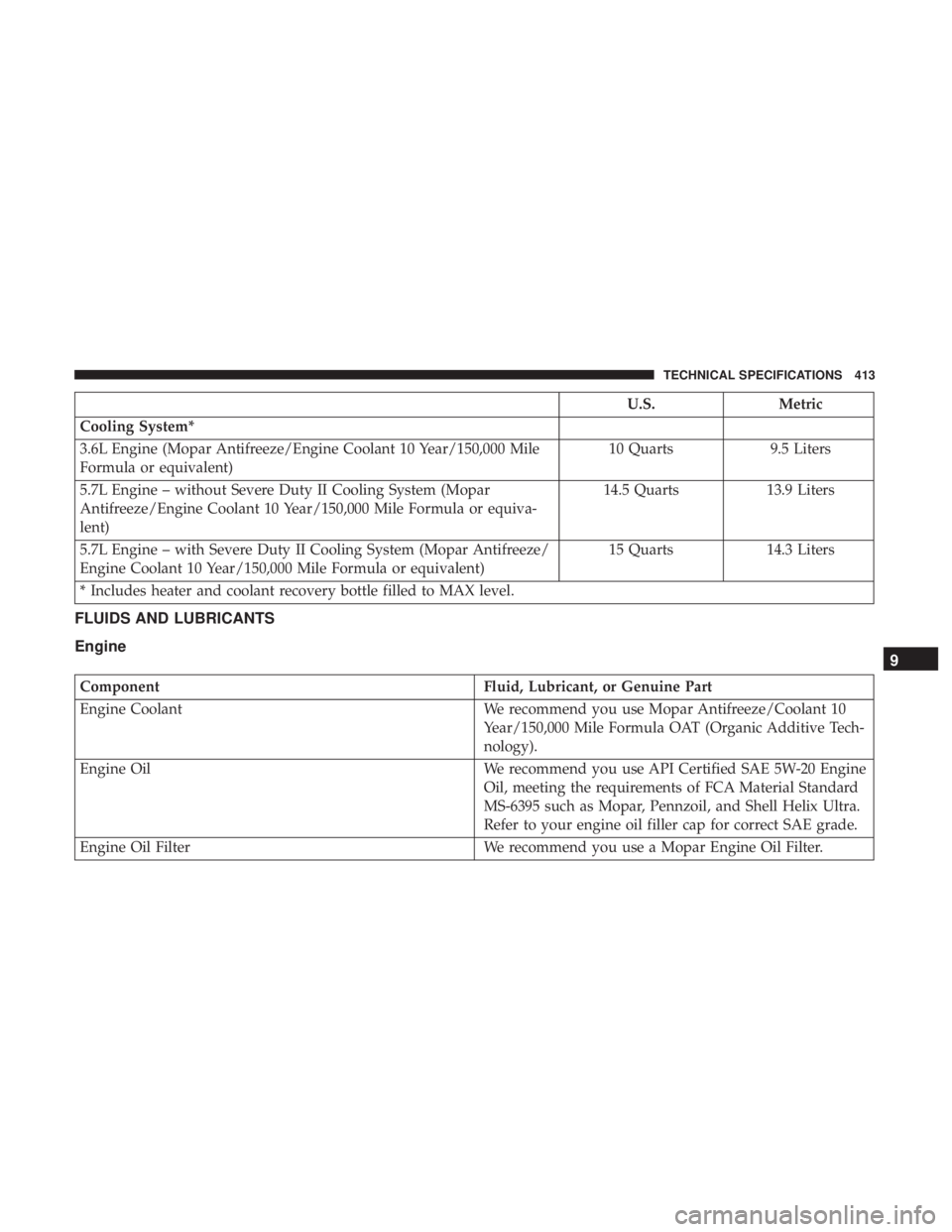
U.S.Metric
Cooling System*
3.6L Engine (Mopar Antifreeze/Engine Coolant 10 Year/150,000 Mile
Formula or equivalent) 10 Quarts
9.5 Liters
5.7L Engine – without Severe Duty II Cooling System (Mopar
Antifreeze/Engine Coolant 10 Year/150,000 Mile Formula or equiva-
lent) 14.5 Quarts
13.9 Liters
5.7L Engine – with Severe Duty II Cooling System (Mopar Antifreeze/
Engine Coolant 10 Year/150,000 Mile Formula or equivalent) 15 Quarts
14.3 Liters
* Includes heater and coolant recovery bottle filled to MAX level.
FLUIDS AND LUBRICANTS
Engine
Component Fluid, Lubricant, or Genuine Part
Engine Coolant We recommend you use Mopar Antifreeze/Coolant 10
Year/150,000 Mile Formula OAT (Organic Additive Tech-
nology).
Engine Oil We recommend you use API Certified SAE 5W-20 Engine
Oil, meeting the requirements of FCA Material Standard
MS-6395 such as Mopar, Pennzoil, and Shell Helix Ultra.
Refer to your engine oil filler cap for correct SAE grade.
Engine Oil Filter We recommend you use a Mopar Engine Oil Filter.
9
TECHNICAL SPECIFICATIONS 413
Page 478 of 492
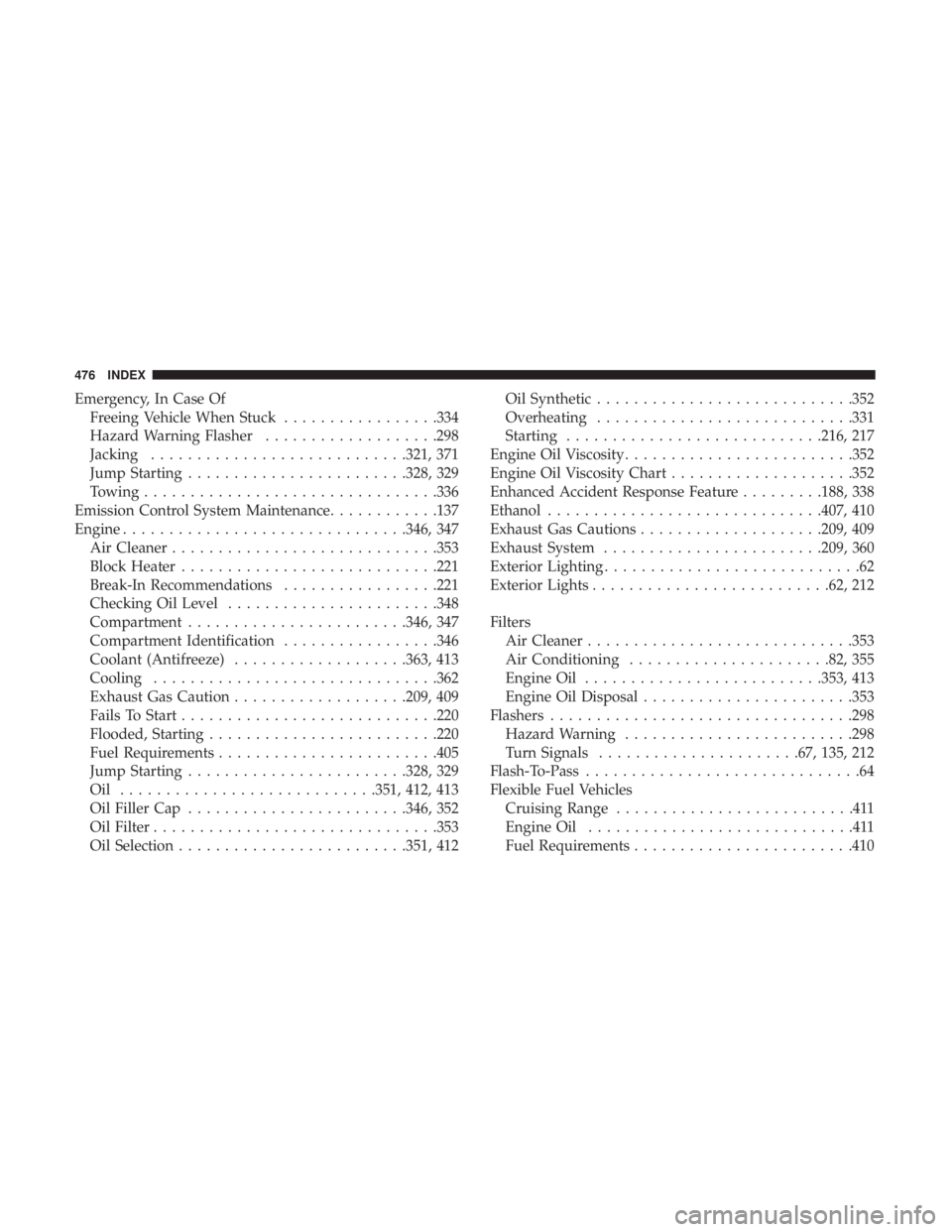
Emergency, In Case OfFreeing Vehicle When Stuck .................334
Hazard Warning Flasher ...................298
Jacking ........................... .321, 371
Jump Starting ....................... .328, 329
Towing ............................... .336
Emission Control System Maintenance ............137
Engine .............................. .346, 347
Air Cleaner ............................ .353
Block Heater ........................... .221
Break-In Recommendations .................221
Checking Oil Level ...................... .348
Compartment ....................... .346, 347
Compartment Identification .................346
Coolant (Antifreeze) ...................363, 413
Cooling .............................. .362
Exhaust Gas Caution ...................209, 409
Fails To Start ........................... .220
Flooded, Starting ........................ .220
Fuel Requirements ....................... .405
Jump Starting ....................... .328, 329
Oil ........................... .351, 412, 413
Oil Filler Cap ....................... .346, 352
Oil Filter .............................. .353
Oil Selection ........................ .351, 412Oil Synthetic
........................... .352
Overheating ........................... .331
Starting ........................... .216, 217
Engine Oil Viscosity ........................ .352
Engine Oil Viscosity Chart ....................352
Enhanced Accident Response Feature .........188, 338
Ethanol ............................. .407, 410
Exhaust Gas Cautions ....................209, 409
Exhaust System ....................... .209, 360
Exterior Lighting ............................62
Exterior Lights ......................... .62,
212
Filters Air Cleaner ............................ .353
Air Conditioning ..................... .82, 355
Engine Oil ......................... .353, 413
Engine Oil Disposal ...................... .353
Flashers ................................ .298
Hazard Warning ........................ .298
Turn Signals ..................... .67, 135, 212
Flash-To-Pass ..............................64
Flexible Fuel Vehicles Cruising Range ..........................411
Engine Oil .............................411
Fuel Requirements ....................... .410
476 INDEX
Page 480 of 492
Headlights.............................. .306
Automatic ..............................64
Cleaning .............................. .396
Delay ..................................65
High Beam/Low Beam Select Switch ...........63
Lights On Reminder .......................66
On With Wipers ..........................65
Passing ................................64
Switch .................................62
Time Delay ..............................65
Washers .............................. .348
Head Restraints ......................... .51, 52
Head Rests ............................ .51, 52
Heated Mirrors .............................61
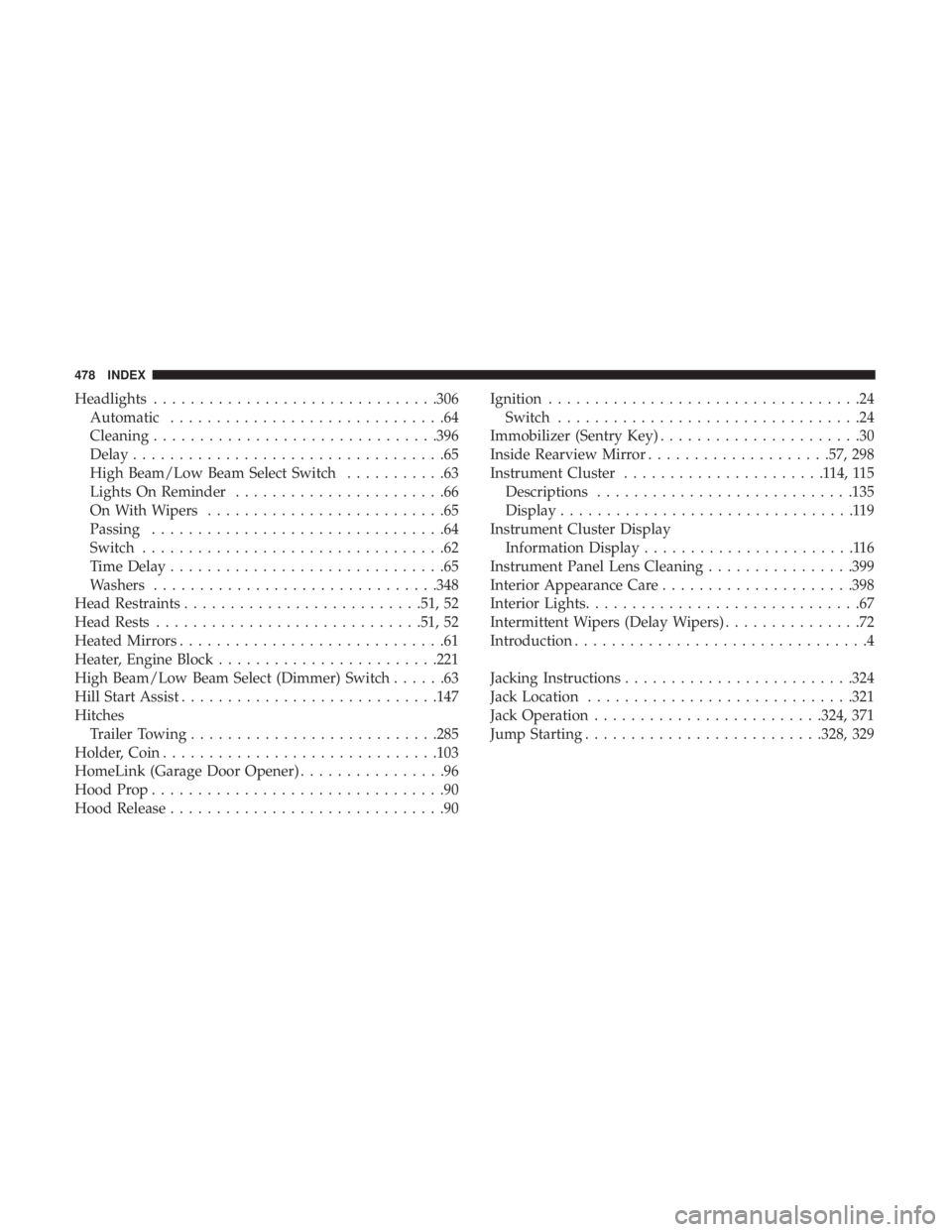
Heater, Engine Block ....................... .221
High Beam/Low Beam Select (Dimmer) Switch ......63
Hill Start Assist ........................... .147
Hitches Trailer Towing .......................... .285
Holder, Coin ............................. .103
HomeLink (Garage Door Opener) ................96
Hood Prop ................................90
Hood Release ..............................90 Ignition
..................................24
Switch .................................24
Immobilizer (Sentry Key) ......................30
Inside Rearview Mirror ....................57, 298
Instrument Cluster ......................114,115
Descriptions ........................... .135
Display ................................119
Instrument Cluster Display Information Display .......................116
Instrument Panel Lens Cleaning ................399
Interior Appearance Care .....................398
Interior Lights ..............................67
Intermittent Wipers (Delay Wipers) ...............72
Introduction ................................4
Jacking Instructions ........................ .324
Jack Location ............................ .321
Jack Operation ........................ .324, 371
Jump Starting ......................... .328, 329
478 INDEX